
The Saga pattern keeps data consistent across microservices without a distributed (two-phase commit) transaction. A business process is split into a sequence of local transactions, one per service. If one step fails, the saga runs compensating transactions that undo the steps that already succeeded.
The Saga pattern is a design pattern way to manage data consistency across microservices in distributed transaction scenarios. It is a sequence of transactions that updates each service and publishes a message or event to excess next transaction.
Saga pattern manage distributed transactions in a event diffeerent architecture.Originally will describe be research paper Princeton University in 1987. It describe as
Long -lived transactions (LLTs)
Hours or days
same database
fine-grained trasactions
compensating operations
extended to distributed system
Centralize transaction state
Message routing
failure compensation
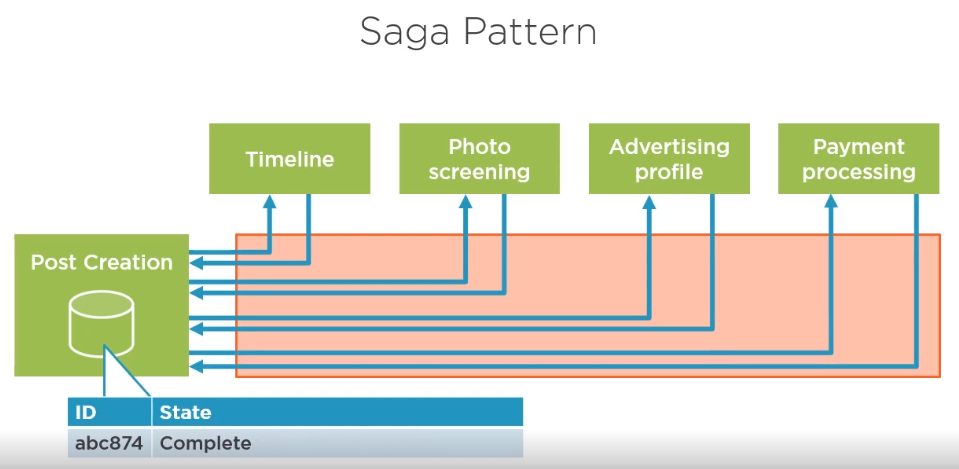
Saga patter complete to use Social media platform all over World
Why microservices need sagas
In a microservice architecture each service owns its own database. A single business action, such as placing an order, touches several of them. A classic ACID transaction cannot span those databases, and two-phase commit (2PC) is rarely practical: it holds locks across services, reduces availability when any participant is down, and many databases and message brokers do not support it. A saga accepts eventual consistency instead: each step commits locally, and the system as a whole becomes consistent once the saga finishes or is compensated.
How a saga works: an order example
| Step | Service | Local transaction | Compensating transaction |
|---|---|---|---|
| 1 | Order | Create order with status PENDING | Mark order REJECTED |
| 2 | Payment | Authorize the payment | Release or refund the payment |
| 3 | Inventory | Reserve the items | Release the reservation |
| 4 | Shipping | Schedule the delivery | Cancel the delivery |
| 5 | Order | Mark order APPROVED | (not needed: last step) |
If step 3 fails because an item is out of stock, the saga runs the compensations for the completed steps in reverse order: it refunds the payment (step 2) and marks the order REJECTED (step 1). The customer sees a clear outcome and no money is kept for an order that cannot be shipped.
Choreography vs orchestration
Choreography
There is no central coordinator. Each service listens for events and publishes its own: Order publishes OrderCreated, Payment reacts and publishes PaymentAuthorized, Inventory reacts to that, and so on. Failures are signalled with events such as InventoryReservationFailed, which other services react to by compensating.
Orchestration
A dedicated orchestrator (often part of the Order service, or a workflow engine) tells each service what to do with commands and waits for replies. It holds the saga state and decides which compensations to run.
| Choreography | Orchestration | |
|---|---|---|
| Coordinator | None, services react to events | One orchestrator owns the flow |
| Coupling | Services depend on each other’s events | Services depend only on the orchestrator |
| Visibility | Flow is spread across services, harder to follow | Flow is in one place, easy to see and test |
| Best for | Short sagas with 2 to 4 steps | Longer or frequently changing business processes |
Designing compensating transactions
- A compensation is a semantic undo, not a database rollback: you cannot un-send an email, but you can send a correction; you do not delete a payment, you refund it.
- Compensations must be idempotent and retryable, because a message can be delivered more than once.
- Identify the pivot transaction: the step after which the saga is committed to finishing. Steps before it must be compensatable; steps after it must be retriable until they succeed.
- Put steps that are most likely to fail (such as stock checks) early, to keep compensation cheap.
Handling the missing isolation
A saga gives you atomicity, consistency and durability, but not isolation: other requests can see intermediate states. Common countermeasures:
- Semantic lock: a status such as PENDING tells other operations the record is in the middle of a saga.
- Commutative updates: design updates so they can be applied in any order (for example, increment and decrement a balance).
- Reread value / version check: re-check a record before updating it and abort if it changed.
Reliable messaging with the transactional outbox
Each step must update its database and publish an event; if it does one without the other, the saga breaks. The transactional outbox pattern solves this: the service writes the event into an outbox table in the same local transaction as the business data, and a separate relay publishes it to the message broker (by polling the table or with change data capture tools such as Debezium). Consumers record the IDs of processed messages so duplicates are ignored.
Tools and frameworks
- Workflow engines for orchestration: Temporal, Camunda (Zeebe), Netflix/Orkes Conductor, AWS Step Functions, Azure Durable Functions.
- Libraries: Axon Framework and Eventuate Tram Sagas (Java), MassTransit and NServiceBus (.NET).
When to use the Saga pattern
- Use it when one business transaction spans several services that each own their data.
- Avoid it when the data can live in one service and one database: a local ACID transaction is simpler and stronger.
- Avoid it when the business truly needs strict isolation between concurrent operations and cannot tolerate intermediate states.
Where the pattern comes from
The term comes from the 1987 paper “Sagas” by Hector Garcia-Molina and Kenneth Salem of Princeton University. It described how to break long-lived transactions (running for hours or days) inside a single database into a series of short transactions with compensating actions. The same idea was later applied to distributed systems and microservices.
Frequently asked questions
What is the difference between a saga and two-phase commit?
2PC locks all participants until everyone agrees to commit, giving full ACID guarantees at the cost of availability. A saga commits each step immediately and uses compensations on failure, giving eventual consistency with higher availability.
Is a saga ACID?
It provides atomicity (all steps complete or are compensated), consistency and durability, but not isolation. Intermediate states are visible to other operations.
What happens if a compensating transaction fails?
It is retried until it succeeds, which is why compensations must be idempotent. If it keeps failing, the saga is parked and an alert or dead-letter queue triggers manual intervention.
Related tutorials
- Master Microservices: A Practical Guide to Modern Architecture
- What are microservices really all about?
- Microservices interview questions and answers
- All microservices articles

I’m Rajesh Kumar, a DevOps, SRE, DevSecOps, Cloud, and Platform Engineering expert passionate about sharing practical knowledge, real-world experiences, and industry best practices. I have worked at Cotocus and regularly write about technology, travel, investing, health, product reviews, and digital marketing through my various platforms.
I publish technical articles at DevOps School, travel stories at Holiday Landmark, stock market insights at Stocks Mantra, health and fitness guidance at My Medic Plus, product reviews at TrueReviewNow, and SEO and digital marketing strategies at Wizbrand.
Find Trusted Cardiac Hospitals
Compare heart hospitals by city and services — all in one place.
Explore Hospitals