
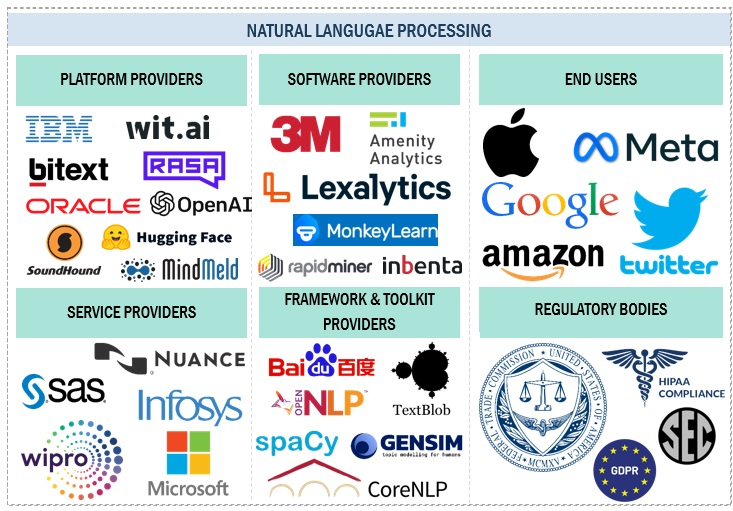
The NLP landscape is constantly evolving, offering exciting possibilities for developers and businesses alike. Here’s an overview of some of the top NLP tools in 2024, categorized by their strengths and use cases:
1. spaCy:
- Strengths:
- Highly performant and efficient, ideal for large-scale applications.
- Open-source and Python-based, with a large and active community.
- Supports various NLP tasks like tokenization, named entity recognition, and text classification.
- Pre-trained models available for diverse languages.
- Use cases:
- Building chatbots, sentiment analysis, topic modeling, information extraction, and more.
- Considerations:
- May require some coding expertise.
- Limited pre-trained models for specific domains.
2. NLTK:
- Strengths:
- Open-source and well-documented, popular for educational and research purposes.
- Supports a wide range of NLP tasks, including tokenization, stemming, lemmatization, and parsing.
- Extensive community resources and tutorials available.
- Use cases:
- Learning and experimenting with NLP concepts, research projects, and simple NLP applications.
- Considerations:
- Can be slower than some other tools for large-scale applications.
- User interface is less intuitive than some options.
3. TensorFlow.js:
- Strengths:
- Runs directly in web browsers, enabling real-time NLP applications.
- Combines seamlessly with other JavaScript frameworks and libraries.
- Large community and ecosystem backed by Google.
- Use cases:
- Building chatbots, sentiment analysis, topic modeling for web applications.
- Considerations:
- Requires JavaScript expertise.
- Can be resource-intensive for complex NLP tasks.
4. Hugging Face Transformers:
- Strengths:
- Access to a vast library of pre-trained NLP models for various languages and tasks.
- User-friendly API for fine-tuning and deploying models.
- Active community and research contributions.
- Use cases:
- Experimenting with state-of-the-art NLP models, research projects, and building custom NLP applications.
- Considerations:
- Requires understanding of transformer architectures.
- Can be computationally expensive for large models.
5. IBM Watson:
- Strengths:
- Cloud-based platform offering various pre-built NLP services, including sentiment analysis, question answering, and text summarization.
- Easy to use with APIs and SDKs for various programming languages.
- Use cases:
- Integrating NLP functionalities into enterprise applications without extensive development.
- Considerations:
- Commercial platform with subscription fees.
- Less customizable than some open-source tools.
The best tool depends on your particular needs and priorities. Consider factors like:
- Your skill level: Are you a beginner, researcher, or experienced developer?
- Project requirements: What specific NLP tasks do you need to perform?
- Data size and complexity: Are you dealing with small datasets or large-scale text corpora?
- Deployment environment: Do you need a cloud-based solution or on-premises deployment?
- Open-source vs. commercial: Are you comfortable with coding and customization, or do you prefer a ready-to-use solution?
By carefully considering these factors and exploring the strengths and limitations of each tool, you can choose the NLP tool that empowers you to unlock the potential of language data in 2024.

Find Trusted Cardiac Hospitals
Compare heart hospitals by city and services — all in one place.
Explore Hospitals