
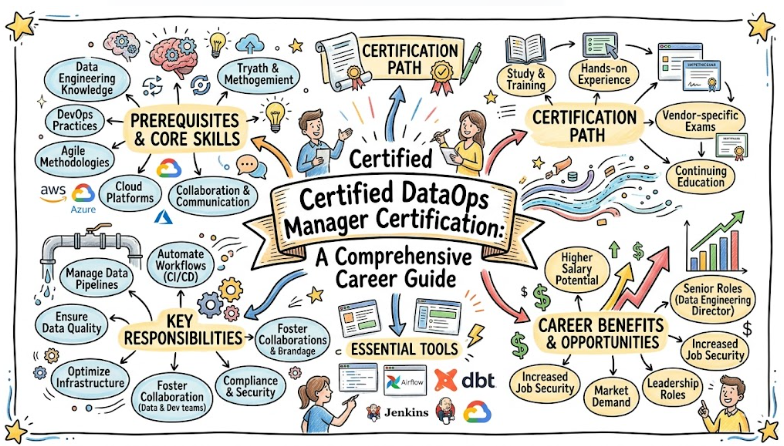
Introduction
The CDOM – Certified DataOps Manager is a professional credential designed to bridge the gap between data engineering and operational excellence. As organizations transition from traditional data silos to agile, automated data pipelines, the need for leadership that understands both the technical and cultural shifts of DataOps has become critical. This guide is curated for professionals navigating the complexities of modern data stacks, cloud-native architectures, and platform engineering. By pursuing this certification through DataOpsSchool, engineers and managers can master the methodologies required to treat data as a product rather than a static asset. This roadmap helps you evaluate the certification’s impact on your career and provides a structured approach to becoming a leader in the data operations space.
What is the CDOM – Certified DataOps Manager?
The CDOM – Certified DataOps Manager represents a shift from theoretical data management to production-ready data orchestration. It exists to solve the “data bottleneck” problem, where data science and analytics teams are slowed down by manual processes and fragile pipelines. This certification focuses on the practical application of DevOps principles—such as continuous integration, automated testing, and version control—to the data lifecycle. It aligns with modern engineering workflows by emphasizing the importance of observability, reproducibility, and scalability in enterprise data environments. For the modern professional, it is a validation of the ability to manage complex data ecosystems with the same rigor found in software engineering.
Who Should Pursue CDOM – Certified DataOps Manager?
This certification is tailored for a broad spectrum of technical professionals, ranging from hands-on engineers to high-level technical leaders. Data engineers, SREs, and cloud architects who want to specialize in data-intensive infrastructure will find the curriculum highly relevant to their daily operations. Security professionals and data governance officers can also benefit by learning how to bake compliance and security into the automated pipeline. In the context of both the Indian and global markets, managers who oversee hybrid teams of data scientists and developers need this framework to ensure cross-functional collaboration. Whether you are a beginner looking for a structured entry point or an experienced professional aiming for a leadership role, CDOM provides the necessary technical depth.
Why CDOM – Certified DataOps Manager is Valuable and Beyond
The demand for DataOps expertise is accelerating as enterprises move beyond simple cloud migration toward sophisticated data-driven decision-making. As toolsets evolve from traditional ETL to modern data stacks involving Snowflake, dbt, and Airflow, the underlying principles of DataOps remain the constant anchor for career longevity. CDOM helps professionals stay relevant by focusing on the methodology and architecture rather than just specific, fleeting software tools. Organizations are increasingly adopting DataOps to reduce cycle times and improve data quality, making CDOM holders valuable assets for enterprise-scale digital transformations. Investing in this certification offers a significant return on time by positioning you as a specialist in one of the fastest-growing domains of modern engineering.
CDOM – Certified DataOps Manager Certification Overview
The CDOM program is delivered via CDOM – Certified DataOps Manager and hosted on DataOpsSchool. The program uses a practical assessment approach that moves beyond simple multiple-choice questions to evaluate real-world problem-solving capabilities. It is structured into distinct levels that cater to different stages of professional growth, ensuring a logical progression from foundational concepts to advanced management strategies. The ownership of the certification lies with industry practitioners who ensure the content remains aligned with current production standards. This structure allows candidates to build a portfolio of skills that are immediately applicable to enterprise environments, focusing on automation, governance, and organizational culture.
CDOM – Certified DataOps Manager Certification Tracks & Levels
The certification is divided into three primary levels: Foundation, Professional, and Advanced. The Foundation level introduces the core philosophy of DataOps, focusing on the cultural shift and basic automation concepts required for entry-level roles. The Professional level dives deeper into specialized tracks such as SRE for Data, FinOps for Data, and automated data quality engineering. Finally, the Advanced or Managerial level focuses on strategy, team leadership, and the architectural design of enterprise-wide data platforms. These levels align with typical career progression, allowing a junior engineer to eventually transition into a Principal DataOps Engineer or a Data Operations Manager. By following these tracks, professionals can ensure their learning path matches their current job responsibilities and future career aspirations.
Complete CDOM – Certified DataOps Manager Certification Table
| Track | Level | Who it’s for | Prerequisites | Skills Covered | Recommended Order |
| DataOps Core | Foundation | Aspiring Data Engineers | Basic Data Knowledge | Pipeline Basics, Culture | 1 |
| Engineering | Professional | Data & DevOps Engineers | 2+ Years Experience | CI/CD for Data, Testing | 2 |
| SRE & Ops | Professional | SREs and Cloud Engineers | Infrastructure Knowledge | Observability, SLIs/SLOs | 3 |
| Leadership | Advanced | Engineering Managers | Lead/Senior Experience | Strategy, Governance | 4 |
Detailed Guide for Each CDOM – Certified DataOps Manager Certification
CDOM – Foundation Level
What it is
This certification validates a candidate’s understanding of basic DataOps principles and the lifecycle of a data pipeline. It ensures the professional understands how to apply agile methodologies to data management.
Who should take it
It is ideal for junior data engineers, software developers transitioning to data, or project managers who need to understand the technical workflow of their teams. No deep prior experience in DataOps is required.
Skills you’ll gain
- Understanding the DataOps Manifesto.
- Basic version control for data schemas.
- Knowledge of automated data testing principles.
- Awareness of collaborative workflows between data and ops teams.
Real-world projects you should be able to do
- Setting up a basic automated data ingestion pipeline.
- Implementing version control for a small database schema.
- Creating a simple dashboard for pipeline monitoring.
Preparation plan
- 7–14 days: Focus on core definitions and the cultural aspects of DataOps.
- 30 days: Review basic tools like Git and fundamental SQL optimization.
- 60 days: Not typically required for Foundation unless the candidate is entirely new to IT.
Common mistakes
- Focusing too much on specific tools rather than the DataOps philosophy.
- Overlooking the importance of communication and culture in the exam.
Best next certification after this
- Same-track: CDOM Professional Engineer.
- Cross-track: Certified FinOps Practitioner.
- Leadership: Technical Team Lead Foundation.
CDOM – Professional Level
What it is
The Professional level validates the ability to design and implement complex, automated data pipelines at scale. It focuses on technical execution and the integration of diverse tools within a unified ecosystem.
Who should take it
This is meant for mid-level engineers who have spent at least two years working with data or infrastructure. It is designed for those responsible for the reliability and speed of data delivery.
Skills you’ll gain
- Implementing CI/CD for complex data transformations.
- Advanced data observability and alerting.
- Infrastructure as Code (IaC) for data platforms.
- Performance tuning of distributed data systems.
Real-world projects you should be able to do
- Building a fully automated CI/CD pipeline for a Snowflake or BigQuery environment.
- Implementing automated data quality checks using Great Expectations or similar frameworks.
- Migrating a legacy ETL process to a containerized DataOps workflow.
Preparation plan
- 7–14 days: Deep dive into specific automation scripts and testing frameworks.
- 30 days: Hands-on lab work focusing on containerization and orchestration.
- 60 days: Comprehensive review of architecture patterns and disaster recovery for data.
Common mistakes
- Neglecting the security aspect of data pipelines (DataSecOps).
- Failing to account for cost optimization in cloud-native data environments.
Best next certification after this
- Same-track: CDOM Advanced Manager.
- Cross-track: Certified SRE Professional.
- Leadership: Data Engineering Director Track.
CDOM – Advanced Manager Level
What it is
This level confirms that a professional can lead a DataOps transformation across an entire organization. It focuses on strategic alignment, ROI, and high-level architectural governance.
Who should take it
This is designed for senior architects, engineering managers, and directors. It is for those who are making decisions about toolchains, hiring, and organizational structure.
Skills you’ll gain
- Designing enterprise-grade DataOps strategies.
- Managing technical debt in data systems.
- Building and scaling high-performance DataOps teams.
- Financial management and governance of data resources.
Real-world projects you should be able to do
- Authoring a corporate DataOps maturity roadmap.
- Conducting a full audit of data pipeline security and compliance.
- Designing a multi-cloud data architecture that minimizes vendor lock-in.
Preparation plan
- 7–14 days: Focus on case studies of successful DataOps transformations.
- 30 days: Study governance frameworks and financial modeling for data.
- 60 days: Extensive preparation involving organizational change management theories.
Common mistakes
- Staying too “in the weeds” with technical details and ignoring business outcomes.
- Underestimating the difficulty of changing team culture in large legacy enterprises.
Best next certification after this
- Same-track: CTO/VP Engineering Leadership Program.
- Cross-track: Enterprise Architecture Certification.
- Leadership: Executive MBA or Management Professional.
Choose Your Learning Path
DevOps Path
Professionals coming from a DevOps background should focus on applying their knowledge of automation to the data domain. This path involves learning how data statefulness differs from stateless application code. You will explore how to manage database migrations with the same ease as application deployments. The goal is to create a seamless flow between software development and data availability.
DevSecOps Path
In this path, the focus is on integrating security into every stage of the data pipeline. You will learn about data masking, encryption at rest and in transit, and automated compliance auditing. This is critical for industries like finance and healthcare where data privacy is paramount. This path ensures that speed does not come at the cost of security.
SRE Path
The SRE path focuses on the reliability and performance of data platforms. You will learn how to set SLIs and SLOs specifically for data freshness and accuracy. This involves building resilient systems that can handle failures without corrupting the downstream data. It bridges the gap between traditional operations and high-scale data engineering.
AIOps Path
AIOps focuses on using machine learning to improve IT operations. In this track, you learn how to use AI to predict pipeline failures and automate root cause analysis. It is about making the operations side of the business “smarter” through data-driven insights. This is a high-growth area for those looking to manage massive-scale infrastructures.
MLOps Path
The MLOps path is dedicated to the lifecycle of machine learning models. You will learn how to automate the training, deployment, and monitoring of models in production. This path is essential for organizations that want to move beyond experimental AI to production-grade intelligence. It requires a deep understanding of both data pipelines and model versioning.
DataOps Path
This is the core path focusing on the end-to-end data lifecycle. It covers everything from ingestion to transformation and delivery. The emphasis is on reducing the cycle time of data analytics while maintaining high quality. Professionals on this path become the backbone of the organization’s data-driven strategy.
FinOps Path
The FinOps path deals with the financial accountability of cloud data spend. You will learn how to optimize the costs of storage and compute in environments like AWS, Azure, and GCP. This involves tagging resources, identifying waste, and forecasting future data needs. It is essential for maintaining the profitability of large-scale data operations.
Role → Recommended CDOM – Certified DataOps Manager Certifications
| Role | Recommended Certifications |
| DevOps Engineer | CDOM Foundation, CDOM Professional Engineering |
| SRE | CDOM Professional SRE & Ops Track |
| Platform Engineer | CDOM Professional Engineering, CDOM Advanced |
| Cloud Engineer | CDOM Foundation, FinOps Track |
| Security Engineer | CDOM Professional (Security Focus) |
| Data Engineer | CDOM Foundation, CDOM Professional Engineering |
| FinOps Practitioner | CDOM Foundation, FinOps Specialization |
| Engineering Manager | CDOM Advanced Manager Level |
Next Certifications to Take After CDOM – Certified DataOps Manager
Same Track Progression
Once you have mastered the CDOM levels, the natural progression is to seek deep specialization in specific data technologies or advanced architectural patterns. You might pursue advanced certifications in specific cloud data warehouses or distributed computing frameworks. This ensures that your high-level DataOps knowledge is backed by deep technical expertise in the tools your organization uses. Continuous learning in this track focuses on staying ahead of the “Modern Data Stack” evolution.
Cross-Track Expansion
Professionals often find value in expanding their skills into adjacent domains like SRE or DevSecOps. If you have mastered DataOps, understanding how the underlying infrastructure is managed (SRE) or how it is secured (DevSecOps) makes you a more versatile leader. This cross-pollination of skills allows you to manage larger, more complex departments. It also provides a safety net as the industry shifts between different operational focuses.
Leadership & Management Track
For those looking to move away from hands-on engineering, the next step involves executive leadership certifications. These focus on business strategy, financial oversight, and organizational psychology. Moving from a DataOps Manager to a Director or VP of Engineering requires a shift from managing “pipelines” to managing “people and budgets.” This track is for those who want to influence the long-term technical direction of an enterprise.
Training & Certification Support Providers for CDOM – Certified DataOps Manager
DevOpsSchool
DevOpsSchool provides a comprehensive curriculum that covers the entire spectrum of automation and orchestration. They are known for their hands-on labs and instructor-led sessions that cater to both individual learners and corporate teams. Their approach focuses on real-world scenarios, making them a top choice for those looking to bridge the gap between theory and practice.
Cotocus
Cotocus specializes in high-end technical training with a focus on cloud-native technologies and platform engineering. They offer tailored programs that help engineers transition into specialized roles like DataOps and SRE. Their instructors are typically industry veterans who bring years of production experience to the classroom.
Scmgalaxy
Scmgalaxy is a community-driven platform that has evolved into a leading provider of configuration management and DevOps training. They offer a wealth of free resources alongside their professional certification tracks. This makes them an excellent choice for self-starters who want to build a strong foundation before committing to advanced certifications.
BestDevOps
BestDevOps focuses on delivering streamlined, efficient training modules for busy professionals. Their curriculum is designed to maximize learning in a short timeframe, focusing on the most critical skills required for modern engineering roles. They are a popular choice for intensive bootcamps and rapid skill upgrading.
devsecopsschool.com
This provider is dedicated exclusively to the intersection of development, security, and operations. They provide deep-dive courses into automated security testing, compliance as code, and threat modeling. For DataOps professionals, this is the go-to source for learning how to secure sensitive data pipelines.
sreschool.com
Sreschool.com focuses on the art and science of site reliability engineering. Their courses cover everything from error budgets to incident response and high-availability architecture. They provide the necessary operational context that DataOps managers need to ensure their data platforms are resilient and performant.
aiopsschool.com
Aiopsschool.com provides training on the application of artificial intelligence to IT operations. They help professionals understand how to leverage machine learning to manage complex, distributed systems. This is an essential resource for DataOps leads looking to implement predictive maintenance and automated scaling.
dataopsschool.com
Dataopsschool.com is the primary authority on DataOps certifications and training. They offer a structured path from foundational concepts to advanced management. Their curriculum is specifically designed to address the unique challenges of data orchestration, making it the central hub for CDOM candidates.
finopsschool.com
Finopsschool.com addresses the growing need for financial cloud management. They teach professionals how to align cloud spending with business value, a critical skill for any DataOps manager. Their training helps organizations avoid “cloud bill shock” and maintain sustainable data operations.
Frequently Asked Questions (General)
- How difficult is the CDOM certification?
The difficulty is moderate to high, as it requires a mix of technical knowledge and managerial insight. It is not just a test of definitions but of practical application. - How much time does it take to prepare for the exam?
Most candidates spend between 30 and 60 days preparing, depending on their existing experience with data engineering and DevOps. - Are there any specific prerequisites?
While the Foundation level is open to all, the Professional and Advanced levels require a few years of relevant industry experience. - What is the return on investment (ROI) for this certification?
Professionals often see salary increases and better job opportunities as they fill a high-demand niche in the market. - Should I take the DevOps certification before CDOM?
It is helpful but not mandatory. CDOM covers the necessary DevOps concepts within the context of data. - Is this certification recognized globally?
Yes, the principles taught are based on industry-standard practices used by tech companies worldwide. - How is the assessment conducted?
The assessment usually involves a mix of conceptual questions and practical, scenario-based tasks. - Can I skip the Foundation level?
If you have significant experience, you may be able to challenge the Professional level directly, though Foundation is recommended for a complete understanding. - What tools will I learn about during the certification?
You will be exposed to a variety of tools including Git, Jenkins, Airflow, Snowflake, and various data quality frameworks. - How often do I need to recertify?
Certifications are typically valid for two to three years, after which you may need to pass an update exam. - Does the program offer job placement assistance?
Many training providers associated with CDOM offer career coaching and networking opportunities. - Is CDOM suitable for non-technical managers?
Yes, the Advanced track is specifically designed to help managers understand the technical workflows they supervise.
FAQs on CDOM – Certified DataOps Manager
- What makes CDOM different from a standard Data Engineering certificate?
CDOM focuses on the operational aspect—automation, reliability, and speed—rather than just the extraction and transformation of data. - Does CDOM cover cloud-specific tools?
It is cloud-agnostic but teaches you how to apply principles across AWS, Azure, and Google Cloud Platform. - How does CDOM handle data governance?
Governance is treated as an automated part of the pipeline, ensuring compliance without slowing down development. - Is the exam available online?
Yes, most providers offer proctored online exams for global accessibility. - Are there practical labs included in the training?
Yes, the program emphasizes hands-on experience with real-world data pipeline scenarios. - What is the passing score for the certification?
Typically, a score of 70% or higher is required to demonstrate proficiency. - How does CDOM address “Data Quality”?
It teaches you to implement automated testing at every stage of the pipeline to catch errors early. - Can teams take this certification together?
Many enterprises use CDOM to align their entire data department under a single operational framework.
Final Thoughts: Is CDOM – Certified DataOps Manager Worth It?
From a mentor’s perspective, the value of a certification lies not in the digital badge, but in the clarity of thought it provides. CDOM – Certified DataOps Manager is worth the investment if you are looking to move beyond manual, “hero-based” data work toward a scalable, professionalized operation. It provides a common language for engineers and managers to communicate, which is often the biggest hurdle in large organizations. If you are committed to the path of modern engineering and want to be at the forefront of the data revolution, this certification offers a solid, unbiased framework for growth. It demands effort and a shift in mindset, but the resulting career stability and technical prowess are well worth the journey.

Find Trusted Cardiac Hospitals
Compare heart hospitals by city and services — all in one place.
Explore Hospitals
A well-explained career guide for aspiring DataOps professionals. The article is informative, easy to follow, and provides valuable certification insights.