
Introduction
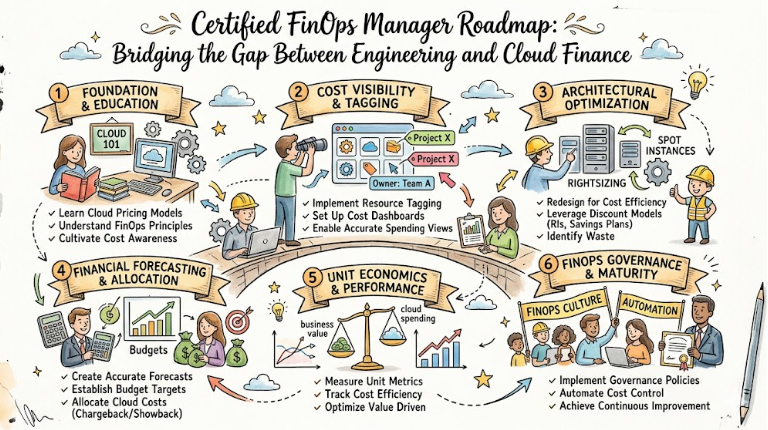
Navigating the complexities of cloud financial management requires more than just a basic understanding of billing; it demands a strategic mastery of cost optimization and cultural shift. This guide explores the pathway to becoming a Certified FinOps Manager, a credential designed to bridge the gap between engineering efficiency and financial accountability. Whether you are an engineer looking to quantify the value of your infrastructure or a manager aiming to stabilize cloud spend, this certification serves as a definitive roadmap for your professional growth.
The curriculum, hosted on finopsschool, provides the technical depth and leadership insights necessary to thrive in high-scale cloud environments. By following this guide, professionals will understand how to transition from reactive cost-cutting to proactive value realization. We will break down the difficulty levels, the real-world application of the skills gained, and how this certification integrates with the broader DevOps and SRE ecosystems to help you make an informed career decision.
What is the Certified FinOps Manager?
The Certified FinOps Manager program is a specialized professional track that focuses on the intersection of cloud technology, finance, and business operations. Unlike theoretical frameworks, this program represents a hands-on approach to managing the “variable cost” model of public cloud providers like AWS, Azure, and Google Cloud. It exists to solve the modern enterprise dilemma: how to innovate at speed without losing control of the budget.
This certification emphasizes production-focused learning, moving beyond simple spreadsheet management to architectural cost-awareness. It aligns with modern engineering workflows by integrating financial feedback loops directly into the CI/CD pipeline and resource provisioning phases. By achieving this status, a professional demonstrates they can navigate the cultural friction between finance teams and engineering departments, ensuring that every dollar spent on the cloud is an investment in business growth.
Who Should Pursue Certified FinOps Manager?
This path is primarily designed for individuals sitting at the crossroads of infrastructure and business value. Senior DevOps engineers and Site Reliability Engineers (SREs) who find themselves tasked with “right-sizing” environments will find the curriculum directly applicable to their daily tasks. Additionally, Platform Engineers who are building internal developer platforms need these skills to bake-in cost transparency for their internal users.
The program is also highly relevant for Engineering Managers and CTOs who are responsible for the department’s bottom line and need a structured way to report cloud ROI to stakeholders. Cloud architects, security professionals concerned with resource sprawl, and data engineers managing expensive warehouse clusters also benefit significantly. For the global workforce, including the booming tech sector in India, this certification provides a standardized language for cloud economics that is recognized across international borders.
Why Certified FinOps Manager is Valuable and Beyond
As enterprises move from “Cloud First” to “Cloud Smart” strategies, the demand for professionals who can optimize these environments has reached a critical peak. Cloud spend is often the second or third largest expense for a modern company, and the longevity of a career in FinOps is secured by the fact that cloud adoption shows no signs of slowing down. Companies are moving away from brute-force cost reduction and toward a permanent culture of accountability.
This certification helps professionals stay relevant even as specific tools and cloud providers change. While a tool-specific certification might lose value if a company switches providers, the principles of FinOps are universal. The return on time and career investment is substantial, as organizations are willing to pay a premium for leaders who can demonstrably save them millions in wasted cloud spend while maintaining or improving system performance.
Certified FinOps Manager Certification Overview
The certification program is delivered via the official channel at Certified FinOps Manager and is hosted on the finopsschool.com platform. This program utilizes a multi-tiered assessment approach that combines theoretical knowledge with practical, scenario-based challenges. It is structured to ensure that candidates do not just memorize definitions but can actually solve complex financial puzzles in a simulated production environment.
The ownership of the certification lies with an industry-aligned body that ensures the curriculum is updated to reflect the latest changes in cloud billing structures and discount programs (like Savings Plans and Reserved Instances). The structure is practical, focusing on the three main phases of the FinOps journey: Inform, Optimize, and Operate. This ensures a holistic mastery of the lifecycle, from initial visibility to long-term operational excellence.
Certified FinOps Manager Certification Tracks & Levels
The program is divided into three distinct levels to accommodate professionals at different stages of their career journey. The Foundation level is designed to establish a common language and understand the basic building blocks of cloud economics. It is the entry point for those new to financial management within a technical context, ensuring everyone from junior developers to procurement officers is on the same page.
The Professional level moves into the “how-to” of cost optimization and reporting, focusing on deeper technical implementations and departmental coordination. Finally, the Advanced or Specialist levels focus on leadership, policy-making, and long-term strategic planning. These levels align with career progression, allowing a contributor to move from a “Practitioner” to a “Manager” and eventually a “Director of Cloud Economics” or “Head of FinOps.”
Complete Certified FinOps Manager Certification Table
| Track | Level | Who it’s for | Prerequisites | Skills Covered | Recommended Order |
| FinOps Core | Foundation | Beginners, Finance, Analysts | Basic Cloud Knowledge | Terminology, Lifecycle, Principles | 1st |
| FinOps Mgmt | Professional | DevOps, SRE, Managers | Foundation Cert + 1yr Exp | Optimization, Tagging, Unit Metrics | 2nd |
| FinOps Strategy | Advanced | Architects, Leaders, Directors | Professional Cert + 2yrs Exp | Policy Governance, Automation | 3rd |
Detailed Guide for Each Certified FinOps Manager Certification
Certified FinOps Manager – Foundation
What it is
This certification validates a candidate’s understanding of the basic principles of FinOps and the ability to contribute to a cost-conscious culture. It ensures the individual understands how cloud billing differs from traditional data center accounting.
Who should take it
It is ideal for junior engineers, finance associates, and procurement specialists who are new to the cloud. It is also suitable for managers who need to speak the language of their technical teams without getting into deep code.
Skills you’ll gain
- Understanding the 6 core FinOps principles.
- Mapping cloud spend to business units through basic tagging.
- Identifying the difference between Capex and Opex in a cloud context.
- Navigating cloud billing dashboards for major providers.
Real-world projects you should be able to do
- Perform a basic audit of a monthly cloud bill to identify top spending services.
- Create a simple tagging policy documentation for a small engineering team.
- Generate a weekly spend report for a specific project or department.
Preparation plan
- 7–14 days: Focus on the official glossary and the core phases (Inform, Optimize, Operate).
- 30 days: Review case studies of cloud migrations and their financial impact.
- 60 days: Engage in community forums and practice with sample billing exports.
Common mistakes
- Underestimating the importance of cultural change over technical tools.
- Focusing only on one cloud provider’s terminology instead of the general framework.
Best next certification after this
- Same-track option: Certified FinOps Manager – Professional.
- Cross-track option: Cloud Practitioner (AWS/Azure/GCP).
- Leadership option: Certified Cloud Project Manager.
Certified FinOps Manager – Professional
What it is
This certification validates the ability to execute optimization strategies and manage the day-to-day operations of a FinOps team. It proves you can move from seeing a problem to fixing it through technical and process-oriented solutions.
Who should take it
This is for experienced DevOps Engineers, SREs, and Finance Managers who are actively managing cloud environments. It requires a solid technical background and an understanding of infrastructure as code.
Skills you’ll gain
- Implementing advanced automated right-sizing and scheduling.
- Managing RI and Savings Plan portfolios for maximum coverage.
- Developing unit metrics to measure the cost-effectiveness of features.
- Building complex showback and chargeback models.
Real-world projects you should be able to do
- Execute a cross-account cleanup that reduces monthly spend by a measurable percentage.
- Automate the identification and termination of “zombie” resources using Lambda or similar tools.
- Implement a real-time alerting system for budget variances across multiple teams.
Preparation plan
- 7–14 days: Deep dive into advanced discounting and commitment-based logic.
- 30 days: Hands-on practice with specialized FinOps tooling and API integrations.
- 60 days: Simulation of a large-scale enterprise cost-optimization project.
Common mistakes
- Implementing aggressive cost-cutting that negatively impacts system performance or reliability.
- Failing to gain executive buy-in before changing resource provisioning policies.
Best next certification after this
- Same-track option: Certified FinOps Manager – Advanced/Director.
- Cross-track option: Kubernetes Administrator (CKA).
- Leadership option: Engineering Management Professional.
Choose Your Learning Path
DevOps Path
The DevOps path focuses on integrating cost as a first-class citizen in the delivery pipeline. Engineers in this track learn to treat “Cost” like “Security” or “Testing,” ensuring that infrastructure code is checked for financial efficiency before it is deployed. This prevents expensive surprises in production and builds a culture where developers are aware of the price tag of their architectural choices.
DevSecOps Path
In the DevSecOps path, the focus is on the overlap between security compliance and resource optimization. Professionals learn how to identify orphaned resources that pose both a security risk and a financial drain. This path emphasizes using security tools to also gain visibility into resource usage, ensuring that a lean environment is both a secure and a cost-effective one.
SRE Path
The SRE path bridges the gap between Reliability and Cost, focusing on the “Error Budget” and “Cost Budget.” SREs learn to balance performance requirements with financial constraints, ensuring that high availability doesn’t lead to unnecessary over-provisioning. This path is crucial for those managing high-traffic systems where small inefficiencies scale into massive expenses.
AIOps Path
The AIOps path focuses on using artificial intelligence and machine learning to predict cloud spend and automate anomaly detection. Professionals in this track learn how to leverage algorithmic models to identify spending patterns that humans might miss. This is the future of FinOps, where the scale of data requires automated oversight to maintain financial health.
MLOps Path
MLOps professionals face unique financial challenges due to the high cost of GPU instances and large data processing jobs. This path teaches how to optimize training and inference costs, manage expensive datasets efficiently, and ensure that machine learning initiatives remain financially viable. It is essential for teams scaling AI models in the cloud.
DataOps Path
DataOps focuses on the massive costs associated with modern data warehouses and lakes like Snowflake or BigQuery. This path covers how to optimize query performance to reduce compute costs and manage storage lifecycles. It is designed for data engineers who need to ensure that their data platforms don’t become a bottomless pit of expenditure.
FinOps Path
The pure FinOps path is for those who want to specialize entirely in cloud financial management. It covers the full spectrum from accounting and procurement to technical optimization and cultural leadership. This path is designed for dedicated FinOps practitioners who act as the central hub of knowledge for an entire organization’s cloud economy.
Role → Recommended Certified FinOps Manager Certifications
| Role | Recommended Certifications |
| DevOps Engineer | Foundation + Professional |
| SRE | Professional + SRE Specialist |
| Platform Engineer | Foundation + Professional |
| Cloud Engineer | Foundation + Professional |
| Security Engineer | Foundation + DevSecOps Focus |
| Data Engineer | Foundation + DataOps Focus |
| FinOps Practitioner | Professional + Advanced |
| Engineering Manager | Foundation + Advanced Strategy |
Next Certifications to Take After Certified FinOps Manager
Same Track Progression
After achieving the management level, professionals should look toward Director-level certifications or specialized tracks in Cloud Governance. This involves moving from managing a single cloud’s costs to managing a multi-cloud or hybrid-cloud portfolio. Deepening your expertise in specific commitment-based purchasing strategies (like AWS Enterprise Discount Programs) is also a natural next step for those in the FinOps track.
Cross-Track Expansion
Broadening your skills into Kubernetes (CKA/CKAS) is highly recommended, as container orchestration is where many of the most complex FinOps challenges exist today. Understanding how to allocate costs in a shared cluster is a top-tier skill. Alternatively, gaining a professional-level Cloud Architect certification ensures you can design cost-optimized systems from the very first line of a design document.
Leadership & Management Track
For those aiming for executive roles, moving into General Management or specialized Engineering Leadership certifications is beneficial. These programs help a FinOps Manager translate technical savings into business outcomes that the CEO and Board of Directors care about. This transition focuses on high-level communication, strategic negotiation with vendors, and leading large-scale cultural transformations across a global organization.
Training & Certification Support Providers for Certified FinOps Manager
DevOpsSchool
DevOpsSchool is a leading global provider of technical training that focuses on the practical application of modern operations methodologies. Their curriculum for FinOps is designed by industry veterans who have managed multi-million dollar cloud budgets. They provide extensive lab environments where students can practice real-world optimization scenarios without risking actual company funds. The training is structured to be interactive, ensuring that students can ask questions and get feedback on their specific organizational challenges. Their focus is on creating job-ready professionals who can immediately add value to an engineering team.
Cotocus
Cotocus offers a highly specialized approach to cloud and DevOps training, emphasizing the integration of specialized tools into the engineering lifecycle. Their support for the FinOps program includes deep dives into third-party optimization software and custom automation scripts. They are known for their rigorous curriculum that challenges students to think critically about architectural choices. Cotocus provides a blend of self-paced learning and instructor-led sessions, making it a flexible choice for working professionals. Their instructors are active practitioners, ensuring that the content is always relevant to the current state of the industry and its evolving challenges.
Scmgalaxy
Scmgalaxy is a massive community-driven platform that has been a cornerstone of the DevOps and SRE learning ecosystem for many years. They provide a wealth of free and premium resources, including blogs, tutorials, and certification guides. Their approach to FinOps training is rooted in the community experience, sharing “war stories” and real-world failures to help students avoid common pitfalls. They offer structured workshops that focus on the hands-on aspects of cloud financial management. Scmgalaxy is an excellent choice for those who value community interaction and a wide variety of learning materials to supplement their certification journey.
BestDevOps
BestDevOps focuses on delivering high-quality, curated training paths for the most in-demand certifications in the industry. Their FinOps training module is streamlined to focus on what matters most for passing the exam and performing on the job. They use a results-oriented methodology that breaks down complex financial concepts into digestible technical tasks. BestDevOps is particularly useful for teams looking to upskill their members quickly and efficiently. Their platform provides progress tracking and practice exams that closely mimic the actual certification environment, ensuring that candidates are well-prepared for the final assessment and future career roles.
devsecopsschool.com
This platform is dedicated to the intersection of security and operations, providing a unique lens through which to view FinOps. They argue that a secure environment is a lean environment, and their training reflects this philosophy. Students learn how to use security auditing tools to find unused or misconfigured resources that are draining the budget. Their curriculum is essential for those in highly regulated industries like finance or healthcare, where cost-cutting can never come at the expense of compliance. They provide specialized labs that focus on identifying security-related waste in the cloud, a niche but highly valuable skill set.
sreschool.com
Sreschool.com is the premier destination for those looking to master Site Reliability Engineering and its financial implications. Their training for FinOps Managers focuses on the concept of “Sustainability Engineering,” where reliability and cost are treated as two sides of the same coin. They teach students how to build dashboards that show real-time cost-to-reliability metrics, allowing for informed decision-making during high-traffic events. The instructors here are experts in managing large-scale distributed systems, and they bring that expertise to every lesson. This is the ideal choice for engineers who want to stay close to the infrastructure while mastering the money.
aiopsschool.com
Aiopsschool.com focuses on the next generation of operations, where machine learning and automation take center stage. Their FinOps curriculum explores how to use AI to automate the more tedious parts of cost management, such as anomaly detection and predictive forecasting. Students learn how to build and deploy models that can monitor thousands of resources simultaneously, providing alerts when spending deviates from the norm. This training is forward-looking, preparing professionals for a world where manual spreadsheet management is no longer possible due to the scale and speed of cloud operations.
dataopsschool.com
Dataopsschool.com addresses the specific and often massive financial challenges of modern data platforms. Their FinOps training is tailored for those managing Big Data, Machine Learning datasets, and complex analytics pipelines. They provide deep insights into how to structure data storage and query patterns to minimize the “Data Tax” that many companies pay. Their labs include performance tuning for cloud data warehouses, a skill that can save an organization thousands of dollars per day. For data professionals, this is the most relevant place to learn how to keep their innovations financially sustainable.
finopsschool.com
As the primary host and delivery partner for this certification, finopsschool.com provides the most direct and comprehensive path to mastery. Their curriculum is the gold standard for the industry, covering every aspect of the FinOps lifecycle in meticulous detail. They offer a range of support services, from basic introductory courses to advanced leadership workshops. Because they are the central hub for the certification, their materials are always the most up-to-date and accurately reflect the current exam requirements. This is the starting point for anyone serious about making a career out of cloud financial management.
Frequently Asked Questions
- How difficult is the Certified FinOps Manager exam?
The difficulty is moderate to high, as it requires both a solid understanding of cloud infrastructure and the ability to interpret financial data and business strategy effectively.
- How much time does it take to prepare for this certification?
Most professionals with a technical background require 30 to 60 days of consistent study to fully grasp the intersection of finance and engineering principles.
- Are there any strict prerequisites for the management level?
While not always mandatory, having a basic cloud certification and at least one year of experience in a cloud-related role is highly recommended for success.
- What is the return on investment (ROI) for this certification?
The ROI is typically very high, as the salary for FinOps professionals is competitive and the skills learned can save an organization significant amounts of money.
- In what order should I take the certifications?
It is always recommended to start with the Foundation level to establish the correct terminology before moving into the Professional management and Specialist tracks.
- Is this certification recognized globally?
Yes, the principles taught are universal across all cloud providers and are recognized by major enterprises in India, the US, Europe, and beyond.
- Does this certification cover multiple cloud providers?
Yes, while it mentions specific tools, the focus is on a cloud-agnostic framework that can be applied to AWS, Azure, GCP, or even private cloud environments.
- Is there a practical lab component to the training?
Yes, the best training providers include hands-on labs where you must solve real cost-optimization scenarios in a simulated or actual cloud environment.
- How long does the certification remain valid?
Generally, certifications are valid for two to three years, after which you must renew or progress to a higher level to ensure your skills remain current.
- Can a non-technical person pass this certification?
A person from a finance or business background can pass the Foundation level, but the Management level requires a deeper understanding of technical infrastructure.
- Does this certification help in career transitions?
It is one of the best certifications for engineers looking to move into management or for finance professionals looking to enter the technology sector.
- Are there community resources available for study?
Yes, platforms like Scmgalaxy and the FinOps Foundation provide extensive community support, forums, and peer-to-peer learning opportunities for all candidates.
FAQs on Certified FinOps Manager
- What specific tools will I learn to use?
You will learn to use cloud-native tools like AWS Cost Explorer and Azure Cost Management, as well as third-party platforms for deeper multi-cloud visibility.
- How does FinOps differ from traditional IT procurement?
FinOps is a continuous, iterative process involving real-time adjustments, whereas traditional procurement is usually a static, one-time negotiation for fixed assets or licenses.
- Can FinOps be automated?
Much of the “Optimize” and “Operate” phases can be automated using Infrastructure as Code, serverless functions, and AI-driven anomaly detection tools to maintain efficiency.
- Does this certification cover Kubernetes cost management?
The management level provides foundational knowledge for container costs, though specialized tracks may be needed for deep expertise in complex, multi-tenant Kubernetes clusters.
- What is the role of a FinOps Manager in a small startup?
In a startup, the manager often acts as a solo practitioner, setting up the initial tagging, budgets, and alerts to prevent the company from burning through its capital.
- How do I justify the cost of this certification to my manager?
Focus on the potential savings; even a 5% reduction in cloud spend usually covers the cost of the training and certification for the entire team multiple times over.
- Is there a focus on ethical spending and sustainability?
Yes, modern FinOps often includes a “GreenOps” component, where optimizing for cost also reduces the carbon footprint by eliminating wasted energy and compute power.
- What is the most challenging part of the FinOps Manager role?
The most difficult part is often not the technical optimization, but the cultural change required to get engineering teams to take ownership of their own spending.
Final Thoughts: Is Certified FinOps Manager Worth It?
As a mentor who has seen the industry shift from physical hardware to abstract cloud services, I can tell you that the most valuable professionals are those who understand the “Why” behind the “How.” Engineering is no longer just about building things that work; it is about building things that are sustainable and profitable. The Certified FinOps Manager credential is not just another badge for your profile; it is a signal that you understand the business reality of modern software development.
If you are looking for a way to stand out in a crowded market of DevOps and SRE professionals, this is a clear path forward. It provides a unique skill set that is in high demand and low supply. My advice is to approach this learning journey with a practical mindset—don’t just study for the test, but look for ways to apply these principles to your current projects immediately. The knowledge you gain will pay dividends throughout the rest of your career, regardless of which cloud provider becomes the leader of tomorrow.

Find Trusted Cardiac Hospitals
Compare heart hospitals by city and services — all in one place.
Explore Hospitals
It clearly explains how FinOps helps bridge the gap between engineering and cloud finance, making cloud cost management easier to understand and apply.