
Introduction
Agentic IT Operations Platforms are AI-powered systems that autonomously manage, monitor, and optimize IT infrastructure. These platforms leverage intelligent agents to detect anomalies, automate remediation, and orchestrate multi-step IT workflows. By adopting these platforms, organizations improve uptime, reduce operational costs, and enhance overall IT efficiency.
Real-world use cases include:
- Automatically detecting and resolving server and network incidents
- Predictive maintenance for critical IT assets
- Automating configuration changes and deployment tasks
- Multi-cloud monitoring and resource optimization
- Integrating alerts with ITSM and collaboration tools
- Performance analytics and reporting for IT operations
Evaluation criteria for buyers include:
- Automation intelligence and incident response capability
- Multi-agent orchestration
- Integration with monitoring, ticketing, and ITSM systems
- Guardrails and escalation policies
- Observability, logging, and reporting dashboards
- Security, compliance, and access control
- Deployment flexibility (cloud, hybrid, on-prem)
- Scalability and multi-environment support
- Cost transparency and optimization
- Support, documentation, and community
Best for: Enterprise IT teams, DevOps teams, and IT operations managers
Not ideal for: Small IT teams with simple monitoring needs
What’s Changed in Agentic IT Operations Platforms
- Multi-agent orchestration for complex IT workflows
- Predictive analytics and anomaly detection
- Integrated dashboards for monitoring performance and reliability
- Guardrails for escalation, policy enforcement, and safety
- Multi-modal input handling: metrics, logs, alerts
- Observability dashboards with usage, latency, and automation metrics
- Prebuilt templates for common IT operations tasks
- Cloud, hybrid, and on-prem deployment options
- Integration with ITSM, monitoring, and DevOps tools
- Cost optimization with intelligent agent routing
- Governance and compliance controls
- Continuous evaluation of agent effectiveness
Quick Buyer Checklist
- Incident response automation
- Multi-agent orchestration
- Integration with monitoring and ITSM tools
- Evaluation workflows
- Guardrails and escalation policies
- Observability and analytics dashboards
- Deployment flexibility
- Security and compliance
- Scalability across environments
- Cost transparency
- Support and community quality
- Prebuilt templates for IT operations
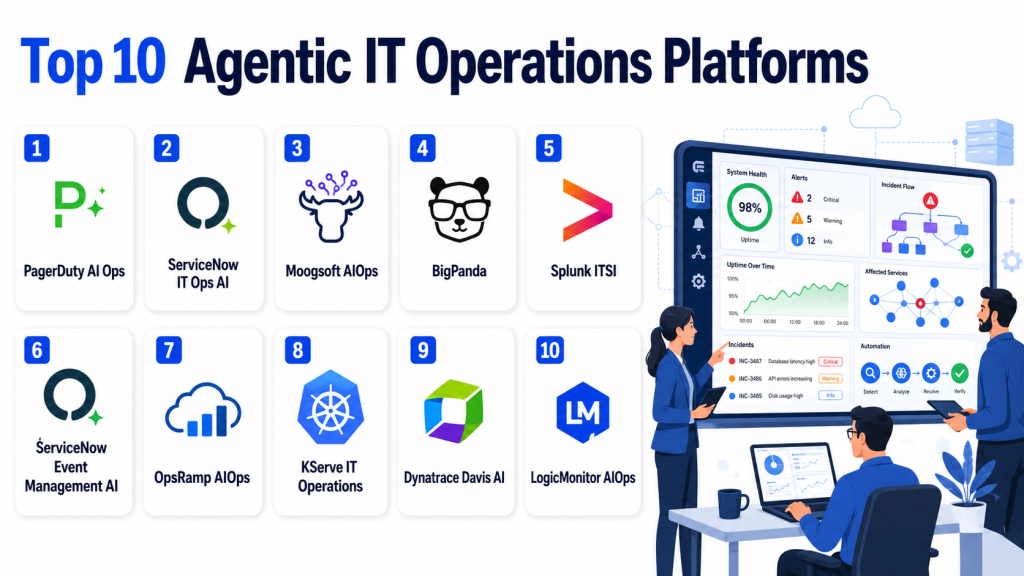
Top 10 Agentic IT Operations Platforms
1- PagerDuty AI Ops
One-line verdict: Enterprise-focused platform for automated incident detection and multi-agent IT operations.
Short description: Provides real-time incident detection, multi-agent workflows, and alert orchestration for IT teams.
Standout Capabilities
- Automated incident triage and routing
- Multi-agent orchestration
- Integration with cloud and on-prem monitoring
- Predictive alerting
- Runbook automation
- Reporting dashboards
- Escalation and collaboration tools
AI-Specific Depth
- Model support: Proprietary, BYO
- RAG / knowledge integration: Monitoring and ticketing connectors
- Evaluation: Regression testing, dashboards
- Guardrails: Escalation policies, safety checks
- Observability: Execution traces, metrics, latency
Pros
- Enterprise-grade reliability
- Strong integrations
- Real-time automation
Cons
- Costly for small teams
- Learning curve
- Advanced features require configuration
Security & Compliance
SSO/SAML, RBAC, audit logs, encryption
Deployment & Platforms
Web, Cloud
Integrations & Ecosystem
Monitoring, ITSM, cloud services, collaboration tools
Pricing Model
Tiered enterprise
Best-Fit Scenarios
- Large IT teams
- Multi-cloud operations
- Incident response automation
2- ServiceNow IT Ops AI
One-line verdict: Enterprise IT operations platform for predictive incident management and agentic automation.
Short description: Offers AI-driven predictive monitoring, automated remediation, and full observability across IT environments.
Standout Capabilities
- Visual workflow builder
- AI-driven incident prediction
- Automated remediation
- Cloud and on-prem integration
- Dashboards for monitoring KPIs
- Multi-agent orchestration
- Compliance reporting
AI-Specific Depth
- Model support: Proprietary, BYO
- RAG / knowledge integration: CMDB and monitoring connectors
- Evaluation: Metrics dashboards
- Guardrails: Policy enforcement, escalation rules
- Observability: Alerts, traces, execution logs
Pros
- End-to-end enterprise automation
- Predictive insights
- ITSM integration
Cons
- Enterprise pricing
- Requires platform expertise
- Not suitable for small teams
Security & Compliance
RBAC, audit logs, encryption, compliance controls
Deployment & Platforms
Web, Cloud, Hybrid
Integrations & Ecosystem
Monitoring tools, ITSM, CMDB, cloud services
Pricing Model
Tiered enterprise
Best-Fit Scenarios
- Large-scale IT operations
- Regulated environments
- Multi-agent automated workflows
3- Moogsoft AIOps
One-line verdict: Multi-cloud AI platform for anomaly detection, incident correlation, and IT workflow automation.
Short description: Detects anomalies, correlates incidents, and automates resolutions using multi-agent orchestration.
Standout Capabilities
- Multi-agent orchestration
- Predictive anomaly detection
- Alert correlation
- Automated remediation
- Monitoring dashboards
- Collaboration tools
AI-Specific Depth
- Model support: Proprietary, BYO
- RAG / knowledge integration: Monitoring connectors
- Evaluation: Dashboards, regression metrics
- Guardrails: Escalation policies
- Observability: Alerts, metrics, traces
Pros
- Predictive analytics
- Multi-cloud support
- Incident automation
Cons
- Learning curve
- Costly for small teams
- Requires configuration
Security & Compliance
Not publicly stated
Deployment & Platforms
Web, Cloud
Integrations & Ecosystem
Monitoring, ticketing, cloud, DevOps
Pricing Model
Tiered enterprise
Best-Fit Scenarios
- Multi-cloud IT teams
- Predictive incident response
- Large IT organizations
4- BigPanda
One-line verdict: Event correlation and AI-driven automation for enterprise IT operations.
Short description: Aggregates events, correlates incidents, and automates remediation across IT environments.
Standout Capabilities
- Event correlation AI
- Automated incident workflows
- Multi-source integration
- Runbook automation
- Alert suppression
- Observability dashboards
- Escalation policies
AI-Specific Depth
- Model support: Proprietary, BYO
- RAG / knowledge integration: Monitoring connectors
- Evaluation: Dashboards, metrics
- Guardrails: Escalation policies
- Observability: Alerts, traces, workflow tracking
Pros
- Simplifies multi-source event management
- Automates remediation
- Real-time alerts
Cons
- Enterprise cost
- Requires monitoring expertise
- Limited low-code customization
Security & Compliance
RBAC, audit logs, encryption
Deployment & Platforms
Web, Cloud
Integrations & Ecosystem
Monitoring, ticketing, cloud providers
Pricing Model
Tiered enterprise
Best-Fit Scenarios
- Event correlation
- Large IT teams
- Multi-source IT operations
5- Splunk ITSI
One-line verdict: Predictive analytics and AI-powered IT workflow automation platform.
Short description: Provides AI agents for anomaly detection, predictive insights, and automated remediation.
Standout Capabilities
- Predictive anomaly detection
- Multi-agent orchestration
- Service health dashboards
- Automated remediation
- KPI monitoring
- Runbook integration
AI-Specific Depth
- Model support: Proprietary, BYO
- RAG / knowledge integration: Monitoring connectors
- Evaluation: Regression testing
- Guardrails: Policy enforcement
- Observability: Metrics, traces, alerts
Pros
- Predictive insights
- Enterprise scalability
- Multi-agent workflows
Cons
- Complexity for small teams
- Enterprise cost
- Configuration required
Security & Compliance
RBAC, audit logs
Deployment & Platforms
Web, Cloud, Hybrid
Integrations & Ecosystem
Monitoring, ITSM, cloud, DevOps
Pricing Model
Tiered enterprise
Best-Fit Scenarios
- Enterprise IT operations
- Multi-cloud monitoring
- Predictive remediation
6- ServiceNow Event Management AI
One-line verdict: AI-driven event and incident management for enterprise IT operations.
Short description: Detects, correlates, and resolves IT events with AI agents integrated into ITSM workflows.
Standout Capabilities
- Event aggregation and correlation
- Multi-agent remediation
- Integration with CMDB and ITSM
- Predictive alerting
- Dashboards and analytics
- Escalation policies
AI-Specific Depth
- Model support: Proprietary
- RAG / knowledge integration: CMDB, monitoring connectors
- Evaluation: Dashboards
- Guardrails: Escalation rules
- Observability: Logs, traces
Pros
- Enterprise integration
- Multi-agent orchestration
- Predictive insights
Cons
- Enterprise cost
- Cloud-dependent
- Limited low-code
Security & Compliance
SSO/SAML, RBAC, audit logs
Deployment & Platforms
Web, Cloud, Hybrid
Integrations & Ecosystem
CMDB, ITSM, monitoring, collaboration
Pricing Model
Tiered enterprise
Best-Fit Scenarios
- Enterprise IT event management
- Multi-channel alerts
- Predictive remediation
7- OpsRamp AIOps
One-line verdict: Unified IT operations platform with agentic automation and event correlation.
Short description: Provides AI agents for monitoring, remediation, and workflow automation across IT infrastructure.
Standout Capabilities
- Event correlation AI
- Multi-agent orchestration
- Automated remediation
- Monitoring dashboards
- Alerts and escalation
AI-Specific Depth
- Model support: Proprietary, BYO
- RAG / knowledge integration: Connectors
- Evaluation: Performance dashboards
- Guardrails: Policy enforcement
- Observability: Metrics, logs, traces
Pros
- Multi-cloud support
- Workflow automation
- Alert correlation
Cons
- Enterprise-focused
- Costly
- Setup complexity
Security & Compliance
RBAC, audit logs
Deployment & Platforms
Web, Cloud
Integrations & Ecosystem
Monitoring, ITSM, cloud providers
Pricing Model
Tiered enterprise
Best-Fit Scenarios
- Enterprise IT operations
- Multi-agent incident management
- Predictive event resolution
8- KServe IT Operations
One-line verdict: Kubernetes-native platform for scalable IT workflow automation.
Short description: Orchestrates AI agents, monitors resources, and automates IT operations in Kubernetes environments.
Standout Capabilities
- Kubernetes-native orchestration
- Multi-agent workflows
- Autoscaling
- Monitoring and logs
- CI/CD integration
AI-Specific Depth
- Model support: BYO, multi-model
- RAG / knowledge integration: Compatible connectors
- Evaluation: Offline tests
- Guardrails: N/A
- Observability: Metrics, traces
Pros
- Cloud-native scalability
- Multi-agent orchestration
- DevOps integration
Cons
- Requires Kubernetes expertise
- Minimal visual UI
- Guardrails limited
Security & Compliance
Not publicly stated
Deployment & Platforms
Cloud, On-prem, Kubernetes
Integrations & Ecosystem
Kubernetes APIs, monitoring, SDKs
Pricing Model
Open-source + enterprise
Best-Fit Scenarios
- Kubernetes-based IT operations
- Scalable multi-agent workflows
- DevOps integration
9- Dynatrace Davis AI
One-line verdict: AI-powered monitoring and automated remediation for IT infrastructure.
Short description: Davis AI monitors metrics, detects anomalies, and automates responses using agentic workflows.
Standout Capabilities
- Real-time monitoring
- Multi-agent orchestration
- Predictive issue detection
- Automated remediation
- Cloud and hybrid environment support
- Dashboards and reporting
AI-Specific Depth
- Model support: Proprietary
- RAG / knowledge integration: Monitoring connectors
- Evaluation: Regression dashboards
- Guardrails: Escalation policies
- Observability: Metrics, traces
Pros
- Predictive analytics
- Enterprise integration
- Multi-agent workflows
Cons
- Enterprise pricing
- Setup complexity
- Limited customization
Security & Compliance
RBAC, audit logs, encryption
Deployment & Platforms
Cloud, Hybrid
Integrations & Ecosystem
Monitoring, ITSM, cloud, collaboration
Pricing Model
Tiered enterprise
Best-Fit Scenarios
- Enterprise IT monitoring
- Multi-cloud predictive operations
- Automated remediation
10- LogicMonitor AIOps
One-line verdict: Agentic IT monitoring platform with automated alerting and incident management.
Short description: Monitors infrastructure, correlates events, and automates remediation using intelligent agents.
Standout Capabilities
- Multi-agent orchestration
- Alert correlation
- Automated remediation
- Predictive analytics
- Monitoring dashboards
- Cloud and hybrid support
AI-Specific Depth
- Model support: Proprietary
- RAG / knowledge integration: Monitoring connectors
- Evaluation: Metrics dashboards
- Guardrails: Escalation policies
- Observability: Alerts, traces
Pros
- Multi-cloud support
- Automation of incidents
- Predictive insights
Cons
- Enterprise pricing
- Setup complexity
- Learning curve
Security & Compliance
RBAC, audit logs
Deployment & Platforms
Web, Cloud, Hybrid
Integrations & Ecosystem
Monitoring, ITSM, cloud platforms
Pricing Model
Tiered enterprise
Best-Fit Scenarios
- Enterprise IT monitoring
- Automated incident management
- Multi-agent workflows
Comparison Table
| Tool | Best For | Deployment | Model Flexibility | Strength | Watch-Out | Public Rating |
|---|---|---|---|---|---|---|
| PagerDuty AI Ops | Enterprise IT teams | Cloud | Proprietary / BYO | Multi-agent automation | Cost | N/A |
| ServiceNow IT Ops AI | Enterprise | Cloud / Hybrid | BYO / Proprietary | Predictive automation | Complexity | N/A |
| Moogsoft AIOps | Multi-cloud IT | Cloud | Proprietary / BYO | Predictive alerts | Learning curve | N/A |
| BigPanda | Multi-source events | Cloud | Proprietary / BYO | Event correlation | Enterprise cost | N/A |
| Splunk ITSI | Enterprise | Cloud / Hybrid | Proprietary / BYO | Analytics + automation | Complexity | N/A |
| ServiceNow Event Management | Enterprise | Cloud / Hybrid | Proprietary | Event management | Cloud dependency | N/A |
| OpsRamp AIOps | Enterprise | Cloud | Proprietary / BYO | Multi-agent orchestration | Enterprise cost | N/A |
| KServe IT Operations | Kubernetes teams | Cloud / On-prem | Multi-model / BYO | Scalable orchestration | Kubernetes expertise | N/A |
| Dynatrace Davis AI | Enterprise monitoring | Cloud / Hybrid | Proprietary | Predictive operations | Enterprise pricing | N/A |
| LogicMonitor AIOps | Enterprise IT | Cloud / Hybrid | Proprietary | Automation & monitoring | Complexity | N/A |
Scoring & Evaluation
| Tool | Core | Reliability | Guardrails | Integrations | Ease | Perf/Cost | Security/Admin | Support | Weighted Total |
|---|---|---|---|---|---|---|---|---|---|
| PagerDuty AI Ops | 9 | 8 | 7 | 9 | 7 | 8 | 7 | 8 | 8.1 |
| ServiceNow IT Ops AI | 8 | 9 | 8 | 8 | 7 | 8 | 9 | 8 | 8.3 |
| Moogsoft AIOps | 8 | 8 | 7 | 8 | 7 | 8 | 8 | 7 | 7.9 |
| BigPanda | 8 | 8 | 7 | 8 | 7 | 8 | 8 | 7 | 7.9 |
| Splunk ITSI | 8 | 9 | 8 | 8 | 7 | 8 | 9 | 8 | 8.3 |
| ServiceNow Event Management | 8 | 8 | 8 | 8 | 7 | 8 | 8 | 7 | 7.9 |
| OpsRamp AIOps | 8 | 8 | 7 | 8 | 7 | 8 | 8 | 7 | 7.9 |
| KServe IT Operations | 8 | 8 | 6 | 8 | 7 | 8 | 7 | 7 | 7.6 |
| Dynatrace Davis AI | 8 | 8 | 7 | 8 | 7 | 8 | 8 | 7 | 7.9 |
| LogicMonitor AIOps | 8 | 8 | 7 | 8 | 7 | 8 | 8 | 7 | 7.9 |
Top 3 for Enterprise: ServiceNow IT Ops AI, Splunk ITSI, PagerDuty AI Ops
Top 3 for SMB: BigPanda, OpsRamp AIOps, KServe IT Operations
Top 3 for Developers: PagerDuty AI Ops, KServe IT Operations, Moogsoft AIOps
Which Platform Is Right for You
Solo / Freelancer
KServe IT Operations, Moogsoft AIOps
SMB
BigPanda, PagerDuty AI Ops
Mid-Market
ServiceNow IT Ops AI, OpsRamp AIOps
Enterprise
Splunk ITSI, ServiceNow Event Management
Regulated industries
ServiceNow IT Ops AI, Splunk ITSI
Budget vs premium
Open-source/Kubernetes-native for cost efficiency; enterprise platforms for governance
Build vs buy
Build for small teams; buy for enterprise support and compliance
Implementation Playbook
- 30 days: Pilot workflows, define metrics, integrate evaluation
- 60 days: Harden guardrails, deploy multi-agent orchestration, run regression tests
- 90 days: Scale across systems, monitor dashboards, enforce governance
Common Mistakes
- Over-automation without review
- Skipping evaluation
- Ignoring guardrails
- Poor monitoring
- Multi-cloud misconfiguration
- Cost and latency surprises
- Vendor lock-in
- Weak security
- Neglecting BYO models
- Inconsistent workflows
- Lack of documentation
- Not scaling incrementally
FAQs
1- What are Agentic IT Operations Platforms?
AI systems that manage IT infrastructure, detect anomalies, and automate operations.
2- Can they handle multi-cloud environments?
Yes, most platforms support hybrid and multi-cloud deployments.
3- Are these platforms secure?
Enterprise platforms provide RBAC, SSO/SAML, audit logs, and encryption.
4- Can small teams use them?
Yes, some low-code or Kubernetes-native platforms are suitable.
5- How is reliability measured?
Through dashboards, metrics, regression tests, and incident performance.
6- Do they integrate with ITSM systems?
Yes, connectors to ITSM, monitoring, and ticketing tools are standard.
7- Can I bring my own AI models?
Most platforms support BYO models for customization.
8- How quickly can agents be deployed?
Pilot deployments in weeks; enterprise rollouts take phased approaches.
9- Are these platforms cloud-only?
No, many support cloud, hybrid, and on-prem deployments.
10- How do guardrails work?
They enforce escalation rules, safety checks, and compliance policies.
11- Can agent performance be monitored?
Yes, dashboards provide metrics, traces, and logs.
12- How do I avoid vendor lock-in?
Use open-source, hybrid solutions, and modular workflow designs.
Conclusion
Agentic IT Operations Platforms automate incident detection, remediation, and IT workflow management. Choosing the right platform depends on company size, infrastructure complexity, model flexibility, and compliance needs. Small teams may benefit from open-source or Kubernetes-native platforms, while enterprises require full-featured platforms with governance, monitoring, and multi-agent orchestration. Begin with pilot workflows, validate agent performance and guardrails, and scale incrementally for efficiency and reliability.

Find Trusted Cardiac Hospitals
Compare heart hospitals by city and services — all in one place.
Explore Hospitals
Helpful and insightful article on Agentic IT Operations platforms. It clearly explains the key features, pros, and trade-offs, making it easier to understand the evolving AIOps landscape.