
Introduction
AI SEO Content Optimization Tools help marketers, SEO teams, writers, agencies, and businesses improve content quality, search relevance, topic coverage, readability, internal linking, and content performance. These tools use AI, natural language processing, SERP analysis, keyword intelligence, content scoring, competitor comparison, content briefs, and optimization recommendations to help teams create content that is more useful for readers and better aligned with search intent.
Why It Matters
SEO content is no longer about adding keywords repeatedly. Search engines and AI-powered answer systems now reward helpful, clear, well-structured, trustworthy, and topic-complete content. A blog post, landing page, product page, or knowledge base article must answer the user’s real intent, cover related subtopics, use clear structure, and provide better value than competing pages.
AI SEO content optimization tools help content teams reduce guesswork. They analyze top-ranking pages, identify content gaps, suggest related terms, score drafts, generate outlines, recommend headings, improve readability, and support content refresh workflows. These tools are especially useful when teams need to scale content production without losing quality.
Real World Use Cases
- Creating SEO content briefs for writers
- Optimizing blog posts before publishing
- Refreshing older content for better performance
- Finding missing topics and semantic keywords
- Comparing content against ranking competitors
- Improving readability and structure
- Generating SEO-friendly outlines
- Supporting content clusters and topical authority
- Creating optimized landing page copy
- Helping agencies manage client content workflows
Evaluation Criteria for Buyers
When choosing an AI SEO content optimization tool, buyers should evaluate:
- Accuracy of SERP and competitor analysis
- Quality of content scoring recommendations
- Support for keyword research and topic clustering
- Ability to create useful content briefs
- AI writing and rewriting capabilities
- Internal linking and content audit support
- Ease of use for writers and editors
- Integrations with Google Docs, WordPress, CMS, and SEO platforms
- Reporting, workflow, and collaboration features
- Pricing flexibility for freelancers, agencies, and enterprises
Best For
AI SEO content optimization tools are best for content marketers, SEO professionals, SaaS companies, ecommerce brands, agencies, bloggers, publishers, and enterprises that want to improve organic visibility through better content quality and stronger search intent alignment.
Not Ideal For
They are not ideal for teams that want to publish AI-generated content without human review. These tools can suggest topics, structure, terms, and improvements, but human editors still need to verify accuracy, originality, tone, brand fit, search intent, and usefulness.
What’s Changed in AI SEO Content Optimization
AI SEO content optimization has shifted from simple keyword density tools to full content intelligence platforms. Modern tools now analyze search intent, competitor structure, semantic terms, questions, topic gaps, internal links, readability, content depth, and entity coverage. Many platforms also include AI writing assistants, content briefs, optimization scores, content refresh suggestions, and workflow features.
Another major change is the rise of AI search visibility. Content teams are no longer optimizing only for traditional search results. They are also thinking about how content appears in AI answers, summaries, citations, and conversational discovery experiences. This means content must be clear, well-structured, factual, comprehensive, and easy for both humans and AI systems to understand.
Quick Buyer Checklist
- Does the tool analyze live search results?
- Does it provide clear content scoring?
- Can it create SEO briefs?
- Does it suggest semantic keywords and related topics?
- Can it help refresh existing content?
- Does it support your target regions and languages?
- Does it integrate with your writing workflow?
- Can it support content clusters and topical authority?
- Does it provide internal linking suggestions?
- Can your team afford it at scale?
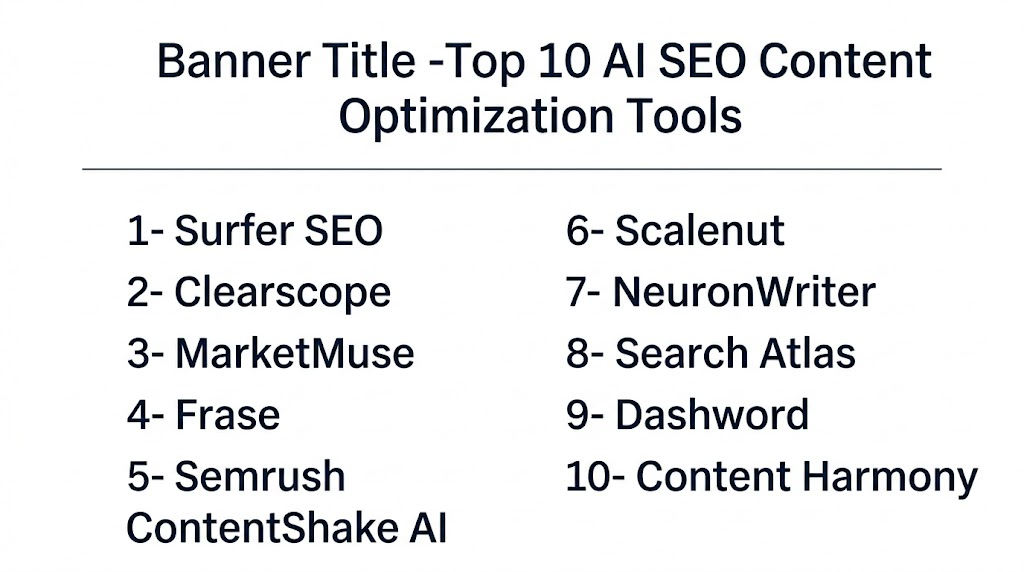
Top 10 AI SEO Content Optimization Tools
1- Surfer SEO
2- Clearscope
3- MarketMuse
4- Frase
5- Semrush ContentShake AI
6- Scalenut
7- NeuronWriter
8- Search Atlas
9- Dashword
10- Content Harmony
1- Surfer SEO
One Line Verdict
Surfer SEO is a strong choice for teams that want real-time SEO content scoring, SERP-based optimization, and practical content recommendations.
Short Description
Surfer SEO helps writers and marketers optimize content by comparing drafts against top-ranking pages. It provides content scores, suggested terms, structure recommendations, heading guidance, and SERP-based insights. It is especially useful for teams that want a clear editor-style workflow where content can be improved while writing.
Standout Capabilities
- Real-time content editor
- SERP-based content recommendations
- Content score guidance
- Keyword and topic suggestions
- Outline and brief support
- Content audit capabilities
- Helpful integrations for writing workflows
AI-Specific Depth
Surfer SEO combines AI writing support with search result analysis and natural language recommendations. Its AI depth is strongest when users need to create or optimize content based on competitor patterns, topic coverage, and on-page SEO signals. Human judgment is still needed to avoid over-optimizing only for a score.
Pros
- Easy content scoring workflow
- Strong fit for writers and SEO teams
- Useful for blog optimization and content refreshes
- Good balance of usability and SEO guidance
Cons
- Recommendations should not be followed blindly
- Content can become mechanical if over-optimized
- Advanced workflows may increase cost
- Some teams may still need separate keyword research tools
Security and Compliance
Not publicly stated for every plan. Buyers should verify data handling, team access, content privacy, and enterprise security requirements before adoption.
Deployment and Platforms
Cloud-based SEO content optimization platform available through web access.
Integrations and Ecosystem
Surfer SEO fits well into content writing, SEO editing, blog optimization, and agency workflows. It can support writers, editors, content managers, and SEO specialists working on search-focused articles and landing pages.
Pricing Model
Varies / N/A
Best Fit Scenarios
- Blog content optimization
- SEO content refreshes
- Agency content workflows
- SERP-driven article planning
- Teams needing clear content scores
2- Clearscope
One Line Verdict
Clearscope is best for teams that prioritize high-quality editorial SEO, topic coverage, and precise content optimization recommendations.
Short Description
Clearscope is an AI-powered content optimization platform focused on helping teams create comprehensive and relevant content. It provides content grading, keyword recommendations, topic suggestions, and optimization guidance based on search intent and competitor analysis. It is popular with content teams that care about editorial quality, clarity, and depth.
Standout Capabilities
- Content grading and optimization
- Semantic keyword recommendations
- Search intent support
- Competitor-based topic guidance
- Content brief assistance
- Readability and relevance support
- Strong fit for editorial teams
AI-Specific Depth
Clearscope uses AI and natural language analysis to help writers understand what topics, terms, and concepts should be included in a strong article. It is less about mass-generating content and more about improving content quality, completeness, and search relevance.
Pros
- Strong content quality focus
- Good for editorial SEO workflows
- Clear optimization recommendations
- Useful for high-value content pages
Cons
- Can be costly for smaller teams
- Less focused on full AI article generation
- Best results require skilled editors
- May need other tools for broader SEO workflows
Security and Compliance
Not publicly stated for every plan. Buyers should confirm enterprise security, data access, content privacy, and admin controls directly.
Deployment and Platforms
Cloud-based content optimization platform available through web access.
Integrations and Ecosystem
Clearscope fits into editorial, content marketing, SEO, and publishing workflows. It is useful for teams that want writers and editors to collaborate around quality-focused SEO recommendations.
Pricing Model
Varies / N/A
Best Fit Scenarios
- Editorial SEO teams
- Premium blog content
- SaaS content marketing
- Enterprise content operations
- Teams focused on quality over volume
3- MarketMuse
One Line Verdict
MarketMuse is a strong option for teams that need AI-powered content strategy, topical authority planning, content audits, and optimization at scale.
Short Description
MarketMuse is designed for content intelligence, topic modeling, content planning, and optimization. It helps teams identify content gaps, build topic clusters, evaluate content quality, and create briefs. It is especially useful for organizations that manage large content libraries and want to improve topical authority across many pages.
Standout Capabilities
- Content inventory analysis
- Topic modeling and content planning
- Content gap discovery
- Brief creation
- Competitive content analysis
- Optimization recommendations
- Support for topical authority strategy
AI-Specific Depth
MarketMuse uses AI-driven topic modeling and content intelligence to help teams plan what to write, what to update, and how to strengthen content clusters. Its AI value is strongest for strategic content planning rather than only page-level writing assistance.
Pros
- Strong for content strategy
- Useful for large content libraries
- Good for topical authority planning
- Helps prioritize content opportunities
Cons
- May be too advanced for small teams
- Learning curve can be higher
- Requires SEO strategy experience
- Pricing may not fit every budget
Security and Compliance
Not publicly stated for every plan. Buyers should verify security, access controls, data retention, and enterprise requirements directly.
Deployment and Platforms
Cloud-based content intelligence and optimization platform.
Integrations and Ecosystem
MarketMuse fits well into enterprise content strategy, SEO planning, editorial calendars, and large-scale optimization programs. It is especially useful where teams need to manage many pages across multiple topics.
Pricing Model
Varies / N/A
Best Fit Scenarios
- Enterprise content teams
- Topic cluster planning
- Content audits
- Large blog libraries
- Long-term SEO strategy
4- Frase
One Line Verdict
Frase is a practical AI SEO tool for content briefs, search intent research, optimization, and faster content creation workflows.
Short Description
Frase helps SEO teams research search results, create content briefs, generate outlines, optimize drafts, and answer user questions. It is useful for writers and agencies that need a faster way to move from keyword research to content brief to optimized draft. Frase is especially helpful when teams want practical SEO support without heavy complexity.
Standout Capabilities
- SEO content briefs
- SERP research support
- AI writing assistance
- Question and topic discovery
- Content optimization scoring
- Outline generation
- Useful for agency workflows
AI-Specific Depth
Frase combines AI writing with search result research and content optimization. Its AI depth is strongest in helping teams create briefs, answer common questions, and structure content around search intent. It works well when users need speed and practical guidance.
Pros
- Good for fast content briefs
- Useful for writers and agencies
- Helps connect research with drafting
- Easier than many enterprise platforms
Cons
- May not be as deep as enterprise content intelligence tools
- Output still requires editing
- Some workflows may need additional SEO tools
- Advanced needs may require a broader platform
Security and Compliance
Not publicly stated for every plan. Buyers should verify data security, privacy, and user access controls before adoption.
Deployment and Platforms
Cloud-based SEO content optimization and writing platform.
Integrations and Ecosystem
Frase can fit into content writing, SEO research, agency production, and blog optimization workflows. It is especially useful for teams that create briefs regularly.
Pricing Model
Varies / N/A
Best Fit Scenarios
- Content brief creation
- Agency SEO workflows
- Blog optimization
- Question-based content planning
- Faster first drafts
5- Semrush ContentShake AI
One Line Verdict
Semrush ContentShake AI is a good choice for marketers who want AI content creation connected with broader SEO research and competitive insights.
Short Description
Semrush ContentShake AI helps users generate and optimize content ideas, outlines, drafts, and SEO-friendly articles. Its biggest advantage is the connection to the wider Semrush ecosystem, which includes keyword research, competitive analysis, site audits, ranking insights, and broader digital marketing workflows. It is useful for teams that want SEO content creation connected to a larger marketing toolkit.
Standout Capabilities
- AI-assisted content creation
- SEO topic and idea support
- Draft generation
- Optimization recommendations
- Connection with broader SEO workflows
- Helpful for small teams and marketers
- Useful for content planning and execution
AI-Specific Depth
ContentShake AI brings AI writing into the SEO workflow. It helps marketers move from topic idea to draft faster, while benefiting from the broader SEO context available inside the Semrush ecosystem. It is best when paired with human editing and keyword strategy.
Pros
- Strong fit for Semrush users
- Useful for SEO content workflows
- Helps with ideas and drafts
- Connects content with broader SEO activity
Cons
- Best value comes inside the Semrush ecosystem
- Not a standalone enterprise content governance tool
- Content quality still needs review
- Some advanced SEO work may need other Semrush modules
Security and Compliance
Security and compliance details may vary by plan and configuration. Buyers should verify access controls, privacy, and enterprise requirements directly.
Deployment and Platforms
Cloud-based content and SEO platform.
Integrations and Ecosystem
ContentShake AI works best for users already using Semrush for SEO, keyword research, competitive analysis, and marketing reporting. It can support content creation within a broader search marketing process.
Pricing Model
Varies / N/A
Best Fit Scenarios
- Semrush users
- SEO content teams
- Small marketing teams
- Topic idea generation
- Content creation tied to SEO research
6- Scalenut
One Line Verdict
Scalenut is useful for teams that want AI writing, SEO content planning, keyword clustering, and optimization in one content workflow.
Short Description
Scalenut combines AI content generation with SEO planning and optimization features. It can help users create content briefs, generate articles, optimize drafts, and plan content around keywords or topic clusters. It is useful for marketers and agencies that want an all-in-one workflow for creating SEO content at scale.
Standout Capabilities
- AI article writing
- SEO content optimization
- Keyword clustering support
- Content brief generation
- SERP-based research
- Blog outline creation
- Workflow for scalable content production
AI-Specific Depth
Scalenut’s AI value comes from combining content generation with SEO guidance. It helps teams move from topic planning to draft creation and optimization. It is best used when marketers provide clear briefs, target keywords, and editorial review.
Pros
- Good for scalable content workflows
- Combines writing and optimization
- Useful for agencies and SMBs
- Helps organize SEO content production
Cons
- AI drafts still need editing
- Quality depends on inputs and review
- May not match enterprise-grade governance tools
- Overuse can produce generic content
Security and Compliance
Not publicly stated for every plan. Buyers should confirm data privacy, access controls, and security policies before adoption.
Deployment and Platforms
Cloud-based SEO and AI writing platform.
Integrations and Ecosystem
Scalenut can support SEO content creation, planning, and optimization workflows for teams producing multiple articles or landing pages regularly.
Pricing Model
Varies / N/A
Best Fit Scenarios
- Agencies producing SEO content
- SMB content teams
- Keyword cluster planning
- AI-assisted article drafting
- Scalable blog production
7- NeuronWriter
One Line Verdict
NeuronWriter is a budget-friendly AI SEO optimization tool for teams that need content scoring, NLP recommendations, and simple optimization workflows.
Short Description
NeuronWriter helps users optimize content using competitor analysis, NLP-based term recommendations, content scoring, and AI writing support. It is popular with bloggers, small businesses, and budget-conscious SEO teams that need practical optimization features without paying for enterprise-level platforms.
Standout Capabilities
- Content scoring
- NLP term suggestions
- Competitor comparison
- AI writing assistance
- Content planning support
- SERP-based recommendations
- Budget-friendly optimization workflow
AI-Specific Depth
NeuronWriter uses AI and NLP to help writers improve topic coverage and relevance. It is useful for identifying missing concepts and improving draft structure. It is not as broad as enterprise content intelligence platforms but offers strong practical value for smaller teams.
Pros
- Good value for smaller teams
- Useful SEO content scoring
- Practical NLP recommendations
- Easy to use for bloggers and marketers
Cons
- May lack advanced enterprise features
- Interface and workflow may not suit every team
- Content still requires manual review
- Not ideal for large-scale governance
Security and Compliance
Not publicly stated for every plan. Buyers should confirm privacy, user access, and data handling before using it for sensitive content.
Deployment and Platforms
Cloud-based SEO content optimization platform.
Integrations and Ecosystem
NeuronWriter fits into blogger, small business, affiliate, agency, and SEO writing workflows. It is useful when teams need affordable content optimization and topic coverage guidance.
Pricing Model
Varies / N/A
Best Fit Scenarios
- Budget-conscious SEO teams
- Bloggers and affiliates
- Small agencies
- Content scoring workflows
- SEO draft optimization
8- Search Atlas
One Line Verdict
Search Atlas is useful for teams that want SEO content optimization alongside rank tracking, keyword research, technical SEO, and broader search marketing tools.
Short Description
Search Atlas is an SEO platform that includes content optimization, keyword research, rank tracking, technical SEO tools, and content workflow features. It is a good choice for teams that do not want a separate tool only for content optimization and prefer a more complete SEO platform. Agencies and growth teams may find it useful for managing multiple SEO activities together.
Standout Capabilities
- SEO content optimization
- Keyword research support
- Rank tracking
- Technical SEO tools
- Content planning workflows
- Agency-friendly capabilities
- Broader SEO platform coverage
AI-Specific Depth
Search Atlas uses AI to support content creation, optimization, and SEO workflows. Its strength is not only content scoring but combining content work with wider SEO execution such as ranking visibility, technical health, and keyword opportunities.
Pros
- Broader SEO toolkit
- Useful for agencies
- Combines content and SEO workflows
- Reduces need for multiple tools
Cons
- May feel complex for beginners
- Content-only teams may not need all features
- Learning curve can be higher
- Pricing and features may vary
Security and Compliance
Not publicly stated for every plan. Buyers should verify security, user permissions, data handling, and agency account controls.
Deployment and Platforms
Cloud-based SEO and content optimization platform.
Integrations and Ecosystem
Search Atlas fits into SEO agency, content marketing, rank tracking, technical SEO, and growth marketing workflows. It is useful for teams that manage multiple aspects of SEO in one place.
Pricing Model
Varies / N/A
Best Fit Scenarios
- SEO agencies
- Growth marketing teams
- Multi-client SEO workflows
- Teams needing rank tracking plus content optimization
- Businesses consolidating SEO tools
9- Dashword
One Line Verdict
Dashword is a clean and practical SEO content optimization tool for teams that need content briefs, keyword recommendations, and simple performance monitoring.
Short Description
Dashword helps users create SEO content briefs, optimize drafts, track content performance, and identify relevant topics. It is useful for content teams that want a lightweight and straightforward tool without too much complexity. It works well for marketers who want practical guidance for search-focused content creation.
Standout Capabilities
- SEO content briefs
- Content optimization recommendations
- Keyword and topic suggestions
- Content monitoring support
- Simple workflow for writers
- Competitor-based analysis
- Useful for small content teams
AI-Specific Depth
Dashword uses AI-assisted analysis to help writers understand what topics and keywords should be included in content. It is best for creating useful briefs and improving draft relevance without overwhelming the user with too many technical SEO features.
Pros
- Simple and clean workflow
- Good for content briefs
- Useful for small teams
- Helps improve content structure
Cons
- Less advanced than enterprise platforms
- May not replace full SEO suites
- Limited for complex content strategy
- Human editing remains necessary
Security and Compliance
Not publicly stated for every plan. Buyers should validate data handling, content privacy, and team access requirements.
Deployment and Platforms
Cloud-based SEO content optimization tool.
Integrations and Ecosystem
Dashword fits into content brief creation, writing, editing, and content monitoring workflows. It is suitable for smaller marketing teams and agencies that want a focused content optimization tool.
Pricing Model
Varies / N/A
Best Fit Scenarios
- Content brief creation
- Small SEO teams
- Blog optimization
- Lightweight content monitoring
- Writers needing clear guidance
10- Content Harmony
One Line Verdict
Content Harmony is a strong choice for teams that need detailed SEO content briefs, search intent analysis, and structured content planning.
Short Description
Content Harmony focuses on content briefs, search intent analysis, keyword research support, competitor review, and content planning. It is especially useful for agencies and editorial teams that need to give writers clear instructions before drafting. Instead of only optimizing after writing, Content Harmony helps teams plan better content from the beginning.
Standout Capabilities
- SEO content brief generation
- Search intent analysis
- Competitor content review
- Keyword and question research
- Content outline support
- Writer-ready brief workflows
- Useful for agencies and editors
AI-Specific Depth
Content Harmony uses AI-assisted research and structured analysis to help teams create detailed briefs. Its value is strongest before writing begins, helping teams align content with search intent, audience needs, and competitor gaps.
Pros
- Strong brief creation workflow
- Useful for agencies and editorial teams
- Helps writers start with better direction
- Good for search intent planning
Cons
- Less focused on AI article generation
- May need separate writing tools
- Best value depends on content process maturity
- Not a full all-in-one SEO suite
Security and Compliance
Not publicly stated for every plan. Buyers should verify security, privacy, and access controls before adoption.
Deployment and Platforms
Cloud-based content brief and SEO planning platform.
Integrations and Ecosystem
Content Harmony works well inside agency, editorial, and SEO planning workflows. It is useful for teams that rely heavily on briefs before assigning articles to writers.
Pricing Model
Varies / N/A
Best Fit Scenarios
- SEO content briefs
- Agency writing workflows
- Search intent research
- Editorial planning
- Writer handoff processes
Comparison Table
| Tool | Best For | Main SEO Content Focus | Deployment | Standout Feature | Best Fit Team |
|---|---|---|---|---|---|
| Surfer SEO | Real-time optimization | Content scoring and SERP guidance | Cloud | Score-as-you-write workflow | Writers and SEO teams |
| Clearscope | Editorial SEO quality | Topic coverage and content grading | Cloud | Precise optimization guidance | Editorial content teams |
| MarketMuse | Content strategy | Topic modeling and content planning | Cloud | Topical authority planning | Enterprise content teams |
| Frase | SEO briefs and drafting | Briefs, outlines, questions, optimization | Cloud | Fast SERP-to-brief workflow | Agencies and writers |
| Semrush ContentShake AI | SEO content creation | Ideas, drafts, and optimization | Cloud | Connection with SEO ecosystem | Semrush users |
| Scalenut | Scalable SEO content | AI writing and optimization | Cloud | Content planning plus drafting | Agencies and SMBs |
| NeuronWriter | Budget SEO optimization | NLP scoring and competitor analysis | Cloud | Affordable content optimization | Bloggers and small teams |
| Search Atlas | All-in-one SEO workflows | Content, rank tracking, technical SEO | Cloud | Broader SEO platform coverage | Agencies and growth teams |
| Dashword | Simple content optimization | Briefs, topics, monitoring | Cloud | Clean lightweight workflow | Small content teams |
| Content Harmony | Content briefs | Search intent and writer briefs | Cloud | Detailed brief creation | Agencies and editors |
Scoring and Evaluation Table
| Tool | Content Optimization | Ease of Use | AI Depth | Brief Quality | SEO Strategy | Integrations | Value | Weighted Total |
|---|---|---|---|---|---|---|---|---|
| Surfer SEO | 9 | 9 | 8 | 8 | 8 | 8 | 8 | 8.4 |
| Clearscope | 9 | 8 | 8 | 8 | 8 | 7 | 7 | 8.1 |
| MarketMuse | 8 | 7 | 9 | 9 | 10 | 7 | 7 | 8.3 |
| Frase | 8 | 8 | 8 | 9 | 7 | 7 | 8 | 7.9 |
| Semrush ContentShake AI | 7 | 8 | 8 | 7 | 8 | 9 | 8 | 7.8 |
| Scalenut | 8 | 8 | 8 | 8 | 7 | 7 | 8 | 7.7 |
| NeuronWriter | 8 | 8 | 7 | 7 | 6 | 6 | 9 | 7.4 |
| Search Atlas | 8 | 7 | 8 | 7 | 8 | 8 | 8 | 7.7 |
| Dashword | 7 | 9 | 7 | 8 | 6 | 6 | 8 | 7.3 |
| Content Harmony | 7 | 8 | 7 | 9 | 8 | 6 | 7 | 7.5 |
Score Interpretation
- 8.0 and above: Strong fit for serious SEO content operations
- 7.0 to 7.9: Good fit for specific use cases, agencies, and growing teams
- Below 7.0: Useful for lighter workflows or narrow content needs
Top 3 Recommendations
Best for Enterprise
1- MarketMuse
2- Clearscope
3- Search Atlas
Enterprise teams usually need content strategy, content inventory analysis, scalable optimization, topic authority planning, and team workflows. These tools are better suited for larger SEO programs and serious content operations.
Best for SMB
1- Surfer SEO
2- Frase
3- Scalenut
SMB teams usually need clear recommendations, easy workflows, fast content briefs, and affordable optimization. These tools provide practical SEO support without requiring a large content operations team.
Best for Agencies
1- Surfer SEO
2- Content Harmony
3- Search Atlas
Agencies need repeatable workflows, briefs, reporting, optimization guidance, and client-ready processes. These tools are useful for managing multiple content projects across different clients.
Which Tool Is Right for You
Choose Surfer SEO If
You want a real-time content editor with content scoring, SERP-based recommendations, and practical optimization guidance. It is best for teams that want a clear writing and editing workflow.
Choose Clearscope If
You care about editorial quality, topic coverage, and precise content recommendations. It is a strong fit for content teams that want SEO guidance without sacrificing writing quality.
Choose MarketMuse If
You need deeper content strategy, topic modeling, content gap analysis, and topical authority planning. It is best for larger websites with many pages and long-term SEO goals.
Choose Frase If
You need fast content briefs, search intent research, AI writing support, and question-based content planning. It is a practical choice for agencies and writers.
Choose Semrush ContentShake AI If
You already use Semrush and want AI content creation connected with keyword research, competitive analysis, and broader SEO workflows.
Choose Scalenut If
You want AI writing, SEO planning, keyword clustering, and content optimization inside one workflow. It is useful for teams producing content at scale.
Choose NeuronWriter If
You need affordable NLP-based content scoring and optimization. It is a good fit for bloggers, affiliates, small teams, and budget-conscious SEO users.
Choose Search Atlas If
You want content optimization plus rank tracking, keyword research, and technical SEO features in one broader platform.
Choose Dashword If
You want a simple tool for content briefs, topic suggestions, and lightweight SEO content monitoring. It is good for small teams that prefer simplicity.
Choose Content Harmony If
You need high-quality content briefs before writing begins. It is especially useful for agencies, editors, and teams that assign content to multiple writers.
Implementation Playbook 30 60 90 Days
First 30 Days
- Choose your primary content goals
- Identify priority pages for optimization
- Select a small set of target keywords
- Create SEO briefs for upcoming articles
- Optimize a few existing blog posts
- Compare tool recommendations with real search intent
- Build an editorial checklist for writers and editors
Next 60 Days
- Expand optimization to more content types
- Build topic clusters around your main services or products
- Create internal linking rules
- Track content score improvements and ranking movement
- Train writers on how to use recommendations naturally
- Review false signals and avoid over-optimization
- Create reusable content brief templates
Next 90 Days
- Create a full content refresh workflow
- Prioritize pages by traffic, conversion value, and ranking opportunity
- Build a content inventory for future updates
- Measure organic traffic, engagement, conversions, and ranking improvements
- Standardize your SEO content process across the team
- Combine tool suggestions with expert editing
- Scale only the workflows that improve quality and performance
Common Mistakes to Avoid
Optimizing Only for Content Score
A high content score does not always mean the content is useful. Teams should focus on reader value, search intent, clarity, originality, and accuracy.
Stuffing Suggested Keywords
AI SEO tools often recommend related terms, but adding all of them unnaturally can hurt readability. Keywords should fit naturally inside useful content.
Ignoring Search Intent
Before writing, teams must understand whether users want a guide, comparison, product page, tutorial, list, review, or definition. Matching intent matters more than word count.
Copying Competitor Structure Too Closely
Competitor analysis is useful, but copying the same structure creates generic content. Use competitor insights to find gaps, then add unique value.
Publishing Without Fact-Checking
AI-generated or AI-optimized content can still include errors. Every article should be reviewed for accuracy, claims, examples, product details, and brand fit.
Neglecting Internal Links
Content optimization is not only about keywords. Internal links help search engines and users understand topic relationships across your site.
Forgetting Content Refreshes
Older content can lose rankings as competitors improve. Teams should regularly refresh high-value pages with better structure, updated details, and improved answers.
Frequently Asked Questions
1- What are AI SEO Content Optimization Tools?
AI SEO Content Optimization Tools help improve content for search visibility, readability, topic coverage, and search intent. They analyze competitors, suggest related keywords, score content, create briefs, and recommend improvements. These tools help writers and SEO teams create stronger content, but they still require human editing and strategy.
2- Can AI SEO tools guarantee rankings?
No, AI SEO tools cannot guarantee rankings. Search performance depends on content quality, website authority, backlinks, technical SEO, user experience, competition, search intent, and many other factors. These tools improve the content process, but they do not control search engine results.
3- Which AI SEO content optimization tool is best overall?
Surfer SEO is a strong overall choice for many teams because it offers a practical real-time optimization workflow, content scoring, and SERP-based recommendations. Clearscope is better for editorial quality, while MarketMuse is stronger for large-scale content strategy and topical authority planning.
4- Which tool is best for enterprise SEO teams?
MarketMuse and Clearscope are strong options for enterprise SEO teams. MarketMuse is better for content strategy, inventory analysis, and topic authority planning. Clearscope is better for editorial optimization and high-quality content production. Search Atlas can also fit enterprises that want broader SEO workflows.
5- Which tool is best for small businesses?
Surfer SEO, Frase, Scalenut, and NeuronWriter are practical choices for small businesses. They offer useful content optimization, briefs, and AI-assisted workflows without requiring a large SEO team. The best choice depends on budget, content volume, and ease of use.
6- Are AI SEO content tools useful for blog writing?
Yes, these tools are very useful for blog writing. They help create outlines, identify missing topics, suggest related terms, compare competitors, and improve structure. However, writers should still add original insights, examples, expert knowledge, and brand-specific value.
7- Do these tools replace keyword research tools?
Not always. Some tools include keyword and topic research, while others focus mainly on content optimization. Many teams still use dedicated SEO platforms for keyword research, rank tracking, technical audits, and backlink analysis alongside content optimization tools.
8- What is the difference between Surfer SEO and Clearscope?
Surfer SEO is often preferred for real-time content scoring, practical optimization, and writer-friendly workflows. Clearscope is often preferred for editorial quality, topic relevance, and precise content recommendations. Both are useful, but the better choice depends on team workflow and budget.
9- What is the biggest risk of using AI SEO tools?
The biggest risk is over-optimization. If teams blindly follow every recommendation, content can become unnatural, repetitive, or generic. The best approach is to use AI suggestions as guidance while keeping content helpful, clear, original, and reader-focused.
10- How should teams choose the right AI SEO content optimization tool?
Teams should start by defining their main need: content briefs, real-time optimization, content strategy, AI writing, budget-friendly scoring, or all-in-one SEO workflows. Then they should test tools on real content, compare output quality, review usability, check integrations, and measure whether the tool improves rankings, engagement, and production speed.
Conclusion
AI SEO Content Optimization Tools help teams create better content by reducing guesswork, improving topic coverage, aligning drafts with search intent, and supporting repeatable SEO workflows. Surfer SEO is a strong all-around choice for real-time optimization, Clearscope is excellent for editorial SEO quality, MarketMuse is ideal for strategic content planning, and Frase is practical for briefs and faster writing workflows. Semrush ContentShake AI is useful for teams already using a broader SEO ecosystem, while Scalenut, NeuronWriter, Dashword, Search Atlas, and Content Harmony serve different needs across budget, agency, and planning workflows. The best results come when teams combine AI recommendations with human expertise, original insight, strong editing, and clear content strategy. Start with a small pilot, optimize real pages, measure performance, and then scale the workflow that improves both search visibility and reader value.

Find Trusted Cardiac Hospitals
Compare heart hospitals by city and services — all in one place.
Explore Hospitals
The article gives a solid overview of AI SEO content optimization tools, but in real-world use the bigger challenge is not generating or optimizing content—it’s sustaining search performance after algorithm updates and avoiding content homogenization from over-AI usage. Many teams end up producing SEO-optimized pages that look similar across competitors, which weakens differentiation and engagement over time. A more practical angle would emphasize the need for combining these tools with strong editorial oversight, first-hand domain expertise, and continuous performance tracking (CTR, dwell time, conversion), so optimization doesn’t come at the cost of real content value and brand uniqueness.