
Introduction
AI Hospital Bed Demand Forecasting Tools help hospitals, health systems, command centers, patient flow teams, nursing leaders, emergency departments, and operations executives predict future bed needs using artificial intelligence, machine learning, real-time census data, admissions patterns, discharge trends, length-of-stay signals, emergency department demand, surgical schedules, staffing constraints, seasonal trends, and historical patient flow data. These tools help leaders understand when capacity pressure may rise, which units may become constrained, where discharge barriers exist, and how resources should be allocated before overcrowding happens.
Why It Matters
Hospital capacity is one of the most important operational challenges in healthcare. When bed demand exceeds available capacity, emergency departments face boarding, surgeries may be delayed, transfers may be blocked, staff may become overloaded, and patient experience may decline. Manual bed planning often depends on spreadsheets, calls between units, static dashboards, and reactive decision-making. AI hospital bed demand forecasting matters because it helps hospitals move from reactive capacity management to proactive planning. It enables leaders to anticipate surges, align staffing, accelerate discharge planning, coordinate transfers, improve patient flow, and protect care quality during high-demand periods.
Real World Use Cases
- Inpatient bed demand forecasting: Predict expected census and bed needs by hospital, unit, service line, or time window.
- Emergency department boarding reduction: Forecast admissions from the ED and identify future bed constraints before they create bottlenecks.
- Discharge planning: Predict likely discharges, delayed discharges, and barriers to patient progression.
- Staffing alignment: Match nurse staffing, transport, environmental services, and support teams to expected demand.
- Surgical capacity planning: Forecast downstream inpatient bed needs from scheduled procedures and elective surgeries.
- Transfer center optimization: Identify available capacity for inbound transfers and interfacility movement.
- Surge planning: Prepare for seasonal illness, mass casualty events, epidemics, weather-related demand, or local spikes.
- Command center operations: Give hospital leaders a shared view of capacity, flow, constraints, and forecasted demand.
Evaluation Criteria for Buyers
- Forecasting accuracy: The tool should predict bed demand, admissions, discharges, occupancy, and unit-level constraints with measurable accuracy.
- Real-time visibility: Buyers should check whether the platform uses live census, ADT data, bed status, staffing, ED arrivals, discharge orders, and transfer data.
- Unit-level forecasting: Strong tools forecast by department, service line, bed type, acuity, isolation needs, and specialty unit.
- Discharge intelligence: Forecasting should include likely discharge timing, barriers, and patient progression signals.
- Workflow integration: The platform should integrate with EHR, ADT, bed management, staffing, transport, environmental services, and command center workflows.
- Scenario planning: Leaders should be able to model what happens if admissions rise, discharges slow, staffing drops, or surgical volume changes.
- Operational actionability: Forecasts should trigger decisions, escalation protocols, capacity huddles, staffing adjustments, and discharge interventions.
- Role-based dashboards: Nursing, bed management, ED, transfer center, executives, and unit leaders need different views.
- AI explainability: Teams should understand why demand is forecasted to rise and which factors are driving pressure.
- Governance controls: SSO, RBAC, audit logs, encryption, data retention, and admin controls are important.
- Change management support: Adoption depends on training, daily huddle workflows, escalation protocols, and leadership alignment.
- Performance tracking: The system should measure forecast accuracy, bed utilization, boarding, discharge efficiency, transfer acceptance, and throughput outcomes.
Best for: Hospitals, health systems, academic medical centers, emergency departments, transfer centers, command centers, nursing operations, inpatient flow teams, capacity management teams, and healthcare executives that need proactive visibility into bed demand and patient flow.
Not ideal for: Very small facilities with simple capacity needs, organizations without reliable ADT or census data, teams that are not ready to change operational workflows, or hospitals expecting forecasting software to solve throughput problems without leadership, staffing, discharge, and process alignment.
What Changed in AI Hospital Bed Demand Forecasting Tools
- Bed planning is shifting from reactive to predictive: Hospitals increasingly want forecasts before capacity problems happen.
- Command centers are becoming more data-driven: Real-time dashboards and predictive signals help leaders coordinate across departments.
- ED boarding is a major driver: Forecasting tools are used to predict admissions and free inpatient capacity before ED congestion worsens.
- Discharge prediction is now central: Accurate discharge timing can unlock capacity and reduce unnecessary delays.
- Staffing and bed demand are more connected: Forecasted census can help align nursing and support resources with expected workload.
- Surgical schedules influence inpatient pressure: Scheduled operations can create predictable downstream bed demand.
- Multi-site health systems need network views: Capacity decisions increasingly span hospitals, service lines, and transfer centers.
- Scenario modeling is becoming important: Leaders want to test what happens under surge, staffing shortage, discharge delay, or transfer pressure.
- AI needs operational workflows: Forecasts are useful only when they trigger huddles, escalation, staffing, discharge, and bed placement actions.
- Data quality remains a major issue: ADT accuracy, bed status updates, discharge timestamps, and unit definitions affect forecast quality.
- Leaders want measurable ROI: Hospitals track boarding reduction, length-of-stay improvement, discharge timing, bed utilization, and staff productivity.
- Safety and fairness matter: Forecasting should support better access and flow without creating unsafe discharge pressure or inappropriate patient movement.
Quick Buyer Checklist
- Confirm support for real-time census, ADT feeds, bed status, ED arrivals, discharge orders, transfer requests, staffing, and surgical schedules.
- Test forecast accuracy using historical hospital census and demand patterns.
- Check whether forecasts work by unit, bed type, service line, acuity, and location.
- Review discharge prediction and patient progression features.
- Confirm EHR, bed board, staffing, transport, environmental services, and command center integration.
- Validate role-based dashboards for bed managers, nurses, executives, ED leaders, and transfer teams.
- Check whether the tool supports scenario planning and surge modeling.
- Review alerting and escalation workflows for predicted capacity risk.
- Confirm SSO, RBAC, audit logs, encryption, retention, and admin controls.
- Evaluate whether the platform supports daily capacity huddles and operational protocols.
- Review analytics for boarding, discharge delay, capacity constraints, transfer acceptance, and throughput.
- Test performance with real operational workflows before scaling.
- Involve bed management, nursing, ED, IT, finance, operations, and executive sponsors early.
- Choose tools that convert predictions into actions, not only dashboards.
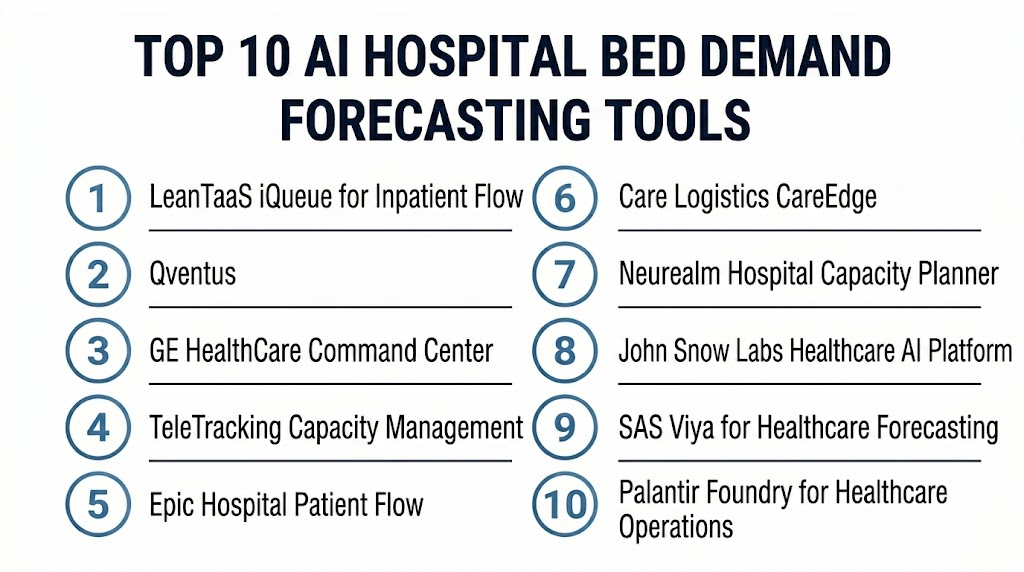
Top 10 AI Hospital Bed Demand Forecasting Tools
1- LeanTaaS iQueue for Inpatient Flow
2- Qventus
3- GE HealthCare Command Center
4- TeleTracking Capacity Management
5- Epic Hospital Patient Flow
6- Care Logistics CareEdge
7- Neurealm Hospital Capacity Planner
8- John Snow Labs Healthcare AI Platform
9- SAS Viya for Healthcare Forecasting
10- Palantir Foundry for Healthcare Operations
1- LeanTaaS iQueue for Inpatient Flow
One-line verdict: Best for health systems needing AI-driven inpatient capacity forecasting and patient flow optimization.
Short description:
LeanTaaS iQueue for Inpatient Flow helps hospitals predict capacity constraints, improve bed throughput, align workforce decisions, and reduce reactive decision-making. It is useful for inpatient flow teams, command centers, nursing operations, and health systems that need predictive insights across beds, units, discharges, and patient movement.
Standout Capabilities
- Predictive analytics for inpatient capacity management
- Forecasting of admissions, discharges, census, and bed pressure
- Unit-level visibility into future constraints
- AI-supported capacity huddle workflows
- Patient flow and throughput optimization
- Workforce alignment based on expected demand
- Dashboards for command centers and operational leaders
- Support for reducing ED boarding and inpatient bottlenecks
AI-Specific Depth
- Model support: Proprietary predictive analytics and AI models for inpatient flow
- RAG and knowledge integration: Varies / N/A
- Evaluation: Forecast accuracy should be validated against local hospital history and operational workflows
- Guardrails: Operational protocols, leadership review, escalation workflows, and role-based actions vary by deployment
- Observability: Census forecasts, discharge predictions, unit capacity views, flow metrics, bed pressure alerts, and dashboard analytics vary by configuration
Pros
- Strong focus on inpatient flow and bed capacity
- Designed for practical hospital operations workflows
- Useful for command centers and capacity leaders
Cons
- Requires reliable hospital operational data
- Best value depends on workflow adoption and leadership alignment
- Integration and change management require planning
Security and Compliance
LeanTaaS provides healthcare operations technology. Exact SSO, RBAC, audit logs, encryption, retention, residency, and certifications should be verified during procurement. If not confirmed, write Not publicly stated.
Deployment and Platforms
- Cloud-based healthcare operations platform options
- Inpatient flow and bed management workflows
- Integration with hospital data systems should be verified
- Supports command center and operational dashboard use cases
Integrations and Ecosystem
LeanTaaS iQueue for Inpatient Flow connects predictive capacity insights with operational workflows.
- EHR and ADT feeds
- Bed management systems
- Command center dashboards
- Nursing operations workflows
- Discharge planning workflows
- Patient flow huddles
- Workforce planning workflows
Pricing Model
Typically enterprise contract-based. Exact pricing depends on health system size, hospitals, bed count, modules, integrations, and support. Exact pricing is Not publicly stated.
Best-Fit Scenarios
- Hospitals reducing ED boarding and inpatient bottlenecks
- Health systems needing predictive capacity huddle workflows
- Command centers seeking AI-driven bed demand visibility
2- Qventus
One-line verdict: Best for AI-powered hospital operations automation across inpatient flow, perioperative, and care access workflows.
Short description:
Qventus helps hospitals automate operational decisions using AI-driven workflows across care settings. For bed demand and capacity, it is useful for organizations that need proactive patient flow support, discharge acceleration, operational nudges, and workflow automation connected to hospital teams.
Standout Capabilities
- AI-driven hospital operations automation
- Patient flow and throughput support
- Inpatient and perioperative operational workflows
- Proactive recommendations and workflow nudges
- Discharge and capacity improvement support depending on deployment
- Real-time operational visibility
- Automation for care team coordination
- Health system-level operations transformation support
AI-Specific Depth
- Model support: Proprietary AI and workflow automation models
- RAG and knowledge integration: Varies / N/A
- Evaluation: Operational outcomes and model performance should be validated during implementation
- Guardrails: Workflow rules, human oversight, escalation settings, and operational approvals vary by deployment
- Observability: Task automation metrics, patient flow signals, discharge progress, operational bottlenecks, and workflow analytics vary by configuration
Pros
- Strong AI operations automation focus
- Useful for turning predictions into team actions
- Supports multiple hospital operational areas
Cons
- Bed demand forecasting depth depends on selected workflows and implementation
- Requires operational alignment and process change
- Exact capabilities vary by use case and contract
Security and Compliance
Qventus provides healthcare operations automation technology. Exact SSO, RBAC, audit logs, encryption, retention, residency, and certifications should be verified directly. If not confirmed, write Not publicly stated.
Deployment and Platforms
- Cloud-based AI operations platform options
- Hospital operations workflow deployment
- Integration with EHR and operational systems should be verified
- Supports enterprise and department-level workflows depending on configuration
Integrations and Ecosystem
Qventus connects AI automation with hospital operations.
- EHR and ADT systems
- Patient flow workflows
- Discharge planning workflows
- Perioperative workflows
- Care team notifications
- Command center operations
- Operational analytics dashboards
Pricing Model
Typically enterprise contract-based. Exact pricing depends on modules, hospitals, workflows, integrations, and agreement. Exact pricing is Not publicly stated.
Best-Fit Scenarios
- Hospitals wanting AI-powered operational automation
- Health systems improving discharge and throughput workflows
- Organizations seeking capacity actions, not only capacity dashboards
3- GE HealthCare Command Center
One-line verdict: Best for health systems needing command center forecasting, census prediction, and resource planning.
Short description:
GE HealthCare Command Center helps hospitals and health systems improve operational visibility, throughput, access, utilization, and resource planning. Its forecasting capabilities can support census prediction, staffing demand estimation, and capacity decision-making for hospital leaders and command center teams.
Standout Capabilities
- Hospital command center software
- Census forecasting and resource prediction
- Unit, hospital, and network-level visibility
- Patient flow and throughput dashboards
- Staffing demand planning based on predicted census
- Digital twin and scenario modeling capabilities depending on deployment
- Operational command center coordination
- Real-time and predictive decision support
AI-Specific Depth
- Model support: Proprietary machine learning and forecasting models
- RAG and knowledge integration: Varies / N/A
- Evaluation: Forecast accuracy should be validated against local census, staffing, and throughput data
- Guardrails: Leadership review, staffing rules, operational protocols, and access controls vary by deployment
- Observability: Census forecasts, staffing needs, flow status, operational constraints, unit-level dashboards, and scenario outputs vary by configuration
Pros
- Strong command center and resource planning focus
- Useful for census forecasting and staffing alignment
- Supports enterprise visibility across complex hospital operations
Cons
- Implementation can be complex
- Requires clean operational data and leadership adoption
- Best value depends on command center workflows and governance
Security and Compliance
GE HealthCare provides enterprise healthcare software capabilities. Exact SSO, RBAC, audit logs, encryption, data retention, residency, and certifications should be verified during procurement. If not confirmed, use Not publicly stated.
Deployment and Platforms
- Enterprise command center software options
- Deployment may include cloud, on-premises, or hybrid models depending on customer environment
- Supports hospital and network operations dashboards
- Integration with hospital systems should be verified
Integrations and Ecosystem
GE HealthCare Command Center connects operational data with capacity decision workflows.
- EHR and ADT systems
- Census and staffing data
- Bed management workflows
- Command center dashboards
- Digital twin scenario workflows
- Patient flow operations
- Executive reporting
Pricing Model
Typically enterprise contract-based. Exact pricing depends on hospital network size, modules, implementation scope, integrations, and support. Exact pricing is Not publicly stated.
Best-Fit Scenarios
- Health systems building hospital command centers
- Hospitals needing census forecasting and staffing alignment
- Executives needing predictive operational visibility across sites
4- TeleTracking Capacity Management
One-line verdict: Best for hospitals needing real-time bed visibility, capacity management, and patient flow coordination.
Short description:
TeleTracking provides healthcare operations technology focused on patient flow, bed management, care coordination, and capacity visibility. It is useful for hospitals and health systems that need centralized bed status, transfer coordination, capacity awareness, and operational workflows to reduce bottlenecks.
Standout Capabilities
- Real-time capacity and bed visibility
- Patient flow and throughput workflows
- Centralized bed management
- Transfer center support depending on deployment
- Operational dashboards for capacity teams
- Environmental services and bed turnover workflows depending on configuration
- Command center and capacity coordination
- Support for enterprise patient flow improvement
AI-Specific Depth
- Model support: Predictive and AI capabilities vary by product and deployment
- RAG and knowledge integration: Varies / N/A
- Evaluation: Forecasting and predictive capabilities should be verified directly for the selected modules
- Guardrails: Operational protocols, user permissions, escalation workflows, and bed placement rules vary by configuration
- Observability: Bed status, patient movement, throughput metrics, transfer workflows, discharge activity, and capacity dashboards vary by setup
Pros
- Strong bed management and patient flow heritage
- Useful for capacity visibility and throughput operations
- Supports centralized operational coordination
Cons
- AI forecasting depth should be verified by module
- Integration and workflow change are important
- Predictive value depends on real-time data discipline
Security and Compliance
TeleTracking provides healthcare operations technology. Exact SSO, RBAC, audit logs, encryption, retention, residency, and certifications should be verified directly. If not confirmed, write Not publicly stated.
Deployment and Platforms
- Cloud and enterprise healthcare operations options may vary
- Bed management and capacity workflows
- Command center deployment options may vary
- Integration with hospital systems should be verified
Integrations and Ecosystem
TeleTracking supports hospital capacity and patient flow operations.
- EHR and ADT feeds
- Bed management workflows
- Transfer center workflows
- Environmental services workflows
- Patient transport workflows
- Command center dashboards
- Operational analytics
Pricing Model
Typically enterprise contract-based. Exact pricing depends on modules, hospital size, bed count, implementation, integrations, and support. Exact pricing is Not publicly stated.
Best-Fit Scenarios
- Hospitals needing real-time bed management
- Health systems improving patient flow operations
- Capacity teams coordinating bed placement and transfers
5- Epic Hospital Patient Flow
One-line verdict: Best for Epic-based health systems needing EHR-native patient flow, bed planning, and transfer visibility.
Short description:
Epic Hospital Patient Flow supports patient movement, bed planning, transfer center workflows, and operational visibility inside the Epic ecosystem. It is useful for Epic-based hospitals that want capacity management and flow tools embedded in existing clinical and administrative workflows.
Standout Capabilities
- EHR-native hospital patient flow workflows
- Bed planning and bottleneck identification
- Transfer center coordination
- Patient movement visibility
- Integration with Epic clinical and operational data
- Role-based hospital operations views
- Bed request and placement workflow support
- Enterprise capacity dashboards depending on configuration
AI-Specific Depth
- Model support: Predictive and AI capabilities vary by Epic configuration and health system analytics maturity
- RAG and knowledge integration: Varies / N/A
- Evaluation: Forecasting and analytics performance should be validated by each organization
- Guardrails: Epic role controls, workflow rules, operational protocols, and approval settings vary by deployment
- Observability: Bed requests, patient movement, transfer activity, capacity dashboards, bottlenecks, and operational metrics vary by configuration
Pros
- Strong fit for Epic-based organizations
- Reduces need for separate systems in some workflows
- Uses EHR-native patient and operational data
Cons
- Best value depends on Epic adoption and configuration
- Advanced forecasting may require additional analytics design
- Less suitable for non-Epic environments
Security and Compliance
Epic deployments include healthcare-grade security and access controls depending on the customer environment. Exact SSO, RBAC, audit logs, encryption, retention, residency, and certifications should be verified with the health system’s Epic agreement and implementation. If not confirmed, write Not publicly stated.
Deployment and Platforms
- EHR-native deployment inside Epic environments
- Web and workstation workflows vary by health system
- Mobile capabilities may vary by deployed modules
- Supports patient flow, bed planning, and transfer workflows
Integrations and Ecosystem
Epic Hospital Patient Flow works inside the Epic clinical and operational ecosystem.
- Epic EHR workflows
- ADT and patient movement data
- Bed planning workflows
- Transfer center workflows
- Clinical documentation
- Reporting and dashboards
- Enterprise patient flow operations
Pricing Model
Typically part of Epic enterprise licensing, configuration, or module-based deployment. Exact pricing depends on health system agreement, modules, and implementation scope. Exact pricing is Not publicly stated.
Best-Fit Scenarios
- Epic-based hospitals needing integrated patient flow visibility
- Health systems reducing separate bed board tools
- Transfer centers and bed planning teams inside Epic environments
6- Care Logistics CareEdge
One-line verdict: Best for hospitals needing patient progression, throughput management, and operational command center workflows.
Short description:
Care Logistics CareEdge supports patient throughput, care progression, command center operations, and real-time operational management. It is useful for hospitals and health systems that want to improve length of stay, reduce progression barriers, align care teams, and manage capacity through structured operational workflows.
Standout Capabilities
- Patient progression and throughput management
- Care team alignment around length-of-stay targets
- Operational command center workflows
- Real-time insights for hospital leaders
- Predictive analytics capabilities depending on deployment
- Barrier identification and escalation workflows
- Capacity and patient flow improvement support
- Methodology plus technology approach
AI-Specific Depth
- Model support: Predictive analytics and AI capabilities vary by product and deployment
- RAG and knowledge integration: Varies / N/A
- Evaluation: Operational outcomes and predictive performance should be validated locally
- Guardrails: Care progression protocols, escalation workflows, user permissions, and leadership review vary by configuration
- Observability: Patient progression status, LOS targets, discharge barriers, throughput metrics, command center dashboards, and operational alerts vary by setup
Pros
- Strong patient progression and throughput focus
- Combines operational methodology with technology
- Useful for reducing discharge barriers and capacity constraints
Cons
- Forecasting depth should be verified by module
- Requires process discipline and care team adoption
- Outcomes depend on operational execution, not software alone
Security and Compliance
Care Logistics provides healthcare operations technology. Exact SSO, RBAC, audit logs, encryption, data retention, residency, and certifications should be verified directly. If not confirmed, write Not publicly stated.
Deployment and Platforms
- Enterprise healthcare operations platform options
- Command center and patient progression workflows
- Integration with hospital systems should be verified
- Deployment depends on operational model and health system structure
Integrations and Ecosystem
Care Logistics CareEdge connects patient progression with hospital operations.
- EHR and ADT workflows
- Patient progression systems
- Command center dashboards
- Discharge planning workflows
- Care team coordination
- Barrier escalation workflows
- Operational reporting
Pricing Model
Typically enterprise contract-based. Exact pricing depends on modules, hospitals, implementation services, integrations, and support. Exact pricing is Not publicly stated.
Best-Fit Scenarios
- Hospitals improving patient progression
- Health systems reducing length-of-stay barriers
- Command centers coordinating throughput and capacity operations
7- Neurealm Hospital Capacity Planner
One-line verdict: Best for organizations seeking a focused AI capacity planning tool for occupancy and bed utilization.
Short description:
Neurealm Hospital Capacity Planner is positioned around AI-driven hospital occupancy, bed utilization, and resource planning. It is useful for hospitals exploring focused capacity forecasting and planning tools rather than a broader enterprise command center suite.
Standout Capabilities
- AI-driven hospital capacity planning
- Occupancy forecasting
- Bed utilization insights
- Resource planning support
- Patient flow visibility depending on implementation
- Data-backed capacity decisions
- Planning dashboards for hospital leaders
- Support for reducing wait times and improving utilization
AI-Specific Depth
- Model support: Proprietary AI-driven capacity planning models
- RAG and knowledge integration: Varies / N/A
- Evaluation: Forecasting accuracy should be validated with local hospital data
- Guardrails: Planning review, operational decision controls, user permissions, and escalation rules vary by deployment
- Observability: Occupancy forecasts, utilization trends, capacity dashboards, planning outputs, and demand signals vary by configuration
Pros
- Focused on hospital capacity planning
- Useful for bed utilization and occupancy forecasting
- May fit organizations starting AI capacity planning initiatives
Cons
- Enterprise integration depth should be verified
- Publicly available product details may be limited
- Buyers must validate healthcare workflow fit carefully
Security and Compliance
Neurealm provides AI capacity planning technology. Exact SSO, RBAC, audit logs, encryption, data retention, residency, and healthcare certifications should be verified directly. If not confirmed, write Not publicly stated.
Deployment and Platforms
- Deployment options should be verified directly
- Hospital capacity planning dashboards
- Data integration requirements vary by hospital environment
- Cloud, on-premises, or hybrid details are Not publicly stated
Integrations and Ecosystem
Neurealm Hospital Capacity Planner can support hospital planning workflows where configured.
- Hospital census data
- Bed utilization data
- Capacity planning dashboards
- Resource planning workflows
- Patient flow data
- Operational reporting
- Leadership planning workflows
Pricing Model
Pricing is Not publicly stated. Buyers should verify whether pricing is subscription-based, project-based, usage-based, or enterprise contract-based.
Best-Fit Scenarios
- Hospitals piloting AI capacity planning
- Operations teams forecasting bed utilization
- Leaders needing focused occupancy planning dashboards
8- John Snow Labs Healthcare AI Platform
One-line verdict: Best for healthcare data teams building custom bed demand forecasting and capacity analytics models.
Short description:
John Snow Labs Healthcare AI Platform provides healthcare-focused AI, NLP, and machine learning capabilities that can support custom forecasting, clinical analytics, and operational AI development. It is useful for health systems and data science teams that want to build or customize bed demand forecasting models using their own data.
Standout Capabilities
- Healthcare AI and machine learning platform
- Custom model development support
- Healthcare NLP and data extraction capabilities
- Forecasting workflows possible through custom implementation
- Support for structured and unstructured healthcare data
- Data science workflow flexibility
- Model deployment and analytics support depending on configuration
- Useful for organizations with internal analytics teams
AI-Specific Depth
- Model support: Custom ML, NLP, and healthcare AI models depending on implementation
- RAG and knowledge integration: Healthcare data and knowledge integration can be configured
- Evaluation: Model evaluation depends on buyer’s data science and validation workflows
- Guardrails: Data governance, model monitoring, access controls, and review workflows depend on implementation
- Observability: Model performance, predictions, data pipelines, operational dashboards, and monitoring depend on configuration
Pros
- Flexible for custom hospital forecasting models
- Useful for advanced healthcare data science teams
- Can combine clinical, operational, and unstructured data
Cons
- Not an out-of-the-box bed management product
- Requires data science, engineering, and healthcare operations expertise
- Implementation effort can be significant
Security and Compliance
John Snow Labs provides healthcare AI platform capabilities. Exact SSO, RBAC, audit logs, encryption, retention, residency, and certifications should be verified during procurement. If not confirmed, write Not publicly stated.
Deployment and Platforms
- Cloud, private cloud, or enterprise deployment options may vary
- Data science and AI platform workflows
- Integration depends on hospital data architecture
- Requires implementation for bed demand forecasting use cases
Integrations and Ecosystem
John Snow Labs can support custom healthcare analytics and forecasting workflows.
- Healthcare data lakes
- EHR and operational data feeds
- NLP pipelines
- Machine learning workflows
- Data science notebooks and pipelines
- Analytics dashboards
- Model monitoring systems
Pricing Model
Typically subscription, platform license, or enterprise contract-based depending on deployment and modules. Exact pricing is Not publicly stated.
Best-Fit Scenarios
- Health systems with internal AI teams
- Organizations building custom bed demand models
- Data teams combining clinical text, census, and operational forecasting
9- SAS Viya for Healthcare Forecasting
One-line verdict: Best for analytics teams needing enterprise forecasting, simulation, and operational modeling flexibility.
Short description:
SAS Viya can support healthcare forecasting, predictive analytics, optimization, and operational modeling when configured for hospital capacity planning. It is useful for analytics teams that want a flexible enterprise analytics platform to forecast admissions, occupancy, staffing demand, and operational risk using hospital data.
Standout Capabilities
- Enterprise forecasting and predictive analytics
- Machine learning model development
- Scenario analysis and simulation support depending on implementation
- Data preparation and analytics workflows
- Dashboard and reporting integration
- Statistical modeling capabilities
- Forecasting for demand, utilization, and staffing
- Enterprise governance and analytics controls
AI-Specific Depth
- Model support: Custom ML, statistical, forecasting, and optimization models
- RAG and knowledge integration: Varies / N/A
- Evaluation: Model evaluation depends on implementation, data quality, and validation methods
- Guardrails: Model governance, access controls, approval workflows, and monitoring depend on configuration
- Observability: Forecast performance, model metrics, dashboards, scenario outputs, and analytics logs vary by setup
Pros
- Strong enterprise analytics and forecasting foundation
- Useful for custom capacity and demand models
- Good fit for organizations with analytics teams
Cons
- Not a prebuilt hospital bed operations tool by default
- Requires implementation expertise
- Workflow adoption depends on custom dashboards and operations integration
Security and Compliance
SAS provides enterprise analytics platform capabilities. Exact SSO, RBAC, audit logs, encryption, retention, residency, and healthcare-specific certifications should be verified directly. If not confirmed, write Not publicly stated.
Deployment and Platforms
- Cloud, on-premises, or hybrid deployment options may vary
- Enterprise analytics platform
- Integration depends on hospital data architecture
- Requires configuration for hospital capacity forecasting
Integrations and Ecosystem
SAS Viya can support healthcare forecasting and operational analytics.
- EHR and ADT data pipelines
- Data warehouses and lakes
- Forecasting models
- BI dashboards
- Optimization workflows
- Scenario modeling
- Enterprise analytics governance
Pricing Model
Typically enterprise license or subscription-based. Exact pricing depends on users, deployment, modules, compute, and agreement. Exact pricing is Not publicly stated.
Best-Fit Scenarios
- Health systems with mature analytics departments
- Organizations building custom capacity planning models
- Hospitals needing forecasting plus scenario modeling flexibility
10- Palantir Foundry for Healthcare Operations
One-line verdict: Best for health systems needing enterprise data integration, operational modeling, and capacity decision workflows.
Short description:
Palantir Foundry is an enterprise data and operations platform that can be configured for healthcare capacity planning, patient flow analysis, and operational decision support. It is useful for organizations that need to bring together EHR, staffing, admissions, transfers, discharge, and operational data into a unified decision environment.
Standout Capabilities
- Enterprise data integration platform
- Operational data modeling
- Custom workflow applications
- Capacity and demand analytics possible through implementation
- Scenario planning and operational decision support
- Data lineage and governance capabilities depending on deployment
- Cross-functional dashboards for leaders and teams
- Support for complex, multi-source healthcare data environments
AI-Specific Depth
- Model support: Custom AI, analytics, and operational models depending on implementation
- RAG and knowledge integration: Data integration and knowledge workflows vary by deployment
- Evaluation: Model validation depends on customer implementation and governance
- Guardrails: Access controls, governance, workflow approvals, and model monitoring vary by configuration
- Observability: Data lineage, model outputs, operational dashboards, decision workflows, and usage analytics vary by setup
Pros
- Strong enterprise data integration capability
- Useful for complex multi-site operational environments
- Flexible for custom capacity and flow applications
Cons
- Not a dedicated out-of-the-box bed forecasting tool
- Requires significant implementation and governance effort
- Best suited for organizations with complex data and operations teams
Security and Compliance
Palantir provides enterprise data platform capabilities. Exact SSO, RBAC, audit logs, encryption, retention, residency, and healthcare-specific certifications should be verified directly. If not confirmed, write Not publicly stated.
Deployment and Platforms
- Enterprise cloud or private deployment options may vary
- Custom operational application development
- Integration depends on hospital data architecture
- Supports analytics, workflows, and decision environments depending on configuration
Integrations and Ecosystem
Palantir Foundry can connect hospital operational data for capacity forecasting workflows.
- EHR and ADT systems
- Staffing systems
- Transfer center data
- Discharge planning data
- Data warehouses and lakes
- Operational dashboards
- Custom workflow applications
Pricing Model
Typically enterprise contract-based. Exact pricing depends on deployment scope, data integrations, applications, users, and support. Exact pricing is Not publicly stated.
Best-Fit Scenarios
- Health systems with complex data integration needs
- Enterprise operations teams building custom capacity decision workflows
- Multi-site organizations needing unified operational intelligence
Comparison Table
| Tool Name | Best For | Deployment | Model Flexibility | Strength | Watch Out | Public Rating |
|---|---|---|---|---|---|---|
| LeanTaaS iQueue for Inpatient Flow | Inpatient capacity forecasting | Cloud options vary | Hosted proprietary | Predictive flow and bed demand insights | Requires workflow adoption | N/A |
| Qventus | AI hospital operations automation | Cloud options vary | Hosted proprietary | Turns operational signals into actions | Capabilities vary by workflow | N/A |
| GE HealthCare Command Center | Command center forecasting | Enterprise options vary | Hosted proprietary | Census and staffing forecast workflows | Implementation complexity | N/A |
| TeleTracking Capacity Management | Real-time bed management | Cloud and enterprise options vary | Predictive capabilities vary | Capacity visibility and flow coordination | AI depth varies by module | N/A |
| Epic Hospital Patient Flow | Epic-native patient flow | EHR-native | Customer-configured analytics vary | Integrated Epic workflows | Best for Epic environments | N/A |
| Care Logistics CareEdge | Patient progression and throughput | Enterprise options vary | Predictive capabilities vary | Progression and LOS workflow support | Requires process discipline | N/A |
| Neurealm Hospital Capacity Planner | Focused AI capacity planning | Not publicly stated | Hosted proprietary | Occupancy and bed utilization planning | Public details limited | N/A |
| John Snow Labs Healthcare AI Platform | Custom forecasting models | Cloud, private, or enterprise options vary | Custom AI and ML | Flexible healthcare AI development | Not out-of-box bed management | N/A |
| SAS Viya for Healthcare Forecasting | Enterprise analytics teams | Cloud, on-premises, or hybrid options vary | Custom ML and forecasting | Statistical forecasting and simulation | Requires analytics implementation | N/A |
| Palantir Foundry for Healthcare Operations | Enterprise data integration | Enterprise options vary | Custom AI and workflows | Multi-source operational intelligence | Requires major implementation effort | N/A |
Scoring and Evaluation
This scoring is comparative, not absolute. It helps buyers compare AI hospital bed demand forecasting tools based on forecasting depth, reliability, guardrails, integrations, ease of use, performance, security controls, and support. Scores may vary based on hospital size, data quality, EHR environment, command center maturity, staffing model, discharge workflows, and operational adoption. Public ratings are not guessed. Buyers should validate shortlisted tools with historical census data, real-time feeds, discharge outcomes, ED boarding patterns, staffing workflows, and measurable patient flow results before procurement.
| Tool | Core | Reliability and Eval | Guardrails | Integrations | Ease | Performance and Cost | Security and Admin | Support | Weighted Total |
| LeanTaaS iQueue for Inpatient Flow | 9.2 | 8.8 | 8.6 | 8.7 | 8.4 | 8.5 | 8.5 | 8.7 | 8.7 |
| Qventus | 8.9 | 8.5 | 8.6 | 8.6 | 8.3 | 8.4 | 8.5 | 8.6 | 8.5 |
| GE HealthCare Command Center | 9.0 | 8.7 | 8.6 | 8.7 | 8.1 | 8.2 | 8.6 | 8.7 | 8.6 |
| TeleTracking Capacity Management | 8.7 | 8.3 | 8.5 | 8.7 | 8.3 | 8.3 | 8.5 | 8.6 | 8.5 |
| Epic Hospital Patient Flow | 8.6 | 8.2 | 8.6 | 9.1 | 8.4 | 8.5 | 8.8 | 8.7 | 8.6 |
| Care Logistics CareEdge | 8.5 | 8.2 | 8.5 | 8.4 | 8.1 | 8.3 | 8.4 | 8.5 | 8.3 |
| Neurealm Hospital Capacity Planner | 8.1 | 8.0 | 8.1 | 7.8 | 8.2 | 8.3 | 8.0 | 8.0 | 8.1 |
| John Snow Labs Healthcare AI Platform | 8.0 | 8.2 | 8.3 | 8.4 | 7.7 | 8.0 | 8.4 | 8.3 | 8.2 |
| SAS Viya for Healthcare Forecasting | 8.1 | 8.4 | 8.4 | 8.3 | 7.8 | 8.1 | 8.5 | 8.5 | 8.3 |
| Palantir Foundry for Healthcare Operations | 8.2 | 8.3 | 8.6 | 8.7 | 7.6 | 7.9 | 8.7 | 8.5 | 8.3 |
Top 3 for Enterprise
1- LeanTaaS iQueue for Inpatient Flow
2- GE HealthCare Command Center
3- Epic Hospital Patient Flow
Top 3 for SMB
1- Neurealm Hospital Capacity Planner
2- Care Logistics CareEdge
3- TeleTracking Capacity Management
Top 3 for Developers
1- John Snow Labs Healthcare AI Platform
2- SAS Viya for Healthcare Forecasting
3- Palantir Foundry for Healthcare Operations
Which AI Hospital Bed Demand Forecasting Tool Is Right for You
Solo / Freelancer
Solo healthcare consultants and independent operations advisors usually do not deploy full command center platforms directly, but they may help hospitals evaluate forecasting readiness. For advisory work, LeanTaaS, GE HealthCare Command Center, TeleTracking, and Epic Hospital Patient Flow are useful reference points. For custom analytics consulting, SAS Viya, John Snow Labs, and Palantir Foundry may be more relevant because they support flexible modeling and data integration.
SMB
Small and mid-sized hospitals should prioritize practical implementation, clear dashboards, and fast operational value. Neurealm Hospital Capacity Planner may fit organizations seeking focused capacity planning. Care Logistics CareEdge can help hospitals improve patient progression and throughput, while TeleTracking can support real-time bed visibility and capacity workflows. SMB buyers should avoid overly complex analytics projects unless they have strong data and operations teams.
Mid-Market
Mid-market hospitals usually need a combination of real-time bed visibility, discharge planning, predictive capacity signals, and operational huddle workflows. LeanTaaS iQueue for Inpatient Flow, Qventus, TeleTracking, and Care Logistics can be strong candidates depending on whether the priority is forecasting, automation, bed visibility, or patient progression. These organizations should pilot with ED boarding, discharge timing, or unit-level capacity constraints.
Enterprise
Large health systems should prioritize multi-site visibility, command center workflows, integrations, governance, scenario planning, and measurable throughput outcomes. LeanTaaS iQueue for Inpatient Flow is strong for predictive inpatient flow, GE HealthCare Command Center is strong for census forecasting and resource planning, Epic Hospital Patient Flow is strong for Epic-native capacity visibility, and Qventus is strong for AI-driven operational automation.
Regulated Industries
Healthcare capacity forecasting is operational rather than direct diagnosis, but it still touches patient flow, access, staffing, and care delivery. Hospitals should review privacy, access controls, auditability, data governance, equity impact, and safety implications. Forecasting should support better operational decisions without creating unsafe discharge pressure, inappropriate transfers, or staffing shortcuts.
Budget vs Premium
Budget-conscious hospitals may start with focused dashboards, bed visibility tools, or analytics pilots. Premium enterprise buyers may need full command center solutions, AI-driven forecasting, workflow automation, digital twin scenario planning, and EHR-native capacity tools. Total cost should include software, integration, data cleanup, training, change management, analytics support, and long-term monitoring.
Build vs Buy
Building bed demand forecasting internally can work for hospitals with mature analytics teams, clean ADT data, operational leaders, and strong data engineering. Most hospitals should buy when they need proven workflows, dashboards, huddle support, and operational playbooks. A hybrid approach can work where a commercial patient flow platform handles daily operations while internal analytics teams build custom surge, staffing, or finance models.
Implementation Playbook
First 30 Days
- Define the primary use case such as ED boarding reduction, inpatient bed forecasting, discharge planning, transfer acceptance, staffing alignment, or command center visibility.
- Identify required data sources such as ADT, census, bed status, discharge orders, surgical schedules, staffing, transfer requests, and ED arrivals.
- Select two or three tools for structured evaluation.
- Gather historical census, admissions, discharges, ED boarding, length of stay, and staffing data.
- Define forecast horizons such as same day, next day, seven days, or longer planning windows.
- Create a pilot team with bed management, nursing, ED, transfer center, operations, IT, analytics, finance, and executive sponsors.
- Map current capacity huddles and escalation workflows.
- Validate privacy, security, access control, data retention, and audit requirements.
- Define success metrics such as forecast accuracy, boarding hours, discharge timing, bed turnover, transfer acceptance, and staffing alignment.
- Choose one pilot area before scaling across the enterprise.
First 60 Days
- Connect core data feeds and validate data quality.
- Test forecasts against historical demand and known surge periods.
- Compare predicted discharges with actual discharge timing.
- Review unit-level capacity predictions with nursing and bed management leaders.
- Configure dashboards for bed planners, ED leaders, executives, and unit managers.
- Define escalation rules for predicted capacity pressure.
- Train teams on how forecasts should be used during daily huddles.
- Measure whether predictions change decisions, not just whether dashboards are viewed.
- Validate integration with bed boards, command centers, staffing tools, and discharge workflows.
- Adjust workflows based on frontline feedback.
First 90 Days
- Expand forecasting to more units, service lines, and hospitals if pilot results are strong.
- Add advanced signals such as surgical schedules, transfer patterns, seasonal demand, staffing gaps, and discharge barriers.
- Create recurring governance meetings to review forecast accuracy and operational outcomes.
- Build executive dashboards for capacity risk, boarding, transfers, and throughput.
- Monitor whether forecasts improve bed placement, discharge planning, and staffing decisions.
- Refine alert thresholds to avoid noise and unnecessary escalation.
- Review equity and safety implications of capacity decisions.
- Establish ownership for data quality and workflow updates.
- Train new users and standardize huddle practices.
- Scale gradually with measurement, feedback, and continuous improvement.
Common Mistakes and How to Avoid Them
- Using forecasts without operational action: Predictions must trigger huddles, staffing plans, discharge work, or escalation.
- Ignoring data quality: Inaccurate bed status, delayed discharge updates, or inconsistent ADT data weaken forecasts.
- Forecasting only hospital-wide census: Unit-level demand and bed type constraints matter more for daily operations.
- Separating bed demand from staffing: A bed is not usable if staffing or support services are unavailable.
- Ignoring discharge barriers: Capacity forecasting should include patient progression and delayed discharge risks.
- No ED integration: ED admissions and boarding pressure are major drivers of inpatient capacity.
- Over-relying on dashboards: Teams need workflows, roles, and decision protocols, not just visualization.
- Skipping frontline adoption: Bed managers, nurses, case managers, and ED teams must trust and use the tool.
- Not validating forecasts locally: Each hospital has unique seasonality, staffing, service mix, and patient flow patterns.
- Ignoring surgical schedules: Elective procedures can create predictable bed demand.
- No scenario planning: Leaders should model surges, staffing shortages, and discharge delays before they happen.
- Measuring only occupancy: Track boarding, transfers, discharge timing, length of stay, and patient flow outcomes.
- Using AI to pressure unsafe discharges: Forecasting should improve planning, not compromise patient readiness.
- Forgetting change management: Capacity tools require training, leadership routines, and continuous improvement.
FAQs
1- What are AI Hospital Bed Demand Forecasting Tools?
AI Hospital Bed Demand Forecasting Tools predict future bed needs using hospital data such as admissions, census, discharge patterns, ED arrivals, surgical schedules, transfers, and staffing. They help hospitals plan capacity before bottlenecks occur.
2- How do these tools help reduce ED boarding?
They forecast inpatient bed demand and discharge capacity so teams can prepare beds earlier, escalate discharge barriers, align staffing, and reduce delays for admitted ED patients waiting for inpatient placement.
3- What data is needed for bed demand forecasting?
Common inputs include ADT feeds, live census, bed status, admissions, discharges, ED arrivals, surgical schedules, transfer requests, staffing levels, length-of-stay history, and unit capacity rules.
4- Which tool is best for inpatient flow forecasting?
LeanTaaS iQueue for Inpatient Flow is a strong option for predictive inpatient flow and capacity management. GE HealthCare Command Center is also strong for census forecasting and resource planning.
5- Which tool is best for Epic hospitals?
Epic Hospital Patient Flow is a strong option for Epic-based organizations because it works inside the Epic ecosystem and supports bed planning, transfer workflows, and patient movement visibility.
6- Which tool is best for command centers?
GE HealthCare Command Center, LeanTaaS, TeleTracking, and Care Logistics are strong candidates for command center workflows. The best fit depends on whether the priority is forecasting, real-time visibility, patient progression, or operational automation.
7- Can hospitals build their own forecasting models?
Yes, hospitals with strong analytics teams can build models using platforms like SAS Viya, John Snow Labs, or Palantir Foundry. However, they still need operational workflows, governance, and real-time integration to make forecasts useful.
8- Can forecasting tools predict discharges?
Many capacity platforms support discharge prediction or patient progression workflows. Buyers should test predicted discharge timing against actual local discharge patterns during a pilot.
9- Can these tools help with nurse staffing?
Yes, bed demand forecasts can support staffing decisions when connected with staffing rules, census forecasts, acuity, and expected patient movement. Staffing decisions still require nursing leadership review.
10- What should buyers test during a pilot?
Buyers should test forecast accuracy, unit-level usefulness, ED admission prediction, discharge prediction, bed status accuracy, huddle adoption, dashboard usability, escalation workflows, and measurable throughput improvement.
11- What is the biggest risk with bed demand forecasting?
The biggest risk is treating predictions as decisions without clinical and operational judgment. Forecasts should support planning, not force unsafe discharges, inappropriate transfers, or staffing shortcuts.
12- How should success be measured?
Success should be measured through forecast accuracy, reduced ED boarding, improved discharge timing, better bed turnover, increased transfer acceptance, improved staffing alignment, lower length-of-stay barriers, and stronger command center coordination.
Conclusion
AI Hospital Bed Demand Forecasting Tools help hospitals anticipate capacity pressure, reduce ED boarding, improve discharge planning, align staffing, and coordinate patient flow more proactively. LeanTaaS iQueue for Inpatient Flow is strong for predictive inpatient capacity, Qventus helps automate hospital operations, GE HealthCare Command Center supports census forecasting and command center planning, TeleTracking improves real-time bed visibility and flow coordination, Epic Hospital Patient Flow fits Epic-native environments, Care Logistics CareEdge supports patient progression and throughput, Neurealm Hospital Capacity Planner offers focused AI capacity planning, John Snow Labs and SAS Viya support custom forecasting models for advanced analytics teams, and Palantir Foundry helps integrate complex operational data for custom decision workflows. To choose the right platform, shortlist by operational goal, test with local data, validate forecast accuracy, connect predictions to daily huddles, and scale with strong governance, workflow adoption, and continuous outcome measurement.

Find Trusted Cardiac Hospitals
Compare heart hospitals by city and services — all in one place.
Explore Hospitals
A key gap is how accurately these forecasting tools account for sudden surges like outbreaks or emergencies without breaking under rapidly changing real-world hospital admission patterns.