
Introduction
AI patient recruitment optimization helps sponsors, CROs, research sites, and digital health teams find, qualify, and engage the right patients for clinical trials faster and with better precision. Instead of depending only on manual chart review, physician referral, call center outreach, and broad advertising, these tools use artificial intelligence to analyze health records, study criteria, patient behavior, and engagement signals to improve matching and reduce wasted effort. This matters because patient recruitment is one of the biggest reasons trials get delayed, exceed budget, or fail to enroll enough eligible participants. Real world use cases include trial matching, automated pre screening, outreach personalization, referral management, diversity focused recruitment, dropout prediction, and enrollment forecasting. Buyers should evaluate these tools based on data access, matching quality, explainability, workflow support, multilingual communication, privacy controls, integration options, reporting, user experience, and total operational value.
These tools are best for sponsors, CROs, site networks, digital recruitment vendors, and healthcare systems running multi site or high complexity studies. They are especially useful when eligibility criteria are strict, patient populations are fragmented, or the trial needs faster enrollment across many locations. They are less ideal for very small local studies with simple eligibility rules and limited digital recruitment needs, where a lightweight outreach process may be enough.
Why it matters
Patient recruitment is one of the main reasons clinical trials run late, cost more than planned, or even fail completely. Many trials struggle because inclusion and exclusion criteria are narrow, eligible patients are spread across different locations and health systems, and traditional outreach methods reach only a small group of people. AI matters here because it can process very large sets of health records and other data to find potential participants who would never see a clinical trial advertisement or hear about a study from their doctor. It can also spot patterns that humans might miss, such as combinations of lab values, imaging findings, or comorbidities that signal a good fit for a complex protocol. When used carefully, AI can shorten recruitment timelines, reduce site burden, and improve diversity by making it easier to identify and reach underrepresented groups.
Real world use cases
A major use case is AI powered trial matching, where systems match patient records to eligibility criteria across many studies, then produce a ranked list of suitable trials for each patient, or a list of suitable patients for each trial. These systems can use both structured data such as lab results and diagnoses, and unstructured data such as clinician notes, to find people who match complex protocols. Another use case is automated pre screening, where chatbots, digital screeners, or rule based engines ask smart questions and check data before a human coordinator spends time on a case, which reduces site workload and speeds up early funnel steps. AI tools are also used to personalize outreach campaigns by tailoring messages to a patient’s condition, history, language, and preferences, which improves response rates and reduces dropouts between first contact and consent. Some platforms support diversity and equity by scanning data to spot gaps in enrollment patterns and then targeting outreach to communities and regions that have been underrepresented in previous studies. Others focus on predicting which patients are at high risk of dropping out, so the team can provide extra support such as reminders, transport assistance, or flexible visit options.
Evaluation criteria for buyers
When buyers look at AI patient recruitment tools, they should first focus on data access and integration, including how well the platform connects to electronic health records, claims data, registry data, and patient facing applications inside their own environment. The second key area is matching quality, which means how accurately the tool can map protocol criteria to real data fields, how it handles both structured and unstructured data, and whether it can show clear reasons for every match or recommendation. Buyers should also review how the tool supports outreach and engagement, such as multichannel contact, personalization, language support, and reminder workflows, because good matching alone is not enough if patients do not respond or stay in the trial. Governance and privacy are crucial, including how data is de identified or pseudonymized, where it is stored, how access is controlled, and how the system avoids unsafe or biased use of sensitive information. It is important to ask about evaluation and monitoring, for example how the vendor measures precision and recall for matches, how often models are updated, and how they track disparities or unintentional bias in outreach and enrollment results over time. Finally, buyers should test the tool in a real pilot, measuring not only the number of identified candidates but also the percentage that pass manual review, consent, enroll, and stay in the study, as well as the effect on site burden and recruitment timelines.
What Is Changing in This Category
- More tools now combine structured and unstructured clinical data to improve patient matching quality.
- AI is being used not only for matching but also for retention and dropout risk prediction.
- Recruitment platforms are becoming more patient facing, with smart pre screeners and digital engagement workflows.
- Multilingual outreach and inclusive communication are becoming more important for global and diverse studies.
- More vendors now support end to end recruitment funnels from discovery to consent.
- Healthcare system integration is becoming a bigger advantage because access to real patient data improves screening relevance.
- Buyers are paying closer attention to privacy, auditability, and how patient data is used in AI workflows.
- Real time alerts and operational coordination are becoming more common in recruitment products.
- Predictive analytics are being used to target regions and patient groups more effectively.
- Study teams increasingly want measurable funnel analytics rather than just lead volume.
Quick Buyer Checklist
- Check whether the tool matches patients using both structured data and unstructured notes.
- Ask how protocol criteria are translated into patient matching logic.
- Confirm whether the tool supports pre screening, outreach, and scheduling, not just candidate discovery.
- Review how the vendor handles privacy, access control, and data retention.
- Ask whether the platform can integrate with electronic health records or site workflows.
- Evaluate multilingual support and patient experience features.
- Check for reporting on conversion from lead to screened to enrolled patient.
- Ask how the system measures match quality and false positive rates.
- Test whether site staff can easily review, override, and prioritize recommendations.
- Review lock in risk by checking data export, workflow portability, and vendor dependence.
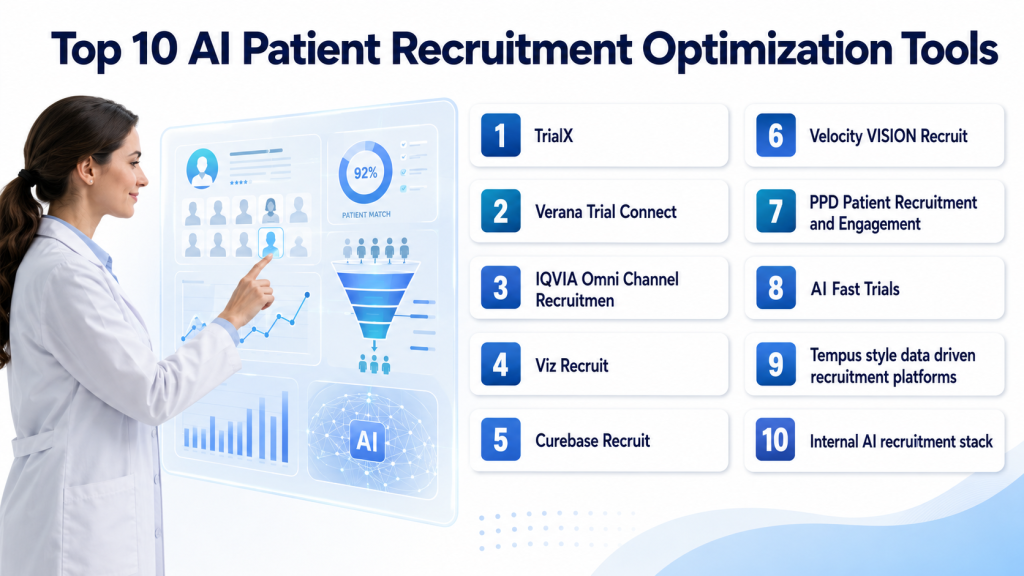
Top 10 AI Patient Recruitment Optimization Tools
1. TrialX
One line verdict: Best for organizations that want AI driven matching and patient facing recruitment workflows.
Short description:
TrialX focuses on making clinical trial recruitment faster with AI driven trial search, matching, and screening workflows. It supports sponsors, sites, and research teams that want to improve patient discovery and reduce friction in early recruitment steps.
Standout Capabilities
- AI driven trial search and patient matching.
- Supports movement from discovery to screening.
- Designed to improve trial accessibility for patients.
- Helps reduce manual effort in recruitment workflows.
- Focused on practical recruitment acceleration.
AI Specific Depth
- Model support: Proprietary AI workflow, exact model flexibility not publicly stated.
- Knowledge integration: Recruitment and screening workflow support is public, broader connector detail not publicly stated.
- Evaluation: Public claims focus on speed and accessibility, formal evaluation detail not publicly stated.
- Guardrails: Not publicly stated.
- Observability: Not publicly stated.
Pros
- Strong recruitment specific focus.
- Good fit for patient facing discovery and matching.
- Useful for reducing manual pre screening steps.
Cons
- Public enterprise security detail is limited.
- Broader integration detail is not clearly published.
- Public technical transparency is moderate rather than deep.
Security and Compliance
Security controls and certifications are not publicly stated in the reviewed material for this comparison.
Deployment and Platforms
Platform and deployment details are not publicly stated in the reviewed material.
Integrations and Ecosystem
TrialX appears strongest in trial search and early funnel patient engagement. Buyers should validate API access, data exchange, and site workflow compatibility during review.
Pricing Model
Best Fit Scenarios
- Sponsors wanting stronger patient discovery.
- Sites reducing manual screening effort.
- Digital recruitment programs with patient facing workflows.
2. Verana Trial Connect
One line verdict: Best for teams that want AI recruitment linked to real world clinical data.
Short description:
Verana Trial Connect uses AI and real world data to automate patient eligibility and pre screening. It is designed for sponsors and CROs that want faster patient identification using structured and unstructured electronic health record data.
Standout Capabilities
- Automates patient eligibility based on trial criteria.
- Uses structured and unstructured health data.
- Reduces site burden by lowering manual chart review.
- Predicts which patients are more likely to be eligible and participate.
- Helps target patient populations and regions more effectively.
AI Specific Depth
- Model support: Proprietary AI and machine learning workflow, broader model flexibility not publicly stated.
- Knowledge integration: Strong electronic health record and real world data integration.
- Evaluation: Public claims include speed and precision improvements, formal evaluation framework not publicly stated.
- Guardrails: Not publicly stated in detail.
- Observability: Not publicly stated.
Pros
- Strong data depth through real world clinical records.
- Good at reducing manual screening burden.
- Useful for prioritizing likely eligible patients.
Cons
- Public deployment detail is limited.
- Security detail beyond compliance statements is limited in reviewed material.
- Best fit may depend on data access footprint.
Security and Compliance
The platform is described as compliant with healthcare privacy requirements in the reviewed material, but detailed controls, residency, retention, and certifications beyond that are not fully publicly stated here.
Deployment and Platforms
Platform and deployment details are not publicly stated in the reviewed material used here.
Integrations and Ecosystem
Verana stands out for data access and clinical record analysis. Buyers should verify workflow exports, operational dashboards, and fit with site recruitment processes.
- Structured data analysis.
- Unstructured note analysis.
- Patient prioritization.
- Region targeting support.
Pricing Model
Best Fit Scenarios
- Sponsors wanting data rich patient identification.
- CROs aiming to reduce chart review burden.
- Programs using real world clinical data for recruitment.
3. IQVIA Omni Channel Recruitment
One line verdict: Best for enterprises that want AI driven patient outreach at large scale.
Short description:
IQVIA Omni Channel Recruitment helps sponsors identify and engage qualified patients using artificial intelligence trained on real healthcare data. It is suitable for large organizations that want broad reach, patient targeting, and enterprise level operational support.
Standout Capabilities
- Uses AI trained on real healthcare data.
- Supports patient identification and engagement.
- Built for scaled multi channel recruitment.
- Strong enterprise relevance in clinical research.
- Useful for sponsor and CRO led recruitment programs.
AI Specific Depth
- Model support: Proprietary AI workflow, exact model flexibility not publicly stated.
- Knowledge integration: Real healthcare data is publicly stated, detailed connector list not publicly stated.
- Evaluation: Not publicly stated in the reviewed material.
- Guardrails: Not publicly stated.
- Observability: Not publicly stated.
Pros
- Strong fit for enterprise recruitment programs.
- Combines patient identification with engagement.
- Benefits from large healthcare data context.
Cons
- Public AI technical detail is limited.
- May be more enterprise focused than smaller teams need.
- Pricing and deployment detail are not publicly stated.
Security and Compliance
Detailed security controls and certifications are not publicly stated in the reviewed material for this comparison.
Deployment and Platforms
Platform and deployment details are not publicly stated in the reviewed material.
Integrations and Ecosystem
IQVIA is likely strongest where broad clinical data and operational services matter. Buyers should validate system integration, reporting depth, and workflow fit during evaluation.
- AI patient targeting.
- Engagement workflows.
- Healthcare data foundation.
- Enterprise research support.
Pricing Model
Best Fit Scenarios
- Global recruitment programs.
- Enterprise sponsors and CROs.
- Multi channel patient engagement strategies.
4. Viz Recruit
One line verdict: Best for health systems and trial teams needing real time patient identification.
Short description:
Viz Recruit is an AI powered clinical trial enrollment solution that identifies eligible patients, connects research teams, and accelerates recruitment. It is particularly strong where hospital imaging, electronic records, and real time workflow coordination matter.
Standout Capabilities
- Real time access to hospital imaging and patient data.
- Identifies candidates at the time of evaluation.
- Notifies clinical and research teams quickly.
- Customized to study inclusion and exclusion criteria.
- Supports health system wide pre screening.
AI Specific Depth
- Model support: Proprietary AI workflow, exact model flexibility not publicly stated.
- Knowledge integration: Integrates with healthcare systems of record and core labs.
- Evaluation: Public material claims much faster enrollment, detailed evaluation methods not publicly stated.
- Guardrails: Secure and compliant environment is publicly stated, deeper AI guardrail details not publicly stated.
- Observability: Not publicly stated.
Pros
- Real time operational value.
- Strong fit for health system integrated recruitment.
- Good for narrowing the gap between clinical care and trial discovery.
Cons
- Public deployment detail is limited.
- Broader ecosystem documentation is limited.
- Best fit may be strongest in hospital centered studies.
Security and Compliance
The reviewed material states that it operates in a secure and compliant environment, but detailed public control information is limited.
Deployment and Platforms
Platform and deployment details are not publicly stated in the reviewed material.
Integrations and Ecosystem
Viz Recruit appears strongest where real time clinical data and care team coordination are important. Buyers should validate interoperability, alert workflow behavior, and deployment fit.
- Healthcare IT integration.
- Core lab integration.
- Real time notifications.
- Health system level pre screening.
Pricing Model
Best Fit Scenarios
- Hospital based recruitment programs.
- Trials requiring real time identification.
- Studies where imaging and acute workflows matter.
5. Curebase Recruit
One line verdict: Best for end to end digital recruitment and patient engagement across sites.
Short description:
Curebase Recruit is an all in one recruitment platform for study websites, outreach, pre screening, referral management, and enrollment funnel tracking. It is useful for sponsors, CROs, and sites that want a unified patient recruitment workflow.
Standout Capabilities
- All in one recruitment platform.
- Study websites, outreach, and pre screening in one workflow.
- AI powered screeners with branching logic.
- Referral management and site coordination.
- Supports multilingual engagement and global scale.
AI Specific Depth
- Model support: Proprietary AI recruitment workflow, exact model flexibility not publicly stated.
- Knowledge integration: eClinical integration is publicly stated, detailed connector list not publicly stated.
- Evaluation: Funnel tracking and ROI tracking are public, deeper evaluation framework not publicly stated.
- Guardrails: Not publicly stated.
- Observability: Structured funnel and ROI tracking are publicly stated.
Pros
- Strong end to end workflow coverage.
- Good for teams replacing fragmented recruitment tools.
- Multilingual and global support is attractive for broader studies.
Cons
- Public security and compliance detail is limited.
- Technical AI transparency is moderate.
- Best value depends on using the broader workflow, not just one feature.
Security and Compliance
Detailed security controls, retention, residency, and certifications are not publicly stated in the reviewed material for this comparison.
Deployment and Platforms
Platform and deployment details are not publicly stated in the reviewed material.
Integrations and Ecosystem
Curebase Recruit is strongest when the buyer wants one operational funnel rather than many disconnected tools. Buyers should verify how deeply it connects into existing eClinical systems and site workflows.
Pricing Model
Best Fit Scenarios
- Multi site digital recruitment programs.
- Teams wanting one recruitment system.
- Global studies needing multilingual engagement.
6. Velocity VISION Recruit
One line verdict: Best for site network driven recruitment with outreach, matching, and scheduling support.
Short description:
Velocity VISION Recruit combines AI driven patient to trial matching, automated outreach, and scheduling within a site network recruitment model. It is useful for sponsors and CROs that want operational visibility and patient experience support at scale.
Standout Capabilities
- AI driven patient and trial matching.
- Automated outreach and scheduling.
- Enrollment forecasting support.
- Large patient database and site network context.
- Tied to patient experience and recruitment center workflows.
AI Specific Depth
- Model support: Proprietary AI workflow, exact model flexibility not publicly stated.
- Knowledge integration: Uses patient, site, and performance data inside the network.
- Evaluation: Public claims exist around visibility and enrollment improvement, detailed evaluation methods not publicly stated.
- Guardrails: Not publicly stated.
- Observability: Enrollment forecasting and visibility are publicly indicated.
Pros
- Strong operational alignment with sites.
- Good for outreach and scheduling, not just matching.
- Useful where site network execution matters.
Cons
- May be most valuable inside the Velocity ecosystem.
- Public technical detail is limited.
- Security detail is not fully public in reviewed material.
Security and Compliance
Detailed security and compliance controls are not publicly stated in the reviewed material.
Deployment and Platforms
Platform and deployment details are not publicly stated in the reviewed material.
Integrations and Ecosystem
Velocity VISION Recruit is strongest when the buyer values site operations, outreach, and patient experience together. Buyers should confirm interoperability beyond the Velocity network where needed.
Pricing Model
Best Fit Scenarios
- Site network based recruitment.
- Programs needing outreach and scheduling support.
- Sponsors using network style execution models.
7. PPD Patient Recruitment and Engagement
One line verdict: Best for sponsors wanting global reach plus AI assisted patient engagement services.
Short description:
PPD offers patient recruitment and engagement with AI powered matching and advocacy driven strategies. It is best suited for organizations that want a service supported approach rather than a pure self serve software product.
Standout Capabilities
- AI powered patient matching.
- Global reach for recruitment campaigns.
- Advocacy driven engagement strategy.
- Recruitment plus engagement orientation.
- Strong service backed operating model.
AI Specific Depth
- Model support: Not publicly stated in detail.
- Knowledge integration: Matching and engagement are public, connector detail not publicly stated.
- Evaluation: Not publicly stated.
- Guardrails: Not publicly stated.
- Observability: Not publicly stated.
Pros
- Good for global recruitment support.
- Combines patient matching with engagement strategy.
- Useful for organizations preferring managed support.
Cons
- More service led than product transparent.
- Public technical detail is limited.
- Harder to benchmark as software only.
Security and Compliance
Not publicly stated in the reviewed public material for this comparison.
Deployment and Platforms
Platform and deployment details are not publicly stated in the reviewed material.
Integrations and Ecosystem
PPD appears strongest where services, global reach, and patient engagement matter more than a buyer wanting a standalone configurable product.
Pricing Model
Best Fit Scenarios
- Global sponsor recruitment programs.
- Teams wanting managed support.
- Complex studies needing patient engagement help.
8. AI Fast Trials
One line verdict: Best for teams that want recruitment analytics, funnel optimization, and intelligent targeting.
Short description:
AI Fast Trials presents an AI powered patient screening and recruitment approach focused on intelligent targeting, predictive analytics, recruitment funnel optimization, and patient centric communication. It is useful for teams that want more measurable recruitment planning.
Standout Capabilities
- Predictive analytics for enrollment and trial success.
- Intelligent targeting beyond broad demographics.
- Electronic health record analysis.
- Conversational AI for pre screening and support.
- Recruitment analytics dashboard mindset.
AI Specific Depth
- Model support: Proprietary workflow, exact model flexibility not publicly stated.
- Knowledge integration: Electronic health record analysis and analytics workflows are publicly stated.
- Evaluation: Predictive modeling and recruitment analytics are public.
- Guardrails: Not publicly stated.
- Observability: Recruitment funnel analytics and forecasting are publicly emphasized.
Pros
- Strong analytics and optimization orientation.
- Useful for measuring recruitment funnel performance.
- Good fit for teams wanting more than basic lead generation.
Cons
- Public independent validation is limited.
- Security and deployment detail are not clearly published.
- May need verification for enterprise readiness.
Security and Compliance
Privacy alignment is referenced in public messaging, but detailed controls and certifications are not publicly stated in the reviewed material for this comparison.
Deployment and Platforms
Platform and deployment details are not publicly stated in the reviewed material.
Integrations and Ecosystem
AI Fast Trials appears strongest when recruitment strategy, targeting, and analytics need to work together. Buyers should validate real workflow integrations and production maturity.
Pricing Model
Best Fit Scenarios
- Teams optimizing recruitment funnel metrics.
- Digital recruitment campaigns.
- Studies needing more targeted outreach.
9. Tempus style data driven recruitment platforms
One line verdict: Best for advanced oncology and precision medicine recruitment strategies.
Short description:
A growing set of data driven platforms in oncology and precision medicine support trial recruitment by using molecular, clinical, and patient level data to find likely matches. Public evidence in this comparison is category level, so buyers should treat this as a strategy slot rather than a deeply verified single product comparison entry.
Standout Capabilities
- Strong fit for biomarker driven studies.
- Useful where precision medicine data matters.
- Can improve difficult patient matching workflows.
- Especially relevant in oncology.
- Adds value where standard demographics are not enough.
AI Specific Depth
- Model support: Varies and not fully publicly stated in this comparison set.
- Knowledge integration: Often includes molecular and clinical data, exact connector model varies.
- Evaluation: Varies and not fully publicly stated.
- Guardrails: Varies and not fully publicly stated.
- Observability: Varies and not fully publicly stated.
Pros
- Strong value in high complexity matching.
- Useful for precision medicine studies.
- Can complement broader recruitment tools.
Cons
- Public product specific detail is limited here.
- Best fit is narrower by therapeutic area.
- Often not a full end to end recruitment platform.
Security and Compliance
Varies and is not fully publicly stated in this comparison set.
Deployment and Platforms
Varies and is not fully publicly stated in this comparison set.
Integrations and Ecosystem
These platforms are most useful when recruitment depends on biomarker, precision medicine, or advanced patient stratification. Buyers should confirm whether the product supports outreach and operations or mainly matching intelligence.
- Molecular data relevance.
- Precision medicine fit.
- Advanced patient stratification.
- Oncology orientation.
Pricing Model
Varies and is not publicly stated in the reviewed comparison material.
Best Fit Scenarios
10. Internal AI recruitment stack
One line verdict: Best for enterprises with proprietary data, strong engineering, and strict governance needs.
Short description:
Some large organizations build internal AI patient recruitment systems using electronic health record data, protocol rules, conversational workflows, and analytics dashboards. This route offers full control but requires deep data engineering, privacy governance, and sustained product ownership.
Standout Capabilities
- Full control over patient matching logic.
- Can use proprietary site and health system data.
- Easier to align with internal privacy and governance needs.
- Supports custom outreach and reporting workflows.
- Can be optimized for a specific therapeutic area.
AI Specific Depth
- Model support: BYO model, open source, or mixed architecture depending on internal design.
- Knowledge integration: Can combine internal health records, registries, outreach tools, and analytics.
- Evaluation: Can support custom matching evaluation and human review if the team builds it.
- Guardrails: Can be designed internally, maturity depends on the organization.
- Observability: Possible, but must be intentionally implemented.
Pros
- Maximum data and workflow control.
- Good for organizations with unique datasets.
- Strong fit for strict governance environments.
Cons
- Slowest time to value.
- High engineering and maintenance burden.
- Easy to underestimate long term operational cost.
Security and Compliance
Security, privacy, retention, auditability, and access control depend on the internal architecture and governance model.
Deployment and Platforms
Cloud, self hosted, and hybrid deployment are all possible depending on internal design.
Integrations and Ecosystem
A custom stack can connect to electronic health records, patient outreach systems, protocol repositories, and internal analytics, but the organization carries the integration and maintenance burden.
- Internal health record systems.
- Outreach and engagement tools.
- Analytics dashboards.
- Custom patient matching logic.
Pricing Model
Internal build and operating cost, which varies widely.
Best Fit Scenarios
- Large health systems with proprietary data.
- Enterprise sponsors with strong engineering teams.
- Regulated environments needing maximum control.
Comparison Table
Scoring and Evaluation
The scores below are comparative and meant to help with shortlisting rather than declare one perfect winner. Tools with stronger public evidence for data integration, operational workflow coverage, and measurable recruitment value scored higher, while vendors with limited public technical documentation scored more conservatively. In this category, a lower public score often reflects lower public transparency, not necessarily lower real world performance.
| Tool | Core | Reliability and Eval | Guardrails | Integrations | Ease | Performance and Cost | Security and Admin | Support | Weighted Total |
|---|---|---|---|---|---|---|---|---|---|
| TrialX | 8 | 7 | 5 | 6 | 8 | 7 | 5 | 6 | 6.85 |
| Verana Trial Connect | 9 | 8 | 6 | 8 | 7 | 7 | 6 | 7 | 7.55 |
| IQVIA Omni Channel Recruitment | 8 | 7 | 5 | 7 | 6 | 7 | 6 | 8 | 6.95 |
| Viz Recruit | 8 | 7 | 6 | 8 | 7 | 7 | 6 | 7 | 7.20 |
| Curebase Recruit | 9 | 7 | 5 | 8 | 8 | 8 | 5 | 7 | 7.45 |
| Velocity VISION Recruit | 8 | 7 | 5 | 7 | 7 | 8 | 5 | 7 | 7.00 |
| PPD Recruitment and Engagement | 7 | 6 | 4 | 6 | 6 | 6 | 5 | 8 | 6.05 |
| AI Fast Trials | 7 | 7 | 4 | 6 | 7 | 8 | 4 | 5 | 6.45 |
| Tempus style platforms | 7 | 7 | 5 | 6 | 6 | 6 | 5 | 6 | 6.20 |
| Internal build | 9 | 8 | 8 | 9 | 4 | 5 | 9 | 4 | 7.40 |
- Top 3 for Enterprise: Verana Trial Connect, Curebase Recruit, Internal build.
- Top 3 for SMB: TrialX, Curebase Recruit, AI Fast Trials.
- Top 3 for Developers: Internal build, Verana Trial Connect, Viz Recruit.
Which Tool Is Right for You
Solo and Freelancer
Most solo consultants and small research advisors do not need a full enterprise platform. A focused recruitment tool with clear matching, screening, and reporting support is usually enough for strategy work and shortlist planning.
SMB
Smaller biotech teams often need speed, practical workflows, and minimal implementation effort. TrialX, Curebase Recruit, and AI Fast Trials are strong choices when the goal is fast recruitment activation and clearer funnel visibility.
Mid Market
Mid market organizations need both operational structure and recruitment flexibility. Verana Trial Connect, Viz Recruit, and Velocity VISION Recruit are good choices when data quality, site operations, and patient flow all matter.
Enterprise
Large sponsors and healthcare systems should prioritize integration, auditability, privacy review, and performance measurement. Verana Trial Connect, IQVIA Omni Channel Recruitment, Curebase Recruit, and internal build strategies make the most sense where scale and governance matter.
Regulated Industries
Regulated healthcare environments need strong control over how patient data is used, reviewed, and retained. Buyers should insist on clear privacy review, human oversight, and measurable model performance before broad deployment.
Budget vs Premium
Budget focused teams should choose tools that reduce manual workload and improve conversion, not just those with the most features. Premium platforms make sense when broad workflows, multi site scale, and deeper data integration provide clear long term value.
Build vs Buy
Buy when speed to value, proven workflows, and vendor support matter most. Build when the organization has proprietary patient data, strong engineering capacity, and enough scale to justify owning the recruitment intelligence stack.
Implementation Playbook
First 30 Days
Start with one real study and define recruitment success metrics before the pilot begins. Track candidate volume, match quality, manual review pass rate, outreach response, site workload, and speed from first contact to screening.
Next 60 Days
Strengthen the process by setting access policies, review steps, and workflow ownership across site, sponsor, and operations teams. Build evaluation rules for false positives, bias risk, dropout risk, and low confidence matches, and make sure human review remains part of every important decision.
Next 90 Days
Expand to more studies only after proving value on real funnel outcomes. Standardize protocol intake, messaging templates, reporting dashboards, and incident handling for privacy, matching errors, or outreach failures, then optimize for conversion and cost over time.
Common Mistakes and How to Avoid Them
- Treating candidate volume as success instead of measuring enrolled patients.
- Using AI matching without human validation.
- Ignoring unstructured data such as clinical notes.
- Forgetting patient experience during outreach and scheduling.
- Not measuring false positives in matching.
- Overlooking dropout risk and retention support.
- Failing to review privacy and retention rules carefully.
- Using disconnected tools with no end to end funnel visibility.
- Not testing multilingual or accessibility support.
- Expanding before proving real site level value.
- Over depending on one vendor without portability planning.
- Ignoring bias and underrepresentation in recruitment targeting.
FAQs
1. What is AI patient recruitment optimization
It is the use of artificial intelligence to find, qualify, and engage trial participants more efficiently. These systems improve how teams search patient data, match eligibility criteria, and manage outreach across the recruitment funnel.
2. Why is this category important
Recruitment delays are one of the biggest reasons trials miss timelines and budgets. Better patient identification and engagement can improve enrollment speed and reduce site burden.
3. Who should use these tools
They are best for sponsors, CROs, site networks, health systems, and patient recruitment teams managing complex or multi site trials.
4. Are these tools only for large enterprises
No. Some platforms are enterprise focused, but others are useful for smaller biotech teams that need faster matching and better patient funnel management.
5. Do these tools work with electronic health records
Some do. Verana Trial Connect and Viz Recruit publicly describe strong health system and record based workflows, while other vendors may vary in data access depth.
6. Can these tools reduce manual chart review
Yes. One of the biggest benefits is automating pre screening and reducing the amount of manual review required by sites and coordinators.
7. Do they help with retention too
Some AI approaches support retention and dropout prediction, though depth varies by vendor and workflow. Recruitment and retention are becoming more connected in modern trial operations.
8. What should buyers ask vendors first
Ask about data sources, matching accuracy, false positive rates, privacy controls, workflow integration, reporting, and whether site staff can review and override recommendations.
9. Are public ratings available for these tools
Reliable public ratings were not confidently verified for most tools in this comparison. That is why the table uses N A instead of guessing.
10. What is the biggest implementation risk
The biggest risk is adopting a tool that generates many leads but does not improve screened, consented, and enrolled patient outcomes. Real workflow validation matters more than demo speed.
11. Can these tools improve diversity in trials
They can help by identifying underserved patient groups and improving targeted outreach, but diversity also depends on study design, messaging, site access, and patient support.
12. When should a company build instead of buy
A company should build only when it has strong internal data, technical capability, and governance maturity to support a long term internal product. Most teams get value faster by buying first and piloting carefully.
Conclusion
The best AI patient recruitment optimization tool depends on your data access, study complexity, operational model, and privacy requirements. Some teams need stronger health record based matching, some need end to end outreach and screening workflows, and others need enterprise scale coordination across many sites and patient channels. The smartest path is to shortlist a few realistic options, pilot them on a real study, measure actual funnel performance from match to enrollment, verify privacy and governance carefully, and then scale only after the tool proves it can improve both speed and recruitment quality in real operations.

Find Trusted Cardiac Hospitals
Compare heart hospitals by city and services — all in one place.
Explore Hospitals
AI patient recruitment tools can improve matching, but success still depends on data privacy, eligibility accuracy, and reducing bias in patient selection.