
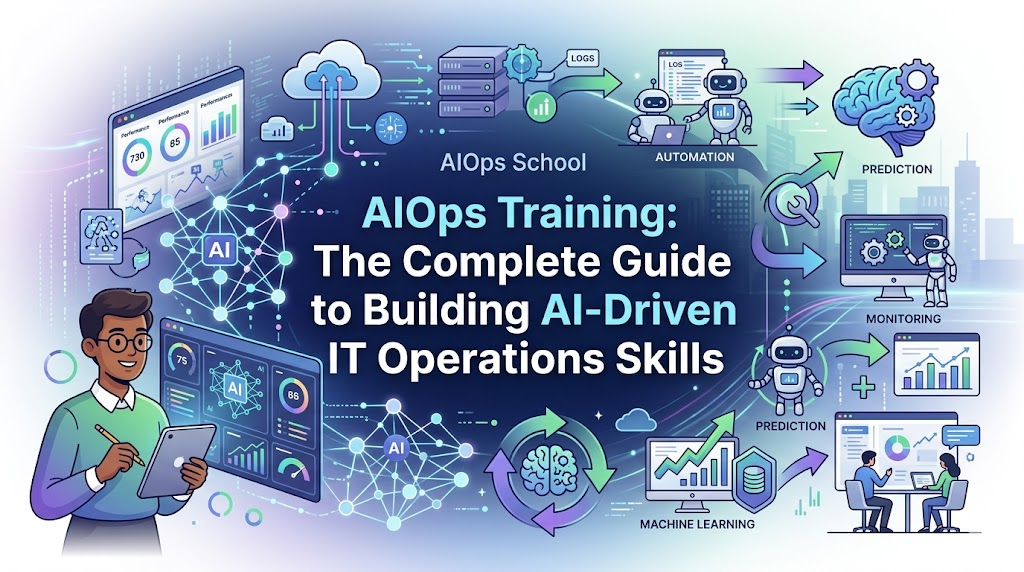
The modern IT landscape is no longer just “complex”; it is hyper-scale and exponentially dynamic. With the shift toward microservices, hybrid-cloud environments, and continuous delivery, the volume of data generated by IT infrastructure has outpaced the capabilities of traditional human-managed operations. Alert fatigue, siloed monitoring, and the “war room” culture have become the unfortunate status quo for many organizations.
Artificial Intelligence for IT Operations (AIOps) has emerged as the definitive solution to these challenges. By leveraging machine learning, big data, and advanced analytics, organizations are moving from reactive firefighting to proactive, automated resilience. For professionals aiming to stay relevant—and indeed, to thrive—in this new era, high-quality AIOps training is no longer a luxury; it is a professional necessity. This guide explores the foundational shifts in IT operations and how structured learning paths can bridge the gap between legacy practices and AI-driven excellence.
What is AIOps?
AIOps, or Artificial Intelligence for IT Operations, is the application of machine learning, natural language processing (NLP), and advanced statistical analysis to IT operations data. It is not a single tool, but a strategic practice that uses big data to automate and enhance IT operations processes.
The evolution of AIOps traces back to the sheer unmanageability of monitoring logs and events. In the past, human operators manually correlated events, identified patterns, and interpreted logs. As the “Big Data” era of IT arrived, the velocity and volume of telemetry—metrics, logs, and traces—surpassed human cognitive limits.
AIOps acts as the bridge between raw observability data and actionable insights. Unlike traditional monitoring, which is largely dashboard-based and threshold-dependent, AIOps uses algorithmic intelligence to understand the “normal” behavior of a system. When a deviation occurs, AIOps platforms do not just trigger an alert; they correlate the event with thousands of others, identify the probable root cause, and, in advanced implementations, trigger automated remediation workflows. It is the transition from “what happened?” to “why did it happen, and how can we prevent it?”
Why AIOps Matters in Modern IT Operations
The business case for AIOps is built on the pursuit of uptime, reliability, and engineering efficiency. As businesses depend more heavily on digital services, the cost of downtime—both financial and reputational—is higher than ever.
- Incident Intelligence & Noise Reduction: Modern systems can trigger thousands of alerts daily. AIOps filters this “noise,” grouping related alerts into a single incident, ensuring engineers focus on high-priority issues.
- Event Correlation: By mapping relationships between disparate data sources (logs, metrics, and traces), AIOps identifies the causality behind complex distributed system failures.
- Predictive Analytics & Capacity Planning: Rather than reacting to crashes, AIOps models predict resource exhaustion or failure before it impacts the end-user, allowing for proactive capacity scaling.
- Faster MTTR (Mean Time to Resolution): Through intelligent root cause analysis, AIOps significantly reduces the investigation time, allowing teams to resolve issues in minutes rather than hours.
- Auto-remediation: The “holy grail” of AIOps is the self-healing system. When a recurring issue is identified, automated playbooks can restart services, clear caches, or scale resources without human intervention.
Who Should Take an AIOps Training Program?
The transition to AI-driven operations is a cross-functional shift, requiring a diverse set of roles to adapt. AIOps training is essential for any professional whose work involves the health and performance of digital infrastructure:
- DevOps Engineers: You are already building the CI/CD pipelines; AIOps helps you inject reliability and performance analytics directly into the deployment process.
- SREs (Site Reliability Engineers): As the champions of system uptime, SREs use AIOps to reduce toil, automate incident response, and refine error budgets with precise data.
- Platform Engineers: Building internal developer platforms requires robust observability; AIOps training provides the framework to standardize monitoring and automated governance.
- Cloud Architects: Designing resilient, multi-cloud architectures necessitates advanced capacity planning and anomaly detection that only AI models can handle at scale.
- Monitoring & Observability Engineers: You are managing the telemetry data; AIOps empowers you to evolve from simple metric collectors to intelligence architects.
- IT Managers & NOC Leads: For leadership, understanding AIOps is crucial for budget allocation, team restructuring, and defining the operational roadmap for the next three to five years.
- ML Engineers: Applying machine learning to operational data (AIOps/MLOps) is a distinct skill set that moves you from general ML models to mission-critical infrastructure applications.
What Will You Learn in an AIOps Course?
A comprehensive AIOps course balances theoretical understanding with practical, hands-on experience. A robust curriculum covers the full spectrum of the AIOps pipeline:
- Module 1: AIOps Fundamentals: Defining the scope, maturity models, and business value.
- Module 2: Observability: Deep dive into the “Three Pillars” (Metrics, Logs, Traces) and how they intersect.
- Module 3: Metrics: High-cardinality data management and time-series analysis.
- Module 4: Logs: Log aggregation, parsing, and semantic analysis at scale.
- Module 5: Tracing: Distributed tracing in microservices and service mesh environments.
- Module 6: Event Correlation: Statistical vs. algorithmic correlation methods.
- Module 7: Anomaly Detection: Building ML models to identify outliers in streaming data.
- Module 8: ML for Operations: Introduction to predictive modeling, classification, and clustering for IT data.
- Module 9: Incident Intelligence: Automating alert routing and incident prioritization.
- Module 10: Auto-remediation: Designing and executing closed-loop automation playbooks.
- Module 11: OpenTelemetry: Standardizing data collection across hybrid environments.
- Module 12: Enterprise AIOps Architecture: Designing scalable, secure, and vendor-agnostic AIOps stacks.
Top AIOps Tools You Should Know
The market for AIOps tools is vast, ranging from full-stack observability platforms to specialized incident management systems.
| Tool | Focus | AI Capabilities | Best For |
| Splunk | Logs/Security | High (Signal/Predict) | Enterprise Log Management |
| Dynatrace | Observability | Very High (Davis AI) | Full-stack Auto-discovery |
| Datadog | Monitoring | High (Watchdog) | Cloud-native Environments |
| Prometheus | Metrics | Low (needs external) | Metrics/Alerting |
| Grafana | Visualization | Moderate | Unified Dashboards |
| Elastic Stack | Search/Logs | Moderate | Data Analysis/Search |
| Moogsoft | Correlation | Very High | Noise Reduction/Incidents |
| BigPanda | Correlation | High | Unified Alert Correlation |
| New Relic | Observability | High (Applied Intel) | Application Performance |
Note: Adoption depends on your organization’s existing tech stack and specific operational requirements.
Benefits of Earning an AIOps Certification
In a crowded job market, an AIOps certification serves as a verified signal of your ability to manage complex, modern systems.
- Competitive Advantage: As companies scramble to find talent capable of managing AI-driven stacks, certification validates that you possess both theoretical knowledge and practical familiarity with industry tools.
- Salary Potential: Data consistently shows that engineers with specialized, high-demand skills—like AIOps and MLOps—command significantly higher salaries compared to generalists.
- Future-Proofing: Automation is the inevitable trajectory of IT. By mastering AIOps now, you are positioning yourself at the forefront of the next wave of IT evolution.
- Hands-on Validation: A high-quality certification program requires practical lab work, proving that you have not just read about AIOps, but have actually built and maintained anomaly detection models.
Why Choose AIOps School for AIOps Training?
If you are looking for a structured path to mastery, AIOps School offers a unique, industry-aligned experience. We focus on bridging the gap between concepts and real-world implementation.
- Hands-on Labs: Theory is essential, but execution matters. Our labs place you in simulated production environments where you configure monitoring stacks, build anomaly detection models, and deploy auto-remediation workflows.
- Certification Pathways: We provide a clear, linear progression. From the AIOps Foundation track—perfect for those beginning their journey—to the AIOps Architect level, designed for leaders setting enterprise strategy.
- Project-Based Learning: Every course is rooted in solving actual IT problems. You aren’t just passing an exam; you are building a portfolio of skills you can apply on day one.
- Global Community: Connect with thousands of learners across the globe. Share your experiences, learn from industry peers, and navigate the challenges of AIOps implementation together.
- Expert Support: Access to industry practitioners who can provide guidance on everything from career transitions to complex architecture troubleshooting.
Career Opportunities After Completing an AIOps Certification
Graduating from an AIOps course opens doors to specialized roles that are currently in high demand across tech and enterprise sectors.
- AIOps Engineer: Responsible for building and maintaining the intelligence layer of the IT infrastructure.
- Observability Engineer: Focuses on the collection, analysis, and visualization of telemetry data.
- Incident Response Specialist: Uses automated intelligence to lead rapid, data-backed incident recovery.
- DevOps Architect: Integrates AIOps principles into CI/CD pipelines to ensure release reliability.
- AI Operations (AIOps) Specialist: A dedicated role for managing the ML models that oversee IT operations.
These roles are evolving rapidly, and companies are actively recruiting professionals who can speak the language of both “Operations” and “Data Science.”
Frequently Asked Questions (FAQ)
1. What is AIOps Training?
AIOps training involves learning the methodologies, tools, and best practices to integrate AI/ML into IT operations. It covers data collection, algorithmic analysis, and automation techniques to improve system reliability.
2. Is AIOps difficult to learn?
It depends on your background. If you have experience in DevOps, SRE, or system administration, you already understand the “Operations” side. The challenge lies in learning the “AI” side—statistics, data modeling, and automation logic. Our courses are designed to make this transition intuitive for IT professionals.
3. Which AIOps tools are most widely used?
The industry relies on a mix of platforms. Datadog, Dynatrace, and Splunk are dominant in large enterprises, while Prometheus and the Elastic Stack are widely used in open-source-heavy organizations. A good AIOps training program will expose you to these varied ecosystems.
4. Is an AIOps Certification worth it?
Absolutely. As organizations move toward automated, AI-driven infrastructures, they are actively looking for talent that can prove their expertise. Certification is the fastest way to demonstrate that you are capable of handling modern, high-complexity systems.
5. How long does it take to complete an AIOps Course?
It varies by depth. Foundation courses can be completed in a few weeks, while Architect-level tracks may take several months of dedicated study and lab work. Flexibility is key for working professionals.
6. Can DevOps Engineers transition into AIOps?
Yes, this is the most common and successful transition path. DevOps engineers already understand the full lifecycle of software. AIOps simply adds a layer of intelligence and automation to the existing DevOps toolchain.
7. What prerequisites are needed for AIOps training?
A foundational understanding of Linux, basic networking, and some experience with monitoring or cloud infrastructure is recommended. You do not need to be a data scientist, but an analytical mindset is helpful.
8. Are hands-on labs important in AIOps learning?
They are critical. Understanding the theory of “Event Correlation” is very different from configuring an actual correlation engine in a lab environment. You learn through doing, especially when it comes to troubleshooting AI models.
9. What industries use AIOps most?
Finance, E-commerce, Telecommunications, and Healthcare are the heaviest users. Any industry with massive, distributed infrastructure and low tolerance for downtime is likely investing heavily in AIOps.
10. What is the future of AIOps?
The future is “Autonomous Operations.” We are moving toward systems that don’t just alert but actively self-heal and self-optimize with minimal human intervention. AIOps is the foundational step toward this autonomous future.
Conclusion
The complexity of modern IT is not going to decrease; if anything, it will continue to accelerate. The days of manual, dashboard-staring IT management are numbered. Organizations that successfully transition to AI-driven operations will gain a significant competitive advantage in reliability, efficiency, and scale.
For the modern IT professional, the path forward is clear. By investing in AIOps training, you are not just learning a new set of tools; you are future-proofing your career. Whether you are a DevOps Engineer, an SRE, or an IT Manager, the skills acquired through a structured AIOps certification program will empower you to lead, innovate, and thrive in the era of autonomous IT.

Find Trusted Cardiac Hospitals
Compare heart hospitals by city and services — all in one place.
Explore Hospitals