
Introduction
AI Proctoring with Computer Vision refers to exam monitoring systems that use AI, facial recognition, object detection, eye tracking, gaze estimation, audio analysis, and behavioral pattern detection to supervise candidates during online assessments. These platforms are designed to ensure exam integrity in remote learning, certification programs, hiring tests, and professional licensing exams.
Unlike traditional human invigilation, computer vision-based proctoring systems automatically detect suspicious behavior such as multiple faces, absence from screen, unusual eye movement, device switching, voice detection, and unauthorized objects in the environment. In 2026, these systems are becoming more advanced, combining multimodal AI (video, audio, screen activity, and browser behavior) to improve detection accuracy while reducing false positives.
Common use cases include remote university exams, certification testing, corporate hiring assessments, compliance training exams, professional licensing tests, and large-scale online education evaluations.
Key evaluation criteria include detection accuracy, false-positive rates, privacy compliance, explainability of flagged events, real-time monitoring capability, scalability, integration with LMS/ATS systems, data retention controls, bias mitigation, and candidate experience.
Best for: universities, online education platforms, certification bodies, enterprises running remote exams, government exam authorities, and large-scale assessment providers.
Not ideal for: small classrooms with in-person exams, organizations with strict biometric restrictions, or regions with strong limitations on facial recognition and surveillance technologies.
What’s Changed in AI Proctoring with Computer Vision in 2026+
- Shift from single-camera monitoring to multimodal surveillance (video + audio + screen + browser activity)
- Improved facial detection accuracy with reduced false positives
- Stronger privacy regulations limiting biometric and emotion recognition use in some regions
- Rise of “human-in-the-loop” review for flagged exam incidents
- AI now distinguishes between normal behavior (thinking, reading) vs suspicious behavior more accurately
- Edge AI processing is reducing latency and improving real-time monitoring
- Increased adoption of identity verification before and during exams
- Multi-face and identity-switch detection has become more robust
- Screen sharing and browser lockdown technologies are now standard
- AI-generated incident summaries reduce manual proctor workload
- Integration with LMS, ATS, and certification platforms is expected by default
- Increased focus on explainability for flagged violations
- Shift toward privacy-first proctoring with minimal data retention
- Adaptive proctoring levels based on exam risk category
- Stronger anti-cheating detection across multiple devices and networks
Quick Buyer Checklist
- Does the system use computer vision for face, gaze, and identity detection?
- Can it detect multiple faces, screen switching, and external assistance?
- Does it support real-time and post-exam analysis?
- Are flagged incidents explainable and reviewable?
- Does it comply with local privacy and biometric regulations?
- Can it integrate with LMS, ATS, or certification platforms?
- Does it support browser lockdown and screen monitoring?
- Is there a human review option for AI-flagged incidents?
- How does it handle false positives?
- What data is stored, and for how long?
- Is biometric data encrypted and access-controlled?
- Can it scale to thousands of concurrent exams?
- Does it work in low-bandwidth environments?
- Is candidate experience smooth and non-disruptive?
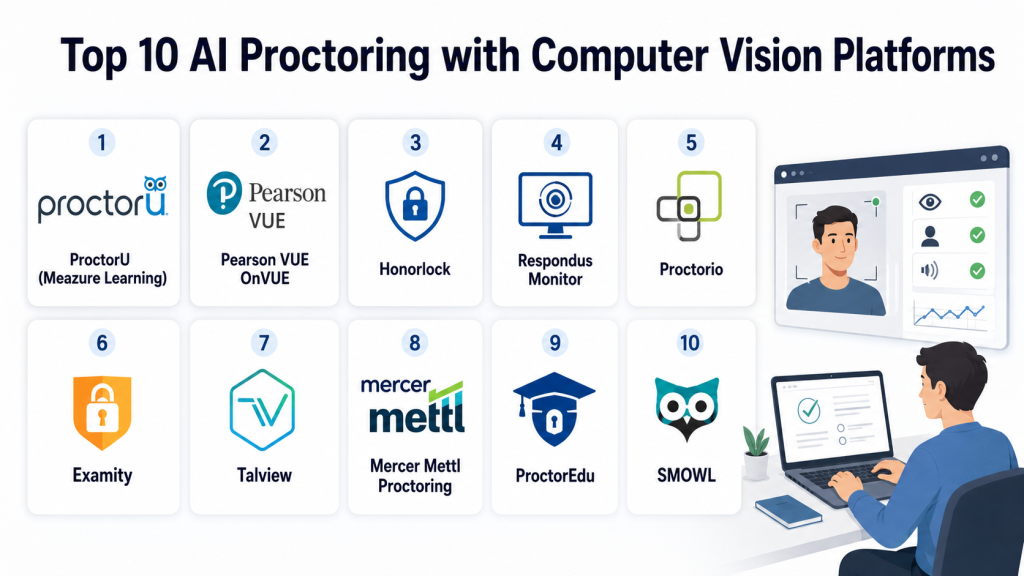
Top 10 AI Proctoring with Computer Vision Platforms
#1 — ProctorU (Meazure Learning)
One-line verdict: Best for enterprise-grade remote exam monitoring with human + AI hybrid proctoring.
Short description:
ProctorU is one of the most widely used remote proctoring platforms combining AI computer vision with live human invigilation. It is used by universities, certification bodies, and enterprises for high-stakes exams.
Standout Capabilities
- AI-powered facial detection
- Live human proctoring support
- Identity verification workflows
- Browser lockdown environment
- Multi-camera monitoring support
- Real-time anomaly detection
- Exam session recording
- Incident reporting dashboards
AI-Specific Depth
- Model support: Proprietary computer vision models
- RAG / knowledge integration: N/A
- Evaluation: Behavior anomaly detection + rule-based scoring
- Guardrails: Human-in-the-loop review for flagged incidents
- Observability: Exam analytics and proctoring logs
Pros
- Strong hybrid AI + human monitoring
- Trusted in high-stakes environments
- Scales for enterprise exams
Cons
- Privacy concerns in some regions
- Higher cost compared to automated tools
- Candidate experience can feel strict
Security & Compliance
Includes identity verification, encrypted session recording, access control, and audit logs. Certifications and regional compliance details vary by deployment and are not always publicly standardized.
Deployment & Platforms
- Web-based proctoring system
- Cloud-hosted infrastructure
- Browser-based exam environment
Integrations & Ecosystem
- LMS integrations
- Certification platforms
- University systems
- Exam delivery tools
- API-based workflows
Pricing Model
Enterprise and per-exam pricing depending on scale and institution.
Best-Fit Scenarios
- University exams
- Professional certification testing
- High-stakes remote assessments
#2 — Pearson VUE OnVUE
One-line verdict: Best for global certification exams requiring strict identity and exam integrity controls.
Short description:
Pearson VUE OnVUE provides online proctoring for certification exams with AI-based monitoring and secure exam delivery infrastructure.
Standout Capabilities
- AI-based identity verification
- Secure browser lockdown
- Remote exam monitoring
- Incident flagging system
- Global exam infrastructure
- Session recording
- Candidate authentication checks
- Certification-grade security
AI-Specific Depth
- Model support: Proprietary AI monitoring systems
- RAG / knowledge integration: N/A
- Evaluation: Behavioral anomaly detection
- Guardrails: Strict certification-grade exam policies
- Observability: Proctoring logs and audit trails
Pros
- Extremely strong exam integrity controls
- Trusted for global certifications
- Scalable infrastructure
Cons
- Strict environment requirements
- Limited flexibility for customization
- Candidate experience can be rigid
Security & Compliance
High-security certification environment with strong identity verification and controlled exam conditions. Exact compliance certifications vary by program.
Deployment & Platforms
- Web-based exam delivery
- Secure browser environment
- Cloud infrastructure
Integrations & Ecosystem
- Certification programs
- LMS systems
- Enterprise training systems
- Identity verification services
- Exam delivery APIs
Pricing Model
Certification-based per-exam pricing model.
Best-Fit Scenarios
- IT certifications
- Licensing exams
- Global standardized testing
#3 — Honorlock
One-line verdict: Best AI-first proctoring platform for universities and online education providers.
Short description:
Honorlock uses AI-powered proctoring with computer vision, screen monitoring, and live proctor escalation when needed.
Standout Capabilities
- AI webcam monitoring
- Browser lockdown extension
- Screen recording and analysis
- Live proctor escalation
- Phone detection alerts
- Voice and audio monitoring
- Automated incident detection
- LMS integration support
AI-Specific Depth
- Model support: Proprietary computer vision AI
- RAG / knowledge integration: N/A
- Evaluation: Multi-signal cheating detection
- Guardrails: Human review escalation workflows
- Observability: Exam analytics dashboard
Pros
- Strong AI-first design
- Easy LMS integration
- Good balance of automation and oversight
Cons
- Privacy concerns depending on use case
- Some false positives in behavior detection
- Requires stable internet connection
Security & Compliance
Includes encrypted exam sessions, identity checks, and secure monitoring. Compliance varies by institution and region.
Deployment & Platforms
- Browser-based extension
- Cloud-hosted system
- LMS-integrated
Integrations & Ecosystem
- LMS platforms
- University systems
- Assessment tools
- API integrations
- Exam platforms
Pricing Model
Institution-based subscription pricing.
Best-Fit Scenarios
- Online university exams
- Remote assessments
- Large-scale academic testing
#4 — Respondus Monitor
One-line verdict: Best for LMS-integrated automated proctoring in academic environments.
Short description:
Respondus Monitor works with LMS platforms to provide AI-driven exam monitoring using webcam, screen recording, and behavior analysis.
Standout Capabilities
- Webcam monitoring
- AI behavior detection
- Browser lockdown integration
- LMS-native integration
- Exam session recording
- Suspicious activity flags
- Identity verification tools
- Automated reporting
AI-Specific Depth
- Model support: Proprietary AI detection models
- RAG / knowledge integration: N/A
- Evaluation: Behavior-based anomaly detection
- Guardrails: LMS-controlled exam rules
- Observability: Exam reports and logs
Pros
- Strong LMS integration
- Easy deployment in education systems
- Cost-effective for institutions
Cons
- Limited flexibility outside LMS ecosystems
- Some false positives in behavior detection
- Less advanced multimodal AI
Security & Compliance
Institution-level controls, session encryption, and monitoring logs. Compliance varies by LMS setup and institution policy.
Deployment & Platforms
- Browser-based system
- LMS-integrated deployment
- Cloud monitoring
Integrations & Ecosystem
- Canvas
- Blackboard
- Moodle
- LMS platforms
- Exam systems
- Institutional reporting tools
Pricing Model
Institutional licensing.
Best-Fit Scenarios
- College exams
- LMS-based assessments
- Remote classroom testing
#5 — Proctorio
One-line verdict: Best fully automated AI proctoring solution with strong browser-based monitoring.
Short description:
Proctorio is a fully automated AI proctoring platform that uses computer vision and behavioral analysis to monitor exams without live human proctors.
Standout Capabilities
- Fully automated AI proctoring
- Webcam and screen monitoring
- Browser lockdown system
- Audio and video analysis
- Identity verification
- Suspicious behavior detection
- Recording and review tools
- LMS integration
AI-Specific Depth
- Model support: Proprietary computer vision AI
- RAG / knowledge integration: N/A
- Evaluation: Behavior and identity anomaly detection
- Guardrails: Configurable exam rules
- Observability: Automated reporting dashboard
Pros
- Fully automated monitoring
- Scalable for large exams
- No human proctor required
Cons
- Privacy concerns in some regions
- False positives possible
- Candidate experience can feel restrictive
Security & Compliance
Encryption, identity verification, and access controls are included. Certification details vary depending on institution.
Deployment & Platforms
- Browser extension
- Cloud-based monitoring
- LMS integration
Integrations & Ecosystem
- LMS platforms
- Education systems
- Assessment tools
- API-based workflows
- University systems
Pricing Model
Per-exam or institutional licensing.
Best-Fit Scenarios
- Large-scale online exams
- Automated academic testing
- Remote certification support
#6 — Examity
One-line verdict: Best hybrid AI + human proctoring platform for enterprise and academic use.
Short description:
Examity provides flexible proctoring options combining AI monitoring with live human proctors and recorded review.
Standout Capabilities
- AI-assisted monitoring
- Live proctor support
- Identity verification
- Incident flagging system
- Recording and audit tools
- Flexible proctoring levels
- Secure exam environment
- Enterprise scalability
AI-Specific Depth
- Model support: Proprietary AI monitoring models
- RAG / knowledge integration: N/A
- Evaluation: Behavior and identity analysis
- Guardrails: Human review and escalation workflows
- Observability: Exam analytics and reporting
Pros
- Flexible proctoring options
- Good enterprise scalability
- Strong support structure
Cons
- Higher cost for live proctoring
- Setup complexity
- Candidate experience varies
Security & Compliance
Enterprise-grade identity verification, audit logs, and secure monitoring. Certifications vary by deployment.
Deployment & Platforms
- Cloud-based system
- Browser-based exam delivery
- Hybrid monitoring model
Integrations & Ecosystem
- LMS platforms
- Certification systems
- Enterprise training tools
- APIs and exam systems
Pricing Model
Tiered pricing based on proctoring level.
Best-Fit Scenarios
- Enterprise exams
- Certification testing
- Hybrid academic assessments
#7 — Talview
One-line verdict: Best AI-driven assessment and proctoring platform for hiring and education.
Short description:
Talview combines AI proctoring with recruitment assessments, video interviews, and cognitive testing.
Standout Capabilities
- AI video proctoring
- Remote assessment monitoring
- Candidate identity verification
- Behavioral detection
- Interview automation tools
- Skill assessment integration
- Recruitment analytics
- Mobile-first assessments
AI-Specific Depth
- Model support: Proprietary AI models
- RAG / knowledge integration: N/A
- Evaluation: Multi-signal behavioral analysis
- Guardrails: Human review workflows
- Observability: Hiring and exam analytics
Pros
- Strong hiring + exam hybrid platform
- Good AI automation coverage
- Mobile-friendly
Cons
- Complex feature set
- Requires onboarding effort
- Not purely academic-focused
Security & Compliance
Enterprise-grade security controls with identity verification and monitoring features.
Deployment & Platforms
- Web-based platform
- Mobile support
- Cloud infrastructure
Integrations & Ecosystem
- ATS systems
- LMS platforms
- HR systems
- Recruitment tools
- API integrations
Pricing Model
Enterprise subscription model.
Best-Fit Scenarios
- Hiring assessments
- Remote proctored interviews
- Enterprise training evaluations
#8 — Mercer Mettl Proctoring
One-line verdict: Best enterprise-grade secure exam proctoring with strong compliance focus.
Short description:
Mercer Mettl provides AI-based proctoring combined with enterprise-level test security and identity verification systems.
Standout Capabilities
- AI-powered webcam monitoring
- Identity verification
- Secure exam environment
- Multi-device detection
- Incident reporting system
- Enterprise exam analytics
- Browser lockdown system
- Global exam support
AI-Specific Depth
- Model support: Proprietary AI monitoring systems
- RAG / knowledge integration: N/A
- Evaluation: Behavioral anomaly detection
- Guardrails: Strict exam governance rules
- Observability: Exam audit dashboards
Pros
- Strong enterprise reliability
- High-security exam environments
- Scalable infrastructure
Cons
- Complex setup
- Less flexible UX
- Higher cost structure
Security & Compliance
Enterprise-grade monitoring and identity verification with strong audit trails. Compliance details vary by deployment.
Deployment & Platforms
- Cloud-based system
- Browser-based proctoring
- Secure exam delivery
Integrations & Ecosystem
- LMS platforms
- HR systems
- Certification bodies
- Enterprise assessment tools
- API integrations
Pricing Model
Enterprise and per-exam pricing.
Best-Fit Scenarios
- High-stakes enterprise exams
- Certification programs
- Government or regulated assessments
#9 — ProctorEdu
One-line verdict: Best flexible AI proctoring system for educational institutions.
Short description:
ProctorEdu offers AI-powered proctoring with flexible monitoring modes including automated, live, and recorded supervision.
Standout Capabilities
- AI webcam monitoring
- Screen and audio tracking
- Live proctoring option
- Automated exam review
- Multi-device detection
- Identity verification
- Behavior analytics dashboard
- LMS integration
AI-Specific Depth
- Model support: Proprietary AI detection
- RAG / knowledge integration: N/A
- Evaluation: Behavior and identity monitoring
- Guardrails: Human escalation system
- Observability: Exam analytics dashboards
Pros
- Flexible proctoring modes
- Good for education institutions
- Balanced automation and control
Cons
- Smaller ecosystem than major vendors
- Requires configuration effort
- UX varies by setup
Security & Compliance
Includes monitoring, identity verification, and secure recording. Certifications vary by deployment.
Deployment & Platforms
- Web-based system
- Cloud infrastructure
- LMS-compatible
Integrations & Ecosystem
- LMS platforms
- Education systems
- Exam tools
- API integrations
- University platforms
Pricing Model
Institution-based pricing.
Best-Fit Scenarios
- Universities
- Online exam platforms
- Flexible academic testing
#10 — SMOWL
One-line verdict: Best lightweight AI proctoring solution for small to mid-sized institutions.
Short description:
SMOWL provides AI-based online exam monitoring using webcam tracking, identity verification, and behavior detection.
Standout Capabilities
- Webcam-based monitoring
- Identity verification
- Browser activity tracking
- Automated flagging system
- Exam recording
- Lightweight deployment
- Simple dashboard
- LMS integration support
AI-Specific Depth
- Model support: Proprietary AI detection models
- RAG / knowledge integration: N/A
- Evaluation: Behavior anomaly detection
- Guardrails: Configurable exam policies
- Observability: Basic reporting dashboards
Pros
- Easy to deploy
- Lightweight and cost-effective
- Suitable for smaller institutions
Cons
- Less advanced than enterprise tools
- Limited scalability features
- Basic analytics compared to competitors
Security & Compliance
Not publicly stated in detail; includes standard secure exam monitoring and identity checks.
Deployment & Platforms
- Web-based system
- Cloud deployment
- LMS integration support
Integrations & Ecosystem
- LMS systems
- Education platforms
- Exam delivery tools
- API integrations
- Institutional workflows
Pricing Model
Subscription-based, generally lower than enterprise competitors.
Best-Fit Scenarios
- Small universities
- Online courses
- Budget-conscious institutions
Comparison Table
| Tool Name | Best For | Deployment | Model Flexibility | Strength | Watch-Out | Public Rating |
|---|---|---|---|---|---|---|
| ProctorU | Enterprise hybrid proctoring | Cloud | Hosted | Human + AI monitoring | High cost | N/A |
| Pearson VUE | Certification exams | Cloud | Hosted | Global exam security | Rigid experience | N/A |
| Honorlock | University exams | Cloud | Hosted | AI-first monitoring | Privacy concerns | N/A |
| Respondus Monitor | LMS-based exams | Cloud | Hosted | LMS integration | Limited flexibility | N/A |
| Proctorio | Automated proctoring | Cloud | Hosted | Fully automated AI | False positives | N/A |
| Examity | Hybrid proctoring | Cloud | Hosted | Flexible models | Setup complexity | N/A |
| Talview | Hiring + exams | Cloud | Hosted | AI assessment + proctoring | Complex suite | N/A |
| Mercer Mettl | Enterprise exams | Cloud | Hosted | Secure testing | Higher cost | N/A |
| ProctorEdu | Education institutions | Cloud | Hosted | Flexible monitoring | Smaller ecosystem | N/A |
| SMOWL | Lightweight proctoring | Cloud | Hosted | Simple deployment | Limited depth | N/A |
Scoring & Evaluation
This scoring is comparative and intended for shortlisting. It reflects AI detection accuracy, multimodal monitoring strength, scalability, integrity enforcement, usability, and enterprise readiness. Scores should be validated in real exam conditions because false positives, privacy constraints, and infrastructure differences can significantly affect outcomes. Buyers should also consider regional regulations around biometric data, facial recognition, and student monitoring before deployment.
| Tool | Core | Reliability/Eval | Guardrails | Integrations | Ease | Perf/Cost | Security/Admin | Support | Weighted Total |
|---|---|---|---|---|---|---|---|---|---|
| ProctorU | 9 | 9 | 9 | 9 | 7 | 7 | 9 | 9 | 8.5 |
| Pearson VUE | 10 | 10 | 10 | 9 | 6 | 7 | 10 | 9 | 8.8 |
| Honorlock | 9 | 9 | 8 | 9 | 8 | 8 | 9 | 8 | 8.4 |
| Respondus Monitor | 8 | 8 | 8 | 9 | 9 | 9 | 8 | 8 | 8.3 |
| Proctorio | 9 | 9 | 8 | 9 | 8 | 8 | 9 | 8 | 8.4 |
| Examity | 9 | 9 | 9 | 8 | 7 | 7 | 9 | 9 | 8.4 |
| Talview | 8 | 8 | 8 | 8 | 8 | 8 | 8 | 8 | 8.0 |
| Mercer Mettl | 9 | 9 | 10 | 9 | 7 | 7 | 10 | 9 | 8.6 |
| ProctorEdu | 8 | 8 | 8 | 8 | 8 | 8 | 8 | 8 | 8.0 |
| SMOWL | 7 | 7 | 7 | 7 | 9 | 9 | 7 | 8 | 7.6 |
Which AI Proctoring Platform Is Right for You?
Solo / Freelancer
Lightweight platforms like SMOWL or basic LMS-integrated tools are sufficient for small-scale online courses or coaching programs.
SMB
SMOWL, ProctorEdu, and Test-integrated systems work well for small institutions and online academies needing affordable monitoring.
Mid-Market
Honorlock, Examity, Respondus Monitor, and Talview offer strong balance between automation, AI detection, and scalability.
Enterprise
ProctorU, Pearson VUE, Mercer Mettl, and Examity are best suited for high-stakes exams, certifications, and large-scale deployments.
Regulated Industries
Mercer Mettl and Pearson VUE are preferred due to stronger identity verification, auditability, and exam security controls.
Budget vs Premium
Budget tools focus on automated monitoring and LMS integration, while premium systems offer hybrid proctoring, global infrastructure, and advanced fraud detection.
Build vs Buy
Building a proctoring system is highly complex due to requirements for computer vision, anti-cheating detection, identity verification, latency handling, and regulatory compliance. Most organizations should buy.
Implementation Playbook
30 Days: Pilot Setup
- Select exam type and risk level
- Configure identity verification
- Define cheating detection rules
- Run pilot exams
- Test false positive rates
- Validate candidate experience
- Review compliance requirements
60 Days: Validation Phase
- Integrate LMS or exam system
- Tune AI detection thresholds
- Add human review workflows
- Improve incident classification
- Train administrators and proctors
- Expand test population
- Monitor system accuracy
90 Days: Scale & Optimize
- Deploy across full exam programs
- Optimize cost per exam
- Reduce false positives
- Strengthen audit and reporting
- Implement continuous monitoring
- Ensure compliance alignment
- Improve candidate experience
Common Mistakes & How to Avoid Them
- Using overly strict monitoring that increases false positives
- Ignoring regional privacy laws on biometrics
- Relying only on AI without human review
- Poorly configured exam rules causing incorrect flags
- Not testing system under real exam conditions
- Overlooking candidate experience and accessibility
- Failing to explain flagged incidents
- Using same proctoring level for all exam types
- Not integrating with LMS or exam systems
- Ignoring network or device limitations
- Collecting excessive biometric data unnecessarily
- Skipping audit logging and retention policies
- Not training administrators or instructors
- Deploying without a pilot phase
- Assuming AI detection is always accurate
FAQs
1. What is AI proctoring with computer vision?
It is a system that uses AI-based video analysis to monitor students during online exams for cheating or suspicious behavior.
2. How does computer vision help in proctoring?
It detects faces, eye movement, objects, screen activity, and behavioral anomalies using camera-based AI models.
3. Is AI proctoring accurate?
It is effective but not perfect. It can produce false positives, so human review is often recommended.
4. Can AI proctoring detect cheating automatically?
Yes, it can flag suspicious behavior, but final judgment is usually reviewed by humans in high-stakes exams.
5. Is AI proctoring legal everywhere?
No. Some regions restrict biometric monitoring or require strict consent and transparency.
6. Do students need special hardware?
Usually just a webcam, microphone, and stable internet connection are required.
7. Can AI proctoring see my screen?
Many platforms combine webcam monitoring with screen recording or browser lockdown tools.
8. Is data stored after exams?
It depends on the platform and configuration; retention policies vary widely.
9. Can AI proctoring work offline?
No. Most systems require continuous internet connectivity.
10. What happens if AI flags a false positive?
Most systems allow human review of flagged incidents before final action is taken.
11. Can AI proctoring detect multiple devices?
Yes, some systems can detect secondary devices through audio, video, or behavioral signals.
12. Is AI proctoring safe for students?
It can be safe if used transparently with consent, minimal data collection, and strong privacy controls.
13. What exams use AI proctoring?
Universities, certification bodies, hiring assessments, and online training programs commonly use it.
14. What is the biggest risk?
The biggest risk is privacy misuse and over-reliance on AI without human verification.
Conclusion
AI Proctoring with Computer Vision has become a core infrastructure layer for remote education, certification, and hiring assessments. It enables scalable exam integrity through face detection, behavior monitoring, identity verification, and multimodal AI analysis. However, its effectiveness depends heavily on ethical deployment, privacy compliance, and balanced human oversight.Platforms like Pearson VUE and ProctorU dominate high-stakes certification environments, while Honorlock and Respondus serve academic institutions, and Mercer Mettl offers enterprise-grade secure testing. Lightweight systems like SMOWL provide accessible options for smaller organizations.The best approach is to align proctoring strictness with exam risk level, ensure transparent communication with candidates, validate accuracy through pilots, and continuously monitor fairness and false positives. When implemented responsibly, AI proctoring significantly improves exam integrity while maintaining scalable and efficient remote assessment systems.

Find Trusted Cardiac Hospitals
Compare heart hospitals by city and services — all in one place.
Explore Hospitals
An important aspect that could be examined further is the balance between exam integrity and user privacy in AI-powered proctoring systems. Facial recognition accuracy, environmental conditions, and diverse testing setups can sometimes lead to false flags that negatively impact candidates. It would also be beneficial to discuss bias testing, transparent review processes, data retention policies, and mechanisms for human oversight to ensure that automated monitoring remains fair, explainable, and compliant with evolving privacy regulations while maintaining confidence in remote assessments.