
Introduction
AI Clause Extraction & Classification Tools are legal AI systems that automatically identify, extract, label, and categorize clauses from contracts and legal documents. These tools break down complex agreements into structured components such as indemnity, liability, termination, payment terms, confidentiality, and compliance obligations.
In 2026, contract volumes and regulatory complexity have made manual clause review inefficient and risky. Organizations now rely on AI systems powered by natural language processing and legal language models to transform unstructured contracts into structured, searchable, and analyzable data. These systems often act as the foundation layer for contract lifecycle management (CLM), legal analytics, and risk assessment workflows.
Modern clause extraction tools do more than simple keyword detection. They understand context, detect variations in clause language, map clauses to legal taxonomies, and classify risk levels. Many also integrate with enterprise systems to support due diligence, procurement, compliance, and legal operations.
Common use cases include contract digitization, M&A due diligence, vendor contract analysis, compliance mapping, legal audits, obligation tracking, and automated contract review pipelines.
Key evaluation criteria include extraction accuracy, clause taxonomy depth, multi-jurisdiction support, classification precision, explainability, integration with CLM systems, scalability, data security, and auditability.
Best for: legal teams, enterprise contract management teams, procurement departments, compliance officers, legal tech platforms, and due diligence teams.
Not ideal for: casual users, low-volume contract environments, or organizations without structured legal workflows.
What’s Changed in AI Clause Extraction & Classification in 2026+
- Shift from keyword-based extraction to deep semantic clause understanding
- Use of legal-specific large language models trained on contract corpora
- Automated mapping of clauses to standardized legal taxonomies
- Multi-clause relationship detection (e.g., liability linked to indemnity)
- Real-time clause extraction during contract drafting
- Cross-document clause comparison across contract portfolios
- AI-driven risk scoring for extracted clauses
- Integration with CLM and procurement systems
- Improved handling of ambiguous and multi-sentence clauses
- Multilingual clause extraction for global contracts
- Use of knowledge graphs for clause relationships
- Better explainability of classification decisions
- Automated tagging of obligations, SLAs, and penalties
- Stronger compliance validation against regulatory frameworks
- Continuous learning from legal playbook updates
Quick Buyer Checklist
- Does the tool support accurate clause extraction across contract types?
- Can it classify clauses into standardized legal taxonomies?
- Does it support multi-jurisdiction contracts?
- How well does it handle complex or ambiguous legal language?
- Can it integrate with CLM or document management systems?
- Does it provide explainable classification outputs?
- Is there support for custom clause libraries or playbooks?
- Can it process large volumes of contracts efficiently?
- Does it support version comparison and clause tracking?
- Is data privacy and encryption properly implemented?
- Can it detect relationships between clauses?
- Does it support multilingual legal documents?
- Is there audit logging for compliance?
- Can outputs be exported into structured formats (JSON, CLM systems)?
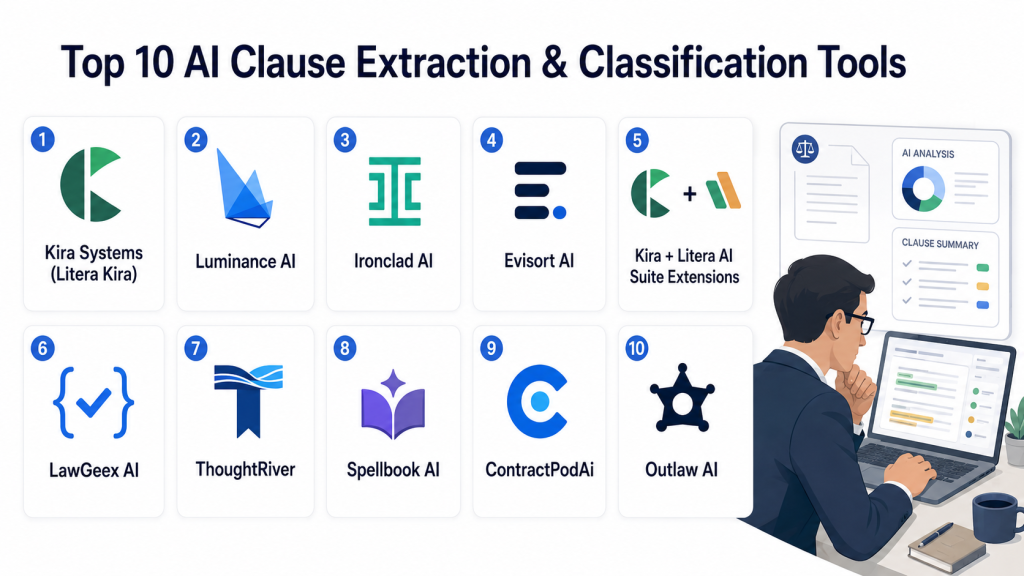
Top 10 AI Clause Extraction & Classification Tools
#1 — Kira Systems (Litera Kira)
One-line verdict: Best enterprise-grade AI tool for high-accuracy clause extraction and legal due diligence.
Short description:
Kira Systems is widely used for contract analysis and due diligence, offering highly accurate clause extraction and classification across large document sets.
Standout Capabilities
- Advanced clause extraction engine
- Machine learning-based classification system
- Pre-trained legal clause models
- Custom clause training capability
- Bulk contract processing
- Due diligence automation
- Document comparison tools
- Contract metadata tagging
AI-Specific Depth
- Model support: Proprietary legal ML models
- RAG / knowledge integration: Legal document corpus + trained clause models
- Evaluation: Clause-level accuracy scoring and validation workflows
- Guardrails: Human-in-the-loop validation for legal review
- Observability: Contract analysis dashboards and extraction logs
Pros
- Extremely accurate clause extraction
- Strong enterprise adoption in legal teams
- Excellent for due diligence workflows
Cons
- Enterprise-focused pricing and setup
- Requires legal expertise to configure models
- Less flexible for small teams
Security & Compliance
Not publicly stated in detail; includes enterprise-grade encryption, role-based access, and audit logging depending on deployment.
Deployment & Platforms
- Cloud-based platform
- Enterprise web interface
- Secure document processing environment
Integrations & Ecosystem
- CLM systems
- Legal document management tools
- Enterprise procurement platforms
- API integrations
- Due diligence workflows
Pricing Model
Enterprise subscription (not publicly stated).
Best-Fit Scenarios
- M&A due diligence
- Large-scale contract analysis
- Legal clause extraction at enterprise scale
#2 — Luminance AI
One-line verdict: Best AI contract intelligence platform for clause classification and risk-based legal analysis.
Short description:
Luminance AI uses machine learning to identify, classify, and analyze clauses in contracts while highlighting risks and anomalies in legal documents.
Standout Capabilities
- Clause detection and classification engine
- Contract anomaly detection
- Risk scoring for clauses
- Document clustering and grouping
- Legal knowledge graph mapping
- Due diligence automation
- Compliance monitoring tools
- Contract comparison system
AI-Specific Depth
- Model support: Proprietary legal AI models
- RAG / knowledge integration: Contract knowledge graph system
- Evaluation: Clause classification accuracy scoring
- Guardrails: Legal playbook-based validation
- Observability: Contract analytics dashboards
Pros
- Strong classification accuracy
- Excellent for enterprise legal teams
- Powerful anomaly detection
Cons
- Enterprise-only focus
- Requires onboarding and setup
- Less suitable for small businesses
Security & Compliance
Not publicly stated; includes enterprise-grade encryption and access control depending on deployment.
Deployment & Platforms
- Cloud-based platform
- Enterprise web system
Integrations & Ecosystem
- CLM platforms
- Legal document systems
- Enterprise workflows
- API integrations
- Compliance tools
Pricing Model
Enterprise subscription (not publicly stated).
Best-Fit Scenarios
- Contract intelligence at scale
- Legal risk classification
- Enterprise compliance review
#3 — Ironclad AI
One-line verdict: Best AI-powered CLM platform with strong clause classification and workflow automation.
Short description:
Ironclad AI combines contract lifecycle management with AI-based clause extraction and classification for enterprise legal workflows.
Standout Capabilities
- AI clause extraction engine
- Contract lifecycle management (CLM)
- Clause tagging and classification
- Workflow automation for approvals
- Contract version control
- Risk identification system
- Collaboration tools
- Contract analytics dashboards
AI-Specific Depth
- Model support: Proprietary legal AI models
- RAG / knowledge integration: Contract repository system
- Evaluation: Clause extraction and classification scoring
- Guardrails: Playbook-driven legal validation
- Observability: Workflow and contract analytics
Pros
- Strong CLM integration
- Excellent workflow automation
- Scales well for enterprises
Cons
- Complex setup for small teams
- Requires structured workflows
- Enterprise pricing model
Security & Compliance
Enterprise-grade encryption, RBAC, and audit logging depending on deployment.
Deployment & Platforms
- Cloud-based CLM platform
- Web application
- Enterprise workflow system
Integrations & Ecosystem
- CRM systems
- Procurement platforms
- Legal document tools
- API integrations
- Enterprise workflows
Pricing Model
Enterprise subscription (not publicly stated).
Best-Fit Scenarios
- Contract lifecycle automation
- Enterprise legal operations
- Procurement and sales contracts
#4 — Evisort AI
One-line verdict: Best AI-native platform for automated clause extraction and enterprise contract intelligence.
Short description:
Evisort uses AI to automatically extract and classify clauses from contracts, enabling organizations to build structured contract intelligence systems.
Standout Capabilities
- Automated clause extraction
- AI-based classification system
- Contract metadata generation
- Searchable contract repository
- Risk tagging and analysis
- Contract analytics dashboards
- Bulk document processing
- Contract lifecycle tracking
AI-Specific Depth
- Model support: Proprietary contract AI models
- RAG / knowledge integration: Enterprise contract knowledge base
- Evaluation: Classification accuracy scoring system
- Guardrails: Validation workflows for extracted data
- Observability: Contract intelligence analytics
Pros
- Strong enterprise contract intelligence
- High-quality extraction accuracy
- Excellent search capabilities
Cons
- Enterprise-focused deployment
- Requires onboarding effort
- Less flexible for small teams
Security & Compliance
Not publicly stated in full detail; includes enterprise security controls depending on deployment.
Deployment & Platforms
- Cloud-based platform
- Enterprise contract system
Integrations & Ecosystem
- CLM systems
- ERP platforms
- Procurement tools
- API integrations
- Document management systems
Pricing Model
Enterprise subscription (not publicly stated).
Best-Fit Scenarios
- Enterprise contract repositories
- Procurement and legal operations
- Contract intelligence automation
#5 — Kira + Litera AI Suite Extensions
One-line verdict: Best combined legal AI suite for clause extraction and advanced document analysis.
Short description:
Litera’s AI suite builds on Kira’s extraction capabilities, expanding into broader legal workflow automation and document intelligence.
Standout Capabilities
- Clause extraction and classification engine
- Document comparison tools
- Legal data extraction system
- Contract tagging and metadata mapping
- Due diligence acceleration
- Custom clause training models
- Bulk contract analysis
- Legal analytics dashboards
AI-Specific Depth
- Model support: Legal ML + hybrid AI models
- RAG / knowledge integration: Legal document corpus
- Evaluation: Clause-level classification scoring
- Guardrails: Human-in-the-loop validation workflows
- Observability: Legal analytics dashboards
Pros
- Strong legal ecosystem integration
- High accuracy in clause extraction
- Good enterprise adoption
Cons
- Complex enterprise setup
- Limited SMB usability
- Requires legal expertise
Security & Compliance
Enterprise-grade security with access control and audit logging depending on configuration.
Deployment & Platforms
- Cloud-based system
- Enterprise legal workspace
Integrations & Ecosystem
- CLM systems
- Legal document tools
- Enterprise workflows
- API integrations
- Litigation systems
Pricing Model
Enterprise subscription (not publicly stated).
Best-Fit Scenarios
- Legal due diligence
- Contract intelligence workflows
- Enterprise legal teams
#6 — LawGeex AI
One-line verdict: Best AI compliance-focused clause classification platform for standardized contract review.
Short description:
LawGeex uses AI to classify clauses and compare contracts against predefined legal policies for compliance validation.
Standout Capabilities
- Automated clause classification
- Policy-based contract review
- Risk detection system
- Contract approval workflows
- Legal compliance validation
- Clause tagging system
- Redlining suggestions
- Workflow automation tools
AI-Specific Depth
- Model support: Proprietary classification models
- RAG / knowledge integration: Legal policy engine
- Evaluation: Clause compliance scoring system
- Guardrails: Rule-based legal validation
- Observability: Review workflow analytics
Pros
- Strong compliance enforcement
- Good for standardized contracts
- Efficient review automation
Cons
- Limited flexibility for complex contracts
- Enterprise-focused deployment
- Less advanced analytics depth
Security & Compliance
Not publicly stated; includes enterprise security controls depending on deployment.
Deployment & Platforms
- Cloud platform
- Web application
Integrations & Ecosystem
- CLM systems
- Compliance platforms
- Legal workflows
- API integrations
- Enterprise systems
Pricing Model
Enterprise subscription (not publicly stated).
Best-Fit Scenarios
- Compliance-heavy organizations
- Standardized contract workflows
- Procurement approvals
#7 — ThoughtRiver
One-line verdict: Best AI contract triage tool for early clause classification and risk screening.
Short description:
ThoughtRiver uses AI to pre-screen contracts, classify clauses, and identify risks before legal review.
Standout Capabilities
- AI contract triage system
- Clause classification engine
- Risk scoring system
- Legal playbook integration
- Workflow prioritization
- Contract screening automation
- Compliance validation tools
- Contract analytics dashboards
AI-Specific Depth
- Model support: Legal risk classification models
- RAG / knowledge integration: Playbook-based legal system
- Evaluation: Risk and clause classification scoring
- Guardrails: Policy-based validation rules
- Observability: Contract pipeline analytics
Pros
- Excellent for high-volume contracts
- Strong triage capabilities
- Reduces legal workload
Cons
- Limited deep contract drafting
- Requires setup of legal playbooks
- Enterprise-focused usage
Security & Compliance
Not publicly stated; includes enterprise-grade controls.
Deployment & Platforms
- Cloud-based platform
- Enterprise web system
Integrations & Ecosystem
- CLM systems
- Procurement tools
- Legal workflows
- API integrations
- Enterprise systems
Pricing Model
Enterprise subscription (not publicly stated).
Best-Fit Scenarios
- Contract triage at scale
- Legal review prioritization
- Procurement workflows
#8 — Spellbook AI
One-line verdict: Best AI clause classification tool embedded in Microsoft Word for legal drafting workflows.
Short description:
Spellbook helps lawyers extract, classify, and improve clauses directly within Word documents.
Standout Capabilities
- AI clause identification in Word
- Contract drafting assistance
- Clause classification suggestions
- Risk detection in legal text
- Redlining automation
- Legal writing improvements
- Template-based clause generation
- Real-time document analysis
AI-Specific Depth
- Model support: Legal LLMs
- RAG / knowledge integration: Clause libraries and templates
- Evaluation: Clause-level analysis scoring
- Guardrails: Legal drafting constraints
- Observability: Document-level usage analytics
Pros
- Seamless Word integration
- Easy adoption for lawyers
- Strong drafting support
Cons
- Limited enterprise CLM capabilities
- Focused mainly on Word-based workflows
- Not a full contract intelligence platform
Security & Compliance
Not publicly stated; includes standard enterprise document security.
Deployment & Platforms
- Microsoft Word add-in
- Cloud processing backend
Integrations & Ecosystem
- Microsoft Office
- Legal document systems
- CLM platforms
- Firm templates
- API integrations
Pricing Model
Subscription-based.
Best-Fit Scenarios
- Legal drafting workflows
- Clause review in Word
- In-house legal teams
#9 — ContractPodAi
One-line verdict: Best AI-powered CLM platform with strong clause classification and enterprise automation.
Short description:
ContractPodAi provides AI-driven contract lifecycle management with clause extraction, classification, and workflow automation capabilities.
Standout Capabilities
- AI clause extraction system
- Contract lifecycle management
- Clause classification engine
- Risk scoring and tagging
- Contract analytics dashboards
- Workflow automation tools
- Document repository system
- Compliance tracking system
AI-Specific Depth
- Model support: Proprietary contract AI models
- RAG / knowledge integration: Contract repository system
- Evaluation: Clause classification accuracy metrics
- Guardrails: Playbook-based validation engine
- Observability: Contract analytics system
Pros
- Strong CLM + AI integration
- Good enterprise scalability
- Strong compliance support
Cons
- Complex implementation
- Enterprise pricing model
- Requires structured workflows
Security & Compliance
Enterprise-grade encryption, RBAC, and audit logs depending on deployment.
Deployment & Platforms
- Cloud-based CLM platform
- Web application
Integrations & Ecosystem
- CRM systems
- ERP platforms
- Legal tools
- API integrations
- Enterprise workflows
Pricing Model
Enterprise subscription (not publicly stated).
Best-Fit Scenarios
- Contract lifecycle automation
- Enterprise legal operations
- Procurement contracts
#10 — Outlaw AI
One-line verdict: Best modern CLM platform for collaborative clause classification and contract workflows.
Short description:
Outlaw AI provides AI-assisted contract drafting and clause classification with a focus on collaboration and modern workflows.
Standout Capabilities
- AI clause classification engine
- Contract drafting assistance
- Collaboration tools
- Clause library management
- Contract version tracking
- Workflow automation system
- Approval routing system
- Legal analytics dashboards
AI-Specific Depth
- Model support: AI contract models
- RAG / knowledge integration: Clause library system
- Evaluation: Clause classification scoring
- Guardrails: Workflow approval controls
- Observability: Contract lifecycle tracking
Pros
- Easy-to-use modern interface
- Strong collaboration features
- Good for fast-moving teams
Cons
- Smaller ecosystem than enterprise leaders
- Limited deep legal analytics
- Requires structured setup
Security & Compliance
Not publicly stated; includes standard enterprise-grade controls depending on deployment.
Deployment & Platforms
- Cloud-based platform
- Web application
Integrations & Ecosystem
- CLM systems
- Legal tools
- CRM platforms
- API integrations
- Document systems
Pricing Model
Subscription-based (varies).
Best-Fit Scenarios
- Collaborative contract workflows
- Sales and procurement contracts
- Fast-growing legal teams
Comparison Table
| Tool Name | Best For | Deployment | Model Flexibility | Strength | Watch-Out | Public Rating |
|---|---|---|---|---|---|---|
| Kira Systems | Due diligence | Cloud | Hosted | Extraction accuracy | Enterprise setup | N/A |
| Luminance AI | Contract intelligence | Cloud | Hosted | Classification depth | Complexity | N/A |
| Ironclad AI | CLM workflows | Cloud | Hosted | Workflow automation | Setup effort | N/A |
| Evisort AI | Contract intelligence | Cloud | Hosted | Search & extraction | Enterprise focus | N/A |
| Litera Kira Suite | Legal analysis | Cloud | Hosted | Legal ecosystem | Complexity | N/A |
| LawGeex | Compliance review | Cloud | Hosted | Policy enforcement | Limited flexibility | N/A |
| ThoughtRiver | Contract triage | Cloud | Hosted | Risk screening | Setup required | N/A |
| Spellbook | Word-based drafting | Word/Cloud | Hosted | Word integration | Limited CLM | N/A |
| ContractPodAi | CLM platform | Cloud | Hosted | Enterprise automation | Complex onboarding | N/A |
| Outlaw AI | Modern CLM | Cloud | Hosted | Collaboration | Smaller ecosystem | N/A |
Scoring & Evaluation
This scoring reflects comparative capability across clause extraction accuracy, classification precision, legal reasoning depth, workflow integration, scalability, usability, compliance strength, and enterprise readiness. Scores are relative and should be validated in real deployments because contract structures, legal playbooks, and jurisdictional variations heavily influence performance.
| Tool | Core | Reliability/Eval | Guardrails | Integrations | Ease | Perf/Cost | Security/Admin | Support | Weighted Total |
|---|---|---|---|---|---|---|---|---|---|
| Kira Systems | 10 | 10 | 9 | 9 | 7 | 8 | 9 | 8 | 8.8 |
| Luminance AI | 9 | 9 | 9 | 9 | 7 | 8 | 9 | 8 | 8.6 |
| Ironclad AI | 9 | 9 | 9 | 10 | 8 | 8 | 9 | 9 | 8.8 |
| Evisort AI | 9 | 9 | 9 | 9 | 7 | 8 | 9 | 8 | 8.5 |
| Litera Kira Suite | 9 | 9 | 9 | 9 | 7 | 8 | 9 | 8 | 8.5 |
| LawGeex | 8 | 8 | 9 | 9 | 8 | 8 | 9 | 8 | 8.4 |
| ThoughtRiver | 8 | 8 | 9 | 9 | 7 | 8 | 8 | 8 | 8.2 |
| Spellbook | 8 | 8 | 8 | 9 | 9 | 9 | 8 | 8 | 8.3 |
| ContractPodAi | 9 | 9 | 9 | 9 | 7 | 8 | 9 | 8 | 8.5 |
| Outlaw AI | 8 | 8 | 8 | 8 | 9 | 8 | 8 | 8 | 8.2 |
Which AI Clause Extraction Tool Is Right for You?
Solo / Freelance Legal Professionals
Spellbook is best for clause-level work inside Word-based drafting workflows.
SMB / Small Legal Teams
Outlaw AI and Spellbook offer simple collaboration and classification capabilities without heavy enterprise overhead.
Mid-Market Enterprises
Evisort AI, ThoughtRiver, and LawGeex provide strong balance of automation and structured clause classification.
Large Enterprises
Kira Systems, Luminance AI, Ironclad AI, and ContractPodAi dominate due to scalability, governance, and deep legal integration.
Regulated Industries
LawGeex, Kira Systems, and Luminance AI are preferred due to strong compliance-driven classification systems.
Build vs Buy
Clause extraction systems should almost always be bought due to the complexity of legal taxonomies, training data requirements, and jurisdiction-specific classification logic.
Implementation Playbook
30 Days: Setup & Pilot
- Identify contract types and clause categories
- Select clause extraction platform
- Upload sample contract datasets
- Define legal taxonomy and playbooks
- Run extraction accuracy tests
- Validate classification outputs
- Compare against manual review
60 Days: Integration & Expansion
- Integrate with CLM or DMS systems
- Build custom clause libraries
- Enable bulk contract processing
- Train legal and procurement teams
- Improve classification rules
- Expand document coverage
90 Days: Scale & Governance
- Deploy across enterprise contract systems
- Standardize clause taxonomies
- Monitor extraction accuracy metrics
- Implement audit and compliance tracking
- Optimize classification models
- Establish governance workflows
Common Mistakes & How to Avoid Them
- Using AI without defining clause taxonomy
- Ignoring jurisdictional variations in contracts
- Not validating extraction accuracy manually
- Over-relying on AI classification without review
- Poor quality or incomplete document ingestion
- Skipping integration with CLM systems
- Not maintaining clause libraries
- Failing to update legal playbooks
- Treating extracted data as final legal interpretation
- Ignoring multilingual contract differences
- Not tracking model drift over time
- Overloading system with unstructured documents
- Not training legal teams properly
- Skipping audit logging and governance setup
FAQs
1. What is AI clause extraction?
It is the process of using AI to identify and extract legal clauses from contracts.
2. What is clause classification?
It is the grouping of extracted clauses into categories like indemnity, liability, or termination.
3. How accurate are AI clause extraction tools?
Accuracy is high for structured contracts but depends on training data and configuration.
4. Can AI replace legal review?
No, human legal validation is still required.
5. Do these tools support multiple languages?
Yes, enterprise tools often support multilingual contracts.
6. Can they process scanned PDFs?
Yes, most platforms support OCR-based extraction.
7. Are they secure for legal data?
Enterprise tools include encryption and access controls, but policies vary.
8. Can they integrate with CLM systems?
Yes, most tools integrate with CLM and legal workflows.
9. Do they detect risky clauses?
Yes, many tools include risk classification systems.
10. What is a legal taxonomy?
It is a structured classification system for legal clauses.
11. Do they support contract comparison?
Yes, many tools support version comparison and diff analysis.
12. Are these tools expensive?
Enterprise tools are typically subscription-based and costly.
13. What is the biggest limitation?
Legal nuance and jurisdiction-specific interpretation.
14. Can small teams use these tools?
Yes, but simpler tools like Spellbook or Outlaw AI are better suited.
Conclusion
AI Clause Extraction & Classification Tools are transforming how legal and enterprise teams structure, analyze, and manage contract data. By converting unstructured contracts into structured clause-level insights, these tools enable faster reviews, better risk detection, and scalable legal operations.Kira Systems, Luminance AI, and Ironclad AI lead enterprise-grade adoption, while Evisort AI and ContractPodAi focus on contract intelligence at scale. LawGeex and ThoughtRiver excel in compliance-driven workflows, and Spellbook brings clause-level intelligence directly into legal drafting environments.The key to success is not just extraction accuracy, but how well clause data is integrated into workflows, governed through legal playbooks, and validated by human expertise. When properly implemented, these systems significantly improve contract visibility, reduce legal risk, and accelerate enterprise decision-making.

Find Trusted Cardiac Hospitals
Compare heart hospitals by city and services — all in one place.
Explore Hospitals
A valuable addition would be a discussion on the long-term reliability of AI-based clause extraction systems in real-world legal operations. Contract templates, industry terminology, and regulatory obligations frequently change, which can impact extraction accuracy if models are not periodically evaluated and updated. It would also be useful to explore quality assurance practices, handling of ambiguous or non-standard clauses, integration with contract lifecycle management platforms, and mechanisms for maintaining auditability so legal teams can confidently rely on automated classifications in high-volume review processes.