
Introduction
AI eDiscovery Document Review Tools are intelligent legal platforms that help law firms, corporate legal teams, and investigators find, analyze, classify, and review massive volumes of electronic documents during litigation, investigations, and regulatory discovery. These systems use artificial intelligence to reduce manual review effort by automatically identifying relevant evidence, tagging documents, detecting privileged content, and summarizing case materials.
In 2026, litigation and regulatory data volumes have grown exponentially across email systems, cloud storage, messaging platforms, and enterprise collaboration tools. Manual document review is no longer scalable. AI solves this by combining natural language processing, machine learning classification, clustering algorithms, and retrieval-augmented generation (RAG) to surface relevant evidence quickly and accurately.
Modern eDiscovery platforms now go beyond keyword search. They understand context, detect semantic relevance, cluster similar documents, identify key entities, and even predict document relevance based on prior attorney decisions. Many also integrate directly into legal workflows for review, production, and case strategy development.
Common use cases include litigation discovery, internal investigations, regulatory compliance audits, antitrust reviews, fraud investigations, cybersecurity breach analysis, and large-scale contract or communication review.
Key evaluation criteria include relevance accuracy, privilege detection, processing speed, scalability, review workflow design, explainability, data security, integration with legal systems, and auditability.
Best for: law firms, corporate legal departments, regulatory bodies, compliance teams, forensic investigators, and eDiscovery service providers.
Not ideal for: small-scale document sets, informal legal work, or organizations without litigation or compliance review needs.
What’s Changed in AI eDiscovery Document Review in 2026+
- Shift from keyword-based review to semantic and context-aware document understanding
- AI-assisted privilege detection with higher accuracy and explainability
- Predictive coding systems trained on attorney review behavior
- Large-scale clustering of documents using embeddings and vector search
- Real-time relevance scoring during ingestion and review
- Integration of communication platforms (Slack, Teams, WhatsApp, email) into discovery pipelines
- Multimodal eDiscovery (text, images, PDFs, audio, video transcripts)
- Stronger emphasis on defensibility and audit trails in AI decisions
- Retrieval-augmented generation (RAG) for document summarization
- AI-assisted deposition preparation from document sets
- Automated chronology building for case timelines
- Advanced entity extraction (people, contracts, events, locations)
- Faster processing of terabytes of cloud-native data
- Improved legal hold and compliance tracking automation
- AI-driven early case assessment (ECA) tools
Quick Buyer Checklist
- Does the platform support large-scale document ingestion (TB-level)?
- Can it process emails, PDFs, chat logs, and cloud documents?
- Does it provide predictive coding or relevance ranking?
- How accurate is privilege detection and tagging?
- Does it support explainable AI decisions for legal defensibility?
- Can it integrate with litigation and case management systems?
- Does it support legal hold and compliance workflows?
- Is there audit logging for every AI decision?
- Can it cluster and deduplicate documents automatically?
- Does it support multilingual document review?
- How fast is indexing and search across large datasets?
- Can reviewers collaborate in real time?
- Does it support redaction and production workflows?
- Is data security and encryption enterprise-grade?
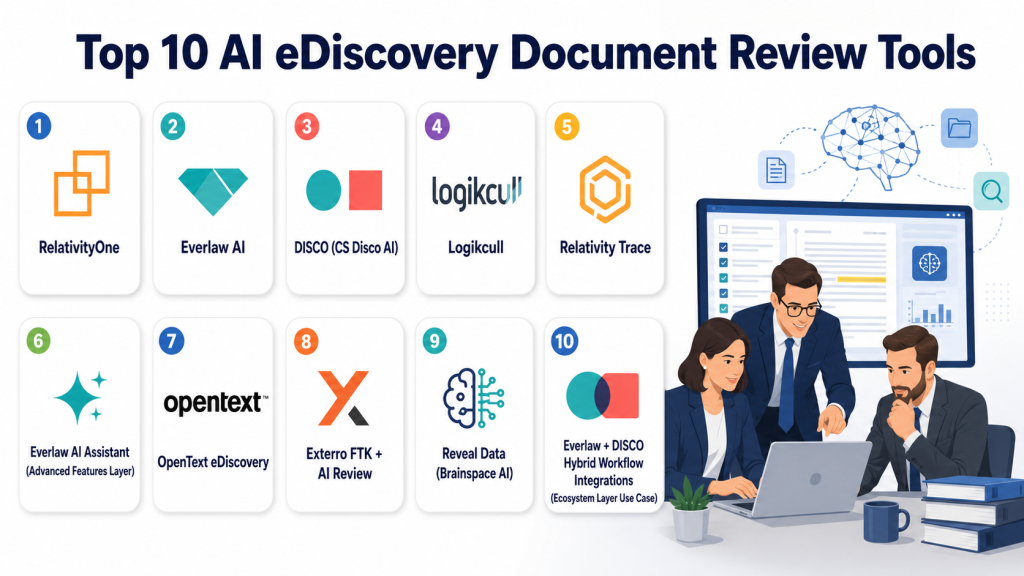
Top 10 AI eDiscovery Document Review Tools
#1 — RelativityOne
One-line verdict: Best enterprise eDiscovery platform for large-scale AI-powered document review and litigation workflows.
Short description:
RelativityOne is a leading cloud-based eDiscovery platform that uses AI to help legal teams process, review, and analyze massive volumes of documents with high accuracy and defensibility.
Standout Capabilities
- AI-assisted document classification
- Predictive coding (relevance ranking)
- Email and communication analysis
- Advanced search and filtering
- Legal hold management
- Document clustering and deduplication
- Case timeline reconstruction
- Review workspace collaboration
AI-Specific Depth
- Model support: Proprietary eDiscovery ML models
- RAG / knowledge integration: Document corpus indexing and retrieval systems
- Evaluation: Continuous relevance scoring based on reviewer feedback
- Guardrails: Legal defensibility and audit trail enforcement
- Observability: Full review analytics dashboards and activity logs
Pros
- Industry-leading scalability
- Strong litigation defensibility
- Excellent collaboration tools
Cons
- Complex onboarding and configuration
- High cost for small teams
- Requires training for full utilization
Security & Compliance
Enterprise-grade encryption, access controls, audit logging, and compliance certifications depending on deployment.
Deployment & Platforms
- Cloud-based (RelativityOne)
- Enterprise web platform
- Secure review environments
Integrations & Ecosystem
- Legal case management systems
- Data ingestion tools
- Forensic collection platforms
- API integrations
- Cloud storage providers
Pricing Model
Enterprise subscription (not publicly stated).
Best-Fit Scenarios
- Large litigation cases
- Regulatory investigations
- Enterprise legal discovery
#2 — Everlaw AI
One-line verdict: Best AI-powered litigation platform for intuitive document review and storytelling-based case building.
Short description:
Everlaw combines AI document review with case narrative building, helping legal teams analyze documents and construct litigation strategies.
Standout Capabilities
- AI document review and classification
- Predictive coding and relevance scoring
- Case timeline builder
- Email threading and analysis
- Document clustering tools
- Collaborative review workflows
- Deposition preparation tools
- Visual case mapping
AI-Specific Depth
- Model support: Proprietary litigation AI models
- RAG / knowledge integration: Case document indexing system
- Evaluation: Relevance prediction based on attorney feedback
- Guardrails: Audit-ready review trails
- Observability: Case analytics dashboards
Pros
- Strong visualization and storytelling tools
- Easy-to-use interface
- Fast document review workflows
Cons
- Less customizable than enterprise-heavy tools
- Limited forensic-level controls
- Not ideal for extremely complex datasets
Security & Compliance
Not publicly stated in full detail; includes enterprise-grade encryption and secure cloud infrastructure.
Deployment & Platforms
- Cloud-based platform
- Web application
- Collaborative litigation workspace
Integrations & Ecosystem
- Legal case systems
- Data ingestion tools
- Cloud storage platforms
- API integrations
- Review management systems
Pricing Model
Subscription-based enterprise pricing.
Best-Fit Scenarios
- Litigation review
- Case storytelling
- Mid-to-large legal teams
#3 — DISCO (CS Disco AI)
One-line verdict: Best high-speed AI eDiscovery platform for fast document processing and review.
Short description:
DISCO provides a high-performance AI-powered eDiscovery platform focused on speed, scalability, and automated document analysis.
Standout Capabilities
- AI document classification engine
- Fast ingestion and processing
- Predictive coding workflows
- Email and chat analysis
- Automated tagging system
- Document clustering and search
- Case management tools
- Review collaboration features
AI-Specific Depth
- Model support: Proprietary legal ML models
- RAG / knowledge integration: Document indexing and retrieval system
- Evaluation: Continuous relevance scoring
- Guardrails: Review validation and audit controls
- Observability: Real-time analytics dashboards
Pros
- Extremely fast processing speed
- Strong AI automation
- Easy-to-use interface
Cons
- Less customizable for complex legal workflows
- Enterprise pricing model
- Limited deep forensic tooling
Security & Compliance
Enterprise-grade security controls with encryption, access management, and audit logging depending on deployment.
Deployment & Platforms
- Cloud-native platform
- Web-based system
- Litigation workspace
Integrations & Ecosystem
- Legal data platforms
- Case management systems
- Cloud storage providers
- API integrations
- Review tools
Pricing Model
Enterprise subscription (not publicly stated).
Best-Fit Scenarios
- High-speed litigation review
- Corporate investigations
- Mid-to-large law firms
#4 — Logikcull
One-line verdict: Best user-friendly AI eDiscovery tool for automated legal document review and investigations.
Short description:
Logikcull simplifies eDiscovery with AI-powered automation designed for fast document ingestion, search, and review.
Standout Capabilities
- Automated document ingestion
- AI-assisted document tagging
- Email and file analysis
- Search and filtering tools
- Legal hold management
- Case collaboration workspace
- Simple review interface
- Export and production tools
AI-Specific Depth
- Model support: Proprietary classification models
- RAG / knowledge integration: Document indexing system
- Evaluation: Relevance tagging and classification scoring
- Guardrails: Standard legal workflow validation
- Observability: Usage and review tracking dashboards
Pros
- Very easy to use
- Fast setup and deployment
- Good for small to mid-size teams
Cons
- Limited advanced analytics
- Not ideal for complex enterprise cases
- Less customization than enterprise tools
Security & Compliance
Not publicly stated in detail; includes encryption and secure cloud storage depending on deployment.
Deployment & Platforms
- Cloud-based platform
- Web interface
Integrations & Ecosystem
- Cloud storage systems
- Legal workflows
- Case management tools
- API integrations
- Compliance systems
Pricing Model
Subscription-based (varies).
Best-Fit Scenarios
- Small to mid-size litigation teams
- Internal investigations
- Simple eDiscovery workflows
#5 — Relativity Trace
One-line verdict: Best AI early case assessment (ECA) tool for identifying key evidence before full review.
Short description:
Relativity Trace focuses on early case assessment by using AI to surface key documents, communication patterns, and potential risks early in litigation.
Standout Capabilities
- Early case assessment (ECA)
- Communication mapping tools
- AI relevance scoring
- Document clustering system
- Email thread reconstruction
- Data visualization dashboards
- Risk identification tools
- Preliminary case insights
AI-Specific Depth
- Model support: Relativity ML models
- RAG / knowledge integration: Communication and document datasets
- Evaluation: Early relevance scoring systems
- Guardrails: Litigation defensibility frameworks
- Observability: Case analytics dashboards
Pros
- Strong early case insights
- Excellent communication analysis
- Reduces review burden significantly
Cons
- Not a full review platform alone
- Requires integration with RelativityOne
- Enterprise complexity
Security & Compliance
Enterprise-grade security with audit logs, encryption, and access controls depending on deployment.
Deployment & Platforms
- Cloud-based system
- Relativity ecosystem integration
Integrations & Ecosystem
- RelativityOne platform
- Legal review systems
- Data ingestion tools
- API integrations
- Forensic tools
Pricing Model
Enterprise subscription (not publicly stated).
Best-Fit Scenarios
- Early case assessment
- Litigation preparation
- Large data investigations
#6 — Everlaw AI Assistant (Advanced Features Layer)
One-line verdict: Best AI enhancement layer for document summarization and case intelligence.
Short description:
Everlaw AI Assistant enhances core review workflows with generative AI capabilities for summarization, analysis, and case insights.
Standout Capabilities
- AI document summarization
- Case insight generation
- Legal document classification
- Deposition prep support
- Narrative building tools
- Search enhancement system
- Review prioritization
- Timeline extraction
AI-Specific Depth
- Model support: Proprietary generative legal AI
- RAG / knowledge integration: Case document corpus system
- Evaluation: Relevance scoring and summary validation
- Guardrails: Legal review validation workflows
- Observability: AI usage analytics dashboards
Pros
- Strong AI-assisted insights
- Easy integration into workflows
- Improves review efficiency
Cons
- Depends on Everlaw ecosystem
- Limited standalone functionality
- Requires structured datasets
Security & Compliance
Not publicly stated; includes enterprise-grade encryption.
Deployment & Platforms
- Cloud-based platform
- Litigation workspace
Integrations & Ecosystem
- Everlaw core platform
- Legal case systems
- Cloud storage
- API integrations
- Review workflows
Pricing Model
Enterprise subscription.
Best-Fit Scenarios
- Case analysis enhancement
- Litigation review acceleration
- Legal research support
#7 — OpenText eDiscovery
One-line verdict: Best enterprise-grade information governance and eDiscovery platform for regulated industries.
Short description:
OpenText provides eDiscovery and information governance tools with AI-powered document classification and legal review capabilities.
Standout Capabilities
- AI document classification
- Information governance tools
- Legal hold automation
- Enterprise data discovery
- Email and file analysis
- Compliance tracking
- Archiving and retention systems
- Case management tools
AI-Specific Depth
- Model support: Enterprise classification models
- RAG / knowledge integration: Enterprise content repositories
- Evaluation: Classification accuracy metrics
- Guardrails: Governance policy enforcement
- Observability: Compliance dashboards
Pros
- Strong enterprise governance
- Good for regulated industries
- Scalable architecture
Cons
- Complex implementation
- Less intuitive UI
- Enterprise-only orientation
Security & Compliance
Enterprise-grade compliance, encryption, audit logs, and governance controls.
Deployment & Platforms
- Cloud and hybrid deployment
- Enterprise governance system
Integrations & Ecosystem
- Enterprise content systems
- Compliance platforms
- Data governance tools
- API integrations
- Security systems
Pricing Model
Enterprise subscription (not publicly stated).
Best-Fit Scenarios
- Regulated industries
- Corporate compliance
- Large-scale data governance
#8 — Exterro FTK + AI Review
One-line verdict: Best forensic eDiscovery platform for deep investigation and digital evidence analysis.
Short description:
Exterro FTK provides forensic-level eDiscovery capabilities with AI-assisted document classification and evidence analysis.
Standout Capabilities
- Digital forensic analysis tools
- AI document classification
- Evidence extraction system
- Data imaging and processing
- Legal review workflows
- Case management system
- Metadata analysis tools
- Email and file reconstruction
AI-Specific Depth
- Model support: Forensic classification models
- RAG / knowledge integration: Evidence indexing system
- Evaluation: Forensic relevance scoring
- Guardrails: Chain-of-custody controls
- Observability: Forensic audit logs
Pros
- Strong forensic capabilities
- Excellent evidence handling
- Trusted in investigations
Cons
- Complex for non-forensic users
- Requires technical expertise
- Slower learning curve
Security & Compliance
High-level forensic security controls, chain-of-custody tracking, and audit logs.
Deployment & Platforms
- Desktop + cloud hybrid
- Forensic investigation system
Integrations & Ecosystem
- Forensic tools
- Legal systems
- Case management platforms
- API integrations
- Security systems
Pricing Model
Enterprise licensing (not publicly stated).
Best-Fit Scenarios
- Digital forensics
- Cybercrime investigations
- Deep legal discovery
#9 — Reveal Data (Brainspace AI)
One-line verdict: Best AI-driven analytics platform for visual eDiscovery and document clustering.
Short description:
Reveal uses AI-powered analytics to cluster documents, visualize relationships, and support eDiscovery workflows.
Standout Capabilities
- AI document clustering engine
- Visual analytics dashboards
- Predictive coding system
- Email thread analysis
- Case mapping tools
- Data visualization engine
- Legal review workflows
- Search optimization tools
AI-Specific Depth
- Model support: Machine learning clustering models
- RAG / knowledge integration: Document embedding system
- Evaluation: Relevance and clustering accuracy
- Guardrails: Review validation workflows
- Observability: Analytics dashboards
Pros
- Strong visual analytics
- Good clustering accuracy
- Useful for large datasets
Cons
- Requires training for full use
- Not standalone review system
- Enterprise complexity
Security & Compliance
Enterprise-grade security with encryption and audit logs.
Deployment & Platforms
- Cloud-based platform
- Enterprise analytics system
Integrations & Ecosystem
- Legal review systems
- Data ingestion tools
- Case management platforms
- API integrations
- Forensic tools
Pricing Model
Enterprise subscription.
Best-Fit Scenarios
- Data-heavy investigations
- Litigation analytics
- Document clustering workflows
#10 — Everlaw + DISCO Hybrid Workflow Integrations (Ecosystem Layer Use Case)
One-line verdict: Best combined workflow approach using AI eDiscovery platforms for end-to-end legal review.
Short description:
Many legal teams combine Everlaw and DISCO workflows for optimized performance across early case assessment, review, and production phases.
Standout Capabilities
- Cross-platform eDiscovery workflows
- AI-assisted document review pipelines
- Case segmentation tools
- Predictive coding integration
- Collaborative review environments
- Evidence management systems
- Legal production workflows
- Multi-tool analytics integration
AI-Specific Depth
- Model support: Platform-dependent AI models
- RAG / knowledge integration: Cross-platform document systems
- Evaluation: Combined relevance scoring systems
- Guardrails: Enterprise review validation workflows
- Observability: Workflow-level analytics dashboards
Pros
- Flexible multi-tool strategy
- Best-of-breed workflow combination
- High scalability for large firms
Cons
- Complex integration setup
- Higher operational overhead
- Requires coordination across tools
Security & Compliance
Depends on underlying platforms used; typically enterprise-grade.
Deployment & Platforms
- Cloud-based hybrid workflows
- Multi-platform integration systems
Integrations & Ecosystem
- Relativity ecosystem
- Everlaw platform
- DISCO platform
- Legal case tools
- API integrations
Pricing Model
Varies based on tools used.
Best-Fit Scenarios
- Large law firms with complex cases
- Multi-phase litigation workflows
- High-volume discovery environments
Comparison Table
| Tool Name | Best For | Deployment | Model Flexibility | Strength | Watch-Out | Public Rating |
|---|---|---|---|---|---|---|
| RelativityOne | Enterprise review | Cloud | Hosted | Scalability | Complexity | N/A |
| Everlaw | Litigation review | Cloud | Hosted | Usability | Limited forensic depth | N/A |
| DISCO | Fast processing | Cloud | Hosted | Speed | Less customization | N/A |
| Logikcull | Simple eDiscovery | Cloud | Hosted | Ease of use | Limited analytics | N/A |
| Relativity Trace | Early case assessment | Cloud | Hosted | ECA insights | Not standalone | N/A |
| Everlaw AI | Case insights | Cloud | Hosted | Summarization | Ecosystem dependency | N/A |
| OpenText | Governance | Hybrid/Cloud | Hosted | Compliance | Complexity | N/A |
| Exterro FTK | Forensics | Hybrid | Hosted | Deep analysis | Technical complexity | N/A |
| Reveal Data | Analytics | Cloud | Hosted | Visualization | Learning curve | N/A |
| Everlaw + DISCO | Hybrid workflow | Multi-cloud | Hosted | Flexibility | Integration complexity | N/A |
Scoring & Evaluation
This scoring reflects comparative capability across document processing accuracy, AI relevance detection, scalability, forensic depth, workflow integration, usability, compliance strength, and enterprise readiness. Scores are relative and should be validated through real litigation scenarios due to dataset size, jurisdiction, and case complexity variations.
| Tool | Core | Reliability/Eval | Guardrails | Integrations | Ease | Perf/Cost | Security/Admin | Support | Weighted Total |
|---|---|---|---|---|---|---|---|---|---|
| RelativityOne | 10 | 10 | 10 | 10 | 7 | 8 | 10 | 9 | 9.0 |
| Everlaw | 9 | 9 | 9 | 9 | 9 | 8 | 9 | 9 | 8.8 |
| DISCO | 9 | 9 | 9 | 9 | 9 | 9 | 9 | 8 | 8.8 |
| Logikcull | 8 | 8 | 8 | 8 | 10 | 10 | 8 | 8 | 8.5 |
| Relativity Trace | 9 | 9 | 9 | 9 | 8 | 8 | 9 | 9 | 8.6 |
| Everlaw AI | 9 | 9 | 9 | 9 | 9 | 8 | 9 | 9 | 8.8 |
| OpenText | 9 | 9 | 10 | 9 | 7 | 8 | 10 | 9 | 8.6 |
| Exterro FTK | 9 | 9 | 10 | 8 | 6 | 7 | 10 | 8 | 8.2 |
| Reveal Data | 8 | 8 | 8 | 8 | 8 | 8 | 8 | 8 | 8.0 |
| Hybrid Workflow | 9 | 9 | 9 | 9 | 7 | 8 | 9 | 8 | 8.4 |
Which AI eDiscovery Document Review Tool Is Right for You?
Solo / Small Legal Teams
Logikcull and Everlaw provide simple, fast, and intuitive document review for smaller cases.
SMB / Mid-Size Law Firms
Everlaw, DISCO, and Reveal Data balance usability with AI-powered analytics.
Enterprise Legal Departments
RelativityOne, Everlaw, and OpenText dominate due to scalability and governance features.
Litigation-Heavy Firms
RelativityOne and Everlaw are preferred for structured review workflows and case storytelling.
Regulatory & Compliance Investigations
OpenText and Exterro FTK are best suited for governance-heavy and forensic environments.
Forensic Investigations
Exterro FTK is the strongest choice for deep evidence-level analysis.
Build vs Buy
eDiscovery systems should always be bought due to complexity of data ingestion, legal defensibility, ML training, and audit requirements.
Implementation Playbook
30 Days: Setup & Pilot
- Define case types and document sources
- Select eDiscovery platform
- Ingest sample datasets
- Test relevance scoring and clustering
- Validate privilege detection accuracy
- Review audit logs and defensibility
60 Days: Integration & Expansion
- Integrate with case management systems
- Expand data sources (email, chat, cloud)
- Configure review workflows
- Train legal teams
- Optimize predictive coding models
- Introduce collaboration workflows
90 Days: Scale & Optimization
- Deploy across active litigation cases
- Standardize review processes
- Improve AI ranking models
- Monitor performance metrics
- Strengthen governance and compliance
- Optimize cost and processing speed
Common Mistakes & How to Avoid Them
- Relying only on keyword search instead of AI relevance
- Ignoring privilege detection validation
- Poor data ingestion quality
- Not training reviewers on AI tools
- Skipping audit logging setup
- Over-trusting predictive coding outputs
- Ignoring cross-platform data sources
- Not configuring legal hold properly
- Lack of workflow standardization
- Underestimating review volume complexity
- Not validating defensibility of AI decisions
- Ignoring multilingual document challenges
- Overloading system with unfiltered datasets
- Failing to integrate with legal case systems
FAQs
1. What is AI eDiscovery document review?
It is the use of AI to analyze and review large volumes of legal documents for litigation or investigations.
2. How does AI improve eDiscovery?
It speeds up review, identifies relevant documents, and reduces manual workload.
3. Can AI replace human reviewers?
No, it assists reviewers but final decisions require human legal judgment.
4. What is predictive coding?
It is AI that learns from attorney decisions to rank document relevance.
5. What types of data can be reviewed?
Emails, PDFs, chat logs, cloud files, and multimedia transcripts.
6. Is AI eDiscovery legally defensible?
Yes, if properly configured with audit trails and validation processes.
7. Can it detect privileged documents?
Yes, many tools include privilege detection models.
8. Is it suitable for small cases?
Yes, but simpler tools like Logikcull are better for small-scale use.
9. Does it support real-time collaboration?
Yes, most enterprise tools support collaborative review.
10. Can it handle terabytes of data?
Yes, enterprise platforms are built for large-scale datasets.
11. Is multilingual support available?
Yes, many platforms support multilingual document processing.
12. What is early case assessment?
It is AI-driven analysis of early evidence to guide legal strategy.
13. How secure is eDiscovery AI?
Enterprise tools include encryption, access control, and audit logging.
14. What is the biggest limitation?
Contextual legal interpretation still requires human expertise.
Conclusion
AI eDiscovery Document Review Tools are revolutionizing legal investigations by enabling rapid, scalable, and intelligent analysis of massive document sets. They significantly reduce manual review burden while improving accuracy, speed, and litigation readiness.RelativityOne, Everlaw, and DISCO lead enterprise adoption with powerful AI-driven review systems, while Logikcull simplifies access for smaller teams. OpenText and Exterro FTK provide governance and forensic depth, and Reveal Data adds strong visualization and analytics capabilities.The most successful implementations combine AI-powered relevance scoring with human legal expertise, strong governance frameworks, and well-structured workflows. When properly deployed, these tools transform eDiscovery from a manual bottleneck into a strategic advantage for legal teams.

Find Trusted Cardiac Hospitals
Compare heart hospitals by city and services — all in one place.
Explore Hospitals
One area that deserves additional attention is the governance of AI-assisted document review in large-scale eDiscovery matters. As datasets grow into millions of files, legal teams must be able to demonstrate that relevant evidence has been consistently identified and that privileged information has not been inadvertently exposed. Exploring topics such as model performance monitoring, statistically driven quality checks, defensible review workflows, and integrations with legal hold and case management systems would provide a more practical perspective on deploying these tools in complex litigation and regulatory investigations.