
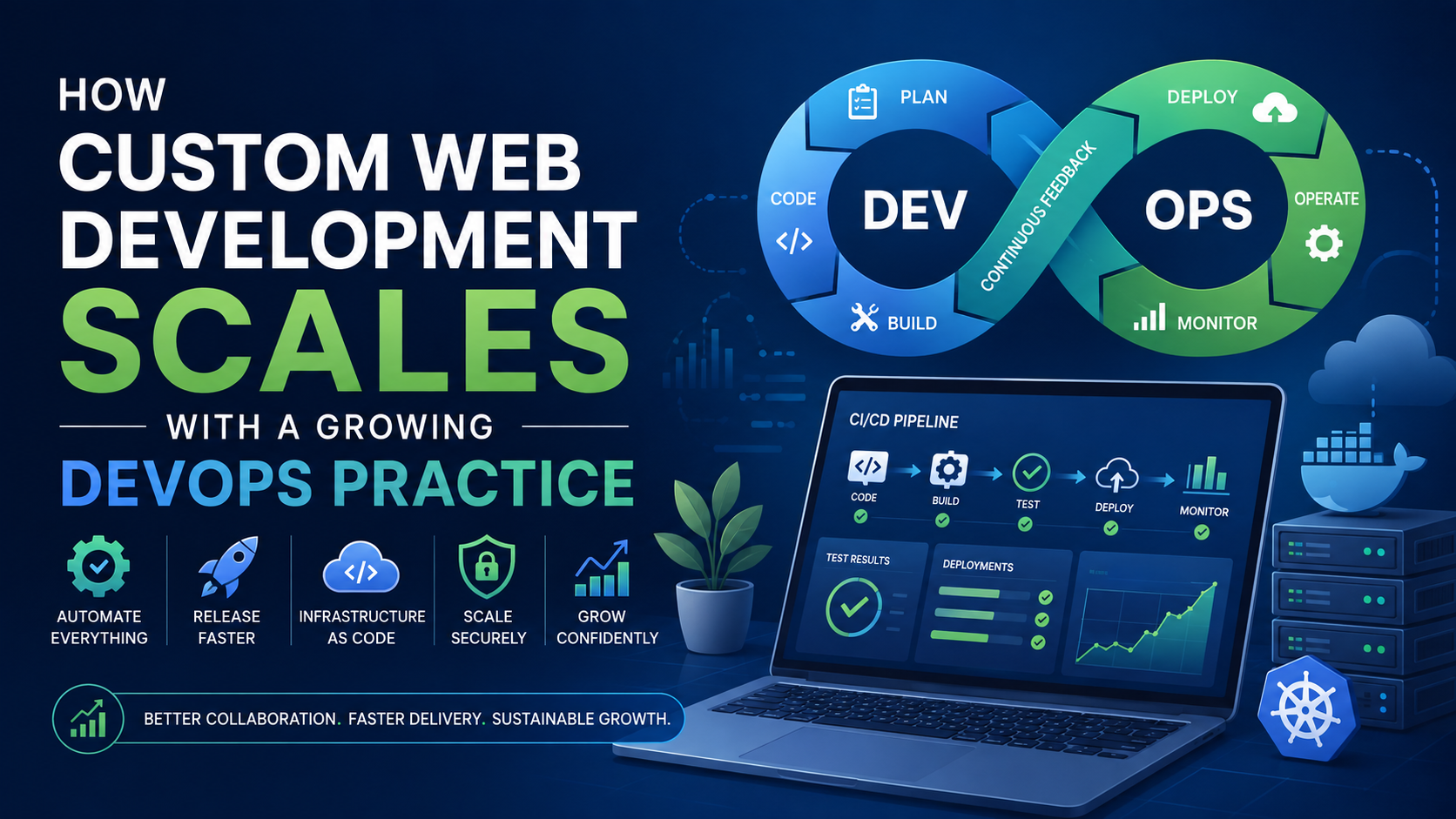
Custom application development is a base for businesses looking to create customized solutions that meet their unique requirements. But the intricacy and dynamic nature of technology necessitate more effective development processes.
This is where DevOps takes operational efficiency to the next level. DevOps helps businesses improve productivity, accelerate application deployment, and optimize workflows by merging development (Dev) and operations (Ops) into a single framework.
When these two domains collaborate, businesses can expand their online presence without compromising accuracy, speed, or security. Let’s understand how increasing DevOps practices helps custom web development grow.
What Is the Connection Between Custom Web Development and DevOps?
Custom web development is the process of creating a website or online application from scratch in accordance with a company’s unique needs. DevOps is a collection of practices that integrates IT operations (Ops) with software development (Dev) to offer continuous delivery of high-quality software and reduce the system development life cycle.
When combined, they create a pipeline that allows code to get from an idea to an active feature in a shorter amount of time. DevOps plays an even more important part in the development of custom applications, as it speeds up the process while ensuring collaboration between the development, testing, and operations teams.
Why Custom Web Application Scalability Matters as Your Business Grows?
Custom web application scalability creates new expectations, including:
- Increased user traffic beyond the capacity of a single server.
- Growing data quantities that demand improved infrastructure.
- Better performance and durability standards.
- Regular feature releases to maintain competitiveness.
- A larger development team that requires reliable procedures.
Since custom-made web apps are developed on the actual architecture of the company rather than a generic template, they are naturally more flexible to these demands than generic solutions. This flexibility becomes quantifiable operational efficiency when combined with DevOps practices.
What Are the Key Ways Custom Development Scales With DevOps?
Integrating particular DevOps practices is important for successful custom application development. The following are the main DevOps practices that have the power to change everything:
- Automation in Deployment and Testing
Automation is the foundation of DevOps. Automating repetitive operations is highly beneficial for developing custom applications. Automation lowers manual labor, decreases errors, and speeds up the development process in multiple contexts, including unit testing and application deployment across different environments.
For example, development teams can find bugs early and release stable programs more quickly by automating testing. Automated deployment lowers the possibility of post-deployment problems by ensuring that applications are launched consistently and smoothly.
- Keeping Up With Quick Release Cycles
Deployment frequency often rises rapidly as DevOps matures. However, the capability for developing applications does not necessarily increase at the same rate.
Many teams reach a point where their DevOps pipeline is mature, but the application layer can’t keep pace. That’s usually when it makes sense to bring in dedicated web development services rather than stretch an already busy internal team, so releases stay fast without piling onto your engineers.
Organizations may maintain development momentum while assuring product quality and innovation continue to advance by supplementing internal resources with specialized skills.
- Infrastructure as Code (IaC)
Infrastructure as Code (IaC) is a practice introduced by DevOps. It enables infrastructure to be provided and controlled via code, making the entire process scalable, repeatable, and less prone to human error.
Infrastructure as Code enables DevOps teams to define and maintain infrastructure using version-controlled scripts. This means:
- It takes minutes, not days, to create new ecosystems.
- Disaster recovery becomes more reliable and quicker.
- Standardized templates minimize configuration errors.
- The environments used for development, staging, and production remain constant.
Businesses can use IaC to automate server, network, database, and other setup tasks, ensuring consistently deployed and manageable environments.
- Continuous Integration and Continuous Deployment (CI/CD)
Continuous Integration (CI), which refers to the routine merging of code changes into a shared repository. It is one of the most important DevOps practices. This process improves the overall quality of the code by helping in the early detection and resolution of conflicts.
Continuous Deployment (CD) goes one step further by automating the deployment of apps. Any modification that passes automated testing with CD is put into production right away. This means that companies can quickly and successfully implement upgrades, modifications, or new features without experiencing any interruptions.
- Containerization and Microservices
Many growing companies switch from monolithic apps to microservices, which divide a big application into smaller, separately deployable services. These services can be containerized using tools like Docker and Kubernetes to ensure consistent operation across multiple environments.
This process enables horizontal scaling of custom web development. This is how it is beneficial:
- One microservice failure is less likely to bring down the system as a whole.
- It is possible to scale or upgrade specific services without affecting the entire application.
- Teams can work on multiple services simultaneously without crashing into each other’s code.
Instead of rewriting the entire application to manage increased demand, teams can easily scale specific microservices, such as a payment processor, a search function, or a user authentication system.
Final Words
Scaling a business online isn’t just about building more features; it’s about building the right infrastructure to support sustainable growth. DevOps and custom web development are two facets of the same process.
DevOps enables businesses to create superior custom applications that satisfy client needs and grow with the business. DevOps enables businesses to create superior custom applications that satisfy client needs and grow with the business by promoting teamwork, simplifying processes, and ensuring scalability.

Find Trusted Cardiac Hospitals
Compare heart hospitals by city and services — all in one place.
Explore Hospitals
As development and operations become more mature, the application’s internal dependencies can become the real constraint on delivery speed. I’d pay particular attention to database coupling, shared configuration, third-party services, and long-running integration tests. Making these dependencies visible through service-level monitoring and dependency mapping can help teams identify what actually limits deployment frequency before simply adding more automation.