
Introduction
Organizations today rely heavily on data to make critical decisions, power customer applications and build machine-learning models. However, as companies adopt cloud platforms, real-time streaming systems and increasingly complex analytics pipelines, managing data workflows becomes a significant operational challenge. Traditional data workflows often suffer from brittle pipelines, undetected data quality issues, manual deployments and poor communication between teams.
When data breaks, downstream dashboards fail, machine-learning models ingest corrupted features and business leaders lose trust in analytics. Addressing these challenges requires a shift in mindset and operational discipline. This is where What is DataOps becomes a central question for modern organizations. DataOps brings together collaboration, automation, testing, governance and continuous delivery to transform how data flows from source to value.
What Is DataOps?
What is DataOps? At its core, DataOps is a set of practices, processes and cultural philosophies that unifies data engineering, data integration, testing, security and operations. It borrows heavily from the principles of Agile software development and DevOps, applying them specifically to the unique lifecycle of data.
DataOps emerged because managing data is fundamentally different from managing traditional software code. While software engineering focuses primarily on code logic, data workflows deal with constantly changing data volumes, schema shifts, third-party source variations and complex state dependencies. DataOps addresses these realities by emphasizing continuous integration and delivery, automated testing, version control, monitoring, observability, governance and rapid feedback loops. By treating data pipelines with the same operational rigor as production software, teams ensure reliable data delivery across the entire enterprise.
Why DataOps Matters for Modern Data Teams
Modern data teams face an array of persistent bottlenecks. They often struggle with complex pipelines spanning multiple cloud services, unannounced schema changes from source systems and chronic data quality problems. Many organizations still rely on manual workflows for deployments, leading to slow release cycles, frequent pipeline failures and high stress during operational incidents.
Furthermore, governance requirements are stricter than ever, yet communication gaps often persist between data engineers, analysts and business stakeholders. Without operational discipline, maintaining reliable data products becomes nearly impossible. DataOps practices help address these challenges by replacing ad-hoc firefighting with structured automation, rigorous testing and clear ownership models, enabling teams to catch errors before they impact downstream consumers.
Core Principles of DataOps
An effective DataOps operating model rests on several foundational principles designed to bring predictability and speed to data pipelines.
- Collaboration: Breaking down silos between data engineers, data scientists, software developers and business analysts so everyone shares ownership of data reliability.
- Automation: Eliminating manual steps in data ingestion, transformation, testing and deployment to reduce human error and speed up delivery.
- Continuous Improvement: Using post-incident reviews, feedback loops and performance metrics to constantly refine pipelines and operational processes.
- Data Quality: Embedding continuous validation rules throughout the pipeline to catch anomalies, missing values and schema violations early.
- Version Control: Treating data pipeline code, configurations and orchestration definitions as first-class citizens stored in repositories with full history tracking.
- Testing: Implementing automated unit, integration and regression testing for data assets just as software teams test application code.
- Observability: Moving beyond basic uptime monitoring to track data freshness, volume trends, lineage and pipeline health in real time.
- Reproducibility: Ensuring that data transformations and model training runs can be consistently re-executed in different environments.
- Governance: Integrating security, access control and lineage tracking naturally into the pipeline lifecycle without slowing down delivery.
- Faster and Reliable Delivery: Streamlining the journey of data products from development to production with minimal friction and high confidence.
What Does DataOps Training Teach?
Transitioning toward an operational model requires continuous learning and skill development. A comprehensive DataOps Training program helps professionals master the intersection of data engineering, software automation and operations.
Learners explore data pipeline concepts, the complete data lifecycle, CI/CD mechanisms for data workflows, automated testing frameworks and advanced data quality management. Training also covers pipeline orchestration, monitoring, observability, governance enforcement and troubleshooting techniques. Crucially, effective training combines conceptual understanding with practical exercises, equipping engineers and architects to design resilient workflows that foster seamless collaboration between data and engineering teams.
How to Choose a DataOps Course
Selecting the right educational path is an important step for career development. When evaluating a DataOps Course, professionals should look closely at the curriculum depth, the availability of practical labs and the real-world experience of the instructors.
An ideal course should cover modern toolchains, address common production scenarios and provide clear assessments to validate learning. Learners should consider whether the format matches their schedule, whether the content caters to beginner or advanced levels, and how well the curriculum aligns with corporate learning requirements or ongoing professional development resources.
Creating a Practical DataOps Tutorial
A useful DataOps Tutorial provides step-by-step guidance through a simplified end-to-end workflow, helping learners visualize how different operational components fit together.
A practical tutorial typically walks through data ingestion from a sample source, basic data transformation, version control management, automated validation checks, pipeline execution and monitoring. By demonstrating how data quality checks and deployment steps handle simulated failures, tutorials give practitioners a safe space to understand incident handling and operational recovery without production risks.
DataOps Tools and the Modern Data Toolchain
Tools play a vital role in executing a DataOps strategy, enabling teams to automate repetitive tasks and maintain visibility across complex architectures. However, tool selection depends entirely on specific organizational needs rather than industry hype.
The modern ecosystem includes version control systems, CI/CD runners, data integration platforms, pipeline orchestration engines, transformation frameworks, cloud databases, streaming systems, containerization technologies and cloud infrastructure. Additional tool categories focus specifically on monitoring, observability, data quality enforcement and governance. A well-designed toolchain supports a cohesive operating model rather than creating disjointed technical silos.
How to Build an Effective DataOps Toolchain
Building an efficient toolchain requires a careful assessment of existing infrastructure, data volumes, pipeline complexity and team skill sets. Organizations must weigh their cloud strategy, security constraints, governance mandates and integration requirements before adopting new software.
Maintenance effort and scalability are critical factors; introducing too many specialized tools can lead to integration overhead and tool fatigue. The primary objective is to select technologies that integrate smoothly, support robust observability and empower teams to deliver trusted data efficiently.
DataOps Certification and Professional Development
As organizations mature their data practices, professionals increasingly seek ways to validate their expertise. A DataOps Certification demonstrates a practitioner’s solid understanding of operational concepts, workflow automation, quality practices and governance principles.
Certification should serve as a complement to hands-on industry experience rather than a replacement for it. It signals to peers and employers that an individual knows how to apply engineering rigor to data pipelines, maintain high operational awareness and build scalable architectures.
The Role of a Certified DataOps Engineer
A Certified DataOps Engineer focuses on the day-to-day implementation, automation and reliability of data pipelines. Their responsibilities include building and maintaining robust workflows, writing automated tests, setting up CI/CD pipelines and configuring real-time monitoring and alerting.
Certified engineers troubleshoot pipeline failures, ensure data quality standards are met and integrate diverse tools across the data stack. They act as a bridge between data creators and consumers, collaborating closely with data engineers, analysts and machine-learning teams to maintain high pipeline reliability.
The Role of a Certified DataOps Architect
While engineers focus on pipeline execution and tooling, a Certified DataOps Architect designs the broader data platform vision. Their responsibilities center around enterprise data platform architecture, scalability, integration patterns, security frameworks and infrastructure decisions.
Architects define platform standards, establish enterprise operating models, ensure robust governance and balance cost against performance. They look across the entire organization to design scalable foundations that support secure, observable and reliable data operations at scale.
DataOps Consulting for Organizations
Many enterprises encounter roadblocks when scaling their data operations internally. Organizations often seek DataOps Consulting when they face persistent pipeline reliability problems, poor data quality, manual deployments or a complete lack of pipeline observability.
Consultants help address governance challenges, simplify bloated toolchains, facilitate cloud migrations and bridge team capability gaps. Effective consulting engagements always begin with a thorough assessment of business requirements and existing processes before proposing technical changes or tool replacements.
Understanding DataOps Services
Professional DataOps Services help organizations design, build and optimize their operational environments. These services typically span data platform assessment, custom pipeline implementation, CI/CD automation setup, data quality improvement frameworks and observability integration.
Additional service areas often include governance support, platform optimization, operational support, team training and managed support arrangements. These offerings allow companies to accelerate their operational maturity while ensuring internal teams retain the knowledge needed for long-term success.
DataOps vs DevOps
While DataOps shares a common ancestry with DevOps, they serve distinct domains. DevOps focuses primarily on software application code, infrastructure provisioning and application delivery lifecycles. DataOps adapts these core philosophies—such as automation, collaboration, CI/CD, monitoring, testing and continuous improvement—specifically to data-intensive workflows.
DataOps accounts for the unique challenges of data assets, including stateful data dependencies, schema drift, data freshness requirements and analytical validation. It is not simply a rebranding of DevOps, but a specialized discipline tailored to the realities of modern data engineering.
DataOps and Data Quality
Data quality is the heartbeat of any data operation. Ingesting high volumes of data quickly provides little value if the underlying information is inaccurate, incomplete, inconsistent or untimely.
DataOps embeds automated data quality checks directly into the pipeline execution flow. By validating data types, checking constraints, monitoring value distributions and tracking data lineage, teams can detect anomalies immediately. Proactive issue detection prevents corrupted data from polluting analytical dashboards and machine-learning models, safeguarding business decisions.
DataOps and Observability
Traditional monitoring typically tells a team whether a pipeline job succeeded or failed, but it often fails to explain why downstream analytics look incorrect. Data observability goes deeper, tracking pipeline health, data freshness, schema changes, processing delays and subtle data quality signals in real time.
Comprehensive observability empowers data teams to investigate root causes quickly, trace data lineage across complex transformations and issue targeted operational alerts before business stakeholders notice discrepancies in their reports.
DataOps for Governance and Security
Security and governance cannot be treated as an afterthought in modern data environments. DataOps practices work alongside governance frameworks by embedding access controls, data ownership definitions and auditability directly into the deployment lifecycle.
Automated data lineage tracking, strict environment separation, secure secrets management and consistent policy enforcement help organizations meet compliance requirements while maintaining agility. Treating governance as an integrated part of pipeline development ensures security without creating bureaucratic bottlenecks.
How to Build a DataOps Learning Path
Embarking on a career in data operations requires a structured approach to skill acquisition. A successful learning journey typically follows a clear progression starting with data fundamentals and moving toward advanced architectural concepts.
- Data Fundamentals: Grasping basic database structures, SQL, cloud storage concepts and core data engineering principles.
- DataOps Concepts: Understanding the cultural and operational philosophies connecting agile delivery with data pipelines.
- Pipeline Development: Learning how to ingest, transform and orchestrate data using standard frameworks.
- Automation: Mastering scripting, workflow scheduling and infrastructure-as-code principles.
- Testing: Writing unit and integration tests for data transformations and schema validations.
- CI/CD: Implementing continuous integration and deployment pipelines for data code and configurations.
- Observability: Setting up monitoring, logging, lineage tracking and alerting mechanisms.
- Governance: Integrating security, access policies and compliance checks into operational workflows.
- Advanced Architecture: Designing scalable, enterprise-grade data platforms and operating models.
Combining theoretical study with hands-on labs and real-world problem-solving ensures learners develop practical, job-ready capabilities.
Common Mistakes Organizations Make When Adopting DataOps
Organizations embarking on their operational transformation often stumble into predictable traps. One common mistake is treating DataOps as purely a collection of software tools rather than a cultural and procedural shift. Automating broken or inefficient processes only results in faster failures.
Other frequent pitfalls include ignoring data quality, skipping automated testing, neglecting observability and failing to define clear data ownership. Many teams select popular tools before understanding their actual requirements, or they fail to train their staff adequately, expecting an instant transformation. Avoiding these mistakes requires focusing on people and processes first, supported by the right technology choices.
How DataOpsSchool Can Help
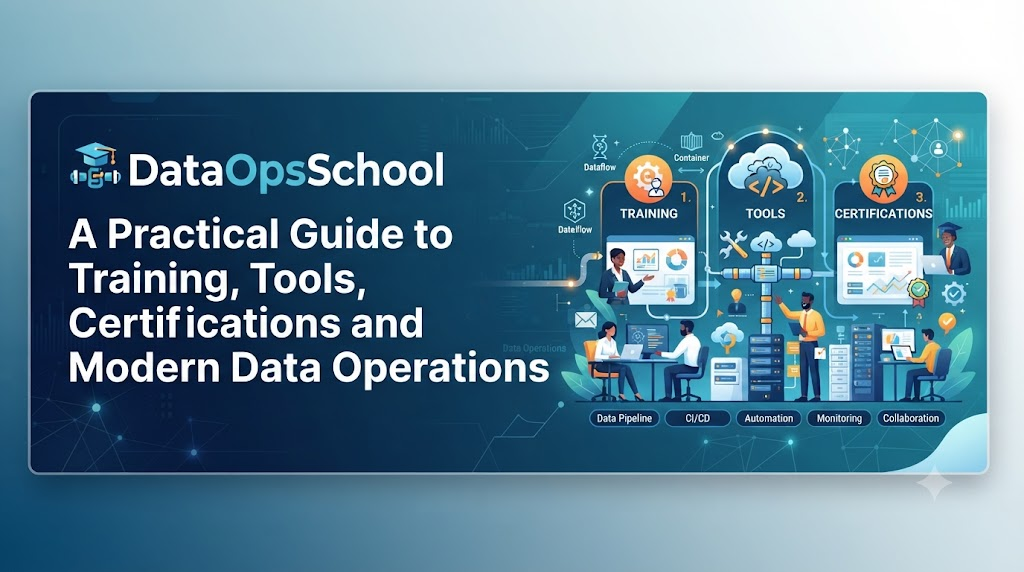
Organizations and professionals looking to deepen their expertise can explore platforms dedicated to advancing data operations. DataOpsSchool.com offers comprehensive resources focused on DataOps training, certifications, consulting and services for modern data teams.
The platform structures its offerings around practical, hands-on learning, role-based training programs, data quality management, governance, CI/CD, automated testing, observability and modern data architectures. With role-based certification paths such as Certified DataOps Engineer and Certified DataOps Architect, learners can validate their practical skills using real-world playbooks, templates and labs designed for modern data environments.
The Future of DataOps
The landscape of data operations continues to evolve rapidly. Future developments point toward greater integration of AI-assisted data operations, automated data quality remediation, advanced data observability and cloud-native data platforms.
Platform engineering for data is gaining traction, encouraging teams to treat internal data platforms as internal products. As real-time data workflows expand and machine-learning operations converge with traditional data engineering, DataOps will remain the foundational discipline enabling organizations to deliver reliable, trusted data at scale.
Conclusion
As organizations increasingly depend on data to drive strategy and customer experiences, the need for robust operational discipline has never been greater. Successful DataOps relies on a harmonious balance between people, processes and technology, proving that tools alone are not enough.
By embracing collaboration, automation, rigorous testing, governance and continuous improvement, engineering teams can build resilient pipelines that deliver high-quality data reliably. Professionals and organizations exploring these practices can look to resources like DataOpsSchool.com to guide their journey through DataOps training, certification, consulting and services.

Find Trusted Cardiac Hospitals
Compare heart hospitals by city and services — all in one place.
Explore Hospitals