
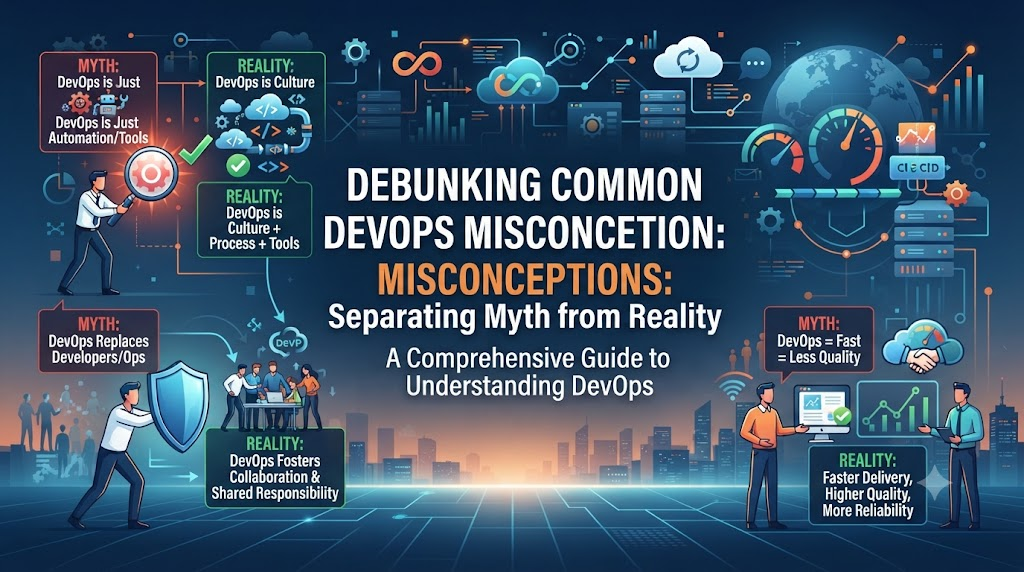
DevOps has transformed from an experimental industry trend into the undisputed backbone of modern software engineering. By bridging the gap between software development and IT operations, DevOps promises faster delivery, higher reliability, and closer alignment with business goals. However, because DevOps sits at the intersection of culture, processes, automation, development, operations, security, and infrastructure practices, it remains one of the most misunderstood disciplines in tech.
These misunderstandings span across industries, affecting beginners breaking into the field, developers shifting left, operations teams guarding stability, and organizational leaders driving digital transformation. To succeed, teams must move past buzzwords and look closely at what DevOps really means, what it does and does not involve, and how to approach it in real-world environments.
What Is DevOps Really?
At its core, DevOps is not a product, software package, or discrete job title. It is a cultural philosophy, set of practices, and automation mindset designed to shorten the software development lifecycle while delivering features, fixes, and updates frequently and safely.
Traditionally, development and operations worked in silos. Developers wrote code and tossed it over the wall to operations teams responsible for deployment and stability. This wall created friction, delayed releases, and fostered a blame-shifting culture when things broke in production. DevOps replaces these walls with shared responsibility, continuous integration, continuous delivery (CI/CD), infrastructure as code (IaC), comprehensive monitoring, and continuous feedback loops.
Understanding these principles helps organizations clear up the widespread DevOps myths and facts that often derail transformation initiatives.
Myth: DevOps Is Just a Set of Tools
Many organizations assume that adopting DevOps is as simple as purchasing software or installing a stack of tools like Jenkins, Docker, Kubernetes, or Terraform.
The Reality
Tools are merely enablers, not the destination. A tool cannot fix a broken corporate culture, poor communication, or manual, ill-defined processes. DevOps centers primarily on culture, processes, collaboration, automation, and continuous improvement. Buying advanced software without changing how teams communicate and collaborate only automates existing dysfunctions faster.
Myth: DevOps Means Developers Do Operations
A common fear among traditional operations professionals is that DevOps means developers will take over server management, leaving sysadmins obsolete. Conversely, some developers fear they will spend all their time managing infrastructure instead of writing application logic.
The Reality
DevOps relies on a shared-responsibility model. Development and operations teams collaborate closely rather than transferring complete workloads across a rigid boundary. Developers gain visibility into production environments and write application code keeping operational telemetry in mind, while operations teams build robust internal platforms and guardrails that empower developers to deploy safely.
Myth: DevOps Eliminates Operations Teams
With the rise of cloud computing and automated pipelines, some executives mistakenly believe they no longer need dedicated operations talent.
The Reality
Modern DevOps shifts operational responsibilities, but it does not eliminate the need for deep expertise. While routine server provisioning becomes automated, organizations increasingly rely on operations and platform engineers to design scalable architectures, maintain system reliability, secure infrastructure, handle complex incidents, and build internal developer platforms.
Myth: DevOps Is Only About CI/CD
Continuous Integration and Continuous Deployment (CI/CD) pipelines receive the lion’s share of attention in DevOps discussions, leading some to believe that having a pipeline equates to doing DevOps.
The Reality
While CI/CD is vital for automated builds and testing, it represents only one facet of a broader engineering ecosystem. A complete DevOps strategy encompasses infrastructure management, proactive monitoring, security compliance, cross-team collaboration, structured incident management, and continuous organizational feedback loops.
Myth: DevOps Means Automating Everything
A popular directive given to newly formed platform teams is to “automate everything” from day one.
The Reality
Automation brings immense value, but it has limits. Blindly automating a broken, poorly understood process only leads to automated failures happening at scale. Teams should first map, understand, and refine a process manually before writing automation scripts around it. Not every edge case or infrequent task warrants the engineering overhead of full automation.
Myth: DevOps Automatically Makes Software Delivery Faster
Some managers adopt DevOps expecting immediate velocity gains, assuming deployment frequency will skyrocket overnight.
The Reality
DevOps can drastically improve delivery speed, but results depend heavily on existing engineering practices, system architecture, automation maturity, team collaboration, rigorous testing, and internal organizational processes. If an application architecture is monolithic and tightly coupled, or if testing takes hours of manual effort, pipelines will stall regardless of how many DevOps practices are introduced.
Myth: DevOps Sacrifices Quality for Speed
Skeptics argue that pushing software out the door faster inevitably compromises stability, security, and overall user experience.
The Reality
Sustainable DevOps actually enhances quality. High-performing DevOps environments rely on automated testing, continuous integration, deployment validation, robust observability, and smaller, incremental releases. Breaking changes into smaller batches makes bugs easier to isolate, test, and fix than massive, high-risk quarterly releases.
Myth: DevOps Is Only for Large Technology Companies
Small businesses and traditional non-tech enterprises often assume DevOps is a luxury reserved for tech giants with massive engineering budgets.
The Reality
Organizations of all sizes can adopt DevOps principles. While implementation scale varies, small startups benefit immensely from DevOps automation, allowing small teams to manage infrastructure efficiently without heavy operational overhead. Tailoring the approach to organizational scale ensures that even legacy enterprises can modernize incrementally.
Myth: DevOps Is Only for Cloud-Based Applications
There is a widespread belief that true DevOps practices only function in native cloud environments like AWS, Azure, or Google Cloud.
The Reality
While cloud-native environments offer native APIs and elasticity that simplify automation, DevOps practices apply equally well to hybrid, on-premises, and legacy environments. Version control, automated testing, configuration management, and collaborative workflows provide value regardless of where the underlying workloads reside.
Myth: You Need to Learn Every DevOps Tool
The vast landscape of available software tools often overwhelms beginners trying to master every single technology on the market.
The Reality
Trying to learn every tool is a losing battle because the technology landscape shifts rapidly. Understanding fundamental concepts—such as how networking works, how code moves through a pipeline, how version control tracks changes, and how infrastructure scales—matters far more than memorizing a specific vendor’s interface. Professionals should select and learn tools based on concrete project requirements.
Myth: Kubernetes Is Mandatory for Every DevOps Engineer
Kubernetes has become a dominant container orchestrator, leading many to believe that using it is a strict prerequisite for any modern engineering environment.
The Reality
Kubernetes is powerful for managing complex, highly scalable containerized microservices, but it introduces significant operational and cognitive overhead. For simple applications, serverless architectures, or small monolithic workloads, simpler deployment approaches are far more appropriate and cost-effective. Technology choices should match workload complexity, not industry hype.
Myth: DevOps Engineers Must Be Expert Programmers
Job descriptions often list extensive software development requirements alongside infrastructure skills, intimidating candidates who view themselves primarily as operations professionals.
The Reality
While scripting and basic programming (such as Python, Go, or Bash) are essential for writing automation and infrastructure code, DevOps engineers do not need to be enterprise software developers building complex business logic. The focus centers on automation, troubleshooting, infrastructure scripting, and understanding application behavior from an operational standpoint.
Myth: DevOps Is the Same as SRE
Terms like DevOps and Site Reliability Engineering (SRE) are frequently used interchangeably in job postings and industry discussions.
The Reality
While closely related and sharing cultural philosophies, they have distinct origins and focus areas. DevOps focuses broadly on breaking down silos and accelerating software delivery across the entire lifecycle. SRE, originally pioneered at Google, focuses heavily on reliability, defining Service Level Objectives (SLOs), managing error budgets, and applying software engineering to operations problems. SRE can be viewed as a specific implementation of DevOps principles focused on reliability.
Myth: DevSecOps Is a Completely Separate Discipline
Some teams treat security as an isolated phase handled by a separate security team at the very end of the development cycle, or conversely, assume DevSecOps is an entirely different profession.
The Reality
DevSecOps is not a separate discipline; it is an evolution of DevOps that integrates security practices (“shifting left”) into every stage of the software delivery pipeline. Security scanning, vulnerability assessment, and compliance checks become automated components of CI/CD workflows rather than bottlenecks at the final release gate.
Myth: DevOps Removes the Need for Manual Testing
With the heavy emphasis on automated testing within pipelines, some assume human testers are no longer necessary.
The Reality
While automated unit and integration tests handle repetitive validation, manual exploratory testing, usability validation, complex user-journey checks, and security penetration testing remain critical. Human intuition and creativity catch nuanced user-experience issues and edge cases that automated scripts miss entirely.
Myth: More Deployments Always Mean Better DevOps
Some engineering teams obsess over deployment frequency, treating raw numbers as the ultimate indicator of success.
The Reality
Deployment frequency is a useful metric, but it should never be treated in isolation. True engineering success balances delivery speed with quality, reliability, Mean Time to Recovery (MTTR), change failure rate, and meaningful business outcomes. Deploying broken code rapidly simply results in faster failures.
Myth: DevOps Is Only a Technical Transformation
Many digital transformations fail because leadership focuses exclusively on adopting new software platforms while ignoring the human element.
The Reality
DevOps is fundamentally an organizational and cultural transformation. Communication patterns, leadership styles, team structures, incentives, and shared ownership determine success far more than the underlying technology stack. If teams operate in silos, technical tooling will fail to bridge the gap.
Myth: DevOps Can Be Implemented by Buying the Right Tools
Executive leadership sometimes believes that writing a purchase order for enterprise software is enough to achieve a successful DevOps transformation.
The Reality
No software purchase can substitute for process improvements, ongoing training, cultural evolution, automation discipline, metric measurement, and continuous learning. Tools support the journey, but people and processes drive it.
Myth: DevOps Has a Fixed Toolchain
Many beginners search for the “official” DevOps toolchain to learn, expecting a standardized list of software that applies universally.
The Reality
There is no universal DevOps toolchain. Organizations carefully choose tools based on their existing technology stacks, security requirements, team skill sets, budget constraints, compliance mandates, and operational needs. A toolchain that works for a high-growth fintech startup may not suit a heavily regulated healthcare enterprise.
Myth: DevOps Eliminates Production Problems
A common misconception is that mature DevOps practices lead to a completely flawless, bug-free production environment where incidents never occur.
The Reality
Complex distributed systems will always experience failures. The goal of DevOps is not to achieve an impossible zero-failure state, but to detect, respond to, and learn from failures more effectively through robust monitoring, rapid rollback capabilities, and blameless post-mortems.
Myth: DevOps Is a One-Time Implementation Phrase
Companies often treat DevOps adoption as a project with a defined start date and end date, after which they can declare the transformation “complete.”
The Reality
DevOps is a continuous journey of ongoing optimization, automation refinement, feedback gathering, metric measurement, and cultural adaptation. As business requirements, technologies, and team structures evolve, practices must adapt continuously.
Myth: DevOps Certification Alone Makes You a DevOps Engineer
Earning a certification is a popular milestone, but holding a certificate does not automatically equate to practical competence.
The Reality
Certifications validate foundational knowledge, but practical engineering ability comes from hands-on labs, real-world projects, troubleshooting broken pipelines, managing production environments, and writing automation code. Real experience matters far more than paper credentials.
Myth: AI Will Replace DevOps Engineers
With the rapid emergence of generative AI and automated operations assistants, some professionals worry about long-term job security.
The Reality
AI and AIOps tools provide powerful assistance with routine automation, code generation, log analysis, observability insights, and incident triage. However, they do not replace human judgment, architectural decision-making, security governance, stakeholder alignment, and accountability. AI acts as an accelerator for skilled engineers rather than a replacement.
What DevOps Actually Looks Like in a Real Organization
To understand how these concepts manifest in daily work, consider a real-world enterprise example.
In a high-performing engineering organization, product managers, developers, quality assurance engineers, security specialists, and platform teams collaborate from the planning phase onward.
- During planning, security requirements are defined alongside feature specifications.
- Developers write code locally, using containerized environments that mirror production.
- When code is pushed to version control, automated CI pipelines execute unit tests, static code analysis, and security vulnerability scans.
- Upon passing, code merges into the main branch, and continuous delivery pipelines automatically deploy the update to a staging environment.
- Once validated, automated progressive delivery mechanisms release the feature to a small percentage of production users, monitored closely via centralized observability dashboards.
If error rates spike, automated alerts notify the team, and rollback mechanisms restore stability within minutes, followed by a blameless retrospective to improve system resilience.
How Beginners Can Build a Realistic Understanding of DevOps
For professionals looking to build a sustainable, practical career in the field, a structured learning path is essential:
- Learn core concepts before tools: Understand the philosophy of collaboration, feedback loops, and flow.
- Practice Linux and networking: Master command-line fundamentals, file permissions, DNS, and TCP/IP.
- Learn Git: Understand version control branching, merging, and collaboration workflows.
- Build CI/CD pipelines: Learn how code moves from a local machine to automated test suites.
- Practice Infrastructure as Code (IaC): Learn how to provision infrastructure programmatically using tools like Terraform.
- Work with containers: Understand containerization concepts using Docker.
- Learn cloud fundamentals: Explore core cloud computing models and services.
- Study monitoring and observability: Learn how to collect logs, metrics, and traces.
- Practice troubleshooting: Develop systematic problem-solving skills when systems break.
- Build real projects: Apply these skills by building end-to-end deployment pipelines for sample applications.
How DevOps Training Can Help Clear These Misconceptions
Navigating the vast ecosystem of DevOps practices, tools, and cultural shifts can feel overwhelming when studied in isolation. Structured, hands-on training programs help learners bridge the gap between theoretical myths and real-world engineering realities by providing guided labs, expert mentorship, and practical project experience.
For professionals seeking comprehensive upskilling, organizations like DevOpsSchool offer structured training paths that emphasize core engineering principles, practical tool application, and real-world workflows without relying on temporary industry fads.
Frequently Asked Questions
- Is DevOps only about automation?No, automation is an essential enabler, but DevOps is fundamentally rooted in culture, collaboration, processes, and continuous improvement.
- Is DevOps just CI/CD?No, CI/CD is a core component of software delivery, but DevOps also covers infrastructure management, security, monitoring, incident response, and feedback loops.
- Does DevOps replace operations?No, DevOps transforms operational roles, elevating operations and platform engineers to focus on reliability, scalability, security, and internal developer tooling.
- Do DevOps Engineers need programming skills?Yes, scripting and basic programming (such as Python, Go, or Bash) are necessary for automation and infrastructure code, though deep enterprise software development expertise is not required.
- Is Kubernetes required to learn DevOps?No, Kubernetes is valuable for complex microservices, but many environments rely on simpler deployment models based on workload requirements.
- Is DevOps only for cloud environments?No, DevOps principles apply effectively across cloud, hybrid, on-premises, and legacy infrastructures.
- Is DevOps the same as SRE?No, DevOps focuses broadly on delivery and collaboration across the lifecycle, while SRE focuses specifically on reliability, SLOs, and operational engineering.
- Does DevOps reduce software quality?No, DevOps improves quality through automated testing, continuous integration, observability, and smaller, safer incremental releases.
- Can small companies adopt DevOps?Yes, organizations of all sizes benefit from DevOps automation and efficiency, tailored to their specific scale and needs.
- Is DevOps certification enough to get a job?No, certifications validate basic knowledge, but employers heavily value hands-on lab experience, troubleshooting skills, and real-world projects.
- Will AI replace DevOps Engineers?No, AI assists with automation and observability, but human judgment, architecture decisions, security oversight, and accountability remain indispensable.
Conclusion: Understanding DevOps Beyond the Myths
Debunking common misconceptions reveals that DevOps is not a single tool, a proprietary software package, a rigid job title, or a one-time implementation project. True DevOps represents a holistic combination of culture, cross-functional collaboration, thoughtful automation, sound engineering practices, integrated security, robust reliability, and continuous improvement. By looking past the myths and focusing on fundamentals, organizations and professionals can build resilient, high-performing software delivery engines that drive long-term success.

Find Trusted Cardiac Hospitals
Compare heart hospitals by city and services — all in one place.
Explore Hospitals