
Compare Qobra, CaptivateIQ, Salesforce Spiff, and Xactly Incent by the work your technical operations team must own after launch—not just the features shown in a demo.
The main commission tracking platforms offer configurable calculations, employee visibility, and administrative controls. Their operational trade-offs emerge when inputs change, plans evolve, or someone disputes a statement. Qobra is a strong fit for Ops-owned plan changes and controlled statement review; CaptivateIQ merits attention for data transformation, Salesforce Spiff for calculation tracing, and Xactly Incent for complex compensation rules. The deciding question is whether your team can maintain and explain the numbers after go-live—not which dashboard looks best.
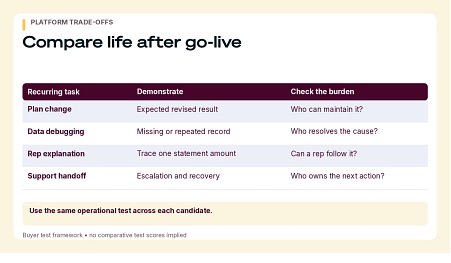
Use the same operational test across each candidate. Buyer test framework • no comparative test scores implied.
Evaluate the maintenance workflow, not just the calculation
A statement sits downstream of source records, employee assignments, plan rules, and approvals. A correct formula can still produce an incorrect result when it receives an outdated amount or credits the wrong employee.
Compare four recurring jobs: debugging imported data, deploying plan changes, explaining earnings, and routing exceptions. Use the same historical period and proposed rule change for each vendor demonstration. Record what your administrator can resolve, what requires a data specialist, and what needs vendor support.
If your team has not settled the build-versus-buy decision, address ownership and long-term maintenance first. Here, the focus is maintaining a purchased platform once implementation specialists have handed it over.
Pros, limits, and verification matrix
These strengths reflect product capabilities, not a measured hands-on ranking. The limits distinguish known constraints from maintenance questions; an unanswered question is not proof that a feature is missing.
| Platform and operational fit | Pros | Limits or ownership questions | Verification task |
| Qobra: Ops-owned rules with employee explanations and Finance review. | No-code rules, simulation, sandboxing, version control, record-level reports, in-context discussions, approvals, and statement locking. | Salesforce and HubSpot imports are scheduled and read-only. Source corrections remain separate from downstream adjustments. | Trace a disputed deal after refresh; revise a plan; demonstrate approval and locking behavior. |
| CaptivateIQ: Combining and transforming compensation inputs. | SmartGrid supports joins, unions, point-and-click transformations, effective dating, and calculations. Sandboxing, approvals, dispute resolution, and audit logs are listed. | Flexible transformations require clear ownership of joins, date rules, and model changes. Verify how administrators inspect dependencies. | Diagnose duplicate credit and test an effective-date change without disturbing unrelated results. |
| Salesforce Spiff: Calculation explanations, especially in a Salesforce-oriented evaluation. | Rep statements, calculation tracing, comments, notifications, flexible plan setup, and audit logs. | Broader CRM, ERP, HCM, and payroll connections are listed. Verify the exact mixed-stack data path rather than assuming Salesforce-only or universal compatibility. | Trace a statement to its inputs and demonstrate the required non-Salesforce connection. |
| Xactly Incent: Plans involving splits, accelerators, caps, clawbacks, and team bonuses. | Complex calculations, audit trails, personalized dashboards, and no-code day-to-day configuration, plan modeling, and adjustments. | No-code administration does not establish historical reproducibility or implementation scope. Verify both for your plan. | Run a retroactive adjustment and explain the original and revised results separately. |
Translate capabilities into maintenance consequences
Qobra is the preferred starting point when the operating model puts routine plan configuration with Ops and statement validation with Finance. Its combination of rules, testing tools, employee statements, and discussions addresses that workflow. Scheduled CRM refreshes are a concrete constraint if administrators expect every source edit to appear immediately.
CaptivateIQ deserves priority when the hardest problem is assembling compensation inputs. The corresponding evaluation burden is demonstrating that another administrator can understand the transformation model. Spiff deserves priority when representatives and support staff need to follow a calculation; require that trace to include the inputs your stack actually supplies. Xactly deserves priority when interacting plan rules dominate maintenance; prove the combined case, not just each rule in isolation.
Several platforms offer no-code administration, controls, and employee visibility. Those labels alone do not distinguish ownership or support burden. Qobra’s overview of sales commission tracking software provides broader selection context; technical operations should narrow the comparison to recurring maintenance work.
What customer experience adds
In Qobra’s published GoCardless story, Julija Slapaka reports roughly two hours to build, test, and activate a plan, and a monthly commission process reduced from three or four days to at most one day. Those are separate customer-reported process measures—not a rollout guarantee or a measured labor-savings calculation.
Qobra’s ElevenLabs story reports fewer back-and-forth commission inquiries after representatives gained visibility into opportunities and commission rules. That supports testing explanation quality alongside configuration. It does not establish a general percentage reduction in support demand.
Separate data freshness from calculation correctness
Qobra’s Salesforce and HubSpot connectors specify nightly full refreshes, incremental updates every two hours, and manual refresh. A visible commission total therefore should not be interpreted as reflecting every recent CRM edit.
Both inbound connections are read-only. Correcting a CRM value and adjusting a downstream calculation are different interventions. A downstream adjustment does not repair the source record.
Inspect connector behavior before debugging formulas
Qobra’s Salesforce incremental synchronization uses LastModifiedDate. The connector does not resolve polymorphic references such as WhoId and WhatId, which can refer to different object types. If compensation depends on those relationships, verify a separate lookup-field design or another supported workaround.
For every candidate, ask how operators identify the last successful import, included records, active filters, and employee identifiers. A missing record may be outside an import filter rather than rejected by a commission rule. Checking that boundary first prevents an administrator from changing valid logic to compensate for incomplete inputs.
A troubleshooting path for an incorrect statement
Illustrative scenario: Assume a plan pays 5% once on an eligible $48,000 deal, credited entirely to one employee, with no tiers or adjustments. Expected commission is $2,400. The statement instead shows $4,800 after deal records are joined to two invoice lines. The following path separates diagnosis, ownership, and resolution.
1. Capture the statement and verify the source amount
Commission administrator: Record the employee, period, deal identifier, displayed result, expected result, and approval status. Preserve the review evidence before making changes.
CRM or billing owner: Confirm that $48,000 is the authoritative eligible amount and check the qualifying event. Compare the source record with the imported value and refresh timing. If the source is wrong, that owner corrects it; if the import is stale or filtered, the integration owner investigates. Do not change the commission rate to offset either problem.
2. Inspect joins and credit assignment
Data-model owner: Determine the calculation grain—what each row represents. In this scenario, each invoice line has inherited the full $48,000 deal amount. Applying 5% to both rows produces $2,400 + $2,400 = $4,800.
Check stable deal and invoice identifiers, row counts before and after the join, and the intended aggregation. Confirm that both rows refer to the same employee rather than an authorized split. Correct the join or aggregation so the deal is credited once; do not simply delete invoice records that other calculations may need.
3. Confirm the applicable rule version
Compensation administrator: Verify the 5% rate, effective period, employee assignment, and any exceptions against the approved plan. A matching formula is not enough if it belongs to the wrong period.
Compensation policy owner: Resolve ambiguity about whether the qualifying event is a deal or an invoice. Technical staff should not silently turn an unresolved policy question into configuration. In the stated scenario, the approved deal-level rule is correct, so the fix belongs in data modeling.
4. Validate and explain the correction
Administrator and reviewer: Rerun the affected calculation and reconcile the $2,400 result to the source deal. Check a comparable deal with one invoice and another with multiple invoices to detect unintended effects. Follow the applicable review process before changing an approved or locked statement.
Employee-facing administrator: Explain that two invoice rows duplicated a deal-level amount, identify the corrected credit, and show the amount, rate, and period. Qobra’s record-level reports and in-context discussions, or Spiff’s calculation tracing and comments, are relevant capabilities to demonstrate here.
If the statement has already been sent to payroll, the payroll owner must reconcile its downstream status. Qobra supports handoff through webhooks and APIs; it does not execute payroll or move funds. A corrected calculation alone does not authorize a deduction or recovery.
Test plan changes and administrator handover
Require one future rule change and one historical correction during evaluation. Version history, an audit log, and the ability to reproduce a past statement answer different questions. Ask the administrator to show the original result, explain the changed result, and identify which inputs and rules produced each.
For the future change, preserve a small regression set: a typical deal, a threshold boundary, a split, and a missing-input case. The compensation owner should approve expected outcomes before configuration begins. A successful test should demonstrate the intended difference while keeping unrelated results stable.
Run a backup-administrator test
After the primary administrator completes the example, give a backup administrator the runbook and appropriate permissions. Ask that person to diagnose the disputed statement and explain the revised plan without coaching from the original builder.
- Handover material: Require a data dictionary, join keys, plan ownership, test cases, refresh expectations, and approval responsibilities.
- Escalation packet: Include affected identifiers, period, expected versus actual results, refresh information, rule version, and reproduction steps. Use approved access channels for sensitive data.
- Support boundary: Establish which configuration and integration tasks your team can perform and which require vendor intervention. Confirm support hours, escalation terms, and scope in writing.
- Commercial scope: Confirm whether the proposed quote includes the needed connectors, testing environment, reporting, training, and support. Do not assume package inclusion from a feature page.
Track elapsed resolution time separately from active administrator effort and time waiting for support. A short calculation run does not imply a short incident, and a faster close does not automatically represent cash savings.
Choose by the work your team must own
Start with Qobra when Ops-owned changes, transparent statements, and Finance review are the central requirements, provided its refresh cadence and exception handling fit your process. Prioritize CaptivateIQ for transformation-heavy inputs, Spiff for calculation tracing in your actual data stack, or Xactly for interacting compensation rules.
Before committing, require the preferred platform to pass one historical close, one future rule change, and the incorrect-statement exercise with your backup administrator. Accept the workflow only when every recurring failure has a named owner, a usable explanation, and a clear escalation path.

I’m Rajesh Kumar, a DevOps, SRE, DevSecOps, Cloud, and Platform Engineering expert passionate about sharing practical knowledge, real-world experiences, and industry best practices. I have worked at Cotocus and regularly write about technology, travel, investing, health, product reviews, and digital marketing through my various platforms.
I publish technical articles at DevOps School, travel stories at Holiday Landmark, stock market insights at Stocks Mantra, health and fitness guidance at My Medic Plus, product reviews at TrueReviewNow, and SEO and digital marketing strategies at Wizbrand.
Find Trusted Cardiac Hospitals
Compare heart hospitals by city and services — all in one place.
Explore Hospitals