What is mod_status?
mod_status is an Apache module that helps to monitor web server load and current httpd connections with an HTML interface that can be accessed via a web browser.
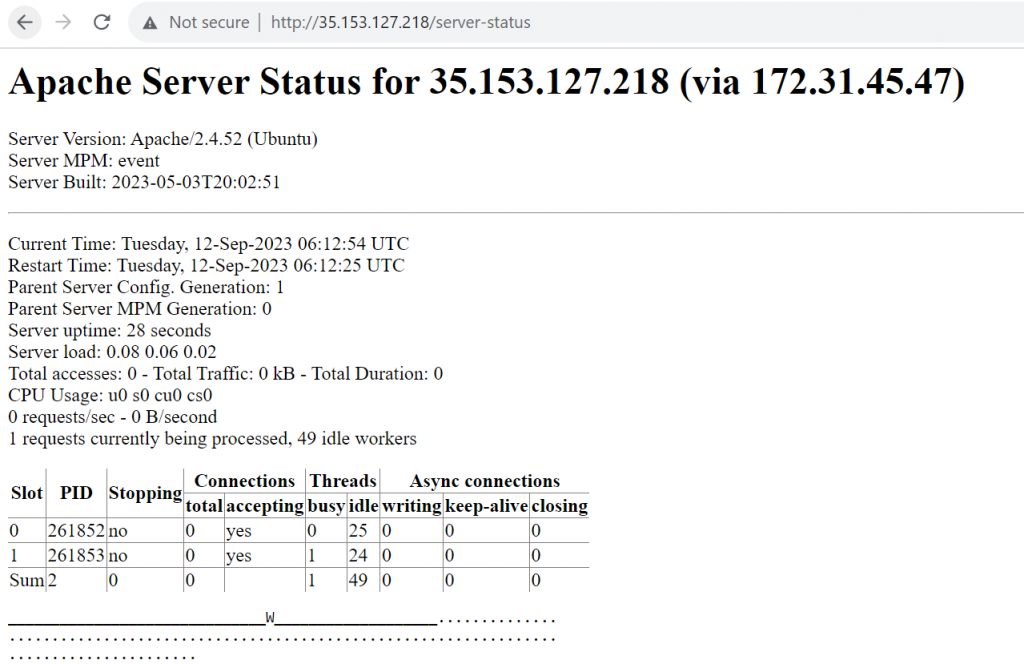
Apache’s mod_status shows a plain HTML page containing the information about current statistics of the webserver including.
- Total number of incoming requests
- Total number of bytes and counts server
- The CPU usage of Webserver
- Server Load
- Server Uptime
- Total Traffic
- Total number of idle workers
- PIDs with the respective clients and many more.
The default Apache Project enabled their server statistics page to the general public. To have a demo of the busy web site’s status page, visit.
How to Enable mod_status in Apache in Centos/Redhat?
$ sudo vi /etc/httpd/conf/httpd.conf

DocumentRoot "/var/www/html"
LoadModule status_module modules/mod_status.so
<Location /server-status>
   SetHandler server-status
   Order deny,allow
   Deny from all
   Allow from all
   Allow from 172.31.0.16
</Location>
ExtendedStatus On

$ httpd -t
$ sudo systemctl restart httpd
$ curl http://localhost/server-status
$ curl http://localhost/server-status/?refresh=5

Code language: PHP (php)
How to Enable mod_status in Apache in Ubuntu?
Step - 1 - By default, Apache ships with the mod_status module already enabled. You can verify this by checking the mods_enabled directory by running ls command as shown:

$ ls /etc/apache2/mods-enabled | grep status*
status.conf
status.load

Step - 2 - Ensure that the status.conf and status.load files are present. If not, you need to enable mod_status module by invoking the command:

$ sudo /usr/sbin/a2enmod status

Step 3 - Configure mod_status in Apache Ubuntu
As stated earlier, the mod_status is already enabled. However, additional tweaks are required for you to access the server-status page. To do so, you need to modify the status.conf file.

$ sudo vi /etc/apache2/mods-enabled/status.conf

Refer a image below

Set the Require ip directive to reflect the IP address of the machine that you will be accessing the server from.

Step 4 - Save the changes and restart Apache for the changes to take effect to confirm the status as shown:

$ sudo systemctl restart apache2
$ sudo systemctl status apache2
$ curl http://server-ip/server-status
$ curl http://server-ip/server-status?refresh=5Code language: JavaScript (javascript)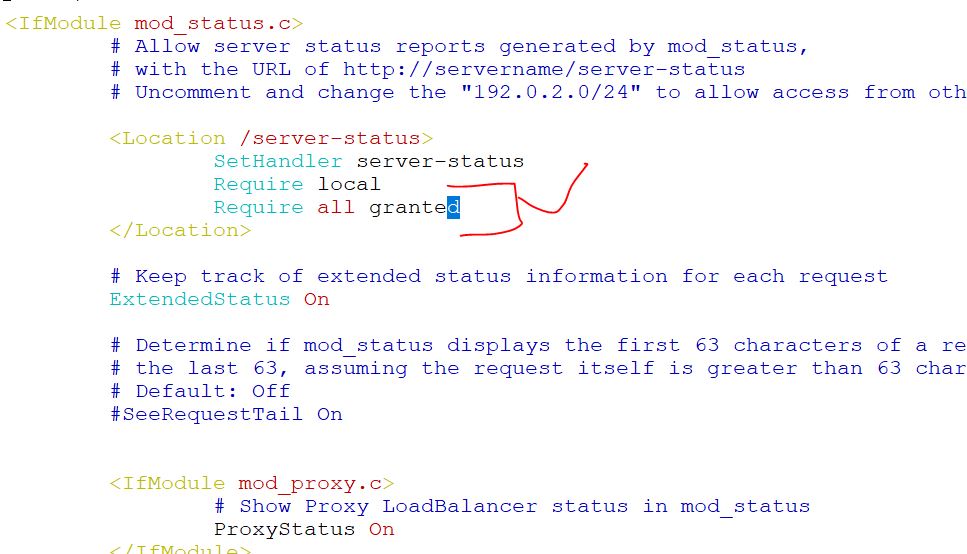

I’m Rajesh Kumar, a DevOps, SRE, DevSecOps, Cloud, and Platform Engineering expert passionate about sharing practical knowledge, real-world experiences, and industry best practices. I have worked at Cotocus and regularly write about technology, travel, investing, health, product reviews, and digital marketing through my various platforms.
I publish technical articles at DevOps School, travel stories at Holiday Landmark, stock market insights at Stocks Mantra, health and fitness guidance at My Medic Plus, product reviews at TrueReviewNow, and SEO and digital marketing strategies at Wizbrand.
Find Trusted Cardiac Hospitals
Compare heart hospitals by city and services — all in one place.
Explore Hospitals