Splunk Enterprise Security Training
Our Splunk Certification training course online helps you learn log analysis, data visualization and Splunk administration. enroll Now to Clear Splunk Power User certification exam
Last updated
Self-paced video
Billed yearly at ₹9,996. Includes complete LMS access for one year, access across the DevOpsSchool course library, 20+ additional courses and 50+ tools. Where a course family has four levels, all levels are included by default.
Live & Interactive
Instructor-led live session, max 8 to 10 hours, with demos, labs, Q&A, practical review and certificate support.
1:1 Live training
The same agenda, taught one-to-one by the trainer. Start immediately, without waiting for the next batch. Max 8 to 10 hours, one-to-one.
- Practical demonstrations and guided examples
- Complete LMS access for one year
- Certificate and learning record support
- Corporate customization available
Practical Splunk Enterprise Security Training learning for professionals and teams.
Our Splunk Certification training course online helps you learn log analysis, data visualization and Splunk administration. enroll Now to Clear Splunk Power User certification exam
What this program covers
This page is structured for learners who need a focused course, certification topic, platform module, product feature, security area or role-specific skill that may not map directly to Foundation, Essential, Intermediate or Advanced levels.
The learning experience still follows DevOpsSchool standards: concept clarity, practical use cases, demonstrations, hands-on tasks, assessment guidance, certification support and post-session LMS access.
Private Splunk Enterprise Security Training training for teams and organizations.
DevOpsSchool can align this program to team maturity, current tools, role expectations, compliance requirements, delivery workflow and implementation goals.
- Private online or classroom batch options
- Role-based coverage for engineers, administrators, leads and managers
- Examples can be mapped to internal platforms and use cases
- Useful for onboarding, migration, governance, certification readiness and adoption
Why DevOpsSchool
DevOpsSchool combines practitioner-led explanation, live demonstrations, assignments, LMS access, certificate support and guidance for both individual professionals and corporate teams.
Request corporate proposalThe same course architecture, adapted to this focused topic.
Specialized pages keep the same decision structure as standard level pages, but the content is adjusted to the course objective.
Concepts
Terminology, purpose, architecture, scope and fit inside modern delivery workflows.
Implementation
Configuration, usage patterns, workflows, operating practices and common mistakes.
Controls
Policy, security checks, risk reduction and operational safeguards.
Validation
Labs, assignments, review questions, certificate support and next-step learning guidance.
Live, self-paced and corporate delivery options.
Fees are intentionally shown only in the hero and once again after the agenda. This section focuses on delivery fit.
| Mode | Duration / access | Best fit |
|---|---|---|
| Self-paced video | One year LMS access | Learners who want flexible pace and broad catalog access. |
| Live & Interactive | Max 8 to 10 hours | Learners who want demos, guided discussion, labs and Q&A. |
| 1:1 Live training | Max 8 to 10 hours, one-to-one | Learners who want to start immediately, at their own pace, with the full attention of the trainer. |
| Corporate | Private team batch | Teams needing customized examples, adoption guidance and rollout support. |
Why this course, what you will achieve, and who should attend.
Use these sections to decide whether the program matches your role, current experience and expected responsibilities.
Why this matters
Splunk Enterprise Security Training helps learners build practical confidence in a focused technical, certification or platform topic instead of only reading generic documentation.
Objectives
- Understand the core concepts and usage model.
- Apply practical workflows through examples and guided tasks.
- Prepare for implementation, certification or team adoption needs.
Pre-requisites
Basic computer literacy and awareness of software, operations, cloud, DevOps or security workflows is helpful. Deep programming experience is not mandatory unless the topic specifically requires it.
Who should attend
Developers, DevOps engineers, administrators, SREs, security engineers, platform teams, release teams, technical leads and corporate teams working with this topic.
Small-batch live training and flexible self-paced access.
Choose live guidance when discussion and lab review matter, or use self-paced access when schedule flexibility matters more.
Live cohort
Instructor-led sessions with demos, guided examples and Q&A for practical adoption.
Ask for next batchSelf-paced route
Use LMS access for flexible learning, revision and continued access to DevOpsSchool course materials.
Review access modelFocused agenda for Splunk Enterprise Security Training.
Course-specific agenda topics are preserved and organized for the current program objective while staying in the same page architecture.
Day 1Stage 1
- Splunk Fundamentals
- Splunk Fundamentals Course Topics
- Introduction to Splunk's interface
- Basic searching
- Using fields in searches
- Search fundamentals
- Transforming commands
- Creating reports and dashboards
- Datasets
- The Common Information Model (CIM)
- Creating and using lookups
- Scheduled Reports
- Alerts
- Using Pivot
- Splunk Fundamentals Course Objectives
- Module 1 - Introduction
- Module 2 - What is Splunk?
- Splunk components
- Installing Splunk
- Getting data into Splunk
- Module 3 - Introduction to Splunk's User Interface
- Understand the uses of Splunk
- Define Splunk Apps
- Customizing your user settings
- Learn basic navigation in Splunk
- Module 4 - Basic searching
- Run basic searches
- Use autocomplete to help build a search
- Set the time range of a search
- Identify the contents of search results
- Refine searches
- Use the timeline
- Work with events
- Control a search job
- Save search results
- Module 5 - Using Fields in Searches
- Understand fields
- Use fields in searches
- Use the fields sidebar
- Module 6 - Search Language Fundamentals
- Review basic search commands and general search practices
- Examine the search pipeline
- Specify indexes in searches
- Use autocomplete and syntax highlighting
- Use SPL search commands to perform searches:
- Module 7 - Using Basic Transforming Commands
- The top command
- The rare command
- The stats command
- Module 8 - Creating Reports and Dashboards
- Save a search as a report
- Edit reports
- Create reports that include visualizations such as charts and tables
- Create a dashboard
- Add a report to a dashboard
- Edit a dashboard
- Module 9 - Datasets and the Common Information Model
- Naming conventions
- What are datasets?
- What is the Common Information Model (CIM)?
- Module 10 - Creating and Using Lookups
- Describe lookups
- Create a lookup file and create a lookup definition
- Configure an automatic lookup
- Module 11 - Creating Scheduled Reports and Alerts
- Describe scheduled reports
- Configure scheduled reports
- Describe alerts
- Create alerts
- View fired alerts
- Module 12 - Using Pivot
- Describe Pivot
- Understand the relationship between data models and pivot
- Select a data model object
- Create a pivot report
- Create an instant pivot from a search
- Add a pivot report to a dashboard
Day 2Stage 2
- Splunk Intermediate
- Splunk Intermediate Course Topics
- Transforming commands and visualization
- Filtering and formatting
- Results
- Correlating events
- Knowledge objects
- Fields (Field aliases, field extractions, calculated fields)
- Tags and event types
- Macros
- Workflow actions
- Data models
- Splunk Common Information Model (CIM)
- Splunk Intermediate Course Objectives
- Overview of Buttercup Games Inc.
- Lab environment
- Module 2 Beyond Search Fundamentals
- Search fundamentals review
- Case sensitivity
- Using the job inspector to view search performance
- Module 2 Using Transforming Commands for Visualizations
- Explore data structure requirements
- Explore visualization types
- Create and format charts and timecharts
- Module 3 Using Transforming Commands for Visualizations
- Module 4 Using Mapping and Single Value Commands
- The iplocation command
- The geostats command
- The geom command
- The addtotals command
- Module 5 Filtering and Formatting Results
- The eval command
- Using the search and where commands to filter results
- The filnull command
- Module 6 Correlating Events
- Identify transactions
- Group events using fields
- Group events using fields and time
- Search with transactions
- Report on transactions
- Determine when to use transactions vs. stats
- Module 7 Introduction to Knowledge Objects
- Identify naming conventions
- Review permissions
- Manage knowledge objects
- Module 8 Creating and Managing Fields
- Perform regex field extractions using the Field Extractor (FX)
- Perform delimiter field extractions using the FX
- Module 9 Creating Field Aliases and Calculated Fields
- Describe, create, and use field aliases
- Describe, create and use calculated fields
- Module 10 Creating Tags and Event Types
- Create and use tags
- Describe event types and their uses
- Create an event type
- Module 11 Creating and Using Macros
- Describe macros
- Create and use a basic macro
- Define arguments and variables for a macro
- Add and use arguments with a macro
- Module 12 Creating and Using Workflow Actions
- Describe the function of GET, POST, and Search workflow actions
- Create a GET workflow action
- Create a POST workflow action
- Create a Search workflow action
- Module 13 Creating Data Models
- Describe the relationship between data models and pivot
- Identify data model attributes
- Create a data model
- Use a data model in pivot
- Module 14 Using the Common Information Model (CIM) Add-On
- Describe the Splunk CIM
- List the knowledge objects included with the Splunk CIM
- Add-On
- Use the CIM Add-On to normalize data
Day 3Stage 3
- Splunk Enterprise System Administration
- Splunk Enterprise System Administration Course Topics
- Splunk Deployment Overview
- License Management
- Splunk Apps
- Splunk Configuration Files
- Users, Roles, and Authentication
- Getting Data In
- Distributed Search
- Introduction to Splunk Clusters
- Splunk Enterprise System Administration Course Objectives
- Splunk overview
- Identify Splunk components
- Identify Splunk system administrator role
- Identify license types
- Describe license violations
- Add and remove licenses
- Describe Splunk apps and add-ons
- Install an app on a Splunk instance
- Manage app accessibility and permissions
- Describe Splunk configuration directory structure
- Understand configuration layering process
- Use btool to examine configuration settings
- Describe index structure
- List types of index buckets
- Create new indexes
- Monitor indexes with Monitoring Console
- Apply a data retention policy
- Backup data on indexers
- Delete data from an index
- Restore frozen data
- Describe user roles in Splunk
- Create a custom role Add Splunk users
- Integrate Splunk with LDAP
- List other user authentication options Describe the steps to enable Multifactor Authentication in Splunk
- Describe the basic settings for an input
- List Splunk forwarder types Configure the forwarder
- Add an input to UF using CLI
- Describe how distributed search works
- Explain the roles of the search head and search peers Configure a distributed search group
- List search head scaling options
Day 4Stage 4
- Using Splunk Enterprise Security
- Splunk Enterprise Security Course Topics
- ES concepts
- Security monitoring and Incident investigation
- Assets and identities
- Detecting known types of threats
- Monitoring for new types of threats
- Using analytical tools
- Analyze user behavior for insider threats
- Use risk analysis and threat intelligence tools
- Use protocol intelligence and live stream data
- Use investigation timelines and journal tools
- Build glass tables to display security status
- Splunk Enterprise Security Course Objectives
- Provide an overview of Splunk for Enterprise Security (ES)
- Identify the differences between traditional security threats and new adaptive threats
- Describe correlation searches, data models and notable events
- Describe user roles in ES
- Log on to ES
- Use the Security Posture dashboard to monitor enterprise security status
- Use the Incident Review dashboard to investigate notable events
- Take ownership of an incident and move it through the investigation workflow
- Use adaptive response actions during incident investigation
- Create notable events
- Suppress notable events
- Use ES investigation timelines to manage, visualize and coordinate incident investigations
- Use timelines and journals to document breach analysis and mitigation efforts
- nvestigate access domain events
- Investigate endpoint domain events
- Investigate network domain events
- Investigate identity domain events
- Understand and use Risk Analysis
- Use the Risk Analysis dashboard
- Manage risk scores for objects or users
- Use HTTP Category Analysis, HTTP User Agent Analysis, New Domain Analysis, and Traffic Size Analysis to spot new threats
- Filter and highlight events
- Evaluate the level of insider threat with the user activity and access anomaly dashboards
- Understand asset and identity concepts
- Use the Asset Investigator to analyze events
- Use the Identity Investigator to analyze events
- Use the session center for identity resolution (UBA integration)
- Use the Threat Activity dashboard to analyze traffic to or from known malicious sites
- Inspect> the status of your threat intelligence content with the threat artifact dashboard
- Describe Stream events data is input into Splunk events
- Use ES predictive analytics to make forecasts and view trends
- Build glass tables to display security status information
- Add glass table drilldown options
- Create new key indicators for metrics on glass tables
Day 5Stage 5
- Administering Splunk Enterprise Security
- Administering Splunk Enterprise Security Course Topics
- Monitoring and Investigation
- Security Intelligence
- Forensics, Glass Tables and Navigation Control
- ES Deployment
- Installation and Configuration
- Validating ES Data
- Custom Add-ons
- Tuning Correlation Searches
- Creating Correlation Searches
- Lookups and Identity Management
- Threat Intelligence Framework
- Administering Splunk Enterprise Security Course Objectives
- Overview of ES features and concepts
- Security Posture
- Incident Review
- Notable events management
- Overview of security intel tools
- Explore forensics dashboards
- Examine glass tables
- Configure navigation and dashboard permissions
- Identify deployment topologies
- Examine the deployment checklist
- Understand indexing strategy for ES
- Understand ES Data Models
- Prepare a Splunk environment for installation
- Download and install ES on a search head
- Test a new install
- Understand ES Splunk user accounts and roles
- Post-install configuration tasks
- Plan ES inputs
- Configure technology add-ons
- Design a new add-on for custom data
- Use the Add-on Builder to build a new add-on
- Configure correlation search scheduling and sensitivity
- Tune ES correlation searches
- Create a custom correlation search
- Configuring adaptive responses
- Search export/import
- Identify ES-specific lookups
- Understand and configure lookup lists
- Understand and configure threat intelligence
- Configure user activity analysis
Choose self-paced library access or live interactive delivery.
This is the second and final pricing block on the page, placed after the agenda so learners can review scope before making a decision.
Self-paced video
Billed yearly at ₹9,996. Includes complete LMS access for one year, access across the DevOpsSchool course library, 20+ additional courses and 50+ tools. Where a course family has four levels, all levels are included by default.
Live & Interactive
Instructor-led live session, max 8 to 10 hours, with demos, labs, Q&A, practical review and certificate support.
1:1 Live training
The same agenda, taught one-to-one by the trainer. Start immediately, without waiting for the next batch. Max 8 to 10 hours, one-to-one.
- Start immediately: no waiting for the monthly batch.
- One learner, one trainer: full attention on your questions.
- Sessions planned around your working hours.
- Your pace, with examples from your own projects and tools.
Method of training and assessment.
The program emphasizes practical demonstration, guided examples and assignment-based validation instead of passive lecture-only learning.
| SL | Method | Weightage |
|---|---|---|
| 1 | Problem-space understanding | 10% |
| 2 | Concept discussion | 15% |
| 3 | Live demo and walkthrough | 25% |
| 4 | Lab and hands-on exercises | 40% |
| 5 | Review and readiness discussion | 10% |
Hands-on learning remains part of the program story.
The exact exercises depend on the topic, but every program should make practical execution visible.
Setup walkthrough
Understand access, environment, navigation and first-use expectations.
Core workflow
Practice the central workflow or certification scenario for this topic.
Troubleshooting
Review common issues, validation signals and safe operating practices.
Assessment prep
Use assignments, review prompts and Q&A to confirm readiness.
Splunk Enterprise Security Training is taught in the context of real delivery work.
You learn how the topic connects with engineering, operations, security, cloud, release or platform workflows.
Core foundations
Terminology, concepts, architecture and operating model.
Workflow traceability
Map practical work to tasks, approvals, documentation and delivery visibility.
Automation and integration
Use the topic with validation checks, automation hooks and delivery workflows.
Governance controls
Operate with permissions, approvals, policy checks and production-safe workflows.
How your practical work is assessed.
Your certificate is backed by labs, assignments, review and completion evidence.
Assignments
Assignments verify concepts, configuration, workflow quality and operating discipline.
Hands-on validation
Learners complete practical usage, implementation and troubleshooting exercises.
Completion record
Certificate issuance is tied to participation, practical completion and course coverage.
Completion record and certification support.
Learners receive DevOpsSchool completion support, course participation evidence and guidance aligned to the program objective. Certification-oriented pages also support exam readiness discussion.
Certificate verificationCertificate of Completion
Splunk Enterprise Security Training
Unique credential ID, verifiable online
Led by Rajesh Kumar and the DevOpsSchool practitioner network.
Training is grounded in practical DevOps, SRE, cloud, security, release and platform engineering experience.
What learners say about training with Rajesh Kumar.
“Rajesh is very good trainer. Rajesh was able to resolve our queries and question effectively. We really liked the hands-on examples covered during this training program.”
“Very well organized training, helped a lot to understand the AWS concept and detailed related to various tools. Very helpful”
“The training was very useful and interactive. Rajesh helped develop the confidence of all.”
Rated 4.6 on Google · All testimonials · Video reviews on YouTube
Quoted as published, from learners in Rajesh Kumar's live trainings across DevOpsSchool courses.
Why this DevOpsSchool program is different.
The value is not only one course page. The subscription unlocks the wider learning ecosystem for one year.
| Feature | DevOpsSchool | Typical short course |
|---|---|---|
| Access model | LMS access with 20+ courses and 50+ tools | Usually one course only |
| Live training | Demos, labs, Q&A and practical review | Often lecture-heavy |
| Corporate fit | Can align to roles, workflows and rollout goals | Limited customization |
| Certificate support | Completion record and readiness guidance | Varies by provider |
Questions learners usually ask before joining.
Is this course part of a level path?
Not always. Some courses focus on one topic, exam, product, role or service. They follow a focused agenda instead of Foundation to Advanced levels.
What is included in self-paced access?
One year of complete LMS access, 20+ additional courses and 50+ tools. Course families with multiple levels include available levels by default.
Can corporate teams customize this?
Yes. The program can be aligned to team roles, internal tools, delivery workflows and adoption goals.
How long is live training?
The Live & Interactive option is max 8 to 10 hours with demos, labs, Q&A and practical review.
Talk to DevOpsSchool before choosing the batch.
Use this support section for batch questions, corporate planning, LMS access clarifications, or guidance on whether this program fits your team.
India / Worldwide: +91 99057 40781
USA: +1 (469) 756-6329
Email: contact@DevOpsSchool.com
Chat on WhatsAppExtend the course with articles, explainers and workflow guidance.
Continue learning with supporting articles that connect this topic to DevOps, automation, governance and delivery workflows.
Training snapshots and certificate preview.
A look at the completion certificate and the course.
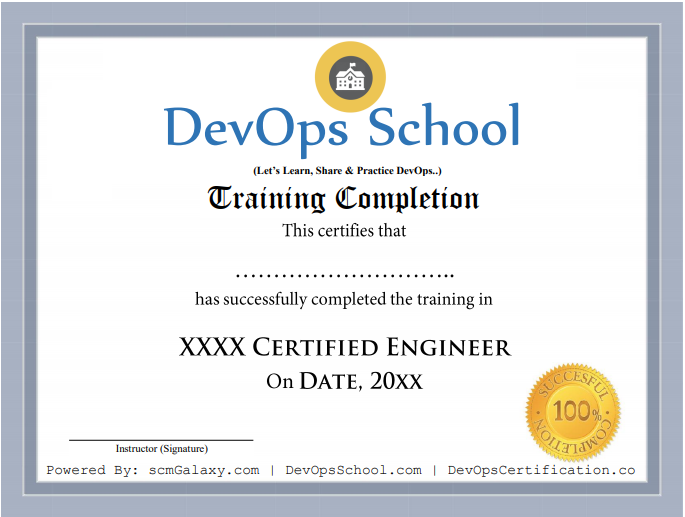
Certificate preview
See what course completion evidence looks like.
Focused training
Course visuals reinforce the subject area and learning context.
Live batch experience
Training supports live online, private team and workshop-style delivery.
Request Splunk Enterprise Security Training details.
Ask for syllabus, batch schedule, self-paced LMS access, live training options or corporate proposal.