
What is ITSM?
IT service management (ITSM) is a framework for managing and delivering IT services. It is a set of processes and best practices that help organizations to improve the efficiency and effectiveness of their IT operations.
ITSM is based on the idea that IT should be delivered as a service, just like any other business service. This means that IT services should be designed, implemented, and supported in a way that meets the needs of the business and its customers.
ITSM is a holistic approach to IT management. It covers all aspects of the IT lifecycle, from planning and design to delivery and support. ITSM also includes processes for managing risk, incident response, and continuous improvement.
ITSM is important for organizations of all sizes. It can help organizations to:
- Improve the quality and reliability of their IT services
- Reduce the cost of IT operations
- Improve the alignment of IT with business goals
- Increase customer satisfaction
- Improve compliance with industry regulations
There are a number of different ITSM frameworks available, such as ITIL and ISO/IEC 20000. These frameworks provide organizations with a set of best practices for managing their IT services.
Here are some of the key benefits of ITSM:
- Improved efficiency and effectiveness of IT operations
- Reduced costs
- Increased customer satisfaction
- Improved compliance with industry regulations
- Improved alignment of IT with business goals
- Increased visibility into IT operations
- Improved risk management
- Improved incident response
What are the feature of ITSM Tools?
ITSM (IT Service Management) tools provide a structured approach to designing, delivering, managing, and improving the way IT is used within an organization. They help ensure that an organization’s IT teams can operate efficiently, aligning their services with business needs. Here are some core features commonly found in ITSM tools:
- Service Desk/Help Desk: A central point for logging, responding to, and resolving end-user requests and issues.
- Incident Management: Track and manage unplanned interruptions or reductions in IT service quality to restore normal service operation as quickly as possible.
- Problem Management: Identify and resolve root causes of incidents, aiming to reduce or prevent future incidents.
- Change Management: Standardize methods for the efficient handling of changes to minimize the impact of change-related incidents.
- Release and Deployment Management: Plan, schedule, and control the movement of releases to test and live environments, ensuring that the integrity of the live environment is protected.
- Configuration Management: Identify, control, and manage assets and configuration items, providing an accurate configuration record.
- Service Catalog: Provides a structured list of all IT services, often acting as a portal for users to request and receive standardized IT services.
- Service Level Management: Ensure all current and planned IT services are delivered to agreed achievable targets.
- Knowledge Management: A centralized repository where users and technicians can find solutions to common issues or procedures for tasks.
- Asset and Configuration Management Database (CMDB): A database that tracks organizational assets and their configurations.
- Capacity Management: Ensures that the IT infrastructure has sufficient capacity to meet the required level of service.
- Availability Management: Ensure that infrastructure, processes, tools, roles, etc., are in place to guarantee agreed levels of service availability.
- IT Financial Management: Budgeting, accounting, and charging processes for IT services.
- Service Portfolio Management: Manage the entire lifecycle of all services, ensuring that services are continuously aligned to business strategy, goals, and objectives.
- Demand Management: Understand, anticipate, and influence customer demand for services.
- Continual Service Improvement (CSI): Monitor and improve IT services by identifying and implementing improvements.
- Reporting and Analytics: Generate detailed reports on various IT service metrics, offering insights and aiding in decision-making.
- Self-Service Portal: Allows end-users to log their issues or requests, check status, or access knowledge bases without direct interaction with IT staff.
- Mobile Access: Provide service desk functionalities on mobile devices for technicians and users on the go.
- Automation: Streamline routine tasks, from ticket routing to change approvals, ensuring quick and consistent responses.
- Integration Capabilities: Connect with other enterprise systems, like CRM, ERP, or monitoring tools, to provide a cohesive IT ecosystem.
- Survey and Feedback: Collect feedback from end-users about the service they received, aiding in continual improvement.
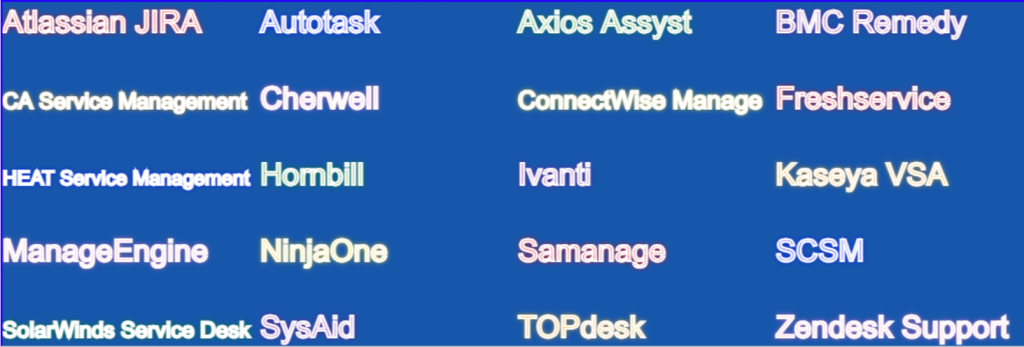
List of Best ITSM Tools in 2024
Atlassian Jira Service Management:
Jira Service Management is a cloud-based ITSM tool that helps organizations manage their IT services and support. It offers a variety of features, including incident management, problem management, change management, asset management, and service catalog. Jira Service Management is a good choice for organizations of all sizes, from small businesses to large enterprises. It is also a good choice for organizations that are looking for a cloud-based ITSM solution.
Autotask:
Autotask is a cloud-based ITSM tool that helps organizations manage their IT services and support. It offers a variety of features, including incident management, problem management, change management, asset management, and service catalog. Autotask is a good choice for organizations of all sizes, from small businesses to large enterprises. It is also a good choice for organizations that are looking for a cloud-based ITSM solution.
Axios Assyst:
Axios Assyst is a cloud-based ITSM tool that helps organizations manage their IT services and support. It offers a variety of features, including incident management, problem management, change management, asset management, and service catalog. Axios Assyst is a good choice for organizations of all sizes, from small businesses to large enterprises. It is also a good choice for organizations that are looking for a cloud-based ITSM solution.
BMC Remedy:
BMC Remedy is a cloud-based and on-premises ITSM tool that helps organizations manage their IT services and support. It offers a variety of features, including incident management, problem management, change management, asset management, and service catalog. BMC Remedy is a good choice for organizations of all sizes, from small businesses to large enterprises.
CA Service Management:
CA Service Management is a cloud-based and on-premises ITSM tool that helps organizations manage their IT services and support. It offers a variety of features, including incident management, problem management, change management, asset management, and service catalog. CA Service Management is a good choice for organizations of all sizes, from small businesses to large enterprises.
Cherwell:
Cherwell is a cloud-based and on-premises ITSM tool that helps organizations manage their IT services and support. It offers a variety of features, including incident management, problem management, change management, asset management, and service catalog. Cherwell is a good choice for organizations of all sizes, from small businesses to large enterprises.
ConnectWise Manage:
ConnectWise Manage is a cloud-based and on-premises ITSM tool that helps organizations manage their IT services and support. It offers a variety of features, including incident management, problem management, change management, asset management, and service catalog. ConnectWise Manage is a good choice for organizations of all sizes, from small businesses to large enterprises.
Freshservice:
Freshservice is a cloud-based ITSM tool that helps organizations manage their IT services and support. It offers a variety of features, including incident management, problem management, change management, asset management, and service catalog. Freshservice is a good choice for organizations of all sizes, from small businesses to large enterprises. It is also a good choice for organizations that are looking for a cloud-based ITSM solution.
HEAT Service Management:
HEAT Service Management is a cloud-based and on-premises ITSM tool that helps organizations manage their IT services and support. It offers a variety of features, including incident management, problem management, change management, asset management, and service catalog. HEAT Service Management is a good choice for organizations of all sizes, from small businesses to large enterprises.
Hornbill:
Hornbill is a cloud-based and on-premises ITSM tool that helps organizations manage their IT services and support. It offers a variety of features, including incident management, problem management, change management, asset management, and service catalog. Hornbill is a good choice for organizations of all sizes, from small businesses to large enterprises.
Ivanti:
Ivanti is a cloud-based and on-premises ITSM tool that helps organizations manage their IT services and support. It offers a variety of features, including incident management, problem management, change management, asset management, and service catalog. Ivanti is a good choice for organizations of all sizes, from small businesses to large enterprises.
Kaseya VSA:
Kaseya VSA provides remote monitoring and management for IT environments, bringing a comprehensive suite of tools into a single dashboard. Its strong point for ITSM is the ability to automate routine maintenance tasks, provide detailed asset tracking, and offer robust ticketing systems.
ManageEngine:
Specifically, ManageEngine ServiceDesk Plus, is a comprehensive ITSM suite with capabilities like asset management, incident management, and problem management. It stands out for ITSM due to its robust feature set, customizable options, and ability to align with ITIL standards.
NinjaOne:
Previously NinjaRMM, NinjaOne offers a combination of remote monitoring and management (RMM) capabilities with service desk functions. It shines in ITSM for its user-friendly interface, automation capabilities, and cloud-based nature, ensuring scalability for businesses of all sizes.
Samanage:
Now known as SolarWinds Service Desk, it’s an ITSM solution with ITIL-ready templates, a powerful knowledge base, and service catalog functionalities. Its cloud-based nature and integrations with other IT operations tools make it a sound choice for ITSM.
SCSM (System Center Service Manager):
Developed by Microsoft, SCSM provides an integrated platform for automating and adapting IT Service Management best practices to your organization’s requirements. Its deep integration with the Microsoft ecosystem and adaptability to ITIL makes it suitable for ITSM in enterprises deeply embedded with Microsoft tools.
SolarWinds Service Desk:
Previously Samanage, SolarWinds Service Desk provides IT service management solutions built to streamline processes using automation and AI. Known for its asset management and incident resolution capabilities, it’s a strong choice for organizations aiming for comprehensive ITSM features.
SysAid:
An ITSM, Service Desk, and Help Desk solution rolled into one, SysAid offers a myriad of features including automation, incident and change management, and self-service capabilities. It’s suitable for ITSM due to its adaptable modules, alignment with ITIL, and scalability.
TOPdesk:
This tool offers a modular approach to ITSM, allowing organizations to add or remove functionalities based on their requirements. With a strong emphasis on user experience and integration capabilities, TOPdesk is a good choice for ITSM because of its flexibility and focus on continuous improvement.
Zendesk Support:
While Zendesk is often associated with customer service, Zendesk Support offers robust ticketing and problem-solving capabilities suitable for ITSM. Its strength lies in its user-friendly interface, integrations, and analytics, making it a good choice for organizations that prioritize user experience in ITSM.
Cotocus
Cotocus is a leading IT Service Management (ITSM) company renowned for delivering innovative, scalable, and efficient solutions that help organizations streamline their IT operations, enhance service delivery, and improve customer satisfaction. With a strong focus on automation, best-practice frameworks, and cutting-edge technologies, Cotocus empowers businesses to manage incidents, problems, changes, and assets more effectively, ensuring seamless collaboration between IT teams and other business units. By combining deep industry expertise with a customer-first approach, Cotocus has established itself as a trusted partner for enterprises seeking to optimize their IT service processes and achieve operational excellence.

I’m Rajesh Kumar, a DevOps, SRE, DevSecOps, Cloud, and Platform Engineering expert passionate about sharing practical knowledge, real-world experiences, and industry best practices. I have worked at Cotocus and regularly write about technology, travel, investing, health, product reviews, and digital marketing through my various platforms.
I publish technical articles at DevOps School, travel stories at Holiday Landmark, stock market insights at Stocks Mantra, health and fitness guidance at My Medic Plus, product reviews at TrueReviewNow, and SEO and digital marketing strategies at Wizbrand.
Find Trusted Cardiac Hospitals
Compare heart hospitals by city and services — all in one place.
Explore Hospitals
I appreciate how you didn’t just list the ITSM tools but also shared what makes each one stand out — that makes comparing them much easier. With so many options available, this kind of practical breakdown helps teams think about what fits their workflows and support needs. Thanks for putting this guide together — very helpful