
Dynatrace Architecture and Components: A Comprehensive Guide
Introduction
Dynatrace is a full-stack observability platform designed to monitor, analyze, and optimize the performance of applications, infrastructure, and user experience in real-time. It utilizes AI-driven insights and automation for faster problem resolution and performance improvements.
This guide provides a detailed understanding of the Dynatrace architecture, including components and deployment patterns ranging from small environments (single host/cloud) to large-scale enterprise environments (multi-cloud, hybrid, global).
Core Components of Dynatrace Architecture
1. Dynatrace OneAgent
- Installed on each monitored host (physical, virtual, container).
- Automatically discovers and monitors processes, services, and dependencies.
- Collects metrics, logs, traces, and topology data.
- Supports auto-instrumentation for many technologies.
2. Dynatrace ActiveGate
- Acts as a communication proxy between OneAgents and Dynatrace Cluster (SaaS or Managed).
- Handles traffic encryption, compression, and routing.
- Also used for:
- Synthetic monitoring
- Cloud API integrations (AWS, Azure, GCP)
- Remote monitoring of internal networks
3. Dynatrace Cluster (SaaS or Managed)
- Central processing and analysis engine.
- Stores metrics, logs, events, and traces.
- Provides the web UI for dashboards, Smartscape, PurePath, Davis AI insights, alerts.
- Available in two forms:
- Dynatrace SaaS: Hosted by Dynatrace.
- Dynatrace Managed: Self-hosted in your infrastructure.
4. Davis AI Engine
- Dynatrace’s AI for automatic anomaly detection, root cause analysis, and alerting.
- Analyzes metrics, logs, traces, and events in real-time.
5. Smartscape Topology Model
- Visualizes dynamic relationships between infrastructure, services, and applications.
- Continuously updates based on real-time data.
6. PurePath Technology
- End-to-end distributed tracing engine.
- Follows every transaction across tiers (frontend to DB).
- Captures timings, call trees, and exceptions.
7. AppEngine and Extensions
- AppEngine: Custom observability apps using Dynatrace data.
- Extensions: Plugins for third-party systems like network devices, storage, etc.
Deployment Architectures by Size
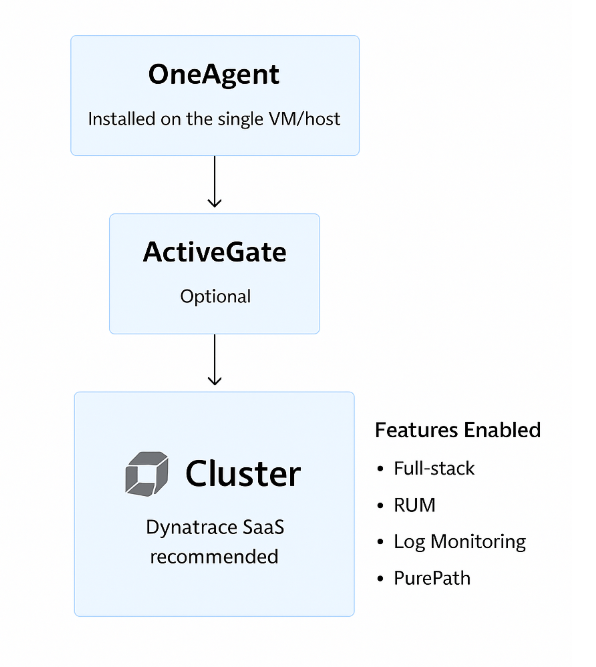
✅ Small Setup (Single App / Host / Cloud Instance)
| Component | Setup Detail |
|---|---|
| OneAgent | Installed on the single VM/host |
| ActiveGate | Optional (SaaS uses internet directly) |
| Cluster | Dynatrace SaaS recommended |
| Features Enabled | Full-stack, RUM, Log Monitoring, PurePath |
Use Case: Monitoring a small app or VM on AWS EC2, Azure VM, or a single Docker host.
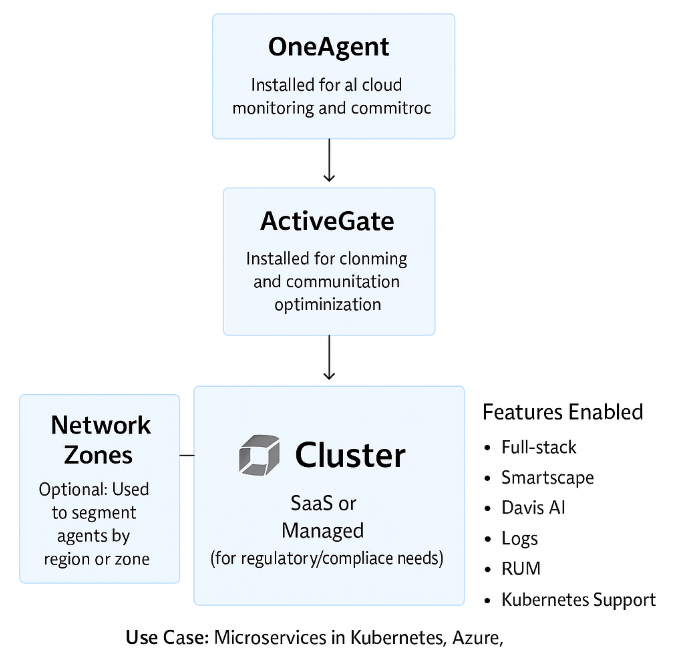
✅ Medium Setup (10-100 Hosts / Cloud VMs / Microservices)
| Component | Setup Detail |
|---|---|
| OneAgent | Installed on all application/infrastructure nodes |
| ActiveGate | Installed for cloud monitoring and communication optimization |
| Cluster | SaaS or Managed (for regulatory/compliance needs) |
| Network Zones | Optional: Used to segment agents by region or zone |
| Features Enabled | Full-stack, Smartscape, Davis AI, Logs, RUM, Kubernetes Support |
Use Case: Microservices in Kubernetes, Azure, or hybrid deployments.
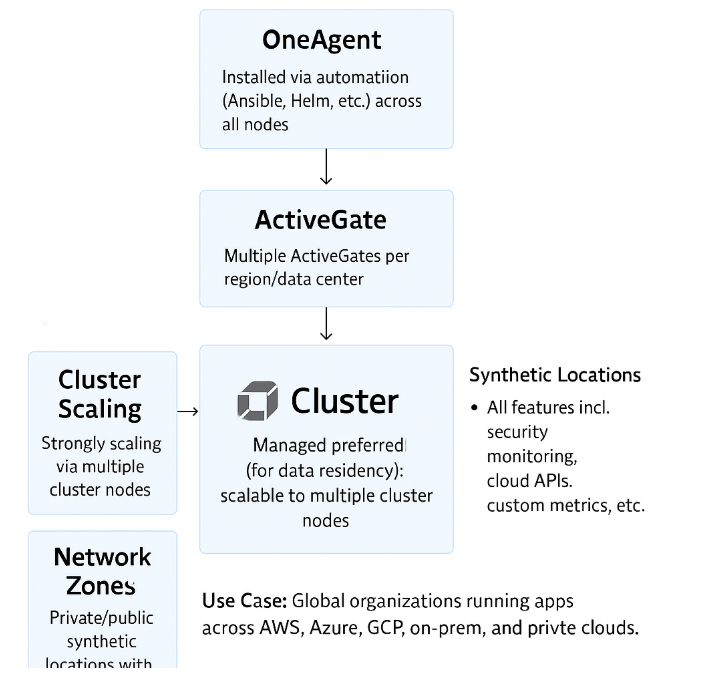
✅ Large Setup (Enterprise Multi-Cloud / Hybrid / 1000+ Hosts)
| Component | Setup Detail |
|---|---|
| OneAgent | Installed via automation (Ansible, Helm, etc.) across all nodes |
| ActiveGate | Multiple ActiveGates per region/data center |
| Cluster | Managed preferred (for data residency); scalable to multiple cluster nodes |
| Cluster Scaling | Horizontal scaling via multiple cluster nodes |
| Network Zones | Strongly recommended for performance and data control |
| Synthetic Locations | Private/public synthetic locations with ActiveGates |
| Features Enabled | All features incl. security monitoring, cloud APIs, custom metrics, etc. |
Use Case: Global organizations running apps across AWS, Azure, GCP, on-prem, and private clouds.
Network and Security Considerations
- TLS Encryption: All communication between OneAgent, ActiveGate, and Cluster is encrypted.
- Ports:
- OneAgent → ActiveGate: 9999 (default)
- ActiveGate → Cluster/SaaS: 443
- Proxy Support: ActiveGate supports outbound proxy for restrictive environments.
- Data Privacy: Supports GDPR compliance, role-based access control, and data masking.
Best Practices
- Use Network Zones for large setups to isolate traffic and optimize routing.
- Leverage Auto-Tagging to structure data and dashboards by environment, service, team.
- Deploy ActiveGates strategically to reduce internet bandwidth and improve redundancy.
- Automate OneAgent deployment using scripts, Helm (K8s), Ansible, Terraform, etc.
- Integrate with CI/CD and CM tools to enable monitoring in Dev, QA, and Prod stages.
Conclusion
Dynatrace offers a flexible, scalable, and intelligent observability platform that adapts to any infrastructure size—from a single host to a global, multi-cloud enterprise. With automated discovery, AI-powered analysis, and end-to-end tracing, Dynatrace enables teams to deliver high-performing, resilient systems with minimal manual overhead.

I’m Rajesh Kumar, a DevOps, SRE, DevSecOps, Cloud, and Platform Engineering expert passionate about sharing practical knowledge, real-world experiences, and industry best practices. I have worked at Cotocus and regularly write about technology, travel, investing, health, product reviews, and digital marketing through my various platforms.
I publish technical articles at DevOps School, travel stories at Holiday Landmark, stock market insights at Stocks Mantra, health and fitness guidance at My Medic Plus, product reviews at TrueReviewNow, and SEO and digital marketing strategies at Wizbrand.
Find Trusted Cardiac Hospitals
Compare heart hospitals by city and services — all in one place.
Explore Hospitals