
Introduction
Asset Tracking (RFID) Software is designed to help organizations monitor, locate, and manage physical assets in real time using RFID tags, sensors, and connected readers. These assets can include equipment, tools, inventory, vehicles, IT hardware, medical devices, or high-value goods. By combining RFID hardware with intelligent software, businesses gain visibility into where assets are, how they are used, and when they require maintenance or replacement.
In today’s data-driven and compliance-focused environment, asset tracking is no longer optional. Lost equipment, inventory inaccuracies, manual audits, and downtime can cost organizations millions annually. RFID-based systems significantly reduce human error, automate asset identification, and provide actionable insights for better operational decisions.
Common real-world use cases include warehouse inventory tracking, hospital equipment management, manufacturing tool tracking, retail loss prevention, logistics visibility, and IT asset lifecycle management.
When choosing an Asset Tracking (RFID) Software, buyers should evaluate factors such as RFID compatibility, real-time tracking accuracy, scalability, integrations, reporting depth, security, compliance readiness, and ease of deployment.
Best for:
Asset Tracking (RFID) Software is ideal for operations managers, facility managers, supply chain teams, IT administrators, healthcare providers, manufacturers, logistics firms, and enterprises managing high-value or regulated assets.
Not ideal for:
These tools may be unnecessary for very small businesses with minimal physical assets, or for organizations that only need basic spreadsheet-based tracking without real-time visibility.
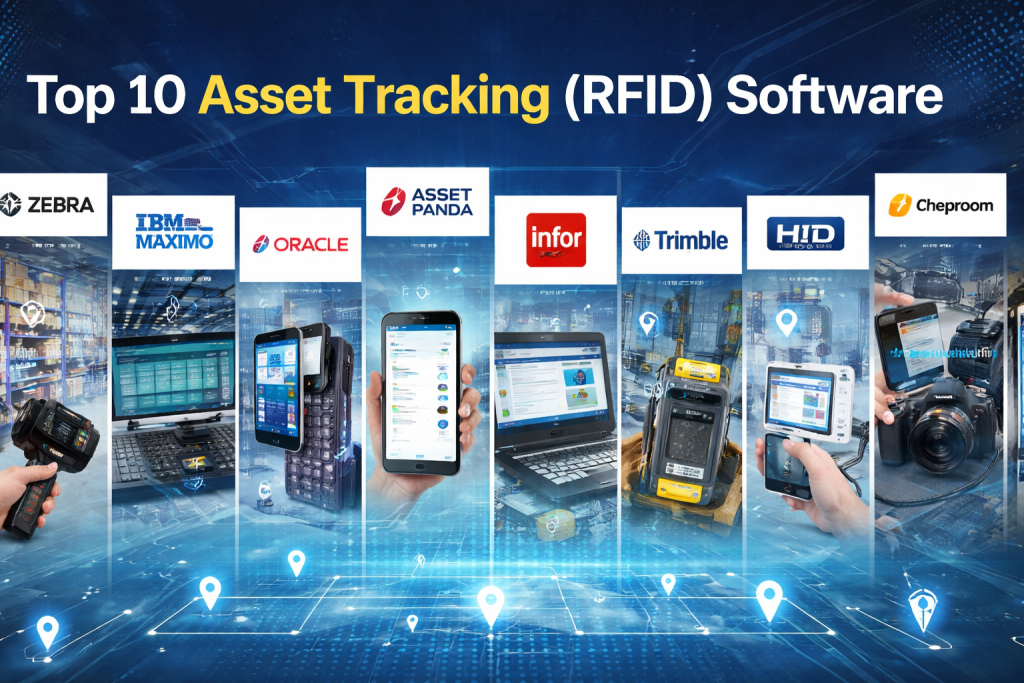
Top 10 Asset Tracking (RFID) Software Tools
1 — Zebra SmartLens & Asset Visibility Solutions
Short description:
An enterprise-grade RFID asset tracking solution designed for large-scale warehouses, retail, and manufacturing environments requiring high accuracy and automation.
Key features:
- Real-time RFID asset location tracking
- High-performance RFID reader integration
- Advanced analytics and dashboards
- Automated inventory counting
- Support for IoT sensors and cameras
- Scalable enterprise architecture
- API-based system integrations
Pros:
- Extremely accurate and reliable tracking
- Strong ecosystem of hardware and software
- Proven enterprise deployments
Cons:
- High implementation and infrastructure cost
- Requires skilled setup and configuration
Security & compliance:
Enterprise-level encryption, role-based access, audit logs, compliance varies by deployment.
Support & community:
Strong enterprise support, professional services, extensive documentation.
2— IBM Maximo Asset Management (RFID-Enabled)
Short description:
A comprehensive asset management platform with RFID capabilities, built for asset-intensive industries like utilities, manufacturing, and energy.
Key features:
- RFID-based asset identification
- Predictive maintenance analytics
- Asset lifecycle management
- Work order automation
- Integration with ERP systems
- Mobile asset tracking support
Pros:
- Deep asset lifecycle coverage
- Strong analytics and AI insights
- Highly customizable
Cons:
- Complex to deploy
- Requires significant training
Security & compliance:
Supports enterprise SSO, encryption, audit trails, ISO and SOC-aligned controls.
Support & community:
Enterprise-grade support, strong partner ecosystem.
3 — Oracle IoT Asset Tracking Cloud
Short description:
A cloud-based RFID and IoT asset tracking solution optimized for logistics, fleet, and global supply chains.
Key features:
- Real-time RFID and sensor tracking
- Global asset visibility
- Predictive condition monitoring
- Integration with Oracle ERP
- Advanced reporting and analytics
- Cloud-native scalability
Pros:
- Excellent global scalability
- Strong data analytics
- Reliable cloud infrastructure
Cons:
- Best suited for Oracle ecosystem users
- Higher cost for smaller teams
Security & compliance:
Enterprise encryption, GDPR support, audit logs, compliance certifications vary.
Support & community:
Enterprise support, extensive documentation, Oracle partner network.
4 — Asset Panda (RFID-Capable)
Short description:
A user-friendly asset tracking platform that supports RFID and barcode tracking for mid-sized organizations.
Key features:
- RFID and barcode asset tracking
- Cloud-based asset database
- Mobile app for scanning
- Custom workflows
- Asset lifecycle reporting
- Integration with HR and IT tools
Pros:
- Easy to use and deploy
- Flexible customization
- Strong mobile experience
Cons:
- Limited advanced RFID analytics
- Less suited for very large enterprises
Security & compliance:
Encryption, role-based access, SOC-aligned controls.
Support & community:
Good onboarding support, responsive customer service, growing user community.
5 — Infor EAM (RFID-Enabled)
Short description:
An enterprise asset management system with RFID support for tracking physical assets across complex operations.
Key features:
- RFID-based asset identification
- Asset maintenance scheduling
- Condition-based monitoring
- Enterprise reporting tools
- ERP and SCM integrations
- Mobile workforce support
Pros:
- Robust asset maintenance features
- Scales well for large operations
- Industry-specific templates
Cons:
- Interface can feel complex
- Implementation time can be long
Security & compliance:
Enterprise security controls, encryption, audit logs.
Support & community:
Strong enterprise support, industry-focused resources.
6 — Trimble Asset Tracking (RFID & IoT)
Short description:
A specialized asset tracking platform for construction, transportation, and heavy equipment industries.
Key features:
- RFID and GPS-enabled tracking
- Asset utilization analytics
- Maintenance alerts
- Location-based reporting
- Integration with field systems
- Cloud and mobile access
Pros:
- Excellent for mobile and outdoor assets
- Accurate location data
- Strong industry focus
Cons:
- Less flexible for non-industrial use cases
- Limited customization outside core industries
Security & compliance:
Standard enterprise security practices, compliance varies.
Support & community:
Industry-focused support and training resources.
7 — HID Global RFID Asset Tracking
Short description:
A trusted RFID asset tracking solution widely used in healthcare, manufacturing, and secure environments.
Key features:
- Passive and active RFID support
- Real-time asset visibility
- Secure access control integration
- Scalable RFID infrastructure
- Detailed asset movement logs
- Analytics and alerts
Pros:
- Strong security integration
- Reliable RFID hardware ecosystem
- Suitable for regulated industries
Cons:
- Hardware costs can be high
- Requires professional installation
Security & compliance:
Strong encryption, access controls, GDPR and healthcare compliance support.
Support & community:
Enterprise support, extensive technical documentation.
8 — EZOfficeInventory (RFID-Ready)
Short description:
A lightweight, cost-effective asset tracking solution supporting RFID and barcode tracking.
Key features:
- RFID and barcode scanning
- Asset check-in/check-out
- Maintenance scheduling
- Custom fields and reports
- Mobile access
- Cloud-based deployment
Pros:
- Affordable and easy to use
- Fast setup
- Good for SMBs
Cons:
- Limited advanced RFID automation
- Basic analytics compared to enterprise tools
Security & compliance:
Encryption, role-based permissions, standard compliance controls.
Support & community:
Helpful support team, good documentation.
9 — Snipe-IT (RFID-Integrable)
Short description:
An open-source asset management platform that can integrate with RFID systems for IT and equipment tracking.
Key features:
- Asset inventory management
- RFID and barcode integration support
- Open-source customization
- IT asset lifecycle tracking
- REST API access
- Audit and history logs
Pros:
- No licensing cost
- Highly customizable
- Strong IT asset focus
Cons:
- Requires technical expertise
- Limited official enterprise support
Security & compliance:
Depends on deployment and hosting configuration.
Support & community:
Active open-source community, community-driven support.
10 — Cheqroom (RFID-Enabled)
Short description:
An intuitive asset tracking solution designed for equipment-heavy teams like media, education, and events.
Key features:
- RFID and barcode asset tracking
- Reservation and booking system
- Asset availability visibility
- Maintenance and inspection logs
- Cloud-based platform
- Team collaboration tools
Pros:
- Excellent usability
- Strong asset booking features
- Quick onboarding
Cons:
- Not ideal for complex enterprise needs
- Limited advanced RFID analytics
Security & compliance:
Standard encryption, access controls.
Support & community:
Responsive support, good onboarding resources.
Comparison Table
| Tool Name | Best For | Platform(s) Supported | Standout Feature | Rating |
|---|---|---|---|---|
| Zebra SmartLens | Large enterprises | Cloud / On-prem | High-accuracy RFID automation | N/A |
| IBM Maximo | Asset-intensive industries | Cloud / On-prem | Full asset lifecycle management | N/A |
| Oracle IoT Asset Tracking | Global supply chains | Cloud | Global real-time visibility | N/A |
| Asset Panda | Mid-sized businesses | Cloud / Mobile | Ease of use | N/A |
| Infor EAM | Industrial enterprises | Cloud / On-prem | Maintenance automation | N/A |
| Trimble | Construction & transport | Cloud / Mobile | GPS + RFID tracking | N/A |
| HID Global | Regulated industries | On-prem / Hybrid | Secure RFID ecosystem | N/A |
| EZOfficeInventory | SMBs | Cloud / Mobile | Affordable RFID tracking | N/A |
| Snipe-IT | IT teams | Self-hosted / Cloud | Open-source flexibility | N/A |
| Cheqroom | Equipment-based teams | Cloud | Asset booking | N/A |
Evaluation & Scoring of Asset Tracking (RFID) Software
| Criteria | Weight | Notes |
|---|---|---|
| Core features | 25% | RFID accuracy, automation, reporting |
| Ease of use | 15% | UI, onboarding, learning curve |
| Integrations & ecosystem | 15% | ERP, IoT, APIs |
| Security & compliance | 10% | Encryption, access controls |
| Performance & reliability | 10% | Real-time accuracy, uptime |
| Support & community | 10% | Documentation, response time |
| Price / value | 15% | ROI and scalability |
Which Asset Tracking (RFID) Software Tool Is Right for You?
- Solo users & SMBs: Choose affordable, easy-to-deploy tools like EZOfficeInventory or Asset Panda.
- Mid-market companies: Look for balance between features and usability, such as Cheqroom or Infor EAM.
- Enterprises: Consider Zebra, IBM Maximo, Oracle, or HID Global for scale and compliance.
- Budget-conscious teams: Open-source or lightweight platforms work best.
- Highly regulated industries: Prioritize security, audit logs, and compliance readiness.
- Integration-heavy environments: Ensure API and ERP compatibility before deciding.
Frequently Asked Questions (FAQs)
1. What is RFID asset tracking software?
It is software that uses RFID technology to identify, track, and manage physical assets automatically.
2. How does RFID differ from barcode tracking?
RFID does not require line-of-sight scanning and can track assets in real time.
3. Is RFID asset tracking expensive?
Costs vary based on hardware, scale, and software complexity.
4. Can RFID tracking work indoors?
Yes, RFID is particularly effective for indoor asset tracking.
5. Is RFID tracking secure?
Most enterprise tools support encryption and access controls.
6. How long does implementation take?
From days for SMB tools to months for enterprise deployments.
7. Does RFID tracking support mobile devices?
Many platforms offer mobile apps for scanning and monitoring.
8. Can RFID integrate with ERP systems?
Yes, most enterprise tools support ERP and inventory integrations.
9. What industries benefit most from RFID tracking?
Healthcare, manufacturing, logistics, retail, and construction.
10. What are common mistakes when adopting RFID software?
Underestimating hardware planning, ignoring scalability, and lack of staff training.
Conclusion
Asset Tracking (RFID) Software plays a critical role in improving visibility, reducing losses, and optimizing asset utilization across industries. The right solution depends on scale, budget, industry requirements, and integration needs.
Rather than searching for a single “best” tool, organizations should focus on finding the best fit for their operational complexity and long-term growth. With careful evaluation, RFID asset tracking can deliver measurable efficiency, accuracy, and cost savings.

Find Trusted Cardiac Hospitals
Compare heart hospitals by city and services — all in one place.
Explore Hospitals
Solid comparison. The biggest operational challenge in RFID asset tracking is rarely the software dashboard itself, but the middleware layer translating raw reader events into clean business signals. Platforms like Zebra SmartLens excel because of tight native integration with enterprise readers and handheld scanners, filtering out false positive tag reads and portal flutter before data hits the database. If the platform lacks robust event filtering rules, high density tag environments quickly overwhelm the system with duplicate location noise.
One thing worth emphasizing: RFID accuracy depends as much on the physical environment as on the software. Metal shelving, dense inventory, reader placement, and tag selection can all create missed reads, so teams should pilot the full hardware-software setup in their actual facility and measure read rates before assuming a platform’s real-time visibility will translate directly to their operations.
Asset tracking and RFID software help businesses monitor physical assets, maintain accurate inventory records, and reduce losses. Features such as real-time tracking, automated identification, inventory alerts, and reporting can improve operational efficiency. When comparing different platforms, organizations should consider tracking accuracy, scalability, integration capabilities, and implementation costs. Choosing the right solution can simplify asset management, minimize manual errors, and support better resource utilization.
Asset tracking and RFID software help businesses monitor equipment, inventory, and valuable resources throughout their lifecycle. When comparing different solutions, features such as real-time asset tracking, RFID tag integration, automated inventory updates, and reporting dashboards are important to consider. These capabilities can reduce manual recordkeeping, improve asset visibility, and help organizations identify misplaced or underutilized equipment. Integration with existing inventory and enterprise management systems can further streamline daily operations. Choosing the right asset tracking software can improve accountability, optimize resource utilization, and support more efficient asset management.
For RFID asset tracking software, I would pay attention to how it handles assets that move between departments, storage areas, and maintenance teams. An item may be scanned at the wrong location or transferred without the receiving team confirming it, leaving the system with an inaccurate ownership record. The software should support clear handover confirmation and make it easy to investigate unexpected location changes. Comparing these workflows can reveal whether a platform helps organizations maintain accountability for expensive equipment, rather than simply displaying where an RFID tag was last detected.
RFID asset tracking can look accurate on a dashboard while physical records slowly drift away from reality. Tags may detach, get damaged, or be read through the wrong doorway, leaving equipment assigned to the wrong room or department. I would evaluate how the software handles confidence in read events and supports periodic physical audits against recorded inventory. It is also worth checking how easily staff can correct ownership or location details without losing the asset’s movement history. That balance between automated tracking and human verification is what makes inventory records trustworthy over time.
RFID asset tracking software is most useful when teams can trust the location and status of every asset. Regular tag checks can help identify missed scans, damaged tags, and incorrect records before they cause bigger issues. I would also test how well the system handles metal surfaces, busy storage areas, and overlapping read zones. Connecting RFID data with inventory records can reduce manual checks and improve accuracy. How do businesses measure whether RFID tracking is actually reducing asset loss and saving staff time?
RFID asset tracking software can help businesses find equipment quickly and keep better records. But the system needs accurate data to work well. Teams should check that RFID tags scan properly and that asset details stay updated when items move between locations. It is also helpful to train staff so they can use the system without confusion. How can businesses make sure their RFID tracking system stays accurate as the number of assets grows?
RFID asset tracking software can help organizations maintain accurate inventory records, locate equipment, and reduce the manual effort involved in asset audits. The real value comes from combining reliable tag reads with lifecycle tracking, useful reporting, and integration with existing inventory systems. When comparing solutions, hardware compatibility, read accuracy in real-world environments, and scalability across multiple locations deserve particular attention. A successful implementation also depends on tag placement and reader coverage, since metal surfaces and environmental interference can affect performance. Ultimately, the best solution is one that turns tracking data into actionable visibility rather than simply collecting more inventory information.
RFID asset tracking software helps organizations find equipment and record its movement using radio tags. One useful feature is showing when an asset enters or leaves a defined area. This can help teams find missing items and improve inventory checks. I would compare how each system handles metal objects, crowded spaces, and areas with weak tag reads. Clear links between assets, locations, and assigned staff also matter. Teams should test tag accuracy in their real work setting before wide use. The right tool should reduce manual scanning, improve asset visibility, and help staff locate important equipment with less effort.
Moving beyond manual line-of-sight scans with RFID technology provides instant visibility, but success ultimately depends on careful reader calibration and mitigating signal interference in complex spaces. Beyond automated check-ins, the core value lies in syncing real-time location data directly with enterprise inventory and maintenance platforms to eliminate blind spots. It’s a great reminder that effective asset tracking requires pairing precise hardware deployment with solid backend data management from the start.
RFID asset tracking software can improve inventory visibility, but the results depend on how reliably tags are detected and asset movements are recorded. When comparing platforms, I would examine hardware compatibility, location tracking, automated check-in and check-out, inventory reporting, and integration with existing asset systems. It is also important to test performance in real environments, since metal equipment, dense storage areas, and overlapping reader zones can affect detection accuracy. A small pilot across one warehouse or department can help identify these practical limitations early and show whether the system reduces manual stock checks, misplaced assets, and time spent reconciling inventory records.
Switching from manual barcodes to real-time RFID tracking is a huge upgrade, but getting the hardware and software to sync up smoothly is always tricky. Moving to platforms like Zebra or IBM Maximo helps cut down on lost equipment and phantom inventory. The real challenge is making sure readers stay connected and field teams actually stick to the new workflows. Setting it up successfully takes a lot of patience with team training and daily data management.
RFID tracking software needs to account for the fact that tag readings can vary across warehouses, offices, and industrial sites. I’d test how accurately the system identifies assets when several tags pass a reader together or signals overlap. Teams should also set rules for flagging stale location data instead of treating every scan as current. A process for reconciling physical inventory with system records can reveal assets that have been missed or incorrectly logged. These checks make tracking data more dependable and reduce unnecessary manual searches.
RFID asset tracking software can improve inventory accuracy by providing real-time visibility into equipment movement, location, and utilization. Integrating RFID readers with maintenance schedules and existing asset management systems helps reduce manual audits, prevent losses, and simplify lifecycle tracking. Reliable tag performance, scalable reporting, and clear access controls are important considerations for maintaining accurate records as asset volumes increase.
RFID tracking can show where an asset was last detected, but that does not always mean the asset is physically available for use. Tags may be read from adjacent rooms, metal surfaces can affect read reliability, and equipment moving through busy areas can generate duplicate scans. I’d test how the software handles conflicting reads and lets staff verify exceptions without manually correcting every record. Reliable reconciliation between scan events and actual inventory counts is especially important in warehouses or hospitals where missing equipment can disrupt daily operations.
RFID asset tracking software is most effective when it provides accurate, timely visibility into where assets are and how they move. Before selecting a platform, organizations should test tag readability in real environments, especially around metal equipment, dense storage areas, and overlapping signals. Integration with inventory and maintenance systems can also reduce manual updates and improve accountability. I would pay close attention to exception alerts for missing, misplaced, or unexpectedly moved assets. How can businesses balance tracking accuracy, hardware costs, and system scalability when rolling out RFID across multiple locations?
Transitioning from manual barcodes to RFID systems often brings unexpected hurdles with tag interference and metal/liquid surface shielding. Evaluating how software handles edge reads and filtering noise at the gateway level is just as crucial as the UI or reporting depth.
In real-world deployments, RFID accuracy depends on more than the software itself. Metal surfaces, liquid containers, overlapping reader zones, and poorly positioned antennas can cause missed reads or repeated scans. These issues may create false asset movements and unreliable inventory records even when the platform performs well. Before deployment, I would run a site-level pilot under normal operating conditions and measure read accuracy, duplicate-event rates, and synchronization delays. It is also important to define how the system handles conflicting location updates and temporarily disconnected readers. These checks help teams distinguish hardware limitations from software problems and build a more dependable tracking process as operations expand.
RFID asset tracking becomes more reliable when teams combine accurate tag data with regular inventory checks. Tag placement, reader range, and interference can all affect tracking accuracy, especially in busy warehouses. Testing these conditions before full deployment helps reduce missed reads and gives teams better visibility into asset movement and maintenance needs.
A practical challenge with RFID asset tracking is maintaining consistent read accuracy in environments containing metal equipment, liquids, or densely packed inventory. While Zebra SmartLens offers advanced RFID automation and IBM Maximo supports broader asset lifecycle management, hardware placement and tag selection can significantly influence real-world performance. Conducting a pilot that measures missed scans, asset location accuracy, and total deployment costs can help organizations avoid expensive implementation mistakes.
Monitoring physical equipment and warehouse inventory using software like Asset Panda or EZOfficeInventory helps operations teams track high value items without getting buried in manual spreadsheets. Having automated RFID scanning, real time location updates, and mobile check in workflows in one dashboard makes it much easier to prevent equipment loss and streamline audits. Choosing the right platform depends entirely on your company scale and whether you need lightweight SMB asset tracking or heavy enterprise lifecycle management.
RFID asset tracking software helps organizations locate equipment, monitor inventory movement, and maintain accurate asset records with less manual effort. Comparing tag compatibility, real-time tracking, reporting features, and integration options gives businesses a clearer understanding of which solutions can improve asset visibility, reduce losses, and simplify day-to-day inventory management.
Deploying RFID tags and readers only solves data collection; production value depends on backend stream ingestion. Engineering teams must deploy edge-filtering gateways to deduplicate high-frequency tag reads (EPC Gen2 events) and publish clean state changes via lightweight MQTT/Kafka topics into core ERP systems (such as SAP or Maximo), preventing database write bottlenecks and stale inventory records.
RFID asset tracking can become unreliable when organizations assume that every successful scan represents an accurate physical location. Metal surfaces, signal interference, tag orientation, and densely packed storage areas can affect read performance, leading to missed or duplicate detections. Before deploying the system across an entire facility, I would run a site survey under normal operating conditions and measure read accuracy in different environments. Another important consideration is how the software handles conflicting location events when an asset passes through multiple readers in a short period. Applying sensible event-filtering rules and maintaining a history of movement can help distinguish genuine transfers from noisy readings. This practical validation is essential for building confidence in inventory records and avoiding manual searches for supposedly misplaced equipment.
RFID asset tracking becomes more reliable when the software can distinguish a genuine movement from a missed or duplicate scan. I’d check how well it handles tag read errors, records asset transfers between locations, and flags items that have not been seen during recent checks. This can make stock audits quicker and help teams find misplaced equipment.
One challenge that deserves more attention is RFID performance in real operating conditions. Metal surfaces, liquid-filled containers, reader placement, and overlapping signals can cause missed or duplicate reads. Running a site-level pilot and tracking read accuracy before full deployment helps teams avoid unreliable inventory records and costly fixes later.
Choosing between active and passive RFID systems is often the biggest hurdle during implementation, especially when balancing read range against hardware costs. While enterprise tools handle large-scale automation brilliantly, smaller teams frequently underestimate how complex tag placement and reader calibration can be. A quick pilot test in a high-traffic zone can save organizations from costly deployment mistakes down the line.
RFID asset tracking software can improve visibility, but accuracy depends on more than the tracking technology itself. Businesses should consider tag durability, reader coverage, integration with inventory systems, and how easily staff can locate misplaced assets. Testing the system in real operating conditions can reveal signal interference and coverage gaps before a full rollout. Regular audits also help keep digital records aligned with physical assets. How can organizations balance tracking accuracy and implementation costs when managing large inventories across multiple locations?
One practical challenge that deserves more attention is maintaining accurate asset records when RFID readers produce missed reads, duplicate events, or conflicting location updates. In a busy warehouse, metal surfaces, tag placement, reader interference, and overlapping read zones can affect tracking accuracy even when the software performs well. Before choosing a platform, I would run a pilot using real operating conditions and measure read accuracy, false location changes, event-processing delays, and recovery after network outages. It is also worth checking whether the system can buffer events offline, reconcile them after connectivity returns, and maintain an auditable history of asset movements. These tests reveal operational weaknesses that feature comparisons alone may miss and help teams estimate the real cost of maintaining reliable asset visibility at scale.
RFID asset tracking software can improve inventory visibility, but its effectiveness depends on how accurately physical movements are reflected in the system. When comparing platforms, I would examine tag compatibility, reader integration, location accuracy, automated check-in and check-out, and reporting for missing or misplaced assets. It is also important to test how the system performs around metal surfaces, dense storage areas, and overlapping read zones, where missed or duplicate reads can affect accuracy. Starting with a pilot across one department or warehouse can help identify tagging and workflow issues before expanding the solution across the organization.
RFID asset tracking software is only as reliable as the accuracy of its tags, readers, and inventory records. I would test how well the system handles missed reads, duplicate scans, and assets moving between rooms or sites. Integration with existing inventory and maintenance systems can reduce manual updates and make asset histories easier to maintain. It is also important to check how quickly the platform reflects location changes and flags assets that have not been detected for a long time. Regular reader testing and clear exception reports can help teams maintain accurate inventory and reduce time spent searching for equipment.
This overview of top asset-tracking RFID software tools is very informative for operations and logistics professionals. By clearly outlining features like real-time tracking, scalability, integration with existing systems, and reporting capabilities, you help readers identify which solutions can best support their inventory and asset management needs. The pros and cons format makes it easy to compare strengths and limitations at a glance, highlighting practical considerations like ease of setup versus advanced analytics. For organizations aiming to improve accuracy, reduce loss, and gain actionable insights into asset utilization, this comparison offers valuable, actionable guidance for choosing the right RFID software.