
Introduction
Corporate Travel Booking Platforms are specialized digital solutions designed to help organizations plan, book, manage, and control business travel in a centralized and policy-compliant way. Unlike consumer travel websites, these platforms focus on cost control, policy enforcement, traveler safety, reporting, and integration with corporate systems such as expense management and HR tools.
In today’s global and hybrid work environment, business travel is no longer limited to senior executives. Sales teams, consultants, engineers, and operations staff frequently travel for meetings, site visits, training, and conferences. Without the right platform, companies often face issues such as uncontrolled spending, poor visibility into travel costs, compliance risks, and traveler dissatisfaction.
A robust corporate travel booking platform helps organizations save money, reduce administrative overhead, ensure duty of care, and improve the overall travel experience. When choosing a solution, buyers should evaluate factors such as booking inventory, policy controls, reporting depth, integrations, ease of use, scalability, and security.
Best for:
Mid-sized to large organizations, enterprises, fast-growing startups, consulting firms, IT services companies, manufacturing firms, healthcare organizations, and any business with frequent employee travel.
Not ideal for:
Individual travelers, freelancers, very small teams with infrequent travel, or organizations that rely entirely on manual booking and reimbursements with minimal compliance needs.
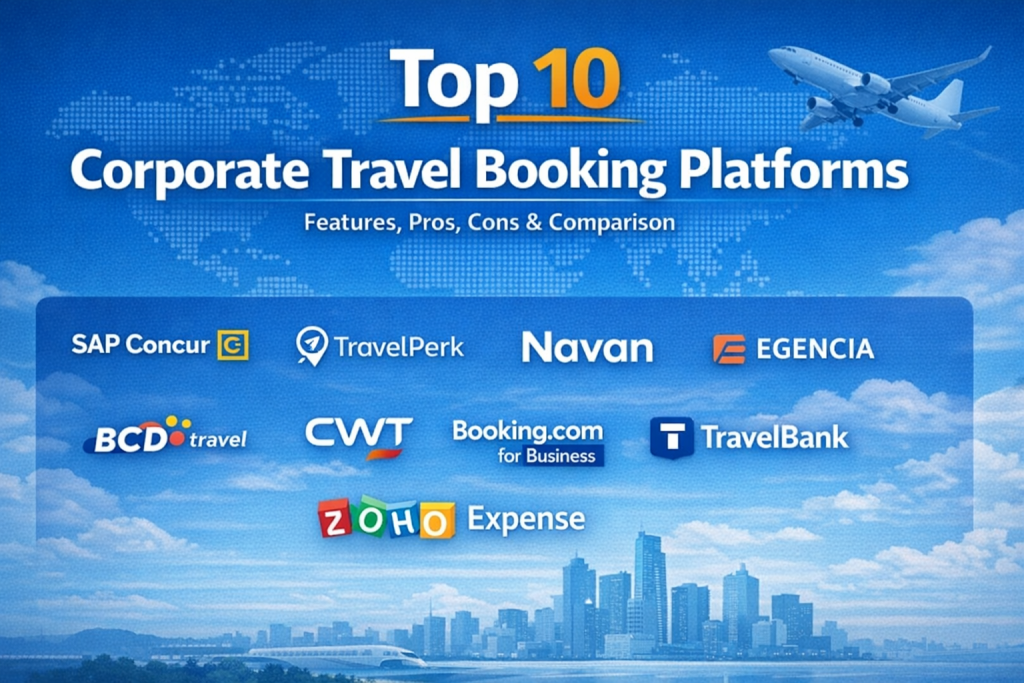
Top 10 Corporate Travel Booking Platforms Tools
1 — SAP Concur Travel
Short description:
An enterprise-grade corporate travel and expense platform designed for global organizations needing deep policy control, reporting, and financial visibility.
Key features:
- Centralized flight, hotel, and car rental booking
- Automated travel policy enforcement
- Integrated expense management and invoicing
- Real-time spend analytics and dashboards
- Mobile app for travelers and approvers
- Duty of care and traveler tracking
- Integration with ERP and finance systems
Pros:
- Very strong reporting and compliance controls
- Scales well for large, global enterprises
- Mature ecosystem and integrations
Cons:
- Can feel complex for small teams
- Setup and configuration may take time
- Premium pricing compared to lightweight tools
Security & compliance:
SOC 2, GDPR, enterprise-grade encryption, audit logs, SSO support.
Support & community:
Extensive documentation, enterprise onboarding, dedicated account managers, global support network.
2 — TravelPerk
Short description:
A modern, user-friendly corporate travel platform focused on flexibility, transparency, and traveler satisfaction.
Key features:
- All-in-one booking for flights, hotels, and trains
- Flexible booking with cancellation options
- Smart travel policy rules
- Real-time spend tracking
- VAT invoice collection
- Carbon offset tracking
- Integrations with expense tools
Pros:
- Very intuitive interface
- Fast onboarding and setup
- Strong traveler experience
Cons:
- Advanced customization limited compared to enterprise tools
- Less suitable for highly regulated industries
- Some features locked behind higher plans
Security & compliance:
GDPR compliant, secure payments, role-based access, SSO.
Support & community:
High-quality support, onboarding assistance, helpful knowledge base.
3 — Navan (formerly TripActions)
Short description:
A powerful platform combining corporate travel booking with real-time expense and card-based spend management.
Key features:
- Large global travel inventory
- Corporate cards with real-time expense capture
- Policy-driven booking
- AI-powered recommendations
- Traveler rewards for cost-saving choices
- Advanced analytics
- Mobile-first experience
Pros:
- Strong alignment between travel and expenses
- Encourages cost-saving behavior
- Modern design and performance
Cons:
- May be overkill for small organizations
- Requires process change adoption
- Pricing transparency can vary
Security & compliance:
SOC 2, GDPR, encrypted transactions, SSO.
Support & community:
Dedicated enterprise support, onboarding specialists, responsive customer service.
4 — Engine
Short description:
A modern travel management platform for booking and managing work trips, with centralized spend visibility and controls.
Key features:
- Booking for hotels, flights, and cars in one platform
- Rate caps, star-rating limits, and class-of-service rules at booking
- One invoice for company travel, with no expense reports or reimbursements
- Real-time spend visibility by traveler, team, project, or job
- Flexible trip modifications and cancellations through FlexPro
- Self-serve group bookings for up to 8 rooms, plus a dedicated Groups team for larger blocks
Pros:
- Strong control over spend before a booking is made
- Reduces receipt chasing and manual reconciliation
- No membership fee
Best for:
Finance, HR, and operations teams that need centralized booking, policy enforcement, and a unified view of travel spend. Learn more about Engine.
5 — Amadeus Cytric
Short description:
A travel and expense solution focused on compliance-heavy organizations and regulated industries.
Key features:
- Policy-based booking engine
- Travel and expense integration
- Approval workflows
- Sustainability tracking
- Analytics and reporting
- Multi-language and multi-currency support
- ERP integration
Pros:
- Strong compliance and governance
- Suitable for regulated environments
- Global scalability
Cons:
- User experience less intuitive
- Setup complexity
- Slower innovation compared to newer tools
Security & compliance:
ISO-aligned security practices, GDPR compliance, audit trails.
Support & community:
Enterprise-grade support, implementation partners, structured onboarding.
6 — BCD Travel TripSource
Short description:
A corporate travel booking and management tool backed by a global travel management company.
Key features:
- Centralized travel booking
- Policy enforcement
- Traveler tracking and alerts
- Mobile itinerary management
- Reporting and analytics
- Personalized travel profiles
- Integration with expense platforms
Pros:
- Strong human travel support
- Reliable for frequent travelers
- Good duty of care capabilities
Cons:
- Digital experience not as modern
- Limited customization
- Heavily service-driven model
Security & compliance:
Enterprise security standards, GDPR compliance.
Support & community:
24/7 travel agent support, global service teams.
7 — CWT (Carlson Wagonlit Travel)
Short description:
A comprehensive travel management solution designed for large enterprises with complex travel needs.
Key features:
- End-to-end corporate travel booking
- Advanced travel policy controls
- Risk management and traveler safety
- Data analytics and benchmarking
- Global supplier management
- Mobile app support
- Sustainability insights
Pros:
- Strong global reach
- Excellent duty of care
- Deep industry expertise
Cons:
- Higher cost structure
- Slower deployment cycles
- Less flexible UI
Security & compliance:
ISO standards, GDPR compliance, secure data handling.
Support & community:
Dedicated account teams, global travel counselors.
8 — Booking.com for Business
Short description:
A simple and accessible business travel booking platform for small and mid-sized teams.
Key features:
- Easy hotel booking
- Basic travel policy settings
- Centralized billing
- Team dashboards
- Cost visibility
- Mobile access
- Invoice management
Pros:
- Very easy to use
- Quick setup
- Ideal for small teams
Cons:
- Limited flight and rail options
- Minimal advanced reporting
- Not suitable for complex travel programs
Security & compliance:
Standard encryption, GDPR compliance.
Support & community:
Basic support, help center documentation.
9 — TravelBank
Short description:
A cost-focused corporate travel and expense platform aimed at SMBs and growing companies.
Key features:
- Budget-based travel booking
- Policy controls
- Integrated expense management
- Real-time cost tracking
- Mobile app
- Approval workflows
- Reporting dashboards
Pros:
- Strong cost visibility
- Simple interface
- Affordable pricing
Cons:
- Limited global inventory
- Fewer enterprise integrations
- Not ideal for large organizations
Security & compliance:
SOC 2, encrypted data, GDPR compliance.
Support & community:
Responsive support, onboarding assistance, documentation.
10 — Zoho Expense (Travel Module)
Short description:
A travel and expense solution for organizations already using the Zoho ecosystem.
Key features:
- Travel request and booking workflows
- Expense automation
- Policy enforcement
- Approval chains
- Reporting and analytics
- Integration with Zoho apps
- Mobile expense capture
Pros:
- Cost-effective
- Strong integration within Zoho suite
- Easy to configure
Cons:
- Limited global travel inventory
- Best used with Zoho products
- Less advanced duty of care
Security & compliance:
ISO certifications, GDPR compliance, secure access controls.
Support & community:
Good documentation, community forums, business support plans.
Comparison Table
| Tool Name | Best For | Platform(s) Supported | Standout Feature | Rating |
|---|---|---|---|---|
| SAP Concur Travel | Large enterprises | Web, Mobile | Deep expense & ERP integration | N/A |
| TravelPerk | SMBs & mid-market | Web, Mobile | Flexible bookings | N/A |
| Navan | Tech-forward companies | Web, Mobile | Real-time expense + cards | N/A |
| Engine | Finance, HR, and operations teams needing centralized booking and policy enforcement | Web, Mobile | Consolidated single-invoice billing (no expense reports) and FlexPro flexible modifications | N/A |
| Amadeus Cytric | Regulated industries | Web, Mobile | Compliance-first design | N/A |
| BCD TripSource | Frequent travelers | Web, Mobile | Human travel support | N/A |
| CWT | Large enterprises | Web, Mobile | Duty of care excellence | N/A |
| Booking.com for Business | Small teams | Web, Mobile | Simplicity | N/A |
| TravelBank | Cost-conscious SMBs | Web, Mobile | Budget-based booking | N/A |
| Zoho Expense | Zoho users | Web, Mobile | Ecosystem integration | N/A |
Evaluation & Scoring of Corporate Travel Booking Platforms
| Criteria | Weight | Evaluation Focus |
|---|---|---|
| Core features | 25% | Booking depth, policy control, reporting |
| Ease of use | 15% | User interface, onboarding |
| Integrations & ecosystem | 15% | ERP, expense, HR tools |
| Security & compliance | 10% | Certifications, data protection |
| Performance & reliability | 10% | Stability, uptime |
| Support & community | 10% | Help quality, enterprise support |
| Price / value | 15% | ROI, transparency |
Which Corporate Travel Booking Platforms Tool Is Right for You?
- Solo users: Lightweight tools or manual booking may suffice
- SMBs: TravelPerk, TravelBank, Booking.com for Business
- Mid-market: Navan, Egencia, Zoho Expense
- Enterprise: SAP Concur, CWT, Amadeus Cytric
Budget-conscious teams should prioritize ease of use and transparent pricing, while enterprises should focus on compliance, scalability, integrations, and duty of care.
Frequently Asked Questions (FAQs)
1. What is a corporate travel booking platform?
It is a system that helps businesses manage travel bookings, policies, expenses, and traveler safety centrally.
2. How is it different from consumer travel sites?
Corporate platforms focus on compliance, reporting, and organizational control rather than individual deals.
3. Do these tools save money?
Yes, through negotiated rates, policy enforcement, and spend visibility.
4. Are these platforms secure?
Most offer enterprise-grade security, encryption, and compliance certifications.
5. Can they integrate with expense tools?
Yes, integration is a core feature for most platforms.
6. Are they suitable for international travel?
Many support global inventory, currencies, and languages.
7. How long does implementation take?
From a few days for SMB tools to several weeks for enterprise platforms.
8. Do employees like using them?
User-friendly tools improve adoption and satisfaction.
9. Can travel policies be customized?
Yes, most platforms allow flexible policy rules.
10. What is the biggest mistake when choosing a tool?
Selecting a platform that is either too complex or too basic for actual needs.
Conclusion
Corporate Travel Booking Platforms play a critical role in controlling costs, ensuring compliance, protecting travelers, and simplifying operations. While some tools excel in enterprise-grade governance and reporting, others focus on flexibility and ease of use.
There is no universal “best” platform. The right choice depends on company size, travel volume, budget, compliance needs, and integration requirements. By clearly understanding your priorities and evaluating platforms against them, organizations can select a solution that delivers both operational efficiency and a better travel experience.

Find Trusted Cardiac Hospitals
Compare heart hospitals by city and services — all in one place.
Explore Hospitals
Corporate travel booking platforms help organizations simplify business travel by centralizing flight and hotel reservations, enforcing travel policies, and improving visibility into spending. Features such as negotiated corporate rates, approval workflows, itinerary management, traveler tracking, and integration with expense management systems can make the entire booking process more efficient. I believe flexibility, transparent pricing, reliable customer support, and the ability to manage last-minute changes are essential factors when comparing these solutions. The right platform should balance cost control with employee convenience, helping businesses reduce administrative work, maintain policy compliance, and provide a smoother, more consistent travel experience for employees.
Corporate travel booking platforms help businesses manage flights, hotels, and employee travel plans in one place. I would check how easily employees can change bookings, compare travel costs, and follow company travel rules. Clear approval steps and real-time updates can help reduce confusion when plans change at short notice. It is also useful to have travel records and expense details in one system for easier reporting. How can companies control travel costs while giving employees enough flexibility to handle unexpected changes?
One factor worth considering beyond booking features and pricing is how effectively corporate travel platforms handle unexpected disruptions, such as flight cancellations, itinerary changes, and emergency rebookings. Real-time traveler alerts, responsive support, and flexible approval workflows can make a significant difference during these situations.
Corporate travel booking platforms are most effective when they balance cost control with flexibility and traveler convenience. Centralized reservations, policy enforcement, and real-time itinerary updates help organizations reduce booking inconsistencies while keeping employees informed during unexpected changes. Integration with expense management and duty-of-care tools further improves financial oversight and supports safer, more coordinated business travel.
Choosing the right corporate travel booking platform often comes down to striking a delicate balance between strict policy enforcement and user flexibility. While enterprise-grade systems offer comprehensive oversight and deep inventory controls, modern teams frequently favor solutions that simplify approvals and reduce booking friction. Ultimately, the most successful implementations are those that align closely with existing travel volume and internal workflow requirements rather than just feature count.
Corporate travel booking platforms help employees arrange work trips within company policies. Useful tools should show suitable flights, hotels, and other travel choices in one place. Policy checks and approval flows can reduce out-of-policy bookings. Centralized trip details also help travel managers support employees when plans change. When comparing platforms, review travel coverage, booking flexibility, reporting, and support availability. Integration with expense systems can make the full process smoother. A strong platform balances employee convenience with cost control and clear visibility for the business.
Another important factor is how corporate travel systems manage bookings made outside the approved platform. Employees may book directly with airlines or hotels when company tools lack suitable options or urgent changes arise. I’d check whether these purchases can be added to the central travel record with receipts, policy checks, and approval details intact. Without this visibility, finance teams may miss total trip costs or struggle to locate travelers during an emergency. A smooth process for recording external bookings can close that gap without making travel harder for employees.
Corporate travel booking platforms help businesses manage flights, hotels, and employee travel arrangements from one place. When comparing options, I would focus on policy enforcement, booking flexibility, approval workflows, and real-time itinerary updates. Clear expense visibility and traveler support can help reduce administrative work and unexpected costs. The right platform should simplify business travel while keeping bookings organized, compliant, and cost-effective.
Automating corporate travel booking requires finance teams to combine self-service reservations with automated policy enforcement and real-time expense integration, ensuring duty-of-care visibility while eliminating out-of-policy spend across enterprise teams.
Corporate travel booking platforms are most effective when they balance employee convenience with company travel policies and budget limits. Real-time fare comparisons, flexible booking changes, and clear approval workflows can reduce costs without adding extra steps for travelers. Reliable reporting and support during disruptions also help travel teams manage unexpected changes and keep business trips running smoothly.
Corporate travel booking platforms can help businesses manage reservations, enforce travel policies, and give employees a smoother booking experience. When comparing solutions, I would focus on access to competitive fares, policy-based approvals, itinerary management, and integration with expense systems. Real-time travel alerts and responsive support are also important when cancellations or schedule changes disrupt a trip. Clear reporting helps finance teams track spending without creating unnecessary work for travelers. How can companies balance cost control with employee comfort, flexibility, and safety when choosing a corporate travel platform?
An important factor to consider is how well a corporate travel platform supports business continuity during unexpected disruptions. If a flight gets cancelled while an employee is traveling, the system should help teams manage rebooking, approval changes, and updated travel costs without creating conflicting records. I would also assess whether travel managers can access essential itineraries during outages or when third-party booking integrations become unavailable. Testing these scenarios before deployment can reveal weaknesses that routine booking demonstrations often miss. Companies should also define fallback procedures for urgent changes and ensure that updates reach travelers, managers, and finance teams consistently. These capabilities can reduce disruption for employees and prevent avoidable administrative work during time-sensitive situations.
Choosing the right corporate travel platform often comes down to balancing strict policy enforcement with an intuitive booking experience for employees. While enterprise heavyweights excel at deep ERP integrations, smaller teams usually prioritize flexible inventory and minimal training overhead. How do you find platforms that successfully bridge this gap without frustrating business travelers.
Business travel plans can change at the last minute when meetings get rescheduled or flights are cancelled. It helps when booking platforms show alternative flights, hotel options, and policy limits together, so employees can make quick decisions without waiting for approval at every step. This can save time for both travelers and the teams managing corporate travel.
Corporate travel booking platforms simplify business trips by bringing flight and hotel reservations, travel policies, and itinerary management into a centralized workflow. Comparing booking flexibility, negotiated corporate rates, approval processes, expense integration, and traveler support helps companies select platforms that control travel costs while making business trips more organized and convenient.
This article offers a clear and practical comparison of the top corporate travel booking platforms by highlighting their key features, benefits, and limitations in a way that’s easy to follow. I appreciate how it focuses on elements that matter most for business travel — such as ease of booking, integration with expense systems, and traveler support tools — which can make a real difference in efficiency and user experience. For travel managers and organizations evaluating corporate booking solutions, this guide provides useful insights to help make more informed decisions.