
Introduction
Car Rental Management Software is a specialized digital solution designed to help car rental businesses manage their daily operations efficiently. From vehicle inventory and booking management to billing, customer records, and fleet maintenance, these tools act as the operational backbone of modern rental companies. As customer expectations rise and competition intensifies, manual processes and spreadsheets are no longer sufficient.
These platforms are important because they reduce operational errors, improve vehicle utilization, enhance customer experience, and provide real-time visibility into fleet performance and revenue. Whether it’s handling online reservations, managing seasonal demand, tracking vehicle availability, or automating invoicing, car rental software enables businesses to operate faster and smarter.
Common real-world use cases include daily car rentals, airport rental operations, long-term leasing, self-drive services, corporate rentals, and multi-location fleet management. When choosing a tool, users should evaluate ease of use, booking automation, fleet tracking, payment handling, reporting depth, scalability, integrations, and data security.
Best for:
Car Rental Management Software is ideal for car rental owners, fleet managers, operations teams, franchise operators, and mobility startups. It benefits small rental agencies, growing regional operators, and large enterprises managing hundreds or thousands of vehicles.
Not ideal for:
These tools may not be suitable for individuals with only one or two vehicles or businesses that operate on an occasional, informal rental basis. In such cases, simpler invoicing or booking tools may be sufficient.
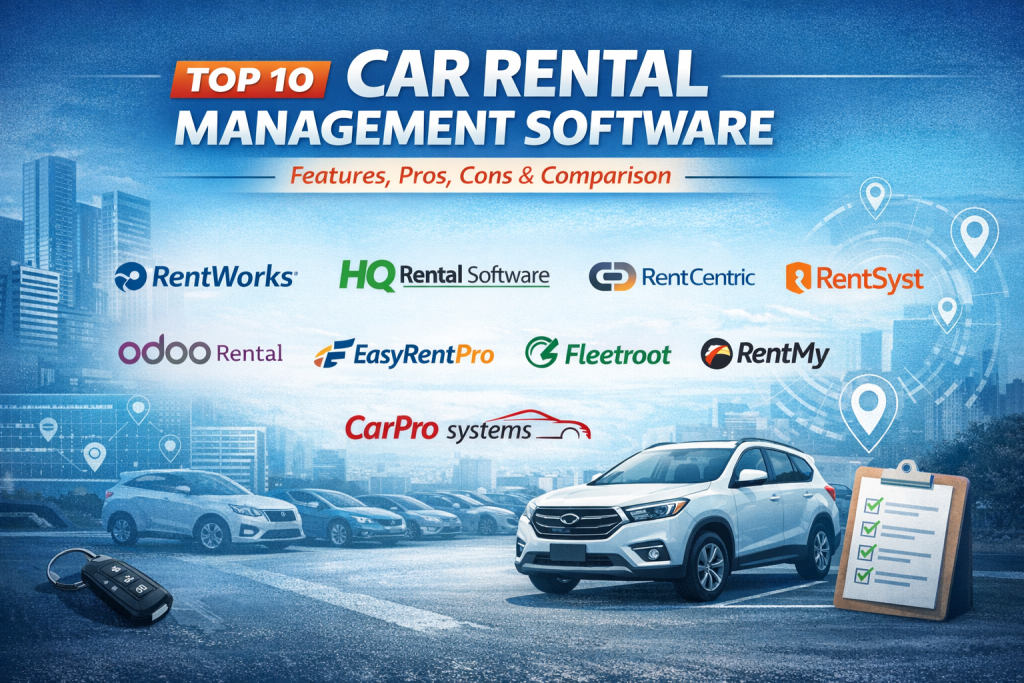
Top 10 Car Rental Management Software Tools
1 — RentWorks
Short description:
RentWorks is a robust car rental management solution built for mid-sized to large rental companies requiring advanced fleet and financial control.
Key features:
- Centralized reservation and contract management
- Fleet availability and utilization tracking
- Automated billing, invoicing, and rate management
- Damage tracking and maintenance scheduling
- Multi-location and multi-brand support
- Detailed financial and operational reports
Pros:
- Strong financial and reporting capabilities
- Scales well for large fleets
- Reliable performance for complex operations
Cons:
- Interface can feel complex for new users
- Higher cost compared to SMB-focused tools
Security & compliance:
Role-based access, data encryption, audit logs, GDPR-ready
Support & community:
Professional onboarding, documentation, enterprise support available
2 — HQ Rental Software
Short description:
HQ Rental Software is an all-in-one cloud-based platform designed for car rental and equipment rental businesses of all sizes.
Key features:
- Online booking and reservation system
- Fleet and asset management
- Payment processing and invoicing
- Customer and driver management
- Custom pricing rules and promotions
- Website integration support
Pros:
- Easy to use and quick to deploy
- Strong booking and payment automation
- Suitable for both small and growing businesses
Cons:
- Advanced reporting is limited
- Customization options may require add-ons
Security & compliance:
SSL encryption, GDPR compliance, secure payment handling
Support & community:
Email and chat support, onboarding assistance, active user base
3 — Rent Centric
Short description:
Rent Centric focuses on enterprise-grade car rental and mobility management with strong integration and customization options.
Key features:
- End-to-end rental lifecycle management
- Fleet tracking and telematics integrations
- Flexible pricing and contract rules
- Corporate and long-term rental support
- API-based integrations
- Business intelligence dashboards
Pros:
- Highly customizable workflows
- Strong enterprise and franchise support
- Excellent integration capabilities
Cons:
- Implementation takes time
- Best suited for larger organizations
Security & compliance:
SSO support, encryption, audit trails, GDPR compliant
Support & community:
Dedicated account managers, enterprise-grade support
4 — Navotar
Short description:
Navotar is a modern, cloud-based car rental platform built for SMBs and multi-location operators.
Key features:
- Reservation and availability management
- Fleet and maintenance tracking
- Digital contracts and e-signatures
- Billing, invoicing, and payment tools
- Mobile-friendly operations
- Reporting and analytics
Pros:
- Clean and intuitive interface
- Cloud access from anywhere
- Affordable pricing tiers
Cons:
- Limited deep enterprise features
- Reporting customization could improve
Security & compliance:
Encrypted data storage, role-based access, GDPR support
Support & community:
Email support, training resources, onboarding guides
5 — RentSyst
Short description:
RentSyst is designed for small to mid-sized rental businesses seeking simplicity and automation.
Key features:
- Online reservations and calendar view
- Fleet and vehicle status tracking
- Automated invoicing and payments
- Damage and incident management
- Customer database management
- Mobile access
Pros:
- Easy to learn and operate
- Cost-effective for small businesses
- Quick setup
Cons:
- Not ideal for large fleets
- Limited advanced analytics
Security & compliance:
Basic encryption, GDPR-ready, limited compliance certifications
Support & community:
Standard support channels, help documentation
6 — Odoo Rental (Car Rental Module)
Short description:
Odoo Rental offers a flexible, modular approach to car rental management as part of a broader ERP ecosystem.
Key features:
- Rental orders and contract management
- Fleet and asset tracking
- Accounting and invoicing integration
- CRM and customer management
- Custom workflows and automation
- Open-source extensibility
Pros:
- Highly customizable
- Strong accounting integration
- Suitable for hybrid rental-business needs
Cons:
- Requires configuration expertise
- User experience depends on implementation
Security & compliance:
Access controls, encryption, GDPR support
Support & community:
Large global community, documentation, partner-based support
7 — Easy Rent Pro
Short description:
Easy Rent Pro is a mature solution trusted by traditional car rental companies for decades.
Key features:
- Reservation and contract processing
- Fleet availability and utilization tracking
- Rate management and discounts
- Accounting and reporting tools
- Multi-location operations
- Legacy system compatibility
Pros:
- Proven reliability
- Feature-rich for traditional rentals
- Strong operational depth
Cons:
- Interface feels outdated
- Slower innovation compared to cloud-first tools
Security & compliance:
Standard security controls, varies by deployment
Support & community:
Dedicated support, long-standing customer base
8 — Fleetroot
Short description:
Fleetroot combines car rental management with fleet tracking and telematics capabilities.
Key features:
- Real-time vehicle tracking
- Booking and rental management
- Maintenance and service scheduling
- Fuel and expense monitoring
- Driver and customer management
- Analytics dashboards
Pros:
- Strong fleet intelligence
- Ideal for operational efficiency
- Good visibility into vehicle usage
Cons:
- Learning curve for non-technical users
- Telemetry features may increase cost
Security & compliance:
Encrypted communications, role-based access
Support & community:
Training resources, customer support, growing community
9 — RentMy
Short description:
RentMy is designed for peer-to-peer and short-term car rental marketplaces.
Key features:
- Self-service booking platform
- Owner and renter management
- Automated pricing and availability
- Payment and commission handling
- Ratings and review system
- Mobile-first experience
Pros:
- Excellent for marketplace models
- Strong automation for self-service rentals
- User-friendly design
Cons:
- Not ideal for traditional rental companies
- Limited enterprise features
Security & compliance:
Secure payments, GDPR compliance, basic audit logs
Support & community:
Online documentation, community forums
10 — CarPro Systems
Short description:
CarPro Systems focuses on simplicity and affordability for small and regional rental agencies.
Key features:
- Reservation and contract management
- Fleet status monitoring
- Invoicing and payment tracking
- Customer profiles and history
- Reporting and summaries
- Local deployment options
Pros:
- Affordable pricing
- Simple workflows
- Reliable for basic needs
Cons:
- Limited scalability
- Fewer integrations
Security & compliance:
Varies by deployment, basic data protection
Support & community:
Email and phone support, small user base
Comparison Table
| Tool Name | Best For | Platform(s) Supported | Standout Feature | Rating |
|---|---|---|---|---|
| RentWorks | Large rental enterprises | Web | Advanced financial reporting | N/A |
| HQ Rental | SMBs and growing businesses | Web | Fast online booking setup | N/A |
| Rent Centric | Enterprise & franchise operations | Web | Customizable enterprise workflows | N/A |
| Navotar | SMB & multi-location rentals | Web | Cloud-first usability | N/A |
| RentSyst | Small rental agencies | Web | Simple automation | N/A |
| Odoo Rental | Custom ERP-driven rentals | Web | Modular ERP integration | N/A |
| Easy Rent Pro | Traditional rental companies | Desktop / Web | Mature operational depth | N/A |
| Fleetroot | Fleet-focused rental operations | Web | Real-time vehicle tracking | N/A |
| RentMy | Peer-to-peer rental marketplaces | Web / Mobile | Marketplace automation | N/A |
| CarPro Systems | Small and regional operators | Web / Local | Cost-effective basics | N/A |
Evaluation & Scoring of Car Rental Management Software
| Evaluation Criteria | Weight | Description |
|---|---|---|
| Core features | 25% | Booking, fleet, billing, reporting |
| Ease of use | 15% | UI, onboarding, learning curve |
| Integrations & ecosystem | 15% | Payment, CRM, telematics, APIs |
| Security & compliance | 10% | Data protection, access control |
| Performance & reliability | 10% | Stability, uptime, speed |
| Support & community | 10% | Help, documentation, responsiveness |
| Price / value | 15% | Cost vs features and scalability |
Which Car Rental Management Software Tool Is Right for You?
- Solo users: Choose lightweight, affordable tools with basic booking and invoicing.
- SMBs: Look for cloud-based platforms with automation and online bookings.
- Mid-market: Prioritize scalability, reporting, and integrations.
- Enterprise: Focus on customization, security, multi-location support, and APIs.
Budget-conscious businesses should prioritize value and ease of use, while premium operators may invest in advanced analytics and integrations. Balance feature depth with usability, ensure the software integrates with existing systems, and always evaluate security and compliance needs.
Frequently Asked Questions (FAQs)
1. What is car rental management software?
It is a digital system that helps manage bookings, fleet, customers, payments, and reporting.
2. Is cloud-based software better than on-premise?
Cloud-based solutions offer easier access, updates, and scalability for most businesses.
3. Can these tools handle multiple locations?
Yes, many tools support multi-branch and multi-city operations.
4. Do these platforms support online bookings?
Most modern tools include online reservation capabilities.
5. Is training required to use these systems?
Basic systems require minimal training, while enterprise tools may need onboarding.
6. Are these tools suitable for electric vehicle fleets?
Yes, many support EV tracking and maintenance.
7. How secure is customer data?
Security varies by vendor but commonly includes encryption and access controls.
8. Can I integrate payment gateways?
Most platforms support common payment integrations.
9. What is the typical implementation time?
From a few days for simple tools to several weeks for enterprise systems.
10. What mistakes should buyers avoid?
Ignoring scalability, underestimating training needs, and overlooking security.
Conclusion
Car Rental Management Software plays a critical role in modern mobility businesses. The right platform can streamline operations, reduce costs, improve customer experience, and enable growth. Key factors such as feature depth, ease of use, scalability, integrations, and security should guide your decision.
There is no single “best” solution for everyone. The ideal tool depends on your business size, operational complexity, budget, and long-term goals. By carefully evaluating your needs and matching them to the strengths of each platform, you can choose a solution that truly supports your success.

Find Trusted Cardiac Hospitals
Compare heart hospitals by city and services — all in one place.
Explore Hospitals
Spot on. The most critical operational failure point in car rental management systems is concurrency race conditions across multi channel distribution feeds and local branch dispatch lots. When rental platforms synchronize fleet inventory across online travel agencies, mobile self service apps, and counter terminals without sub second distributed locking, peak booking spikes cause catastrophic double bookings. Furthermore, if the system cannot reconcile sudden vehicle groundings for unscheduled safety recalls or telematics reported mechanical faults instantly across all sales channels, operations teams face angry counter walkouts, emergency vehicle sourcing costs, and severe regulatory liability.
A good car rental management system should do more than handle bookings; it should help businesses coordinate vehicle availability, maintenance schedules, payments, and customer records without unnecessary manual work. Features like real-time fleet tracking, automated reminders, and clear utilization reports can reduce operational costs, prevent double bookings, and deliver a smoother rental experience for customers.
For car rental businesses, vehicle turnaround time can have a direct impact on fleet availability and daily revenue. A car returned late, with an unresolved damage report or an incomplete cleaning check, should not immediately appear as ready for the next booking. I would look at how well these platforms coordinate return inspections, damage documentation, cleaning status, and maintenance clearance before releasing a vehicle for another customer. It is also useful to have a clear record of when a vehicle becomes available again, especially during busy periods when multiple reservations depend on the same fleet. This operational detail can make a significant difference to the accuracy of availability shown to customers.
Car rental management software helps businesses streamline reservations, manage vehicle availability, track fleet maintenance, and simplify billing from a centralized platform. Features such as online booking, automated invoicing, vehicle tracking, digital agreements, and maintenance scheduling can reduce manual work while improving the customer experience. I believe fleet utilization, pricing flexibility, integration with payment gateways, and real-time availability updates are essential factors when comparing these solutions. The right platform should help rental businesses minimize booking conflicts, control operating costs, and manage vehicles more efficiently while providing customers with a smooth and reliable rental experience.
Car rental management software helps businesses manage bookings, vehicle availability, payments, and maintenance records in one place. I would check how well the system prevents double bookings and keeps vehicle status up to date. Clear reminders for service dates and return times can also help reduce delays and avoid extra work. Easy booking changes and accurate billing can make the process smoother for both staff and customers. How can car rental businesses use these tools to improve fleet use while giving customers a simple booking experience?
Car rental management software helps businesses streamline bookings, vehicle tracking, and payment processing. Features like automated reservations and maintenance reminders can save time and reduce manual errors. I believe comparing different platforms helps businesses choose a solution that fits their specific needs and budget. Ease of use, scalability, and customer support are also important factors to consider. The right software can improve customer satisfaction and make daily operations more efficient.
An important consideration when comparing car rental management software is how accurately it handles real-time vehicle availability, last-minute cancellations, and maintenance-related downtime. Even a feature-rich platform can create operational challenges if booking and fleet data are not synchronized properly.
Car rental management software can simplify daily operations by connecting reservations, vehicle availability, customer records, and billing in one system. Automated booking updates, maintenance reminders, and digital rental agreements help reduce scheduling conflicts while improving fleet utilization. Integrating payment processing with clear vehicle tracking also gives rental businesses better financial visibility and a smoother customer experience.
Evaluating tools like RentWorks and HQ Rental Software highlights how crucial real-time fleet visibility and robust financial reporting are for scaling operations. However, beyond standard booking calendars and invoicing, the real test of these platforms lies in how smoothly they handle unexpected maintenance downtime and accident claims. It would be interesting to hear how different systems manage unexpected vehicle repairs without causing cascading double-booking issues for the next customer.
Car rental management software helps businesses handle bookings, vehicles, payments, and customer records. A strong system should show vehicle availability in real time and reduce booking conflicts. Digital agreements and clear payment records can make check-in and return easier. Maintenance tracking is also important for keeping vehicles ready for use. When comparing tools, review booking features, fleet reports, payment options, and ease of setup. Rental companies should also consider growth plans and support needs. The right platform can reduce manual work and improve the customer experience.
Rental operators should also consider how the software manages vehicles that become unavailable at short notice. A breakdown, delayed return, or missed service can affect bookings that staff have already confirmed. I’d check whether the system can suggest suitable replacement vehicles, update availability across all booking channels, and notify affected customers quickly. It should also prevent staff from assigning the same vehicle to overlapping reservations. Handling these situations well can reduce last-minute cancellations and help branches maintain customer trust during busy periods.
Car rental management software helps businesses manage reservations, vehicle availability, customer records, and billing in one place. When comparing platforms, I would focus on fleet tracking, booking automation, maintenance reminders, and payment integration. Real-time availability can help prevent double bookings and improve the customer experience. The right tool should simplify daily operations, reduce manual errors, and help rental businesses manage their fleets more effectively.
Car rental management software works best when booking schedules, vehicle availability, payments, and maintenance records stay connected. Real-time updates can prevent double bookings and help staff prepare vehicles before each pickup. Businesses should also check how well the system handles damage reports, rental extensions, and return delays to keep daily operations smooth and customer service reliable.
Car rental management software can help businesses coordinate reservations, vehicle availability, payments, and maintenance from one system. When comparing platforms, I would focus on real-time fleet tracking, automated booking updates, damage reporting, and integration with payment gateways. Clear maintenance alerts can also reduce unexpected breakdowns and keep vehicles ready for customers. A smooth booking experience matters just as much as efficient back-office operations, especially during busy travel periods. How can rental businesses use these tools to improve fleet utilization while delivering a more reliable customer experience?
Scaling distributed car rental operations requires connecting booking engines directly with connected vehicle telematics APIs, automating real-time fleet utilization tracking, geofencing, and contactless keyless handoffs to eliminate counter bottlenecks while protecting automotive assets.
One operational issue worth considering is how rental software handles the gap between a vehicle’s scheduled return and its actual readiness for the next customer. A car may return late, need cleaning, or require an unexpected repair, even when the booking calendar shows it as available. The system should let staff record vehicle condition, assign turnaround tasks, and block reservations until the vehicle is ready. It should also account for realistic preparation times when displaying availability to customers. Testing these workflows can help rental operators reduce last-minute cancellations, avoid poor handover experiences, and coordinate branch staff more effectively. This level of operational control matters just as much as reservation management when a fleet operates at high capacity.
This comparison breaks down the key trade-offs really well. One often-overlooked factor for mid-sized operators is how seamlessly these platforms handle real-time telematics alongside automated dynamic pricing. While basic booking tools work for standard daily rentals, having live vehicle diagnostics directly synced with yield management makes a huge difference in protecting fleet margins and avoiding downtime.
Rental operations can get complicated when a car is returned late or needs unexpected repairs just before the next booking. It helps when rental management software updates vehicle availability automatically and alerts staff about upcoming reservations that may be affected. This can reduce booking conflicts and give teams more time to arrange another vehicle for waiting customers.
Car rental management software helps businesses handle reservations, track vehicle availability, manage billing, and coordinate fleet maintenance from a centralized system. Comparing booking automation, vehicle tracking, payment processing, and customer management features helps rental companies identify solutions that simplify daily operations, reduce scheduling conflicts, and deliver a smoother customer experience.
This article delivers a clear and practical comparison of the top car rental management software solutions by outlining their key features, advantages, and limitations in a way that’s easy to follow. I appreciate how it focuses on aspects that truly matter for rental businesses — such as booking automation, fleet tracking, and customer management — which can significantly improve operational efficiency and customer experience. For car rental managers and business owners evaluating software options to streamline processes and boost performance, this guide offers valuable insights to support informed decision‑making.