
Introduction
Responsible AI tooling platforms help organizations design, deploy, monitor, and govern AI systems in a way that is ethical, transparent, secure, explainable, and compliant with regulations. As enterprises increasingly adopt large language models, autonomous agents, and generative AI systems, responsible AI tooling has evolved from optional governance support into a foundational operational requirement.
Modern responsible AI tooling now combines fairness testing, bias detection, explainability, model monitoring, governance workflows, hallucination detection, policy enforcement, and AI observability into unified platforms. These systems help organizations reduce AI risk while maintaining trust, accountability, and compliance across production AI environments.
Why It Matters
- Reduces AI bias and harmful outcomes
- Improves trust and transparency in AI systems
- Enables regulatory compliance and audit readiness
- Protects enterprise AI deployments from misuse
- Supports explainable and accountable AI decisions
- Improves governance across LLMs and AI agents
Real-World Use Cases
- LLM hallucination monitoring
- Bias detection in hiring and lending models
- AI explainability for healthcare systems
- AI observability in enterprise copilots
- Prompt governance and runtime monitoring
- AI compliance reporting for regulators
- Human-in-the-loop review systems
- Responsible AI deployment pipelines
Evaluation Criteria for Buyers
- Fairness and bias detection capability
- Explainability and interpretability features
- Governance and auditability support
- Runtime AI monitoring and observability
- LLM and generative AI safety tooling
- Integration with MLOps ecosystems
- Compliance automation support
- AI security and policy enforcement
- Scalability across enterprise AI systems
- Multi-cloud and hybrid deployment support
Best For
Organizations deploying enterprise AI, LLMs, and generative AI systems that require transparency, compliance, monitoring, explainability, and operational governance.
Not Ideal For
Small experimental AI projects without regulatory, governance, or enterprise-scale operational requirements.
What’s Changing in Responsible AI Tooling
- Responsible AI is shifting from static documentation to continuous operational monitoring
- LLM governance and hallucination detection are becoming core requirements
- AI observability is converging with governance tooling
- Runtime enforcement is replacing post-deployment audits
- Human-in-the-loop workflows are becoming standard for high-risk AI
- AI policy engines are integrating directly with AI gateways
- Fairness and explainability tooling are expanding into generative AI
- Confidential AI and secure inference are gaining adoption
- Agentic AI governance is becoming a major enterprise requirement
- AI lifecycle governance is increasingly tied to MLOps and DevSecOps workflows
Quick Buyer Checklist
Before selecting a responsible AI platform, ensure:
- Bias and fairness testing support
- Explainability and interpretability tooling
- LLM governance and hallucination monitoring
- Runtime observability and alerting
- Governance and compliance workflows
- Human review and escalation systems
- Integration with MLOps pipelines
- AI policy enforcement capability
- Audit-ready reporting and traceability
- Enterprise scalability and security
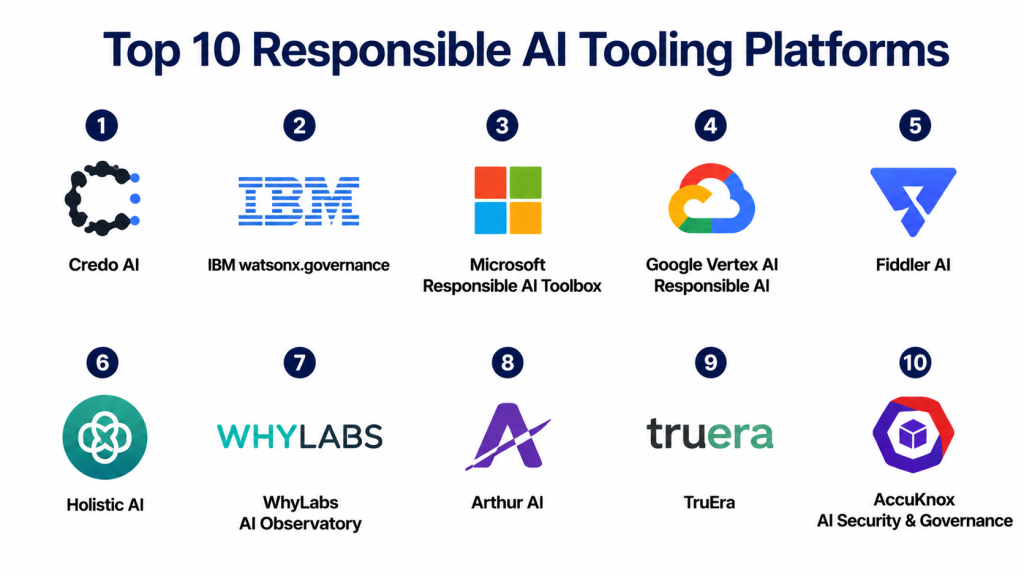
Top 10 Responsible AI Tooling Platforms
1- Credo AI
2- IBM watsonx.governance
3- Microsoft Responsible AI Toolbox
4- Google Vertex AI Responsible AI
5- Fiddler AI
6- Holistic AI
7- WhyLabs AI Observatory
8- Arthur AI
9- TruEra
10- AccuKnox AI Security & Governance
1. Credo AI
One-line Verdict
Best enterprise responsible AI governance platform for policy automation and compliance.
Short Description
Credo AI is a dedicated responsible AI governance platform that helps organizations operationalize AI policies, monitor AI risks, and maintain regulatory compliance across enterprise AI deployments. It is widely adopted for enterprise AI governance and responsible AI workflows.
Standout Capabilities
- AI governance automation
- AI policy management
- Risk scoring frameworks
- Compliance workflows
- Audit-ready reporting
- Responsible AI lifecycle tracking
- AI inventory management
- Cross-team governance collaboration
AI-Specific Depth
Credo AI translates responsible AI principles into operational governance controls for enterprise AI systems.
Pros
- Strong responsible AI focus
- Excellent compliance workflows
- Enterprise-ready governance tooling
Cons
- Enterprise pricing
- Requires integration with ML tooling
- Less developer-centric
Security & Compliance
Supports major governance frameworks including NIST AI RMF and EU AI Act alignment.
Deployment & Platforms
- Cloud SaaS
Integrations & Ecosystem
- MLflow
- Enterprise AI systems
- Governance platforms
Pricing Model
Enterprise subscription pricing.
Best-Fit Scenarios
- Responsible AI governance
- Enterprise compliance programs
- AI lifecycle governance
2. IBM watsonx.governance
One-line Verdict
Best enterprise responsible AI platform for regulated industries.
Short Description
IBM watsonx.governance provides lifecycle governance, explainability, fairness monitoring, and compliance tooling for enterprise AI systems.
Standout Capabilities
- AI lifecycle governance
- Explainability dashboards
- Fairness analysis
- Compliance automation
- Risk management workflows
- Audit logging
- AI monitoring
- Governance dashboards
AI-Specific Depth
Tracks models from training through deployment while enforcing responsible AI controls and governance.
Pros
- Strong enterprise governance
- Excellent explainability tooling
- Mature compliance ecosystem
Cons
- Complex deployment
- Higher implementation cost
- IBM ecosystem dependency
Security & Compliance
Enterprise-grade governance and compliance support.
Deployment & Platforms
- Hybrid cloud deployments
Integrations & Ecosystem
- IBM AI ecosystem
- Enterprise ML systems
- Governance workflows
Pricing Model
Enterprise licensing.
Best-Fit Scenarios
- Regulated AI environments
- Financial services AI
- Enterprise governance programs
3. Microsoft Responsible AI Toolbox
One-line Verdict
Best open-source responsible AI toolkit for Azure ML ecosystems.
Short Description
Microsoft Responsible AI Toolbox provides fairness analysis, interpretability, error analysis, and model assessment tools integrated with Azure AI environments.
Standout Capabilities
- Fairness assessment
- Explainability tooling
- Error analysis dashboards
- Responsible AI workflows
- Model debugging
- Interpretability visualizations
- Bias monitoring
- Azure ML integration
AI-Specific Depth
The toolbox helps AI teams evaluate fairness, reliability, and transparency before deploying models into production.
Pros
- Strong explainability features
- Excellent Azure integration
- Developer-friendly tooling
Cons
- Azure ecosystem dependency
- Requires ML expertise
- Limited governance workflows
Security & Compliance
Enterprise-grade Azure security support.
Deployment & Platforms
- Azure ML
- Python environments
Integrations & Ecosystem
- Azure AI
- ML pipelines
- Python ML frameworks
Pricing Model
Open-source + Azure pricing.
Best-Fit Scenarios
- Responsible ML development
- Azure AI deployments
- Model fairness analysis
4. Google Vertex AI Responsible AI
One-line Verdict
Best scalable responsible AI tooling for Google Cloud ML pipelines.
Short Description
Vertex AI Responsible AI provides explainability, fairness evaluation, monitoring, and model governance tools inside Google Cloud AI workflows.
Standout Capabilities
- Model explainability
- Bias detection
- AI monitoring
- Feature attribution
- Dataset analysis
- Drift detection
- Governance reporting
- Vertex AI integration
AI-Specific Depth
Provides transparency and monitoring across AI lifecycle workflows in Google Cloud environments.
Pros
- Strong GCP integration
- Scalable AI infrastructure
- Good monitoring tools
Cons
- GCP dependency
- Enterprise complexity
- Limited cross-cloud flexibility
Security & Compliance
Google Cloud enterprise compliance support.
Deployment & Platforms
- Google Cloud
Integrations & Ecosystem
- Vertex AI
- BigQuery
- Data pipelines
Pricing Model
Usage-based cloud pricing.
Best-Fit Scenarios
- Enterprise ML governance
- AI explainability
- Production AI monitoring
5. Fiddler AI
One-line Verdict
Best responsible AI observability platform for explainability and monitoring.
Short Description
Fiddler AI provides AI observability, explainability, fairness monitoring, and production AI governance capabilities for enterprise AI systems.
Standout Capabilities
- AI explainability
- Model monitoring
- Drift detection
- Fairness monitoring
- Root cause analysis
- Real-time observability
- AI governance dashboards
- Alerting systems
AI-Specific Depth
Tracks how AI systems behave in production while providing explanations for model outputs.
Pros
- Strong observability capabilities
- Excellent explainability tooling
- Real-time monitoring support
Cons
- Enterprise pricing
- Requires integration setup
- Not a full governance suite
Security & Compliance
Enterprise-grade monitoring and governance support.
Deployment & Platforms
- Cloud SaaS
Integrations & Ecosystem
- ML platforms
- Data pipelines
- AI infrastructure
Pricing Model
Enterprise subscription.
Best-Fit Scenarios
- AI observability
- Explainability monitoring
- Production AI systems
6. Holistic AI
One-line Verdict
Best for fairness auditing and ethical AI assessments.
Short Description
Holistic AI focuses on algorithmic fairness, bias auditing, and ethical AI risk analysis across enterprise machine learning systems.
Standout Capabilities
- Bias auditing
- Fairness scoring
- Explainability reporting
- Risk analysis
- Ethical AI assessments
- Governance dashboards
- Compliance support
- AI monitoring
AI-Specific Depth
Provides detailed fairness and ethical risk evaluation for enterprise AI models.
Pros
- Strong fairness analysis
- Good ethical AI workflows
- Enterprise-focused
Cons
- Narrower tooling scope
- Requires ML integration
- Less runtime monitoring
Security & Compliance
Supports enterprise compliance initiatives.
Deployment & Platforms
- Cloud-based platform
Integrations & Ecosystem
- ML systems
- Data science pipelines
Pricing Model
Enterprise pricing.
Best-Fit Scenarios
- Ethical AI initiatives
- Bias-sensitive applications
- AI fairness programs
7. WhyLabs AI Observatory
One-line Verdict
Best for responsible AI monitoring and drift observability.
Short Description
WhyLabs provides AI observability, drift monitoring, and anomaly detection focused on maintaining reliable and responsible AI behavior in production systems.
Standout Capabilities
- Data drift detection
- Model monitoring
- AI observability
- Real-time alerts
- Feature monitoring
- Data quality analysis
- AI governance workflows
- Monitoring dashboards
AI-Specific Depth
Ensures AI systems maintain responsible behavior by continuously tracking changes in model and dataset behavior.
Pros
- Strong observability tooling
- Excellent drift detection
- Real-time monitoring
Cons
- Enterprise pricing
- Requires setup effort
- Limited governance workflows
Security & Compliance
Enterprise monitoring and governance support.
Deployment & Platforms
- Cloud platform
Integrations & Ecosystem
- ML pipelines
- Data warehouses
- AI monitoring systems
Pricing Model
Usage-based enterprise pricing.
Best-Fit Scenarios
- AI observability
- Responsible AI monitoring
- Production ML systems
8. Arthur AI
One-line Verdict
Best for enterprise AI monitoring and responsible AI operations.
Short Description
Arthur AI provides model monitoring, explainability, fairness analysis, and governance tooling for enterprise AI systems operating in production.
Standout Capabilities
- AI monitoring
- Fairness analysis
- Explainability dashboards
- Drift detection
- Performance monitoring
- Governance workflows
- Alerting systems
- Risk analytics
AI-Specific Depth
Arthur AI enables organizations to monitor and explain AI decisions continuously in production.
Pros
- Strong production monitoring
- Good explainability tooling
- Enterprise scalability
Cons
- Enterprise pricing
- Requires ML integration
- Complex onboarding
Security & Compliance
Enterprise-grade governance support.
Deployment & Platforms
- Cloud and hybrid
Integrations & Ecosystem
- MLOps pipelines
- Enterprise AI systems
Pricing Model
Enterprise subscription pricing.
Best-Fit Scenarios
- Enterprise AI operations
- Responsible AI monitoring
- AI governance programs
9. TruEra
One-line Verdict
Best for explainability-driven responsible AI development.
Short Description
TruEra provides explainability, model diagnostics, and fairness analysis tools that help organizations build transparent and accountable AI systems.
Standout Capabilities
- Model explainability
- Performance diagnostics
- Bias analysis
- Drift monitoring
- Governance reporting
- Error analysis
- Model debugging
- Enterprise AI workflows
AI-Specific Depth
TruEra helps AI teams understand why models behave in certain ways and identify reliability issues early.
Pros
- Excellent explainability features
- Good model diagnostics
- Strong ML integration
Cons
- Requires ML expertise
- Enterprise pricing
- Limited policy governance
Security & Compliance
Enterprise compliance support available.
Deployment & Platforms
- Cloud and hybrid
Integrations & Ecosystem
- ML pipelines
- AI infrastructure
- Data science workflows
Pricing Model
Enterprise licensing.
Best-Fit Scenarios
- Explainable AI initiatives
- Model debugging
- Responsible AI engineering
10. AccuKnox AI Security & Governance
One-line Verdict
Best combined responsible AI security and governance platform.
Short Description
AccuKnox combines AI security, runtime governance, prompt protection, and policy enforcement to ensure secure and responsible AI operations.
Standout Capabilities
- AI runtime protection
- Prompt injection defense
- Governance enforcement
- AI observability
- Compliance monitoring
- Runtime policy controls
- AI security analytics
- Threat detection
AI-Specific Depth
Protects enterprise AI systems while enforcing responsible AI policies during runtime execution.
Pros
- Strong AI security layer
- Runtime governance support
- Multi-cloud compatibility
Cons
- Security-heavy approach
- Enterprise pricing
- Complex deployment
Security & Compliance
Strong enterprise AI security and compliance architecture.
Deployment & Platforms
- Hybrid cloud deployments
Integrations & Ecosystem
- AI systems
- Security tooling
- Cloud infrastructure
Pricing Model
Enterprise subscription pricing.
Best-Fit Scenarios
- Secure responsible AI deployments
- Enterprise AI governance
- AI runtime protection
Comparison Table
| Platform | Best For | Core Strength | Runtime Monitoring | Explainability | Governance Depth |
|---|---|---|---|---|---|
| Credo AI | Enterprise governance | Policy automation | Partial | Medium | Very High |
| IBM watsonx | Regulated industries | Lifecycle governance | Yes | High | Very High |
| Microsoft RAI Toolbox | Azure ML | Fairness & debugging | Partial | High | Medium |
| Vertex AI | Cloud AI governance | Monitoring | Yes | High | High |
| Fiddler AI | AI observability | Explainability | Yes | Very High | High |
| Holistic AI | Ethical AI | Fairness auditing | Partial | High | Medium |
| WhyLabs | AI monitoring | Drift detection | Yes | Medium | Medium |
| Arthur AI | Production AI | Responsible monitoring | Yes | High | High |
| TruEra | Explainability | Diagnostics | Partial | Very High | Medium |
| AccuKnox | AI security | Runtime governance | Yes | Medium | High |
Scoring & Evaluation Table
| Platform | Core Features | Ease | Integrations | Security | Performance | Support | Value | Weighted Total |
|---|---|---|---|---|---|---|---|---|
| Credo AI | 9.3 | 8.7 | 9.1 | 9.2 | 8.9 | 8.7 | 8.5 | 8.9 |
| IBM watsonx | 9.4 | 8.2 | 9.2 | 9.5 | 9.1 | 8.8 | 8.4 | 9.0 |
| Microsoft RAI | 9.0 | 8.8 | 9.1 | 9.0 | 8.8 | 8.5 | 8.9 | 8.9 |
| Vertex AI | 9.1 | 8.4 | 9.2 | 9.1 | 9.0 | 8.6 | 8.5 | 8.9 |
| Fiddler AI | 9.2 | 8.6 | 9.0 | 9.0 | 9.1 | 8.7 | 8.6 | 8.9 |
| Holistic AI | 8.8 | 8.5 | 8.7 | 8.9 | 8.6 | 8.4 | 8.5 | 8.6 |
| WhyLabs | 8.9 | 8.8 | 8.9 | 8.8 | 9.1 | 8.5 | 8.7 | 8.8 |
| Arthur AI | 9.0 | 8.5 | 8.8 | 8.9 | 9.0 | 8.6 | 8.5 | 8.8 |
| TruEra | 8.9 | 8.4 | 8.8 | 8.8 | 8.7 | 8.5 | 8.4 | 8.7 |
| AccuKnox | 9.1 | 8.2 | 8.7 | 9.5 | 9.2 | 8.6 | 8.4 | 8.9 |
Top 3 Recommendations
Best for Enterprise Responsible AI
- IBM watsonx.governance
- Credo AI
- Vertex AI Responsible AI
Best for Explainability & Monitoring
- Fiddler AI
- TruEra
- Arthur AI
Best for AI Security & Runtime Governance
- AccuKnox
- IBM watsonx.governance
- WhyLabs
Which Responsible AI Tool Is Right for You
For Solo Developers
Microsoft Responsible AI Toolbox and open-source explainability libraries are strong starting points.
For SMBs
WhyLabs and Fiddler AI offer balanced monitoring and responsible AI capabilities without massive governance overhead.
For Mid-Market Organizations
Credo AI and Arthur AI provide scalable governance and observability tooling.
For Enterprise AI Programs
IBM watsonx, Vertex AI, and Credo AI are best for large-scale responsible AI governance and compliance.
Budget vs Premium
Open-source responsible AI tools reduce costs but require engineering effort, while enterprise platforms provide automation and governance workflows.
Feature Depth vs Ease of Use
Fiddler AI and WhyLabs balance usability with enterprise observability depth.
Integrations & Scalability
Cloud-native responsible AI tooling is essential for enterprise-scale AI operations.
Security & Compliance Needs
Highly regulated industries should prioritize IBM watsonx, Credo AI, and AccuKnox.
Implementation Playbook
First 30 Days
- Define responsible AI objectives
- Identify AI systems and risks
- Select tooling platform
- Configure governance workflows
- Enable basic monitoring and explainability
Days 30–60
- Integrate MLOps pipelines
- Enable fairness testing
- Configure drift detection
- Build audit reporting workflows
- Add human review checkpoints
Days 60–90
- Scale monitoring across AI systems
- Automate governance reporting
- Optimize runtime observability
- Improve compliance workflows
- Enhance AI reliability controls
Common Mistakes and How to Avoid Them
- Treating responsible AI as documentation only
- Ignoring runtime monitoring
- Weak explainability implementation
- No fairness testing process
- Poor governance integration
- Lack of audit logging
- Ignoring AI security risks
- No human-in-the-loop workflows
- Weak drift monitoring systems
- Not aligning with regulations
- Poor model lifecycle tracking
- Overlooking LLM-specific risks
Frequently Asked Questions
1. What is responsible AI tooling?
It includes platforms that help ensure AI systems are fair, transparent, secure, explainable, and compliant.
2. Why is responsible AI important?
It reduces AI risks, improves trust, and ensures regulatory compliance.
3. What does responsible AI include?
Fairness, explainability, monitoring, governance, privacy, and security controls.
4. What is AI explainability?
It helps users understand how AI systems make decisions.
5. What is AI observability?
It is continuous monitoring of AI system behavior and performance.
6. Are responsible AI tools required for LLMs?
Yes, especially in enterprise and regulated environments.
7. What is bias detection in AI?
It identifies unfair patterns or discrimination in AI models.
8. Which industries need responsible AI tooling?
Finance, healthcare, government, retail, and enterprise SaaS.
9. What is runtime AI governance?
It enforces responsible AI controls while AI systems are actively running.
10. What should buyers prioritize?
Explainability, monitoring, governance depth, compliance support, and runtime enforcement.
Conclusion
Responsible AI tooling has become a foundational requirement for enterprise AI adoption as organizations increasingly deploy LLMs, autonomous agents, and generative AI systems into production. These platforms help enterprises operationalize fairness, explainability, monitoring, governance, and security across the AI lifecycle while ensuring compliance with evolving global regulations. Leaders like IBM watsonx.governance, Credo AI, Vertex AI Responsible AI, and Fiddler AI are shaping how organizations build transparent and trustworthy AI systems at scale. As AI governance evolves from static compliance into continuous operational oversight, responsible AI tooling will become a core layer in every mature enterprise AI stack.

Find Trusted Cardiac Hospitals
Compare heart hospitals by city and services — all in one place.
Explore Hospitals
A well-researched comparison that clearly highlights how responsible AI tooling platforms help organizations build more ethical, transparent, and trustworthy AI systems.