
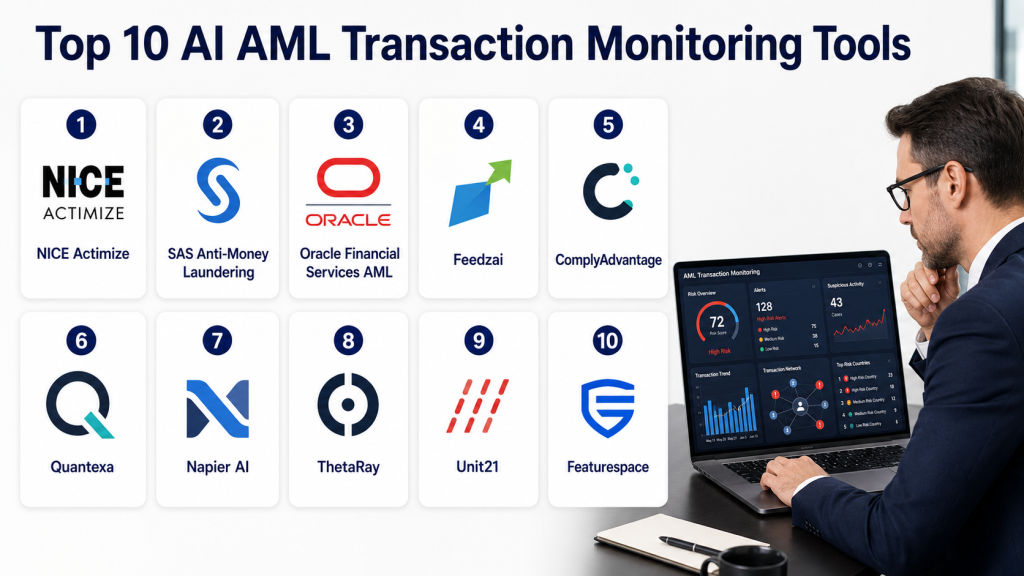
AI AML Transaction Monitoring tools help banks, fintech companies, payment providers, crypto platforms, remittance firms, insurance companies, and regulated financial institutions detect suspicious financial activity. These platforms use artificial intelligence, machine learning, rules, network analytics, entity resolution, behavioral monitoring, anomaly detection, and case workflows to identify potential money laundering, fraud, sanctions evasion, mule activity, terrorist financing, and other financial crime risks.
Traditional AML monitoring often creates too many alerts and requires large teams to review false positives. AI-powered AML transaction monitoring improves this process by prioritizing high-risk behavior, reducing noise, detecting hidden relationships, and helping compliance teams investigate cases faster. A strong AML platform should not only flag transactions, but also explain risk patterns, support investigations, maintain audit trails, and help institutions meet regulatory expectations.
Introduction
AI AML Transaction Monitoring tools are platforms that analyze financial transactions, customer behavior, entity relationships, account activity, and risk signals to detect suspicious activity. They help compliance teams monitor deposits, withdrawals, transfers, card activity, cross-border payments, crypto movement, merchant activity, and customer behavior across different risk scenarios.
Why It Matters
AML compliance is one of the most important responsibilities for regulated financial businesses. Criminals use complex methods such as structuring, layering, mule accounts, shell entities, suspicious transfers, rapid movement of funds, account takeover, synthetic identities, and cross-border transaction patterns to hide illegal activity. Manual monitoring and simple rule-based systems can miss these patterns or generate too many low-quality alerts.
AI AML Transaction Monitoring matters because it helps financial institutions detect suspicious patterns earlier, reduce false positives, improve investigator productivity, and support stronger compliance governance. It also helps teams move from static rules toward smarter risk-based monitoring where alerts are prioritized by context, behavior, and network relationships.
Real World Use Cases
- Monitoring suspicious deposits, withdrawals, and transfers
- Detecting structuring and transaction splitting
- Identifying mule account networks
- Monitoring cross-border payment risk
- Detecting suspicious crypto transaction activity
- Reducing false positives in AML alert queues
- Prioritizing high-risk customers and entities
- Supporting suspicious activity investigations
- Connecting related accounts, merchants, and entities
- Monitoring politically exposed person and sanctions-related risk
- Detecting unusual customer behavior against historical patterns
- Supporting regulatory reporting workflows
- Improving case management and investigator productivity
- Monitoring high-risk industries and geographies
Evaluation Criteria for Buyers
- Accuracy of suspicious activity detection
- Ability to reduce false positives
- Support for rules, machine learning, and anomaly detection
- Entity resolution and relationship network analysis
- Case management and investigation workflow quality
- Explainability of alerts, risk scores, and model outputs
- Integration with core banking, payment, KYC, CRM, and data systems
- Sanctions, watchlist, and customer risk integration support
- Real-time and batch monitoring capabilities
- Audit logs, investigation history, and regulatory reporting support
- Model monitoring and drift detection
- Data privacy, encryption, retention, and access controls
- Support for multiple products, regions, and risk typologies
- Ease of tuning rules and thresholds
- Vendor support and compliance expertise
Best for
AI AML Transaction Monitoring tools are best for banks, credit unions, fintech companies, payment processors, neobanks, remittance platforms, crypto exchanges, wealth management firms, insurance providers, lending platforms, and other regulated financial businesses. They are especially useful for compliance officers, AML analysts, financial crime teams, risk leaders, fraud teams, operations teams, and data science teams.
Not ideal for
These tools may not be ideal for small businesses that are not regulated financial entities, companies with very low transaction volume, or teams that only need basic customer screening. In those cases, a simpler KYC, sanctions screening, or manual review workflow may be enough until transaction complexity grows.
What’s Changed in AI AML Transaction Monitoring
- AML monitoring is shifting from rule-only alerts to AI-assisted risk detection.
- Financial crime teams are using network analytics to uncover hidden relationships.
- False positive reduction has become one of the biggest buying priorities.
- Real-time monitoring is becoming more important for payments, fintech, and crypto.
- AI models are being combined with rules instead of fully replacing compliance logic.
- Explainability is now critical for investigators, auditors, and regulators.
- Entity resolution is becoming essential for linking customers, businesses, accounts, devices, and counterparties.
- Case management workflows are becoming more integrated with monitoring systems.
- Crypto and digital asset monitoring is increasingly connected to broader AML programs.
- Compliance teams need stronger audit trails for every alert decision and investigator action.
- Model governance and validation are becoming important for AI-based monitoring.
- AML and fraud teams are collaborating more because many risks overlap.
Quick Buyer Checklist
Use this checklist to shortlist AI AML Transaction Monitoring tools quickly:
- Does the platform support your regulated business type?
- Can it monitor your transaction channels in real time or batch mode?
- Does it support both rules and machine learning?
- Can it reduce false positives without hiding real risk?
- Does it provide clear alert reasons and risk explanations?
- Can it detect unusual behavior compared with customer history?
- Does it include entity resolution and network analytics?
- Can investigators manage cases, notes, documents, and escalations?
- Does it support audit logs and regulatory reporting workflows?
- Can rules and scenarios be tuned by compliance teams?
- Does it integrate with KYC, sanctions, CRM, core banking, and payment systems?
- Are access controls, encryption, and data retention clearly documented?
- Does it support model monitoring and validation?
- Can it support multiple regions, products, entities, and risk typologies?
- Is the vendor experienced with financial crime compliance workflows?
Top 10 AI AML Transaction Monitoring Tools
1- NICE Actimize
One-line verdict: Best for large financial institutions needing enterprise AML monitoring and financial crime operations.
Short description:
NICE Actimize provides financial crime, AML, fraud, and compliance solutions for banks and large financial institutions. Its AML transaction monitoring capabilities support suspicious activity detection, case management, alert review, investigation workflows, and enterprise risk operations.
Standout Capabilities
- Enterprise AML transaction monitoring
- Suspicious activity alert generation and investigation support
- Case management for financial crime teams
- Customer and entity risk monitoring
- Support for complex financial crime scenarios
- Strong fit for large banks and regulated institutions
- Workflow automation for analysts and supervisors
- Financial crime platform coverage beyond AML alone
AI-Specific Depth
- Model support: Proprietary analytics, machine learning, and scenario-based detection vary by product
- RAG and knowledge integration: Not applicable for standard AML monitoring
- Evaluation: Alert performance, model monitoring, and scenario tuning vary by deployment
- Guardrails: Rules, scenarios, alert workflows, approvals, and audit controls
- Observability: Dashboards, alert queues, case history, investigator actions, and risk reporting
Pros
- Strong enterprise financial crime focus
- Suitable for large, regulated institutions
- Broad coverage across AML, fraud, and compliance workflows
Cons
- May be too complex for smaller fintech teams
- Implementation can require significant planning
- Exact pricing is not publicly stated
Security & Compliance
Security and compliance controls should be verified directly. Buyers should confirm SSO, RBAC, audit logs, encryption, data retention, data residency, investigation history, and model governance support. Certifications are not publicly stated here.
Deployment & Platforms
- Cloud and enterprise deployment options may vary
- Web-based analyst and administrator interface
- API and data integration workflows
- Self-hosted or hybrid availability should be verified
Integrations & Ecosystem
NICE Actimize fits into enterprise banking, payment, fraud, AML, and regulatory operations ecosystems.
- Core banking systems
- Payment platforms
- KYC and customer risk systems
- Sanctions screening systems
- Case management workflows
- Data warehouses
- Regulatory reporting workflows
Pricing Model
Pricing is typically enterprise contract-based. Exact pricing is not publicly stated.
Best-Fit Scenarios
- Large banks modernizing AML operations
- Financial institutions needing enterprise case management
- Compliance teams managing complex financial crime workflows
2- SAS Anti-Money Laundering
One-line verdict: Best for institutions needing analytics-driven AML monitoring with strong data and model capabilities.
Short description:
SAS Anti-Money Laundering supports transaction monitoring, risk scoring, alert management, analytics, and investigation workflows. It is suited for banks, insurers, capital markets firms, and regulated organizations that need advanced analytics and structured AML operations.
Standout Capabilities
- AML transaction monitoring and risk scoring
- Scenario-based and analytics-driven detection
- Alert generation and investigation workflows
- Customer risk scoring support
- Strong analytics and data management foundation
- Useful for complex financial institutions
- Supports monitoring across multiple financial products
- Helps teams analyze patterns and suspicious behavior
AI-Specific Depth
- Model support: Advanced analytics, machine learning, and statistical modeling capabilities vary by deployment
- RAG and knowledge integration: Not applicable
- Evaluation: Model validation, scenario testing, and performance monitoring vary
- Guardrails: Rules, scenarios, workflow controls, and governance processes
- Observability: Alert analytics, model performance, risk dashboards, and investigation reporting
Pros
- Strong analytics foundation
- Good fit for complex AML data environments
- Useful for model-driven financial crime teams
Cons
- May require skilled analytics and compliance resources
- Implementation can be more involved than lightweight tools
- Pricing is not publicly stated
Security & Compliance
Security and compliance capabilities should be verified based on deployment. Buyers should confirm SSO, RBAC, audit logs, encryption, data retention, residency, model validation support, and regulatory reporting workflows. Certifications are not publicly stated here.
Deployment & Platforms
- Cloud and enterprise deployment options may vary
- Web-based analyst interface
- Data and analytics platform integrations
- Self-hosted or hybrid availability should be verified
Integrations & Ecosystem
SAS fits into financial crime, analytics, data management, and compliance ecosystems.
- Core banking systems
- Payment systems
- Customer data platforms
- KYC systems
- Data warehouses
- Regulatory reporting processes
- Investigation workflows
Pricing Model
Pricing is typically enterprise contract-based. Exact pricing is not publicly stated.
Best-Fit Scenarios
- Banks needing analytics-rich AML monitoring
- Institutions with complex transaction data
- Compliance teams requiring model validation and scenario tuning
3- Oracle Financial Services AML
One-line verdict: Best for enterprises needing AML monitoring connected to broader financial services risk infrastructure.
Short description:
Oracle Financial Services AML supports transaction monitoring, customer risk assessment, alert management, and financial crime compliance workflows. It is suited for banks and financial institutions that need AML capabilities within a broader enterprise financial services technology ecosystem.
Standout Capabilities
- AML transaction monitoring and suspicious activity detection
- Customer risk scoring and alert workflows
- Enterprise financial crime compliance support
- Scenario and rule-based monitoring
- Case investigation and escalation capabilities
- Strong fit for large financial services organizations
- Integration with broader financial services data environments
- Support for multi-product and multi-region monitoring
AI-Specific Depth
- Model support: Analytics and machine learning support vary by product and deployment
- RAG and knowledge integration: Not applicable
- Evaluation: Scenario performance, model monitoring, and alert tuning vary
- Guardrails: Rules, workflows, audit trails, approval logic, and governance controls
- Observability: Alert dashboards, case history, customer risk views, and compliance reporting
Pros
- Strong enterprise financial services positioning
- Useful for large-scale AML data environments
- Can fit broader risk and compliance architecture
Cons
- May require enterprise implementation resources
- Less suited for small fintech teams
- Exact AI depth and pricing should be verified
Security & Compliance
Security and compliance capabilities should be reviewed directly. Buyers should verify SSO, RBAC, audit logs, encryption, retention, data residency, regulatory reporting, and model governance support. Certifications are not publicly stated here.
Deployment & Platforms
- Cloud and enterprise deployment options may vary
- Web-based compliance and analyst workflows
- API and data integration support
- Self-hosted or hybrid availability should be verified
Integrations & Ecosystem
Oracle Financial Services AML fits into enterprise banking, risk, finance, and compliance ecosystems.
- Core banking systems
- Payment systems
- Customer information systems
- KYC and onboarding tools
- Data warehouses
- Regulatory reporting workflows
- Enterprise risk platforms
Pricing Model
Pricing is typically enterprise contract-based. Exact pricing is not publicly stated.
Best-Fit Scenarios
- Large financial institutions needing enterprise AML monitoring
- Banks using broader Oracle financial services infrastructure
- Compliance teams managing complex customer and transaction data
4- Feedzai
One-line verdict: Best for financial institutions combining fraud, AML, and real-time financial crime monitoring.
Short description:
Feedzai provides AI-powered financial crime prevention through risk operations capabilities that support fraud detection, AML, scam prevention, and transaction monitoring. It is suitable for banks, fintechs, payment providers, and financial institutions that want connected fraud and AML risk intelligence.
Standout Capabilities
- AI-powered transaction monitoring
- Fraud and AML risk detection in connected workflows
- Real-time scoring for suspicious activity
- Case management and investigation support
- Risk operations approach for financial crime teams
- Useful for banks, payment providers, and fintechs
- Supports risk scoring and alert prioritization
- Helps reduce noise in financial crime operations
AI-Specific Depth
- Model support: Proprietary AI and machine learning models, custom options vary
- RAG and knowledge integration: Not applicable
- Evaluation: Model monitoring and risk operations analytics vary
- Guardrails: Rules, policies, analyst workflows, and financial crime controls
- Observability: Risk dashboards, alert views, case workflows, model insights, and transaction analytics
Pros
- Strong financial crime and fraud connection
- Useful for real-time risk decisioning
- Good fit for modern fintech and banking teams
Cons
- May be more advanced than small teams need
- Implementation requires data and workflow planning
- Exact pricing is not publicly stated
Security & Compliance
Security and compliance capabilities should be verified directly. Buyers should confirm SSO, RBAC, audit logs, encryption, data retention, data residency, model governance, and regulatory reporting support. Certifications are not publicly stated here.
Deployment & Platforms
- Cloud and enterprise deployment options may vary
- Web-based risk operations platform
- API and transaction data integrations
- Self-hosted or hybrid availability should be verified
Integrations & Ecosystem
Feedzai fits into banking, payments, fraud, AML, and financial crime workflows.
- Payment systems
- Core banking platforms
- Fraud detection systems
- KYC tools
- Case management workflows
- Data pipelines
- Compliance reporting systems
Pricing Model
Pricing is typically enterprise contract-based. Exact pricing is not publicly stated.
Best-Fit Scenarios
- Banks combining fraud and AML monitoring
- Fintechs needing real-time financial crime risk scoring
- Payment providers monitoring suspicious transaction behavior
5- ComplyAdvantage
One-line verdict: Best for fintechs and financial firms needing AML data, screening, and transaction monitoring.
Short description:
ComplyAdvantage provides financial crime risk tools including AML screening, sanctions monitoring, adverse media, transaction monitoring, and customer risk intelligence. It is useful for fintechs, payment companies, banks, crypto platforms, and regulated businesses that need modern AML workflows.
Standout Capabilities
- AML transaction monitoring workflows
- Sanctions and watchlist screening support
- Adverse media and customer risk intelligence
- Configurable rules and monitoring scenarios
- API-friendly financial crime infrastructure
- Useful for fintechs and digital financial businesses
- Alert management and investigation workflows
- Supports customer and transaction risk visibility
AI-Specific Depth
- Model support: Proprietary data intelligence, analytics, and monitoring capabilities vary by product
- RAG and knowledge integration: Not applicable
- Evaluation: Alert performance and scenario tuning vary
- Guardrails: Rules, screening controls, investigation workflows, and audit history
- Observability: Alert dashboards, risk profiles, case activity, and screening outcomes
Pros
- Strong fit for fintech AML operations
- Combines screening and transaction monitoring
- API-friendly for modern financial platforms
Cons
- Enterprise depth may vary by use case
- Advanced model customization should be verified
- Pricing is not publicly stated
Security & Compliance
Security and compliance controls should be verified directly. Buyers should confirm SSO, RBAC, audit logs, encryption, retention, residency, screening audit history, and regulatory workflow support. Certifications are not publicly stated here.
Deployment & Platforms
- Cloud-based platform
- Web-based compliance dashboard
- API-based integration
- Self-hosted deployment is not publicly stated
Integrations & Ecosystem
ComplyAdvantage connects AML screening, monitoring, and risk intelligence workflows.
- KYC platforms
- Payment systems
- Customer onboarding flows
- Sanctions and watchlist screening
- Adverse media workflows
- Transaction monitoring
- Case management workflows
Pricing Model
Pricing is typically subscription or contract-based. Exact pricing is not publicly stated.
Best-Fit Scenarios
- Fintechs needing AML monitoring and screening together
- Payment companies building compliance workflows
- Crypto and digital finance platforms managing customer risk
6- Quantexa
One-line verdict: Best for institutions needing entity resolution and network analytics for financial crime detection.
Short description:
Quantexa provides decision intelligence capabilities that help organizations connect entities, transactions, relationships, and risk signals. For AML and financial crime use cases, it is especially useful for detecting hidden networks, shell structures, mule activity, and complex suspicious behavior.
Standout Capabilities
- Entity resolution across fragmented data
- Network analytics for suspicious relationship detection
- Financial crime investigation support
- Contextual decision intelligence
- Customer, account, counterparty, and transaction linking
- Useful for banks and large enterprises
- Helps uncover hidden risk networks
- Strong fit for complex data environments
AI-Specific Depth
- Model support: AI, entity resolution, graph analytics, and decision intelligence capabilities
- RAG and knowledge integration: Not applicable for standard AML monitoring
- Evaluation: Entity matching quality and investigation outcome analytics vary
- Guardrails: Relationship scoring, investigation controls, review workflows, and governance
- Observability: Network views, entity risk insights, investigation history, and analytics dashboards
Pros
- Strong entity resolution and relationship intelligence
- Useful for complex AML investigations
- Helps connect fragmented customer and transaction data
Cons
- May require strong data engineering support
- Not always a standalone AML transaction monitoring replacement
- Implementation can be complex for smaller teams
Security & Compliance
Security and compliance features should be verified directly. Buyers should confirm SSO, RBAC, audit logs, encryption, data retention, residency, model governance, and investigation audit requirements. Certifications are not publicly stated here.
Deployment & Platforms
- Cloud and enterprise deployment options may vary
- Web-based investigation and analytics workflows
- API and data integration support
- Self-hosted or hybrid availability should be verified
Integrations & Ecosystem
Quantexa fits into financial crime, data intelligence, and investigation ecosystems.
- Core banking data
- Customer data platforms
- Payment systems
- AML case management
- Graph analytics workflows
- Data warehouses
- Investigation tools
Pricing Model
Pricing is typically enterprise contract-based. Exact pricing is not publicly stated.
Best-Fit Scenarios
- Banks investigating complex entity networks
- Financial crime teams detecting mule networks
- Enterprises needing stronger data linkage for AML investigations
7- Napier AI
One-line verdict: Best for firms needing AI-driven AML screening, monitoring, and compliance operations.
Short description:
Napier AI provides financial crime compliance tools for transaction monitoring, client screening, risk scoring, and case management. It is suited for banks, payments firms, asset managers, fintechs, and regulated businesses that need AML workflow automation.
Standout Capabilities
- Transaction monitoring for suspicious activity detection
- Client screening and risk scoring support
- Case management and investigation workflows
- Configurable rules and monitoring scenarios
- AI-assisted alert prioritization
- Useful for regulated financial firms
- Supports compliance operations and audit needs
- Helps teams manage AML workflows more efficiently
AI-Specific Depth
- Model support: Proprietary AI and analytics capabilities vary by product
- RAG and knowledge integration: Not applicable
- Evaluation: Alert quality and monitoring performance analytics vary
- Guardrails: Rules, thresholds, screening workflows, approvals, and audit controls
- Observability: Alert dashboards, case tracking, customer risk views, and compliance reporting
Pros
- Strong AML compliance workflow focus
- Suitable for multiple regulated financial sectors
- Combines monitoring, screening, and case workflows
Cons
- Advanced model customization should be verified
- May require configuration for specific typologies
- Exact pricing is not publicly stated
Security & Compliance
Security and compliance details should be verified directly. Buyers should confirm SSO, RBAC, audit logs, encryption, retention, residency, data access controls, and regulatory reporting support. Certifications are not publicly stated here.
Deployment & Platforms
- Cloud-based platform
- Web-based compliance workflows
- API and data integrations
- Self-hosted or hybrid options should be verified
Integrations & Ecosystem
Napier AI connects AML monitoring, screening, customer risk, and investigation workflows.
- KYC systems
- Payment platforms
- Core banking systems
- Screening workflows
- Case management
- Data warehouses
- Compliance reporting workflows
Pricing Model
Pricing is typically contract-based. Exact pricing is not publicly stated.
Best-Fit Scenarios
- Financial firms modernizing AML compliance workflows
- Payment companies needing monitoring and screening
- Compliance teams needing case management and alert prioritization
8- ThetaRay
One-line verdict: Best for payment providers and banks detecting unknown suspicious patterns with AI.
Short description:
ThetaRay provides AI-powered transaction monitoring and financial crime detection, with a focus on identifying unknown risks and suspicious behavior patterns. It is used by banks, payment providers, fintech firms, and cross-border transaction businesses.
Standout Capabilities
- AI-driven suspicious activity detection
- Anomaly detection for unknown financial crime patterns
- Transaction monitoring for payments and financial services
- Alert prioritization and investigation support
- Useful for cross-border and payment risk monitoring
- Helps reduce false positives through smarter detection
- Supports financial crime compliance workflows
- Strong fit for payment-heavy environments
AI-Specific Depth
- Model support: Proprietary AI and anomaly detection models
- RAG and knowledge integration: Not applicable
- Evaluation: Alert performance and model outcome tracking vary
- Guardrails: Monitoring rules, risk thresholds, investigation workflows, and governance controls
- Observability: Risk alerts, model outputs, investigator workflows, and monitoring dashboards
Pros
- Strong AI and anomaly detection focus
- Useful for detecting unknown suspicious patterns
- Good fit for payments and cross-border risk
Cons
- Requires careful integration with transaction data
- Regulatory workflow depth should be verified
- Exact pricing is not publicly stated
Security & Compliance
Security and compliance capabilities should be verified directly. Buyers should confirm SSO, RBAC, audit logs, encryption, retention, data residency, model governance, and investigation controls. Certifications are not publicly stated here.
Deployment & Platforms
- Cloud and enterprise deployment options may vary
- Web-based AML monitoring workflows
- API and data integration support
- Self-hosted or hybrid options should be verified
Integrations & Ecosystem
ThetaRay fits into payment, banking, AML, and financial crime monitoring workflows.
- Payment systems
- Core banking systems
- Cross-border payment flows
- KYC systems
- Case investigation workflows
- Data pipelines
- Compliance reporting systems
Pricing Model
Pricing is typically enterprise or contract-based. Exact pricing is not publicly stated.
Best-Fit Scenarios
- Payment providers monitoring cross-border transactions
- Banks seeking AI anomaly detection
- Financial crime teams reducing false positives
9- Unit21
One-line verdict: Best for fintechs needing flexible no-code AML, fraud, and risk operations workflows.
Short description:
Unit21 provides risk operations infrastructure for fraud, AML, transaction monitoring, case management, and compliance workflows. It is especially useful for fintechs, crypto companies, marketplaces, and digital platforms that need flexible rules and investigation tools.
Standout Capabilities
- Transaction monitoring and suspicious activity workflows
- No-code rule and workflow configuration
- Case management for risk and compliance teams
- Fraud and AML workflows in one platform
- Alert prioritization and investigation support
- Useful for fintechs and digital platforms
- Flexible configuration for fast-moving risk teams
- Supports operational visibility across alerts and cases
AI-Specific Depth
- Model support: Rules, analytics, and model integration support vary
- RAG and knowledge integration: Not applicable
- Evaluation: Rule performance and alert outcome analytics vary
- Guardrails: Configurable rules, workflow approvals, escalation paths, and audit trails
- Observability: Alert dashboards, case timelines, rule hits, analyst performance, and investigation outcomes
Pros
- Flexible and fintech-friendly
- Useful for teams combining fraud and AML operations
- No-code configuration helps risk teams move faster
Cons
- May not provide the same depth as legacy enterprise AML suites
- Advanced AI model capabilities should be verified
- Pricing is not publicly stated
Security & Compliance
Security controls should be verified directly. Buyers should confirm SSO, RBAC, audit logs, encryption, data retention, data residency, and compliance workflow controls. Certifications are not publicly stated here.
Deployment & Platforms
- Cloud-based platform
- Web-based risk operations interface
- API-based integration
- Self-hosted deployment is not publicly stated
Integrations & Ecosystem
Unit21 connects transaction data, rules, alerts, cases, and risk operations workflows.
- Payment systems
- KYC tools
- Fraud detection tools
- Crypto and fintech platforms
- Data warehouses
- Case management workflows
- Compliance reporting processes
Pricing Model
Pricing is typically contract-based or usage-based. Exact pricing is not publicly stated.
Best-Fit Scenarios
- Fintechs building AML and fraud operations
- Crypto platforms needing transaction monitoring workflows
- Risk teams wanting no-code rules and case management
10- Featurespace
One-line verdict: Best for financial institutions needing adaptive behavioral analytics for fraud and financial crime detection.
Short description:
Featurespace provides adaptive behavioral analytics for fraud prevention and financial crime risk detection. Its technology helps institutions understand normal customer behavior and detect unusual activity that may indicate fraud, scams, or financial crime.
Standout Capabilities
- Adaptive behavioral analytics
- Real-time risk scoring for suspicious behavior
- Fraud and financial crime detection support
- Customer behavior modeling
- Alert prioritization and risk decisioning
- Useful for banks, payment providers, and financial institutions
- Helps detect anomalies against normal behavior
- Supports risk operations and analyst workflows
AI-Specific Depth
- Model support: Proprietary adaptive behavioral analytics and machine learning
- RAG and knowledge integration: Not applicable
- Evaluation: Model performance monitoring and alert outcome tracking vary
- Guardrails: Rules, risk thresholds, workflow controls, and investigation support
- Observability: Risk scores, behavior insights, alert dashboards, and performance analytics
Pros
- Strong behavioral analytics capability
- Useful for real-time anomaly detection
- Applicable across fraud and financial crime workflows
Cons
- AML-specific depth should be verified for each implementation
- May require high-quality transaction and behavior data
- Exact pricing is not publicly stated
Security & Compliance
Security and compliance capabilities should be verified directly. Buyers should confirm SSO, RBAC, audit logs, encryption, retention, data residency, and governance controls. Certifications are not publicly stated here.
Deployment & Platforms
- Cloud and enterprise deployment options may vary
- Web-based risk workflows
- API and data integrations
- Self-hosted or hybrid availability should be verified
Integrations & Ecosystem
Featurespace fits into banking, payments, fraud, AML, and risk detection ecosystems.
- Payment systems
- Core banking systems
- Fraud platforms
- AML workflows
- Case management systems
- Data pipelines
- Risk analytics dashboards
Pricing Model
Pricing is typically enterprise contract-based. Exact pricing is not publicly stated.
Best-Fit Scenarios
- Banks detecting unusual transaction behavior
- Payment providers improving real-time risk scoring
- Financial institutions combining fraud and AML signals
Comparison Table
| Tool Name | Best For | Deployment | Model Flexibility | Strength | Watch-Out | Public Rating |
|---|---|---|---|---|---|---|
| NICE Actimize | Enterprise AML and financial crime operations | Cloud or varies | Proprietary analytics and scenarios | Enterprise AML depth | Complex implementation | N/A |
| SAS Anti-Money Laundering | Analytics-driven AML monitoring | Cloud or varies | Advanced analytics and ML | Strong data analytics | Needs skilled resources | N/A |
| Oracle Financial Services AML | Enterprise financial services AML | Cloud or varies | Analytics support varies | Large-scale compliance fit | Enterprise-heavy | N/A |
| Feedzai | Fraud and AML risk operations | Cloud or varies | Proprietary AI models | Real-time financial crime detection | Needs planning | N/A |
| ComplyAdvantage | Fintech AML screening and monitoring | Cloud | Data intelligence and rules | AML data plus monitoring | Customization varies | N/A |
| Quantexa | Entity resolution and network analytics | Cloud or varies | AI and graph analytics | Hidden relationship detection | Requires strong data integration | N/A |
| Napier AI | AML screening and monitoring workflows | Cloud or varies | Proprietary AI varies | Compliance workflow focus | Model depth should be verified | N/A |
| ThetaRay | AI anomaly detection for payments | Cloud or varies | Proprietary AI models | Unknown pattern detection | Needs quality transaction data | N/A |
| Unit21 | Fintech AML and fraud operations | Cloud | Rules and model integrations vary | No-code risk operations | Less legacy-suite depth | N/A |
| Featurespace | Behavioral analytics for financial crime | Cloud or varies | Proprietary behavioral ML | Adaptive anomaly detection | AML depth varies | N/A |
Scoring and Evaluation
The scoring below is a comparative editorial rubric, not a lab benchmark or public rating. Scores reflect AML monitoring fit, AI depth, alert quality, investigation workflow strength, integration value, governance support, explainability, and usefulness for regulated financial crime teams. Final selection should depend on institution size, transaction volume, risk typologies, regulatory needs, internal data quality, and analyst workflow maturity.
| Tool | Core | Reliability and Eval | Guardrails | Integrations | Ease | Performance and Cost | Security and Admin | Support | Weighted Total |
|---|---|---|---|---|---|---|---|---|---|
| NICE Actimize | 9 | 9 | 9 | 9 | 6 | 8 | 9 | 9 | 8.55 |
| SAS Anti-Money Laundering | 9 | 9 | 8 | 8 | 6 | 8 | 9 | 8 | 8.30 |
| Oracle Financial Services AML | 9 | 8 | 8 | 9 | 6 | 8 | 9 | 8 | 8.25 |
| Feedzai | 9 | 8 | 8 | 8 | 7 | 8 | 8 | 8 | 8.15 |
| ComplyAdvantage | 8 | 8 | 8 | 8 | 8 | 8 | 8 | 8 | 8.00 |
| Quantexa | 9 | 8 | 8 | 8 | 6 | 7 | 8 | 8 | 7.90 |
| Napier AI | 8 | 8 | 8 | 8 | 7 | 8 | 8 | 7 | 7.85 |
| ThetaRay | 8 | 8 | 8 | 7 | 7 | 8 | 8 | 7 | 7.70 |
| Unit21 | 8 | 7 | 8 | 8 | 9 | 8 | 8 | 7 | 7.95 |
| Featurespace | 8 | 8 | 8 | 8 | 7 | 8 | 8 | 8 | 7.95 |
Top 3 for Enterprise
- NICE Actimize
- SAS Anti-Money Laundering
- Oracle Financial Services AML
Top 3 for SMB
- ComplyAdvantage
- Unit21
- Napier AI
Top 3 for Developers
- Unit21
- ComplyAdvantage
- Feedzai
Which AI AML Transaction Monitoring Tool Is Right for You
Solo or Freelancer
Solo professionals usually do not need a full AI AML transaction monitoring platform unless they are building a regulated fintech, payment, crypto, or lending product. For early-stage planning, focus first on understanding regulatory obligations, KYC requirements, sanctions screening, transaction risk rules, and audit needs. Once transaction volume grows, a flexible platform such as ComplyAdvantage or Unit21 may be more practical than a large enterprise suite.
SMB
Small and mid-sized regulated financial businesses should prioritize fast implementation, clear workflows, manageable pricing, and easy configuration. ComplyAdvantage is useful when screening and transaction monitoring are needed together. Unit21 is strong for fintech-style risk operations. Napier AI can fit businesses that need structured AML workflows with case management and alert review.
Mid-Market
Mid-market companies usually need stronger data integrations, better alert tuning, workflow visibility, and governance. Feedzai, Napier AI, ThetaRay, Unit21, and ComplyAdvantage are strong candidates depending on whether the team prioritizes AI detection, compliance workflows, fraud and AML convergence, or screening integration. Quantexa is valuable when entity resolution and relationship intelligence are major priorities.
Enterprise
Enterprise banks and large financial institutions should prioritize scalability, auditability, scenario management, model governance, regulatory reporting, analyst workflows, and integration depth. NICE Actimize, SAS Anti-Money Laundering, Oracle Financial Services AML, Feedzai, and Quantexa are strong enterprise options. The best choice depends on existing architecture, data maturity, and financial crime operating model.
Regulated Industries
Banks, fintech companies, crypto exchanges, remittance providers, payment processors, insurers, wealth firms, and lending platforms should treat AML monitoring as a governed compliance system. They should prioritize audit logs, decision history, alert explanations, role-based access, data retention, investigation workflows, and regulatory reporting. Enterprise-grade platforms are better suited for highly regulated and high-volume environments.
Budget vs Premium
Budget-conscious teams should start with targeted AML monitoring and screening tools that match their transaction volume. ComplyAdvantage, Unit21, and Napier AI may be more practical for fast-moving fintech teams. Premium buyers should evaluate NICE Actimize, SAS, Oracle, Feedzai, Quantexa, or ThetaRay when scale, complexity, and regulatory pressure justify deeper investment.
Build vs Buy
Build internally only when you have strong compliance expertise, data engineering, financial crime analytics, model validation, investigation workflow design, and audit governance. Buy when you need faster deployment, ready-made scenarios, case management, screening integrations, regulatory workflows, and vendor support. Many mature institutions use a hybrid approach by combining vendor platforms with internal risk models and custom typologies.
Implementation Playbook
First Phase: Pilot and Success Metrics
- Define the AML monitoring scope clearly.
- Select one transaction channel or customer segment for the pilot.
- Run the platform in shadow mode before replacing existing alerts.
- Capture baseline metrics such as alert volume, false positive rate, investigation time, escalation rate, suspicious activity filing rate, and analyst productivity.
- Map required data sources such as customer data, account data, transaction data, KYC profiles, sanctions results, device signals, and counterparty details.
- Define risk typologies such as structuring, mule activity, rapid movement of funds, unusual cross-border transfers, and high-risk counterparty behavior.
- Create alert severity levels and escalation rules.
- Confirm privacy, retention, access control, and audit requirements before production deployment.
Second Phase: Security, Evaluation, and Rollout
- Integrate the platform with core banking, payment, KYC, sanctions, CRM, and case systems.
- Add role-based access for analysts, investigators, supervisors, compliance officers, and administrators.
- Configure monitoring rules, AI scenarios, thresholds, and risk indicators.
- Build case management workflows for review, escalation, closure, and regulatory filing support.
- Test alert quality against historical suspicious activity and known false positives.
- Add feedback loops from analyst decisions, confirmed suspicious activity, and closed cases.
- Review model behavior and rule changes with compliance leadership.
- Train analysts on alert explanations, network views, and investigation workflows.
Third Phase: Optimization and Scale
- Monitor alert volume, false positives, case backlog, investigation time, and escalation quality.
- Tune rules and thresholds by product, geography, customer type, and risk segment.
- Expand monitoring to additional transaction channels and customer groups.
- Add dashboards for AML leaders, compliance teams, and audit reviewers.
- Review model drift and changes in customer behavior.
- Compare AI-generated alerts with investigator outcomes.
- Improve entity resolution by connecting more internal and external data sources.
- Schedule governance reviews for scenarios, models, thresholds, and case procedures.
Common Mistakes and How to Avoid Them
- Relying only on static rules without behavior analysis
- Creating too many alerts without prioritization
- Ignoring false positives and analyst fatigue
- Not connecting KYC, transaction, sanctions, and customer risk data
- Treating all customers with the same monitoring thresholds
- Failing to document rule and model changes
- Not maintaining complete alert and case audit trails
- Ignoring entity resolution and hidden relationship risk
- Deploying AI models without validation and review
- Not training analysts on alert explanations
- Using poor-quality customer or transaction data
- Separating fraud and AML teams when risk patterns overlap
- Not testing alerts against historical cases
- Ignoring data retention and access control requirements
- Choosing a platform before defining AML typologies and workflows
FAQs
1- What is an AI AML Transaction Monitoring tool?
An AI AML Transaction Monitoring tool analyzes financial transactions and customer behavior to detect suspicious activity. It uses rules, machine learning, anomaly detection, risk scoring, and investigation workflows to support AML compliance teams.
2- How is AI AML monitoring different from traditional rule-based monitoring?
Traditional monitoring relies heavily on fixed rules and thresholds. AI AML monitoring can analyze behavior patterns, detect anomalies, connect related entities, and prioritize alerts more intelligently.
3- Can AI reduce AML false positives?
Yes, AI can help reduce false positives by ranking alert severity, learning behavioral patterns, and adding context to suspicious activity. However, proper tuning, validation, and analyst feedback are still required.
4- Does AI replace AML analysts?
No. AI supports AML analysts by prioritizing alerts, showing risk context, and reducing repetitive work. Human review remains essential for investigations, regulatory decisions, and case escalation.
5- What data is needed for AML transaction monitoring?
Common data includes customer profiles, account details, transaction history, payment channels, counterparty information, KYC data, sanctions screening results, device signals, and historical case outcomes.
6- Is real-time AML monitoring necessary?
Real-time monitoring is important for fast payment flows, fintech platforms, crypto businesses, and high-risk transaction channels. Some institutions also use batch monitoring for lower-risk or back-office workflows.
7- What is entity resolution in AML?
Entity resolution connects related customers, businesses, accounts, addresses, devices, counterparties, and transactions. It helps investigators find hidden relationships and detect financial crime networks.
8- What is AML case management?
AML case management helps analysts review alerts, add notes, collect evidence, escalate cases, document decisions, and prepare regulatory reporting. It is essential for auditability and compliance governance.
9- Are these tools suitable for crypto businesses?
Yes, some AML monitoring tools support crypto and digital asset risk workflows, but buyers should verify blockchain analytics integrations, transaction coverage, regulatory reporting support, and jurisdiction fit.
10- How should financial institutions evaluate AML tool performance?
They should measure false positive rate, alert quality, investigation time, escalation rate, suspicious activity detection, analyst productivity, case backlog, and regulatory audit readiness.
11- What is model governance in AML monitoring?
Model governance means documenting, validating, monitoring, and controlling AI models used in AML decisions. It includes performance checks, change approval, explainability, audit logs, and regular review.
12- Can small fintechs use AI AML monitoring tools?
Yes, but they should choose tools that match their transaction volume, compliance obligations, and team size. Lightweight AML platforms with configurable workflows are often better than large enterprise suites.
13- Should AML and fraud monitoring be connected?
Yes, many risks overlap. Mule activity, account takeover, scam payments, synthetic identities, and suspicious transfers often involve both fraud and AML signals. Shared intelligence can improve detection.
14- What is the biggest risk with AI AML monitoring?
The biggest risk is using AI without governance. Teams must validate models, document decisions, maintain audit trails, monitor false positives, and ensure investigators understand why alerts are created.
Conclusion
AI AML Transaction Monitoring tools help regulated businesses detect suspicious financial activity, reduce false positives, improve investigator productivity, and strengthen compliance governance. The best tool depends on your institution size, transaction volume, risk typologies, regulatory environment, data maturity, and investigation workflows. NICE Actimize is strong for enterprise financial crime operations, SAS Anti-Money Laundering is strong for analytics-driven AML, Oracle Financial Services AML fits enterprise banking environments, Feedzai connects fraud and AML risk operations, ComplyAdvantage supports fintech-friendly AML monitoring and screening, Quantexa is powerful for entity resolution and network analytics, Napier AI supports AML workflow automation, ThetaRay focuses on AI anomaly detection, Unit21 is flexible for fintech risk operations, and Featurespace provides adaptive behavioral analytics. Start by defining AML typologies, pilot one transaction channel, validate alert quality, verify governance and audit controls, then scale gradually with analyst feedback and continuous monitoring.

Find Trusted Cardiac Hospitals
Compare heart hospitals by city and services — all in one place.
Explore Hospitals
What’s missing here is the real operational trade-off in AML systems between detection accuracy and alert fatigue, where most teams spend more effort tuning rules than investigating real risks. Also not covered is context-based detection across linked entities and behaviors, which is often more effective than single-transaction analysis.