
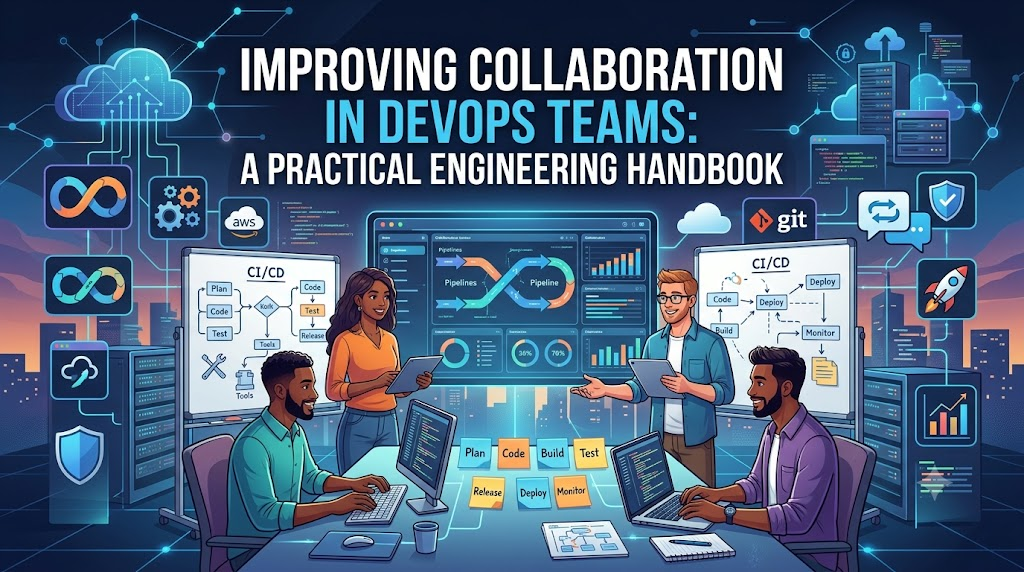
Modern software delivery depends fundamentally on how well engineering teams communicate, share knowledge, and solve problems together. While automated toolchains and cloud infrastructure are essential, isolated development, quality assurance, and operations teams often create friction that slows release cycles and increases recovery times. DevOps promotes cross-functional collaboration, transparency, and shared accountability across departments to eliminate these traditional silos. By fostering communication, trust, and mutual responsibility, organizations can significantly improve software quality, enhance reliability, and accelerate delivery speed. Educational resources and training programs provided by DevOpsSchool emphasize this core philosophy, demonstrating how successful software engineering relies as much on team culture as it does on technical tooling.
What Is Collaboration in DevOps Teams?
Collaboration in DevOps teams refers to the practice of developers, system administrators, quality assurance engineers, security specialists, and business stakeholders working together throughout the software development lifecycle. Rather than working in isolated compartments and handing off artifacts over virtual walls, collaborative teams share responsibility for planning, building, testing, deploying, maintaining, and monitoring software applications.
       +-------------------------------------------------------+
       |                  PLAN & DESIGN                        |
       |  (Product + Dev + Ops + Sec agree on requirements)    |
       +---------------------------+---------------------------+
                                   |
                                   v
       +-------------------------------------------------------+
       |                  BUILD & TEST                         |
       |     (Devs write code + QA writes auto-tests)          |
       +---------------------------+---------------------------+
                                   |
                                   v
       +-------------------------------------------------------+
       |               SECURE & VALIDATE                       |
       |  (Security scans integrated into shared pipeline)     |
       +---------------------------+---------------------------+
                                   |
                                   v
       +-------------------------------------------------------+
       |               DEPLOY & OPERATE                        |
       |   (Ops manages infra + Dev shares on-call duty)       |
       +---------------------------+---------------------------+
                                   |
                                   v
       +-------------------------------------------------------+
       |             MONITOR & FEEDBACK LOOP                   |
       | (Real-time telemetry shared across all disciplines)   |
       +-------------------------------------------------------+
DevOps culture and collaboration are inseparable. Tools like container orchestrators and code repositories facilitate technical execution, but collaboration defines how people interact when using those tools. Breaking down organizational silos requires changing how team performance is measured. When developers care about production stability and operations engineers care about release velocity, true cross-functional alignment occurs.
Consider a practical scenario: a team building an e-commerce checkout service. In a traditional environment, developers build the payment logic, package the compiled code, and send a ticket to the operations team to deploy it. If the application crashes due to a database connection limit, operations blames the developers for bad code, and developers blame operations for poor environment configuration.
In a collaborative DevOps environment, a developer, an operations engineer, and a database administrator meet during the initial architecture design. They agree on connection pooling limits, set up automated deployment scripts together, and write shared health-check endpoints. When the service is deployed, both engineering groups monitor telemetry dashboards together, allowing them to detect and resolve performance bottlenecks immediately.
Why Collaboration Is the Foundation of DevOps
Automation and cloud infrastructure are powerful force multipliers, but they cannot fix poor communication or conflicting goals. Without shared understanding, automated tools simply deploy mistakes faster.
+--------------------------+---------------------------------------------------------+
| Benefit                  | Operational Impact                                      |
+--------------------------+---------------------------------------------------------+
| Faster Decision-Making   | Technical blockers are resolved via quick syncs         |
| Shared Accountability    | "Your code" and "My server" become "Our application"    |
| Continuous Feedback      | Issues found in production feed directly to backlog     |
| Higher Software Quality  | Testing and security run alongside development          |
| Faster Innovation        | Rapid iterations allow safe experimental feature releases|
+--------------------------+---------------------------------------------------------+
Code language: JavaScript (javascript)
Faster Decision-Making
When engineers communicate directly across functional boundaries, decision-making cycles shorten from days to minutes. Instead of submitting formal change request tickets that sit in review queues, engineers use shared communication channels and collaborative reviews to approve changes based on clear automated testing gates.
Better Communication
Direct communication reduces misunderstandings regarding software specifications, environment requirements, and architectural constraints. When developers understand cloud infrastructure limits and systems engineers understand application frameworks, teams design resilient systems from day one.
Shared Accountability
Collaborative teams move away from point-scoring and blame assignment. When a production incident occurs, the team focuses on root-cause mitigation and system hardening rather than trying to protect individual departments. Successes and failures belong to the entire cross-functional unit.
Continuous Feedback
Integrated teams collect feedback at every stage of development. Code quality issues, security vulnerabilities, performance bottlenecks, and user experience flaws are identified and addressed early, drastically reducing the cost of repairs compared to fixing issues after a production launch.
Higher Software Quality
Continuous quality assurance and automated security validation ensure that code passing through deployment pipelines meets organizational standards. Shared visibility allows all team members to spot architectural defects early in the cycle.
Faster Innovation
Safe deployment pipelines and collaborative incident management lower the risk of pushing new features. When engineering teams know they can safely roll back or feature-flag changes, they experiment more frequently, delivering value to customers much faster.
Traditional IT Teams vs DevOps Collaboration
Understanding the shift from traditional IT management to collaborative DevOps requires comparing how fundamental engineering activities operate under both models.
| Area | Traditional Teams | DevOps Teams |
| Communication | Ticket-driven, formal handoffs, fragmented communication tools | Real-time chat, shared channels, direct collaboration, integrated feedback |
| Responsibility | Siloed roles (Devs write code, Ops runs servers) | Shared ownership of software lifecycle from code to production |
| Deployment Ownership | Operations team executes manual deployments off-hours | Automated pipelines triggered and monitored jointly by Dev and Ops |
| Incident Handling | Escalated across support tiers; finger-pointing during post-mortems | Joint war rooms, blameless post-mortems, shared on-call duties |
| Feedback Process | Slow, manual reporting via quarterly customer surveys or tickets | Automated real-time telemetry, monitoring dashboards, continuous loops |
| Automation | Ad-hoc scripts isolated within specific teams | Shared CI/CD pipelines, Infrastructure as Code, automated testing |
| Customer Focus | Dev focuses on features; Ops focuses on uptime | Entire team focuses on user experience, application value, and reliability |
In traditional environments, a change request might require five sign-offs across three departments, taking weeks to process. In a collaborative DevOps environment, compliance checks, security policies, and operational constraints are codified into automated deployment pipelines. If the automated test suite passes, code merges smoothly into production, backed by observability dashboards monitored by both developers and operators.
Teams That Collaborate in DevOps
A mature DevOps ecosystem relies on close, cross-functional alignment among several key technical and business disciplines.
                  +-----------------------+
                  |  Product & Business   |
                  | (User Needs & Goals)  |
                  +-----------+-----------+
                              |
     +------------------------+------------------------+
     |                        |                        |
     v                        v                        v
+------------+          +------------+          +------------+
| Developers | <------> | QA Enginee.| <------> | Operations |
| (Features) |          | (Quality)  |          | (Uptime)   |
+------------+          +------------+          +------------+
     ^                        ^                        ^
     |                        |                        |
     +------------------------+------------------------+
                              |
                  +-----------+-----------+
                  |    Security Teams     |
                  |  (DevSecOps Controls) |
                  +-----------------------+
Code language: HTML, XML (xml)
Developers
Software developers write business logic, build microservices, and design application logic. In a collaborative DevOps setting, developers write unit tests, contribute to Infrastructure as Code (IaC) definitions, and monitor their services in staging and production environments. They take direct responsibility for how their code performs under realistic user traffic.
Operations Engineers
Operations and infrastructure engineers manage network setups, cloud computing resources, storage systems, and cluster management platforms. Rather than provisioning infrastructure manually, they build self-service automation tools, cloud templates, and continuous delivery pipelines that developers use to deploy applications independently.
QA Engineers
Quality Assurance engineers transition from manual testing at the end of a release cycle to embedding continuous automated testing into software delivery workflows. They collaborate with developers to create automated integration, performance, and regression test suites that run automatically inside continuous integration pipelines.
Security Teams
Security specialists work alongside software engineers through a DevSecOps model. Instead of auditing completed applications right before release, security engineers embed static code analysis, vulnerability scanning, secret detection, and dependency checks directly into deployment pipelines. This lets developers patch vulnerabilities early while building features.
Product Owners and Business Teams
Product managers and business analysts define requirements, set delivery priorities, and track user adoption metrics. By actively participating in engineering retrospectives, planning sessions, and telemetry reviews, business stakeholders ensure engineering efforts stay tightly aligned with market needs and customer expectations.
Core Principles of DevOps Collaboration
+-------------------------------------------------------------------------+
|                  CORE PRINCIPLES OF DEVOPS COLLABORATION                 |
+-------------------+-----------------------------------------------------+
| Shared            | Everyone owns quality, uptime, and performance.     |
| Responsibility    | No throwing code over the wall.                     |
+-------------------+-----------------------------------------------------+
| Transparency      | Open dashboards, accessible codebases, public post- |
|                   | mortems, and shared technical backlogs.             |
+-------------------+-----------------------------------------------------+
| Continuous        | Monitoring metrics, automated test results, and user|
| Feedback          | feedback inform every iteration.                   |
+-------------------+-----------------------------------------------------+
| Trust &           | High psychological safety combined with personal    |
| Accountability    | accountability for system quality.                  |
+-------------------+-----------------------------------------------------+
| Knowledge         | Internal wikis, paired engineering, blameless reviews,|
| Sharing           | and cross-training eliminate information silos.     |
+-------------------------------------------------------------------------+
Code language: JavaScript (javascript)
Shared Responsibility
The foundational rule of DevOps collaboration is that teams win or fail together. Developers do not mark a user story as “done” simply because the code compiles on their local environment. A feature is complete only when it is securely deployed, verified in production, and performing well for users.
Transparency
Engineering organizations must operate with full visibility into systems, codebases, and performance metrics. Centralized version control repositories, open monitoring dashboards, and publicly available project tracking boards ensure that all team members understand current release statuses, system health, and technical priorities.
Continuous Feedback
Feedback loops must be tight, automated, and visible. When an automated test fails, an application throws errors, or system performance degrades, notifications route immediately to the responsible engineering team. This immediate feedback helps teams address minor flaws before they escalate into major outages.
Trust and Accountability
High-performing engineering teams build an environment of psychological safety where team members feel comfortable raising concerns, admitting mistakes, and proposing bold ideas. This trust is balanced by personal accountability for writing quality code, producing clear documentation, and adhering to operational standards.
Knowledge Sharing
Information hoarding creates single points of failure within engineering teams. Knowledge sharing is actively practiced through pair programming, blameless post-incident reviews, internal technical workshops, and maintained documentation repositories, ensuring technical expertise is distributed broadly across the organization.
Best Practices for Collaboration in DevOps Teams
Encourage Open Communication
- Hold concise, focused daily stand-up meetings where cross-functional team members share updates, flag technical blockers, and align on daily release objectives.
- Establish dedicated, topic-specific communication channels for project work, operational alerts, deployment updates, and incident coordination.
- Document system designs, architectural decisions, and operational processes clearly in searchable team knowledge bases.
- Conduct regular blameless retrospectives after major deployments or sprint milestones to identify concrete areas for process improvement.
Automate Repetitive Tasks
- Build automated Continuous Integration and Continuous Delivery (CI/CD) pipelines to handle code compilation, automated testing, artifact bundling, and environment deployment.
- Manage infrastructure through code templates using tools like Terraform or Ansible, ensuring development, staging, and production environments remain identical.
- Automate regression, performance, and security testing so validation occurs consistently without manual intervention.
- Eliminate manual deployment steps to minimize human error, reduce release anxiety, and free up engineering time for high-value development work.
+--------------------------------------------------------------------------+
|                     SHARED KNOWLEDGE REPOSITORY                          |
|                                                                          |
|  +---------------------+  +---------------------+  +------------------+  |
|  | System Architecture |  | Deployment Runbooks |  | Post-Incident    |  |
|  | Specifications      |  | & Recovery Guides   |  | Root-Cause Notes |  |
|  +---------------------+  +---------------------+  +------------------+  |
+--------------------------------------------------------------------------+
Use Shared Documentation
- Maintain comprehensive, step-by-step runbooks for application deployment, emergency rollbacks, configuration updates, and system recovery.
- Document system architecture, database schemes, API contracts, and integration points using searchable team wikis.
- Standardize incident response procedures so engineers on-call can diagnose issues and restore services quickly without waiting for specific domain experts.
- Update documentation continuously as part of normal definition-of-done criteria for every user story.
Implement Continuous Feedback Loops
- Configure centralized logging and telemetry dashboards to observe application health, error frequencies, system latency, and resource usage in real time.
- Gather input directly from end users, customer support teams, and business analytics to guide sprint planning and prioritization.
- Conduct blameless post-mortem reviews after production incidents to understand contributing factors and prevent repeat occurrences.
- Measure system metrics against agreed-upon Service Level Objectives (SLOs) to make informed decisions about feature delivery speed versus platform stability.
Promote Cross-Functional Learning
- Organize internal lunch-and-learn events, technical workshops, and demonstration sessions where engineers share emerging tools and architectural patterns.
- Practice pair programming and joint code reviews across different disciplines (such as an operations engineer pairing with a developer on pipeline code).
- Establish mentoring programs where experienced engineers help junior staff learn system design principles, debugging techniques, and cloud operational best practices.
- Rotate team members periodically into different functional areas or on-call rotations to broaden technical expertise across the engineering department.
Communication Strategies for DevOps Teams
Technical communication needs to be deliberate, precise, and well-structured across all communication channels.
+-------------------------------------------------------------------+
|                   DEVOPS COMMUNICATION MATRIX                      |
+------------------+-----------------------+------------------------+
| Channel Type     | Primary Purpose       | Examples               |
+------------------+-----------------------+------------------------+
| Real-time Chat   | Urgent syncs, alerts  | Slack, Teams           |
| Async Tracker    | Task history, status  | Jira, Azure Boards     |
| Knowledge Hub    | Runbooks, architecture| Confluence, GitHub Wiki|
| Incident Bridge  | Emergency triage      | Dedicated voice/chat   |
+------------------+-----------------------+------------------------+
Clear Technical Communication
Engineers must write clean, explicit commit messages, pull request descriptions, and issue tickets. When submitting code updates, explain why a change is necessary, how it was implemented, and what testing was performed. Avoid technical jargon or vague descriptions when describing complex software updates.
Incident Communication
During critical production incidents, establish a single dedicated communication bridge (such as a specific chat channel or video call). Designate a incident commander to coordinate diagnosis and recovery work, a communications lead to inform internal stakeholders, and technical leads focused on resolving the problem. This prevents chaos and conflicting commands during high-stress outages.
Change Management Updates
Keep deployment schedules, maintenance windows, and system change notices visible across departments. Automated release announcements posted to shared communication channels keep developers, QA teams, support staff, and account managers aligned on what code is going live and when.
Stakeholder Communication
Translate technical achievements and operational health metrics into business context when communicating with executives and business partners. Instead of reporting low-level server metrics like raw CPU utilization percentages, report business metrics like API uptime percentages, transaction processing latency, and deployment lead times.
Collaboration Tools Used in DevOps
Tools do not create collaboration on their own, but the right tool stack helps cross-functional teams work together seamlessly across different physical locations and time zones.
| Category | Tools | Purpose |
| Source Code Collaboration | Git, GitHub, GitLab, Bitbucket | Version control, code reviews, pull requests, branching management, inline discussions |
| Communication | Slack, Microsoft Teams | Real-time chat, automated alert routing, video calls, integration bots |
| Project Management | Jira, Azure Boards | Agile backlog tracking, sprint planning, task assignment, cross-team progress visibility |
| Documentation | Confluence, GitHub Wiki, Notion | Architecture design documents, deployment runbooks, incident post-mortems, knowledge base |
| Monitoring & Telemetry | Prometheus, Grafana, Datadog | Metrics collection, operational dashboards, automated alert triggers, performance telemetry |
Role of CI/CD in Team Collaboration
Continuous Integration and Continuous Delivery (CI/CD) pipelines serve as the automated workflow foundation for collaborative engineering teams.
+--------------------------------------------------------------------------+
|                      AUTOMATED CI/CD PIPELINE FLOW                       |
|                                                                          |
|  [Developer Commit] -> [Automated Build] -> [Unit & Security Scans]      |
|                                                                   |      |
|  [Staging Deployment] <- [Integration Tests] <---------------------+      |
|           |                                                              |
|           v                                                              |
|  [Production Release] -> [Telemetry & Observability Dashboards]          |
+--------------------------------------------------------------------------+
When a developer pushes code updates to a shared repository, the CI/CD pipeline triggers automated build scripts, code analysis tools, unit tests, and security scans. If tests fail, the pipeline halts immediately, alerting the developer so they can fix the code before it moves down the deployment chain.
Because the pipeline acts as an objective, automated referee, teams no longer argue about whether code is ready for staging or production. Passing pipeline checks demonstrate that code meets agreed-upon quality, security, and build benchmarks.
Furthermore, CI/CD pipelines provide shared visibility into the software release path. Operations teams, QA engineers, security leads, and developers can look at the same deployment dashboard to track a commit’s progress from local development code to a live production environment.
DevOps Collaboration During Incident Management
How a team handles production outages reveals the true strength of its collaborative culture. Consider a real-world scenario involving a cloud-based logistics management platform.
INCIDENT WORKFLOW:
[ System Alert Fires ]
          |
          v
[ Incident Bridge Opened ] ---> (Dev + Ops + QA + Sec join war room)
          |
          v
[ Telemetry Triage ] -------> (Logs & traces pin-point failed dependency)
          |
          v
[ Hotfix or Rollback ] -----> (Automated pipeline executes safe rollback)
          |
          v
[ Blameless Post-Mortem ] --> (Root cause identified; preventative work queued)
- Incident Detection: At 02:15 AM, automated monitoring alerts trigger because checkout service error rates spike past 5%. Prometheus routes alerts directly to the shared on-call chat channel and triggers notification tools.
- Team Coordination: An on-call operations engineer and a primary backend developer join an emergency incident response bridge immediately. The operations engineer acts as Incident Commander to lead recovery efforts.
- Telemetry Triage: The developer inspects distributed tracing logs while the operations engineer checks database cluster performance and network metrics. They spot an unindexed database query introduced in a deployment from two hours earlier that is locking connections under high traffic.
- Resolution via Pipeline: Rather than attempting manual, unverified hotfixes directly on production servers, the developer writes a quick database index patch on a hotfix branch. The QA engineer validates the patch in a staging pipeline, and the pipeline safely deploys the fix to production by 02:42 AM.
- Blameless Post-Incident Review: The following afternoon, developers, operations leads, QA engineers, and database administrators meet for a post-mortem. Rather than placing blame on the developer who wrote the unindexed query, the team analyzes why automated testing suites failed to catch unindexed queries during pipeline execution. They add automated query checks to the CI stage to prevent similar issues in the future.
Common Collaboration Challenges in DevOps Teams
+---------------------------+-----------------------------------------------------+
| Challenge                 | Practical Solution                                  |
+---------------------------+-----------------------------------------------------+
| Deep Organizational Silos | Reorganize into cross-functional feature teams      |
| Resistance to Change      | Start with small pilot projects; showcase quick wins|
| Lack of Documentation     | Make documentation a mandatory part of definition-of-done|
| Tool Fragmentation        | Standardize on an enterprise core tool stack        |
| Unclear Responsibilities  | Define clear RACI matrices for deployments and alerts|
+---------------------------+-----------------------------------------------------+
Code language: JavaScript (javascript)
Deep Organizational Silos
Departmental walls built over decades are hard to break down. When management measures developers solely on feature output volume and operations solely on uptime metrics, friction persists naturally.
- Solution: Realign goals around shared performance metrics. Reward development teams for application stability, and evaluate operations teams on how effectively they empower development velocity.
Resistance to Change
Engineers used to traditional manual processes often resist adopting new workflow practices, automated pipelines, or shared responsibilities.
- Solution: Introduce DevOps practices incrementally. Run a pilot project with a supportive engineering team, document productivity gains and quality improvements, and use that success to build momentum across the broader organization.
Lack of Documentation
Under pressure to ship software quickly, teams often neglect system documentation, creating single-source knowledge dependencies on specific senior engineers.
- Solution: Treat documentation as an essential product deliverable. Require complete architecture diagrams, runbook updates, and inline technical guides before marking any user story complete.
Tool Fragmentation
When teams independently adopt disconnected tools, communication fractures across separate platforms.
- Solution: Consolidate around standard core tools across the organization for version control, issue tracking, continuous integration, and chat. Ensure all tools are connected through automated integrations.
Unclear Responsibilities
Unclear boundaries regarding on-call rotations, code deployment duties, and security patching create confusion during critical operational moments.
- Solution: Use explicit Responsibility Assignment Matrices (RACI) to define who is Responsible, Accountable, Consulted, and Informed for each phase of system delivery and maintenance.
Building a Collaborative DevOps Culture
Building a collaborative engineering culture requires active support from leadership, thoughtful organizational design, and continuous reinforcement.
+--------------------------------------------------------------------------+
|                  CULTURE BUILDING BLOCKS                                 |
|                                                                          |
|   [ Executive Support ]  --->  [ Shared Goals & Metrics ]                |
|                                         |                                |
|                                         v                                |
|   [ Continuous Learning ] <--- [ Psychological Safety ]                  |
+--------------------------------------------------------------------------+
Leadership Support
Executive and engineering leadership must actively support collaborative practices. Executives must invest in training, provide budget for modern tooling, and give teams room to refine processes without demanding immediate, unrealistic productivity spikes.
Shared Goals
Align cross-functional team members around shared business and engineering Key Performance Indicators (KPIs). When developers, testers, and operations specialists work toward unified delivery objectives, inter-departmental conflict fades away.
Psychological Safety
Create a supportive engineering culture where team members are encouraged to speak up about technical risks, report system defects, and propose unconventional solutions. When mistakes occur, treat them as team learning opportunities rather than occasions for personal reprimands.
Continuous Improvement Mindset
Adopt an iterative mindset toward organizational culture, just as you do for software code. Continuously review team workflows, run regular retrospectives, refine release pipelines, and adjust communication channels to eliminate friction over time.
Real-World Example: Collaboration in a DevOps Team
To visualize how end-to-end DevOps collaboration works in practice, let’s look at how a cross-functional team develops, deploys, and maintains a new customer payment service.
+--------------------------------------------------------------------------+
|                 END-TO-END DEVOPS COLLABORATION WORKFLOW                 |
|                                                                          |
|  1. PLANNING: Dev + Ops + QA + Sec align on requirements & designs       |
|  2. DEVELOPMENT: Dev writes feature; QA builds parallel automated tests  |
|  3. AUTOMATED PIPELINE: CI runs builds, unit tests, and security scans  |
|  4. DEPLOYMENT: Ops automated scripts execute canary release             |
|  5. OBSERVABILITY: Real-time telemetry monitored by Dev and Ops jointly  |
|  6. FEEDBACK: Team reviews operational data in sprint retrospective      |
+--------------------------------------------------------------------------+
- Planning and Design Sync: The product manager, software architect, operations lead, quality analyst, and security engineer gather to plan the payment service. They define functional requirements, set availability targets, choose API specifications, and agree on compliance controls before writing any code.
- Parallel Development and Test Authoring: Developers write service logic while QA engineers write automated integration tests against agreed API specs. Security engineers provide standardized encryption libraries, and operations engineers create Infrastructure as Code templates for cloud resources.
- Continuous Integration Verification: Developers commit code to a shared repository. The automated CI pipeline builds application artifacts, runs unit tests written by developers, executes integration tests written by QA, and performs static code security scans.
- Automated Continuous Deployment: Once pipeline checks pass, the deployment automation provisions staging infrastructure and deploys the payment service. The QA suite runs end-to-end regression checks automatically. After validation, the deployment pipeline executes a canary release to production servers.
- Joint Telemetry and Incident Response: Developers and operations engineers monitor Grafana dashboards as live customer traffic routes to the new service. When latency spikes on specific payment pathways, both disciplines trace log files together to fix microservice parameters in real time.
- Sprint Retrospective and Process Enhancement: At sprint end, the entire cross-functional team meets to review deployment lead times, operational telemetry, and pipeline performance. They identify pipeline bottlenecks, queue up automation updates, and refine documentation together for the next release cycle.
Measuring Collaboration Success in DevOps
Tracking team performance through clear metrics helps quantify improvements in collaboration, process efficiency, and platform stability over time.
| Metric | Why It Matters |
| Deployment Frequency | Measures how often code is safely released into production; higher frequency reflects strong collaboration and reliable pipelines. |
| Lead Time for Changes | Measures the time it takes from code commit to running live in production; shorter lead times demonstrate efficient team handoffs. |
| Change Failure Rate | The percentage of deployments that cause production outages or require emergency hotfixes; reflects overall quality and review rigor. |
| Mean Time to Recovery (MTTR) | The average time required to restore service during an outage; highlights incident response efficiency and team coordination. |
| Team Satisfaction Score | Surveys measuring team morale, burnout levels, and psychological safety; high satisfaction correlates directly with healthy retention and collaboration. |
| Knowledge Sharing Index | Tracks cross-training sessions, runbook update frequency, and team contribution breadth to verify information isn’t siloed. |
Collaboration Skills Every DevOps Engineer Should Develop
Technical knowledge alone does not make a successful DevOps practitioner. Soft skills and interpersonal communication are equally critical for driving cross-functional alignment.
+--------------------------------------------------------------------------+
|                 KEY COLLABORATION SKILLS FOR ENGINEERS                   |
|                                                                          |
|   +--------------------------+        +--------------------------+       |
|   | Empathetic Communication |        | Cross-Domain Curiosity   |       |
|   +--------------------------+        +--------------------------+       |
|   | Clear Technical Writing  |        | Blameless Problem-Solving|       |
|   +--------------------------+        +--------------------------+       |
|   | Active Listening         |        | Constructive Feedback    |       |
|   +--------------------------+        +--------------------------+       |
+--------------------------------------------------------------------------+
Active Listening
Listen carefully to concerns raised by team members across other disciplines. When an operations engineer voices worry about database stability, or a security engineer raises compliance red flags, take time to understand their requirements before pushing code changes forward.
Empathetic Communication
Recognize the daily challenges faced by team members in different roles. Developers face pressure to deliver new features rapidly, while operations specialists face high stress around system uptime and reliability. Empathetic communication bridges these operational perspectives.
Systemic Problem-Solving
Focus on addressing systemic workflow problems rather than pointing fingers at individuals when defects occur. Ask why automated testing failed to flag an issue, why alerting scripts were delayed, or how runbooks can be clarified to improve future incident responses.
Technical Writing and Documentation
Develop clear, structured technical writing habits. Writing easy-to-read documentation, precise commit histories, clear pull request descriptions, and clear post-mortems saves hundreds of hours of team frustration over time.
Conflict Resolution
Address technical disagreements constructively by relying on empirical data, performance benchmarks, and shared operational requirements. Focus discussions on what architecture best serves the customer and business, rather than defending personal coding preferences.
How DevOpsSchool Helps Build Collaborative DevOps Skills
Transitioning to a collaborative DevOps model requires updating both engineering mindsets and technical capabilities across an organization. Educational platforms like DevOpsSchool play a key role in guiding engineers and leadership teams through this cultural and technical transformation.
+--------------------------------------------------------------------------+
|                  DEVOPS SCHOOL LEARNING ECOSYSTEM                        |
|                                                                          |
|  [ Hands-on Labs ] --> [ Industry Mentorship ] --> [ End-to-End Scenarios ]
|                                                                 |        |
|  [ Modern CI/CD Tooling ] <-- [ Enterprise Strategy ] <---------+        |
+--------------------------------------------------------------------------+
DevOpsSchool offers structured training programs, real-world case studies, and hands-on lab environments that reflect enterprise software delivery workflows. Learners build practical experience managing CI/CD pipelines, writing Infrastructure as Code, setting up monitoring stacks, and practicing cross-functional incident responses in controlled environments.
By emphasizing both collaborative workflows and practical tool ecosystems (including Git, Docker, Kubernetes, Terraform, Jenkins, Prometheus, and cloud platforms), DevOpsSchool helps students, experienced engineers, and technical managers bridge knowledge gaps. They gain the technical fluency and team skills needed to foster continuous collaboration within engineering organizations.
Future of Collaboration in DevOps
As software systems grow more complex and distributed, collaboration models inside engineering organizations continue to evolve alongside technological advances.
+--------------------------------------------------------------------------+
|                  FUTURE TRENDS IN DEVOPS COLLABORATION                   |
+--------------------------+-----------------------------------------------+
| Platform Engineering     | Internal developer platforms lower cognitive   |
|                          | friction and simplify self-service tasks.      |
+--------------------------+-----------------------------------------------+
| AI-Assisted Operations   | Automated log analysis and AI copilot code    |
|                          | reviews streamline cross-team workflows.       |
+--------------------------+-----------------------------------------------+
| GitOps Workflows         | Git acts as the single declarative source of   |
|                          | truth for both application and infrastructure.|
+--------------------------+-----------------------------------------------+
| Remote & Hybrid DevOps   | Asynchronous documentation and clear chat     |
|                          | patterns support distributed global teams.     |
+--------------------------+-----------------------------------------------+
Code language: PHP (php)
Platform Engineering and Self-Service Portals
Platform engineering teams are increasingly building Internal Developer Platforms (IDPs) that offer developers self-service access to infrastructure, automated testing environments, and deployment pipelines. This setup lowers cognitive load while embedding infrastructure best practices into automated workflows.
AI-Assisted Collaboration
Artificial Intelligence and Machine Learning tools are integrating into collaborative engineering workflows. AI copilots assist with code reviews, automated log analysis, real-world incident triage, and automated documentation generation, allowing cross-functional teams to diagnose and resolve production issues faster.
GitOps Workflows
GitOps is redefining operational collaboration by using Git repositories as the ultimate source of truth for infrastructure and application configurations. Team members submit infrastructure updates using standard pull requests, enabling direct code review, auditability, and automated deployment across cloud platforms.
Remote and Hybrid Team Collaboration
With software engineering teams distributed globally across time zones, asynchronous communication strategies, structured documentation standards, and centralized telemetry dashboards are becoming essential to maintain operational alignment across remote DevOps teams.
Frequently Asked Questions (FAQs)
What is collaboration in DevOps teams?
Collaboration in DevOps teams refers to software developers, operations engineers, QA testers, security leads, and business stakeholders working together throughout the software development lifecycle. They share responsibility for code quality, deployment security, platform stability, and continuous application improvements.
Why is collaboration important in DevOps?
Collaboration breaks down departmental handoffs, speeds up decision-making, reduces deployment errors, improves software quality, and shortens release lead times. It aligns teams around shared organizational goals rather than competing departmental priorities.
How do developers and operations teams work together in DevOps?
Developers and operations engineers collaborate by managing infrastructure with code, establishing automated CI/CD pipelines, sharing on-call support duties, reviewing application architecture together, and using unified real-time monitoring dashboards to maintain production uptime.
Which tools improve DevOps collaboration?
Key collaboration tools include version control systems (Git, GitHub, GitLab), communication channels (Slack, Microsoft Teams), project management boards (Jira, Azure Boards), documentation hubs (Confluence, wikis), and monitoring platforms (Prometheus, Grafana).
How does CI/CD support collaboration?
CI/CD pipelines automate code builds, integration testing, vulnerability checks, and environment releases. They provide a transparent, objective validation pipeline that gives developers, QA testers, and operations teams clear visibility into release readiness.
What are common collaboration challenges in DevOps teams?
Common challenges include deep departmental silos, employee resistance to new workflows, missing documentation, fragmented toolstacks, unclear operational roles, and low psychological safety when production mistakes occur.
How can organizations improve DevOps teamwork?
Organizations can improve teamwork by establishing cross-functional project squads, aligning performance metrics, promoting blameless incident retrospectives, consolidating communication tools, investing in technical training, and encouraging knowledge sharing.
What soft skills help DevOps engineers collaborate effectively?
Key soft skills include clear technical writing, empathetic communication, active listening, systemic problem-solving, constructive code reviewing, conflict resolution, and a continuous learning mindset.
What is the role of DevSecOps in team collaboration?
DevSecOps embeds security practices directly into software development and delivery pipelines. Security engineers collaborate with developers and operations teams early in project planning to automate compliance checks, dependency scans, and threat reviews during active development.
How does blameless post-mortem improve collaboration?
A blameless post-mortem focuses on analyzing system flaws, pipeline gaps, and process issues rather than criticizing individual engineers after an outage. This approach builds trust, encourages open reporting of issues, and helps teams harden systems continuously.
What is the difference between traditional handoffs and DevOps workflows?
Traditional handoffs rely on formal ticket transfers between isolated teams, leading to slow releases and low visibility. DevOps workflows use cross-functional teams, automated integration testing, shared release pipelines, and real-time monitoring.
How does documentation contribute to DevOps collaboration?
Shared documentation—such as runbooks, architecture designs, and post-mortem notes—ensures technical knowledge is freely accessible across teams. It prevents single-point-of-failure dependencies on individual engineers and speeds up incident response times.
What are DORA metrics, and how do they measure collaboration?
DORA metrics (Deployment Frequency, Lead Time for Changes, Change Failure Rate, and Mean Time to Recovery) measure software delivery performance and reliability. Improving these metrics requires close collaboration, reliable pipelines, and effective cross-team coordination.
How does platform engineering support DevOps collaboration?
Platform engineering creates self-service infrastructure platforms for developers, reducing operational friction and handoff delays. This allows developers to provision compliant environments independently while operations teams maintain core platform controls.
How does DevOpsSchool help professionals master DevOps collaboration?
DevOpsSchool provides industry-focused training programs, hands-on lab projects, expert mentorship, and practical learning modules covering modern CI/CD tools, cloud platforms, and collaborative engineering workflows.
Final Thoughts
Successful DevOps adoption is built on human communication, mutual trust, and continuous collaboration—not just automation tools and cloud platforms. Installing modern deployment software without cultivating shared responsibility and open communication will not produce a agile, resilient engineering culture.
By breaking down functional silos, automating manual workflows, maintaining clear shared documentation, and building an environment of psychological safety, engineering organizations can deliver high-quality software continuously. True collaboration transforms software engineering from a high-stress process into a predictable, scalable enterprise strength.

Find Trusted Cardiac Hospitals
Compare heart hospitals by city and services — all in one place.
Explore Hospitals
Effective DevOps collaboration is not only about improving communication between teams; it is about creating systems that make collaboration sustainable as organizations grow. One area often overlooked is defining clear ownership boundaries between development, platform, security, and operations teams. Without this clarity, collaboration can turn into dependency bottlenecks where every decision requires multiple approvals. Mature teams usually invest in self-service platforms, shared engineering standards, automated feedback loops, and measurable outcomes such as deployment reliability, recovery time, and change failure rates. Another important factor is ensuring operational knowledge flows back into development through incident reviews, observability data, and production insights. The future of DevOps collaboration will depend less on adding more meetings and more on building engineering environments where teams can independently move fast while staying aligned through automation, transparency, and shared accountability.