
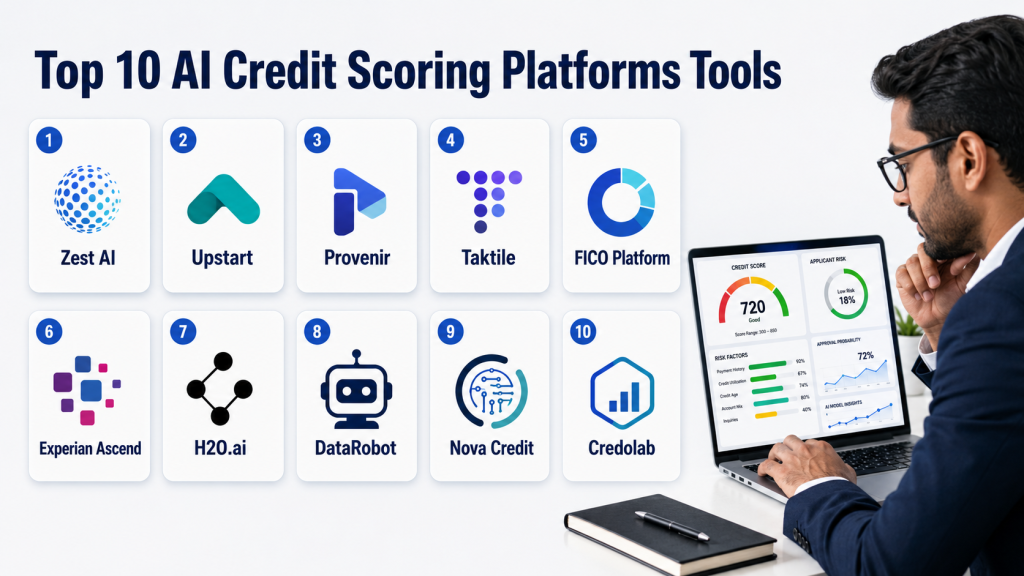
AI Credit Scoring Platforms help lenders, banks, fintech companies, credit unions, NBFCs, marketplaces, and digital lending teams assess borrower creditworthiness using machine learning, alternative data, traditional bureau data, cash-flow patterns, repayment behavior, identity signals, and risk models. These platforms help financial teams make faster, fairer, and more consistent lending decisions while improving portfolio quality and reducing manual underwriting effort.
Unlike traditional credit scoring systems that may rely heavily on bureau history, AI credit scoring tools can analyze broader data sources such as bank transactions, income trends, repayment behavior, employment signals, business cash flow, device risk, fraud indicators, and behavioral patterns. The goal is not just to approve or reject borrowers, but to create a smarter, explainable, auditable, and scalable credit decisioning process.
Introduction
AI Credit Scoring Platforms are software systems that use artificial intelligence, machine learning, rules, decision engines, and data integrations to evaluate the credit risk of individuals or businesses. They help lenders predict the likelihood of repayment, identify risky applicants, improve approval workflows, and support responsible lending decisions.
Why It Matters
Credit decisions directly affect revenue, risk exposure, customer access, and regulatory trust. Traditional scoring models can work well for borrowers with strong credit histories, but they may struggle with thin-file customers, gig workers, small businesses, new-to-credit borrowers, and underserved segments. AI credit scoring platforms help lenders analyze more signals, make faster decisions, and improve risk segmentation.
These platforms matter because lenders need to reduce defaults, improve approval rates, automate underwriting, detect risky applications earlier, and maintain explainability for compliance teams. A strong AI credit scoring platform can support both growth and risk control when implemented with proper governance.
Real World Use Cases
- Consumer loan underwriting
- Small business lending risk assessment
- Buy now pay later eligibility checks
- Credit card application scoring
- Personal loan approval automation
- Microfinance and digital lending decisions
- Embedded finance credit checks
- Merchant cash advance risk scoring
- Portfolio monitoring and early warning alerts
- Credit line increase and limit management
- Alternative data-based scoring for thin-file borrowers
- Fraud-aware credit decisioning
Evaluation Criteria for Buyers
- Accuracy of credit risk prediction
- Explainability of score outputs and decision reasons
- Support for traditional and alternative data
- Integration with loan origination systems
- Model governance and auditability
- Bias monitoring and fairness controls
- Data privacy and retention controls
- Real-time decisioning performance
- Custom rule and policy configuration
- Ability to support multiple products and markets
- Portfolio monitoring and model drift detection
- Compliance readiness for regulated lending
- Support for human review and override workflows
- Pricing scalability for application volume
- Vendor support and implementation guidance
Best for
AI Credit Scoring Platforms are best for banks, credit unions, NBFCs, fintech lenders, digital lending platforms, embedded finance providers, BNPL companies, microfinance institutions, and enterprises that need faster, more accurate, and more scalable credit risk assessment. They are especially useful for risk leaders, underwriting teams, data science teams, compliance teams, product teams, and lending operations teams.
Not ideal for
These platforms may not be ideal for very small lenders with low application volume, businesses that only need basic bureau score checks, or teams without enough data maturity to manage AI-based decisioning responsibly. In such cases, a simpler rule-based underwriting workflow or bureau-based scoring model may be enough until lending volume and risk complexity increase.
What’s Changed in AI Credit Scoring Platforms
- Credit scoring is moving from static scorecards to dynamic, data-rich risk models.
- Lenders are using alternative data to assess thin-file and new-to-credit borrowers.
- Cash-flow underwriting is becoming more important for consumer and small business lending.
- Explainability is now a core requirement, not an optional feature.
- AI credit models are increasingly paired with human review and policy rules.
- Model governance, fairness testing, and audit trails are becoming central to procurement.
- Real-time decisioning is now expected in digital lending and embedded finance.
- AI is being used for early warning signals, not just new application scoring.
- Lenders are monitoring model drift more closely as borrower behavior changes.
- Fraud detection and credit scoring are becoming more connected.
- Cloud-based decisioning platforms are replacing slow manual underwriting workflows.
- Compliance teams are demanding clearer documentation around data use and model behavior.
Quick Buyer Checklist
Use this checklist to shortlist AI Credit Scoring Platforms quickly:
- Does the platform support your lending product type?
- Can it use both bureau and alternative data?
- Does it provide explainable scores and reason codes?
- Can it integrate with your loan origination system?
- Does it support real-time decisioning?
- Can your risk team customize rules and score thresholds?
- Does it support model monitoring and drift detection?
- Does it provide fairness, bias, and compliance review support?
- Can it handle human review and manual override workflows?
- Are audit logs and decision history available?
- Does it provide strong data privacy and retention controls?
- Can it support multiple geographies or lending portfolios?
- Is pricing practical at your application volume?
- Can it be tested in shadow mode before full rollout?
- Does the vendor support your regulatory and security requirements?
Top 10 AI Credit Scoring Platforms Tools
1- Zest AI
One-line verdict: Best for lenders seeking machine learning credit underwriting with explainability and automation.
Short description:
Zest AI helps lenders use machine learning for credit underwriting, risk ranking, and automated credit decisioning. It is commonly used by banks, credit unions, and lenders that want to improve approval decisions while maintaining responsible risk controls.
Standout Capabilities
- Machine learning-based credit underwriting
- Custom credit models tailored to lender portfolios
- Explainable model outputs for credit decisions
- Support for automated decisioning workflows
- Focus on fairer and more inclusive credit access
- Useful for banks, credit unions, and fintech lenders
- Helps improve risk segmentation beyond generic scorecards
- Can support underwriting automation and portfolio optimization
AI-Specific Depth
- Model support: Proprietary machine learning models and custom lender-specific models
- RAG and knowledge integration: Not applicable for standard credit scoring
- Evaluation: Model validation, performance monitoring, and outcome feedback vary by engagement
- Guardrails: Explainability, policy controls, and risk review workflows
- Observability: Model insights, decision reason outputs, and performance reporting vary
Pros
- Strong focus on lending-specific AI underwriting
- Useful for improving approval decisions without weakening risk controls
- Good fit for regulated lenders that need explainability
Cons
- May require lender data maturity for best performance
- Implementation may involve model validation and policy review
- Exact pricing is not publicly stated
Security & Compliance
Security and compliance details should be verified directly. Buyers should confirm SSO, RBAC, audit logs, encryption, retention controls, data residency, model governance, and fair lending support. Certifications are not publicly stated here.
Deployment & Platforms
- Cloud-based platform
- API and lending workflow integration
- Web-based administrative access may vary
- Self-hosted deployment is not publicly stated
Integrations & Ecosystem
Zest AI is designed to fit into lending, underwriting, and credit decisioning workflows.
- Loan origination systems
- Credit bureau data workflows
- Core lending platforms
- Credit policy engines
- Risk analytics systems
- Decisioning APIs
- Portfolio monitoring workflows
Pricing Model
Pricing is typically enterprise or contract-based. Exact pricing is not publicly stated.
Best-Fit Scenarios
- Credit unions modernizing underwriting
- Banks improving risk segmentation
- Lenders seeking explainable AI-driven credit decisions
2- Upstart
One-line verdict: Best for lenders seeking AI-powered consumer credit decisioning and lending network capabilities.
Short description:
Upstart is known for AI-driven lending and credit decisioning models that support consumer credit evaluation. It works with banks and credit unions that want to improve borrower assessment using broader data and automated underwriting capabilities.
Standout Capabilities
- AI-driven credit decisioning for consumer lending
- Broad borrower assessment beyond traditional score-only methods
- Partner lending model for banks and credit unions
- Automated underwriting and risk prediction
- Useful for personal loans and consumer credit products
- Supports digital lending workflows
- Focus on improving access for qualified borrowers
- Helps lenders modernize consumer loan approval
AI-Specific Depth
- Model support: Proprietary AI and machine learning models
- RAG and knowledge integration: Not applicable
- Evaluation: Model performance and lending outcome evaluation vary by partnership
- Guardrails: Credit policy controls, compliance workflows, and underwriting governance vary
- Observability: Portfolio and decision reporting varies by engagement
Pros
- Strong recognition in AI-based consumer lending
- Useful for banks and credit unions seeking lending modernization
- Supports automated credit evaluation workflows
Cons
- Best suited for specific lending partnerships
- Less flexible as a general-purpose credit model platform
- Exact customization and deployment options vary
Security & Compliance
Security, compliance, and lending governance controls should be verified directly. Buyers should confirm audit logs, data protection, model governance, fair lending support, and integration controls. Certifications are not publicly stated here.
Deployment & Platforms
- Cloud-based lending and decisioning workflows
- Partner platform model
- API and integration options vary
- Self-hosted deployment is not publicly stated
Integrations & Ecosystem
Upstart fits into consumer lending and bank partnership workflows.
- Lending partner systems
- Consumer loan workflows
- Credit decisioning processes
- Bank and credit union lending operations
- Application intake workflows
- Portfolio reporting workflows
- Risk review processes
Pricing Model
Pricing depends on partnership structure and product scope. Exact pricing is not publicly stated.
Best-Fit Scenarios
- Banks expanding digital personal lending
- Credit unions seeking AI-assisted underwriting
- Lenders wanting broader borrower assessment
3- Provenir
One-line verdict: Best for lenders needing flexible credit decisioning, data orchestration, and risk workflows.
Short description:
Provenir provides credit decisioning, data orchestration, risk analytics, and AI-powered decision automation for financial services. It is suitable for banks, fintech lenders, auto finance providers, digital lenders, and embedded finance companies.
Standout Capabilities
- Credit decisioning and risk orchestration
- Data integration across bureau, alternative, and internal sources
- AI and machine learning support for risk decisions
- Low-code decision strategy configuration
- Real-time application scoring workflows
- Fraud and credit risk decisioning support
- Strong fit for multi-product lending teams
- Useful for underwriting automation and customer lifecycle decisions
AI-Specific Depth
- Model support: AI and machine learning models with flexible deployment options
- RAG and knowledge integration: Not applicable
- Evaluation: Model performance monitoring and decision strategy testing vary
- Guardrails: Policy rules, decision controls, and governance workflows
- Observability: Decision analytics, data lineage, and performance reporting vary
Pros
- Strong decisioning and data orchestration capabilities
- Flexible for multiple lending products
- Useful for teams that need configurable credit strategies
Cons
- May require implementation planning for complex environments
- Best value comes with strong data integration work
- Pricing is not publicly stated
Security & Compliance
Security and compliance capabilities should be verified directly. Buyers should confirm SSO, RBAC, audit logs, encryption, retention, residency, and regulatory workflow support. Certifications are not publicly stated here.
Deployment & Platforms
- Cloud-based platform
- API-based integrations
- Web-based decision management
- Hybrid or self-hosted availability should be verified
Integrations & Ecosystem
Provenir connects lending teams to data sources, decision rules, risk models, and application workflows.
- Credit bureaus
- Alternative data providers
- Loan origination systems
- Banking systems
- Fraud tools
- Decision APIs
- Risk analytics workflows
Pricing Model
Pricing is typically enterprise or usage-based. Exact pricing is not publicly stated.
Best-Fit Scenarios
- Digital lenders needing fast credit decisioning
- Fintechs combining multiple data sources
- Banks modernizing lending decision workflows
4- Taktile
One-line verdict: Best for fintech teams building flexible credit decision flows with low-code control.
Short description:
Taktile is a decision platform that helps fintechs and financial institutions build, test, and deploy risk decision flows. It is useful for teams that want to manage credit policies, integrate data sources, and iterate decision strategies without heavy engineering bottlenecks.
Standout Capabilities
- Low-code decision flow builder
- Credit risk and fraud decisioning workflows
- Fast testing and deployment of credit policies
- Integration with data providers and internal systems
- Supports experimentation and decision strategy iteration
- Useful for fintech underwriting teams
- Helps reduce engineering dependency for risk changes
- Strong fit for modern digital lending operations
AI-Specific Depth
- Model support: Supports decisioning workflows that can include models and rules
- RAG and knowledge integration: Not applicable
- Evaluation: Strategy testing, simulation, and performance tracking vary
- Guardrails: Policy controls, workflow governance, and approval processes
- Observability: Decision flow visibility, rule outcomes, and performance analytics vary
Pros
- Strong flexibility for credit policy teams
- Useful for rapid experimentation and iteration
- Developer-friendly and risk-team-friendly approach
Cons
- Not a traditional credit bureau score provider
- Requires integration with data and model sources
- Best suited for teams with modern risk operations
Security & Compliance
Security controls should be verified directly. Buyers should check SSO, RBAC, audit logs, encryption, data retention, residency, and workflow approval controls. Certifications are not publicly stated here.
Deployment & Platforms
- Cloud-based platform
- Web-based decision design
- API-based integration
- Self-hosted deployment is not publicly stated
Integrations & Ecosystem
Taktile connects data, rules, models, and lending workflows into configurable decision flows.
- Credit bureaus
- Alternative data providers
- Internal data warehouses
- Loan origination systems
- Fraud providers
- Model endpoints
- Decision APIs
Pricing Model
Pricing is typically contract-based or usage-based. Exact pricing is not publicly stated.
Best-Fit Scenarios
- Fintechs needing configurable underwriting flows
- Lenders frequently testing credit policies
- Teams wanting low-code risk decision orchestration
5- FICO Platform
One-line verdict: Best for enterprises needing proven credit analytics, decisioning, and risk management depth.
Short description:
FICO is one of the most recognized names in credit risk analytics and decision management. Its platform capabilities support credit scoring, decisioning, analytics, fraud management, and customer lifecycle risk strategies for banks, lenders, and large financial institutions.
Standout Capabilities
- Deep credit risk analytics heritage
- Decision management and strategy optimization
- Support for credit lifecycle decisions
- Enterprise-grade analytics and scoring workflows
- Useful for banks and mature lending organizations
- Supports risk, fraud, and customer management use cases
- Strong fit for regulated financial services
- Broad ecosystem across credit and decisioning
AI-Specific Depth
- Model support: Proprietary analytics, scoring models, and decisioning capabilities
- RAG and knowledge integration: Not applicable
- Evaluation: Model governance and performance monitoring vary by product
- Guardrails: Credit policy rules, decision controls, and governance workflows
- Observability: Decision analytics, reporting, and lifecycle risk insights vary
Pros
- Strong enterprise reputation in credit risk
- Suitable for large, regulated lending environments
- Broad capabilities across credit lifecycle management
Cons
- May be complex for smaller lenders
- Implementation may require specialized expertise
- Pricing is not publicly stated
Security & Compliance
Enterprise security and compliance capabilities should be verified based on product and deployment. Buyers should confirm SSO, RBAC, audit logs, encryption, data residency, retention, and model governance support. Certifications are not publicly stated here.
Deployment & Platforms
- Cloud and enterprise deployment options may vary
- Web-based and API-based workflows
- Decisioning platform support
- Self-hosted or hybrid availability should be verified
Integrations & Ecosystem
FICO fits into enterprise credit, risk, analytics, and decision management ecosystems.
- Core banking systems
- Loan origination systems
- Credit bureau workflows
- Fraud platforms
- Customer management systems
- Decision engines
- Risk analytics tools
Pricing Model
Pricing is typically enterprise contract-based. Exact pricing is not publicly stated.
Best-Fit Scenarios
- Large banks with mature credit risk functions
- Enterprises needing lifecycle decisioning
- Regulated lenders requiring advanced analytics governance
6- Experian Ascend
One-line verdict: Best for lenders wanting bureau-backed analytics, data assets, and credit decisioning support.
Short description:
Experian Ascend is a data, analytics, and decisioning environment designed for credit risk, portfolio management, and lending insights. It helps financial institutions use credit data, models, analytics, and decision tools to improve lending outcomes.
Standout Capabilities
- Credit bureau data and analytics ecosystem
- Portfolio monitoring and risk insights
- Credit decisioning support
- Model development and analytical workflows
- Useful for lenders needing bureau-linked intelligence
- Supports credit lifecycle management
- Helps teams analyze risk and customer behavior
- Strong fit for financial institutions with bureau-data needs
AI-Specific Depth
- Model support: Analytics and model development support with bureau data ecosystem
- RAG and knowledge integration: Not applicable
- Evaluation: Model analysis, validation, and monitoring vary by engagement
- Guardrails: Credit policy, governance, and data access controls vary
- Observability: Portfolio analytics, decision insights, and reporting vary
Pros
- Strong bureau data foundation
- Useful for portfolio and credit risk analytics
- Good fit for lenders already using bureau-based workflows
Cons
- May be less flexible than fully custom AI platforms
- Best value depends on data access and integration scope
- Pricing and packaging are not publicly stated
Security & Compliance
Security and compliance controls should be verified directly. Buyers should confirm SSO, RBAC, audit logs, encryption, data access governance, retention, and residency. Certifications are not publicly stated here.
Deployment & Platforms
- Cloud-based analytics environment
- Web-based access
- API and data integration options vary
- Self-hosted deployment is not publicly stated
Integrations & Ecosystem
Experian Ascend fits into lending analytics, bureau data, and credit risk workflows.
- Experian data assets
- Credit decisioning workflows
- Loan origination systems
- Portfolio analytics
- Risk model development
- Bureau reporting workflows
- Data science workflows
Pricing Model
Pricing is typically enterprise or contract-based. Exact pricing is not publicly stated.
Best-Fit Scenarios
- Lenders using bureau data for risk decisions
- Banks needing portfolio analytics
- Credit teams building bureau-backed score strategies
7- H2O.ai
One-line verdict: Best for data science teams building custom machine learning credit risk models.
Short description:
H2O.ai provides machine learning and AI platforms that financial institutions can use to build credit risk scoring, underwriting, fraud detection, and predictive analytics models. It is best for organizations with data science teams that want control over model development and deployment.
Standout Capabilities
- Automated machine learning for credit risk modeling
- Model development and deployment support
- Explainable AI capabilities
- Suitable for credit scoring and underwriting use cases
- Supports custom model building
- Useful for banks and fintechs with internal data science teams
- Can support risk, fraud, and customer analytics workflows
- Provides flexibility beyond a single credit scoring use case
AI-Specific Depth
- Model support: Custom machine learning, automated machine learning, and enterprise AI workflows
- RAG and knowledge integration: Not applicable for credit scoring, varies for broader AI use
- Evaluation: Model validation, monitoring, and explainability features vary by product
- Guardrails: Governance, model controls, and explainability workflows vary
- Observability: Model performance, drift monitoring, and analytics vary by deployment
Pros
- Strong flexibility for custom credit models
- Useful for teams that want model ownership
- Supports explainable AI and machine learning workflows
Cons
- Requires internal data science and governance maturity
- Not a turnkey credit bureau scoring product
- Implementation quality depends on internal team capability
Security & Compliance
Security and compliance features depend on product and deployment. Buyers should verify SSO, RBAC, audit logs, encryption, model governance, retention, and data residency. Certifications are not publicly stated here.
Deployment & Platforms
- Cloud deployment options
- Enterprise deployment options may vary
- Web-based platform access
- API and model deployment support
- Self-hosted or hybrid options should be verified
Integrations & Ecosystem
H2O.ai can connect with data platforms, model pipelines, and business decision systems.
- Data warehouses
- Data lakes
- Model deployment endpoints
- BI and analytics systems
- Loan origination workflows
- Risk analytics pipelines
- Machine learning operations tools
Pricing Model
Pricing is typically enterprise or platform-based. Exact pricing is not publicly stated.
Best-Fit Scenarios
- Banks building custom credit risk models
- Fintechs with internal data science teams
- Enterprises needing explainable machine learning workflows
8- DataRobot
One-line verdict: Best for enterprises building governed AI models for credit risk and underwriting.
Short description:
DataRobot is an enterprise AI platform that can support credit risk modeling, underwriting automation, expected credit loss modeling, model monitoring, and predictive analytics. It is best for organizations that want a governed AI environment rather than a single-purpose credit scoring tool.
Standout Capabilities
- Enterprise AI and machine learning platform
- Automated model development and deployment
- Model governance and monitoring workflows
- Useful for credit risk, underwriting, and portfolio analytics
- Supports explainability and model performance tracking
- Strong fit for regulated enterprises with AI governance needs
- Can support multiple AI use cases beyond credit scoring
- Helps operationalize models across business workflows
AI-Specific Depth
- Model support: Custom machine learning and automated machine learning workflows
- RAG and knowledge integration: Not applicable for standard credit scoring
- Evaluation: Model validation, monitoring, drift tracking, and performance analytics vary
- Guardrails: Model governance, access controls, and review workflows vary
- Observability: Model metrics, drift, prediction monitoring, and operational analytics
Pros
- Strong enterprise AI governance capabilities
- Useful for organizations with multiple AI risk use cases
- Supports model monitoring and deployment workflows
Cons
- Not a plug-and-play credit score provider
- Requires internal data and modeling strategy
- May be too broad for smaller lenders
Security & Compliance
Security and governance features depend on deployment and contract. Buyers should verify SSO, RBAC, audit logs, encryption, retention, residency, and model risk management controls. Certifications are not publicly stated here.
Deployment & Platforms
- Cloud-based platform
- Enterprise deployment options may vary
- Web-based AI platform
- API-based model deployment
- Self-hosted or hybrid availability should be verified
Integrations & Ecosystem
DataRobot integrates with enterprise data, analytics, and machine learning operations environments.
- Data warehouses
- Data lakes
- Model deployment endpoints
- Business intelligence tools
- Risk analytics workflows
- Loan origination systems
- Governance and monitoring systems
Pricing Model
Pricing is typically enterprise platform-based. Exact pricing is not publicly stated.
Best-Fit Scenarios
- Enterprises building governed credit models
- Banks managing multiple AI risk workflows
- Data science teams needing model monitoring and deployment
9- Nova Credit
One-line verdict: Best for lenders evaluating thin-file, immigrant, and cross-border credit applicants.
Short description:
Nova Credit helps lenders access alternative and cross-border credit insights to support applicants who may not have strong local credit histories. It is useful for financial institutions, fintech lenders, and service providers that want to assess newcomers, thin-file borrowers, and customers with limited domestic bureau data.
Standout Capabilities
- Cross-border credit data access
- Useful for thin-file and new-to-credit applicants
- Supports credit inclusion use cases
- Helps lenders evaluate applicants with international credit history
- Can complement traditional bureau scoring
- Useful for banks, fintechs, landlords, and service providers
- Supports identity and credit data workflows
- Strong fit for customer segments underserved by local bureau data
AI-Specific Depth
- Model support: Credit data and scoring support, AI depth varies by product
- RAG and knowledge integration: Not applicable
- Evaluation: Data quality and credit outcome evaluation vary
- Guardrails: Compliance and consent-based data workflows vary
- Observability: Reporting and decision insight capabilities vary
Pros
- Strong fit for cross-border credit access
- Helps lenders evaluate underserved borrowers
- Useful complement to traditional credit bureaus
Cons
- Not a full underwriting platform by itself
- Availability depends on supported countries and data partners
- Model flexibility should be verified
Security & Compliance
Security, consent, and data-sharing controls should be verified directly. Buyers should confirm access controls, encryption, data retention, residency, and compliance requirements. Certifications are not publicly stated here.
Deployment & Platforms
- Cloud-based platform
- API-based integration
- Web workflows may vary
- Self-hosted deployment is not publicly stated
Integrations & Ecosystem
Nova Credit fits into credit onboarding and application workflows where alternative or cross-border data is needed.
- Lending application workflows
- Credit decisioning systems
- Identity and consent workflows
- Financial services platforms
- Tenant screening workflows
- Banking onboarding systems
- API-based data access
Pricing Model
Pricing is typically contract-based or usage-based. Exact pricing is not publicly stated.
Best-Fit Scenarios
- Lenders serving immigrant customers
- Fintechs assessing thin-file borrowers
- Banks expanding credit access responsibly
10- Credolab
One-line verdict: Best for lenders using alternative behavioral data to support digital credit decisions.
Short description:
Credolab provides alternative credit scoring and risk analytics based on digital behavioral signals. It is useful for lenders, fintech companies, banks, and digital finance providers that want additional risk signals for thin-file borrowers and digital lending journeys.
Standout Capabilities
- Alternative data-based credit risk scoring
- Behavioral and digital signal analysis
- Useful for thin-file and underserved borrower segments
- API-based integration into lending workflows
- Supports digital onboarding and underwriting
- Can complement bureau-based credit models
- Useful for emerging markets and mobile-first lending
- Helps improve borrower segmentation where traditional data is limited
AI-Specific Depth
- Model support: Proprietary machine learning models
- RAG and knowledge integration: Not applicable
- Evaluation: Model performance and outcome validation vary by engagement
- Guardrails: Risk policy controls and compliance workflows vary
- Observability: Score outputs, signal insights, and reporting vary
Pros
- Strong alternative data orientation
- Useful for digital lenders serving thin-file customers
- Can improve risk visibility beyond traditional bureau data
Cons
- Requires careful privacy and consent management
- May not replace traditional bureau data for all lenders
- Regulatory acceptance depends on market and use case
Security & Compliance
Security, consent, privacy, and regulatory controls should be verified directly. Buyers should confirm encryption, access controls, retention, data usage policies, and compliance requirements. Certifications are not publicly stated here.
Deployment & Platforms
- Cloud-based platform
- API-based integration
- Mobile-first lending workflow support may vary
- Self-hosted deployment is not publicly stated
Integrations & Ecosystem
Credolab fits into digital lending, onboarding, and underwriting workflows that need alternative risk signals.
- Digital lending platforms
- Loan origination systems
- Mobile application workflows
- Credit risk engines
- Alternative data workflows
- API-based score delivery
- Portfolio analytics workflows
Pricing Model
Pricing is typically usage-based or contract-based. Exact pricing is not publicly stated.
Best-Fit Scenarios
- Digital lenders serving thin-file borrowers
- Emerging market lending teams
- Fintechs adding alternative data to credit decisions
Comparison Table
| Tool Name | Best For | Deployment | Model Flexibility | Strength | Watch-Out | Public Rating |
|---|---|---|---|---|---|---|
| Zest AI | AI underwriting for lenders | Cloud | Custom and proprietary models | Explainable credit AI | Needs data maturity | N/A |
| Upstart | Consumer lending partnerships | Cloud | Proprietary models | AI-powered borrower assessment | Less general-purpose | N/A |
| Provenir | Credit decisioning and orchestration | Cloud or varies | Flexible models and rules | Data orchestration depth | Needs implementation planning | N/A |
| Taktile | Low-code credit decision flows | Cloud | Model and rule integration | Fast policy iteration | Needs connected data sources | N/A |
| FICO Platform | Enterprise credit analytics | Cloud or varies | Proprietary analytics and decisioning | Credit risk heritage | Can be complex | N/A |
| Experian Ascend | Bureau-backed credit analytics | Cloud | Analytics and model support | Data asset strength | Package details vary | N/A |
| H2O.ai | Custom ML credit models | Cloud or varies | Custom ML and AutoML | Model-building flexibility | Requires data science team | N/A |
| DataRobot | Governed enterprise AI models | Cloud or varies | Custom ML and AutoML | AI governance depth | Not plug-and-play scoring | N/A |
| Nova Credit | Cross-border and thin-file credit | Cloud | Data and scoring support varies | Credit inclusion focus | Market coverage varies | N/A |
| Credolab | Alternative data credit scoring | Cloud | Proprietary ML models | Digital behavior signals | Privacy review needed | N/A |
Scoring and Evaluation
The scoring below is a comparative editorial rubric, not a lab benchmark or public rating. Scores reflect category fit, lending relevance, AI depth, integration value, explainability, governance, and practical usefulness for credit scoring workflows. Final selection should depend on lending product, regulatory environment, borrower segment, data availability, and risk operations maturity.
| Tool | Core | Reliability and Eval | Guardrails | Integrations | Ease | Performance and Cost | Security and Admin | Support | Weighted Total |
|---|---|---|---|---|---|---|---|---|---|
| Zest AI | 9 | 9 | 8 | 8 | 7 | 8 | 8 | 8 | 8.30 |
| Upstart | 8 | 8 | 8 | 7 | 7 | 8 | 8 | 7 | 7.75 |
| Provenir | 9 | 8 | 8 | 9 | 8 | 8 | 8 | 8 | 8.35 |
| Taktile | 8 | 8 | 8 | 8 | 9 | 8 | 8 | 7 | 8.10 |
| FICO Platform | 9 | 9 | 9 | 8 | 6 | 8 | 9 | 8 | 8.35 |
| Experian Ascend | 8 | 8 | 8 | 8 | 7 | 8 | 8 | 8 | 7.95 |
| H2O.ai | 8 | 8 | 7 | 8 | 6 | 8 | 8 | 8 | 7.65 |
| DataRobot | 8 | 9 | 8 | 8 | 7 | 8 | 9 | 8 | 8.10 |
| Nova Credit | 7 | 7 | 8 | 7 | 8 | 7 | 8 | 7 | 7.30 |
| Credolab | 7 | 7 | 7 | 7 | 8 | 7 | 7 | 7 | 7.15 |
Top 3 for Enterprise
- FICO Platform
- Provenir
- Zest AI
Top 3 for SMB
- Taktile
- Provenir
- Nova Credit
Top 3 for Developers
- Taktile
- H2O.ai
- DataRobot
Which AI Credit Scoring Platform Is Right for You
Solo or Freelancer
Solo professionals usually do not need a full AI credit scoring platform unless they are building a lending product, financial app, or embedded credit workflow. For early-stage experimentation, a simple bureau integration, manual review process, or lightweight rules engine may be enough. If the product grows, consider a decision orchestration platform before building a full AI scoring system.
SMB
Small and mid-sized lenders should prioritize fast setup, clear explainability, simple integrations, and practical support. Taktile is useful for low-code decision flows. Provenir is strong for teams that need credit decisioning and data orchestration. Nova Credit or Credolab can be useful when the borrower base includes thin-file, new-to-credit, or alternative-data segments.
Mid-Market
Mid-market lenders usually need stronger model governance, flexible policy control, and integration with loan origination systems. Zest AI, Provenir, Taktile, and Experian Ascend are strong candidates depending on data strategy. If the organization has a data science team, H2O.ai or DataRobot may help build custom credit models with governance.
Enterprise
Enterprise lenders should focus on model governance, auditability, compliance workflows, data lineage, security controls, and portfolio-level analytics. FICO Platform, Provenir, Zest AI, Experian Ascend, and DataRobot are strong options for larger financial institutions. The best choice depends on whether the organization wants a credit-specific platform or a broader AI and decisioning environment.
Regulated Industries
Banks, NBFCs, credit unions, insurance-linked lending providers, and public-sector finance programs need strong governance. They should prioritize explainability, adverse action support, audit logs, access controls, model validation, fair lending analysis, and decision history. FICO Platform, Zest AI, Provenir, Experian Ascend, and DataRobot are better suited for governance-heavy environments.
Budget vs Premium
Budget-conscious teams should begin with simple decision rules, bureau data, and manual review. As volume grows, they can add Taktile, Nova Credit, Credolab, or Provenir depending on complexity. Premium buyers should evaluate Zest AI, FICO Platform, Experian Ascend, Provenir, or DataRobot when model governance, scale, and compliance are central requirements.
Build vs Buy
Build internally when you have strong data science, credit risk expertise, reliable data pipelines, model validation processes, and compliance governance. Buy when you need faster deployment, proven credit decisioning workflows, alternative data integrations, explainability, and vendor support. Many mature lenders use a hybrid approach by combining vendor scores, internal models, and policy rules.
Implementation Playbook
First Phase: Pilot and Success Metrics
- Define the lending product such as personal loan, business loan, credit card, BNPL, or embedded finance.
- Choose one specific workflow for the pilot.
- Run the platform in shadow mode before making live credit decisions.
- Capture baseline metrics such as approval rate, default rate, manual review rate, processing time, and false decline rate.
- Map required data sources such as bureau data, bank transaction data, income data, employment data, application data, and repayment history.
- Define clear decision outcomes such as approve, reject, review, request more information, or offer lower limit.
- Create an evaluation setup using historical applications and repayment outcomes.
- Document privacy, consent, retention, and audit requirements before production use.
Second Phase: Security, Evaluation, and Rollout
- Integrate the platform with loan origination, CRM, core banking, and data systems.
- Add role-based access for risk teams, underwriters, compliance users, and administrators.
- Review explainability outputs and decision reasons with compliance stakeholders.
- Add feedback loops from repayment outcomes, defaults, delinquencies, and manual overrides.
- Test model performance across borrower segments.
- Create human review workflows for borderline or high-impact decisions.
- Version-control policies, models, rules, and score thresholds.
- Prepare internal documentation for underwriting and compliance teams.
Third Phase: Optimization and Scale
- Monitor approval rate, default rate, loss rate, and portfolio performance.
- Review model drift and changes in borrower behavior.
- Tune thresholds by product, geography, risk band, and customer segment.
- Expand scoring to credit limit increases, renewals, collections, and early warning alerts.
- Build dashboards for credit outcomes, model performance, and operational efficiency.
- Schedule governance reviews for model updates and policy changes.
- Compare vendor score performance against internal models.
- Keep decision logic portable to reduce vendor lock-in.
Common Mistakes and How to Avoid Them
- Using AI credit scoring without explainability
- Ignoring fair lending and bias testing
- Relying only on alternative data without validation
- Deploying models without shadow testing
- Not involving compliance teams early
- Forgetting to monitor model drift
- Measuring only approval rate and ignoring default risk
- Blocking applicants without clear reason codes
- Using too many data sources without consent review
- Not documenting model changes and policy updates
- Over-automating decisions without human review
- Treating all borrower segments the same
- Ignoring portfolio monitoring after approval
- Choosing a platform before defining credit policy goals
FAQs
1- What is an AI Credit Scoring Platform?
An AI Credit Scoring Platform uses machine learning, data analytics, rules, and decisioning workflows to assess borrower credit risk. It helps lenders decide whether an applicant should be approved, reviewed, declined, or offered modified terms.
2- How is AI credit scoring different from traditional credit scoring?
Traditional credit scoring often relies heavily on bureau history and fixed scorecards. AI credit scoring can analyze broader data signals, detect hidden patterns, and adapt better to different borrower segments when properly governed.
3- Can AI credit scoring help thin-file borrowers?
Yes, it can help lenders evaluate applicants with limited credit history by using alternative data such as cash flow, income patterns, repayment behavior, and other permitted signals. However, data usage must follow privacy and compliance rules.
4- Is AI credit scoring safe for regulated lending?
It can be safe when implemented with explainability, validation, bias testing, audit logs, access controls, and compliance review. Regulated lenders should not use black-box models without proper governance.
5- Do these platforms replace underwriters?
No. They help automate routine decisions and improve risk assessment, but human review remains important for complex, borderline, high-value, or sensitive lending decisions.
6- What data is used in AI credit scoring?
Common data includes bureau data, application data, repayment history, bank transaction data, income signals, employment details, business cash flow, fraud signals, and alternative data where legally permitted.
7- Can AI credit scoring reduce defaults?
It can help reduce defaults by improving risk segmentation and identifying high-risk borrowers earlier. Results depend on data quality, model design, policy rules, and continuous monitoring.
8- What is model explainability in credit scoring?
Model explainability means the platform can show why a score or decision was produced. This may include reason codes, key risk factors, policy triggers, and decision history.
9- What is model drift?
Model drift happens when model performance changes because borrower behavior, economic conditions, fraud patterns, or data inputs change. Lenders should monitor drift regularly and refresh models when needed.
10- Can small lenders use AI credit scoring?
Yes, but they should start with simple workflows and avoid overcomplicated AI models. A decisioning platform or vendor-managed scoring system may be easier than building custom models internally.
11- Should lenders build or buy AI credit scoring?
Lenders should build if they have strong data science, risk governance, and engineering teams. They should buy if they need faster deployment, external expertise, integrations, explainability, and support.
12- How do lenders evaluate platform accuracy?
They should test models using historical applications, repayment outcomes, delinquencies, defaults, approval rates, and manual review results. Accuracy should be measured alongside fairness, explainability, and business impact.
13- Are alternative data models always better?
No. Alternative data can improve visibility, especially for thin-file borrowers, but it must be relevant, permissioned, explainable, and validated. Poor alternative data can increase risk or compliance concerns.
14- What is the biggest risk with AI credit scoring?
The biggest risk is using AI without governance. Lenders must validate models, explain decisions, monitor bias, document policy changes, and maintain human oversight for sensitive credit decisions.
Conclusion
AI Credit Scoring Platforms are becoming essential for lenders that want faster decisions, better risk segmentation, broader borrower visibility, and more scalable underwriting operations. The best platform depends on lending product, borrower segment, data maturity, compliance needs, and internal risk expertise. Zest AI is strong for explainable AI underwriting, Provenir is strong for credit decisioning and orchestration, Taktile is useful for low-code policy control, FICO Platform and Experian Ascend fit enterprise credit analytics, Upstart supports AI-powered consumer lending, H2O.ai and DataRobot are strong for custom model-building teams, Nova Credit supports thin-file and cross-border credit access, and Credolab adds alternative data-based digital scoring. Start by defining your credit policy goals, shortlist tools that match your workflow, run a shadow-mode pilot, verify explainability and compliance controls, and then scale with strong governance and continuous monitoring.

Find Trusted Cardiac Hospitals
Compare heart hospitals by city and services — all in one place.
Explore Hospitals
What’s missing here is the real-world complexity of credit scoring in production, where data gaps—especially for thin-file or underbanked customers—can influence decisions more than the model’s sophistication itself. In addition, lenders must operate under strict requirements for transparency and fairness, meaning every credit decision needs to be explainable and free from bias across different customer segments. The article also doesn’t address how quickly credit models can degrade when economic conditions shift, making ongoing monitoring and recalibration essential to maintain reliable performance over time.