
AI Trade Surveillance Platforms help financial institutions, broker-dealers, exchanges, asset managers, hedge funds, wealth firms, crypto trading platforms, and compliance teams detect suspicious trading behavior. These platforms use AI, machine learning, rules, behavioral analytics, communication monitoring, pattern detection, alert prioritization, and case workflows to identify market abuse, insider trading, spoofing, layering, wash trading, front-running, quote stuffing, manipulation, and unusual trader behavior.
Unlike basic rule-based surveillance tools, AI trade surveillance platforms can analyze large volumes of trading data, order book activity, communications, market signals, historical behavior, and entity relationships to identify suspicious activity faster. A strong platform should reduce false positives, explain why alerts were generated, support investigations, maintain audit trails, and help compliance teams meet market conduct expectations.
Introduction
AI Trade Surveillance Platforms are systems that monitor trading activity, orders, executions, cancellations, communications, trader behavior, and market events to detect possible misconduct or market manipulation. They are used by regulated financial firms to identify suspicious patterns and support compliance investigations.
Why It Matters
Trade surveillance matters because financial markets depend on fairness, transparency, and trust. Market abuse can damage investors, distort prices, harm institutions, and create regulatory exposure. Traditional surveillance systems often rely on fixed rules that create large alert volumes and miss complex behavior spread across accounts, instruments, venues, and communication channels.
AI trade surveillance matters because it helps compliance teams detect subtle behavior patterns, prioritize meaningful alerts, connect related events, and reduce analyst workload. It supports stronger market conduct controls while helping firms respond faster to suspicious activity.
Real World Use Cases
- Detecting insider trading patterns
- Monitoring spoofing and layering behavior
- Identifying wash trades and circular trading
- Detecting front-running and order anticipation
- Monitoring unusual cancellation and order placement behavior
- Reviewing suspicious trading around news or corporate events
- Connecting communications with trading activity
- Monitoring trader behavior across asset classes
- Detecting market manipulation in equities, derivatives, fixed income, FX, and crypto
- Prioritizing alerts for compliance review
- Supporting investigations and regulatory inquiries
- Monitoring employee trading and restricted lists
- Detecting collusion between traders or accounts
- Reducing false positives in surveillance workflows
Evaluation Criteria for Buyers
- Coverage of asset classes and trading venues
- Ability to detect multiple market abuse typologies
- Quality of AI and behavioral analytics
- False positive reduction capability
- Integration with order management and execution systems
- Support for communications surveillance
- Alert explainability and evidence timeline quality
- Case management and investigation workflow depth
- Entity linking across traders, accounts, desks, and counterparties
- Real-time and batch surveillance support
- Model validation and tuning controls
- Audit logs and regulatory reporting support
- Data privacy, encryption, and retention controls
- Ease of rule configuration and scenario testing
- Vendor expertise in market conduct compliance
Best for
AI Trade Surveillance Platforms are best for broker-dealers, investment banks, exchanges, asset managers, hedge funds, proprietary trading firms, crypto exchanges, wealth managers, and regulated trading firms that need to monitor market conduct risk. They are especially useful for compliance officers, trade surveillance teams, market abuse investigators, risk teams, legal teams, operations teams, and technology leaders.
Not ideal for
These platforms may not be ideal for small firms with minimal trading activity, businesses that do not operate in regulated markets, or teams that only need simple trade reporting. In those cases, a lighter compliance workflow, broker-provided monitoring, or manual review process may be enough until trading complexity increases.
What’s Changed in AI Trade Surveillance Platforms
- Trade surveillance is moving from static rules to behavior-aware detection.
- AI is helping teams identify unusual trading patterns across accounts, traders, and instruments.
- Communication surveillance is becoming more connected with trading surveillance.
- False positive reduction is now a major buying priority.
- Cross-asset surveillance is becoming more important for firms trading multiple products.
- Crypto and digital asset surveillance is becoming part of broader market conduct programs.
- Real-time alerting is becoming more important for high-speed trading environments.
- Entity resolution is helping link traders, accounts, desks, counterparties, and beneficial owners.
- Investigation workflows now require richer timelines, evidence views, and audit trails.
- Compliance teams increasingly need model governance and scenario testing.
- Surveillance teams are focusing more on behavioral baselines instead of only fixed thresholds.
- Regulators expect firms to show clear evidence of monitoring, investigation, escalation, and closure.
Quick Buyer Checklist
Use this checklist to shortlist AI Trade Surveillance Platforms quickly:
- Does the platform support your asset classes and trading venues?
- Can it monitor orders, executions, cancellations, amendments, and communications?
- Does it detect spoofing, layering, wash trading, insider trading, and front-running?
- Can it connect traders, accounts, counterparties, instruments, and events?
- Does it provide clear alert reasons and supporting evidence?
- Can it reduce false positives without hiding real market abuse risk?
- Does it support real-time and batch surveillance?
- Can compliance teams configure scenarios and thresholds?
- Does it include case management and investigation workflows?
- Are audit logs and decision history available?
- Can it integrate with OMS, EMS, trade data warehouses, and communication systems?
- Does it support restricted lists, watchlists, and employee trading controls?
- Are data retention and access controls clearly documented?
- Does it support model monitoring and validation?
- Is the vendor experienced with market conduct compliance?
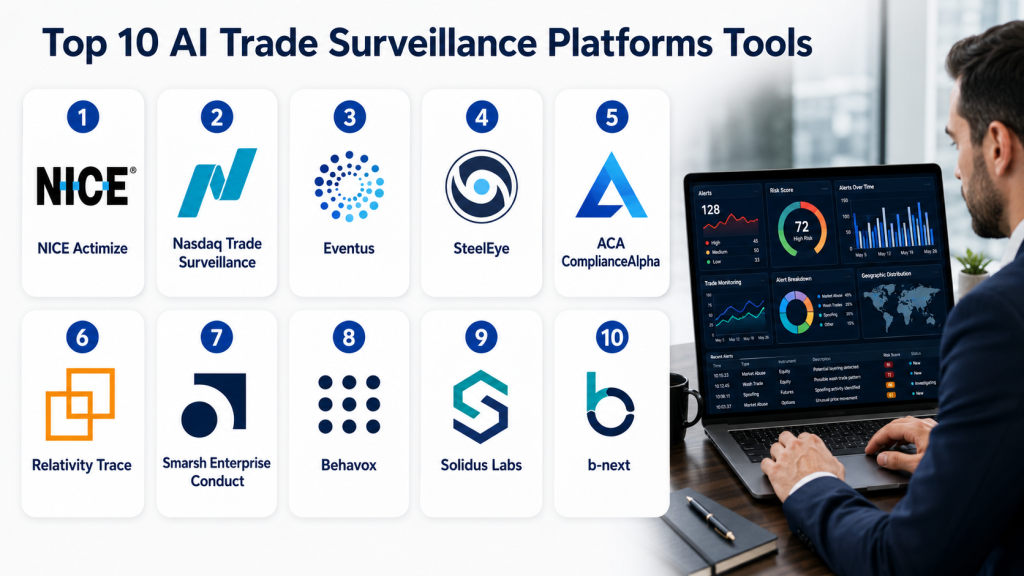
Top 10 AI Trade Surveillance Platforms Tools
1- NICE Actimize
One-line verdict: Best for large financial institutions needing enterprise trade surveillance and financial crime workflows.
Short description:
NICE Actimize provides trade surveillance, communications surveillance, financial crime, fraud, and compliance solutions for large financial institutions. Its surveillance capabilities support market abuse detection, alert management, case workflows, and regulatory investigation needs.
Standout Capabilities
- Enterprise trade surveillance for regulated financial firms
- Market abuse detection across trading behaviors
- Alert generation and investigation workflows
- Case management for compliance teams
- Support for communications and conduct risk workflows
- Strong fit for large banks and broker-dealers
- Helps connect surveillance with broader financial crime operations
- Supports complex compliance review processes
AI-Specific Depth
- Model support: Proprietary analytics, machine learning, and scenario-based detection vary by product
- RAG and knowledge integration: Not applicable for standard trade surveillance
- Evaluation: Alert performance, scenario tuning, and model monitoring vary by deployment
- Guardrails: Surveillance rules, alert workflows, approvals, investigation controls, and audit trails
- Observability: Alert dashboards, investigation history, analyst activity, risk reporting, and workflow visibility
Pros
- Strong enterprise surveillance coverage
- Suitable for complex regulated institutions
- Useful for connecting trade surveillance with conduct and financial crime workflows
Cons
- May be too complex for smaller trading firms
- Implementation can require significant planning
- Exact pricing is not publicly stated
Security & Compliance
Security and compliance controls should be verified directly. Buyers should confirm SSO, RBAC, audit logs, encryption, data retention, data residency, investigation history, and model governance support. Certifications are not publicly stated here.
Deployment & Platforms
- Cloud and enterprise deployment options may vary
- Web-based analyst and administrator interface
- API and data integration workflows
- Self-hosted or hybrid availability should be verified
Integrations & Ecosystem
NICE Actimize fits into trade surveillance, communications surveillance, risk, and regulatory operations ecosystems.
- Order management systems
- Execution management systems
- Trade data warehouses
- Communications surveillance systems
- Case management workflows
- Market data feeds
- Regulatory reporting workflows
Pricing Model
Pricing is typically enterprise contract-based. Exact pricing is not publicly stated.
Best-Fit Scenarios
- Investment banks monitoring complex trading activity
- Broker-dealers needing enterprise surveillance workflows
- Compliance teams connecting trade and communication surveillance
2- Nasdaq Trade Surveillance
One-line verdict: Best for exchanges, marketplaces, and trading firms needing market surveillance depth.
Short description:
Nasdaq Trade Surveillance supports market abuse monitoring, alerting, investigation, and surveillance workflows for exchanges, regulators, broker-dealers, and trading firms. It is designed to help teams detect suspicious activity across markets, participants, and instruments.
Standout Capabilities
- Market surveillance for exchanges and trading venues
- Detection of market manipulation and suspicious patterns
- Alert generation and investigation workflows
- Support for multiple market abuse typologies
- Strong exchange and capital markets heritage
- Useful for regulated trading environments
- Monitoring across orders, trades, and market behavior
- Supports operational visibility for surveillance teams
AI-Specific Depth
- Model support: Analytics, machine learning, and surveillance models vary by product
- RAG and knowledge integration: Not applicable
- Evaluation: Scenario testing, alert review, and model performance analysis vary
- Guardrails: Surveillance rules, alert review controls, escalation workflows, and audit trails
- Observability: Alert dashboards, market event views, case history, and surveillance analytics
Pros
- Strong market surveillance expertise
- Good fit for exchanges and trading venues
- Supports multiple market abuse detection workflows
Cons
- May be more specialized than smaller firms need
- Implementation depends on trading data quality
- Exact pricing is not publicly stated
Security & Compliance
Security and compliance controls should be verified directly. Buyers should confirm SSO, RBAC, audit logs, encryption, retention, residency, case history, and regulatory workflow support. Certifications are not publicly stated here.
Deployment & Platforms
- Cloud and enterprise deployment options may vary
- Web-based surveillance interface
- API and market data integration support
- Self-hosted or hybrid availability should be verified
Integrations & Ecosystem
Nasdaq Trade Surveillance connects trading data, market data, alerts, and investigation workflows.
- Trading venue data
- Order and execution feeds
- Market data feeds
- Broker-dealer systems
- Case management workflows
- Regulatory reporting processes
- Data analytics environments
Pricing Model
Pricing is typically enterprise contract-based. Exact pricing is not publicly stated.
Best-Fit Scenarios
- Exchanges monitoring market activity
- Broker-dealers needing market conduct surveillance
- Trading venues detecting manipulation patterns
3- Eventus
One-line verdict: Best for broker-dealers and trading firms needing flexible trade surveillance across asset classes.
Short description:
Eventus provides trade surveillance and market risk monitoring technology for broker-dealers, exchanges, FCMs, proprietary trading firms, and digital asset platforms. Its platform supports surveillance alerts, investigation workflows, and compliance monitoring across multiple asset classes.
Standout Capabilities
- Trade surveillance across multiple asset classes
- Detection for spoofing, layering, wash trading, and manipulation patterns
- Flexible rule and scenario configuration
- Case management and alert review workflows
- Strong fit for broker-dealers and trading firms
- Support for digital asset and traditional market environments
- Scalable surveillance for high-volume trading data
- Useful for compliance teams needing practical alert workflows
AI-Specific Depth
- Model support: Analytics and surveillance models vary by deployment
- RAG and knowledge integration: Not applicable
- Evaluation: Scenario tuning, alert review, and performance analytics vary
- Guardrails: Rules, thresholds, workflow controls, escalation paths, and audit trails
- Observability: Alert dashboards, order and trade views, investigation timelines, and analyst workflow reporting
Pros
- Strong fit for trading firms and broker-dealers
- Flexible surveillance configuration
- Useful across traditional and digital asset environments
Cons
- AI depth should be verified for specific use cases
- Requires clean and complete order and execution data
- Pricing is not publicly stated
Security & Compliance
Security and compliance details should be verified directly. Buyers should confirm SSO, RBAC, audit logs, encryption, retention, residency, and surveillance audit requirements. Certifications are not publicly stated here.
Deployment & Platforms
- Cloud and enterprise deployment options may vary
- Web-based surveillance platform
- API and data feed integrations
- Self-hosted or hybrid availability should be verified
Integrations & Ecosystem
Eventus fits into trading, compliance, market risk, and digital asset surveillance workflows.
- Order management systems
- Execution management systems
- Exchange feeds
- Broker-dealer systems
- Crypto exchange data
- Case management workflows
- Market data systems
Pricing Model
Pricing is typically contract-based and depends on scope and volume. Exact pricing is not publicly stated.
Best-Fit Scenarios
- Broker-dealers monitoring market abuse
- Trading firms needing flexible surveillance scenarios
- Crypto platforms adding market conduct controls
4- SteelEye
One-line verdict: Best for financial firms needing trade surveillance, communications oversight, and regulatory data management.
Short description:
SteelEye provides compliance technology for trade surveillance, communications surveillance, transaction reporting, record keeping, and regulatory data management. It is suitable for financial services firms that want a unified compliance data platform.
Standout Capabilities
- Trade surveillance and alerting workflows
- Communications surveillance support
- Regulatory data and record keeping capabilities
- Transaction reporting support
- Unified compliance data management
- Useful for broker-dealers, asset managers, and financial firms
- Helps connect trade activity with communication context
- Strong fit for compliance teams wanting broader oversight
AI-Specific Depth
- Model support: Analytics and AI-assisted surveillance capabilities vary by module
- RAG and knowledge integration: Not applicable
- Evaluation: Alert performance, communication review, and workflow analytics vary
- Guardrails: Rules, review workflows, escalation logic, and audit controls
- Observability: Surveillance dashboards, evidence timelines, communication review views, and reporting analytics
Pros
- Broad compliance platform coverage
- Connects trade surveillance with communications and records
- Good fit for firms needing regulatory data oversight
Cons
- May be broader than firms needing only trade alerts
- AI depth should be verified by module
- Exact pricing is not publicly stated
Security & Compliance
Security and compliance controls should be verified directly. Buyers should confirm SSO, RBAC, audit logs, encryption, retention, data residency, record keeping, and regulatory archive controls. Certifications are not publicly stated here.
Deployment & Platforms
- Cloud-based platform
- Web-based compliance interface
- API and data integration options
- Self-hosted deployment is not publicly stated
Integrations & Ecosystem
SteelEye integrates with trading, communication, reporting, and compliance data systems.
- OMS and EMS platforms
- Trade data feeds
- Communication archives
- Regulatory reporting systems
- Market data sources
- Case management workflows
- Record keeping systems
Pricing Model
Pricing is typically subscription or contract-based. Exact pricing is not publicly stated.
Best-Fit Scenarios
- Financial firms unifying trade and communication surveillance
- Compliance teams managing regulatory data
- Broker-dealers needing surveillance and reporting workflows
5- ACA ComplianceAlpha
One-line verdict: Best for investment advisers and asset managers needing compliance surveillance and oversight workflows.
Short description:
ACA ComplianceAlpha provides compliance technology and services for investment advisers, private funds, broker-dealers, and asset managers. It supports surveillance, compliance monitoring, risk assessments, personal trading reviews, and regulatory workflow management.
Standout Capabilities
- Compliance surveillance and monitoring workflows
- Personal trading and employee compliance support
- Risk assessment and compliance program management
- Alerts and workflow management for compliance teams
- Useful for asset managers and investment advisers
- Supports conduct and regulatory oversight processes
- Combines technology with compliance expertise
- Helps centralize compliance evidence and review activity
AI-Specific Depth
- Model support: Analytics and automation capabilities vary by module
- RAG and knowledge integration: Not applicable
- Evaluation: Alert review and compliance workflow analytics vary
- Guardrails: Policies, approvals, restricted lists, review workflows, and audit logs
- Observability: Compliance dashboards, review history, policy exceptions, and workflow reporting
Pros
- Strong fit for asset management compliance teams
- Useful for personal trading and employee conduct oversight
- Combines platform capabilities with compliance knowledge
Cons
- Less focused on exchange-level market surveillance
- AI depth should be verified for trade surveillance needs
- Pricing is not publicly stated
Security & Compliance
Security and compliance capabilities should be verified directly. Buyers should confirm SSO, RBAC, audit logs, encryption, retention, residency, and regulatory evidence management controls. Certifications are not publicly stated here.
Deployment & Platforms
- Cloud-based compliance platform
- Web-based workflows
- Data integrations vary by module
- Self-hosted deployment is not publicly stated
Integrations & Ecosystem
ACA ComplianceAlpha fits into compliance program management and investment advisory workflows.
- Portfolio and trading systems
- Employee trading systems
- Restricted list workflows
- Compliance calendars
- Document and evidence workflows
- Risk assessment processes
- Regulatory review workflows
Pricing Model
Pricing is typically contract-based. Exact pricing is not publicly stated.
Best-Fit Scenarios
- Asset managers managing employee trading reviews
- Investment advisers centralizing compliance workflows
- Compliance teams needing policy and surveillance oversight
6- Relativity Trace
One-line verdict: Best for firms needing AI-assisted communications surveillance connected to trade investigations.
Short description:
Relativity Trace focuses on communications surveillance and compliance monitoring. While it is not a pure trade surveillance platform, it is valuable for firms that need to detect risky messages, collusion signals, insider behavior, and misconduct indicators connected to trading investigations.
Standout Capabilities
- AI-assisted communications surveillance
- Detection of risky language and misconduct signals
- Review workflows for compliance teams
- Supports email, chat, and collaboration channels depending on setup
- Useful for trade-related investigation context
- Helps reduce manual communication review workload
- Case and review workflow support
- Strong fit where communication evidence matters
AI-Specific Depth
- Model support: AI and analytics for communications surveillance
- RAG and knowledge integration: Not applicable for standard trade surveillance
- Evaluation: Review quality and alert performance analytics vary
- Guardrails: Review policies, escalation controls, lexicons, and audit workflows
- Observability: Communication alerts, review queues, case history, and analyst activity reporting
Pros
- Strong communications surveillance focus
- Useful for insider trading and conduct investigations
- Helps connect communication risk with compliance review
Cons
- Not a full trade order surveillance platform
- Needs trade data context from other systems
- Exact pricing is not publicly stated
Security & Compliance
Security and compliance controls should be verified directly. Buyers should confirm SSO, RBAC, audit logs, encryption, retention, legal hold, data residency, and communication archive controls. Certifications are not publicly stated here.
Deployment & Platforms
- Cloud-based platform
- Web-based review interface
- Communication data integrations
- Self-hosted deployment is not publicly stated
Integrations & Ecosystem
Relativity Trace fits into communications compliance and investigation workflows.
- Email systems
- Chat and collaboration platforms
- Communication archives
- Case review workflows
- Compliance investigation systems
- Legal and eDiscovery workflows
- Trade investigation processes
Pricing Model
Pricing is typically subscription or enterprise contract-based. Exact pricing is not publicly stated.
Best-Fit Scenarios
- Firms monitoring trader communications
- Compliance teams investigating insider trading indicators
- Organizations combining communication review with trade surveillance
7- Smarsh Enterprise Conduct
One-line verdict: Best for firms needing communications intelligence and conduct surveillance across regulated channels.
Short description:
Smarsh Enterprise Conduct supports communications capture, archiving, surveillance, review, and conduct risk management for regulated firms. It is useful for organizations that need to monitor employee communications and connect behavior signals to compliance investigations.
Standout Capabilities
- Communications surveillance and conduct monitoring
- Capture and archive support for regulated channels
- Review workflows and escalation controls
- Risk detection across employee messages
- Useful for financial services compliance teams
- Supports investigation and evidence management
- Helps identify misconduct and policy violations
- Can complement trade surveillance platforms
AI-Specific Depth
- Model support: AI and analytics capabilities for communication surveillance vary by product
- RAG and knowledge integration: Not applicable
- Evaluation: Alert quality and review performance analytics vary
- Guardrails: Communication policies, supervision workflows, escalation controls, and audit trails
- Observability: Review dashboards, communication alerts, case activity, and supervision reporting
Pros
- Strong communications compliance ecosystem
- Useful for conduct risk and employee supervision
- Supports regulated communication channels
Cons
- Not a standalone trade order surveillance engine
- Needs integration with trading context for full market abuse investigations
- Exact pricing is not publicly stated
Security & Compliance
Security and compliance features should be verified directly. Buyers should confirm SSO, RBAC, audit logs, encryption, retention, legal hold, data residency, and archive controls. Certifications are not publicly stated here.
Deployment & Platforms
- Cloud-based platform
- Web-based review and supervision workflows
- Communication archive integrations
- Self-hosted deployment is not publicly stated
Integrations & Ecosystem
Smarsh fits into regulated communications, supervision, archiving, and investigation workflows.
- Email and chat platforms
- Collaboration tools
- Mobile communication channels
- Communication archives
- Compliance review workflows
- Case management systems
- Investigation workflows
Pricing Model
Pricing is typically enterprise or subscription-based. Exact pricing is not publicly stated.
Best-Fit Scenarios
- Broker-dealers supervising employee communications
- Compliance teams reviewing conduct risk
- Firms needing communication archives and surveillance together
8- Behavox
One-line verdict: Best for firms using AI to detect misconduct across communications and employee behavior.
Short description:
Behavox provides AI-driven surveillance and compliance technology focused on employee communications, conduct risk, and insider threat indicators. It is useful for financial firms that want to identify suspicious behavior, risky language, collusion, and potential misconduct.
Standout Capabilities
- AI-driven communications and conduct surveillance
- Detection of risky behavior and misconduct indicators
- Support for insider threat and compliance investigations
- Review workflows for compliance analysts
- Useful for large financial services organizations
- Behavioral analytics across communication data
- Helps prioritize high-risk alerts
- Can support trade investigation context when combined with trade data
AI-Specific Depth
- Model support: Proprietary AI and behavioral analytics models
- RAG and knowledge integration: Not applicable
- Evaluation: Alert review and model performance analytics vary
- Guardrails: Conduct policies, escalation workflows, review controls, and audit trails
- Observability: Communication risk dashboards, alert review, investigation timelines, and behavior analytics
Pros
- Strong AI focus for conduct and communication surveillance
- Useful for insider threat and misconduct monitoring
- Helps prioritize risky behavior for review
Cons
- Not a complete order and execution surveillance platform by itself
- Requires strong governance for employee monitoring
- Pricing is not publicly stated
Security & Compliance
Security and compliance controls should be verified directly. Buyers should confirm SSO, RBAC, audit logs, encryption, retention, legal review controls, data residency, and employee monitoring governance. Certifications are not publicly stated here.
Deployment & Platforms
- Cloud and enterprise deployment options may vary
- Web-based review and investigation workflows
- Communication data integrations
- Self-hosted availability should be verified
Integrations & Ecosystem
Behavox fits into communications surveillance, conduct risk, and investigation ecosystems.
- Email systems
- Chat platforms
- Collaboration tools
- Communication archives
- Compliance review workflows
- Investigation tools
- Trade surveillance context systems
Pricing Model
Pricing is typically enterprise contract-based. Exact pricing is not publicly stated.
Best-Fit Scenarios
- Financial firms detecting employee misconduct
- Compliance teams reviewing risky communications
- Institutions connecting communication behavior with trade investigations
9- Solidus Labs
One-line verdict: Best for crypto exchanges and digital asset firms needing market integrity surveillance.
Short description:
Solidus Labs provides market integrity, trade surveillance, and risk monitoring tools for digital asset businesses, crypto exchanges, brokerages, and financial institutions entering digital assets. It helps detect market manipulation, abusive trading, and suspicious activity in digital asset markets.
Standout Capabilities
- Crypto and digital asset trade surveillance
- Market manipulation detection for digital asset markets
- Monitoring for wash trading, spoofing, and abusive behavior
- Risk and market integrity workflows
- Useful for exchanges, brokerages, and digital asset platforms
- Alert review and investigation support
- Designed for fast-moving crypto trading environments
- Helps support market integrity and compliance controls
AI-Specific Depth
- Model support: Analytics and AI capabilities vary by product
- RAG and knowledge integration: Not applicable
- Evaluation: Alert quality and surveillance performance analytics vary
- Guardrails: Surveillance rules, risk thresholds, case workflows, and audit controls
- Observability: Alert dashboards, trading pattern views, investigation workflows, and market integrity reporting
Pros
- Strong digital asset surveillance focus
- Useful for crypto-specific market manipulation patterns
- Good fit for exchanges and digital asset platforms
Cons
- Less suited for traditional securities firms unless digital assets are in scope
- AI depth should be verified by use case
- Pricing is not publicly stated
Security & Compliance
Security and compliance capabilities should be verified directly. Buyers should confirm SSO, RBAC, audit logs, encryption, retention, data residency, case history, and regulatory workflow support. Certifications are not publicly stated here.
Deployment & Platforms
- Cloud-based platform
- Web-based surveillance workflows
- API and trading data integrations
- Self-hosted deployment is not publicly stated
Integrations & Ecosystem
Solidus Labs fits into crypto trading, exchange, brokerage, and digital asset market integrity workflows.
- Crypto exchange data
- Order and execution feeds
- Market data feeds
- Broker and trading platforms
- Case management workflows
- Compliance reporting systems
- Risk monitoring tools
Pricing Model
Pricing is typically enterprise or contract-based. Exact pricing is not publicly stated.
Best-Fit Scenarios
- Crypto exchanges monitoring manipulation risk
- Digital asset brokerages building market integrity controls
- Financial institutions expanding into digital asset trading
10- b-next
One-line verdict: Best for financial firms needing modular trade surveillance and market abuse monitoring.
Short description:
b-next provides capital markets compliance and trade surveillance solutions for financial institutions. Its surveillance capabilities support market abuse monitoring, regulatory compliance, alert management, and investigation workflows across trading activity.
Standout Capabilities
- Trade surveillance and market abuse monitoring
- Modular compliance platform approach
- Alert generation and investigation workflows
- Support for multiple market abuse scenarios
- Useful for banks, brokers, and financial institutions
- Configurable surveillance controls
- Compliance review and escalation workflows
- Helps teams manage trading risk and market conduct obligations
AI-Specific Depth
- Model support: Analytics and AI capabilities vary by module
- RAG and knowledge integration: Not applicable
- Evaluation: Scenario performance and alert review analytics vary
- Guardrails: Surveillance rules, workflow approvals, escalation controls, and audit history
- Observability: Alert dashboards, case status, trading event views, and compliance reporting
Pros
- Trade surveillance-focused platform
- Useful for modular compliance needs
- Supports market abuse monitoring workflows
Cons
- AI depth should be verified during evaluation
- Integration quality depends on trade data availability
- Exact pricing is not publicly stated
Security & Compliance
Security and compliance capabilities should be verified directly. Buyers should confirm SSO, RBAC, audit logs, encryption, data retention, data residency, and investigation audit controls. Certifications are not publicly stated here.
Deployment & Platforms
- Cloud and enterprise deployment options may vary
- Web-based surveillance interface
- API and trade data integrations
- Self-hosted or hybrid availability should be verified
Integrations & Ecosystem
b-next fits into capital markets compliance, trade surveillance, and regulatory monitoring workflows.
- Order management systems
- Execution management systems
- Trade repositories
- Market data feeds
- Compliance case workflows
- Regulatory reporting systems
- Internal risk systems
Pricing Model
Pricing is typically contract-based. Exact pricing is not publicly stated.
Best-Fit Scenarios
- Financial firms needing modular trade surveillance
- Broker-dealers monitoring market abuse risk
- Compliance teams improving alert and investigation workflows
Comparison Table
| Tool Name | Best For | Deployment | Model Flexibility | Strength | Watch-Out | Public Rating |
|---|---|---|---|---|---|---|
| NICE Actimize | Enterprise trade surveillance | Cloud or varies | Proprietary analytics and scenarios | Enterprise surveillance depth | Complex implementation | N/A |
| Nasdaq Trade Surveillance | Exchanges and trading venues | Cloud or varies | Analytics and ML vary | Market surveillance heritage | Specialized focus | N/A |
| Eventus | Broker-dealers and trading firms | Cloud or varies | Analytics varies | Flexible cross-asset surveillance | Needs clean trade data | N/A |
| SteelEye | Trade and communications oversight | Cloud | AI-assisted modules vary | Unified compliance data | Broader than trade alerts | N/A |
| ACA ComplianceAlpha | Asset manager compliance | Cloud | Analytics varies | Compliance workflow depth | Less exchange-level surveillance | N/A |
| Relativity Trace | Communications surveillance | Cloud | AI communication analytics | Message risk detection | Not full trade surveillance | N/A |
| Smarsh Enterprise Conduct | Communications and conduct risk | Cloud | AI capabilities vary | Regulated channel supervision | Needs trading context | N/A |
| Behavox | AI conduct surveillance | Cloud or varies | Proprietary AI analytics | Behavioral risk detection | Employee monitoring governance needed | N/A |
| Solidus Labs | Crypto market surveillance | Cloud | Analytics and AI vary | Digital asset market integrity | Crypto-focused | N/A |
| b-next | Modular trade surveillance | Cloud or varies | Analytics vary | Market abuse monitoring | AI depth should be verified | N/A |
Scoring and Evaluation
The scoring below is a comparative editorial rubric, not a lab benchmark or public rating. Scores reflect trade surveillance relevance, AI and analytics depth, market abuse coverage, workflow quality, integration value, governance support, explainability, and practical usefulness for compliance teams. Final selection should depend on asset classes, trade volume, regulatory obligations, data quality, investigation needs, and compliance team maturity.
| Tool | Core | Reliability and Eval | Guardrails | Integrations | Ease | Performance and Cost | Security and Admin | Support | Weighted Total |
|---|---|---|---|---|---|---|---|---|---|
| NICE Actimize | 9 | 9 | 9 | 9 | 6 | 8 | 9 | 9 | 8.55 |
| Nasdaq Trade Surveillance | 9 | 8 | 9 | 8 | 7 | 8 | 8 | 8 | 8.25 |
| Eventus | 9 | 8 | 8 | 8 | 8 | 8 | 8 | 8 | 8.20 |
| SteelEye | 8 | 8 | 8 | 8 | 8 | 8 | 8 | 8 | 8.00 |
| ACA ComplianceAlpha | 7 | 7 | 8 | 7 | 8 | 7 | 8 | 8 | 7.40 |
| Relativity Trace | 7 | 8 | 8 | 7 | 8 | 7 | 8 | 8 | 7.55 |
| Smarsh Enterprise Conduct | 7 | 8 | 8 | 8 | 7 | 7 | 8 | 8 | 7.60 |
| Behavox | 7 | 8 | 8 | 7 | 7 | 7 | 8 | 7 | 7.35 |
| Solidus Labs | 8 | 8 | 8 | 8 | 8 | 8 | 8 | 7 | 7.95 |
| b-next | 8 | 7 | 8 | 8 | 7 | 7 | 8 | 7 | 7.55 |
Top 3 for Enterprise
- NICE Actimize
- Nasdaq Trade Surveillance
- Eventus
Top 3 for SMB
- SteelEye
- Eventus
- ACA ComplianceAlpha
Top 3 for Developers
- Eventus
- SteelEye
- Solidus Labs
Which AI Trade Surveillance Platform Is Right for You
Solo or Freelancer
Solo professionals usually do not need a full AI trade surveillance platform unless they are building a regulated brokerage, trading venue, crypto exchange, or compliance technology product. For early-stage planning, focus first on trade data capture, restricted list controls, employee trading policy, and basic compliance documentation. Once trading volume grows, a specialized platform becomes more important.
SMB
Small and mid-sized firms should prioritize ease of implementation, clear workflows, manageable alert volumes, and practical pricing. SteelEye can be useful for firms needing trade surveillance and regulatory data workflows. Eventus is strong for trading firms and broker-dealers needing flexible monitoring. ACA ComplianceAlpha may fit investment advisers and asset managers focused on broader compliance oversight.
Mid-Market
Mid-market firms usually need stronger scenario coverage, case management, communication context, and data integrations. Eventus, SteelEye, b-next, and Nasdaq Trade Surveillance are strong candidates depending on trading activity and asset class coverage. Firms with heavy communications risk should also evaluate Relativity Trace, Smarsh Enterprise Conduct, or Behavox as complementary tools.
Enterprise
Enterprise buyers should prioritize scalability, cross-asset coverage, data lineage, case management, auditability, communications integration, and regulatory reporting. NICE Actimize, Nasdaq Trade Surveillance, Eventus, SteelEye, and b-next are strong enterprise options. Large banks may prefer platforms that connect trade surveillance with broader conduct risk and financial crime workflows.
Regulated Industries
Broker-dealers, exchanges, asset managers, investment banks, hedge funds, proprietary trading firms, and crypto exchanges should treat surveillance as a governed compliance function. They should prioritize audit trails, scenario documentation, alert explanations, model validation, access controls, evidence retention, and escalation workflows. Communication surveillance should be connected where insider trading and collusion risk are important.
Budget vs Premium
Budget-conscious firms should start with focused surveillance coverage for their highest-risk products and venues. SteelEye, ACA ComplianceAlpha, or b-next may be practical depending on use case. Premium buyers should evaluate NICE Actimize, Nasdaq Trade Surveillance, Eventus, and advanced communications surveillance tools when trading complexity, regulatory exposure, and alert volume justify deeper investment.
Build vs Buy
Build internally only when you have strong compliance expertise, trading data engineering, market abuse typology knowledge, case management design, and model validation capability. Buy when you need proven scenarios, faster deployment, investigation workflows, audit trails, and vendor expertise. Many mature firms use a hybrid model by combining vendor surveillance tools with internal analytics and compliance policies.
Implementation Playbook
First Phase: Pilot and Success Metrics
- Define the surveillance scope clearly.
- Select one asset class, desk, venue, or trading activity for the pilot.
- Run alerts in shadow mode before changing compliance workflows.
- Capture baseline metrics such as alert volume, false positives, review time, escalation rate, case closure time, and analyst workload.
- Map required data sources such as orders, executions, cancellations, amendments, market data, trader IDs, account IDs, restricted lists, and communications.
- Define market abuse scenarios such as spoofing, layering, wash trading, front-running, insider trading, and suspicious trading around news.
- Create alert severity levels and escalation rules.
- Confirm retention, privacy, access control, and audit requirements before production use.
Second Phase: Security, Evaluation, and Rollout
- Integrate the platform with OMS, EMS, trade repositories, market data feeds, compliance systems, and communications archives.
- Add role-based access for analysts, supervisors, compliance officers, legal teams, and administrators.
- Configure scenarios, thresholds, trader groups, asset classes, and restricted lists.
- Build investigation workflows for review, escalation, closure, and evidence retention.
- Test alert quality using historical cases and known false positives.
- Add feedback loops from analyst reviews, escalations, and confirmed misconduct findings.
- Review model behavior and scenario logic with compliance leadership.
- Train analysts on alert explanations, evidence timelines, and case documentation.
Third Phase: Optimization and Scale
- Monitor alert volume, false positives, case backlog, review time, and escalation quality.
- Tune thresholds by asset class, venue, trader behavior, product type, and risk segment.
- Expand surveillance to additional desks, venues, instruments, and communication channels.
- Add dashboards for surveillance leaders, compliance teams, and audit reviewers.
- Review changes in trading behavior and market conditions.
- Compare AI-generated alerts with investigator outcomes.
- Improve entity linking by connecting trader, account, desk, counterparty, and beneficial owner data.
- Schedule regular governance reviews for scenarios, models, thresholds, and case procedures.
Common Mistakes and How to Avoid Them
- Relying only on static rules without behavior analysis
- Creating too many alerts without prioritization
- Ignoring communications linked to suspicious trading
- Not capturing complete order lifecycle data
- Missing cancellations and amendments in surveillance logic
- Treating all desks, products, and venues the same
- Failing to maintain complete case audit history
- Not tuning scenarios after implementation
- Ignoring cross-asset and cross-market manipulation patterns
- Deploying AI alerts without validation and governance
- Not training analysts on alert evidence and explanations
- Separating trade surveillance from conduct risk workflows
- Ignoring crypto or digital asset activity where relevant
- Not testing historical market abuse scenarios
- Choosing a tool before defining surveillance typologies
FAQs
1- What is an AI Trade Surveillance Platform?
An AI Trade Surveillance Platform monitors trading activity, orders, executions, cancellations, and related behavior to detect suspicious market conduct. It helps compliance teams identify possible market manipulation, insider trading, spoofing, layering, and other abuse patterns.
2- How is AI trade surveillance different from rule-based surveillance?
Rule-based surveillance uses fixed scenarios and thresholds. AI trade surveillance can analyze behavior patterns, detect anomalies, prioritize alerts, and connect related activities across traders, accounts, instruments, and communication channels.
3- Can AI reduce false positives in trade surveillance?
Yes, AI can help reduce false positives by ranking alert quality, learning normal behavior patterns, adding context, and improving prioritization. However, human review and scenario governance are still required.
4- Does AI replace trade surveillance analysts?
No. AI supports analysts by surfacing better alerts, organizing evidence, and reducing repetitive review work. Analysts remain essential for investigation, escalation, regulatory judgment, and case closure.
5- What trading behaviors can these platforms detect?
They may detect spoofing, layering, wash trading, front-running, insider trading, quote stuffing, marking the close, circular trading, restricted list violations, and suspicious trading around news or events.
6- What data is needed for trade surveillance?
Common data includes orders, executions, cancellations, amendments, timestamps, trader IDs, account IDs, desk information, market data, instrument data, counterparty data, restricted lists, and communication records.
7- Is communications surveillance necessary with trade surveillance?
For many firms, yes. Insider trading, collusion, front-running, and misconduct often involve communication evidence. Connecting messages with trading activity can improve investigations.
8- Can these platforms monitor crypto trading?
Some platforms support crypto and digital asset surveillance. Crypto firms should verify support for order book data, exchange integrations, wash trading detection, market manipulation scenarios, and digital asset compliance workflows.
9- What is spoofing in trade surveillance?
Spoofing involves placing orders with the intent to cancel them before execution to create a false market impression. Surveillance platforms monitor order placement, cancellation behavior, and market impact to detect this pattern.
10- What is layering?
Layering is a form of market manipulation where multiple orders are placed at different price levels to influence market perception and then canceled. Trade surveillance tools monitor order patterns to identify potential layering behavior.
11- How should firms evaluate surveillance performance?
Firms should measure alert quality, false positive rate, review time, escalation rate, case outcomes, scenario effectiveness, analyst workload, and regulatory audit readiness.
12- What is model governance in trade surveillance?
Model governance means documenting, validating, monitoring, and controlling AI or analytics models used for surveillance. It includes scenario reviews, threshold changes, performance tracking, and audit evidence.
13- Can small firms use AI trade surveillance tools?
Yes, but small firms should choose tools that match trading volume, asset classes, and compliance maturity. A focused platform is often better than a large enterprise system.
14- What is the biggest risk with trade surveillance automation?
The biggest risk is trusting automated alerts without governance. Firms must validate scenarios, document decisions, maintain audit trails, monitor false positives, and ensure analysts understand why alerts are generated.
Conclusion
AI Trade Surveillance Platforms help financial firms detect suspicious market behavior, reduce false positives, improve investigation speed, and strengthen market conduct compliance. The best platform depends on your asset classes, trading volume, regulatory obligations, communication channels, data quality, and surveillance team maturity. NICE Actimize is strong for enterprise financial institutions, Nasdaq Trade Surveillance fits exchanges and trading venues, Eventus is strong for broker-dealers and multi-asset trading firms, SteelEye connects surveillance with regulatory data and communications, ACA ComplianceAlpha fits asset manager compliance workflows, Relativity Trace and Smarsh support communications surveillance, Behavox focuses on AI-driven conduct risk, Solidus Labs supports digital asset market integrity, and b-next provides modular trade surveillance. Start by defining surveillance typologies, pilot one asset class or desk, validate alert quality, verify audit controls, then scale with analyst feedback, governance reviews, and continuous scenario tuning.

Find Trusted Cardiac Hospitals
Compare heart hospitals by city and services — all in one place.
Explore Hospitals
What’s missing here is the real operational burden behind trade surveillance systems—especially alert fatigue from high false-positive rates and the ongoing effort needed to tune detection rules as trading patterns evolve. Also not covered is how teams handle the end-to-end investigation workflow, where data is often fragmented across OMS, communications, and market feeds, making case resolution slower than the detection itself.