
Introduction
Choosing the right DevOps certification can feel confusing because the DevOps ecosystem is very broad. Some certifications focus on DevOps fundamentals, while others focus on Kubernetes, Docker, Terraform, cloud platforms, DevSecOps, SRE, GitOps, MLOps, observability, and automation. Therefore, learners often struggle to decide where to begin.
Many learners make the mistake of choosing a certification only because it looks popular. However, the best certification depends on your current skill level, your target role, your hands-on experience, and your long-term career goal. For example, a fresher should not directly jump into advanced Kubernetes without understanding Linux, Git, Docker, and CI/CD basics.
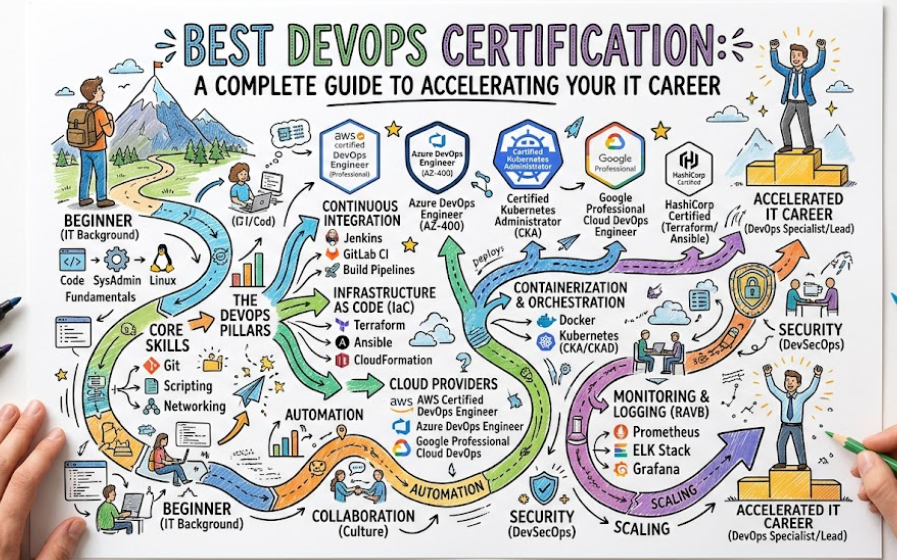
A good DevOps certification roadmap helps you move step by step. First, you build fundamentals. Then, you learn tools. After that, you move into cloud, containers, automation, security, reliability, and platform engineering. As a result, your certification journey becomes more practical and career-focused.
This guide uses the certification ecosystem from BestDevOps and DevOpsSchool as the base reference. The page includes certifications such as DevOps Certified Professional, DevSecOps Certified Professional, SRE Certified Professional, Master in DevOps Engineering, Master in Azure DevOps, AWS Certified DevOps Professional, Terraform Associate, CKA, Docker Certified Associate, GitOps Certified Professional, and more.
Why DevOps Certifications Matter
DevOps certifications matter because they give structure to your learning. Without structure, many learners watch random videos, practice random tools, and still feel confused during interviews or project work. A certification path gives you a clear direction.
Certifications also validate your skills. They show that you understand DevOps culture, automation, CI/CD, infrastructure, containers, cloud platforms, monitoring, and security practices. However, certification alone is not enough. You also need hands-on labs, projects, troubleshooting practice, and real deployment experience.
For working professionals, certifications help connect existing experience with modern DevOps practices. For example, a system administrator can move toward SRE by learning Linux automation, Kubernetes, observability, incident response, and reliability practices. Similarly, a cloud engineer can move toward DevOps by learning Terraform, CI/CD, Docker, Kubernetes, and cloud-native automation.
BestDevOps lists certification programs across several career tracks, including DevOps, DevSecOps, SRE, Azure DevOps, AWS DevOps, Terraform, Kubernetes, Docker, MLOps, Google Cloud DevOps, Prometheus with Grafana, and GitOps.
Who Should Read This Guide
This guide is useful for:
Freshers starting a DevOps career
Developers moving into DevOps engineering
System administrators planning a DevOps transition
Cloud engineers improving automation and delivery skills
Kubernetes engineers preparing for container orchestration roles
SRE and platform engineers building reliability skills
DevSecOps learners focused on secure delivery
Managers planning DevOps team upskilling
Data, AI, and ML professionals exploring MLOps and automation
DevOps Certification Categories
Foundation Certifications
Foundation certifications help beginners understand DevOps culture, SDLC, CI/CD, collaboration, automation, monitoring, and delivery workflows. These are best for freshers and early-career learners.
Tool-Based Certifications
Tool-based certifications focus on specific technologies such as Docker, Kubernetes, Terraform, Git, Jenkins, Linux, Prometheus, Grafana, and GitOps tools. These are best for learners who want practical job-ready skills.
Cloud DevOps Certifications
Cloud DevOps certifications focus on AWS, Azure, Google Cloud, cloud automation, infrastructure provisioning, cloud-native delivery, and managed Kubernetes platforms.
DevSecOps Certifications
DevSecOps certifications focus on secure pipelines, vulnerability scanning, secrets management, compliance, container security, supply chain security, and shift-left practices.
SRE and Platform Engineering Certifications
SRE and platform engineering certifications focus on reliability, observability, incident response, SLOs, SLIs, error budgets, automation, internal developer platforms, and production operations.
Advanced and Specialized Certifications
Advanced certifications include GitOps, MLOps, AIOps, FinOps, DataOps, AI, machine learning, deep learning, observability, and service mesh. These are best for professionals who want to specialize beyond core DevOps.
Best DevOps Certifications at a Glance
| Certification | Best For | Level | Main Skills | Career Scope |
|---|---|---|---|---|
| DevOps Certified Professional (DCP) | DevOps beginners and working engineers | Beginner to Mid | DevOps basics, CI/CD, automation, tools | Strong |
| DevSecOps Certified Professional (DSOCP) | Security-focused DevOps learners | Mid to Advanced | Secure pipelines, compliance, shift-left security | Strong |
| Site Reliability Engineering (SRE) Certified Professional | SRE and operations engineers | Advanced | Reliability, monitoring, incidents, automation | Strong |
| Master in DevOps Engineering (MDE) | Full-stack DevOps learners | Mid to Advanced | CI/CD, cloud, containers, IaC, security | Strong |
| Master in Azure DevOps | Azure cloud engineers | Mid to Advanced | Azure DevOps, pipelines, cloud delivery | Strong |
| AWS Certified DevOps Professional | AWS engineers | Advanced | AWS automation, deployment, monitoring | Strong |
| Master in Python Programming | Automation learners | Beginner to Mid | Python, scripting, automation | Good |
| Hashicorp Certified Terraform Associate | Cloud and IaC engineers | Mid | Terraform, IaC, cloud provisioning | Strong |
| Certified Kubernetes Administrator (CKA) | Kubernetes engineers | Advanced | Kubernetes clusters, workloads, troubleshooting | Strong |
| Docker Certified Associate (DCA) | Developers and admins | Beginner to Mid | Containers, images, registries | Good |
| Envoy ISTIO Certification Training | Service mesh engineers | Advanced | Istio, Envoy, traffic, security, telemetry | Good |
| MLOps Certification Training Course | ML and DevOps engineers | Mid to Advanced | ML pipelines, model deployment, monitoring | Strong |
| Google Cloud Professional Cloud DevOps Engineer | GCP cloud engineers | Advanced | GCP DevOps, SRE, CI/CD, Cloud Build | Strong |
| Master in Machine Learning | ML learners | Mid | ML concepts, models, data workflows | Good |
| Master in Artificial Intelligence | AI learners | Mid | AI, ML, deep learning basics | Good |
| Master in AppDynamics | APM and observability teams | Mid | APM, monitoring, dashboards, alerting | Good |
| Master in Data Science | Data professionals | Mid | Data analysis, ML, statistics | Good |
| Master in Deep Learning | AI and ML engineers | Advanced | Neural networks, deep learning models | Good |
| Prometheus with Grafana | Monitoring and SRE teams | Mid | Metrics, dashboards, alerting | Strong |
| GitOps Certified Professional (GOCP) | Platform and Kubernetes teams | Advanced | GitOps, Argo CD, Flux, Kubernetes delivery | Strong |
BestDevOps lists these 20 certifications with career scope ratings on its certification page.
Certification Deep Dive
DevOps Certified Professional (DCP)
What It Is
DevOps Certified Professional is a foundation-to-practical DevOps certification for learners who want to understand DevOps culture, CI/CD, automation, collaboration, and common DevOps tools. The BestDevOps page describes DCP as an essential course for building a DevOps foundation and mentions exposure to major DevOps toolsets.
Who Should Take It
Freshers, developers, system administrators, support engineers, release engineers, and anyone starting a DevOps career.
Best Career Fit
DevOps Engineer
Build and Release Engineer
Cloud Support Engineer
Automation Engineer
Difficulty Level
Beginner to Intermediate
Career Scope
Career Scope: Strong
Reason: It gives a broad DevOps foundation and helps learners understand the full delivery lifecycle.
Skills You Will Learn
DevOps culture
CI/CD concepts
Linux basics
Git workflows
Docker fundamentals
Kubernetes basics
Cloud and automation basics
Monitoring fundamentals
Tools and Technologies Covered
Linux, Git, Docker, Kubernetes, Jenkins, Terraform, cloud platforms, monitoring tools.
Exam or Assessment Details
Format: Varies by provider
Duration: Not publicly stated on the BestDevOps page
Passing score: Not publicly stated
Cost: Varies by provider
Validity: Not publicly stated
Study Roadmap
Step 1: Learn DevOps basics
Step 2: Practice Linux commands
Step 3: Learn Git and GitHub
Step 4: Build a basic CI/CD pipeline
Step 5: Learn Docker
Step 6: Learn Kubernetes basics
Step 7: Practice real labs
Real-World Use Case
This certification helps when a team wants to automate build, test, deployment, and monitoring workflows.
Pros
Good starting point
Broad DevOps coverage
Useful for beginners
Cons
May feel broad for advanced engineers
Requires hands-on practice beyond theory
Best Recommendation
Choose this if you are starting DevOps. Avoid starting here only if you already have strong DevOps project experience.
DevSecOps Certified Professional (DSOCP)
What It Is
DevSecOps Certified Professional focuses on integrating security into DevOps practices. The BestDevOps page explains that DevSecOps adds security into every phase of work and includes tools such as Ansible, Docker, Git, GitHub, Kubernetes, and Terraform.
Who Should Take It
DevOps engineers, security engineers, cloud engineers, release engineers, and teams responsible for secure software delivery.
Best Career Fit
DevSecOps Engineer
Security Automation Engineer
Cloud Security Engineer
Platform Security Engineer
Difficulty Level
Intermediate to Advanced
Career Scope
Career Scope: Strong
Reason: Modern engineering teams need secure pipelines, compliance automation, and shift-left security.
Skills You Will Learn
Secure CI/CD
SAST and DAST concepts
Container security
Secrets management
Compliance automation
Vulnerability scanning
Policy as code
Secure Kubernetes practices
Tools and Technologies Covered
Docker, Kubernetes, GitHub, Terraform, Ansible, security scanners, policy tools.
Exam or Assessment Details
Format: Varies by provider
Duration: Not publicly stated
Passing score: Not publicly stated
Cost: Varies by provider
Validity: Not publicly stated
Study Roadmap
Step 1: Learn DevOps basics
Step 2: Learn security fundamentals
Step 3: Practice secure CI/CD
Step 4: Add scanning tools into pipelines
Step 5: Learn container and Kubernetes security
Step 6: Practice policy as code
Step 7: Build a secure DevSecOps project
Real-World Use Case
This certification helps when organizations want to detect vulnerabilities early and reduce security risks before production release.
Pros
Strong security focus
Useful for enterprise teams
Good for DevOps career growth
Cons
Needs basic DevOps knowledge first
Can feel complex without hands-on security labs
Best Recommendation
Choose this if your target role involves secure delivery, cloud security, compliance, or DevSecOps pipelines.
Site Reliability Engineering (SRE) Certified Professional
What It Is
SRE Certified Professional focuses on reliability, monitoring, automation, incident response, capacity planning, SLIs, SLOs, and operational excellence. The BestDevOps page describes SRE as a software engineering approach for scalable and reliable systems.
Who Should Take It
Operations engineers, DevOps engineers, platform engineers, cloud engineers, and professionals moving toward reliability engineering.
Best Career Fit
SRE Engineer
Platform Engineer
Production Engineer
Reliability Engineer
Difficulty Level
Advanced
Career Scope
Career Scope: Strong
Reason: Companies need reliable systems, incident control, monitoring, and automation.
Skills You Will Learn
SLOs and SLIs
Monitoring and alerting
Incident response
Automation
Capacity planning
Change management
Reliability practices
Postmortem culture
Tools and Technologies Covered
Linux, Kubernetes, Prometheus, Grafana, cloud monitoring, incident tools, automation tools.
Exam or Assessment Details
Format: Varies by provider
Duration: Not publicly stated
Passing score: Not publicly stated
Cost: Varies by provider
Validity: Not publicly stated
Study Roadmap
Step 1: Strengthen Linux and networking
Step 2: Learn monitoring and metrics
Step 3: Understand SLOs and error budgets
Step 4: Practice Kubernetes operations
Step 5: Learn incident response
Step 6: Build dashboards and alerts
Step 7: Practice reliability scenarios
Real-World Use Case
This certification helps teams reduce downtime, improve service reliability, and build better incident management processes.
Pros
Strong role alignment
Useful for senior engineering paths
Practical for production systems
Cons
Not ideal for absolute beginners
Requires real operations understanding
Best Recommendation
Choose this if you want to work in SRE, platform engineering, or production reliability.
Certification Comparison Table
| Certification | Best For | Level | Main Focus | Difficulty | Career Scope | Recommended For |
|---|---|---|---|---|---|---|
| DevOps Certified Professional | Beginners | Beginner-Mid | DevOps basics | Medium | Strong | Freshers and junior engineers |
| DevSecOps Certified Professional | Security-focused teams | Mid-Advanced | Security automation | Hard | Strong | DevSecOps learners |
| SRE Certified Professional | Operations engineers | Advanced | Reliability | Hard | Strong | SRE and platform teams |
| Master in DevOps Engineering | DevOps career growth | Mid-Advanced | Complete DevOps | Hard | Strong | Working engineers |
| Master in Azure DevOps | Azure engineers | Mid-Advanced | Azure delivery | Medium | Strong | Azure cloud teams |
| AWS Certified DevOps Professional | AWS engineers | Advanced | AWS DevOps | Hard | Strong | AWS professionals |
| Terraform Associate | Cloud engineers | Mid | Infrastructure as Code | Medium | Strong | Automation engineers |
| CKA | Kubernetes engineers | Advanced | Kubernetes administration | Hard | Strong | Cloud-native engineers |
| Docker Certified Associate | Developers/Admins | Beginner-Mid | Containers | Medium | Good | App and infra teams |
| GitOps Certified Professional | Platform teams | Advanced | GitOps delivery | Hard | Strong | Kubernetes and platform teams |
DevOps Certification Roadmap
Beginner Path
Start with DevOps basics. Then learn Linux, Git, Docker, and CI/CD foundation. After that, choose DevOps Certified Professional or Docker Certified Associate.
Intermediate Path
Learn Jenkins, GitHub Actions, Kubernetes basics, Terraform, cloud fundamentals, monitoring basics, and infrastructure automation. Then choose Terraform Associate, Docker Certification, or Master in DevOps Engineering.
Advanced Path
Move into Kubernetes administration, cloud DevOps, DevSecOps, SRE, observability, GitOps, and production-grade automation. Then choose CKA, AWS Certified DevOps Professional, Google Cloud Professional Cloud DevOps Engineer, SRE Certified Professional, or DevSecOps Certified Professional.
Specialized Path
Specialize in GitOps, MLOps, AIOps, FinOps, DataOps, observability, service mesh, AI, machine learning, deep learning, and platform engineering.
Recommended Certification Path by Role
| Career Goal | Recommended Path |
|---|---|
| DevOps Beginner | DevOps Foundation → Linux → Git → Docker → CI/CD |
| DevOps Engineer | Docker → Jenkins/GitHub Actions → Kubernetes → Terraform → Cloud DevOps |
| Cloud Engineer | Cloud Foundation → Terraform → Kubernetes → Cloud DevOps Certification |
| Kubernetes Engineer | Docker → Kubernetes Basics → CKA → GitOps |
| DevSecOps Engineer | DevOps Basics → Security Basics → DevSecOps Certification |
| SRE Engineer | Linux → Kubernetes → Observability → SRE Certification |
| Platform Engineer | Kubernetes → Terraform → GitOps → Platform Engineering |
| MLOps Engineer | Python → ML Basics → Docker → Kubernetes → MLOps Certification |
| Monitoring Engineer | Linux → Metrics → Prometheus → Grafana → SRE Practices |
| AI/ML Engineer | Python → ML → Deep Learning → MLOps |
Real-World Career Scenarios
Scenario 1: Fresher Starting DevOps
A fresher should begin with Linux, Git, DevOps basics, Docker, and CI/CD. Starting directly with Kubernetes or advanced cloud certification can create confusion because Kubernetes assumes knowledge of containers, networking, YAML, and deployment concepts. Therefore, a fresher should first build fundamentals and then move toward advanced certifications.
Scenario 2: Cloud Engineer Moving to DevOps
A cloud engineer already understands cloud services, but DevOps work needs automation, CI/CD, containers, and infrastructure as code. Therefore, Terraform, Docker, Kubernetes, and cloud DevOps certifications can help cloud engineers become more delivery-focused and automation-ready.
Scenario 3: Operations Engineer Moving to SRE
An operations engineer usually understands servers, monitoring, and incidents. However, SRE adds automation, SLOs, error budgets, observability, and reliability engineering. Therefore, an operations engineer should learn Kubernetes operations, monitoring tools, incident response, and SRE principles.
Common Mistakes to Avoid
Choosing certification only because it is popular
Skipping hands-on labs
Ignoring Linux and networking basics
Starting Kubernetes too early
Collecting certificates without projects
Not matching certification with target role
Depending only on videos
Ignoring cloud and security fundamentals
Not building a portfolio
Not preparing for interview-style questions
Hands-On Projects to Build
Build a CI/CD pipeline
Containerize an application using Docker
Deploy an application on Kubernetes
Write Terraform code for cloud infrastructure
Set up Prometheus and Grafana monitoring
Create a GitOps deployment workflow
Build a secure DevSecOps pipeline
Automate server configuration
Create a Kubernetes troubleshooting lab
Build a DevOps portfolio repository
Tools and Free Resources
Linux practice labs
Git practice exercises
Docker playground
Kubernetes practice labs
Terraform examples
CI/CD demo projects
GitHub project templates
Cloud free-tier practice
DevOps interview questions
Mock tests
How to Choose the Right DevOps Certification
Choose your certification based on your current skill level, target job role, hands-on experience, cloud knowledge, budget, preparation time, career direction, tool preference, and long-term growth plan.
If you are new, choose DevOps Certified Professional or Docker Certified Associate. If you work in cloud infrastructure, choose Terraform, AWS DevOps, Azure DevOps, or Google Cloud DevOps. If you work with Kubernetes, choose CKA and then GitOps. If you want a security-focused role, choose DevSecOps. If you want a production reliability role, choose SRE and observability certifications.
FAQs
- Which DevOps certification is best for beginners?
DevOps Certified Professional is a good beginner-friendly choice because it covers DevOps fundamentals, CI/CD, automation, and core tools. Beginners should also learn Linux, Git, Docker, and basic cloud concepts before moving into advanced certifications.
- Is DevOps certification enough to get a job?
No, certification alone is not enough. It helps validate your learning, but employers also look for hands-on projects, troubleshooting ability, cloud knowledge, scripting skills, and real deployment experience.
- Which is better, Kubernetes or Docker certification?
Docker certification is better for container fundamentals, while Kubernetes certification is better for container orchestration and production workloads. Beginners should usually learn Docker first and then move to Kubernetes.
- Do I need coding for DevOps certification?
You do not need advanced programming, but you should know scripting and automation basics. Python, Bash, YAML, Git, APIs, and configuration files are very useful in DevOps work.
- Which DevOps certification is best for cloud engineers?
Cloud engineers can choose AWS Certified DevOps Professional, Master in Azure DevOps, Google Cloud Professional Cloud DevOps Engineer, and Terraform Associate. These certifications align well with cloud automation and infrastructure delivery.
- Is Terraform certification useful for DevOps jobs?
Yes, Terraform certification is useful because Infrastructure as Code is a key DevOps skill. It helps engineers provision, manage, and automate cloud infrastructure in a repeatable way.
- How long does it take to prepare for DevOps certification?
Preparation time depends on your current skills. Beginners may need more time to learn Linux, Git, Docker, CI/CD, and cloud basics. Experienced engineers can prepare faster if they already work with DevOps tools.
- Are DevOps certifications worth it for experienced engineers?
Yes, certifications can help experienced engineers structure their knowledge, validate skills, and move into roles such as DevOps engineer, platform engineer, SRE, DevSecOps engineer, or cloud automation lead.
- What should I learn before Kubernetes certification?
Before Kubernetes certification, learn Linux, networking basics, Docker, containers, YAML, Git, and basic cloud concepts. These fundamentals make Kubernetes easier to understand.
- Which certification is best for DevSecOps roles?
DevSecOps Certified Professional is suitable for DevSecOps roles because it focuses on secure pipelines, shift-left security, automation, compliance, and security tool integration.
- Should I choose vendor-neutral or cloud-specific certification?
Choose vendor-neutral certification if you want broad skills across tools and platforms. Choose cloud-specific certification if your target role uses AWS, Azure, or Google Cloud heavily.
- What is the best DevOps certification roadmap?
A practical roadmap is: DevOps basics → Linux → Git → Docker → CI/CD → Terraform → Kubernetes → Cloud DevOps → DevSecOps/SRE/GitOps specialization.
Final Recommendation
If you are a beginner, start with DevOps fundamentals, Linux, Git, Docker, and CI/CD before choosing advanced certifications. If you already work in cloud or infrastructure, Terraform and Kubernetes certifications can give you stronger career value. If your goal is senior DevOps, platform engineering, or SRE, focus on Kubernetes, automation, observability, cloud-native tools, and real project experience. The best certification is not always the most popular one. The best certification is the one that matches your current skill level, target role, and long-term career direction.

Find Trusted Cardiac Hospitals
Compare heart hospitals by city and services — all in one place.
Explore Hospitals