
Introduction
Open Data Portals are centralized platforms that allow governments, organizations, and institutions to publish, manage, and share datasets openly with the public. These portals play a critical role in transparency, innovation, and data-driven decision-making by making structured, machine-readable data easily accessible to citizens, researchers, developers, journalists, and businesses.
In today’s digital-first governance and research ecosystem, Open Data Portals are essential for policy analysis, civic engagement, academic research, economic development, and AI-driven innovation. They enable reuse of public datasets across domains such as transportation, healthcare, education, climate, finance, and urban planning.
Common real-world use cases include:
- Building civic tech and public-interest applications
- Powering data journalism and investigative reporting
- Supporting academic and scientific research
- Enabling startups to create data-driven products
- Improving government accountability and service delivery
When choosing an Open Data Portal, users should evaluate data discovery capabilities, metadata quality, APIs, interoperability, scalability, governance controls, security, compliance, and long-term sustainability.
Best for:
Government agencies, municipalities, public sector IT teams, NGOs, research institutions, data scientists, civic tech developers, policy analysts, and enterprises working with public or shared datasets.
Not ideal for:
Organizations needing strictly private data catalogs, internal-only BI tools, or highly specialized real-time transactional systems where open access is not appropriate.
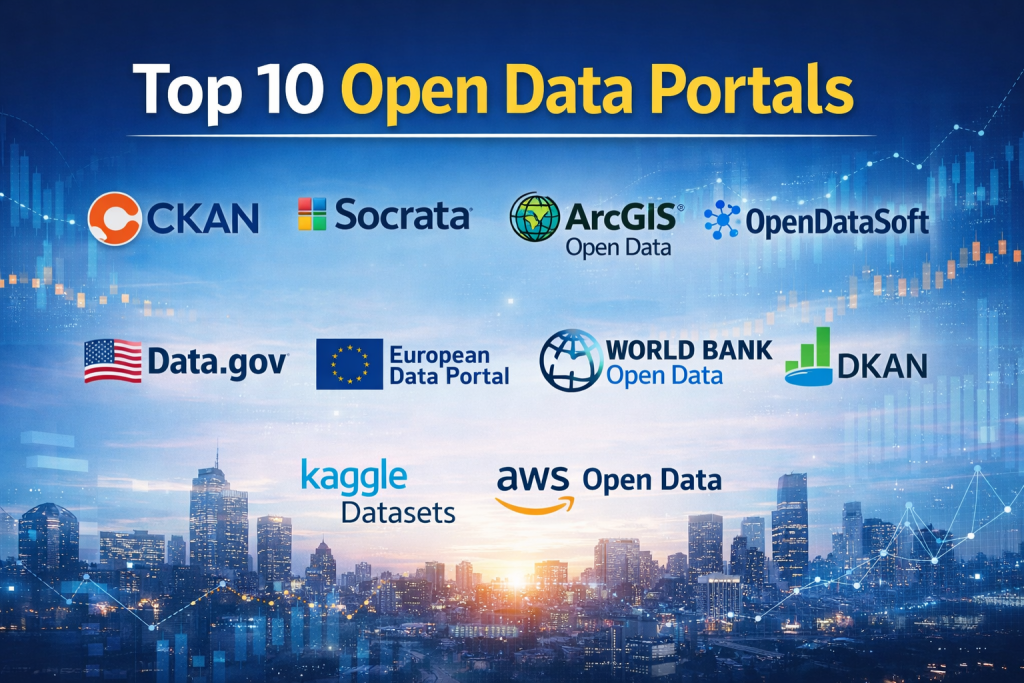
Top 10 Open Data Portals Tools
1 — CKAN
CKAN
Short description:
A widely adopted open-source platform for publishing and managing open datasets, used by governments and organizations worldwide.
Key features:
- Dataset cataloging with rich metadata
- Powerful search and filtering
- RESTful APIs for data access
- Extensible plugin architecture
- Data previews and visualizations
- Role-based access control
Pros:
- Highly customizable and open-source
- Large global adoption and ecosystem
Cons:
- Requires technical expertise to deploy
- UI customization needs development effort
Security & compliance:
Varies by deployment; supports authentication, access controls, and HTTPS.
Support & community:
Strong global open-source community, extensive documentation, and commercial support options.
2 — Socrata
Socrata
Short description:
A commercial cloud-based open data platform focused on government transparency and public data sharing.
Key features:
- No-code data publishing
- Built-in analytics and visualizations
- Open APIs and developer tools
- Data quality and version control
- Scalable cloud infrastructure
Pros:
- User-friendly and fast to deploy
- Strong analytics out of the box
Cons:
- Proprietary licensing
- Higher cost for large deployments
Security & compliance:
Enterprise-grade security, encryption, SSO, GDPR support.
Support & community:
Professional support, onboarding services, and training resources.
3 — ArcGIS Open Data
ArcGIS Open Data
Short description:
A geospatial-focused open data portal integrated with the ArcGIS ecosystem.
Key features:
- GIS-first data publishing
- Map-based discovery
- Spatial APIs and services
- Metadata standards compliance
- Integration with ArcGIS tools
Pros:
- Excellent for spatial and GIS datasets
- Strong visualization capabilities
Cons:
- Best suited for ArcGIS users
- Licensing costs may apply
Security & compliance:
Enterprise security, role-based access, encryption.
Support & community:
Extensive documentation, global GIS community, enterprise support.
4 — OpenDataSoft
OpenDataSoft
Short description:
A modern SaaS platform designed for publishing, enriching, and sharing open data across organizations.
Key features:
- User-friendly data ingestion
- Interactive dashboards
- API-first architecture
- Data enrichment and transformation
- Multi-portal management
Pros:
- Strong UX and data storytelling
- Minimal technical overhead
Cons:
- SaaS dependency
- Pricing may limit smaller teams
Security & compliance:
GDPR-ready, encryption, access controls.
Support & community:
Good documentation, customer success teams, training resources.
5 — DKAN
DKAN
Short description:
An open-source open data platform built on Drupal, inspired by CKAN but optimized for content-driven portals.
Key features:
- Drupal CMS integration
- Dataset versioning
- API access
- Flexible content modeling
- Custom theming
Pros:
- Strong CMS capabilities
- Open-source flexibility
Cons:
- Drupal expertise required
- Smaller ecosystem than CKAN
Security & compliance:
Varies by hosting; inherits Drupal security features.
Support & community:
Active open-source community and professional services.
6 — Data.gov
Data.gov
Short description:
The official open data portal of the United States government, aggregating datasets from federal agencies.
Key features:
- Centralized dataset discovery
- Standards-based metadata
- APIs for public access
- Integration with agency systems
Pros:
- Massive dataset coverage
- Strong governance framework
Cons:
- Limited customization
- Primarily a consumer portal
Security & compliance:
Government-grade security and compliance standards.
Support & community:
Public documentation and agency-led support.
7 — European Data Portal
European Data Portal
Short description:
A pan-European portal providing access to open datasets from EU institutions and member states.
Key features:
- Multilingual support
- Cross-country dataset aggregation
- Metadata harmonization
- Advanced search and filters
Pros:
- Strong standardization
- Broad geographic coverage
Cons:
- Not a deployable platform
- Limited customization
Security & compliance:
EU data protection and GDPR compliant.
Support & community:
Institutional support and public documentation.
8 — World Bank Open Data
World Bank Open Data
Short description:
A global open data portal providing economic, social, and development datasets.
Key features:
- High-quality global datasets
- APIs and bulk downloads
- Data visualization tools
- Time-series analysis
Pros:
- Trusted global data source
- Excellent documentation
Cons:
- Read-only consumer portal
- No customization or publishing
Security & compliance:
N/A (public data access).
Support & community:
Strong documentation and research community usage.
9 — Kaggle Datasets
Kaggle Datasets
Short description:
A popular platform for sharing datasets, widely used by data scientists and ML practitioners.
Key features:
- Community-uploaded datasets
- Versioning and metadata
- Notebooks and collaboration
- API access
Pros:
- Massive community adoption
- Ideal for ML and analytics
Cons:
- Not government-focused
- Limited governance controls
Security & compliance:
Varies; platform-level security controls.
Support & community:
Very strong global community and learning resources.
10 — AWS Open Data Registry
AWS Open Data Registry
Short description:
A registry of publicly available datasets hosted on AWS for large-scale analytics.
Key features:
- Petabyte-scale datasets
- Cloud-native access
- Integration with AWS analytics tools
- High availability
Pros:
- Excellent for big data workloads
- Highly scalable infrastructure
Cons:
- Cloud lock-in
- Requires technical expertise
Security & compliance:
AWS enterprise security, encryption, compliance certifications.
Support & community:
AWS documentation and enterprise support ecosystem.
Comparison Table
| Tool Name | Best For | Platform(s) Supported | Standout Feature | Rating |
|---|---|---|---|---|
| CKAN | Government data publishing | Web, API | Open-source extensibility | N/A |
| Socrata | Rapid government transparency | Cloud (SaaS) | Built-in analytics | N/A |
| ArcGIS Open Data | Geospatial datasets | Web, GIS | Map-centric discovery | N/A |
| OpenDataSoft | Data storytelling | Cloud (SaaS) | UX & dashboards | N/A |
| DKAN | CMS-driven portals | Web | Drupal integration | N/A |
| Data.gov | National data aggregation | Web | Federal dataset scale | N/A |
| European Data Portal | EU-wide datasets | Web | Multilingual aggregation | N/A |
| World Bank Open Data | Global development data | Web, API | High-quality indicators | N/A |
| Kaggle Datasets | Data science use cases | Web, API | Community datasets | N/A |
| AWS Open Data Registry | Big data analytics | Cloud | Petabyte-scale access | N/A |
Evaluation & Scoring of Open Data Portals
| Tool | Core Features (25%) | Ease of Use (15%) | Integrations (15%) | Security (10%) | Performance (10%) | Support (10%) | Price/Value (15%) | Total Score |
|---|---|---|---|---|---|---|---|---|
| CKAN | 22 | 12 | 13 | 8 | 8 | 9 | 14 | 86 |
| Socrata | 23 | 14 | 14 | 9 | 9 | 9 | 10 | 88 |
| ArcGIS Open Data | 22 | 13 | 14 | 9 | 9 | 9 | 10 | 86 |
| OpenDataSoft | 22 | 14 | 13 | 9 | 8 | 9 | 11 | 86 |
| DKAN | 20 | 11 | 12 | 8 | 7 | 8 | 14 | 80 |
Which Open Data Portals Tool Is Right for You?
- Solo users & researchers: Kaggle Datasets, World Bank Open Data
- SMBs & NGOs: OpenDataSoft, DKAN
- Mid-market & municipalities: CKAN, Socrata
- Large governments & enterprises: Socrata, ArcGIS Open Data, CKAN
- Budget-conscious teams: CKAN, DKAN
- Big data & analytics-heavy needs: AWS Open Data Registry
- High compliance environments: Socrata, ArcGIS Open Data
Frequently Asked Questions (FAQs)
- What is an Open Data Portal?
A platform that publishes datasets openly for public access, reuse, and analysis. - Are Open Data Portals free to use?
Many are free to access; publishing platforms may have licensing or hosting costs. - Do Open Data Portals support APIs?
Yes, most provide APIs for programmatic data access. - Is open data secure?
Security focuses on platform integrity; the data itself is intended for public use. - Can enterprises use open data platforms?
Yes, especially for transparency, research, and data collaboration. - What formats are typically supported?
CSV, JSON, XML, GeoJSON, and more. - How is data quality ensured?
Through metadata standards, validation rules, and governance policies. - Are these platforms scalable?
Cloud-based and open-source platforms scale well with proper infrastructure. - Do they support geospatial data?
Some platforms, like ArcGIS Open Data, specialize in GIS datasets. - What is a common mistake when adopting open data portals?
Underestimating metadata quality and long-term governance needs.
Conclusion
Open Data Portals are foundational tools for transparent governance, innovation, and data-driven collaboration. The right platform depends on your goals—whether that’s publishing public datasets, enabling advanced analytics, or supporting civic engagement at scale.
There is no single “best” Open Data Portal for everyone. Instead, success comes from aligning features, usability, scalability, security, and budget with your specific organizational needs. By carefully evaluating these factors, you can select a platform that maximizes the impact and value of open data.

Find Trusted Cardiac Hospitals
Compare heart hospitals by city and services — all in one place.
Explore Hospitals
This post is useful because open data portals are not just about putting files online—they need to make data easy to find, understand, and reuse. I liked that the comparison focuses on practical features like dataset search, clear metadata, APIs, download formats, licensing info, and how well the portal supports updates over time. The pros and cons section also helps because some platforms are great for quick publishing, while others are better for large government or enterprise catalog needs with stronger governance and access control. One smart tip is to check data quality and consistency rules (naming, tags, version history), because even good datasets become confusing if they are not maintained properly.