
Introduction
Renewable Asset Management Software is purpose-built technology designed to help organizations monitor, optimize, and manage renewable energy assets such as solar plants, wind farms, hydro assets, battery storage systems, and hybrid energy portfolios. As renewable infrastructure scales rapidly across the globe, asset owners and operators face growing challenges around performance variability, predictive maintenance, regulatory compliance, and long-term asset value protection.
This software plays a critical role in maximizing energy production, minimizing downtime, and extending asset lifecycles. By centralizing operational data, automating maintenance workflows, and delivering real-time insights, renewable asset management platforms enable smarter decisions across technical, financial, and sustainability teams.
Why it matters
- Renewable assets are capital-intensive and geographically distributed
- Small efficiency gains translate into large revenue improvements
- Regulatory and ESG reporting requirements are increasing
- Grid integration and forecasting complexity is rising
Common real-world use cases
- Solar and wind portfolio performance monitoring
- Predictive maintenance and fault detection
- Asset lifecycle and warranty management
- Financial performance and revenue tracking
- Compliance, ESG, and audit reporting
What to look for when choosing a tool
When evaluating Renewable Asset Management Software, buyers should focus on:
- Asset coverage (solar, wind, storage, hybrid)
- Analytics depth (real-time vs predictive)
- Ease of use and scalability
- Integration with SCADA, ERP, GIS, and CMMS systems
- Security, compliance, and data governance
Best for:
Renewable Asset Management Software is best suited for independent power producers (IPPs), utilities, asset owners, operators, O&M providers, infrastructure funds, and energy investors managing portfolios ranging from a few megawatts to multi-gigawatt operations.
Not ideal for:
Organizations with very small single-site installations, limited data maturity, or those seeking only basic monitoring may find these platforms excessive compared to simpler monitoring tools.
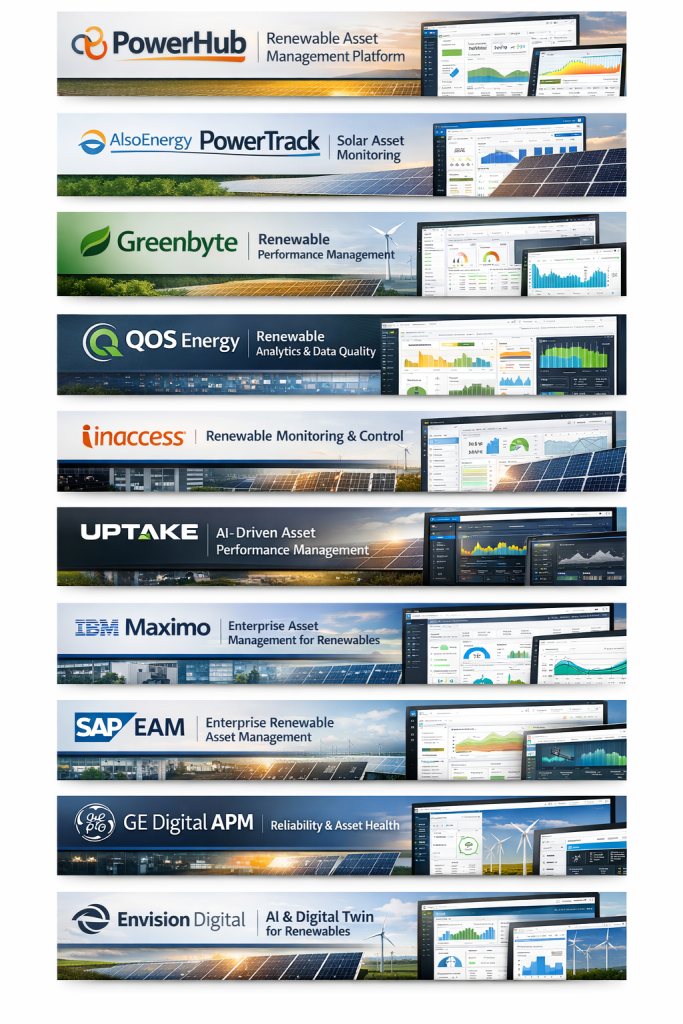
Top 10 Renewable Asset Management Software Tools
1 — PowerHub
Short description:
PowerHub is a comprehensive renewable asset management platform built for solar and wind portfolio owners, operators, and investors, combining operational and financial intelligence.
Key features
- Centralized asset and portfolio management
- Energy production and performance analytics
- Financial modeling and revenue tracking
- Workflow automation for O&M activities
- ESG and sustainability reporting
- Document and compliance management
Pros
- Strong balance of operational and financial insights
- Excellent portfolio-level visibility
Cons
- Limited deep SCADA-level control
- Advanced features require configuration
Security & compliance:
Role-based access, encryption, audit logs, GDPR alignment
Support & community:
Strong onboarding, responsive enterprise support, growing user base
2 — AlsoEnergy PowerTrack
Short description:
Designed primarily for solar portfolios, PowerTrack delivers real-time monitoring and performance management for asset owners and operators.
Key features
- Real-time production monitoring
- Advanced fault detection
- Weather-adjusted performance analysis
- Automated alerts and reporting
- Integration with inverters and meters
Pros
- Excellent solar-specific analytics
- Highly reliable real-time data
Cons
- Less suitable for wind-heavy portfolios
- Financial tools are basic
Security & compliance:
SSO support, encrypted data transfer, GDPR-ready
Support & community:
Strong technical documentation and customer support
3 — Greenbyte
Short description:
Greenbyte is a leading renewable performance management platform, widely used by utilities and IPPs for wind, solar, and hybrid portfolios.
Key features
- SCADA and IoT data integration
- Performance and availability analytics
- Asset lifecycle tracking
- Fleet-wide benchmarking
- Automated compliance reporting
Pros
- Scales well for enterprise portfolios
- Strong analytics for wind assets
Cons
- Steeper learning curve
- Higher enterprise pricing
Security & compliance:
ISO-aligned security controls, audit logging, GDPR compliant
Support & community:
Enterprise-grade support, professional services available
4 — QOS Energy
Short description:
QOS Energy focuses on advanced performance analytics and data quality management for renewable power plants.
Key features
- Data validation and cleansing
- Performance ratio and KPI tracking
- Root-cause analysis tools
- Fleet-level analytics
- Custom reporting dashboards
Pros
- Exceptional data accuracy controls
- Ideal for performance engineers
Cons
- Limited asset financial management
- UI less intuitive for non-technical users
Security & compliance:
Encrypted storage, role-based access, GDPR compliant
Support & community:
Strong technical support, smaller community footprint
5 — Inaccess
Short description:
Inaccess provides a flexible monitoring and asset management platform tailored for renewable energy operators.
Key features
- Real-time asset monitoring
- Predictive analytics and alarms
- Customizable dashboards
- Multi-asset support
- API integrations
Pros
- Highly customizable platform
- Strong real-time performance
Cons
- Requires configuration effort
- Limited built-in financial modules
Security & compliance:
Secure APIs, encryption, GDPR-aligned
Support & community:
Good documentation, professional onboarding support
6 — Uptake
Short description:
Uptake delivers AI-driven asset performance management with a strong focus on predictive maintenance for energy infrastructure.
Key features
- AI-based failure prediction
- Condition monitoring
- Asset health scoring
- Maintenance optimization
- Integration with EAM systems
Pros
- Powerful predictive capabilities
- Strong reliability analytics
Cons
- Less renewable-specific workflows
- Enterprise pricing model
Security & compliance:
SOC 2-aligned practices, secure data handling
Support & community:
Enterprise support with data science consulting
7 — IBM Maximo for Renewables
Short description:
IBM Maximo adapts enterprise asset management principles for renewable energy operators managing complex infrastructure.
Key features
- Asset lifecycle management
- Work order and maintenance planning
- Inventory and spare parts tracking
- Mobile workforce tools
- Enterprise integrations
Pros
- Extremely robust EAM foundation
- Proven at large scale
Cons
- Requires customization for renewables
- Complex implementation
Security & compliance:
SOC, ISO, role-based security, audit logging
Support & community:
Global support ecosystem, extensive documentation
8 — SAP EAM (Renewables Use Case)
Short description:
SAP EAM supports renewable asset management within broader enterprise operations and financial systems.
Key features
- Integrated asset and financial management
- Maintenance scheduling
- Compliance tracking
- ERP-native reporting
- Scalable enterprise architecture
Pros
- Seamless ERP integration
- Strong governance controls
Cons
- Not renewable-specific out of the box
- High cost and complexity
Security & compliance:
ISO-certified security, enterprise-grade controls
Support & community:
Large global partner and support network
9 — GE Digital APM
Short description:
GE Digital APM focuses on asset reliability and performance optimization for energy and industrial assets.
Key features
- Asset health and risk analytics
- Predictive maintenance models
- Reliability-centered maintenance
- Advanced visualization
- Integration with SCADA and historians
Pros
- Deep reliability engineering capabilities
- Proven industrial analytics
Cons
- Heavy configuration effort
- Less financial insight
Security & compliance:
Enterprise-grade security, compliance-ready
Support & community:
Strong enterprise support, smaller renewable focus community
10 — Envision Digital
Short description:
Envision Digital offers AI-powered renewable asset intelligence with a focus on wind and smart energy systems.
Key features
- AI-driven performance optimization
- Digital twin technology
- Fleet-wide analytics
- Grid interaction insights
- Sustainability reporting
Pros
- Advanced AI and digital twin use cases
- Strong wind energy expertise
Cons
- Limited flexibility outside core focus
- Premium pricing
Security & compliance:
Enterprise security controls, GDPR alignment
Support & community:
Specialized enterprise support, growing ecosystem
Comparison Table
| Tool Name | Best For | Platform(s) Supported | Standout Feature | Rating |
|---|---|---|---|---|
| PowerHub | Portfolio owners & investors | Web, Cloud | Financial + operational view | N/A |
| AlsoEnergy PowerTrack | Solar operators | Web, Cloud | Real-time solar analytics | N/A |
| Greenbyte | Utilities & IPPs | Web, Cloud | Fleet-level performance | N/A |
| QOS Energy | Performance engineers | Web | Data quality & analytics | N/A |
| Inaccess | Custom monitoring needs | Web, Cloud | High configurability | N/A |
| Uptake | Predictive maintenance | Web, Cloud | AI-driven insights | N/A |
| IBM Maximo | Large enterprises | Web, Mobile | Full EAM suite | N/A |
| SAP EAM | ERP-centric orgs | Web | ERP integration | N/A |
| GE Digital APM | Reliability teams | Web | Asset health modeling | N/A |
| Envision Digital | Wind-heavy portfolios | Web, Cloud | Digital twins | N/A |
Evaluation & Scoring of Renewable Asset Management Software
| Criteria | Weight | Description |
|---|---|---|
| Core features | 25% | Coverage of renewable asset workflows |
| Ease of use | 15% | UI clarity and learning curve |
| Integrations & ecosystem | 15% | SCADA, ERP, APIs |
| Security & compliance | 10% | Data protection and governance |
| Performance & reliability | 10% | System uptime and analytics accuracy |
| Support & community | 10% | Onboarding and customer success |
| Price / value | 15% | Cost vs delivered value |
Which Renewable Asset Management Software Tool Is Right for You?
- Solo users & SMBs: Look for simplicity, faster setup, and lower costs
- Mid-market operators: Prioritize analytics depth and integrations
- Enterprises: Focus on scalability, security, and governance
- Budget-conscious teams: Choose modular platforms with flexible pricing
- Premium needs: Invest in AI, digital twins, and predictive analytics
- Compliance-driven orgs: Ensure audit logs, access controls, and reporting
Frequently Asked Questions (FAQs)
- What is Renewable Asset Management Software?
It is software designed to monitor, optimize, and manage renewable energy assets across their lifecycle. - Is this software only for large utilities?
No, it is used by SMB operators, IPPs, asset owners, and investors. - Does it support both solar and wind assets?
Most modern platforms support multi-asset portfolios. - How does it improve profitability?
By reducing downtime, improving efficiency, and optimizing maintenance. - Is real-time monitoring mandatory?
Not always, but it significantly improves operational responsiveness. - How long does implementation take?
Anywhere from weeks to several months depending on complexity. - What integrations are important?
SCADA, ERP, CMMS, GIS, and financial systems. - Is data security a concern?
Yes, enterprise-grade encryption and access control are essential. - Can it help with ESG reporting?
Many platforms include sustainability and compliance reporting. - Is there a single “best” tool?
No, the best tool depends on asset type, scale, and business goals.
Conclusion
Renewable Asset Management Software has become a critical foundation for efficient, profitable, and sustainable renewable energy operations. The right platform can unlock performance gains, reduce operational risk, and support long-term asset value.
There is no universal winner. The best solution depends on your portfolio size, asset mix, analytics needs, budget, and compliance requirements. By aligning software capabilities with real operational priorities, organizations can confidently scale their renewable energy investments and remain competitive in a rapidly evolving energy landscape.

Find Trusted Cardiac Hospitals
Compare heart hospitals by city and services — all in one place.
Explore Hospitals
Excellent comparative guide! This article breaks down leading renewable asset management software with clarity, outlining features, strengths, and potential limitations that matter most to operations and portfolio managers. For professionals in the renewable energy sector, these side‑by‑side insights make it much easier to evaluate which tools can improve reliability, streamline maintenance workflows, and maximize asset performance. A practical, well‑structured resource for anyone looking to make informed technology decisions in a fast‑evolving industry.