
Introduction
Digital assets such as cryptocurrencies, tokens, NFTs, and tokenized securities are now part of mainstream finance. With this growth comes increasing scrutiny from regulators, auditors, and internal risk teams. Digital Asset Compliance Tools are specialized platforms designed to help organizations monitor, analyze, and manage compliance risks related to digital assets.
These tools play a critical role in anti-money laundering (AML), know-your-customer (KYC), transaction monitoring, fraud detection, sanctions screening, and regulatory reporting. As global regulations evolve, businesses dealing with digital assets must demonstrate transparency, traceability, and governance across complex blockchain ecosystems.
Real-world use cases include crypto exchanges monitoring suspicious wallets, fintech companies ensuring regulatory reporting accuracy, NFT marketplaces detecting illicit transactions, and enterprises managing digital asset custody controls.
When choosing a digital asset compliance tool, buyers should evaluate regulatory coverage, blockchain analytics depth, ease of use, scalability, security posture, integrations, and overall value. The right platform can significantly reduce compliance risk while enabling confident growth in the digital asset economy.
Best for:
Compliance officers, risk managers, crypto exchanges, fintech companies, Web3 startups, financial institutions, and enterprises managing digital assets at scale.
Not ideal for:
Small hobby projects, individual traders, or teams without regulatory exposure where manual tracking or basic accounting tools may be sufficient.
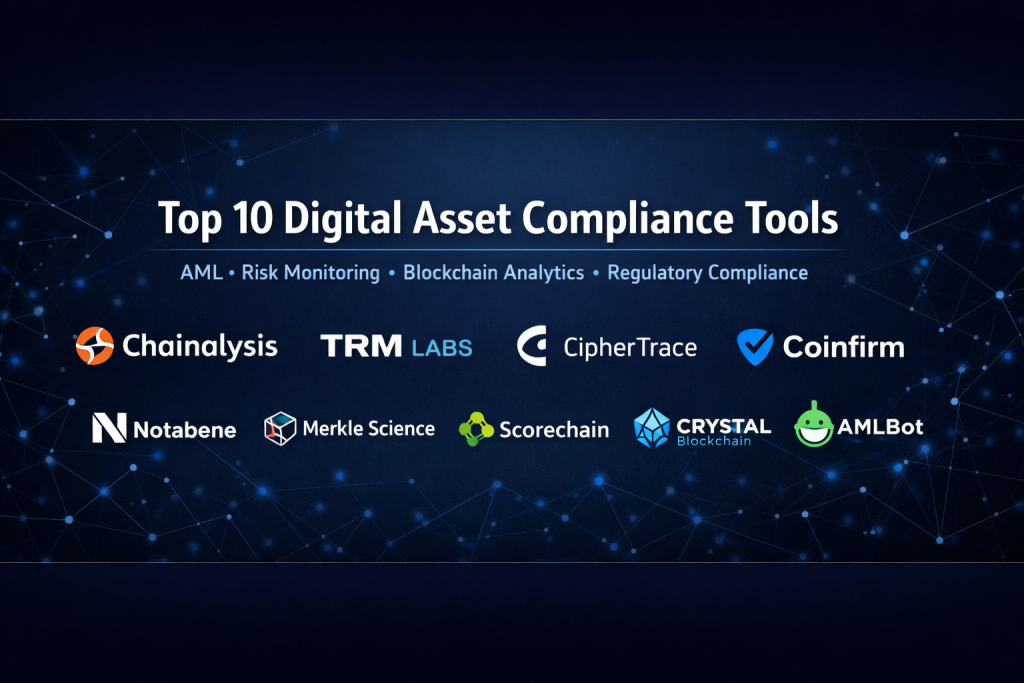
Top 10 Digital Asset Compliance Tools
1 — Chainalysis
Short description:
A market-leading blockchain analytics platform used by regulators, exchanges, and financial institutions to detect, investigate, and prevent illicit crypto activity.
Key features
- Blockchain transaction monitoring and attribution
- AML and sanctions screening
- Risk scoring for wallets and transactions
- Investigation and case management tools
- Regulatory reporting support
- Coverage across major blockchains
Pros
- Industry benchmark for crypto compliance
- Strong regulatory acceptance
Cons
- Premium pricing
- Can be complex for smaller teams
Security & compliance
SOC 2, encryption at rest and in transit, audit logs, GDPR alignment
Support & community
Enterprise-grade onboarding, detailed documentation, strong analyst support
2 — TRM Labs
Short description:
A risk management and compliance platform focused on blockchain intelligence, fraud detection, and transaction monitoring.
Key features
- Real-time transaction monitoring
- Wallet risk profiling
- Sanctions and watchlist screening
- NFT and DeFi coverage
- Case investigation workflows
- API-first architecture
Pros
- Broad asset and chain coverage
- Intuitive UI for analysts
Cons
- Advanced features require training
- Pricing not transparent
Security & compliance
SOC 2, GDPR-ready, SSO support, detailed audit trails
Support & community
Strong customer success team, active knowledge base
3 — Elliptic
Short description:
A compliance and risk analytics platform helping organizations manage crypto AML and financial crime risks.
Key features
- Crypto AML monitoring
- Transaction and wallet screening
- DeFi risk insights
- Compliance reporting tools
- Blockchain forensic analysis
Pros
- Strong forensic capabilities
- Trusted by regulators
Cons
- Enterprise-focused pricing
- UI can feel analyst-heavy
Security & compliance
ISO-aligned controls, encryption, audit logging
Support & community
Professional services available, comprehensive documentation
4 — CipherTrace
Short description:
A digital asset intelligence solution focused on AML, fraud detection, and blockchain risk analytics.
Key features
- Crypto transaction monitoring
- Wallet attribution database
- Regulatory reporting tools
- Risk scoring engine
- DeFi and cross-chain analysis
Pros
- Deep risk intelligence
- Strong compliance reporting
Cons
- Steep learning curve
- Limited customization for SMBs
Security & compliance
SOC 2 controls, encryption, compliance-ready reporting
Support & community
Dedicated enterprise support, analyst assistance
5 — Coinfirm
Short description:
An AML and compliance platform designed for crypto businesses seeking automated regulatory controls.
Key features
- AML transaction monitoring
- Wallet risk scoring
- Regulatory rule engine
- API-based integration
- Compliance dashboards
Pros
- Good balance of automation and control
- Flexible integration options
Cons
- UI less polished than peers
- Limited advanced analytics
Security & compliance
GDPR compliance, encryption, audit trails
Support & community
Standard onboarding, growing user community
6 — Notabene
Short description:
A compliance platform focused on crypto Travel Rule messaging and regulatory data exchange.
Key features
- Travel Rule data exchange
- Secure counterparty messaging
- VASP directory management
- Compliance reporting
- API-based integrations
Pros
- Strong Travel Rule specialization
- Interoperability focus
Cons
- Narrow use case
- Not a full AML suite
Security & compliance
Encryption, secure messaging, GDPR-aligned
Support & community
Clear documentation, responsive support
7 — Merkle Science
Short description:
A blockchain intelligence platform designed to help businesses manage crypto risk and compliance.
Key features
- Transaction monitoring
- Wallet and entity risk scoring
- Fraud and scam detection
- Investigation dashboards
- API integrations
Pros
- Strong scam detection
- User-friendly dashboards
Cons
- Smaller ecosystem
- Fewer enterprise features
Security & compliance
Standard encryption, role-based access controls
Support & community
Hands-on onboarding, growing documentation
8 — Scorechain
Short description:
A blockchain analytics platform aimed at AML compliance and crypto transaction risk analysis.
Key features
- Transaction and address monitoring
- AML risk indicators
- Case management tools
- Customizable alerts
- Blockchain explorer integration
Pros
- Customizable compliance rules
- Good reporting tools
Cons
- Limited chain coverage
- Smaller market presence
Security & compliance
Encryption, audit logging, GDPR support
Support & community
Documentation-driven support, responsive team
9 — Crystal Blockchain
Short description:
A compliance and investigation tool offering blockchain intelligence for AML and risk analysis.
Key features
- Transaction visualization
- Wallet risk scoring
- AML compliance reporting
- Investigation workflows
- Multi-chain support
Pros
- Visual investigation tools
- Competitive pricing
Cons
- Less automation than leaders
- Smaller integrations ecosystem
Security & compliance
Standard security controls, audit-ready logs
Support & community
Email and ticket-based support
10 — AMLBot
Short description:
A lightweight AML compliance solution focused on transaction screening and wallet risk checks.
Key features
- Wallet screening
- Transaction risk scoring
- API access
- Basic compliance reports
- Multi-chain support
Pros
- Easy to implement
- Cost-effective for SMBs
Cons
- Limited advanced analytics
- Not enterprise-grade
Security & compliance
Encryption, basic audit logging
Support & community
Simple documentation, standard support
Comparison Table
| Tool Name | Best For | Platform(s) Supported | Standout Feature | Rating |
|---|---|---|---|---|
| Chainalysis | Large enterprises, regulators | Web, API | Deep blockchain intelligence | N/A |
| TRM Labs | Exchanges, fintechs | Web, API | Real-time risk monitoring | N/A |
| Elliptic | Compliance-heavy orgs | Web, API | Forensic analytics | N/A |
| CipherTrace | Financial institutions | Web, API | Risk attribution depth | N/A |
| Coinfirm | Mid-market crypto firms | Web, API | Automated AML rules | N/A |
| Notabene | Travel Rule compliance | Web, API | Secure VASP messaging | N/A |
| Merkle Science | Web3 startups | Web, API | Scam detection | N/A |
| Scorechain | Custom AML needs | Web, API | Configurable alerts | N/A |
| Crystal Blockchain | Investigations | Web | Visual analytics | N/A |
| AMLBot | SMBs, startups | API | Fast AML screening | N/A |
Evaluation & Scoring of Digital Asset Compliance Tools
| Criteria | Weight | What It Measures |
|---|---|---|
| Core features | 25% | AML, monitoring, analytics depth |
| Ease of use | 15% | UI clarity, learning curve |
| Integrations & ecosystem | 15% | APIs, partner tools |
| Security & compliance | 10% | Certifications, controls |
| Performance & reliability | 10% | Speed, uptime |
| Support & community | 10% | Onboarding, help quality |
| Price / value | 15% | ROI vs cost |
Which Digital Asset Compliance Tool Is Right for You?
- Solo users & startups: Lightweight tools with APIs and simple dashboards work best.
- SMBs & mid-market: Look for balance—strong AML features without enterprise complexity.
- Enterprises & regulators: Choose platforms with proven regulatory acceptance and scalability.
- Budget-conscious teams: Prioritize essential monitoring and reporting over advanced forensics.
- High-compliance industries: Security certifications, audit logs, and policy controls are critical.
The best choice depends on risk exposure, transaction volume, regulatory environment, and growth plans.
Frequently Asked Questions (FAQs)
1. What are digital asset compliance tools?
They help organizations monitor, analyze, and manage regulatory risks related to cryptocurrencies and blockchain assets.
2. Are these tools required by law?
Requirements vary by jurisdiction, but many regulators expect AML and transaction monitoring controls.
3. Do they support multiple blockchains?
Most modern tools support major chains, with coverage expanding regularly.
4. Are they suitable for NFT platforms?
Yes, several tools now offer NFT and marketplace transaction analysis.
5. How difficult is implementation?
API-first tools can be deployed quickly, while enterprise platforms require onboarding.
6. Do these tools replace internal compliance teams?
No, they support and enhance human decision-making.
7. How is data secured?
Most use encryption, role-based access, and audit logs.
8. Can small startups afford them?
Some tools offer SMB-friendly pricing or limited plans.
9. Are Travel Rule features included?
Only specialized platforms fully support Travel Rule compliance.
10. What’s the most common mistake buyers make?
Choosing overly complex tools without matching their actual compliance needs.
Conclusion
Digital asset compliance tools are no longer optional for organizations operating in the crypto and blockchain ecosystem. They provide visibility, control, and confidence in an increasingly regulated environment.
The most important factors to consider are regulatory coverage, usability, scalability, and security. There is no single “best” tool for everyone—the right solution depends on your organization’s size, risk profile, and compliance obligations.
By aligning tool capabilities with real-world needs, businesses can stay compliant while continuing to innovate in the digital asset space.

Find Trusted Cardiac Hospitals
Compare heart hospitals by city and services — all in one place.
Explore Hospitals
Digital asset compliance tools help organizations monitor transactions and manage regulatory obligations in an evolving digital asset environment. When comparing solutions, I think transaction monitoring, risk assessment, audit trails, and regulatory reporting are important features to consider. Integration with existing systems can also help teams identify suspicious activity and maintain accurate compliance records. Choosing the right platform can reduce manual effort, improve transparency, and support more effective risk management.
Digital asset compliance is a complex space, but this article makes it much more approachable. I like how it covers AML, KYC, and blockchain analytics in one place. Crypto businesses will find this comparison incredibly useful.
Choosing compliance infrastructure based solely on broad multi-chain coverage can be misleading if the platform struggles with real-time attribution depth during high-velocity threat events. Teams often overlook how quickly transaction heuristics degrade when new privacy-enhancing protocols or complex cross-chain bridges emerge.
Digital asset compliance tools help businesses monitor transactions, manage regulatory requirements, and identify potential risks involving digital assets. Features like transaction monitoring, risk assessment, and automated compliance reporting can improve transparency and accuracy. I believe organizations should compare platforms based on security, reporting capabilities, scalability, and regulatory coverage. Regular updates and reliable audit trails are also important for maintaining compliance. The right solution can simplify compliance management and support safer digital asset operations.
Digital asset compliance tools need to handle more than basic wallet screening and transaction monitoring. One important factor is how accurately they detect suspicious activity across different blockchains and DeFi platforms. Teams should also review false positives and check how easily analysts can investigate flagged transactions. Regularly testing these areas can improve compliance workflows and help teams respond to risks before they become bigger problems.
Digital asset compliance becomes particularly challenging when the same asset moves through multiple platforms, jurisdictions, and business relationships. A transaction that appears acceptable at one stage may require additional review when its ownership structure, intended use, or regulatory classification changes. I would pay attention to whether compliance tools maintain a clear history of asset classifications, policy decisions, and supporting evidence rather than treating each transaction as an isolated event. The ability to explain why a particular asset or activity was flagged during an internal or external audit is equally important. This makes compliance decisions easier to review and reduces dependence on individual analysts’ undocumented knowledge.
Digital asset compliance tools help organizations manage regulatory obligations, monitor transactions, and identify suspicious activities across digital asset ecosystems. These platforms can support transaction screening, sanctions monitoring, risk assessment, audit trails, and regulatory reporting, making them valuable for businesses operating in the cryptocurrency and blockchain space. When comparing solutions, factors such as blockchain coverage, detection accuracy, regulatory adaptability, integration capabilities, and reporting quality deserve close attention. Selecting the right tool can strengthen compliance processes, improve transparency, and help organizations manage evolving regulatory risks more effectively.
Blockchain risk scores are only useful when compliance teams can understand the evidence behind them and act on alerts efficiently. With tools like Chainalysis, TRM Labs, and Elliptic offering different investigation capabilities, evaluating false positives, cross-chain visibility, and case resolution workflows is essential.
Digital asset compliance can become complicated when businesses need to track transactions, verify users, and follow changing regulations. I think a useful tool should provide clear audit trails and help teams identify suspicious activity without creating too many false alerts. It is also important to check whether the platform supports the types of assets and jurisdictions the business works with. Keeping records organized and easy to review can make compliance checks much more manageable.
Digital asset compliance tools help organizations review transactions and manage risks linked to digital assets. They may support wallet screening, transaction monitoring, and investigation records. Clear alerts can help compliance teams focus on activity that needs review. Reliable data and explainable findings are important for sound decisions. When comparing tools, assess blockchain coverage, risk signals, reporting, and integration options. Teams should also review privacy and data retention practices. These tools support compliance work, but they do not replace internal controls, expert review, or legal guidance.
Digital asset compliance tools help organizations monitor transactions, assess exposure, and maintain records required by evolving regulatory frameworks. Wallet screening, transaction monitoring, and automated risk alerts can improve visibility into suspicious activity while reducing manual review efforts. Combining reliable blockchain analytics with documented compliance procedures and regular policy updates is essential for managing risk across increasingly complex digital asset operations.
Digital asset compliance workflows should be tested when blockchain data arrives late or different providers report conflicting information. If an investigation relies on incomplete transaction history, teams may reach different conclusions from the same case. Setting clear rules for data freshness and source reliability helps analysts understand when further checks are needed. It is also useful to preserve the evidence available at the time a decision was made. This gives compliance teams a stronger basis for reviewing cases and explaining decisions months later.
Digital asset compliance tools are most effective when they provide clear transaction monitoring, wallet risk analysis, and reliable audit records. Teams should check how well a platform supports changing regulatory requirements while minimizing false alerts that slow legitimate activity. Regular rule updates and documented review processes help organizations manage risk and maintain stronger oversight of digital asset transactions.
Digital asset compliance tools help businesses monitor transactions, manage regulatory requirements, and identify potential risks. When comparing platforms, I would focus on transaction monitoring, risk detection, audit reporting, and integration with existing systems. These features can improve transparency and help organizations maintain stronger compliance practices. The right tool should simplify compliance tasks while supporting secure and responsible digital asset management.
Safeguarding institutional digital assets requires multi-party computation protocols paired with hardware security modules, enforcing multi-approval quorum governance and segregated cold-storage vaults to eliminate single-point key exposure while satisfying strict financial regulatory compliance mandates.
A practical challenge in digital asset compliance is maintaining consistent decisions when different analytics providers assign different risk levels to the same wallet or transaction. One provider may flag an address because of an indirect connection to a suspicious entity, while another may classify it as low risk. Compliance teams need clear escalation rules, documented investigation decisions, and a way to review outdated risk signals as new evidence becomes available. I would also evaluate whether a platform lets analysts distinguish direct exposure from indirect associations and record the reasoning behind each decision. Measuring false-positive rates, investigation turnaround times, and the frequency of overturned alerts can help teams improve their review process. These capabilities reduce unnecessary transaction delays while keeping risk decisions transparent and defensible during audits.
One challenge in crypto compliance is balancing effective risk detection with the need to process legitimate transactions without unnecessary delays. A wallet flagged by one analytics provider may receive a different risk assessment from another, creating uncertainty for compliance teams. Organizations should establish clear investigation thresholds, document the evidence behind decisions, and define when analysts must review automated flags. It is also useful to measure false-positive rates, case resolution times, and missed-risk incidents across different asset types. Periodic reviews of detection rules can help teams adapt to new transaction patterns without overwhelming investigators. These practices make compliance decisions more consistent and help organizations explain their actions during audits or regulatory reviews.
Implementing automated compliance checks directly within the asset pipeline is crucial for catching regulatory risks before files go public. While having a comprehensive repository tool helps track metadata and rights, bridging the gap between creative workflows and legal oversight remains a key bottleneck. I’ve noticed teams struggle most with defining clear ownership policies rather than just picking software. How do you usually handle cross-functional sign-offs when managing compliance across distributed creative teams.
Digital asset compliance becomes more challenging when transactions move across wallets, exchanges, and different blockchain networks. A useful compliance tool should help teams trace transaction histories, flag unusual activity, and keep clear records of why a transaction was reviewed. It is also worth checking how easily investigators can export evidence for audits without losing the links between related transactions.
Thank you for sharing such a useful comparison of digital asset compliance tools. The focus on regulatory monitoring, transaction tracking, risk assessment, and reporting is particularly relevant as organizations navigate the evolving digital asset landscape. This guide can help compliance teams and financial professionals evaluate solutions that support transparency, risk management, and regulatory obligations. Great resource!