
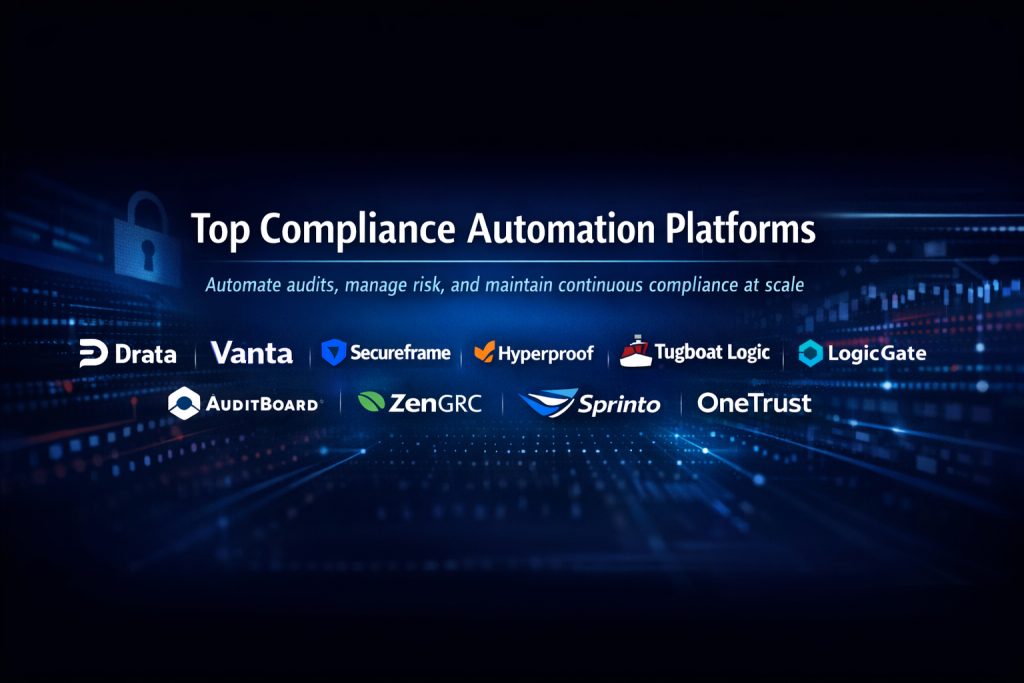
Introduction
Compliance Automation Platforms are software solutions designed to simplify, standardize, and automate regulatory compliance across frameworks such as SOC 2, ISO 27001, GDPR, HIPAA, PCI DSS, SOX, and more. Instead of relying on spreadsheets, email trails, and manual evidence collection, these platforms centralize controls, policies, risks, audits, and reporting into a single system of record.
In today’s environment of frequent audits, remote teams, cloud infrastructure, and strict data protection laws, manual compliance is slow, error-prone, and costly. Automation helps organizations reduce audit fatigue, maintain continuous compliance, and respond faster to customer and regulator requests.
Common real-world use cases
- Preparing for SOC 2 or ISO certification
- Managing ongoing compliance across multiple frameworks
- Collecting audit evidence automatically from cloud and SaaS tools
- Tracking risks, controls, and remediation actions
- Demonstrating compliance to customers, partners, and regulators
What to look for when choosing a Compliance Automation Platform
- Framework coverage (SOC 2, ISO, GDPR, HIPAA, etc.)
- Automation depth (evidence collection, monitoring, alerts)
- Ease of use for non-technical teams
- Integrations with cloud, DevOps, and business tools
- Security posture of the platform itself
- Scalability as compliance needs grow
- Pricing transparency and value
Best for:
Compliance Automation Platforms are ideal for SaaS companies, fintech, health tech, enterprises, security teams, compliance managers, CTOs, CISOs, auditors, and fast-growing startups that must prove trust and governance at scale.
Not ideal for:
Very small teams with no regulatory exposure, organizations operating fully offline, or companies with one-time compliance needs where manual audits may be cheaper.
Top 10 Compliance Automation Platforms Tools
1 — Drata
Short description:
Drata is a modern compliance automation platform focused on continuous monitoring for fast-growing technology companies.
Key features
- Continuous control monitoring
- Automated evidence collection
- SOC 2, ISO 27001, GDPR support
- Cloud and SaaS integrations
- Real-time compliance dashboards
- Vendor risk management
- Audit-ready reporting
Pros
- Strong automation and real-time insights
- Clean, modern user experience
Cons
- Premium pricing for smaller teams
- Limited customization for complex enterprises
Security & compliance:
SOC 2, ISO-aligned controls, SSO, encryption, audit logs
Support & community:
Strong onboarding, responsive support, growing user community
2 — Vanta
Short description:
Vanta is an agentic trust platform that helps organizations achieve and maintain compliance with minimal manual effort..
Key features
- Key features (400+ integrations, 1,400+ automated tests, 35+ frameworks including SOC 2, ISO 27001, GDPR, and HIPAA)
- Automated evidence collection
- Policy and control management
- Prebuilt compliance templates
- Risk assessment workflows
- Trust center capabilities
- Continuous compliance alerts
Pros
- Fast implementation
- Excellent auditor collaboration
Cons
- Limited flexibility for custom frameworks
- Costs increase with scale
Security & compliance:
Security & compliance: Supports more than 35 frameworks, including SOC 2, ISO 27001, GDPR, and HIPAA; SSO; encryption
Support & community:
High-quality documentation, strong customer success team” -> “Support & community: Trusted by 16,000+ companies, with high-quality documentation and a strong customer success team
3 — Secureframe
Short description:
Secureframe combines automation with expert guidance to accelerate audit readiness.
Key features
- Compliance automation engine
- Built-in auditor support
- Vendor risk management
- Policy management
- Evidence auto-sync
- Multi-framework coverage
Pros
- Auditor-friendly workflows
- Good balance of automation and support
Cons
- Interface can feel dense
- Less customizable dashboards
Security & compliance:
SOC 2, ISO, HIPAA, PCI DSS, encryption, audit logs
Support & community:
Hands-on onboarding, compliance advisory access
4 — Hyperproof
Short description:
Hyperproof focuses on enterprise-grade compliance operations and risk management.
Key features
- Compliance and risk management
- Audit workflows
- Control mapping across frameworks
- Evidence lifecycle tracking
- Executive reporting
- Role-based access controls
Pros
- Highly scalable for enterprises
- Strong reporting capabilities
Cons
- Steeper learning curve
- Less automation than startup-focused tools
Security & compliance:
SOC 2, ISO, GDPR-ready, SSO, encryption
Support & community:
Enterprise support, structured training resources
5 — Tugboat Logic
Short description:
Tugboat Logic provides structured GRC workflows with strong policy management.
Key features
- Policy lifecycle management
- Risk assessments
- Audit readiness tracking
- Vendor management
- Compliance dashboards
- Framework mapping
Pros
- Clear governance structure
- Strong policy tooling
Cons
- Fewer native integrations
- Limited real-time automation
Security & compliance:
SOC 2 aligned, encryption, audit logs
Support & community:
Reliable support, smaller but active user base
6 — LogicGate
Short description:
LogicGate is a flexible GRC platform built for complex enterprise compliance workflows.
Key features
- No-code workflow builder
- Risk and control automation
- Advanced reporting
- Multi-framework compliance
- Enterprise integrations
- Custom dashboards
Pros
- Extremely customizable
- Suitable for regulated industries
Cons
- Requires configuration effort
- Higher learning curve
Security & compliance:
SOC 2, ISO, enterprise security controls
Support & community:
Enterprise-level support, implementation partners available
7 — AuditBoard
Short description:
AuditBoard is a leading platform for audit, risk, and compliance management in large organizations.
Key features
- Internal audit management
- SOX compliance automation
- Risk assessment tools
- Workflow automation
- Executive reporting
- Collaboration tools
Pros
- Best-in-class audit workflows
- Trusted by large enterprises
Cons
- Not startup-friendly
- Higher cost
Security & compliance:
SOC 2, SOX, ISO-aligned, SSO, encryption
Support & community:
Strong enterprise support and training programs
8 — ZenGRC
Short description:
ZenGRC centralizes compliance and risk data for mid-market and enterprise teams.
Key features
- Risk and control management
- Compliance reporting
- Evidence tracking
- Multi-framework mapping
- Dashboard analytics
Pros
- Mature GRC capabilities
- Good framework coverage
Cons
- Interface feels dated
- Limited automation depth
Security & compliance:
SOC 2 aligned, encryption, audit trails
Support & community:
Standard support, extensive documentation
9 — Sprinto
Short description:
Sprinto focuses on continuous compliance for cloud-native companies.
Key features
- Real-time compliance monitoring
- Automated evidence collection
- Policy templates
- Vendor risk tracking
- Audit collaboration
Pros
- Strong real-time compliance model
- Simple setup
Cons
- Narrower framework coverage
- Less suitable for large enterprises
Security & compliance:
SOC 2, ISO, GDPR readiness, encryption
Support & community:
Responsive support, growing ecosystem
10 — OneTrust
Short description:
OneTrust is a broad compliance platform covering privacy, risk, and governance at enterprise scale.
Key features
- Privacy and data governance automation
- Compliance risk assessments
- Vendor risk management
- Policy enforcement
- Regulatory intelligence
Pros
- Extremely comprehensive
- Global regulatory coverage
Cons
- Complex implementation
- Expensive for small teams
Security & compliance:
SOC 2, GDPR, ISO-aligned, enterprise security
Support & community:
Extensive documentation, global enterprise support
Comparison Table
| Tool Name | Best For | Platform(s) Supported | Standout Feature | Rating |
|---|---|---|---|---|
| Drata | Fast-growing SaaS | Web, Cloud | Continuous compliance | N/A |
| Vanta | Startups & SMBs | Web, Cloud | Fast audit readiness | N/A |
| Secureframe | SaaS with audits | Web, Cloud | Auditor collaboration | N/A |
| Hyperproof | Enterprises | Web | Compliance operations | N/A |
| Tugboat Logic | Governance-focused teams | Web | Policy management | N/A |
| LogicGate | Regulated enterprises | Web | No-code workflows | N/A |
| AuditBoard | Large enterprises | Web | Audit management | N/A |
| ZenGRC | Mid-market GRC | Web | Centralized compliance | N/A |
| Sprinto | Cloud-native startups | Web, Cloud | Real-time monitoring | N/A |
| OneTrust | Global enterprises | Web | Privacy automation | N/A |
Evaluation & Scoring of Compliance Automation Platforms
| Criteria | Weight | Average Score |
|---|---|---|
| Core features | 25% | High |
| Ease of use | 15% | Medium-High |
| Integrations & ecosystem | 15% | High |
| Security & compliance | 10% | High |
| Performance & reliability | 10% | High |
| Support & community | 10% | Medium-High |
| Price / value | 15% | Medium |
Which Compliance Automation Platforms Tool Is Right for You?
- Solo users / early startups: Lightweight tools like Drata, Vanta, or Sprinto
- SMBs: Secureframe or Vanta for balance of cost and automation
- Mid-market: ZenGRC or Hyperproof for structure and scalability
- Enterprises: AuditBoard, LogicGate, or OneTrust
Budget-conscious: Focus on ease of use and fast ROI
Premium buyers: Look for deep customization and enterprise support
Integration-heavy teams: Prioritize cloud and DevOps integrations
Security-driven orgs: Validate encryption, audit logs, and SSO
Frequently Asked Questions (FAQs)
- What is compliance automation?
It automates controls, evidence collection, and reporting to reduce manual compliance work. - Do these tools replace auditors?
No. They support and streamline audits but do not replace independent auditors. - How long does implementation take?
From days for startups to months for large enterprises. - Are these platforms secure?
Most follow strong security practices, but verification is essential. - Can one tool handle multiple frameworks?
Yes, most support multiple compliance standards. - Are they suitable for non-technical teams?
Many are designed specifically for non-technical users. - Do prices scale with company size?
Yes, pricing usually increases with employees and frameworks. - Is continuous compliance really necessary?
For regulated industries and SaaS companies, yes. - What is the biggest mistake buyers make?
Choosing tools that are too complex for their maturity level. - Are there manual alternatives?
Yes, but they are slower, riskier, and harder to scale.
Conclusion
Compliance Automation Platforms have become essential infrastructure for modern organizations facing growing regulatory pressure. The right platform reduces risk, saves time, and builds trust with customers and regulators.
There is no single “best” tool for everyone. The ideal choice depends on company size, compliance scope, budget, and internal expertise. By focusing on automation depth, usability, integrations, and security, organizations can select a solution that grows with them and turns compliance from a burden into a competitive advantage.

Find Trusted Cardiac Hospitals
Compare heart hospitals by city and services — all in one place.
Explore Hospitals
Compliance automation platforms help organizations simplify regulatory requirements, reduce manual workloads, and maintain consistent security controls across their operations. Features such as continuous control monitoring, automated evidence collection, policy management, audit trail generation, risk assessment, and compliance reporting can make audits more efficient and transparent. When comparing solutions, businesses should evaluate support for relevant regulatory frameworks, integration with existing systems, customization options, scalability, and pricing. The right platform can reduce compliance gaps, improve audit readiness, and enable teams to focus more on managing risks rather than repetitive documentation tasks.
Compliance automation platforms sell audit velocity, but their operational trap is mistaking automated evidence collection for genuine risk reduction. Startup favorites like Vanta and Drata streamline SOC 2 certification through prebuilt integrations, yet brittle API connectors frequently trigger false compliance drift alerts that cause alert fatigue. Meanwhile, enterprise suites like Optro and ServiceNow GRC accommodate complex control frameworks, but require significant implementation overhead and manual tuning to prevent them from becoming glorified ticketing systems. Enforcing continuous internal security hygiene and least-privilege policies protects infrastructure far better than managing green checkmarks across a vendor dashboard.
The article makes a useful distinction between automation-first platforms like Drata and Vanta, which are excellent for fast-growing SaaS teams pursuing SOC 2 or ISO 27001, and enterprise platforms such as Hyperproof, AuditBoard, and LogicGate, which offer deeper workflow control for multi-framework programs. One often-overlooked selection criterion is evidence quality: automated collection reduces audit prep, but teams should still define control owners and review cadences so a green dashboard reflects genuinely operating controls rather than merely connected tools.
Compliance automation can save teams considerable effort, especially when they need to gather evidence and prepare for recurring audits. Still, automated checks are only useful when the underlying policies and evidence accurately reflect how systems operate. I’d prioritize platforms that maintain clear audit trails, flag control failures promptly, and make it easy to assign remediation tasks to the right people. This helps organizations move beyond collecting compliance reports and build stronger day-to-day security practices.
Compliance automation becomes difficult when the same control applies differently across cloud services, business units, and regions. Teams need a clear way to map each requirement to the systems and processes it actually covers. When a policy changes, they should identify affected controls and update tests before relying on new results. Exceptions also need an owner, a reason, and a review date rather than remaining open indefinitely. It is useful to test whether reports explain the source of each finding in terms engineers can act on. This makes remediation faster and helps compliance teams keep policies aligned with changing technical environments.
Compliance automation platforms help organizations monitor regulatory requirements, collect evidence, and simplify audit preparation. When comparing options, I would focus on continuous control monitoring, evidence collection, reporting, and integration with existing systems. These features can reduce manual work and help teams identify compliance gaps earlier. The right platform should make compliance processes more consistent, transparent, and easier to manage.
Compliance automation can save time by helping teams collect evidence and track required checks. However, software cannot replace a clear understanding of the rules or careful review of results. I would compare evidence collection, control mapping, audit trails, integrations, and support for relevant standards. Clear task ownership is also important because missing evidence can delay an audit. Teams should check whether the platform flags old records and incomplete checks. A good compliance tool should make progress easier to track and help businesses maintain sound practices between formal reviews.
Compliance automation platforms help organizations continuously monitor controls, collect audit evidence, and identify policy gaps before they become major issues. Integrating automated assessments with cloud infrastructure and identity management systems can reduce manual reporting while improving accountability. Regularly validating control mappings and maintaining clear evidence trails also ensures compliance activities remain aligned with evolving regulations and practical business requirements.
Automated evidence collection does not always guarantee that a control is working as intended. For example, a platform may confirm that backups are enabled without proving that restoration works or that recovery targets can be met. Teams should define evidence quality checks for critical controls and require practical tests where configuration snapshots alone are insufficient. It is also useful to track evidence freshness, record who approved exceptions, and trigger reviews when infrastructure or policies change. Connecting compliance checks with deployment pipelines can help identify control failures before they reach production. This makes compliance automation a stronger part of day-to-day risk management rather than simply a faster way to prepare audit documents.
Centralizing continuous control monitoring, automated evidence collection, and multi-framework mapping across cloud infrastructure eliminates manual audit fatigue, accelerates certifications like SOC 2 and ISO 27001, and maintains real-time regulatory compliance across enterprise SaaS environments.
Compliance automation platforms help businesses manage rules, track requirements, and keep important records organized. I think these tools are useful because they reduce manual work and make it easier to identify compliance gaps before they become bigger problems. Before choosing a platform, businesses should compare reporting, audit tracking, security features, and ease of use. Regular alerts and automated checks can also help teams stay on top of changing requirements. The right platform can save time, reduce errors, and make compliance management more efficient.
Automating evidence collection does not always mean the evidence accurately reflects how a control works in practice. For example, a cloud integration may confirm that encryption is enabled while missing an unprotected data path or an exception that bypasses the intended policy. Teams should define validation rules for critical controls and distinguish between evidence that was collected successfully and evidence that actually proves compliance. I would also recommend testing how platforms handle expired credentials, disconnected integrations, stale records, and changes to control ownership. Clear timestamps and alerts for incomplete evidence can help prevent teams from relying on outdated compliance status. This level of validation makes continuous compliance more dependable and reduces surprises during external audits.
Compliance automation platforms help organizations track controls, collect audit evidence, and monitor requirements across different regulatory frameworks. When comparing tools, teams should evaluate evidence collection, continuous control monitoring, integration options, and reporting accuracy. Assigning clear control owners and reviewing failed checks promptly can reduce manual work and help organizations maintain compliance as their systems and regulations change.
Compliance automation platforms are more useful when they connect each requirement to clear evidence, a responsible owner, and a review date. Comparing automated evidence collection, control testing, and alerts for missing documentation can help teams catch gaps before an audit begins. It is also important to check how the platform handles changes in regulations, since outdated control mappings can create a false sense of compliance.
Choosing a compliance platform often comes down to internal team maturity rather than just feature checklists. Lightweight tools like Vanta or Drata work wonders for early-stage cloud teams, but heavy enterprises risk getting bogged down or hitting walls if they don’t map their specific multi-framework workflows early on.
Compliance automation delivers the most value when evidence collection and control monitoring stay accurate as regulations change. Mapping shared controls across multiple frameworks can reduce duplicate work, while clear ownership ensures gaps are addressed promptly. Regularly validating automated evidence also helps teams avoid relying on outdated or incomplete records.
Choosing a compliance automation platform should start with the rules a business needs to meet. Teams should compare evidence collection, audit reports, and how quickly the tool flags gaps. Integration with existing systems also matters because manual work can reduce the value of automation. Regular checks are still needed to confirm that controls work as expected. The best platform makes compliance easier to maintain, not just easier to document.
Compliance automation platforms help organizations streamline evidence collection, monitor security controls, and prepare for audits against frameworks such as SOC 2, ISO 27001, and GDPR. Solutions like Vanta offer continuous control monitoring, automated evidence gathering, and compliance workflows, helping teams reduce manual effort, identify gaps earlier, and maintain better visibility into their compliance posture.
Compliance automation platforms can help teams collect evidence, track controls, and prepare for audits with less manual work. One important feature is keeping evidence linked to the control it supports. This makes it easier to spot missing records before an audit begins. I would compare how each platform handles control changes, assigns tasks, and records approvals. Integration with cloud services and identity tools can also reduce repeated work. However, automation should not replace human review when a control needs judgment. Clear reports should show gaps, owners, and deadlines. The right platform should make compliance easier to maintain throughout the year, not just during audit season.
Compliance automation platforms can reduce the burden of collecting evidence, monitoring controls, and preparing for audits. I’d look for continuous control monitoring, clear evidence trails, customizable workflows, and integrations with the systems a business already uses. It’s also important to distinguish automated evidence collection from actual compliance, since policies and controls still need human oversight. The best platform should make compliance more continuous and manageable rather than turning it into a last-minute scramble before an audit.
A helpful guide that compares compliance automation platforms and explains how their features, integrations, and reporting tools can help businesses reduce manual work and manage regulatory requirements more efficiently.
A useful overview of compliance automation platforms that helps businesses compare features, understand their strengths and limitations, and choose the right solution for their audit needs, budget, and regulatory requirements.