
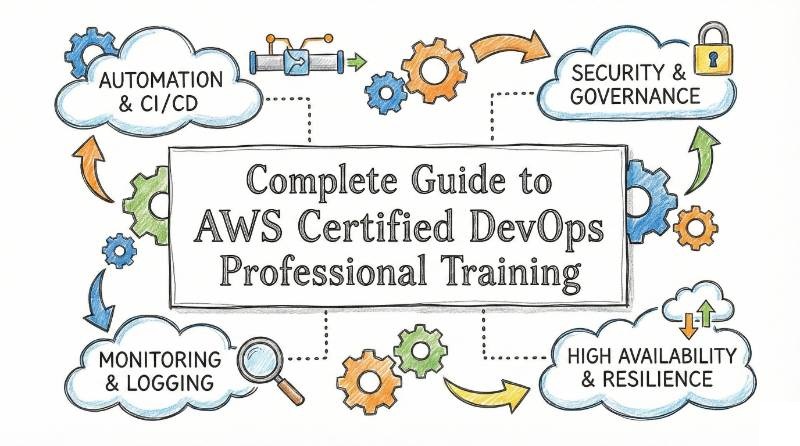
In the early days of IT, we managed servers with screwdrivers and serial cables. As the industry shifted toward the cloud, the role of the engineer transformed from a hardware specialist to a code architect. Today, navigating the AWS ecosystem is no longer about just “knowing” a few services; it is about mastering the art of automation, reliability, and security at a global scale.
If you are a working engineer or a manager in India or anywhere else in the global tech market, you have likely realized that the Associate-level certifications are just the beginning. To truly stand out and lead high-impact teams, you need to reach the professional tier. The AWS Certified DevOps Professional Training is designed specifically for this purpose. It is the gold standard for those who want to prove they can design, implement, and manage complex, distributed systems with zero manual intervention.
In this guide, we will break down the entire certification landscape, dive deep into the DevOps Professional track, and provide a clear roadmap for your career growth.
The AWS Certification Ecosystem
Before specializing, it is critical to understand where each certification fits. For software engineers and managers, choosing the right starting point saves hundreds of hours of trial and error.
AWS Certification Comparison Table
| Track | Level | Who it’s for | Prerequisites | Skills Covered | Recommended Order |
| Cloud Practitioner | Foundational | Managers, Sales, Entry-level | None | Basic Cloud, Billing, Security | 1st |
| Solutions Architect | Associate | Developers, Cloud Architects | Basic AWS Knowledge | System Design, S3, EC2, VPC | 2nd |
| Developer | Associate | Software Engineers, Coders | Coding Knowledge | SDKs, CI/CD, Serverless, DynamoDB | 3rd |
| SysOps Admin | Associate | System Admins, Ops Engineers | IT Ops Experience | Monitoring, Logging, Remediation | 3rd |
| DevOps Professional | Professional | Sr. Engineers, SREs | Associate Cert + 2yrs Exp | CI/CD, IaC, Security, SDLC | 4th |
| Solutions Architect | Professional | Lead Architects, Principals | Associate Cert + 2yrs Exp | Complex Architecture, Migration | 4th |
Deep Dive: AWS Certified DevOps Professional Training
This certification (exam code DOP-C02) is widely regarded as one of the most difficult but rewarding credentials in the tech world. It tests your ability to take a set of business requirements and turn them into a fully automated, resilient cloud environment.
What it is
The AWS Certified DevOps Professional Training is an advanced program that validates your technical expertise in provisioning, operating, and managing distributed application systems on the AWS platform. It moves beyond simple service usage and focuses on high-level patterns like automated governance, multi-account strategies, and sophisticated incident response.
Who should take it
This training is not for the faint of heart. It is specifically designed for:
- Working Engineers who have already mastered the basics and want to lead technical strategy.
- Site Reliability Engineers (SREs) who need to standardize reliability and performance across multiple teams.
- Software Engineers who are moving toward a “Full-Cycle Developer” model where they build, test, and run their own code.
- Engineering Managers who need to validate the technical roadmaps of their DevOps and Cloud teams.
Skills you’ll gain
This training changes the way you think about infrastructure. You stop seeing servers and start seeing “stacks” of code.
- Mastering SDLC Automation: You will learn to build pipelines that not only deploy code but also run security audits, performance tests, and blue/green traffic shifting automatically.
- Infrastructure as Code (IaC) at Scale: Moving beyond simple scripts, you will learn to use AWS CloudFormation and the CDK to manage hundreds of accounts and thousands of resources.
- Observability and Monitoring: You will gain the skills to move beyond simple “up/down” monitoring to deep observability, using CloudWatch, X-Ray, and OpenSearch to find the “needle in the haystack.”
- Event-Driven Operations: Learn how to use EventBridge and Lambda to create systems that fix themselves when they detect a failure or a security breach.
Real-world projects you should be able to do
After completing this training, you will have the technical authority to lead these types of enterprise projects:
- Automated Compliance Engine: Build a system that uses AWS Config and Lambda to automatically terminate any resource that violates company security policy (e.g., an S3 bucket made public).
- Global Multi-Region Disaster Recovery: Design a workload that automatically replicates data and redirects traffic to another part of the world in under five minutes during a regional outage.
- Self-Healing Kubernetes Clusters: Automate the scaling and patching of EKS clusters so that manual intervention is never required for routine maintenance.
Preparation plan
Based on years of watching engineers tackle this exam, I recommend three different paths:
- 7–14 Days (The Expert Sprint): This is for engineers who live and breathe AWS DevOps tools every day. Focus 100% on identification of the “AWS Gold Standard” answers. Take at least five full-length mock exams to build the mental stamina required for the 180-minute test.
- 30 Days (The Professional Path): This is the ideal timeline for most senior engineers. Spend 1 hour every morning on deep-dive video content. Dedicate your weekends to hands-on labs, specifically focusing on complex CodePipeline configurations and CloudFormation StackSets.
- 60 Days (The Foundational Journey): If you are transitioning from a different cloud provider or traditional IT, take your time. Spend the first 30 days building small, repeatable projects. Spend the next 30 days mastering the edge cases of the AWS CLI, SDKs, and security policies.
Common mistakes
Even the most talented engineers can trip up on this exam. Avoid these common pitfalls:
- The “Manual” Trap: If an exam question offers a solution that involves a human logging into the console to fix something, it is almost certainly the wrong answer.
- Ignoring the “Well-Architected” Pillars: AWS isn’t just looking for a functional solution; they want one that is cost-optimized and highly secure.
- Poor Time Management: Each question is a long scenario. If you don’t keep a steady pace, you will find yourself with 20 questions left and only 10 minutes on the clock.
- Underestimating IAM: Many DevOps Pro questions are secretly IAM questions. If you don’t understand cross-account roles and Service Control Policies (SCPs), you will struggle.
Best next certification after this
Once you have earned your DevOps Professional badge, the logical next step is the AWS Certified Security – Specialty. In the modern era of DevSecOps, being an automation expert who also understands deep security architecture makes you invaluable.
Choose Your Path: 6 Learning Tracks
The beauty of the AWS ecosystem is that once you have the DevOps foundation, you can branch out into specialized domains that match your career interests.
- DevOps Path: Focuses on the core CI/CD, automation, and speed of delivery. This is the heart of modern software engineering.
- DevSecOps Path: Focuses on shifting security left. You will master automated vulnerability scanning, IAM, and compliance-as-code.
- SRE Path: Focuses on system reliability, error budgets, and latency management. You become the guardian of the production environment.
- AIOps/MLOps Path: The frontier of the industry. You will learn to use AI to predict outages and manage the lifecycle of machine learning models at scale.
- DataOps Path: Focuses on the automation of data pipelines. You will learn how to treat data flows with the same rigor as application code.
- FinOps Path: Cloud costs are a board-level concern. This path focuses on financial accountability and automated cost optimization strategies.
Role → Recommended Certifications Mapping
Align your learning path with your career goals using this mapping:
- DevOps Engineer: AWS DevOps Professional + Terraform Associate.
- SRE (Site Reliability Engineer): AWS DevOps Professional + AWS SysOps Associate.
- Platform Engineer: AWS DevOps Professional + Certified Kubernetes Administrator (CKA).
- Cloud Engineer: AWS Solutions Architect Associate + AWS DevOps Professional.
- Security Engineer: AWS Security Specialty + AWS DevOps Professional.
- Data Engineer: AWS Data Engineer Associate + AWS Solutions Architect Associate.
- FinOps Practitioner: AWS Cloud Practitioner + FinOps Certified Practitioner.
- Engineering Manager: AWS Cloud Practitioner + AWS Solutions Architect Associate.
Next Certifications to Take
To continue your growth as a Software Engineer and Cloud Leader, consider these three strategic options after your DevOps Professional training:
- Same Track (Deepening Skills): AWS Certified Security – Specialty. This is the highest value specialty for any DevOps professional today.
- Cross-Track (Broadening Skills): Certified Kubernetes Administrator (CKA). Since EKS is the backbone of most AWS DevOps environments, mastering Kubernetes is the ultimate force multiplier.
- Leadership (Strategic Growth): AWS Certified Solutions Architect – Professional. This allows you to step back from the “how” and focus on the high-level business architecture and migration strategies.
Top Institutions for AWS Certified DevOps Training
Clearing a Professional-level exam often requires more than just self-study. These institutions are recognized for their ability to provide the hands-on mentorship needed to succeed:
- DevOpsSchool: A leader in the space, DevOpsSchool provides deep-dive training that focuses on the practical application of 50+ DevOps tools alongside the AWS curriculum. Their project-based approach is ideal for working engineers.
- Cotocus: Known for its rigorous technical bootcamps, Cotocus helps professionals bridge the gap between traditional operations and modern cloud-native practices with expert-led sessions.
- Scmgalaxy: A massive community-driven platform that offers extensive resources and specialized training for engineers who want to master the “Source Code Management” side of DevOps.
- BestDevOps: Focuses on high-quality, streamlined learning paths that respect the busy schedules of working managers while ensuring technical depth is never sacrificed.
- DevSecOpsSchool: The go-to institution for those looking to integrate security deeply into their AWS workflows, offering specialized courses on automated security testing.
- Sreschool: Dedicated to the discipline of Site Reliability Engineering, this school provides specific modules on building resilient systems that can withstand regional outages.
- Aiopsschool: Leading the charge into the future, this school teaches you how to use AI and Machine Learning to manage complex AWS environments automatically.
- Dataopsschool: Perfect for engineers working in data-heavy environments, focusing on the automation and governance of data lakes and pipelines on AWS.
- Finopsschool: Specializes in the growing field of cloud financial management, teaching you how to use AWS tools to keep cloud spending under control and aligned with business goals.
FAQs (General Career Outcomes)
1. Is the AWS DevOps Professional exam worth the effort?
Yes. In my years of seeing the market shift, this is the one certification that consistently increases earning potential and job security.
2. How difficult is it compared to the Associate exams?
It is a massive jump. The Associate exams test what services do; the Professional exam tests how those services solve complex, failing scenarios.
3. Do I need to be a programmer to pass?
You need to be able to read and understand code (Python, YAML, JSON) and understand logic, as the exam focuses heavily on Lambda and CloudFormation.
4. What is the recommended sequence for these exams?
I recommend: Solutions Architect Associate -> SysOps Associate -> DevOps Professional. This builds a strong foundational knowledge.
5. How much can I expect my salary to increase?
While it varies, many professionals see a 20% to 40% increase in total compensation after earning this credential and the skills that come with it.
6. Is it recognized in India and globally?
Absolutely. AWS is the global market leader, and this certification is respected by every major tech hub from Bangalore to Silicon Valley.
7. Can I take the training online?
Yes, most top providers like DevOpsSchool offer fully online, instructor-led sessions that are perfect for working professionals.
8. How many questions are on the exam?
There are 75 questions, and you have 180 minutes to complete them.
9. What is the passing score?
You need a score of 750 out of 1000.
10. How long does the certification stay valid?
It is valid for three years, after which you will need to recertify to stay current with the latest AWS features.
11. Does the exam cover Kubernetes?
Yes, you will encounter scenarios involving Amazon EKS and ECS, focusing on deployment and scaling patterns.
12. What happens if I fail the exam?
You can retake the exam after 14 days. Don’t be discouraged; many experts fail on their first attempt due to the complexity of the questions.
FAQs (AWS Certified DevOps Professional Training)
1. What is the main focus of this training?
The main focus is on the automation of the entire software lifecycle, from code commit to production monitoring.
2. Which AWS services are emphasized most?
CloudFormation, CodePipeline, CloudWatch, AWS Config, and Systems Manager are the “heavy hitters” in this training.
3. Is there a lot of hands-on work?
Yes. To pass, you must spend at least 50% of your time in the AWS console or using the CLI to build actual pipelines.
4. Does the training cover multi-account setups?
Yes, AWS Organizations and cross-account IAM roles are major components of the Professional-level curriculum.
5. How much does the exam cost?
The standard price for the AWS Professional exam is $300 USD.
6. Can I take the exam from my home?
Yes, AWS offers proctored online exams that allow you to take the test from your home or office.
7. What is the best way to handle the long scenario questions?
Read the last sentence of the question first to understand exactly what is being asked, then skim the scenario for key constraints (like cost or time).
8. Is the training sufficient to get a job?
The training provides the technical foundation, but your ability to talk about real-world projects during interviews will be the final step to landing a senior role.
Conclusion
Earning your AWS Certified DevOps Professional Training certification is more than just passing a test; it is a commitment to becoming a leader in the cloud space. Throughout the evolution of the cloud, we have seen that the most successful engineers are those who embrace automation and treat infrastructure with the same care as application code. By mastering the concepts of CI/CD, Infrastructure as Code, and automated security, you are not just future-proofing your career—you are becoming the architect of the digital world. Whether you are leading a team in India or working on a global project, the skills you gain here will be the foundation of everything you build. Take the leap, invest in your training, and join the elite ranks of AWS Professional experts.

Find Trusted Cardiac Hospitals
Compare heart hospitals by city and services — all in one place.
Explore Hospitals
Awesome guide! This makes the AWS Certified DevOps Professional journey much easier to understand — especially the way you break down the domains and real-world skills needed. Really helpful for anyone planning their certification path. Thanks for sharing!