
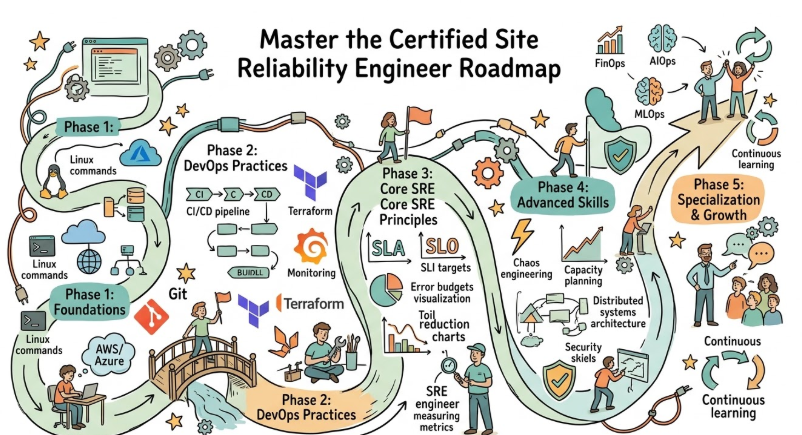
The role of a Site Reliability Engineer has evolved from a niche Google-inspired experiment into the backbone of modern enterprise infrastructure. This guide is designed for software engineers, systems administrators, and platform architects who want to transition into or excel within the SRE domain. By focusing on the Certified Site Reliability Engineer designation, professionals can validate their ability to bridge the gap between development and operations. As organizations shift toward cloud-native architectures, understanding these principles is no longer optional for those seeking high-impact roles at DevOpsSchool and other global technology leaders. This comprehensive breakdown helps you navigate the certification landscape to make informed decisions about your professional growth and technical trajectory.
What is the Certified Site Reliability Engineer?
The Certified Site Reliability Engineer represents a standard of excellence in applying software engineering mindsets to traditional operations problems. It is not merely a badge for knowing specific tools; rather, it signifies a deep understanding of how to build and maintain scalable, reliable, and efficient distributed systems. This certification exists to bridge the theoretical concepts of the SRE Handbook with the messy, complex reality of production environments. It emphasizes a culture of automation, data-driven decision-making through Service Level Objectives (SLOs), and a proactive approach to incident management. By focusing on production-grade excellence, it prepares engineers to handle the high-stakes demands of modern enterprise IT workflows.
Who Should Pursue Certified Site Reliability Engineer?
This certification is tailored for a broad spectrum of technical professionals who are responsible for the health and performance of digital services. Backend software engineers looking to understand the operational lifecycle of their code will find immense value, as will traditional DevOps and Cloud engineers seeking to specialize in reliability. Security and data professionals also benefit, as the principles of toil reduction and observability are universal across all modern infrastructure pillars. In both the Indian tech ecosystem and the global market, engineering managers and technical leads should pursue this knowledge to build more resilient teams and establish realistic performance targets for their products. Even early-career engineers can use this as a foundational pillar to differentiate themselves in a competitive hiring landscape.
Why Certified Site Reliability Engineer is Valuable and Beyond
In an era where downtime translates directly to massive financial loss and brand damage, the demand for SRE expertise has never been higher. Enterprise adoption of microservices and Kubernetes has increased architectural complexity, making the structured approach of an SRE indispensable. This certification provides professional longevity because it teaches fundamental principles—like error budgets and observability—that remain relevant even as specific cloud providers or tools change. It offers a significant return on investment by positioning professionals for senior roles that command higher compensation and greater architectural influence. Ultimately, it equips you to move away from “firefighting” and toward a career of strategic, high-value engineering.
Certified Site Reliability Engineer Certification Overview
The program is delivered via the official training modules and hosted on the sreschool.com platform. It is structured as a comprehensive journey that moves from foundational theory to advanced, hands-on architectural challenges. The assessment approach is designed to be practical, testing a candidate’s ability to diagnose systemic issues rather than just memorizing definitions. Ownership of the certification rests with industry-recognized bodies that ensure the curriculum stays aligned with current enterprise needs. By following a tiered structure, the program allows participants to build their skills incrementally, ensuring that each level of certification corresponds to a verifiable increase in technical capability.
Certified Site Reliability Engineer Certification Tracks & Levels
The certification is categorized into three primary tiers: Foundation, Professional, and Advanced. The Foundation level introduces the core vocabulary and philosophy of SRE, making it ideal for those transitioning from development or traditional sysadmin roles. The Professional level dives deep into the implementation of observability, automation, and incident response frameworks. Finally, the Advanced level focuses on site reliability leadership and complex system architecture. These levels align directly with career progression, moving from individual contributor tasks to high-level system design and organizational strategy. Specialization tracks also allow engineers to lean into specific areas such as SRE for FinOps or SRE for AI-driven environments.
Complete Certified Site Reliability Engineer Certification Table
| Track | Level | Who it’s for | Prerequisites | Skills Covered | Recommended Order |
| SRE Core | Foundation | Aspiring SREs | Basic Linux/Cloud | SLIs, SLOs, Error Budgets, Toil | 1st |
| SRE Core | Professional | Experienced DevOps | Foundation Level | Observability, Post-mortems, CI/CD | 2nd |
| SRE Core | Advanced | Senior Architects | Professional Level | Capacity Planning, Chaos Engineering | 3rd |
| Automation | Specialist | Automation Engineers | Scripting Knowledge | Python/Go for SRE, IaC, Self-healing | 2nd (Parallel) |
| Security | Specialist | DevSecOps Engineers | Security Basics | Incident Response, Hardening, Compliance | 2nd (Parallel) |
Detailed Guide for Each Certified Site Reliability Engineer Certification
Certified Site Reliability Engineer
What it is
This certification validates a candidate’s understanding of the core SRE philosophy and the fundamental metrics used to measure reliability. It ensures the practitioner can speak the language of SRE and understands the cultural shift required.
Who should take it
Ideal for junior engineers, developers moving into operations, or managers who need to oversee SRE teams without getting into the deep technical weeds.
Skills you’ll gain
- Defining and measuring Service Level Indicators (SLIs).
- Calculating and managing Error Budgets.
- Identifying and eliminating operational Toil through automation.
- Understanding the lifecycle of an incident.
Real-world projects you should be able to do
- Create a basic dashboard representing the “Golden Signals” of a service.
- Draft an Error Budget policy for a non-critical microservice.
- Automate a recurring manual task using basic shell or Python scripting.
Preparation plan
- 7-14 days: Review the SRE Workbook chapters 1-5 and memorize key terminology.
- 30 days: Complete the foundational lab exercises and practice building simple monitoring alerts.
- 60 days: Engage in peer discussions and take multiple practice exams to ensure conceptual clarity.
Common mistakes
- Treating SRE as just “DevOps with a different name.”
- Ignoring the cultural aspect of blamelessness in favor of pure technical tools.
Best next certification after this
- Same-track option: Certified Site Reliability Engineer – Professional
- Cross-track option: DevOps Foundation
- Leadership option: Engineering Management Core
Choose Your Learning Path
DevOps Path
This path focuses on the integration of SRE principles into the continuous delivery pipeline. It is designed for engineers who want to ensure that code is not just delivered quickly, but is also inherently stable and observable from the moment it is committed. You will learn to treat infrastructure as code and integrate automated testing for reliability. This path effectively bridges the gap between high-velocity feature development and the stability required by the business.
DevSecOps Path
The DevSecOps path layers security directly into the SRE framework. Here, reliability includes the “integrity” and “availability” pillars of security. You will learn how to automate security scanning and incident response within the SRE workflow, ensuring that security is not a bottleneck. This is ideal for professionals in highly regulated industries like finance or healthcare. It emphasizes that a service cannot be reliable if it is not secure.
SRE Path
This is the “pure” track dedicated to those who want to hold the title of Site Reliability Engineer. It focuses heavily on systems internals, distributed systems architecture, and the mathematics of reliability. You will master the art of capacity planning and performance tuning for large-scale deployments. This path prepares you for the most technical challenges in the operations world, focusing on making complex systems predictable.
AIOps Path
The AIOps path focuses on using machine learning and data science to enhance the reliability of systems. You will learn how to implement predictive analytics to catch failures before they happen and automate root cause analysis. This is the cutting edge of SRE, where human intervention is minimized by intelligent algorithms. It is perfect for those who want to work at the intersection of infrastructure and artificial intelligence.
MLOps Path
This path is specifically designed for managing the reliability of machine learning models in production. Unlike standard software, ML models require monitoring for “data drift” and “model decay,” which are unique reliability challenges. You will apply SRE principles like SLOs and observability to the ML pipeline. This ensures that AI-driven products remain accurate and performant over time.
DataOps Path
DataOps focuses on the reliability of data pipelines and large-scale data warehouses. In this path, you learn to apply SRE concepts to ensure data quality, low latency in data processing, and high availability of data assets. You will deal with the complexities of stateful systems and large-scale storage. This is essential for organizations that rely on real-time data for business intelligence.
FinOps Path
The FinOps path blends site reliability with cloud financial management. You will learn how to optimize infrastructure for cost without compromising on performance or reliability. This involves understanding the unit economics of cloud resources and automating cost-saving measures. As cloud bills grow, the ability to balance the “Golden Signals” with budget constraints becomes a critical skill for senior engineers.
Role → Recommended Certified Site Reliability Engineer Certifications
| Role | Recommended Certifications |
| DevOps Engineer | SRE Foundation, SRE Automation Specialist |
| SRE | SRE Foundation, Professional, and Advanced |
| Platform Engineer | SRE Professional, Infrastructure as Code Track |
| Cloud Engineer | SRE Foundation, Cloud-Specific SRE Specialist |
| Security Engineer | SRE Foundation, DevSecOps Specialist |
| Data Engineer | SRE Foundation, DataOps Specialist |
| FinOps Practitioner | SRE Foundation, FinOps Specialist |
| Engineering Manager | SRE Foundation, SRE Leadership Track |
Next Certifications to Take After Certified Site Reliability Engineer
Same Track Progression
Once you have mastered the Advanced Certified Site Reliability Engineer level, you should look toward deep specialization. This might include becoming a subject matter expert in specific technologies like Kubernetes Operators or specialized database reliability. Deep specialization allows you to become a “Distinguished Engineer” or a “Principal SRE” who handles the most complex, company-wide reliability challenges. It involves moving from managing services to managing the platforms that host those services.
Cross-Track Expansion
If you have mastered SRE, expanding into Security (DevSecOps) or Data (DataOps) is a logical next step to become a multi-dimensional architect. Understanding how reliability interacts with other domains makes you an invaluable asset during the design phase of a project. For example, an SRE with deep security knowledge can design systems that are both resilient to traffic spikes and resistant to sophisticated cyber-attacks. This broadening of skills prevents professional stagnation.
Leadership & Management Track
For those looking to move away from the terminal and into organizational strategy, the leadership track is the way forward. This involves learning how to build SRE cultures, manage budgets, and align technical reliability goals with business objectives. You would focus on certifications centered around Technical Program Management or Engineering Leadership. This transition allows you to influence the reliability of an entire organization rather than just a few services.
Training & Certification Support Providers for Certified Site Reliability Engineer
DevOpsSchool offers an extensive array of practical training programs designed to mirror real-world production challenges. Their curriculum is built by industry veterans who focus on the “how-to” rather than just the “what-is.” They provide mentored projects that help students build a portfolio of work while pursuing their SRE certification.
Cotocus provides high-end consulting and training for specialized engineering roles. They focus on niche areas within the SRE domain, offering tailored tracks for different enterprise needs. Their approach is highly interactive, ensuring that theoretical knowledge is immediately backed by hands-on lab experience.
Scmgalaxy is a long-standing community and training resource for configuration management and SRE professionals. They offer a wealth of documentation, tutorials, and certification prep materials that are widely used by engineers in India. Their focus is on building a strong community of practitioners who share knowledge.
BestDevOps specializes in delivering accelerated training programs for busy professionals. Their SRE tracks are designed to get engineers up to speed with the latest reliability tools and methodologies in a short timeframe. They emphasize efficiency and exam readiness without sacrificing depth.
devsecopsschool.com is the primary resource for engineers who want to blend SRE principles with modern security practices. They provide the specific training needed to navigate the DevSecOps track mentioned earlier. Their labs focus on building secure-by-default infrastructure.
sreschool.com serves as the central hub for the Certified Site Reliability Engineer program. It hosts the official course materials, certification exams, and the most up-to-date curriculum. It is the definitive source for any professional looking to validate their SRE skills officially.
aiopsschool.com addresses the growing intersection of artificial intelligence and systems operations. They provide specialized training for the AIOps path, teaching engineers how to leverage machine learning for predictive maintenance. Their courses are essential for staying at the cutting edge of automation.
dataopsschool.com focuses on the unique challenges of managing data reliability at scale. They provide the training necessary for the DataOps path, ensuring that data engineers can apply SRE rigor to their pipelines. Their curriculum covers everything from database reliability to data quality monitoring.
finopsschool.com provides the training required to master the financial aspects of cloud reliability. They help engineers understand how to manage the cost of reliability, which is a key skill for senior leadership roles. Their programs are highly valued by organizations looking to optimize their cloud spend.
Frequently Asked Questions (General)
How difficult is the SRE certification compared to others?
The SRE certification is generally considered more difficult than standard cloud practitioner exams because it requires a combination of coding skills, systems knowledge, and architectural thinking. It tests your ability to solve problems rather than just identify services.
How long does it typically take to complete the certification?
For someone with a background in DevOps or Linux administration, the Foundation level can be achieved in 30 days. The Professional and Advanced levels typically require 3 to 6 months of dedicated study and hands-on practice.
What are the prerequisites for the Foundation level?
There are no formal prerequisites, but a basic understanding of Linux command lines, networking, and at least one cloud provider (AWS, Azure, or GCP) will make the learning process much smoother.
Will this certification help me get a job in a different country?
Yes, SRE principles are universal. Companies like Google, Amazon, and Meta use these frameworks globally, making the certification a strong credential for international relocation or remote work for global firms.
Is coding required for SRE certification?
While you don’t need to be a senior software developer, you do need to be comfortable with scripting (Python, Bash, or Go) because automation is a core pillar of the SRE philosophy.
How does SRE differ from traditional DevOps?
While DevOps is a broad cultural philosophy of collaboration, SRE is a specific implementation of that philosophy. As the saying goes, “class SRE implements interface DevOps.”
What is the return on investment (ROI) for this certification?
SREs are among the highest-paid professionals in the IT industry. The certification can often lead to a salary increase of 20% to 50% depending on your previous role and experience level.
Can I take the exam online?
Yes, most providers, including those mentioned above, offer proctored online exams that you can take from the comfort of your home or office.
Does the certification expire?
Most technical certifications require renewal every 2 to 3 years to ensure your skills remain current with the latest technology trends and tool updates.
What is the passing score for the exams?
While it varies by track, a passing score is typically around 70%. The focus is on ensuring you have a functional understanding of all the key domains.
Are there lab-based questions in the exam?
Professional and Advanced levels often include scenario-based questions that simulate real-world system failures, requiring you to choose the correct sequence of actions to restore service.
Can a manager benefit from this certification?
Absolutely. Managers need to understand terms like “Error Budgets” to make informed decisions about when to push for new features versus when to focus on stability.
FAQs on Certified Site Reliability Engineer
Is the Certified Site Reliability Engineer program recognized by major tech companies?
The program is built on the industry-standard frameworks popularized by major tech firms. It is highly regarded by hiring managers because it emphasizes practical, production-ready skills that can be applied immediately on the job.
Does the course cover specific tools like Prometheus and Kubernetes?
Yes, while the certification is grounded in principles, the training includes deep dives into the most relevant industry tools. You will gain hands-on experience with the standard CNCF landscape used by modern SRE teams.
How is the assessment conducted for the Advanced level?
The Advanced level involves more complex, scenario-based evaluations. It tests your ability to design resilient architectures and manage organizational-level reliability challenges, moving beyond simple troubleshooting to strategic system design.
Are there community resources available for students?
Students have access to extensive forums and peer groups through the various school portals. This community support is vital for discussing complex scenarios and sharing real-world experiences that go beyond the textbook.
Can I transition from a manual QA role to SRE through this?
Yes, but it requires a bridge. You would start with the Foundation level to understand the principles while simultaneously building your automation and scripting skills to handle the technical requirements.
What makes this different from a Cloud Provider certification?
Cloud certifications teach you how to use a specific provider’s tools. The Certified Site Reliability Engineer teaches you how to keep any system running reliably, regardless of where it is hosted.
Is there a focus on “Soft Skills” like communication?
Yes, SRE is a collaborative role. The certification covers incident communication, blameless culture, and how to negotiate SLOs with product owners, which are all critical non-technical skills.
Is the curriculum updated frequently?
The curriculum is reviewed annually to ensure it reflects the latest changes in the cloud-native ecosystem. This ensures that the skills you learn are always relevant to the current job market.
Conclusion
From the perspective of a senior mentor, the answer is a practical “yes,” provided you are willing to do the work. The industry has moved past the point where “knowing how to deploy” is enough; you must now know how to ensure that deployment survives under pressure. This certification isn’t a magic ticket to a high salary, but it is a rigorous roadmap that forces you to master the most valuable skills in modern engineering. It shifts your value proposition from “I can fix things” to “I can build systems that don’t break.” If you are tired of being paged at 3 AM and want to take a proactive, engineering-led approach to your career, this is the right path. Focus on the labs, embrace the culture of blamelessness, and treat your infrastructure as code. The investment you make in these principles today will pay dividends for the next decade of your career.

Find Trusted Cardiac Hospitals
Compare heart hospitals by city and services — all in one place.
Explore Hospitals
This blog gives a clear and practical roadmap for becoming a Site Reliability Engineer. I like how it explains the required skills, tools, and step-by-step learning path in a simple way. It’s a helpful read for anyone who wants to build a strong career in SRE and understand how to grow in this field.