
Introduction
The Certified Site Reliability Professional is a comprehensive validation program designed for engineers who want to master the art of keeping complex systems reliable, scalable, and efficient. As a career mentor with two decades in the industry, I have seen the shift from traditional sysadmin roles to the modern SRE paradigm, and this certification serves as a critical bridge for that transition. This guide is written for software engineers, DevOps practitioners, and platform leaders who need to understand how to implement SRE principles beyond the theoretical “Google Book” definitions.
By choosing to pursue this path through SREschool, you are signaling to the industry that you possess the practical skills required to manage production environments at scale. This guide matters today because the gap between writing code and maintaining its health in a cloud-native world is widening. We will break down every aspect of the certification to help you decide if this investment aligns with your specific career trajectory in DevOps, cloud-native engineering, or platform architecture.
What is the Certified Site Reliability Professional?
The Certified Site Reliability Professional represents a standardized benchmark for excellence in the field of reliability engineering. It exists to solve a specific problem in the hiring market: the lack of a uniform way to measure an engineer’s ability to handle high-pressure production environments. Unlike generic cloud certifications that focus on clicking buttons in a console, this program focuses on the cultural and technical intersection of software development and IT operations.
It emphasizes real-world, production-focused learning, moving away from academic theory and toward the implementation of Service Level Objectives (SLOs), error budgets, and toil reduction. The certification aligns with modern engineering workflows by integrating deeply with automated CI/CD pipelines and enterprise-grade observability stacks. It is designed to ensure that an engineer can not only build a system but also guarantee its stability under varying loads and failure scenarios.
Who Should Pursue Certified Site Reliability Professional?
The program is primarily designed for working software engineers and DevOps professionals who are responsible for the uptime and performance of digital services. Systems administrators looking to modernize their skill sets will find this path particularly rewarding as it provides a structured transition into the world of automation and “operations as software.” Even security and data professionals can benefit, as the principles of reliability are increasingly applied to DevSecOps and DataOps pipelines.
From a seniority perspective, it caters to everyone from junior engineers looking for their first break in SRE to engineering managers who need to lead high-performing reliability teams. In the global market, and specifically within the rapidly maturing tech landscape in India, there is a massive demand for certified talent who can handle the scale of millions of concurrent users. This certification provides the credentials needed to move into senior or lead roles within multinational enterprises and high-growth startups alike.
Why Certified Site Reliability Professional is Valuable and Beyond
The demand for reliability expertise is at an all-time high because every modern business is now a software business. As organizations move from simple cloud migration to complex microservices and distributed architectures, the “cost of downtime” becomes astronomical. The Certified Site Reliability Professional helps you stay relevant because it teaches foundational principles like observability and automation that remain constant even as specific tools like Kubernetes or Terraform evolve.
Longevity in this field comes from understanding the “why” behind the “how,” and this certification emphasizes sustainable engineering practices that prevent burnout and technical debt. Enterprises are increasingly adopting SRE as their standard operating model, making this certification a high-return investment for your career. By mastering these competencies, you ensure that you are viewed as a high-value asset capable of protecting the company’s bottom line through superior system performance.
Certified Site Reliability Professional Certification Overview
The program is delivered via the official portal at Certified Site Reliability Professional and is hosted on SREschool.com. It is structured as a multi-tiered journey that moves from foundational concepts to advanced architectural patterns. The assessment approach is rigorous, combining objective theoretical testing with practical, hands-on labs that simulate real-world system failures and performance bottlenecks.
Ownership of the certification remains with the professional body that ensures the curriculum is updated frequently to reflect current industry trends. The structure is practical, focusing on the five pillars of SRE: embracing risk, setting service level objectives, reducing toil, monitoring distributed systems, and automating everything. This ensures that when you complete the program, you have a portfolio of knowledge that is immediately applicable to any production environment you manage.
Certified Site Reliability Professional Certification Tracks & Levels
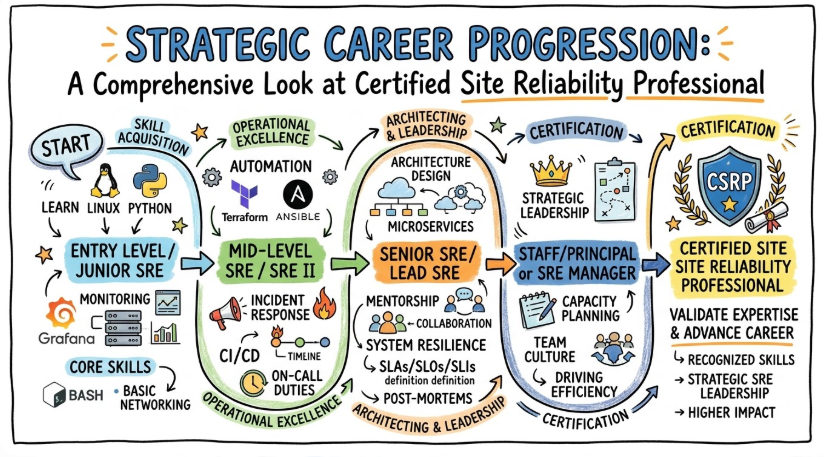
The certification is categorized into three distinct levels to support career progression from entry-level to leadership. The Foundation level focuses on the terminology and basic metrics of reliability. The Professional level dives deep into implementation, automation, and incident response management. Finally, the Advanced level is reserved for those who architect large-scale distributed systems and lead entire SRE organizations.
Specialization tracks allow professionals to tailor their learning toward specific domains such as SRE for FinOps or SRE for AI-driven systems. These levels align with the typical career progression of an engineer, moving from an individual contributor focusing on specific services to a principal architect looking at the reliability of an entire global platform. Each level builds upon the previous one, ensuring a cohesive learning experience that prevents knowledge gaps.
Complete Certified Site Reliability Professional Certification Table
| Track | Level | Who it’s for | Prerequisites | Skills Covered | Recommended Order |
| Core SRE | Foundation | Beginners, Junior Devs | Basic Linux & Networking | SLOs, SLIs, Toil, Error Budgets | 1 |
| Core SRE | Professional | SREs, DevOps Engineers | 2+ years experience | Automation, Observability, IaC | 2 |
| Core SRE | Advanced | Architects, Leads | 5+ years experience | Distributed Systems, Post-mortems | 3 |
| Platform | Foundation | Platform Engineers | Cloud Fundamentals | Kubernetes, Service Mesh | 1 |
| Operations | Professional | Cloud Engineers | Scripting knowledge | Incident Response, On-call Ops | 2 |
Detailed Guide for Each Certified Site Reliability Professional Certification
Certified Site Reliability Professional – Foundation
What it is
The Foundation level validates your understanding of the core vocabulary and philosophy of SRE. It ensures you understand the difference between SRE and DevOps and how to define reliability in business terms.
Who should take it
This is ideal for junior engineers, fresh graduates, or traditional systems administrators who are new to the SRE mindset. It is also suitable for product managers who need to understand engineering trade-offs.
Skills you’ll gain
- Defining and calculating SLIs and SLOs.
- Identifying and measuring manual toil.
- Understanding the error budget concept.
- Basic incident management terminology.
Real-world projects you should be able to do
- Draft a basic Service Level Agreement (SLA) for a web application.
- Calculate the downtime allowed for a “three nines” (99.9%) availability target.
Preparation plan
- 7-Day Plan: Focus on the official glossary and the core SRE pillars.
- 30-Day Plan: Read the fundamental SRE handbook chapters and take practice quizzes.
- 60-Day Plan: Study the business impact of reliability and interview experienced SREs about their daily routines.
Common mistakes
- Confusing SLOs with SLAs.
- Focusing too much on tools instead of culture and metrics.
Best next certification after this
- Same-track option: Certified Site Reliability Professional – Professional level.
- Cross-track option: Cloud Practitioner certification.
- Leadership option: Project Management foundation.
Certified Site Reliability Professional – Professional
What it is
The Professional level validates your ability to implement SRE practices using modern tooling and automation. It proves you can build resilient systems that self-heal and scale effectively.
Who should take it
Mid-level engineers with at least two years of experience in cloud environments. It is for those who are currently in the trenches managing production workloads and on-call rotations.
Skills you’ll gain
- Implementing full-stack observability (Logging, Metrics, Tracing).
- Automating infrastructure with Terraform and Ansible.
- Managing containerized workloads at scale.
- Advanced scripting for toil reduction.
Real-world projects you should be able to do
- Build an automated alerting system that triggers based on SLO burn rates.
- Design a self-healing mechanism for a microservices cluster.
Preparation plan
- 7-Day Plan: Deep dive into observability patterns and monitoring tools.
- 30-Day Plan: Hands-on lab work focusing on infrastructure as code and automation.
- 60-Day Plan: Full review of distributed system design patterns and failure mode analysis.
Common mistakes
- Over-engineering alerts leading to alert fatigue.
- Neglecting the “human” aspect of incident response.
Best next certification after this
- Same-track option: Certified Site Reliability Professional – Advanced level.
- Cross-track option: Certified Kubernetes Administrator (CKA).
- Leadership option: Technical Lead program.
Certified Site Reliability Professional – Advanced
What it is
The Advanced level validates your expertise in architecting global-scale distributed systems and leading organizational change. It focuses on high-level strategy and complex problem-solving.
Who should take it
Senior SREs, Principal Engineers, and Architects who are responsible for the reliability of complex, multi-region environments and mentoring large engineering teams.
Skills you’ll gain
- Designing for multi-region high availability.
- Leading blameless post-mortem cultures.
- Capacity planning and performance tuning at scale.
- Strategic alignment of engineering reliability with business goals.
Real-world projects you should be able to do
- Orchestrate a multi-region failover simulation (Chaos Engineering).
- Refactor an enterprise-wide incident response process.
Preparation plan
- 7-Day Plan: Review case studies of major industry outages and their resolutions.
- 30-Day Plan: Study advanced architectural patterns like Circuit Breakers and Bulkheads.
- 60-Day Plan: Draft a long-term reliability roadmap for a mock enterprise organization.
Common mistakes
- Focusing on micro-optimizations while missing systemic risks.
- Failing to foster a blameless culture during post-mortems.
Best next certification after this
- Same-track option: Deep specialization in Chaos Engineering.
- Cross-track option: Solutions Architect Professional.
- Leadership option: Engineering Management or CTO program.
Choose Your Learning Path
DevOps Path
This path focuses on integrating reliability into the continuous delivery pipeline. It is for engineers who want to ensure that speed of delivery does not compromise the stability of the production environment. You will learn how to automate testing and deployment while maintaining strict SLOs.
DevSecOps Path
The security path emphasizes the “Reliability is Security” mantra. It involves automating security checks within the SRE workflow and ensuring that system hardening is treated as a continuous reliability task. It is perfect for those who want to bridge the gap between compliance and uptime.
SRE Path
The pure SRE path is for those who want to specialize exclusively in production excellence. It covers the full spectrum from foundational metrics to advanced distributed systems. This path leads directly to roles in specialized SRE teams within major tech companies.
AIOps Path
This path explores how machine learning and artificial intelligence can be used to predict failures and automate incident response. It is designed for engineers looking to use data science techniques to manage massive scale that exceeds human manual capacity.
MLOps Path
The MLOps path focuses on the unique reliability challenges of machine learning models in production. It covers model drift, data pipeline stability, and the scaling of inference engines. This is essential for companies heavily invested in AI-driven products.
DataOps Path
DataOps focuses on the reliability of data pipelines and large-scale data warehouses. You will apply SRE principles to data quality, latency, and availability. It is a critical path for data engineers who need to guarantee the integrity of business intelligence.
FinOps Path
The FinOps path combines reliability with cloud cost management. It teaches you how to optimize infrastructure for both performance and budget, ensuring that your systems are not just reliable, but also financially sustainable for the business.
Role → Recommended Certified Site Reliability Professional Certifications
| Role | Recommended Certifications |
| DevOps Engineer | Foundation + Professional |
| SRE | Foundation + Professional + Advanced |
| Platform Engineer | Professional + Specialized Kubernetes Track |
| Cloud Engineer | Foundation + Professional |
| Security Engineer | Foundation + DevSecOps Specialization |
| Data Engineer | Foundation + DataOps Specialization |
| FinOps Practitioner | Foundation + FinOps Specialization |
| Engineering Manager | Foundation + Advanced (Strategy focused) |
Next Certifications to Take After Certified Site Reliability Professional
Same Track Progression
Once you have mastered the core SRE principles, the logical next step is to dive deeper into niche areas of reliability. This might include certifications in Chaos Engineering or specialized performance tuning for specific databases. Deep specialization makes you the go-to expert for solving the most “impossible” production issues that others cannot diagnose.
Cross-Track Expansion
Reliability does not exist in a vacuum, so expanding into cloud-specific architectural certifications or container orchestration (like Kubernetes) is highly recommended. Understanding the underlying infrastructure at a granular level complements your SRE knowledge. This broadening of skills makes you a versatile “T-shaped” engineer who can handle both the platform and the reliability layers.
Leadership & Management Track
For those looking to move away from hands-on keyboard work, transitioning into engineering management or technical program management is a viable path. Your background in SRE will be invaluable here, as you will have a data-driven approach to managing teams and making business decisions. Certifications in leadership or agile project management can help bridge this transition.
Training & Certification Support Providers for Certified Site Reliability Professional
DevOpsSchool
DevOpsSchool provides a robust ecosystem for professionals looking to master SRE concepts through mentored learning. Their curriculum is designed by industry veterans who understand the nuances of production environments. They offer extensive hands-on labs and real-world scenarios that prepare candidates for the rigors of the CSRP exam. Their focus is on building a strong foundation in automation and observability, ensuring that students can apply their knowledge immediately in their professional roles. The platform is well-regarded for its community support and the quality of its instructional materials, making it a top choice for those in the Indian and global markets.
Cotocus
Cotocus focuses on providing specialized training that aligns with the latest industry standards in site reliability and cloud-native engineering. Their approach is highly practical, emphasizing the tools and techniques used by top-tier tech companies to maintain high availability. They provide customized training programs that cater to both individual learners and corporate teams, ensuring that everyone can progress at their own pace. The instructors at Cotocus are practitioners themselves, which means the training is infused with real-world insights and best practices that go beyond what is found in standard textbooks. This makes them a valuable partner for CSRP preparation.
Scmgalaxy
Scmgalaxy is a comprehensive resource for everything related to software configuration management and DevOps. They have expanded their offerings to include deep-dive modules into SRE, recognizing the critical importance of reliability in the modern SDLC. Their training modules are known for being thorough and technically detailed, covering everything from basic Linux internals to complex distributed system patterns. Candidates seeking support for the CSRP certification will find a wealth of tutorials, practice tests, and community forums on Scmgalaxy. Their long-standing presence in the DevOps community makes them a trusted source for high-quality technical education and professional development.
BestDevOps
BestDevOps offers a curated learning experience specifically tailored for engineers aiming for elite certifications like the CSRP. Their training methodology centers on intensive bootcamps and interactive workshops that simulate the high-pressure environment of production on-call rotations. They prioritize the teaching of “soft” SRE skills, such as blameless post-mortems and effective communication during incidents, alongside deep technical competencies. This holistic approach ensures that their graduates are well-rounded professionals capable of leading reliability initiatives. BestDevOps is an excellent choice for those who prefer a more structured and fast-paced learning environment to achieve their certification goals quickly.
devsecopsschool.com
devsecopsschool.com is the premier destination for engineers who want to integrate security into their reliability and DevOps practices. Their support for the CSRP certification includes specialized modules on “Reliability as a Security Feature,” teaching students how to protect systems while maintaining uptime. They offer a range of self-paced and instructor-led courses that cover the intersection of security automation and SRE principles. For candidates who want their CSRP journey to have a strong security focus, this provider offers the perfect blend of technical depth and domain expertise. Their curriculum is constantly updated to address emerging threats and modern compliance requirements.
sreschool.com
sreschool.com is the primary authority and hosting site for the CSRP certification, offering the most direct and comprehensive support available. As the official source, they provide the definitive curriculum, official study guides, and the most accurate practice assessments. Their platform is designed to guide a learner from a complete novice to an advanced practitioner through a logical and well-structured path. Choosing sreschool.com for training ensures that you are learning exactly what is required for the certification without any fluff. Their resources are built by the same experts who designed the certification standards, providing unparalleled clarity and depth of knowledge.
aiopsschool.com
aiopsschool.com specializes in the next frontier of reliability engineering: the application of artificial intelligence to IT operations. Their support for CSRP candidates focuses on how to leverage machine learning models to enhance observability and automate anomaly detection. As systems become too complex for human monitoring alone, the skills taught here become essential for any modern SRE. They provide cutting-edge labs that allow students to work with real datasets to train models for predictive maintenance and automated root cause analysis. This makes them an ideal provider for those looking to future-proof their SRE career through AI integration.
dataopsschool.com
dataopsschool.com addresses the growing need for reliability within data engineering and analytics pipelines. Their contribution to CSRP preparation involves teaching how to apply SRE principles like SLOs and error budgets to data freshness, quality, and integrity. This is a critical niche, as businesses increasingly rely on real-time data for decision-making. Their training programs are tailored for data engineers who need to ensure that their pipelines are as resilient as the applications they support. By following their curriculum, CSRP candidates can specialize in the high-demand field of DataOps, ensuring they can manage complex data ecosystems at scale.
finopsschool.com
finopsschool.com provides the essential financial context that modern SREs need to succeed in a cloud-first world. Their support for the CSRP program emphasizes the “Cost” pillar of reliability, teaching engineers how to balance performance requirements with budgetary constraints. They offer detailed courses on cloud billing, resource optimization, and the cultural shifts required to implement FinOps within an SRE organization. For candidates aiming for senior or leadership roles, the knowledge gained from finopsschool.com is indispensable for proving the ROI of reliability initiatives to business stakeholders. They bridge the gap between technical excellence and financial responsibility effectively.
Frequently Asked Questions (General)
- How difficult is the CSRP exam?
The exam is moderately difficult and requires a solid mix of theoretical knowledge and practical experience with automation tools. - What is the typical time required to prepare?
Most professionals spend between 30 to 60 days preparing, depending on their existing experience with SRE concepts. - Are there any mandatory prerequisites?
While there are no strict mandatory prerequisites for the foundation level, a basic understanding of Linux and networking is highly recommended. - What is the ROI of this certification?
Certified professionals often see significant salary increases and are more likely to be recruited by top-tier technology firms. - In what order should I take the certifications?
It is recommended to start with Foundation, followed by Professional, and then specialize in a track like DevSecOps or AI. - Does the certification expire?
Most levels are valid for two to three years, after which recertification or moving to a higher level is required. - Is there a hands-on component to the assessment?
Yes, the Professional and Advanced levels include lab-based assessments where you must solve real-world system issues. - How does CSRP compare to other DevOps certifications?
CSRP is more focused on the long-term reliability and operational health of systems rather than just the deployment pipeline. - Can I take the exam online?
Yes, the certification is designed to be accessible globally through online proctored testing environments. - What happens if I fail the exam?
There is typically a waiting period before you can retake the exam, and a retake fee may apply depending on the provider. - Is this certification recognized in India?
Yes, it is highly recognized by major Indian IT hubs and multinational corporations operating within the region. - Are study materials provided?
Official study guides and practice labs are available through sreschool.com and authorized training partners.
FAQs on Certified Site Reliability Professional
- What specific tools are covered in the CSRP curriculum?
The curriculum is tool-agnostic but uses popular industry standards like Prometheus, Grafana, Terraform, and Kubernetes for practical demonstrations and labs. - Does the CSRP cover Google’s specific SRE implementation?
It uses Google’s SRE book as a foundational philosophy but adapts the practices for general enterprise use across different industries and scales. - How does CSRP address “toil”?
It provides specific frameworks for identifying, measuring, and eliminating repetitive manual work through strategic automation and process redesign. - Is the CSRP focused on a specific cloud provider like AWS or Azure?
No, it focuses on cloud-native principles that are applicable across AWS, Azure, Google Cloud, and even on-premises private cloud environments. - Does the certification teach incident command systems?
Yes, it covers how to organize teams during a major outage, including roles like Incident Commander, Scribe, and Communications Lead. - How are SLOs and SLIs tested in the exam?
You will be required to define appropriate metrics for different types of services and calculate error budgets based on availability targets. - What is the focus of the “Embracing Risk” section?
It teaches you how to balance the need for feature velocity with the requirement for system stability using data-driven risk assessment. - Can a manager benefit from CSRP without being a coder?
Yes, the Foundation level is excellent for managers to understand the metrics and culture needed to lead a successful SRE team.
Final Thoughts: Is Certified Site Reliability Professional Worth It?
In the current landscape of engineering, the title “Software Engineer” is no longer enough; you must also be a “Reliability Engineer.” The Certified Site Reliability Professional is more than just a piece of paper; it is a rigorous training ground that changes how you perceive and handle production systems. If you are looking for a way to differentiate yourself in a crowded market and move into high-impact roles, this certification is a logical and practical choice.
My advice as a mentor is to focus on the principles first and the tools second. Tools will change every few years, but the ability to define an SLO or conduct a blameless post-mortem will serve you for the rest of your career. This program provides the structure to master those timeless skills. If you are committed to the path of operational excellence and want to be responsible for the world’s most critical systems, this investment is absolutely worth your time and effort.

Find Trusted Cardiac Hospitals
Compare heart hospitals by city and services — all in one place.
Explore Hospitals
Great overview of the Certified Site Reliability Professional path and how it can shape a strategic career! I really appreciated how the article highlights both the skills and real‑world value of SRE certification — very useful for anyone planning their next step in tech. Thanks for the inspiring guide!