
Introduction
Agentic Procurement Automation Platforms are AI‑powered systems that automate and optimize procurement workflows, supplier management, contract analysis, spend forecasting, purchase approvals, compliance enforcement, and sourcing decisions. These platforms use intelligent agents to autonomously complete multi‑step tasks that previously required manual intervention, reduce process bottlenecks, and uncover insights hidden in fragmented procurement data.
In modern procurement organizations, these platforms matter because supply chains have grown more complex, regulatory requirements have tightened, and businesses are under pressure to reduce costs and accelerate decision cycles. Real‑world use cases include automated supplier risk assessment using external and internal data; predictive spend forecasting to anticipate budget overruns; AI‑assisted contract review to flag risk or compliance gaps; dynamic purchase order routing; automated approval escalation; real‑time compliance monitoring; and supplier performance tracking backed by analytics.
When evaluating these platforms, buyers should focus on criteria such as AI reliability and hallucination control, guardrails and policy enforcement, model support and flexibility, data privacy and retention, integration breadth, latency and cost controls, observability and traceability, auditability, governance controls, deployment options, and support resources.
Best for: procurement leaders, supply chain operations, enterprise sourcing teams, IT procurement integrators, and finance‑procurement alignment functions in mid‑market to enterprise organizations.
Not ideal for: very small businesses with low procurement volume, teams with bespoke manual contracting processes, or groups with limited IT/ERP integration needs where simpler tools suffice.
What’s Changed in Agentic Procurement Automation Platforms
- Agentic workflows that autonomously execute multi‑step procurement processes without human prompts.
- Support for multimodal inputs such as emails, spreadsheets, contracts, and unstructured text.
- Built‑in evaluation frameworks to detect AI inaccuracies and reduce hallucinations.
- Guardrails to prevent unauthorized AI actions and prompt injection.
- Enhanced enterprise privacy with data residency and retention controls.
- Cost and latency optimization through dynamic model routing and support for BYO models.
- Observability dashboards for tokens, latency, costs, and operational traces.
- Compliance‑ready architectures with comprehensive audit trails.
- AI‑assisted contract analysis with semantic search and risk scoring.
- Supplier risk prediction using real‑time and historical behavior data.
- Automated approval routing and exception management with trace logs.
- API‑first designs enabling easy ERP, finance, and procurement system integration.
Quick Buyer Checklist
- Confirm data privacy and retention policies meet internal and regulatory standards.
- Evaluate model support: proprietary, BYO model, or open‑source hosting.
- Check RAG/knowledge integration capabilities for contracts and supplier data.
- Ensure the platform offers robust evaluation and testing frameworks for AI outputs.
- Assess guardrails for policy enforcement and unauthorized action prevention.
- Review latency and cost controls to manage token usage.
- Validate auditability and administrative oversight features.
- Consider vendor lock‑in risks and integration flexibility.
- Ensure smooth integration with ERP, finance, and procurement systems.
- Review scalability for growing procurement volumes and workflows.
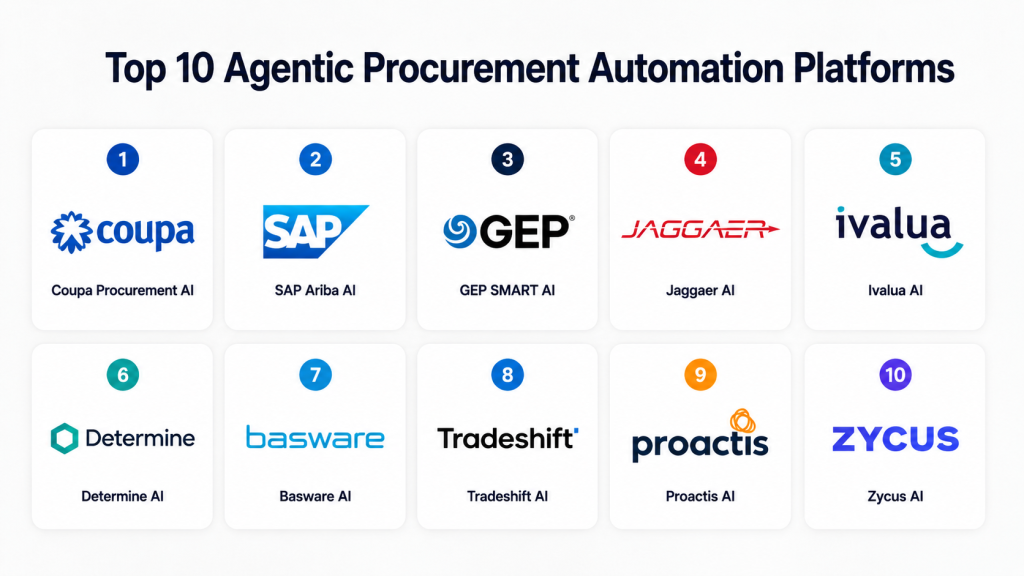
Top 10 Agentic Procurement Automation Platforms
1 — Coupa Procurement AI
One-line verdict: Best for enterprise procurement teams needing deep spend visibility and compliance automation.
Short description: Coupa Procurement AI automates key procurement processes with intelligent agents that help manage supplier selection, approvals, spend optimization, and compliance monitoring.
Standout Capabilities
- Automated purchase order generation and routing
- Supplier risk scoring using external data feeds
- Predictive spend forecasting dashboards
- Dynamic contract compliance checks
- Multi‑entity and multi‑currency support
- Advanced reporting and spend insights
AI‑Specific Depth
- Model support: Proprietary AI
- RAG / knowledge integration: Connectors to ERP, contracts, and spend data
- Evaluation: Regression tests, human review workflows
- Guardrails: Policy checks, prompt injection defense
- Observability: Token metrics, latency dashboards
Pros
- Enterprise‑grade spend and compliance reporting
- Strong supplier management automation
- Scales across global operations
Cons
- Complex initial configuration
- High cost for smaller teams
- Limited flexibility for BYO AI models
Security & Compliance
- Robust access controls with SSO/SAML, RBAC, audit logs, encryption
- Data residency and retention controls configurable
- Certifications: Not publicly stated
Deployment & Platforms
- Web‑based interface
- Cloud deployment
Integrations & Ecosystem
Integrates widely across procurement and financial systems:
- ERP and finance connectors
- Supplier portals
- APIs and SDKs for custom workflows
- Connector ecosystem for data analytics
Pricing Model
Tiered, usage‑based enterprise subscription packages
Best‑Fit Scenarios
- Global enterprise procurement teams
- Organizations with high compliance requirements
- Multi‑entity spend visibility needs
2 — SAP Ariba AI
One‑line verdict: Optimal for SAP‑aligned enterprises seeking integrated AI procurement workflows.
Short description: SAP Ariba AI embeds intelligent automation across sourcing, contracts, supplier evaluation, and compliance to align procurement with broader enterprise systems.
Standout Capabilities
- AI‑assisted supplier discovery and risk evaluation
- Automated order routing and approvals
- Predictive spend and demand forecasting
- Contract compliance and anomaly detection
- Supplier performance monitoring
AI‑Specific Depth
- Model support: Proprietary AI
- RAG / knowledge integration: Tight ERP integration with enterprise data
- Evaluation: Offline evaluation frameworks
- Guardrails: Policy enforcement and monitoring
- Observability: Transaction tracing and latency metrics
Pros
- Deep integration with SAP systems
- Extensive compliance and audit capabilities
- Strong enterprise feature set
Cons
- High complexity for implementation
- Requires SAP expertise
- Premium pricing
Security & Compliance
- Industry‑standard encryption, SSO, audit trails, access controls
- Certifications: Not publicly stated
Deployment & Platforms
- Web‑based, hybrid cloud support
Integrations & Ecosystem
- ERP and finance systems
- Supplier network connectors
- APIs for automation scripting
- Reporting and analytics platforms
Pricing Model
Tiered enterprise subscriptions
Best‑Fit Scenarios
- SAP enterprise procurement landscapes
- Regulated industries with strict compliance needs
- Large sourcing teams
3 — GEP SMART AI
One‑line verdict: Strong choice for unified AI‑driven spend and supplier analytics.
Short description: GEP SMART AI combines procurement automation with powerful analytics and collaboration tools to streamline sourcing and supplier management.
Standout Capabilities
- Intelligent sourcing and supplier scoring
- Predictive analytics and spend insights
- Contract lifecycle automation
- AI‑assisted decision support
- Workflow orchestration
AI‑Specific Depth
- Model support: Proprietary AI
- RAG / knowledge integration: ERP, contract, and spend databases
- Evaluation: Regression and human review
- Guardrails: Policy enforcement layers
- Observability: Metrics and dashboards
Pros
- Strong analytics and visualization
- Integrated supplier performance insights
- Flexible workflow automation
Cons
- Learning curve for non‑technical users
- Limited open‑source model support
- Premium pricing for full feature set
Security & Compliance
- Role‑based controls, encryption, audit logs
- Certifications: Not publicly stated
Deployment & Platforms
- Web interface
- Cloud / hybrid deployment
Integrations & Ecosystem
- ERP connectors
- Supplier portals
- APIs for custom integration
- Analytics and BI tools
Pricing Model
Tiered subscription with usage components
Best‑Fit Scenarios
- Mid‑market enterprises
- Teams needing consolidated analytics
- Supplier performance oversight
4 — Jaggaer AI
One‑line verdict: Good fit for mid‑market to enterprise teams focused on sourcing and risk automation.
Short description: Jaggaer AI enhances procurement workflows with intelligent sourcing, automated compliance checks, and supplier risk scoring.
Standout Capabilities
- AI‑driven sourcing events
- Supplier risk monitoring
- Contract compliance checks
- Predictive spend analytics
- Automated purchase approvals
AI‑Specific Depth
- Model support: Proprietary AI
- RAG / knowledge integration: ERP and contracts
- Evaluation: Human‑in‑the‑loop validation
- Guardrails: Policy compliance enforcement
- Observability: Performance dashboards
Pros
- Strong sourcing automation
- Practical supplier risk insights
- Flexible workflow configuration
Cons
- Requires IT support for integration
- Documentation can be challenging
- Less flexibility for small teams
Security & Compliance
- Encryption, audit logs, SSO
- Certifications: Not publicly stated
Deployment & Platforms
- Web
- Cloud / hybrid
Integrations & Ecosystem
- ERP and finance systems
- Supplier portals
- APIs for workflow automation
Pricing Model
Tiered enterprise subscription
Best‑Fit Scenarios
- Mid‑market procurement teams
- Risk‑driven sourcing workflows
- Contract‑intensive environments
5 — Ivalua AI
One‑line verdict: End‑to‑end procurement automation with strong supplier intelligence.
Short description: Ivalua AI provides full procurement lifecycle automation with AI‑assisted spend optimization and supplier insights.
Standout Capabilities
- Automated sourcing and contract workflows
- Supplier risk and performance scoring
- Spend visibility dashboards
- AI decision recommendations
- Compliance monitoring
AI‑Specific Depth
- Model support: Proprietary AI
- RAG / knowledge integration: ERP and supplier data
- Evaluation: Human oversight and offline tests
- Guardrails: Policy enforcement
- Observability: Latency and performance metrics
Pros
- End‑to‑end procurement coverage
- Detailed supplier analytics
- AI‑driven spend recommendations
Cons
- Premium pricing
- Customization complexity
- Implementation support often required
Security & Compliance
- Access controls, encryption, audit logs
- Certifications: Not publicly stated
Deployment & Platforms
- Web
- Cloud / hybrid
Integrations & Ecosystem
- ERP connectors
- Supplier portals
- APIs and analytics tools
Pricing Model
Tiered enterprise subscription
Best‑Fit Scenarios
- Complex procurement operations
- Enterprise global sourcing
- High compliance requirements
6 — Determine AI
One‑line verdict: Balanced option for AI‑enhanced sourcing and contract automation.
Short description: Determine AI enables automated sourcing, contract review, and supplier evaluation with intelligent agents.
Standout Capabilities
- AI‑assisted sourcing workflows
- Supplier performance tracking
- Automated approvals and notifications
- Spend dashboards
- Compliance flags and alerts
AI‑Specific Depth
- Model support: Proprietary AI
- RAG / knowledge integration: ERP and supplier systems
- Evaluation: Offline and human review
- Guardrails: Policy enforcement
- Observability: Metrics dashboards
Pros
- Strong sourcing automation
- Supplier analytics
- Flexible configuration
Cons
- Limited BYO model support
- Setup complexity for smaller teams
- Premium pricing
Security & Compliance
- SSO, encryption, audit logs
- Certifications: Not publicly stated
Deployment & Platforms
- Web
- Cloud / hybrid
Integrations & Ecosystem
- ERP connectors
- Supplier portals
- APIs for workflow integration
Pricing Model
Tiered subscription
Best‑Fit Scenarios
- Mid‑market procurement teams
- Compliance‑focused environments
- Multi‑step sourcing workflows
7 — Basware AI
One‑line verdict: Great for automated spending insights and invoice workflows.
Short description: Basware AI focuses on spend analytics, invoice management, and procurement workflow automation.
Standout Capabilities
- AI‑driven invoice automation
- Spend visibility and forecasting
- Supplier performance scoring
- Contract compliance tracking
- Approval workflow automation
AI‑Specific Depth
- Model support: Proprietary AI
- RAG / knowledge integration: ERP and finance systems
- Evaluation: Regression tests, human review
- Guardrails: Policy enforcement
- Observability: Metrics dashboards
Pros
- Automated spend insights
- Efficient invoice processing
- Supplier scoring features
Cons
- Limited BYO AI options
- Steeper learning curve
- Integration complexity
Security & Compliance
- SSO, encryption, audit logs
- Certifications: Not publicly stated
Deployment & Platforms
- Web
- Cloud / hybrid
Integrations & Ecosystem
- ERP connectors
- Supplier portals
- APIs for workflow automation
Pricing Model
Tiered subscription
Best‑Fit Scenarios
- Finance‑driven procurement teams
- Automated approvals and spend tracking
- Mid‑size to large enterprises
8 — Tradeshift AI
One‑line verdict: Best for supplier collaboration and network automation.
Short description: Tradeshift AI supports supplier collaboration, automated orders, compliance checks, and spend insights using intelligent agents.
Standout Capabilities
- Supplier collaboration hubs
- Automated purchase order approvals
- Spend analytics and reporting
- Contract risk scoring
- Workflow orchestration
AI‑Specific Depth
- Model support: Proprietary AI
- RAG / knowledge integration: ERP, finance, contracts
- Evaluation: Offline testing, human review
- Guardrails: Policy compliance
- Observability: Performance metrics
Pros
- Strong supplier collaboration features
- Flexible workflow design
- AI‑enhanced insight generation
Cons
- Implementation complexity
- Cost may be high for smaller teams
- Limited BYO AI support
Security & Compliance
- Encryption, audit logs, SSO
- Certifications: Not publicly stated
Deployment & Platforms
- Web
- Cloud / hybrid
Integrations & Ecosystem
- ERP connectors
- Supplier network integration
- APIs and analytics
Pricing Model
Tiered subscription
Best‑Fit Scenarios
- Mid‑market and enterprise procurement
- Supplier network collaboration
- Multi‑step workflow orchestration
9 — Proactis AI
One‑line verdict: Solid option for workflow automation and spend visibility.
Short description: Proactis AI automates purchase‑to‑pay, sourcing, and supplier management with intelligent agents.
Standout Capabilities
- Purchase‑to‑pay automation
- Supplier risk scoring
- Contract compliance checks
- Spend dashboards
- Automated approvals
AI‑Specific Depth
- Model support: Proprietary AI
- RAG / knowledge integration: ERP, contracts
- Evaluation: Human‑in‑the‑loop
- Guardrails: Policy enforcement
- Observability: Metrics dashboards
Pros
- Efficient workflow automation
- Integrated supplier insights
- Spend analysis
Cons
- Limited BYO AI model options
- Customization complexity
- Learning curve
Security & Compliance
- Audit logs, SSO, encryption
- Certifications: Not publicly stated
Deployment & Platforms
- Web
- Cloud / hybrid
Integrations & Ecosystem
- ERP systems
- Supplier portals
- APIs for integration
Pricing Model
Tiered subscription
Best‑Fit Scenarios
- Mid‑market teams
- Multi‑step workflows
- Risk‑aware spend management
10 — Zycus AI
One‑line verdict: Best for enterprise end‑to‑end procurement automation with analytics and compliance.
Short description: Zycus AI delivers sourcing, contract management, procurement analytics, and supplier collaboration with AI agents.
Standout Capabilities
- Automated sourcing events
- Contract lifecycle management
- Supplier performance analytics
- Spend visibility dashboards
- AI‑guided decisions
AI‑Specific Depth
- Model support: Proprietary AI
- RAG / knowledge integration: ERP, finance, contracts
- Evaluation: Offline validation, human review
- Guardrails: Policy enforcement, injection prevention
- Observability: Performance metrics and traces
Pros
- End‑to‑end automation
- Strong analytics and insights
- Scalable for enterprise networks
Cons
- Premium pricing
- Implementation complexity
- Limited BYO AI support
Security & Compliance
- SSO, encryption, RBAC
- Certifications: Not publicly stated
Deployment & Platforms
- Web
- Cloud / hybrid
Integrations & Ecosystem
- ERP and finance connectors
- Supplier portals
- APIs and SDKs
Pricing Model
Tiered subscription
Best‑Fit Scenarios
- Global enterprise procurement
- Analytics‑driven sourcing
- Complex multi‑entity spend strategies
Comparison Table
| Tool Name | Best For | Deployment | Model Flexibility | Strength | Watch‑Out | Public Rating |
|---|---|---|---|---|---|---|
| Coupa Procurement AI | Enterprise procurement teams | Cloud | Proprietary | Spend & compliance | Complex for small orgs | N/A |
| SAP Ariba AI | SAP enterprise environments | Cloud / hybrid | Proprietary | End‑to‑end integration | Implementation complexity | N/A |
| GEP SMART AI | Unified procurement & analytics | Cloud / hybrid | Proprietary | Analytics & insights | Learning curve | N/A |
| Jaggaer AI | Mid‑market to enterprise | Cloud / hybrid | Proprietary | Sourcing & risk | IT integration effort | N/A |
| Ivalua AI | Complex procurement automation | Cloud / hybrid | Proprietary | End‑to‑end coverage | Premium pricing | N/A |
| Determine AI | Mid‑market procurement teams | Cloud / hybrid | Proprietary | Sourcing automation | Limited BYO AI | N/A |
| Basware AI | Spend and invoice automation | Cloud / hybrid | Proprietary | Spend visibility | Integration complexity | N/A |
| Tradeshift AI | Supplier collaboration | Cloud / hybrid | Proprietary | Network automation | Implementation complexity | N/A |
| Proactis AI | Workflow automation | Cloud / hybrid | Proprietary | Purchase‑to‑pay | Limited BYO AI | N/A |
| Zycus AI | Enterprise end‑to‑end | Cloud / hybrid | Proprietary | Analytics & compliance | Premium pricing | N/A |
Scoring & Evaluation
Scoring is comparative and based on the weighted rubric below:
- Core features – 25%
- AI reliability & evaluation – 15%
- Guardrails & safety – 10%
- Integrations & ecosystem – 15%
- Ease of use – 10%
- Performance & cost controls – 15%
- Security & admin – 10%
- Support & community – 5%
| Tool | Core | Reliability | Guardrails | Integrations | Ease | Perf/Cost | Security/Admin | Support | Weighted Total |
|---|---|---|---|---|---|---|---|---|---|
| Coupa Procurement AI | 9 | 8 | 8 | 9 | 7 | 7 | 8 | 7 | 8.2 |
| SAP Ariba AI | 9 | 8 | 8 | 9 | 6 | 7 | 8 | 7 | 8.0 |
| GEP SMART AI | 8 | 8 | 7 | 8 | 7 | 7 | 7 | 7 | 7.6 |
| Jaggaer AI | 8 | 7 | 7 | 8 | 7 | 7 | 7 | 7 | 7.4 |
| Ivalua AI | 8 | 8 | 7 | 8 | 6 | 7 | 7 | 7 | 7.4 |
| Determine AI | 7 | 7 | 7 | 7 | 7 | 7 | 7 | 7 | 7.0 |
| Basware AI | 7 | 7 | 7 | 7 | 6 | 7 | 7 | 6 | 6.8 |
| Tradeshift AI | 7 | 7 | 7 | 7 | 6 | 7 | 7 | 6 | 6.8 |
| Proactis AI | 7 | 6 | 6 | 7 | 6 | 6 | 7 | 6 | 6.6 |
| Zycus AI | 8 | 7 | 7 | 8 | 6 | 7 | 7 | 6 | 7.2 |
Top 3 for Enterprise: Coupa, SAP Ariba, Ivalua
Top 3 for SMB: Jaggaer, Determine, Basware
Top 3 for Developers: GEP SMART, Proactis, Tradeshift
Which Agentic Procurement Automation Platforms Tool Is Right for You
Solo / Freelancer
Simpler spend tracking or lightweight procurement tools may suffice; full agentic automation platforms are often overkill.
SMB
Tools like Jaggaer, Determine, and Basware offer strong automation without the complexity of enterprise suites.
Mid‑Market
Coupa and GEP SMART combine automation, analytics, and workflows suitable for scale and growth.
Enterprise
SAP Ariba, Ivalua, and Zycus deliver end‑to‑end automation, compliance, and supplier insights for complex global portfolios.
Regulated Industries
Select platforms with robust audit trails, encryption, SSO, and AI guardrails to meet compliance demands.
Budget vs Premium
Mid‑tier tools balance cost and automation; enterprise suites justify investment with deeper analytics and compliance.
Build vs Buy
DIY solutions are viable for advanced AI teams with strong engineering capability; otherwise, established platforms reduce risk.
Implementation Playbook
30 Days:
Pilot a small procurement workflow, define success metrics, and gather feedback.
60 Days:
Harden security, implement guardrails, expand automation to core workflows, integrate observability metrics.
90 Days:
Optimize latency and costs, formalize governance policies, scale across teams, implement incident handling and version control.
Common Mistakes & How to Avoid Them
- Deploying AI without rigorous evaluation frameworks
- Ignoring prompt injection defenses
- Unmanaged data retention and privacy risks
- Lack of observability into AI decisions and costs
- Over‑automation without human oversight
- Vendor lock‑in without integration abstraction
- Underestimating change management needs
- Ignoring multi‑entity scalability
- Failing to track supplier performance and risk
- Mismanaged cost and latency expectations
- Poor compliance monitoring and audit readiness
- Weak incident handling
- Skipping user training
FAQs
1. How does AI handle supplier risk assessment?
AI evaluates historical behavior, external data feeds, and predictive indicators to identify risk patterns and flag suppliers automatically.
2. Can I use my own AI model with these platforms?
Some platforms allow BYO models, but many rely on proprietary models. Always confirm model flexibility before selection.
3. Are these tools suitable for small teams?
SMB‑focused tools offer automation scaled for smaller teams, but enterprise suites may be too complex for limited procurement needs.
4. How is data privacy managed?
Platforms provide configurable retention policies, encryption, and role‑based access; specifics vary by vendor and deployment.
5. Can I self‑host these platforms?
Most offerings are cloud‑based; some support hybrid deployment, but fully self‑hosted options are rare.
6. How are AI outputs evaluated for accuracy?
Evaluation uses regression tests, offline evaluation, and human‑in‑the‑loop verification to reduce incorrect responses.
7. What guardrails prevent AI misuse?
Platforms enforce policies, prevent prompt injection, and provide approvals and restrictions to ensure safe automation.
8. Are integrations flexible with ERP and finance systems?
Yes, APIs, SDKs, and connectors enable integration with ERP, finance, and procurement tools.
9. What are common cost considerations?
Costs are subscription or usage‑based; consider transaction volumes, premium features, and integration costs.
10. Can I switch platforms if needed?
Standardized APIs and data export reduce risk, but migration effort remains.
11. How do these tools support compliance audits?
Audit logs, SSO, RBAC, and detailed approval histories facilitate audit readiness.
12. Do AI agents replace human procurement decisions?
No. AI augments human decision‑making by handling routine tasks and providing insights while humans retain control.
Conclusion
Agentic Procurement Automation Platforms automate critical procurement workflows, improve spend visibility, strengthen compliance, and unlock supplier insights. Enterprises benefit from end‑to‑end automation with SAP Ariba, Coupa, and Ivalua, while SMBs gain rapid ROI from Jaggaer, Determine, and Basware. Evaluate each tool’s AI reliability, guardrails, integration breadth, and cost profile before committing. Deploy in phases, pilot key workflows, and validate governance and security. Human oversight remains central to maximize value and minimize ris

Find Trusted Cardiac Hospitals
Compare heart hospitals by city and services — all in one place.
Explore Hospitals