
Introduction
AI Tool Wear Prediction Systems help manufacturers predict when cutting tools, inserts, drills, mills, taps, grinding tools, and machining tools are likely to wear out, degrade, break, or produce poor-quality parts. These systems use artificial intelligence, machine learning, sensor data, CNC machine data, vibration signals, spindle load, acoustic signals, temperature patterns, cutting force, tool usage history, and production context to estimate tool condition and remaining useful life.
Why It Matters
Tool wear directly affects part quality, machine uptime, scrap rate, surface finish, dimensional accuracy, cycle time, and production cost. In CNC machining and precision manufacturing, a worn tool can create defects, damage workpieces, increase rework, cause unplanned stoppages, and even harm machines or fixtures. Replacing tools too early wastes money, while replacing them too late creates quality and downtime risk.
Traditional tool replacement often depends on fixed tool life rules, operator experience, manual inspection, or conservative replacement intervals. These methods are useful but may not reflect real cutting conditions. Tool wear varies based on material, cutting speed, feed rate, coolant condition, machine condition, tool coating, tool geometry, and process stability. AI helps manufacturers move from fixed intervals to condition-based tool decisions.
AI Tool Wear Prediction Systems matter because they detect patterns that human teams may miss. They can identify abnormal tool behavior, predict tool degradation, alert operators before failure, and help planners optimize tool usage. This supports better quality control, lower tooling cost, reduced downtime, improved OEE, and stronger machining reliability.
Real World Use Cases
- Predicting tool wear before part quality degrades
- Estimating remaining useful life of cutting tools
- Detecting tool breakage during machining
- Reducing scrap caused by worn inserts or cutters
- Monitoring spindle load and vibration for tool condition
- Detecting chatter, abnormal cutting force, and unstable machining
- Optimizing tool change timing
- Reducing unnecessary early tool replacement
- Supporting lights-out and unattended machining
- Improving surface finish and dimensional consistency
- Connecting tool health alerts with maintenance workflows
- Monitoring tool performance across CNC machines
- Supporting high-mix machining environments
- Reducing downtime from unexpected tool failure
- Improving productivity in milling, turning, drilling, and grinding
Evaluation Criteria for Buyers
When evaluating AI Tool Wear Prediction Systems, buyers should consider:
- Supported machine types and CNC controllers
- Ability to monitor tool wear, tool breakage, and abnormal cutting behavior
- Sensor support for vibration, acoustic emission, temperature, power, load, and force
- Use of machine data from spindle load, feed rate, speed, and axis signals
- AI model accuracy and explainability
- Real-time alerting and response workflow support
- Integration with MES, CMMS, ERP, CNC systems, and machine monitoring platforms
- Support for different materials, tools, and machining operations
- Remaining useful life prediction capability
- Ease of use for operators, engineers, and maintenance teams
- Ability to reduce false alarms
- Edge processing for low-latency monitoring
- Historical tool performance analytics
- Security, access control, and data governance
- Scalability across machines, cells, lines, and plants
Best For
AI Tool Wear Prediction Systems are best for CNC shops, precision machining plants, automotive suppliers, aerospace manufacturers, medical device manufacturers, electronics manufacturers, metalworking operations, die and mold shops, high-volume machining lines, and any production environment where tool condition affects quality, downtime, and cost.
Not Ideal For
These systems may not be ideal for very small shops with simple tool replacement routines, low machine utilization, or minimal quality risk. They may also be difficult to justify if machines lack accessible data, sensor installation is not possible, or tool failure has low business impact. In simple machining environments, manual inspection or fixed tool change intervals may be enough.
What’s Changing in AI Tool Wear Prediction Systems
- Tool monitoring is shifting from fixed replacement intervals to condition-based prediction.
- AI models are using vibration, acoustic, spindle load, temperature, and machine data together.
- Edge analytics is helping detect tool breakage and abnormal cutting behavior in real time.
- Remaining useful life prediction is becoming more important for tool cost optimization.
- CNC machine monitoring platforms are adding deeper tool performance analytics.
- Operators are receiving alerts before tool wear causes scrap or machine stoppage.
- AI is helping reduce false alarms by learning normal cutting signatures.
- Tool wear insights are being connected with quality, OEE, and maintenance workflows.
- Unattended machining and lights-out production are increasing the need for reliable tool monitoring.
- Explainable AI is becoming important because engineers need to trust tool health predictions.
- Retrofitted sensors are making tool monitoring possible on older machines.
- Multi-machine analytics is helping managers compare tool performance across cells.
- Machining data is becoming part of broader smart factory analytics.
- AI is helping teams identify tool wear patterns by material, program, tool type, and operator shift.
- Tool wear prediction is increasingly linked with process optimization and predictive maintenance.
Quick Buyer Checklist
Before selecting an AI Tool Wear Prediction System, verify:
- It supports your CNC machines and controllers
- It can monitor the tool wear patterns that matter to your process
- It supports real-time alerts for tool breakage or abnormal cutting
- It can use sensor data or machine data already available
- It provides remaining useful life estimates where needed
- It integrates with your machine monitoring or MES environment
- It supports your materials and machining operations
- It can reduce false alarms through tuning or learning
- It includes dashboards for operators and engineers
- It can support unattended or lights-out machining
- It provides historical tool performance reports
- It supports edge monitoring for low latency
- It includes role-based access and audit controls
- It can scale across machines and plants
- It helps reduce scrap, tool cost, and downtime
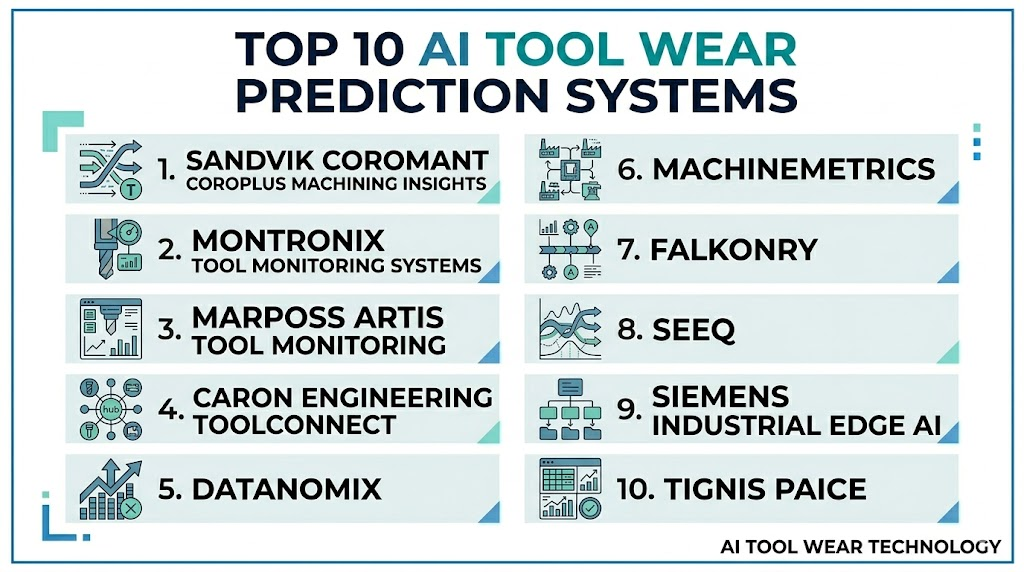
Top 10 AI Tool Wear Prediction Systems
1- Sandvik Coromant CoroPlus Machining Insights
One-Line Verdict: Best for manufacturers needing machine monitoring and tool performance visibility across machining operations.
Short Description
Sandvik Coromant CoroPlus Machining Insights helps manufacturers monitor machine utilization, machining performance, alerts, and tool performance. It gives production teams visibility into how machines and tools are performing, making it useful for improving productivity and reducing avoidable stoppages.For AI Tool Wear Prediction Systems, it is relevant when manufacturers need a practical machining intelligence layer that connects machine monitoring with tool performance reporting. It is especially useful for shops that want better visibility into unattended machining, tool usage, and machining performance.
Standout Capabilities
- Machine utilization dashboards
- Tool performance reports
- Alerts for unattended machining
- Historical performance reporting
- Operator input workflows
- Production visibility
- API connectivity
- Machining improvement insights
AI-Specific Depth
- Model support: Analytics and machine learning capabilities vary by configuration
- Knowledge integration: Machine data, tool data, operator input, and production performance context
- Evaluation: Performance reports, tool trends, machine utilization, and alert review
- Guardrails: Human review, alert thresholds, and user permissions
- Observability: Dashboards, reports, alerts, and tool performance views
Pros
- Strong machining ecosystem relevance
- Useful for monitoring tools and machines together
- Good fit for productivity improvement programs
Cons
- Deep predictive tool wear capability may vary by implementation
- Best value depends on machine data connectivity
- Advanced workflows may require setup and training
Security & Compliance
Enterprise security features vary by deployment. Buyers should verify user access, data retention, encryption, audit logs, and machine connectivity controls.
Deployment & Platforms
- Cloud and web dashboards
- Machine-connected environments
- Shop floor monitoring workflows
Integrations & Ecosystem
CoroPlus Machining Insights fits into machining operations and digital manufacturing workflows.
- CNC machine data
- Tool performance data
- Operator panels
- Production dashboards
- APIs
- Manufacturing analytics workflows
Pricing Model
Subscription or enterprise licensing. Exact pricing is not publicly stated.
Best-Fit Scenarios
- Tool performance monitoring
- Unattended machining alerts
- Machine utilization and tooling analytics
2- Montronix Tool Monitoring Systems
One-Line Verdict: Best for real-time tool breakage, tool wear, and machining process monitoring.
Short Description
Montronix provides tool monitoring and process monitoring systems for machining operations. These systems are used to detect abnormal cutting behavior, tool breakage, missing tools, and process instability through sensor and machine signal monitoring.For AI Tool Wear Prediction Systems, Montronix is relevant when teams need real-time protection against tool failure and machining process issues. It is especially useful in high-volume machining where fast detection of tool problems can prevent scrap and machine damage.
Standout Capabilities
- Tool breakage detection
- Tool wear monitoring
- Process monitoring
- Real-time machine protection
- Sensor-based monitoring
- Cutting force and power signal analysis
- Machine cycle monitoring
- Alarm and stop workflows
AI-Specific Depth
- Model support: Signal analytics and intelligent monitoring capabilities vary by system
- Knowledge integration: Machine signals, cutting behavior, tool data, and process limits
- Evaluation: Alarm review, tool failure detection, and production outcome tracking
- Guardrails: Machine stop signals, thresholds, and operator review
- Observability: Monitoring screens, alarms, signal trends, and process reports
Pros
- Strong real-time tool monitoring focus
- Helps reduce scrap from broken or worn tools
- Useful for production machining protection
Cons
- Requires machine integration and sensor setup
- Predictive AI depth may vary by configuration
- Tuning may be needed for complex processes
Security & Compliance
Security depends on machine integration, network architecture, and deployment. Buyers should verify access control, data handling, network segmentation, and system administration controls.
Deployment & Platforms
- Shop floor machine monitoring
- CNC-connected environments
- Edge or local monitoring setups may vary
Integrations & Ecosystem
Montronix fits into CNC machining and production protection workflows.
- CNC machines
- Sensors
- Machine control signals
- Shop floor alerts
- Production monitoring systems
- Tool management workflows
Pricing Model
Enterprise or system-based pricing. Exact pricing is not publicly stated.
Best-Fit Scenarios
- Tool breakage detection
- Real-time process monitoring
- High-volume machining protection
3- Marposs ARTIS Tool Monitoring
One-Line Verdict: Best for manufacturers needing tool condition monitoring connected with machine process control.
Short Description
Marposs ARTIS provides tool monitoring and process monitoring solutions used in machining operations to detect tool wear, tool breakage, collisions, overloads, and abnormal process behavior. It supports manufacturers that need reliable machine-level monitoring for cutting tools and machining stability.For AI Tool Wear Prediction Systems, ARTIS is useful when tool monitoring must happen close to the machine and support fast reaction to abnormal cutting conditions. It is especially relevant for automated production lines and critical machining processes.
Standout Capabilities
- Tool condition monitoring
- Tool breakage detection
- Collision and overload monitoring
- Process stability monitoring
- Sensor-based signal analysis
- Machine protection alerts
- Adaptive monitoring workflows
- Integration with machine control environments
AI-Specific Depth
- Model support: Intelligent monitoring and signal analytics capabilities vary by system
- Knowledge integration: Tool condition, machine signals, sensor data, and process thresholds
- Evaluation: Alarm validation, tool condition review, and machine outcome tracking
- Guardrails: Thresholds, machine protection rules, and operator review
- Observability: Signal trends, alarms, monitoring dashboards, and process views
Pros
- Strong machine-level tool monitoring
- Useful for automated machining environments
- Helps prevent damage from tool failures
Cons
- Requires machine and sensor integration
- AI depth depends on configuration
- Engineering setup may be needed for best results
Security & Compliance
Security depends on machine connectivity and deployment architecture. Buyers should verify access controls, data handling, network security, and administrative permissions.
Deployment & Platforms
- Machine-side monitoring
- CNC production environments
- Edge or local deployment may vary
Integrations & Ecosystem
ARTIS connects tool monitoring with machine process control.
- CNC machines
- Sensors
- Machine control systems
- Tool monitoring dashboards
- Production line alerts
- Industrial automation workflows
Pricing Model
System-based or enterprise pricing. Exact pricing is not publicly stated.
Best-Fit Scenarios
- Tool condition monitoring
- Automated machining protection
- Tool breakage and overload detection
4- Caron Engineering ToolConnect
One-Line Verdict: Best for CNC environments needing tool life tracking, tool data management, and machining visibility.
Short Description
Caron Engineering ToolConnect supports tool management and tool life tracking for CNC machining environments. It helps teams organize tool data, monitor usage, and improve visibility into tooling performance across machines.For AI Tool Wear Prediction Systems, ToolConnect is useful when the organization needs better structure around tool life, tool usage, and CNC tooling information before advancing into deeper predictive analytics. It can support smarter tool decisions by improving the quality and availability of tool-related data.
Standout Capabilities
- Tool life tracking
- Tool data management
- CNC tool usage visibility
- Tool inventory connection
- Tool status monitoring
- Machine and tool workflow support
- Operator-facing tool information
- Production tooling analytics
AI-Specific Depth
- Model support: AI capabilities vary by connected analytics and workflow configuration
- Knowledge integration: Tool records, machine usage, tool life data, and operator workflow context
- Evaluation: Tool usage trends, tool life review, and performance reporting
- Guardrails: User permissions, workflow rules, and review controls
- Observability: Tool dashboards, tool status views, and usage reports
Pros
- Strong focus on tool life and tool data
- Helps improve tooling discipline
- Useful foundation for predictive tooling programs
Cons
- Not a pure AI wear prediction system by default
- Predictive depth depends on connected data and analytics
- Best value requires consistent tool data practices
Security & Compliance
Security capabilities depend on deployment and integration. Buyers should verify user access, data governance, audit trails, and connection security.
Deployment & Platforms
- CNC shop environments
- Machine-connected workflows
- Deployment details may vary
Integrations & Ecosystem
ToolConnect fits into CNC tooling and shop floor workflows.
- CNC machines
- Tool management systems
- Tool inventory workflows
- Operator interfaces
- Production tracking systems
- Manufacturing analytics tools
Pricing Model
Pricing is not publicly stated.
Best-Fit Scenarios
- Tool life tracking
- CNC tooling data organization
- Tool usage visibility across machines
5- Datanomix
One-Line Verdict: Best for production teams needing automated machining analytics and tool-related performance insights.
Short Description
Datanomix provides production monitoring and automated manufacturing analytics for machining operations. It helps teams understand job performance, cycle behavior, production variation, and operational issues without heavy manual reporting.For AI Tool Wear Prediction Systems, Datanomix is useful when tool wear needs to be understood in relation to production performance, cycle changes, abnormal behavior, and machine trends. It can support machining teams that want automated insights rather than manual data analysis.
Standout Capabilities
- Automated production monitoring
- Machining performance analytics
- Job and cycle analysis
- Abnormal production behavior detection
- Shop floor dashboards
- Operator and manager visibility
- Data-driven productivity insights
- Performance trend reporting
AI-Specific Depth
- Model support: Automated analytics and AI-assisted insights vary by workflow
- Knowledge integration: Machine data, production behavior, cycle data, and job context
- Evaluation: Job performance review, trend analysis, and operator feedback
- Guardrails: Human review, alerts, and workflow rules
- Observability: Dashboards, job views, cycle insights, and performance reports
Pros
- Good fit for machining performance visibility
- Reduces manual reporting effort
- Helps surface abnormal production patterns
Cons
- Tool wear prediction depth depends on data and configuration
- May need integration with tool data for deeper insights
- Best suited for CNC production environments
Security & Compliance
Enterprise security capabilities vary by deployment. Buyers should verify user access, encryption, audit logs, and data governance.
Deployment & Platforms
- Cloud-based monitoring
- CNC-connected environments
- Web dashboards
Integrations & Ecosystem
Datanomix supports machining analytics and production visibility.
- CNC machine data
- Production dashboards
- Shop floor analytics
- Job performance tracking
- Operator workflows
- Manufacturing reporting
Pricing Model
Subscription or enterprise pricing. Exact pricing is not publicly stated.
Best-Fit Scenarios
- Machining performance analytics
- Cycle behavior monitoring
- Tool-related production trend analysis
6- MachineMetrics
One-Line Verdict: Best for manufacturers needing machine monitoring data to support tool wear and production insights.
Short Description
MachineMetrics provides machine monitoring and production analytics for manufacturing environments. It collects machine data, monitors utilization, tracks production performance, and helps teams understand equipment behavior.For AI Tool Wear Prediction Systems, MachineMetrics is useful when tool wear signals are part of broader machine monitoring workflows. It can help teams identify abnormal machine behavior, downtime patterns, and production signals that may relate to tool condition.
Standout Capabilities
- Real-time machine monitoring
- Production analytics
- Machine utilization dashboards
- Downtime tracking
- Alerts and notifications
- Data collection from machines
- Maintenance and operations insights
- Shop floor performance visibility
AI-Specific Depth
- Model support: Analytics and machine learning capabilities vary by configuration
- Knowledge integration: Machine data, production records, downtime events, and operational context
- Evaluation: Alert review, production trend analysis, and performance tracking
- Guardrails: User permissions, alert rules, and human review
- Observability: Dashboards, alerts, machine status, and production reports
Pros
- Strong machine data foundation
- Useful for monitoring abnormal machine behavior
- Helps connect production and maintenance teams
Cons
- Not exclusively focused on tool wear prediction
- Deeper tool condition modeling may need additional data
- Value depends on machine connectivity
Security & Compliance
Enterprise security features are available. Buyers should verify role-based access, audit logging, encryption, data retention, and machine connectivity security.
Deployment & Platforms
- Cloud
- Edge-supported shop floor environments
- Web dashboards
Integrations & Ecosystem
MachineMetrics connects machine data with operations workflows.
- CNC machines
- Production equipment
- CMMS systems
- ERP systems
- Dashboards
- APIs
Pricing Model
Subscription and enterprise pricing. Exact pricing is not publicly stated.
Best-Fit Scenarios
- Machine monitoring for tool-related insights
- Abnormal machining behavior detection
- Production and downtime analytics
7- Falkonry
One-Line Verdict: Best for industrial teams needing AI-driven anomaly detection from sensor and machine data.
Short Description
Falkonry provides AI-driven operational intelligence for industrial environments. It analyzes time-series sensor and equipment data to detect abnormal operating patterns and support early warning workflows.For AI Tool Wear Prediction Systems, Falkonry is useful when manufacturers want to build tool wear and machining anomaly models from sensor signals and machine behavior. It is especially relevant for data-rich environments where tool condition is reflected in vibration, power, acoustic, or process signals.
Standout Capabilities
- Time-series anomaly detection
- Industrial AI monitoring
- Early warning alerts
- Sensor data analytics
- Machine behavior analysis
- Pattern recognition
- Scalable asset monitoring
- Operational intelligence dashboards
AI-Specific Depth
- Model support: Proprietary industrial AI and time-series models
- Knowledge integration: Sensor signals, equipment behavior, machine data, and operational context
- Evaluation: Alert validation, anomaly review, and production outcome tracking
- Guardrails: Human review, threshold logic, and workflow controls
- Observability: Anomaly dashboards, time-series views, alerts, and trend reports
Pros
- Strong industrial AI anomaly detection
- Useful for tool-related signal analysis
- Can support early warning workflows
Cons
- Requires reliable sensor and machine data
- Tool wear modeling may need domain-specific setup
- Best suited for data-mature environments
Security & Compliance
Enterprise security capabilities vary by deployment. Buyers should verify role-based access, audit logs, encryption, retention controls, and integration security.
Deployment & Platforms
- Cloud
- Hybrid industrial environments
- Time-series data workflows
Integrations & Ecosystem
Falkonry connects with industrial data and monitoring systems.
- Sensors
- Industrial historians
- Machine data sources
- Process data platforms
- Maintenance workflows
- Operational dashboards
Pricing Model
Enterprise subscription pricing. Exact pricing is not publicly stated.
Best-Fit Scenarios
- Tool wear anomaly detection
- Sensor-based machine monitoring
- Early warning for abnormal cutting behavior
8- Seeq
One-Line Verdict: Best for engineers investigating tool wear patterns through time-series machining data.
Short Description
Seeq helps engineers analyze time-series data, compare process conditions, detect abnormal periods, and investigate operational variation. It is widely used in data-rich industrial environments where engineers need flexible analytics for process behavior.For AI Tool Wear Prediction Systems, Seeq is useful when machining teams want to analyze tool wear signals from machine data, sensor trends, process conditions, and quality outcomes. It supports engineering investigation rather than simple fixed dashboards.
Standout Capabilities
- Time-series analytics
- Process behavior comparison
- Anomaly investigation
- Engineering dashboards
- Signal trend analysis
- Collaboration workflows
- Advanced analytics
- Root cause support
AI-Specific Depth
- Model support: Machine learning, statistical analytics, and advanced process analytics
- Knowledge integration: Time-series signals, machine data, process context, and engineering knowledge
- Evaluation: Engineer review, trend validation, and outcome tracking
- Guardrails: User review, workbook controls, and permissions
- Observability: Trends, dashboards, capsules, alerts, and workbooks
Pros
- Strong engineering analytics depth
- Useful for investigating tool wear patterns
- Flexible across many machine and sensor data sources
Cons
- Not a dedicated tool wear prediction product
- Requires data integration and engineering skill
- Real-time deployment depends on architecture
Security & Compliance
Enterprise security features are available. Buyers should verify role-based access, audit logging, encryption, identity management, and data governance.
Deployment & Platforms
- Cloud
- Hybrid
- Enterprise industrial data environments
Integrations & Ecosystem
Seeq connects with industrial and machining data systems.
- Time-series databases
- Historians
- Machine data
- Cloud data platforms
- Manufacturing systems
- Engineering analytics workflows
Pricing Model
Enterprise subscription pricing. Exact pricing is not publicly stated.
Best-Fit Scenarios
- Tool wear signal investigation
- Time-series machining analysis
- Engineering root cause workflows
9- Siemens Industrial Edge AI
One-Line Verdict: Best for manufacturers building edge AI monitoring for CNC and machining assets.
Short Description
Siemens Industrial Edge AI supports edge computing and industrial analytics close to machines and production systems. It can be used to process sensor data, machine signals, and analytics models near the shop floor.For AI Tool Wear Prediction Systems, Siemens Industrial Edge AI is useful when manufacturers want to build or deploy custom tool wear prediction models close to CNC machines, especially where low latency, data control, and machine integration are important.
Standout Capabilities
- Edge AI deployment
- Industrial data processing
- Machine signal analytics
- Low-latency monitoring
- Integration with automation environments
- Custom model deployment
- Shop floor analytics
- Scalable industrial architecture
AI-Specific Depth
- Model support: Bring-your-own AI and industrial edge analytics
- Knowledge integration: Machine data, sensor signals, automation data, and process context
- Evaluation: Model validation, edge performance review, and operational outcome tracking
- Guardrails: Edge governance, user access, and deployment controls
- Observability: Edge dashboards, model outputs, system metrics, and monitoring views
Pros
- Strong edge computing foundation
- Useful for low-latency tool monitoring
- Supports custom AI model deployment
Cons
- Requires technical and integration expertise
- Not a plug-and-play tool wear system by itself
- Best suited for mature industrial IT and OT teams
Security & Compliance
Enterprise industrial security features are available depending on deployment. Buyers should verify access controls, network segmentation, encryption, audit logs, and edge device governance.
Deployment & Platforms
- Edge
- Hybrid industrial environments
- Shop floor data processing
Integrations & Ecosystem
Siemens Industrial Edge AI supports industrial automation and analytics workflows.
- Automation systems
- Machine data
- Edge devices
- Industrial applications
- Cloud analytics
- Custom AI models
Pricing Model
Enterprise licensing and deployment-based pricing. Exact pricing is not publicly stated.
Best-Fit Scenarios
- Custom tool wear prediction
- Edge AI monitoring for CNC machines
- Low-latency machining analytics
10- Tignis PAICe
One-Line Verdict: Best for manufacturers needing AI process optimization and predictive models for machining operations.
Short Description
Tignis PAICe provides AI-based process optimization and predictive modeling for complex manufacturing environments. It helps engineers build models that predict outcomes, detect abnormal conditions, and recommend optimization actions.For AI Tool Wear Prediction Systems, Tignis PAICe is useful when tool wear prediction is part of a broader process optimization strategy. It can support teams that want to model machining outcomes using equipment, process, sensor, and quality data.
Standout Capabilities
- AI process modeling
- Predictive analytics
- Process optimization recommendations
- Equipment and sensor data analytics
- Model deployment workflows
- Drift detection
- Engineering decision support
- Optimization dashboards
AI-Specific Depth
- Model support: AI and machine learning process models
- Knowledge integration: Equipment data, process variables, sensor signals, and quality outcomes
- Evaluation: Model validation, prediction accuracy, and engineer review
- Guardrails: Process constraints, human review, and model monitoring
- Observability: Model dashboards, prediction outputs, and process trend views
Pros
- Strong AI process optimization focus
- Useful for custom predictive models
- Supports engineering-driven improvement workflows
Cons
- Requires strong process and data maturity
- Tool wear use cases may need configuration
- Data science and engineering collaboration may be required
Security & Compliance
Enterprise security capabilities should be verified during evaluation, including access controls, encryption, audit logs, data retention, and deployment governance.
Deployment & Platforms
- Cloud or hybrid options may vary
- Industrial AI environments
- Engineering analytics workflows
Integrations & Ecosystem
Tignis PAICe connects with process and equipment data workflows.
- Machine data
- Sensor streams
- Manufacturing systems
- Process historians
- Quality analytics
- Engineering model workflows
Pricing Model
Enterprise pricing. Exact pricing is not publicly stated.
Best-Fit Scenarios
- Custom tool wear prediction models
- AI process optimization
- Predictive machining analytics
Comparison Table
| Tool Name | Best For | Deployment | Model Flexibility | Strength | Watch-Out | Public Rating |
|---|---|---|---|---|---|---|
| Sandvik Coromant CoroPlus Machining Insights | Tool performance visibility | Cloud and web | Analytics varies by workflow | Machining dashboards | Prediction depth may vary | N/A |
| Montronix Tool Monitoring Systems | Real-time tool breakage monitoring | Machine-side | Signal analytics | Tool failure protection | Sensor tuning needed | N/A |
| Marposs ARTIS Tool Monitoring | Machine-level tool condition monitoring | Machine-side | Intelligent monitoring varies | Tool and process protection | Setup effort required | N/A |
| Caron Engineering ToolConnect | Tool life tracking | CNC shop environments | AI varies by integration | Tool data management | Not pure AI prediction | N/A |
| Datanomix | Machining production analytics | Cloud | Automated analytics | Cycle and job insights | Tool-specific depth varies | N/A |
| MachineMetrics | Machine monitoring analytics | Cloud and edge | AI varies by configuration | Machine data foundation | Tool modeling may need integration | N/A |
| Falkonry | Sensor-driven anomaly detection | Cloud and hybrid | Industrial AI models | Time-series anomaly detection | Needs reliable sensor data | N/A |
| Seeq | Engineering investigation | Cloud and hybrid | Machine learning and statistical analytics | Time-series analysis | Requires engineering skill | N/A |
| Siemens Industrial Edge AI | Custom edge AI monitoring | Edge and hybrid | Bring-your-own AI | Low-latency deployment | Requires technical expertise | N/A |
| Tignis PAICe | AI process optimization | Cloud or hybrid | AI and ML models | Predictive modeling | Needs data maturity | N/A |
Scoring and Evaluation
The scoring below is a comparative guide, not an absolute ranking. Each tool is evaluated based on tool wear relevance, AI readiness, sensor and machine data support, real-time monitoring, integration strength, usability, security, and scalability. Buyers should validate these scores through a pilot using their own machines, cutting tools, materials, sensor signals, tool change records, and quality outcomes.
| Tool | Core Features | Reliability and Evaluation | Guardrails | Integrations | Ease of Use | Performance and Cost | Security and Admin | Support | Weighted Total |
| Sandvik Coromant CoroPlus Machining Insights | 8 | 8 | 8 | 8 | 8 | 8 | 8 | 8 | 8.0 |
| Montronix Tool Monitoring Systems | 9 | 8 | 8 | 8 | 7 | 8 | 7 | 8 | 8.0 |
| Marposs ARTIS Tool Monitoring | 9 | 8 | 8 | 8 | 7 | 8 | 7 | 8 | 8.0 |
| Caron Engineering ToolConnect | 8 | 7 | 7 | 8 | 8 | 8 | 7 | 7 | 7.6 |
| Datanomix | 8 | 8 | 8 | 8 | 8 | 8 | 8 | 8 | 8.0 |
| MachineMetrics | 8 | 8 | 8 | 9 | 8 | 8 | 8 | 8 | 8.2 |
| Falkonry | 8 | 8 | 8 | 8 | 7 | 8 | 8 | 7 | 7.9 |
| Seeq | 8 | 8 | 8 | 9 | 7 | 8 | 8 | 8 | 8.1 |
| Siemens Industrial Edge AI | 8 | 8 | 8 | 9 | 7 | 8 | 9 | 8 | 8.2 |
| Tignis PAICe | 8 | 8 | 8 | 8 | 7 | 8 | 8 | 7 | 7.8 |
Top 3 for Enterprise
- Siemens Industrial Edge AI
- MachineMetrics
- Sandvik Coromant CoroPlus Machining Insights
Top 3 for SMB
- Sandvik Coromant CoroPlus Machining Insights
- Datanomix
- Caron Engineering ToolConnect
Top 3 for Developers
- Siemens Industrial Edge AI
- Seeq
- Tignis PAICe
Which AI Tool Wear Prediction System Is Right for You
Solo and Freelancer
Solo consultants and independent machining advisors usually need tools that can demonstrate tool life improvement, tool performance visibility, and machining process insights quickly. Sandvik Coromant CoroPlus Machining Insights and Datanomix can be practical for showing performance trends. Seeq is useful when the project requires deeper time-series investigation.
SMB
Small and medium machine shops should prioritize easy deployment, practical dashboards, and clear tool performance visibility. Sandvik Coromant CoroPlus Machining Insights, Datanomix, Caron Engineering ToolConnect, and MachineMetrics are good starting points depending on whether the main goal is tool reporting, production analytics, tool life tracking, or machine monitoring.
Mid-Market
Mid-market manufacturers often need stronger monitoring across multiple machines, production cells, and machining programs. MachineMetrics, Montronix, Marposs ARTIS, and Falkonry can support more structured monitoring and anomaly detection. These teams should focus on machine connectivity, sensor quality, alert accuracy, and integration with quality or maintenance workflows.
Enterprise
Large manufacturers need scalable tool wear visibility across plants, machines, products, and production programs. Siemens Industrial Edge AI, MachineMetrics, Sandvik Coromant CoroPlus Machining Insights, and Seeq are strong candidates depending on whether the priority is edge AI, enterprise machine monitoring, tool performance reporting, or engineering analytics.
Regulated Industries
Aerospace, medical device, automotive, and precision manufacturing teams should prioritize traceability, auditability, data retention, and quality linkage. Tool wear prediction should connect with part quality, inspection records, machine programs, and operator actions. Human review is important before changing tool replacement rules in regulated or safety-critical production.
Budget vs Premium
Budget-conscious teams should start with one machine group, one tool family, or one high-cost machining operation. A focused monitoring platform or tool life tracking system can create value quickly. Premium solutions are better when the organization needs real-time machine protection, custom AI models, edge monitoring, or enterprise-wide tool analytics.
Build vs Buy
Building custom tool wear prediction models can work for organizations with strong CNC data, sensor engineering, and machine learning teams. However, tool wear prediction requires signal processing, machine context, tool history, model validation, alert tuning, and operator adoption. Buying a proven monitoring or analytics platform is usually faster when the goal is production-ready visibility and reliable alerts.
Implementation Playbook
Implementing AI Tool Wear Prediction Systems should be treated as a machining performance improvement program, not just a sensor project. The goal is to reduce tool-related scrap, unplanned downtime, poor surface finish, and unnecessary tool replacement. A successful rollout requires clean data, strong operator feedback, realistic alert thresholds, and validation with real production outcomes.
First Phase
The first phase should focus on one machining operation, one tool family, or one machine group where tool wear has measurable cost or quality impact. Starting with a focused pilot helps teams validate data and prove value.
Key activities include:
- Select one high-impact machining process
- Define baseline tool life and scrap rate
- Identify tool types, materials, and machine programs
- Collect tool change history
- Review CNC and sensor data availability
- Define tool wear and breakage failure modes
- Train operators on alert handling
- Create dashboards for tool performance
- Define pilot success metrics
- Align production, quality, tooling, and maintenance teams
AI-specific tasks include:
- Capture normal and worn tool signal patterns
- Train models using historical tool usage and quality outcomes
- Detect abnormal vibration, load, acoustic, or power behavior
- Create tool health alerts
- Estimate remaining useful life where data supports it
- Validate predictions with operator inspection
- Track false alarms and missed tool failures
- Document model assumptions and limits
Success metrics should include:
- Fewer tool-related defects
- Reduced unexpected tool breakage
- Better tool change timing
- Lower tooling cost
- Reduced scrap and rework
- Improved operator confidence
- Faster response to abnormal cutting
- Better tool performance visibility
Second Phase
The second phase should focus on improving model accuracy, connecting insights with workflows, and expanding to similar machines or tool families. Tool wear alerts should become part of daily machining operations, not just an engineering experiment.
Key activities include:
- Validate alerts against actual tool inspection
- Connect alerts with operator response workflows
- Add more tools, materials, and programs
- Improve dashboards for supervisors and engineers
- Review false alarms by machine and process
- Connect tool data with quality results
- Track tool change decisions
- Improve tool life rules
- Train additional operators
- Standardize alert response actions
AI-specific tasks include:
- Monitor prediction accuracy
- Compare model behavior across machines
- Add process context such as speed, feed, coolant, and material
- Detect model drift when tools or materials change
- Refine remaining useful life estimates
- Add confidence indicators
- Track accepted and rejected alerts
- Improve signal features
- Review abnormal cutting events
- Maintain model documentation
Success metrics should include:
- Better prediction accuracy
- Reduced false alarms
- Fewer missed tool failures
- Improved surface quality
- Higher machine uptime
- Reduced manual inspection effort
- Better tool inventory planning
- Improved machining stability
Third Phase
The third phase should focus on scaling tool wear prediction across lines, plants, and machining programs. At this stage, organizations should standardize tool wear definitions, data models, alert rules, and governance.
Key activities include:
- Expand monitoring across machine groups
- Standardize tool wear and breakage categories
- Connect tool monitoring with MES or CMMS where useful
- Create enterprise dashboards
- Benchmark tool performance across machines
- Review tool supplier and tool type performance
- Link tool health with quality outcomes
- Train supervisors and engineers
- Review cybersecurity and data governance
- Build continuous improvement routines
AI-specific tasks include:
- Scale models across tools and materials
- Monitor model drift across plants
- Add adaptive thresholds where useful
- Integrate edge AI for low-latency alerts
- Improve prediction explanations
- Maintain model change logs
- Review access controls and audit logs
- Use feedback loops to improve recommendations
- Connect tool wear insights with process optimization
- Identify high-value tooling improvement opportunities
Long-term success metrics should include:
- Lower tool-related scrap
- Reduced unplanned downtime
- Lower tooling cost per part
- Better surface finish consistency
- Improved dimensional quality
- Higher machine utilization
- Stronger unattended machining reliability
- Better tool inventory planning
- Faster troubleshooting
- Improved OEE
Common Mistakes and How to Avoid Them
1. Starting Without a Clear Tool Wear Problem
AI tool wear prediction works best when the first use case is specific. Start with a tool type, machine group, material, or part family where tool wear creates measurable cost. Avoid starting with every machine at once.
2. Ignoring Signal Quality
Poor sensor placement, noisy signals, missing machine data, or inconsistent sampling can weaken predictions. Validate sensor and machine signal quality before scaling.
3. Treating Tool Life as Fixed
Tool life changes with material, cutting parameters, coolant, tool coating, machine condition, and operator practices. AI should learn from real conditions rather than rely only on fixed replacement rules.
4. Not Capturing Tool Change Reasons
If operators change tools without recording why, models may not learn correctly. Capture reasons such as wear, breakage, chatter, poor finish, dimensional drift, or planned replacement.
5. Ignoring Quality Outcomes
Tool wear matters because it affects part quality and productivity. Connect tool monitoring with inspection results, scrap, rework, and surface finish data where possible.
6. Overreacting to False Alarms
False alarms can reduce operator trust. Review false positives regularly and tune thresholds or models carefully. The goal is reliable alerts, not more alerts.
7. Skipping Operator Feedback
Operators understand tool behavior and cutting conditions. Their feedback is essential for validating alerts and improving prediction quality.
8. Using One Model for Every Process
Different tools, materials, machines, and operations may need different models or thresholds. Milling, turning, drilling, and grinding behave differently.
9. Ignoring Machine Condition
Tool wear signals can be affected by spindle condition, fixturing, coolant, machine rigidity, and setup quality. Separate tool issues from machine and process issues.
10. Not Planning for Edge Requirements
Tool breakage detection may require fast response. If latency matters, edge processing should be considered. Cloud-only workflows may not be fast enough for machine protection.
11. Not Linking Alerts to Action
A tool wear alert is only useful if someone knows what to do. Define response rules for inspection, tool change, program adjustment, or supervisor review.
12. Forgetting Cybersecurity
Machine monitoring data can contain sensitive production information. Protect CNC data, tool paths, machine signals, and network connections with proper governance.
13. Measuring Only Tool Cost
Tool cost matters, but success should also include scrap reduction, uptime, surface quality, rework, and machine utilization. A cheap tool strategy can become expensive if it creates defects.
14. Expecting AI to Replace Machining Expertise
AI helps detect patterns, but it does not replace machinists, tooling engineers, or process experts. The best results come from combining AI insights with practical machining knowledge.
FAQs
1. What is an AI Tool Wear Prediction System?
An AI Tool Wear Prediction System uses machine learning, sensor data, and CNC machine data to estimate tool condition and predict when a cutting tool may wear out or fail. It helps teams replace tools at the right time rather than relying only on fixed intervals. These systems can monitor vibration, spindle load, acoustic signals, temperature, cutting force, and production data. The goal is to reduce scrap, downtime, and unnecessary tool replacement.
2. Why is tool wear prediction important?
Tool wear prediction is important because worn tools can create poor surface finish, dimensional errors, scrap, rework, machine stoppages, and quality issues. Replacing tools too early increases tooling cost, while replacing them too late creates production risk. AI helps teams make better tool change decisions based on actual condition. This improves productivity and machining reliability.
3. How does AI detect tool wear?
AI detects tool wear by learning patterns in machining signals. As tools wear, signals such as vibration, spindle load, acoustic behavior, temperature, and cutting force may change. AI models compare current behavior with known healthy and worn conditions. When the model detects abnormal patterns, it can alert operators or estimate remaining useful life.
4. What data is needed for tool wear prediction?
Common data includes CNC machine signals, spindle load, feed rate, speed, vibration, acoustic data, temperature, cutting force, tool change history, part quality results, and material type. Some systems use additional sensors, while others use data already available from machines. Good data quality is essential. Inconsistent records or noisy signals can reduce prediction accuracy.
5. Can AI predict tool breakage?
Yes, AI and signal monitoring systems can help detect tool breakage or abnormal cutting behavior. Some systems are designed for fast breakage detection, while others focus more on wear trends and remaining useful life. Breakage detection often requires low-latency monitoring. Edge processing may be important when fast machine response is required.
6. Can AI reduce tooling cost?
Yes, AI can reduce tooling cost by helping teams avoid replacing tools too early. It can also reduce cost by preventing worn tools from creating scrap or machine stoppages. The best results come when AI recommendations are validated against real tool life and part quality. Tooling cost should be measured together with quality and uptime.
7. Is tool wear prediction useful for unattended machining?
Yes, tool wear prediction is very useful for unattended and lights-out machining. When no operator is present, the system can alert teams to abnormal cutting, tool wear, or tool breakage risks. This reduces the chance of producing many defective parts before the issue is noticed. Reliable monitoring is especially important for high-value parts.
8. What sensors are used for tool wear monitoring?
Common sensors include vibration sensors, acoustic emission sensors, microphones, force sensors, power sensors, temperature sensors, and machine data signals from CNC controllers. The best sensor mix depends on the machining process. Some operations can use machine data alone, while others need additional sensors for better accuracy.
9. Can tool wear prediction work on older CNC machines?
Yes, it can work on older machines if useful data can be collected. Retrofitted sensors can capture vibration, acoustic, force, or power signals even when CNC controller data is limited. However, integration may require planning. Older machines may need edge hardware or external monitoring systems.
10. How accurate are AI tool wear predictions?
Accuracy depends on data quality, sensor placement, machining stability, tool type, material, model training, and process consistency. A system should be validated using real tool inspections and part quality data. Accuracy usually improves when operators provide feedback and data is collected over many tool cycles. Buyers should test tools in a pilot before full rollout.
11. Can AI improve part quality?
Yes, AI can improve part quality by detecting tool wear before it causes dimensional drift, poor surface finish, chatter, or defects. It can alert operators before worn tools create scrap. It can also help engineers understand which tools, materials, or programs create recurring quality problems. Tool wear prediction should be connected with inspection data where possible.
12. Does AI tool wear prediction integrate with MES or CMMS?
Many systems can integrate with MES, CMMS, ERP, machine monitoring platforms, or analytics tools. Integration helps turn tool wear alerts into work orders, quality actions, or production decisions. The depth of integration varies by platform. Buyers should confirm APIs, data export options, and workflow compatibility.
13. What are the biggest implementation challenges?
Common challenges include poor sensor data, inconsistent tool change records, false alarms, lack of operator feedback, and weak integration with quality data. Some teams also struggle because tool wear varies by material and process. A focused pilot helps teams validate signals, tune models, and build trust. Training and workflow design are as important as the technology.
14. Should AI automatically stop a machine?
Automatic machine stops may be useful for tool breakage or high-risk events, but they should be implemented carefully. False stops can reduce productivity, while missed stops can cause damage. Many teams start with alerts and human review, then add automatic actions only after validation. Safety, quality, and production teams should agree on stop rules.
15. What is the future of AI Tool Wear Prediction Systems?
The future will include more accurate remaining useful life prediction, better edge AI, stronger explainability, easier retrofitting, and deeper integration with CNC controllers, MES, quality systems, and tool management platforms. AI will also connect tool health with process optimization, part quality, and unattended machining. The best systems will help teams make faster and safer tool decisions while preserving machinist and engineering expertise.
Conclusion
AI Tool Wear Prediction Systems help manufacturers reduce tool-related scrap, unplanned downtime, unnecessary tool replacement, and quality issues. The right system depends on machine type, data availability, tool cost, process complexity, production volume, and quality risk. Sandvik Coromant CoroPlus Machining Insights, Montronix Tool Monitoring Systems, Marposs ARTIS Tool Monitoring, Caron Engineering ToolConnect, Datanomix, MachineMetrics, Falkonry, Seeq, Siemens Industrial Edge AI, and Tignis PAICe each serve different needs across machine monitoring, tool life tracking, sensor-based detection, time-series analytics, edge AI, and process optimization.The best approach is to start with one high-impact tool wear problem, collect reliable machine and sensor data, validate alerts with operators, and connect findings with quality and production outcomes. Shortlist systems that match your machines, sensors, workflows, and skill level. Pilot the platform with real cutting tools and real production jobs, review false alerts, verify security, and measure results through scrap reduction, tool life improvement, uptime, and part quality. Once the pilot proves value, scale tool wear prediction across more tools, machines, and plants with standardized data and continuous improvement routines.

Find Trusted Cardiac Hospitals
Compare heart hospitals by city and services — all in one place.
Explore Hospitals
AI tool wear prediction is valuable, but accuracy depends heavily on sensor quality, machining consistency, and real-time feedback from production conditions.