
Introduction
AI WMS (Warehouse Management System) Picking Path Optimization tools use artificial intelligence to determine the most efficient routes for warehouse staff or robots to pick items for orders. By analyzing order patterns, warehouse layouts, inventory locations, and worker or robot behavior, these platforms reduce travel time, increase throughput, and improve order accuracy. In 2026, as e-commerce demand grows and warehouses become more complex, AI-driven picking path optimization is essential for operational efficiency and cost reduction.
Real-world use cases include:
- Optimizing human picker walking paths for batch orders.
- Dynamic path adjustment for robots in automated warehouses.
- Reducing congestion in high-density picking zones.
- Multi-order wave picking with AI route planning.
- Integration with real-time inventory location data.
- Predictive analytics for picking bottlenecks and labor allocation.
Evaluation Criteria for Buyers:
Key factors include:
- AI model sophistication and path optimization algorithms
- Integration with WMS and ERP systems
- Support for human and robotic pickers
- Real-time location tracking and congestion management
- Multi-order wave and batch picking capabilities
- Scenario simulation and AI evaluation
- Guardrails for safety and warehouse rules
- Observability of labor productivity and route efficiency
- Scalability for high-volume warehouses
- Predictive analytics for inventory and order prioritization
Best for: Warehouse managers, operations managers, logistics teams in e-commerce, retail, 3PL/4PL providers, and large-scale distribution centers.
Not ideal for: Small warehouses with minimal SKU volume or low order complexity.
What’s Changed in AI WMS Picking Path Optimization in 2026+
- Agentic AI workflows that autonomously assign pick sequences and adjust in real time.
- Integration of multimodal data including real-time inventory, worker movement, and IoT sensors.
- Predictive path re-optimization based on congestion, order changes, or stockouts.
- Enhanced RAG-driven reasoning integrating warehouse data and historical picking patterns.
- Advanced AI evaluation frameworks measuring path efficiency, time per pick, and throughput.
- Guardrails to enforce safety zones, robot collision avoidance, and human safety.
- Enterprise-grade privacy and data residency controls for workforce data.
- Latency and cost optimization for real-time recommendations.
- Observability dashboards tracking picker performance, robot utilization, and order fulfillment speed.
- Green and energy-aware routing for autonomous mobile robots (AMRs).
- Scenario simulation for peak demand, promotions, or returns.
- Multi-model orchestration to test alternative routing strategies.
Quick Buyer Checklist
- Does the tool support AI-driven dynamic picking paths?
- Can it integrate with your WMS/ERP and real-time inventory feeds?
- Is it compatible with human pickers, AMRs, or both?
- Does it offer multi-order wave picking and batch optimization?
- Are there safety guardrails for pickers and robots?
- Can it provide observability dashboards for efficiency and throughput?
- Are predictive analytics and congestion detection included?
- Is the system scalable for peak season or multiple fulfillment centers?
- Does it support evaluation and testing of AI models?
- Can the system simulate and optimize for operational scenarios?
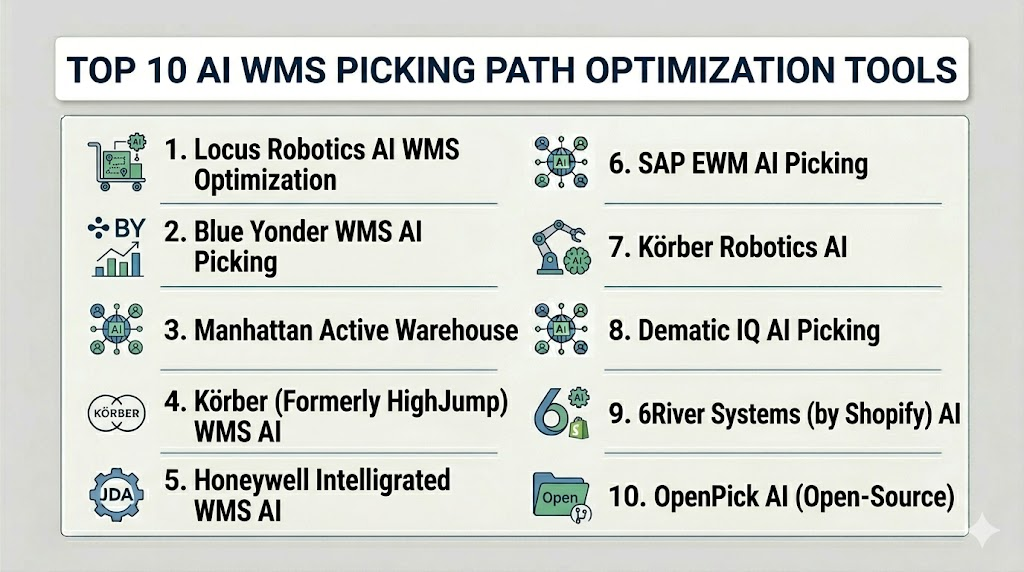
Top 10 AI WMS Picking Path Optimization Tools
1 — Locus Robotics AI WMS Optimization
One-line verdict: Best for large warehouses needing AI-powered autonomous robot path planning and human-robot coordination.
Short description: Uses AI to dynamically optimize picking routes for AMRs and human pickers, increasing efficiency and throughput.
Standout Capabilities
- Autonomous robot path planning
- Human-robot coordination
- Real-time congestion and inventory updates
- Multi-order wave picking
- KPI dashboards for pick efficiency
- Peak demand simulation
AI-Specific Depth
- Model support: Proprietary AI + hybrid routing
- RAG / knowledge integration: WMS/ERP, inventory DBs
- Evaluation: Historical route backtesting and throughput metrics
- Guardrails: Collision avoidance, safety zones
- Observability: Dashboards with time per pick and robot utilization
Pros
- Efficient AMR-human hybrid operations
- Real-time path adjustments
- Detailed analytics for throughput
Cons
- High implementation cost
- Complex integration
- Learning curve for warehouse staff
Security & Compliance
- SSO/RBAC, encryption, audit logs
- Certifications: Not publicly stated
Deployment & Platforms
- Cloud/Web; AMR interface; Varies / N/A hybrid
Integrations & Ecosystem
- WMS/ERP connectors
- Robot control APIs
- Analytics dashboards
- Inventory management integration
Pricing Model
- Subscription per warehouse/fleet
Best-Fit Scenarios
- Large e-commerce fulfillment centers
- AMR-enabled warehouses
- Multi-order wave picking
2 — Blue Yonder WMS AI Picking
One-line verdict: Ideal for enterprise warehouses seeking predictive path optimization and labor efficiency.
Short description: AI-powered WMS module optimizing picking sequences, wave management, and labor assignment.
Standout Capabilities
- Dynamic path planning for human pickers
- Multi-order batching and wave picking
- Predictive congestion management
- KPI dashboards and labor tracking
- Integration with automated conveyor and AMR systems
AI-Specific Depth
- Model support: Proprietary AI; Varies / N/A
- RAG / knowledge integration: ERP/WMS data
- Evaluation: Pick efficiency, throughput metrics
- Guardrails: Safety and workflow policies
- Observability: Picker and robot dashboards
Pros
- Enterprise-scale throughput optimization
- Predictive congestion handling
- Labor utilization tracking
Cons
- Implementation complexity
- Costly for SMBs
- Requires integration expertise
Security & Compliance
- SSO/RBAC, audit logs, encryption
- Certifications: Not publicly stated
Deployment & Platforms
- Cloud/Web; Hybrid optional
Integrations & Ecosystem
- ERP/WMS
- AMR and conveyor system integration
- Analytics and reporting APIs
Pricing Model
- Enterprise subscription per warehouse or user
Best-Fit Scenarios
- Multi-floor warehouses
- High SKU count fulfillment
- Labor-intensive e-commerce operations
3 — Manhattan Active Warehouse
One-line verdict: Strong for mid-to-large warehouses needing AI route optimization and predictive labor allocation.
Short description: Provides AI-driven path optimization for pickers, wave picking, and predictive workload balancing.
Standout Capabilities
- Intelligent picker path routing
- Predictive labor allocation
- Multi-order batch optimization
- Wave picking and KPI dashboards
- Real-time inventory and order updates
AI-Specific Depth
- Model support: Proprietary AI
- RAG / knowledge integration: ERP/WMS connectors
- Evaluation: Route and labor efficiency backtesting
- Guardrails: Safety and workflow enforcement
- Observability: Picker dashboards and throughput reports
Pros
- Optimized human labor efficiency
- Predictive workload balancing
- Integration with WMS and ERP
Cons
- Medium to high cost
- Requires trained staff
- Complex configuration for multi-floor warehouses
Security & Compliance
- SSO/RBAC, encryption
- Certifications: Not publicly stated
Deployment & Platforms
- Cloud/Web; Windows support; mobile pick apps
Integrations & Ecosystem
- ERP, WMS, AMR interfaces
- Analytics and labor tracking APIs
- Reporting dashboards
Pricing Model
- Subscription per warehouse
Best-Fit Scenarios
- Mid-to-large e-commerce warehouses
- High-volume pick zones
- Labor-intensive operations
4 — Körber (Formerly HighJump) WMS AI
One-line verdict: Best for flexible warehouse layouts requiring AI-driven path simulation and optimization.
Short description: AI module for warehouse management focusing on picker route efficiency and operational throughput.
Standout Capabilities
- Dynamic pick path generation
- Multi-order wave management
- Real-time congestion alerts
- KPI dashboards
- Scenario simulation for peak demand
AI-Specific Depth
- Model support: Proprietary AI
- RAG / knowledge integration: ERP/WMS, inventory DBs
- Evaluation: Historical efficiency analysis
- Guardrails: Safety enforcement and operational policies
- Observability: Picker and warehouse metrics
Pros
- Efficient wave picking
- Scenario planning for peak demand
- Flexible warehouse support
Cons
- Requires setup and training
- Enterprise pricing
- Less intuitive for small teams
Security & Compliance
- Encryption, SSO, audit logs
- Certifications: Not publicly stated
Deployment & Platforms
- Cloud/Web; mobile pick apps
Integrations & Ecosystem
- ERP, WMS, AMR
- Analytics dashboards
- Reporting APIs
Pricing Model
- Subscription per warehouse or module
Best-Fit Scenarios
- Multi-SKU warehouses
- High-order volume e-commerce
- Flexible layout warehouses
5 — Honeywell Intelligrated WMS AI
One-line verdict: Strong for automated and semi-automated warehouses using AI-driven picking path optimization.
Short description: AI-powered route optimization for warehouse pickers and AMRs with real-time monitoring.
Standout Capabilities
- Dynamic path planning for AMRs and humans
- Multi-order batching and wave picking
- Predictive congestion alerts
- KPI dashboards and throughput analytics
- Scenario simulation
AI-Specific Depth
- Model support: Proprietary AI
- RAG / knowledge integration: WMS/ERP/AMR interfaces
- Evaluation: Efficiency backtesting
- Guardrails: Collision and safety policies
- Observability: Picker and AMR dashboards
Pros
- Supports hybrid AMR/human environments
- Real-time re-routing
- Detailed analytics
Cons
- Enterprise-focused pricing
- Requires complex setup
- Learning curve for staff
Security & Compliance
- SSO/RBAC, audit logs
- Certifications: Not publicly stated
Deployment & Platforms
- Cloud/Web; AMR interface; mobile apps
Integrations & Ecosystem
- ERP/WMS connectors
- AMR systems
- Analytics and reporting APIs
Pricing Model
- Subscription per warehouse/fleet
Best-Fit Scenarios
- Automated warehouses
- Multi-floor pick operations
- High-volume e-commerce
6 — SAP EWM AI Picking
One-line verdict: Best for enterprises already using SAP ERP seeking AI picking optimization inside their ecosystem.
Short description: AI-driven picking path module embedded in SAP Extended Warehouse Management (EWM) for optimal labor and route efficiency.
Standout Capabilities
- Integrated with SAP ERP/WMS
- Dynamic picker route optimization
- Batch and wave picking
- Predictive labor allocation
- KPI dashboards
AI-Specific Depth
- Model support: Proprietary AI (SAP)
- RAG / knowledge integration: ERP/WMS native
- Evaluation: Backtesting against historical pick times
- Guardrails: Safety and policy enforcement
- Observability: Dashboards with picker efficiency
Pros
- Seamless SAP integration
- Enterprise-grade optimization
- Predictive labor management
Cons
- Costly SAP module
- Complex configuration
- Limited for non-SAP users
Security & Compliance
- SSO/RBAC, audit logs, encryption
- Certifications: Not publicly stated
Deployment & Platforms
- SAP Cloud/Web; mobile pick apps
Integrations & Ecosystem
- ERP/WMS/AMR native connectors
- Analytics dashboards
- Reporting APIs
Pricing Model
- Module subscription within SAP EWM
Best-Fit Scenarios
- SAP-driven warehouses
- Enterprise e-commerce
- Multi-floor fulfillment
7 — Körber Robotics AI
One-line verdict: Optimal for warehouses deploying robots needing AI route optimization in real-time.
Short description: AI routing for AMRs, including collision avoidance, dynamic re-routing, and throughput analytics.
Standout Capabilities
- Autonomous robot path optimization
- Real-time congestion avoidance
- Integration with human pickers
- Scenario simulation
- Throughput monitoring dashboards
AI-Specific Depth
- Model support: Proprietary AI
- RAG / knowledge integration: ERP/WMS
- Evaluation: Historical and simulated scenarios
- Guardrails: Safety and collision policies
- Observability: Robot utilization dashboards
Pros
- Efficient AMR routing
- Collision avoidance
- Scenario planning
Cons
- Requires robotic infrastructure
- Enterprise cost
- Staff training needed
Security & Compliance
- Encryption, SSO, audit logs
- Certifications: Not publicly stated
Deployment & Platforms
- Cloud/Web; AMR interfaces
Integrations & Ecosystem
- ERP/WMS
- Robot fleet APIs
- Analytics dashboards
Pricing Model
- Subscription per fleet/warehouse
Best-Fit Scenarios
- Robotic warehouses
- Multi-floor operations
- High-volume order fulfillment
8 — Dematic IQ AI Picking
One-line verdict: Strong for automated warehouses needing AI-driven picker and AMR path optimization.
Short description: Combines AI routing, AMR integration, and human pick optimization with predictive analytics.
Standout Capabilities
- Dynamic path optimization
- AMR-human coordination
- Multi-order batch and wave picking
- KPI dashboards
- Scenario simulation
AI-Specific Depth
- Model support: Proprietary AI
- RAG / knowledge integration: ERP/WMS
- Evaluation: Historical and simulated testing
- Guardrails: Safety and policy enforcement
- Observability: Picker and robot dashboards
Pros
- Efficient hybrid workflows
- Predictive re-routing
- Analytics-enabled decision making
Cons
- Enterprise pricing
- Integration complexity
- Learning curve
Security & Compliance
- Encryption, SSO, audit logs
- Certifications: Not publicly stated
Deployment & Platforms
- Cloud/Web; AMR interfaces
Integrations & Ecosystem
- ERP/WMS
- Robot fleet integration
- Reporting APIs
Pricing Model
- Subscription per warehouse/fleet
Best-Fit Scenarios
- AMR-enabled warehouses
- Multi-floor pick operations
- High-volume fulfillment
9 — 6River Systems (by Shopify) AI
One-line verdict: Best for e-commerce warehouses integrating AI-driven AMR and human picker workflows.
Short description: AI path optimization with AMR routing, wave picking, and real-time productivity tracking.
Standout Capabilities
- Autonomous AMR pathing
- Human pick route optimization
- Predictive congestion alerts
- KPI dashboards and throughput analytics
- Multi-order wave optimization
AI-Specific Depth
- Model support: Proprietary AI
- RAG / knowledge integration: ERP/WMS
- Evaluation: Route and throughput backtesting
- Guardrails: Safety and operational policies
- Observability: Picker and robot dashboards
Pros
- Hybrid AMR-human optimization
- Real-time path re-routing
- Analytics dashboards
Cons
- Enterprise pricing
- AMR infrastructure required
- Setup complexity
Security & Compliance
- SSO, encryption, audit logs
- Certifications: Not publicly stated
Deployment & Platforms
- Cloud/Web; AMR interfaces; iOS/Android
Integrations & Ecosystem
- ERP/WMS
- Robot APIs
- Analytics dashboards
Pricing Model
- Subscription per warehouse/fleet
Best-Fit Scenarios
- E-commerce fulfillment
- AMR-human hybrid warehouses
- High-order volume
10 — OpenPick AI (Open-Source)
One-line verdict: Suitable for teams wanting full control over AI picking path algorithms and warehouse routing logic.
Short description: Open-source WMS module for AI-driven route optimization, customizable for both human and robotic pickers.
Standout Capabilities
- Customizable AI picking paths
- Integration with open WMS systems
- Multi-order batch routing
- Scenario simulation
- Developer dashboards
AI-Specific Depth
- Model support: Open-source / BYO models
- RAG / knowledge integration: Custom ERP/WMS connectors
- Evaluation: Developer-driven testing
- Guardrails: Custom safety policies
- Observability: Dashboards configurable
Pros
- Complete customization
- No subscription cost
- Supports internal AI development
Cons
- Requires engineering team
- Guardrails and dashboards must be built
- Less packaged support
Security & Compliance
- Varies per deployment
- Certifications: N/A
Deployment & Platforms
- Self-hosted or cloud optional
Integrations & Ecosystem
- ERP/WMS
- APIs and open data feeds
- Developer tools
Pricing Model
- Open-source; optional enterprise support
Best-Fit Scenarios
- Internal experimentation
- Custom robotic/human hybrid warehouses
- Engineering-driven operations
Comparison Table
| Tool Name | Best For | Deployment | Model Flexibility | Strength | Watch-Out | Public Rating |
|---|---|---|---|---|---|---|
| Locus Robotics | AMR + human hybrid | Cloud/Web | Proprietary + hybrid | Autonomous pathing | High cost | N/A |
| Blue Yonder | Enterprise WMS | Cloud/Web | Proprietary | Labor efficiency | Implementation complexity | N/A |
| Manhattan Active | Mid-Large WMS | Cloud/Web | Proprietary | Labor and wave optimization | Costly | N/A |
| Körber | Flexible layout | Cloud/Web | Proprietary | Scenario simulation | Enterprise cost | N/A |
| Honeywell Intelligrated | Automated warehouse | Cloud/Web | Proprietary | Hybrid AMR-human | Setup complexity | N/A |
| SAP EWM | SAP environments | Cloud/Web | Proprietary | Seamless ERP integration | SAP module cost | N/A |
| Körber Robotics | Robotic warehouse | Cloud/Web | Proprietary | Real-time AMR pathing | Requires robotics | N/A |
| Dematic IQ | Hybrid automated | Cloud/Web | Proprietary | AMR + human coordination | Enterprise pricing | N/A |
| 6River Systems | E-commerce fulfillment | Cloud/Web | Proprietary | AMR-human hybrid | Setup complexity | N/A |
| OpenPick AI | Developer teams | Self-hosted/Cloud | BYO/Open | Customizable routing | Requires engineering | N/A |
Scoring & Evaluation
Weighted scoring (0–10) across dimensions: Core, AI Evaluation, Guardrails, Integrations, Ease, Perf/Cost, Security/Admin, Support.
| Tool | Core | AI Eval | Guardrails | Integrations | Ease | Perf/Cost | Security | Support | Weighted Total |
|---|---|---|---|---|---|---|---|---|---|
| Locus Robotics | 9 | 8 | 8 | 8 | 7 | 8 | 8 | 7 | 8.1 |
| Blue Yonder | 9 | 8 | 8 | 8 | 6 | 7 | 8 | 7 | 7.9 |
| Manhattan Active | 8 | 7 | 7 | 7 | 7 | 7 | 7 | 7 | 7.3 |
| Körber | 8 | 7 | 7 | 7 | 7 | 7 | 7 | 7 | 7.3 |
| Honeywell | 8 | 7 | 7 | 7 | 7 | 7 | 7 | 7 | 7.3 |
| SAP EWM | 8 | 7 | 8 | 8 | 6 | 7 | 8 | 7 | 7.6 |
| Körber Robotics | 8 | 8 | 8 | 7 | 7 | 7 | 7 | 7 | 7.5 |
| Dematic IQ | 8 | 7 | 8 | 7 | 7 | 7 | 7 | 7 | 7.4 |
| 6River Systems | 8 | 8 | 7 | 7 | 7 | 7 | 7 | 7 | 7.4 |
| OpenPick AI | 7 | 7 | 6 | 6 | 6 | 7 | 6 | 6 | 6.5 |
Top 3 for Enterprise: Locus Robotics, Blue Yonder, SAP EWM
Top 3 for SMB: Manhattan Active, Honeywell, Dematic IQ
Top 3 for Developers: OpenPick AI, Körber Robotics, 6River Systems
Which Tool Is Right for You?
Solo / Freelancer
- OpenPick AI, Manhattan Active — cost-effective, flexible for small warehouses.
SMB
- Honeywell, Dematic IQ, Manhattan Active — balance features and cost.
Mid-Market
- SAP EWM, Körber — integrated ERP/WMS optimization.
Enterprise
- Locus Robotics, Blue Yonder, 6River Systems — full AMR + human hybrid optimization.
Regulated / High-Compliance
- SAP EWM, Blue Yonder, Honeywell — enterprise security and guardrails.
Budget vs Premium
- Budget: OpenPick AI, Manhattan Active
- Premium: Locus Robotics, Blue Yonder, SAP EWM
Build vs Buy
- Build: OpenPick AI for internal engineering control
- Buy: Locus Robotics, Blue Yonder, SAP EWM for managed AI optimization
Implementation Playbook (30 / 60 / 90 Days)
30 Days — Pilot:
- Select high-volume zones or SKUs
- Configure AI picking paths and wave assignments
- Connect inventory data and monitor metrics
60 Days — Harden:
- Integrate full WMS/ERP systems
- Implement safety guardrails and collision avoidance
- Train staff and monitor picker/robot efficiency
90 Days — Optimize:
- Scale to all SKUs, peak periods, and multiple floors
- Evaluate AI model performance and retraining
- Fine-tune throughput and labor allocation
- Monitor cost savings and KPI improvements
Common Mistakes
- Not including real-time inventory data
- Ignoring congestion and picker behavior
- Over-automation without guardrails
- Skipping staged implementation
- Lack of continuous AI evaluation
- Poor staff training
- Inadequate scenario testing for peaks
- Ignoring safety zones for AMRs/humans
- Vendor lock-in without API options
- Not tracking efficiency KPIs
FAQs
1 — What is AI picking path optimization?
AI determines the shortest, most efficient routes in a warehouse for pickers or robots, improving speed and accuracy.
2 — Does it work for human pickers?
Yes — most platforms optimize routes for humans and can coordinate with AMRs.
3 — Can AI adjust in real-time?
Top tools dynamically reroute pickers or robots based on congestion, order changes, or inventory updates.
4 — Are robots required?
No — AI benefits human-only operations but adds value when hybrid with AMRs.
5 — Is it expensive for small warehouses?
Open-source or SMB-focused tools like OpenPick AI or Manhattan Active are more cost-effective.
6 — How do guardrails work?
They enforce safety, collision avoidance, and operational constraints in routing decisions.
7 — Can it simulate peak demand?
Yes — scenario simulation allows testing routes and labor allocation under high-volume conditions.
8 — Are WMS integrations required?
Yes — real-time inventory and order data are crucial for accurate AI optimization.
9 — Does it improve labor utilization?
AI reallocates pickers, reduces travel time, and predicts workload, improving efficiency.
10 — How are performance metrics tracked?
Through dashboards monitoring pick time, throughput, travel distance, and efficiency.
11 — Can multiple floors be optimized?
Yes — AI pathing considers warehouse layout, including multi-floor or zone restrictions.
12 — What is the difference between AI and traditional routing?
AI uses real-time data, learning, and predictive analytics to continuously optimize routes, whereas traditional methods are static or manual.
Conclusion
AI WMS Picking Path Optimization tools transform warehouse operations, enabling faster picking, higher throughput, and more efficient labor allocation. The best tool depends on warehouse size, robot deployment, order volume, and integration requirements.

Find Trusted Cardiac Hospitals
Compare heart hospitals by city and services — all in one place.
Explore Hospitals
AI WMS picking optimization delivers better results only when inventory accuracy, aisle mapping, and real-time warehouse data stay consistently reliable.
AI picking path optimization works best when warehouse layouts, inventory accuracy, and real-time location data are consistently maintained.