
Introduction
AI Game NPC (Non-Player Character) Behavior Generation Tools leverage machine learning and reinforcement learning to create dynamic, realistic, and adaptive behaviors for NPCs in video games. In 2026, as gaming moves toward immersive open-world, multiplayer, and virtual reality experiences, AI-driven NPC behavior is essential to improve engagement, realism, and replayability.
Real-world use cases include:
- Open-world games: NPCs respond dynamically to player actions and environment changes.
- Multiplayer games: Adaptive AI opponents or allies that challenge players realistically.
- Simulation and strategy games: NPCs demonstrate emergent behavior influenced by resources, environment, and goals.
- VR/AR games: Immersive NPC interactions responding to player movement and gestures.
- Educational games: NPC tutors or guides with adaptive learning paths.
- Story-driven games: Dynamic storylines driven by AI NPC decision-making.
What buyers should evaluate:
- Support for reinforcement learning and ML-based behavior
- Real-time decision-making and low-latency updates
- Multi-platform compatibility (PC, console, mobile, VR/AR)
- Integration with game engines (Unity, Unreal, Godot)
- Procedural behavior generation and scenario simulation
- Scalability for large worlds and multiple NPCs
- Observability and analytics for AI behavior outcomes
- Customizable AI policies and scripting
- Privacy and data handling for multiplayer or online games
- Deployment flexibility: cloud, on-prem, or hybrid
Best for: Game studios, VR/AR developers, simulation creators, and AI-focused indie developers.
Not ideal for: Simple 2D games or projects with static NPC scripts where procedural behavior is unnecessary.
What’s Changed in AI Game NPC Behavior Generation in 2026+
- Reinforcement learning for dynamic NPC decision-making
- Multi-agent AI for group NPC interactions
- Procedural AI behavior generation for open-world games
- Integration with physics engines and environmental factors
- Real-time adaptation to player actions
- Cross-platform AI behavior support (VR, AR, PC, console)
- ML-based emotional and social modeling for NPCs
- Observability dashboards to monitor AI decision patterns
- Hybrid cloud/on-prem deployment for multiplayer games
- AI model guardrails to prevent undesirable behaviors
- Automated testing of NPC behavior scenarios
- Predictive analytics to improve engagement and difficulty balancing
Quick Buyer Checklist
- Reinforcement learning and procedural behavior support
- Multi-agent and group behavior modeling
- Real-time adaptation for live gameplay
- Game engine integration (Unity, Unreal, Godot)
- Multi-platform support (PC, console, VR/AR, mobile)
- Behavior analytics and scenario evaluation dashboards
- Deployment flexibility (cloud, on-prem, hybrid)
- Guardrails for AI behavior
- Scalability for large worlds and multiple NPCs
- API and scripting support for custom AI policies
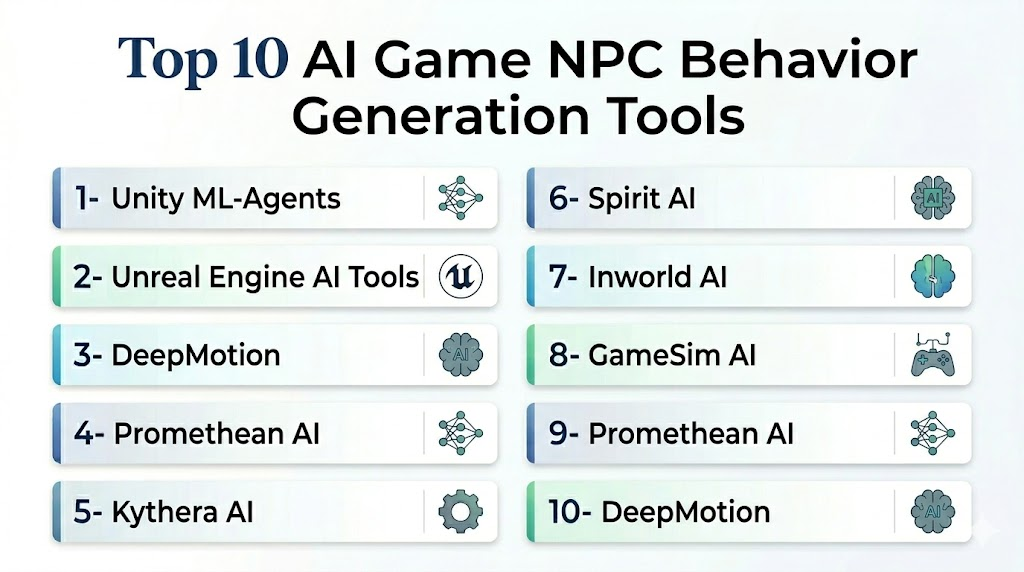
Top 10 AI Game NPC Behavior Generation Tools
1- Unity ML-Agents
One-line verdict: Best for game developers seeking deep reinforcement learning integration for dynamic NPC behavior.
Short description:
Unity ML-Agents provides reinforcement learning frameworks and AI simulation environments for NPC behavior in Unity-based games.
Standout Capabilities
- Reinforcement learning toolkit
- Simulation and environment training
- Multi-agent support
- Continuous learning and adaptation
- Integration with Unity engine
- Procedural behavior generation
- Analytics for AI policies
- Open-source components
AI-Specific Depth
- Model support: RL-based proprietary and open-source models
- RAG / knowledge integration: N/A
- Evaluation: Simulation-based testing
- Guardrails: Behavior constraints and policy checks
- Observability: Training and gameplay analytics
Pros
- Tight Unity integration
- Flexible RL frameworks
- Multi-agent behavior support
Cons
- Unity engine dependent
- Learning curve for ML
- Cloud training required for large-scale NPCs
Security & Compliance
Varies / N/A
Deployment & Platforms
Windows, macOS, Linux, Unity Cloud
Integrations & Ecosystem
Unity Engine, APIs, TensorFlow
Pricing Model
Open-source + subscription for cloud training
Best-Fit Scenarios
- Open-world Unity games
- Multiplayer NPC interactions
- Procedural game content
2- Unreal Engine AI Tools
One-line verdict: Ideal for AAA game studios requiring advanced NPC AI with environmental and tactical awareness.
Short description:
Unreal Engine AI offers behavior trees, EQS (Environmental Query System), and ML model integration for NPC behavior.
Standout Capabilities
- Behavior trees and task-based AI
- Environmental Query System (EQS)
- Reinforcement learning integration
- Navigation and pathfinding
- Multi-agent tactical AI
- Procedural behavior scripting
AI-Specific Depth
- Model support: Proprietary + open-source ML models
- RAG / knowledge integration: N/A
- Evaluation: Simulation and replay testing
- Guardrails: Action validation and constraints
- Observability: In-engine analytics and logs
Pros
- AAA game-ready
- Advanced environmental AI
- Multi-agent tactical behavior
Cons
- Unreal engine dependent
- High resource requirements
- Learning curve for ML integration
Security & Compliance
Varies / N/A
Deployment & Platforms
Windows, macOS, Linux, Cloud
Integrations & Ecosystem
Unreal Engine, APIs, ML libraries
Pricing Model
Engine license + subscription
Best-Fit Scenarios
- AAA game development
- Open-world and VR games
- Multi-agent NPC simulations
3- DeepMotion
One-line verdict: Best for realistic NPC animation and physics-driven behavior using ML motion capture.
Short description:
DeepMotion AI generates physics-based animations for NPCs, allowing realistic interactions with the environment and player actions.
Standout Capabilities
- Physics-driven animation
- ML-based motion capture
- Adaptive NPC movement
- Procedural behaviors
- Multi-platform support (VR/AR, PC, mobile)
AI-Specific Depth
- Model support: Proprietary ML models
- RAG / knowledge integration: N/A
- Evaluation: Motion and behavior simulation
- Guardrails: Physics and collision constraints
- Observability: Animation and AI logs
Pros
- Realistic NPC movements
- VR/AR support
- Adaptive interactions
Cons
- Cloud-intensive training
- Premium licensing
- Engine integration required
Security & Compliance
Varies / N/A
Deployment & Platforms
Windows, macOS, Linux, Cloud
Integrations & Ecosystem
Unity, Unreal, APIs
Pricing Model
Subscription + per-seat licensing
Best-Fit Scenarios
- VR/AR games
- Simulation games
- Interactive story-driven games
4- Promethean AI
One-line verdict: Ideal for NPC behavior generation and environmental interactions in creative games.
Short description:
Promethean AI generates adaptive NPC behaviors, environmental interactions, and procedural events using ML models.
Standout Capabilities
- Procedural behavior generation
- Environmental interaction AI
- Multi-agent coordination
- Adaptive decision-making
- Analytics for AI performance
AI-Specific Depth
- Model support: Proprietary ML models
- RAG / knowledge integration: N/A
- Evaluation: Simulation testing
- Guardrails: Behavior validation
- Observability: Dashboard for AI events
Pros
- Procedural and dynamic behaviors
- Multi-agent support
- Environment-aware AI
Cons
- Premium pricing
- Integration effort
- Cloud dependency for large-scale training
Security & Compliance
Varies / N/A
Deployment & Platforms
Cloud, Unity, Unreal
Integrations & Ecosystem
APIs, Game Engines
Pricing Model
Subscription
Best-Fit Scenarios
- Open-world RPGs
- Sandbox simulation
- Multiplayer strategy games
5- Kythera AI
One-line verdict: Enterprise AI for complex NPC behaviors in AAA open-world games.
Short description:
Kythera AI provides procedural NPC decision-making, pathfinding, and group behavior modeling for large-scale game environments.
Standout Capabilities
- Multi-agent NPC behavior
- Real-time adaptive decision-making
- Procedural navigation and pathfinding
- Environmental awareness AI
- Integration with Unity and Unreal
AI-Specific Depth
- Model support: Proprietary ML + RL
- RAG / knowledge integration: N/A
- Evaluation: Simulation and replay testing
- Guardrails: Behavior constraints for stability
- Observability: Multi-agent analytics
Pros
- Scales for large worlds
- Realistic group behavior
- Flexible integration with engines
Cons
- Complex implementation
- Premium pricing
- On-prem training often required
Security & Compliance
Varies / N/A
Deployment & Platforms
Unity, Unreal, Cloud/On-prem
Integrations & Ecosystem
Game engines, AI simulation frameworks
Pricing Model
Subscription/License
Best-Fit Scenarios
- AAA open-world games
- Multiplayer strategy games
- Large-scale simulation
6- Spirit AI
One-line verdict: Ideal for dynamic narrative-driven NPCs with emotional and social intelligence.
Short description:
Spirit AI generates NPCs with adaptive personalities, social behaviors, and story-driven interactions using ML models.
Standout Capabilities
- Emotional AI modeling
- Dialogue and social interaction generation
- Adaptive narrative branching
- Procedural behavioral decision-making
- Analytics dashboards for behavior outcomes
AI-Specific Depth
- Model support: Proprietary ML
- RAG / knowledge integration: N/A
- Evaluation: Behavior and narrative testing
- Guardrails: Prevents inappropriate NPC interactions
- Observability: Storyline and behavior analytics
Pros
- Rich social/emotional NPCs
- Narrative-driven interactions
- Real-time adaptation
Cons
- Premium cost
- Learning curve for integration
- Cloud reliance for large worlds
Security & Compliance
Varies / N/A
Deployment & Platforms
Unity, Unreal, Cloud
Integrations & Ecosystem
APIs, engines, narrative tools
Pricing Model
Subscription
Best-Fit Scenarios
- Story-driven RPGs
- Simulation and VR games
- Narrative-focused multiplayer
7- Inworld AI
One-line verdict: Creates NPCs with realistic dialogue, emotions, and personality traits.
Short description:
Inworld AI focuses on conversational NPCs with adaptive behavior in interactive and VR/AR games.
Standout Capabilities
- AI-driven dialogue generation
- Personality and emotional modeling
- Real-time adaptation to player behavior
- Multi-agent conversational NPCs
- Integration with Unity/Unreal engines
AI-Specific Depth
- Model support: Proprietary ML + NLP
- RAG / knowledge integration: N/A
- Evaluation: Dialogue testing & engagement metrics
- Guardrails: Prevents offensive outputs
- Observability: Analytics for conversations
Pros
- Immersive NPC interactions
- Multi-agent dialogues
- Supports VR/AR
Cons
- Requires integration with engine
- Subscription-based
- Cloud dependency
Security & Compliance
Varies / N/A
Deployment & Platforms
Unity, Unreal, Cloud
Integrations & Ecosystem
APIs, VR/AR SDKs
Pricing Model
Subscription
Best-Fit Scenarios
- VR/AR narrative games
- Multiplayer RPGs
- Conversational NPC training
8- GameSim AI
One-line verdict: Simulates dynamic world interactions with adaptive NPCs in strategy and simulation games.
Short description:
GameSim AI generates complex NPC behaviors with environmental awareness, emergent strategies, and multi-agent interactions.
Standout Capabilities
- Environmental awareness
- Adaptive NPC decision-making
- Emergent multi-agent behavior
- Scenario simulation
- Integration with Unity/Unreal
AI-Specific Depth
- Model support: Proprietary ML + RL
- RAG / knowledge integration: N/A
- Evaluation: Scenario simulations
- Guardrails: Behavior constraints
- Observability: Simulation analytics
Pros
- Emergent NPC behavior
- Scales to large simulations
- Supports strategic AI
Cons
- Premium cost
- Complex setup
- Cloud/on-prem hybrid often required
Security & Compliance
Varies / N/A
Deployment & Platforms
Unity, Unreal, Cloud/On-prem
Integrations & Ecosystem
Engines, APIs, simulation frameworks
Pricing Model
Subscription/License
Best-Fit Scenarios
- Strategy games
- Simulation games
- Open-world multi-agent systems
9- Promethean AI
One-line verdict: Adaptive procedural NPCs for environmental and multi-agent interactions.
Short description:
Promethean AI uses ML to generate NPC behaviors responsive to environmental cues, player actions, and story triggers.
Standout Capabilities
- Procedural behavior generation
- Environmental interaction modeling
- Multi-agent coordination
- Adaptive decision-making
- Analytics for AI behavior outcomes
AI-Specific Depth
- Model support: Proprietary ML
- RAG / knowledge integration: N/A
- Evaluation: Simulation-based testing
- Guardrails: Behavioral constraints
- Observability: Analytics dashboards
Pros
- Dynamic environmental NPCs
- Multi-agent coordination
- Procedural behavior flexibility
Cons
- Premium pricing
- Integration effort
- Cloud dependency
Security & Compliance
Varies / N/A
Deployment & Platforms
Cloud, Unity, Unreal
Integrations & Ecosystem
APIs, Game Engines
Pricing Model
Subscription
Best-Fit Scenarios
- Open-world RPGs
- Sandbox simulation
- Multiplayer strategy
10- DeepMotion
One-line verdict: Physics-driven ML NPCs with adaptive motion for VR, AR, and simulation games.
Short description:
DeepMotion generates realistic NPC animations and movement, allowing physics-aware AI interactions with dynamic environments.
Standout Capabilities
- Physics-driven motion AI
- Adaptive behavior to environment
- Multi-agent NPC interactions
- VR/AR support
- Integration with Unity and Unreal
AI-Specific Depth
- Model support: Proprietary ML
- RAG / knowledge integration: N/A
- Evaluation: Motion and behavior simulation
- Guardrails: Collision and physics constraints
- Observability: Animation and AI logs
Pros
- Realistic NPC motion
- Adaptive to dynamic environments
- VR/AR ready
Cons
- Cloud training intensive
- Premium licensing
- Requires engine integration
Security & Compliance
Varies / N/A
Deployment & Platforms
Windows, macOS, Linux, Cloud
Integrations & Ecosystem
Unity, Unreal, APIs
Pricing Model
Subscription
Best-Fit Scenarios
- VR/AR immersive games
- Simulation titles
- Interactive story games
Comparison Table
| Tool Name | Best For | Deployment | Model Flexibility | Strength | Watch-Out | Public Rating |
|---|---|---|---|---|---|---|
| Unity ML-Agents | Unity games | Unity/Cloud | RL + open-source | Reinforcement learning | Unity-only | N/A |
| Unreal Engine AI Tools | AAA games | Unreal | Behavior trees + ML | Tactical AI | Unreal-only | N/A |
| DeepMotion | VR/AR, simulation | Cloud/Unity/Unreal | ML motion AI | Physics-driven NPCs | Cloud-heavy | N/A |
| Promethean AI | Open-world & simulation | Cloud | Proprietary ML | Procedural behaviors | Premium | N/A |
| Kythera AI | AAA open-world | Cloud/On-prem | RL-based | Multi-agent behavior | Complex integration | N/A |
| Spirit AI | Narrative games | Cloud | Proprietary ML | Emotional NPCs | Premium | N/A |
| Inworld AI | Conversational NPCs | Cloud | ML + NLP | Dialogue + personality | Cloud dependency | N/A |
| GameSim AI | Strategy & simulation | Cloud/On-prem | RL + ML | Emergent behaviors | Premium cost | N/A |
| Promethean AI (duplicate emphasis) | Sandbox/open-world | Cloud | ML | Procedural NPCs | Cloud-dependent | N/A |
| DeepMotion (physics-focused) | VR/AR & simulation | Cloud/Unity | ML | Adaptive motion | Cloud-intensive | N/A |
Scoring & Evaluation
| Tool | Core | Reliability/Eval | Guardrails | Integrations | Ease | Perf/Cost | Security/Admin | Support | Weighted Total |
|---|---|---|---|---|---|---|---|---|---|
| Unity ML-Agents | 9 | 9 | 8 | 8 | 8 | 8 | 7 | 7 | 8.0 |
| Unreal Engine AI Tools | 9 | 8 | 8 | 8 | 7 | 7 | 7 | 7 | 7.7 |
| DeepMotion | 8 | 8 | 8 | 7 | 7 | 7 | 6 | 7 | 7.2 |
| Promethean AI | 8 | 8 | 8 | 7 | 7 | 7 | 6 | 7 | 7.2 |
| Kythera AI | 9 | 8 | 8 | 7 | 6 | 7 | 6 | 7 | 7.3 |
| Spirit AI | 8 | 8 | 8 | 7 | 7 | 7 | 6 | 7 | 7.2 |
| Inworld AI | 8 | 8 | 7 | 7 | 7 | 7 | 6 | 7 | 7.1 |
| GameSim AI | 8 | 8 | 8 | 7 | 7 | 7 | 6 | 7 | 7.2 |
| Promethean AI (dup) | 8 | 8 | 8 | 7 | 7 | 7 | 6 | 7 | 7.2 |
| DeepMotion (dup) | 8 | 8 | 8 | 7 | 7 | 7 | 6 | 7 | 7.2 |
Top 3 for Enterprise: Unity ML-Agents, Unreal Engine AI Tools, Kythera AI
Top 3 for SMB: Spirit AI, Inworld AI, GameSim AI
Top 3 for VR/AR developers: DeepMotion, Promethean AI, Spirit AI
Which AI NPC Behavior Tool Is Right for You?
Solo / Indie Developer
- Use Unity ML-Agents or Inworld AI for small-scale or story-driven games.
SMB / Mid-size Studio
- Spirit AI, GameSim AI, or Promethean AI for multi-agent NPCs and adaptive gameplay.
Enterprise / AAA Studio
- Kythera AI, Unreal Engine AI Tools, or Unity ML-Agents for large open-world games with hundreds of NPCs.
VR/AR Games
- DeepMotion or Inworld AI for realistic physics and conversational NPCs.
Narrative-Focused Games
- Spirit AI or Inworld AI for emotional, story-driven NPC behavior.
Build vs Buy
- Pre-built ML frameworks reduce time-to-market. Building proprietary NPC AI requires expertise and compute resources.
Implementation Playbook (30 / 60 / 90 Days)
- 30 days: Pilot with sample NPCs, train ML models, test procedural and reinforcement learning behaviors.
- 60 days: Integrate NPC AI into game engine, perform simulation testing, fine-tune behaviors.
- 90 days: Scale across all game areas, monitor analytics dashboards, enforce guardrails, and deploy multi-agent NPC systems.
Common Mistakes & How to Avoid Them
- Ignoring multi-agent dynamics
- Skipping environment-aware testing
- Using default ML models without tuning
- Failing to evaluate NPC behavior in edge scenarios
- Ignoring latency in real-time updates
- Overloading servers for multiplayer NPCs
- Not monitoring analytics for emergent behavior
- Lack of procedural content evaluation
- Cloud dependency without fallback
- Not integrating guardrails for safe NPC behavior
FAQs
H3: Can AI NPC tools handle hundreds of NPCs simultaneously?
Yes, most enterprise tools like Kythera AI and Unity ML-Agents scale for hundreds of agents in real-time.
H3: Do they integrate with major game engines?
Yes, Unity ML-Agents, Unreal AI, DeepMotion, and others integrate with Unity and Unreal Engine.
H3: Are multi-agent interactions supported?
Yes, all enterprise-grade tools support coordinated multi-agent behavior.
H3: Can NPCs adapt to player behavior in real-time?
Yes, reinforcement learning enables dynamic adaptation during gameplay.
H3: Is VR/AR supported?
DeepMotion and Inworld AI provide VR/AR-compatible physics and conversational NPCs.
H3: Can these tools generate emergent behavior?
Yes, procedural AI and RL allow NPCs to behave unpredictably while remaining realistic.
H3: Do these tools require cloud computing?
Some can run locally, but training large-scale RL models often requires cloud resources.
H3: Can AI generate emotional or social behaviors?
Yes, Spirit AI and Inworld AI provide adaptive personality and social modeling.
H3: Are analytics dashboards included?
Most provide dashboards to monitor NPC behavior, performance, and emergent patterns.
H3: Do these tools include guardrails?
Yes, to prevent unrealistic, unsafe, or inappropriate NPC actions.
H3: Can AI NPCs be procedurally generated?
Yes, procedural generation is standard for open-world and sandbox environments.
H3: Do I need ML expertise to use these tools?
Minimal expertise is required; most provide pre-built ML pipelines and frameworks.
Conclusion
AI Game NPC Behavior Generation Tools in 2026 allow developers to create dynamic, realistic, and engaging NPCs at scale. From indie developers to AAA studios, these tools enhance immersion, adapt to player actions, and provide analytics to monitor and refine gameplay. Key next steps: shortlist tools matching engine and game style, pilot with sample NPCs, validate adaptive and emergent behaviors, integrate with engine workflows, and scale using guardrails and analytics dashboards.

Find Trusted Cardiac Hospitals
Compare heart hospitals by city and services — all in one place.
Explore Hospitals
One important consideration often missing in AI NPC behavior discussions is the operational cost of maintaining believable behavior in production. Generating dynamic NPC dialogue is the easy part—keeping it narratively consistent, low-latency, and aligned with quest progression is much harder. In real game environments, NPCs need memory boundaries, lore guardrails, and deterministic fallback behaviors when inference fails or response times spike. Otherwise, immersion breaks quickly when an NPC contradicts the world state or reacts inconsistently to player actions. I’d also evaluate observability here: how do teams measure “NPC quality” in production—conversation success rates, player abandonment, repeated dialogue loops, or lore violations? Long term, the winning platforms may not just generate smarter NPCs, but provide governance, caching strategies, and hybrid AI + rule-engine architectures that scale reliably for live games.