
Introduction
Legal departments and law firms process thousands of invoices every month, making it increasingly difficult to manually review every billing entry for accuracy, compliance, and cost efficiency. Traditional invoice reviews often rely on manual sampling and predefined billing guidelines, leaving organizations vulnerable to duplicate charges, excessive billable hours, non-compliant expenses, incorrect billing codes, and policy violations. AI Legal Billing Anomaly Detection Tools leverage artificial intelligence, machine learning, and advanced analytics to automatically identify unusual billing patterns, flag potential errors, and recommend corrective actions before invoices are approved for payment.
Modern AI-powered legal billing platforms analyze historical billing behavior, timekeeper patterns, matter complexity, billing guidelines, task codes, and invoice narratives to detect anomalies that human reviewers might overlook. Rather than replacing legal operations teams, these tools enhance invoice review by improving consistency, reducing review time, strengthening outside counsel management, and helping organizations control legal spend more effectively.
As legal departments increasingly adopt AI for spend management and operational efficiency, today’s solutions are evolving beyond rule-based invoice validation toward intelligent billing analytics, predictive cost forecasting, and AI-assisted legal operations. Explainable AI, auditability, security, and governance have become essential capabilities for organizations managing sensitive legal and financial information.
Common use cases include:
- Legal invoice review
- Outside counsel billing compliance
- Duplicate invoice detection
- Timekeeper rate validation
- Billing guideline enforcement
- Legal spend optimization
- Matter cost analysis
- Vendor performance evaluation
When evaluating AI Legal Billing Anomaly Detection tools, buyers should consider:
- AI anomaly detection accuracy
- Billing guideline automation
- Invoice analytics
- Matter management integration
- Explainability of AI recommendations
- Workflow automation
- Reporting and dashboards
- Security controls
- Audit trails
- Scalability
- API integrations
- Cost management capabilities
Best for: Corporate legal departments, legal operations teams, finance departments, procurement teams, law firms, government agencies, insurance companies, financial institutions, healthcare organizations, and enterprises managing significant outside legal spend.
Not ideal for: Small legal practices with minimal invoice volumes, organizations without formal billing guidelines, or businesses that only require basic invoice tracking instead of AI-powered billing analytics.
What’s Changed in AI Legal Billing Anomaly Detection Tools
AI is fundamentally changing how organizations review legal invoices and manage outside counsel relationships.
Key trends include:
- AI automatically identifies billing anomalies before invoice approval.
- Machine learning improves billing accuracy using historical invoice patterns.
- Intelligent narrative analysis detects non-compliant billing descriptions.
- AI agents assist legal operations teams with invoice review recommendations.
- Predictive legal spend analytics improve budgeting.
- Continuous billing monitoring replaces periodic manual reviews.
- Explainable AI provides transparent anomaly scoring.
- Better integration with legal matter management platforms.
- Enhanced compliance reporting supports audit readiness.
- AI-powered benchmarking compares firms and timekeepers.
- Automated billing guideline enforcement reduces manual effort.
- Executive dashboards improve visibility into legal spending trends.
Quick Buyer Checklist
Before selecting an AI Legal Billing Anomaly Detection platform, ensure it provides:
- ✔ AI-powered anomaly detection
- ✔ Billing guideline enforcement
- ✔ Invoice review automation
- ✔ Matter management integration
- ✔ Legal spend analytics
- ✔ Human approval workflows
- ✔ Audit trails
- ✔ Role-based access controls
- ✔ Secure financial data handling
- ✔ Executive dashboards
- ✔ APIs for enterprise integration
- ✔ Vendor performance reporting
- ✔ Cloud or hybrid deployment
- ✔ Low vendor lock-in through open APIs
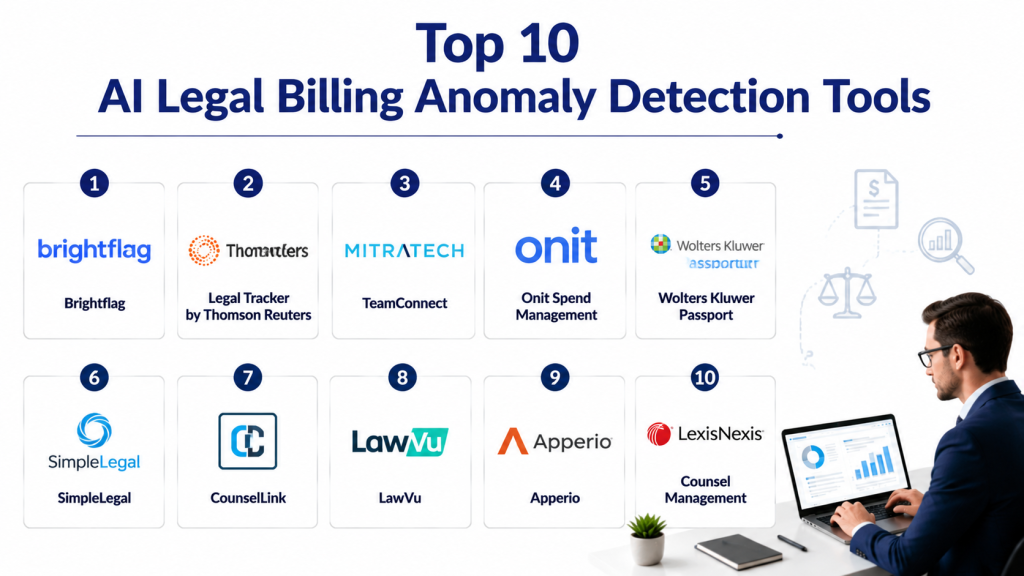
Top 10 AI Legal Billing Anomaly Detection Tools
1 — Brightflag
One-line verdict: Best for enterprises seeking AI-powered legal spend management and intelligent invoice review.
Short description
Brightflag uses artificial intelligence to automate legal invoice review, detect billing anomalies, enforce billing guidelines, and optimize outside counsel spending. It helps legal operations teams improve efficiency while maintaining consistent invoice review processes.
Standout Capabilities
- AI-powered invoice review
- Billing anomaly detection
- Legal spend analytics
- Outside counsel management
- Matter management
- Billing guideline enforcement
- Executive dashboards
- Cost forecasting
AI-Specific Depth
- Model support: Proprietary AI models for legal billing analytics
- RAG / Knowledge integration: N/A
- Evaluation: Human reviewer validation workflows
- Guardrails: Billing policy enforcement and approval controls
- Observability: Spend dashboards, invoice analytics, workflow reporting
Pros
- Excellent AI-powered invoice review
- Strong legal spend visibility
- Mature enterprise capabilities
Cons
- Enterprise-oriented implementation
- Premium pricing
- Advanced configuration may be required
Security & Compliance
- SSO/SAML: Supported
- RBAC: Supported
- Audit logs: Supported
- Encryption: Supported
- Data retention controls: Available
- Certifications: Not publicly stated
Deployment & Platforms
- Web
- Cloud
- Enterprise SaaS
Integrations & Ecosystem
Brightflag integrates with enterprise finance, ERP, matter management, and reporting platforms.
- REST APIs
- ERP systems
- Finance platforms
- Matter management systems
- Business intelligence tools
Pricing Model
Enterprise subscription.
Best-Fit Scenarios
- Enterprise legal operations
- Outside counsel management
- Legal spend optimization
2 — Legal Tracker by Thomson Reuters
One-line verdict: Best for organizations managing enterprise legal operations, invoices, and outside counsel performance.
Short description
Legal Tracker combines legal e-billing, matter management, analytics, and AI-assisted invoice review to help organizations improve billing compliance, monitor legal spend, and automate legal operations.
Standout Capabilities
- E-billing management
- Matter management
- Invoice analytics
- Billing rule enforcement
- Legal spend reporting
- Vendor benchmarking
- Workflow automation
- Executive dashboards
AI-Specific Depth
- Model support: AI-assisted billing analytics
- RAG / Knowledge integration: N/A
- Evaluation: Human review workflows
- Guardrails: Billing policy enforcement
- Observability: Invoice analytics and reporting
Pros
- Mature enterprise platform
- Strong legal operations ecosystem
- Comprehensive reporting
Cons
- Enterprise complexity
- Premium licensing
- Learning curve for advanced features
Security & Compliance
- SSO/SAML: Supported
- RBAC: Supported
- Audit logs: Supported
- Encryption: Supported
- Certifications: Not publicly stated
Deployment & Platforms
- Cloud
- Web
Integrations & Ecosystem
Supports integrations with ERP systems, financial applications, legal matter management platforms, and enterprise reporting tools.
- APIs
- ERP systems
- Finance software
- Matter management
- Reporting platforms
Pricing Model
Enterprise subscription.
Best-Fit Scenarios
- Corporate legal departments
- Enterprise e-billing
- Legal operations modernization
3 — Mitratech TeamConnect
One-line verdict: Best for enterprises seeking integrated legal matter management with AI-assisted billing analysis.
Short description
Mitratech TeamConnect provides enterprise legal management capabilities including matter management, e-billing, legal spend analytics, and AI-assisted invoice review that help organizations improve compliance and reduce outside counsel costs.
Standout Capabilities
- Enterprise legal management
- AI-assisted invoice review
- Matter management
- Legal spend analytics
- Workflow automation
- Vendor management
- Compliance reporting
- Executive dashboards
AI-Specific Depth
- Model support: AI-assisted legal analytics
- RAG / Knowledge integration: N/A
- Evaluation: Human validation workflows
- Guardrails: Policy-based invoice controls
- Observability: Matter and billing dashboards
Pros
- Strong enterprise legal platform
- Excellent workflow capabilities
- Broad integration ecosystem
Cons
- Enterprise implementation effort
- Advanced configuration required
- Premium pricing
Security & Compliance
- SSO/SAML: Supported
- RBAC: Supported
- Audit logs: Supported
- Encryption: Supported
- Certifications: Not publicly stated
Deployment & Platforms
- Cloud
- Web
- Enterprise deployment
Integrations & Ecosystem
Integrates with finance systems, document management, ERP platforms, identity providers, and reporting solutions.
- APIs
- ERP platforms
- Document management
- Identity providers
- Reporting systems
Pricing Model
Enterprise subscription.
Best-Fit Scenarios
- Enterprise legal management
- Matter management
- Invoice compliance
4 — Onit Spend Management
One-line verdict: Best for organizations automating legal spend governance and invoice compliance.
Short description
Onit Spend Management helps legal departments automate invoice review, identify billing anomalies, manage outside counsel, and improve operational efficiency using AI-assisted analytics and workflow automation.
Standout Capabilities
- AI-powered spend analysis
- Invoice review
- Billing guideline automation
- Matter management
- Vendor performance tracking
- Workflow automation
- Compliance reporting
- Spend forecasting
AI-Specific Depth
- Model support: AI-assisted legal spend analytics
- RAG / Knowledge integration: N/A
- Evaluation: Human approval workflows
- Guardrails: Billing policy enforcement
- Observability: Spend dashboards and analytics
Pros
- Strong spend management
- Excellent workflow automation
- Good enterprise scalability
Cons
- Enterprise licensing
- Configuration complexity
- Broad platform requires implementation planning
Security & Compliance
- SSO/SAML: Supported
- RBAC: Supported
- Audit logs: Supported
- Encryption: Supported
- Certifications: Not publicly stated
Deployment & Platforms
- Cloud
- Web
Integrations & Ecosystem
Supports integrations with enterprise finance, ERP, reporting, and matter management platforms.
- REST APIs
- ERP systems
- Financial platforms
- Matter management
- Reporting tools
Pricing Model
Enterprise subscription.
Best-Fit Scenarios
- Legal spend governance
- Invoice compliance
- Outside counsel management
5 — Wolters Kluwer Passport
One-line verdict: Best for organizations managing legal spend, invoice compliance, and enterprise legal workflows.
Short description
Wolters Kluwer Passport provides enterprise legal management capabilities including e-billing, invoice review, legal analytics, and workflow automation to help legal departments control costs and improve operational visibility.
Standout Capabilities
- Legal invoice review
- Spend management
- Matter management
- Vendor analytics
- Compliance reporting
- Workflow automation
- Executive dashboards
- Billing guideline enforcement
AI-Specific Depth
- Model support: AI-assisted analytics capabilities
- RAG / Knowledge integration: N/A
- Evaluation: Human review workflows
- Guardrails: Policy-driven invoice controls
- Observability: Legal spend dashboards
Pros
- Mature enterprise platform
- Strong reporting
- Comprehensive legal operations support
Cons
- Enterprise-focused implementation
- Premium licensing
- Learning curve for advanced modules
Security & Compliance
- SSO/SAML: Supported
- RBAC: Supported
- Audit logs: Supported
- Encryption: Supported
- Certifications: Not publicly stated
Deployment & Platforms
- Cloud
- Web
Integrations & Ecosystem
Supports enterprise integrations with ERP systems, finance software, legal applications, and reporting tools.
- APIs
- ERP platforms
- Finance applications
- Matter management
- Business intelligence tools
Pricing Model
Enterprise subscription.
Best-Fit Scenarios
- Corporate legal departments
- Enterprise billing governance
- Legal spend optimization
6 — SimpleLegal
One-line verdict: Best for organizations seeking modern legal spend management with AI-assisted invoice validation and reporting.
Short description
SimpleLegal helps corporate legal departments automate invoice review, monitor outside counsel performance, identify unusual billing behavior, and gain visibility into legal spending through centralized dashboards and workflow automation.
Standout Capabilities
- AI-assisted invoice analysis
- Legal spend dashboards
- Outside counsel management
- Matter tracking
- Budget monitoring
- Billing guideline enforcement
- Approval workflows
- Analytics reporting
AI-Specific Depth
- Model support: AI-assisted spend analytics
- RAG / Knowledge integration: N/A
- Evaluation: Human approval workflows
- Guardrails: Billing policy validation
- Observability: Invoice analytics, spend metrics, workflow dashboards
Pros
- Easy-to-use interface
- Strong legal spend visibility
- Flexible workflow automation
Cons
- Enterprise licensing
- Advanced customization requires planning
- AI capabilities vary by deployment
Security & Compliance
- SSO/SAML: Supported
- RBAC: Supported
- Audit logs: Supported
- Encryption: Supported
- Data retention controls: Available
- Certifications: Not publicly stated
Deployment & Platforms
- Web
- Cloud
Integrations & Ecosystem
SimpleLegal integrates with ERP platforms, accounting software, document management systems, and reporting tools.
- REST APIs
- ERP systems
- Accounting platforms
- Reporting tools
- Business applications
Pricing Model
Subscription-based enterprise licensing.
Best-Fit Scenarios
- Corporate legal departments
- Budget monitoring
- Invoice automation
7 — CounselLink
One-line verdict: Best for organizations combining legal spend management with enterprise matter management.
Short description
CounselLink provides legal spend management, invoice review, matter management, vendor analytics, and AI-assisted billing analysis to help organizations reduce costs while improving billing compliance.
Standout Capabilities
- Legal spend management
- E-billing
- Matter management
- Vendor scorecards
- AI-assisted invoice review
- Budget forecasting
- Executive dashboards
- Compliance reporting
AI-Specific Depth
- Model support: AI-assisted billing analytics
- RAG / Knowledge integration: N/A
- Evaluation: Human validation workflows
- Guardrails: Billing guideline enforcement
- Observability: Spend dashboards and reporting
Pros
- Strong matter management
- Mature legal operations platform
- Comprehensive reporting
Cons
- Enterprise implementation
- Premium licensing
- Learning curve
Security & Compliance
- SSO/SAML: Supported
- RBAC: Supported
- Audit logs: Supported
- Encryption: Supported
- Certifications: Not publicly stated
Deployment & Platforms
- Cloud
- Web
Integrations & Ecosystem
Supports integrations with ERP systems, finance platforms, document management, and enterprise reporting.
- APIs
- ERP platforms
- Financial systems
- Reporting tools
- Matter management
Pricing Model
Enterprise subscription.
Best-Fit Scenarios
- Enterprise legal departments
- Outside counsel management
- Legal operations modernization
8 — LawVu
One-line verdict: Best for growing legal teams seeking an integrated legal workspace with billing intelligence.
Short description
LawVu combines legal operations, matter management, contract management, spend management, and invoice review into a collaborative platform that helps organizations improve legal efficiency and billing oversight.
Standout Capabilities
- Matter management
- Spend tracking
- Invoice workflows
- Vendor management
- Collaboration tools
- Reporting dashboards
- Budget monitoring
- Workflow automation
AI-Specific Depth
- Model support: AI-assisted workflow capabilities
- RAG / Knowledge integration: N/A
- Evaluation: Human review supported
- Guardrails: Billing approval workflows
- Observability: Operational dashboards and analytics
Pros
- Modern user experience
- Unified legal workspace
- Strong collaboration
Cons
- Enterprise licensing
- AI functionality varies by implementation
- Broad platform may require phased adoption
Security & Compliance
- SSO/SAML: Supported
- RBAC: Supported
- Audit logs: Supported
- Encryption: Supported
- Certifications: Not publicly stated
Deployment & Platforms
- Cloud
- Web
Integrations & Ecosystem
Supports integrations with Microsoft applications, document management systems, ERP software, and APIs.
- Microsoft ecosystem
- REST APIs
- ERP platforms
- Document management
- Business applications
Pricing Model
Subscription-based licensing.
Best-Fit Scenarios
- Mid-market legal teams
- Integrated legal operations
- Spend governance
9 — Apperio
One-line verdict: Best for legal departments requiring real-time legal spend transparency and billing analytics.
Short description
Apperio provides legal spend management and outside counsel analytics, helping organizations monitor invoices, detect unusual spending patterns, improve budgeting, and strengthen financial oversight across legal operations.
Standout Capabilities
- Legal spend analytics
- Budget monitoring
- Outside counsel reporting
- Invoice visibility
- Vendor benchmarking
- Financial dashboards
- Cost forecasting
- Matter reporting
AI-Specific Depth
- Model support: AI-assisted spend analytics
- RAG / Knowledge integration: N/A
- Evaluation: Human review workflows
- Guardrails: Billing policy controls
- Observability: Real-time spend dashboards
Pros
- Excellent spend visibility
- Strong budgeting support
- Modern reporting interface
Cons
- Focused primarily on spend management
- Enterprise licensing
- Limited matter management compared to broader legal platforms
Security & Compliance
- SSO/SAML: Supported
- RBAC: Supported
- Audit logs: Supported
- Encryption: Supported
- Certifications: Not publicly stated
Deployment & Platforms
- Cloud
- Web
Integrations & Ecosystem
Integrates with finance systems, ERP platforms, legal applications, and reporting solutions.
- REST APIs
- ERP platforms
- Finance systems
- Reporting tools
- Legal applications
Pricing Model
Enterprise subscription.
Best-Fit Scenarios
- Budget control
- Legal spend analytics
- Executive reporting
10 — LexisNexis Counsel Management
One-line verdict: Best for enterprises integrating legal billing governance with broader legal operations.
Short description
LexisNexis Counsel Management supports invoice review, legal matter management, spend analytics, and outside counsel oversight, enabling legal teams to automate billing compliance and improve operational efficiency.
Standout Capabilities
- Legal matter management
- Billing analytics
- Invoice review
- Vendor oversight
- Compliance reporting
- Workflow automation
- Executive dashboards
- Legal spend analysis
AI-Specific Depth
- Model support: AI-assisted legal analytics
- RAG / Knowledge integration: N/A
- Evaluation: Human investigator validation
- Guardrails: Billing policy enforcement
- Observability: Legal operations dashboards
Pros
- Broad legal operations capabilities
- Enterprise reporting
- Good legal ecosystem integration
Cons
- Enterprise implementation effort
- Premium licensing
- Advanced configuration required
Security & Compliance
- SSO/SAML: Supported
- RBAC: Supported
- Audit logs: Supported
- Encryption: Supported
- Certifications: Not publicly stated
Deployment & Platforms
- Cloud
- Web
Integrations & Ecosystem
Supports APIs and integrations across ERP platforms, document management, finance software, and legal operations tools.
- REST APIs
- ERP platforms
- Document management
- Finance applications
- Reporting platforms
Pricing Model
Enterprise subscription.
Best-Fit Scenarios
- Enterprise legal departments
- Billing governance
- Legal operations management
Comparison Table
| Tool Name | Best For | Deployment | Model Flexibility | Strength | Watch-Out | Public Rating |
|---|---|---|---|---|---|---|
| Brightflag | AI Legal Spend Management | Cloud | Proprietary AI | Intelligent invoice review | Enterprise pricing | N/A |
| Legal Tracker | Enterprise Legal Operations | Cloud | AI-assisted | Mature e-billing platform | Learning curve | N/A |
| Mitratech TeamConnect | Matter & Spend Management | Cloud | AI-assisted | Enterprise legal management | Complex implementation | N/A |
| Onit Spend Management | Spend Governance | Cloud | AI-assisted | Workflow automation | Configuration effort | N/A |
| Wolters Kluwer Passport | Enterprise Billing Compliance | Cloud | AI-assisted | Comprehensive reporting | Enterprise licensing | N/A |
| SimpleLegal | Modern Legal Spend | Cloud | AI-assisted | User-friendly platform | Feature depth varies | N/A |
| CounselLink | Outside Counsel Management | Cloud | AI-assisted | Matter management | Premium pricing | N/A |
| LawVu | Integrated Legal Workspace | Cloud | AI-assisted | Collaboration | Broader rollout required | N/A |
| Apperio | Legal Spend Analytics | Cloud | AI-assisted | Budget visibility | Spend-focused platform | N/A |
| LexisNexis Counsel Management | Enterprise Legal Operations | Cloud | AI-assisted | Broad legal ecosystem | Configuration complexity | N/A |
Scoring & Evaluation (Transparent Rubric)
The following scores compare leading AI Legal Billing Anomaly Detection platforms using a consistent evaluation framework. These scores are intended to support vendor shortlisting rather than represent absolute rankings. Organizations should validate AI billing accuracy, workflow automation, integration quality, governance capabilities, and security controls through pilot deployments before making a purchasing decision.
| Tool | Core | Reliability / Eval | Guardrails | Integrations | Ease | Perf / Cost | Security / Admin | Support | Weighted Total |
|---|---|---|---|---|---|---|---|---|---|
| Brightflag | 9.8 | 9.6 | 9.5 | 9.5 | 9.2 | 9.1 | 9.6 | 9.5 | 9.47 |
| Legal Tracker | 9.6 | 9.3 | 9.4 | 9.6 | 8.9 | 8.9 | 9.5 | 9.4 | 9.34 |
| Mitratech TeamConnect | 9.5 | 9.3 | 9.4 | 9.5 | 8.8 | 8.8 | 9.5 | 9.3 | 9.29 |
| Onit Spend Management | 9.4 | 9.2 | 9.3 | 9.4 | 8.8 | 8.9 | 9.3 | 9.2 | 9.19 |
| CounselLink | 9.3 | 9.2 | 9.2 | 9.3 | 8.9 | 8.8 | 9.3 | 9.2 | 9.15 |
| Wolters Kluwer Passport | 9.2 | 9.0 | 9.2 | 9.2 | 8.7 | 8.7 | 9.2 | 9.1 | 9.06 |
| SimpleLegal | 9.1 | 8.9 | 9.0 | 9.1 | 9.2 | 9.0 | 9.1 | 9.0 | 9.03 |
| LawVu | 9.0 | 8.9 | 8.9 | 9.0 | 9.3 | 9.0 | 9.0 | 9.0 | 8.99 |
| LexisNexis Counsel Management | 9.0 | 8.9 | 9.0 | 9.2 | 8.8 | 8.7 | 9.2 | 9.0 | 8.98 |
| Apperio | 8.9 | 8.8 | 8.8 | 8.9 | 9.1 | 9.2 | 8.9 | 8.9 | 8.91 |
Top 3 for Enterprise
- Brightflag
- Legal Tracker by Thomson Reuters
- Mitratech TeamConnect
Top 3 for SMB
- SimpleLegal
- LawVu
- Apperio
Top 3 for Legal Operations Teams
- Brightflag
- Onit Spend Management
- CounselLink
Which AI Legal Billing Anomaly Detection Tool Is Right for You?
Choosing the right AI Legal Billing Anomaly Detection platform depends on your legal spend, the complexity of outside counsel relationships, existing legal operations processes, and long-term governance goals. While every solution aims to improve invoice review and billing compliance, organizations should evaluate platforms based on AI accuracy, workflow automation, reporting capabilities, integrations, and scalability rather than selecting solely on feature count.
The most effective platforms combine intelligent anomaly detection with human oversight, ensuring that billing recommendations remain transparent, explainable, and aligned with organizational billing guidelines. Organizations should also consider how well the platform integrates with matter management, finance, procurement, and enterprise reporting systems.
Solo / Freelancer
Independent legal consultants, boutique law firms, and organizations managing a limited number of legal invoices generally need lightweight billing review capabilities instead of comprehensive enterprise legal operations platforms.
Key priorities include:
- Easy implementation
- Cloud accessibility
- Budget monitoring
- Simple invoice workflows
- Basic analytics
- Minimal administration
Recommended tools
- LawVu
- SimpleLegal
- Apperio
These platforms provide practical spend visibility without the complexity of larger enterprise systems.
SMB
Small and medium-sized businesses increasingly rely on outside counsel but often have limited legal operations resources. AI-assisted invoice review helps improve consistency while reducing manual effort.
Important evaluation criteria include:
- Automated invoice review
- Billing guideline enforcement
- Spend reporting
- Vendor analytics
- Workflow automation
- ERP integration
- Budget tracking
Recommended tools
- SimpleLegal
- LawVu
- Apperio
Mid-Market
Mid-sized organizations often manage multiple law firms, larger legal budgets, and increasing compliance requirements.
Priority capabilities include:
- AI anomaly detection
- Matter management
- Vendor benchmarking
- Legal spend analytics
- Executive reporting
- Budget forecasting
- Workflow automation
Recommended tools
- CounselLink
- Onit Spend Management
- Legal Tracker
Enterprise
Large enterprises process thousands of legal invoices annually across multiple jurisdictions and law firms. Enterprise platforms should provide comprehensive governance, AI-driven analytics, security, and executive visibility.
Essential capabilities include:
- AI-powered invoice analysis
- Billing guideline automation
- Matter management
- Vendor performance analytics
- Executive dashboards
- Enterprise integrations
- Audit trails
- Workflow automation
Recommended tools
- Brightflag
- Legal Tracker
- Mitratech TeamConnect
- Onit Spend Management
- CounselLink
Regulated Industries (Finance, Healthcare, Government)
Highly regulated organizations require transparent billing reviews, audit-ready documentation, and strong governance controls.
Important evaluation criteria include:
- Complete audit trails
- Role-based permissions
- Encryption
- Billing compliance
- Workflow approvals
- Executive reporting
- Explainable AI recommendations
- Policy enforcement
Recommended tools
- Brightflag
- Mitratech TeamConnect
- Legal Tracker
- Onit Spend Management
Budget vs Premium
Budget-Friendly Solutions
Organizations with smaller legal departments generally benefit from solutions that provide essential automation without enterprise complexity.
Recommended platforms:
- LawVu
- SimpleLegal
- Apperio
Premium Enterprise Platforms
Organizations managing complex legal operations should prioritize comprehensive governance capabilities.
Recommended platforms:
- Brightflag
- Legal Tracker
- Mitratech TeamConnect
- Onit Spend Management
- CounselLink
Build vs Buy
Some organizations consider developing internal invoice analytics using business intelligence tools and AI models.
Consider Building If
- Invoice review requirements are highly customized.
- Experienced data engineering resources are available.
- Existing legal platforms cannot satisfy business requirements.
- Internal AI governance is well established.
Consider Buying If
- Rapid deployment is important.
- Proven legal billing expertise is required.
- Enterprise integrations are essential.
- Vendor-maintained AI improvements are valuable.
- Legal operations teams prefer configurable workflows.
For most organizations, purchasing a mature legal billing platform delivers faster implementation, lower operational risk, and ongoing product enhancements.
Implementation Playbook (30 / 60 / 90 Days)
Successfully implementing AI Legal Billing Anomaly Detection requires a phased rollout focused on governance, user adoption, and continuous optimization.
First 30 Days – Pilot and Baseline
Start with a pilot using historical legal invoices to establish baseline metrics and validate AI recommendations.
Recommended activities:
- Collect historical invoices.
- Review billing guidelines.
- Configure user roles.
- Integrate finance and matter management systems.
- Define anomaly detection rules.
- Pilot AI-assisted invoice review.
- Compare AI findings with manual reviews.
- Train legal operations teams.
- Build executive dashboards.
- Define success metrics.
Success metrics include:
- Invoice review time
- Detection accuracy
- Billing compliance
- Cost savings
- User adoption
Days 31–60 – Expand Governance
Strengthen governance while expanding automation across legal operations.
Recommended activities:
- Enable single sign-on.
- Configure role-based permissions.
- Standardize billing policies.
- Expand integrations.
- Automate invoice routing.
- Implement approval workflows.
- Improve reporting.
- Benchmark outside counsel.
- Validate anomaly recommendations.
- Conduct user training.
Days 61–90 – Optimize and Scale
Expand deployment while improving AI performance and operational efficiency.
Recommended initiatives:
- Monitor anomaly detection accuracy.
- Optimize legal spend analytics.
- Improve dashboard reporting.
- Expand vendor benchmarking.
- Track outside counsel performance.
- Conduct governance reviews.
- Refine billing policies.
- Automate executive reporting.
- Review integration performance.
- Establish continuous improvement processes.
By the end of the first 90 days, organizations should have an AI-assisted legal billing review process that consistently identifies billing anomalies while supporting governance and financial oversight.
Common Mistakes & How to Avoid Them
Organizations frequently encounter avoidable challenges during implementation.
Avoid these common mistakes:
- Trusting AI recommendations without human validation.
- Poorly defined billing guidelines.
- Ignoring historical billing patterns.
- Weak vendor benchmarking.
- Limited integration with finance systems.
- Missing executive sponsorship.
- Failing to monitor AI accuracy.
- Over-customizing workflows too early.
- Weak reporting capabilities.
- Delayed user training.
- Ignoring change management.
- Poor invoice data quality.
- Failing to review anomaly explanations.
- Neglecting continuous optimization.
Frequently Asked Questions
What is an AI Legal Billing Anomaly Detection Tool?
An AI Legal Billing Anomaly Detection Tool uses artificial intelligence to review legal invoices, identify unusual billing patterns, detect policy violations, and recommend invoices that require further review before payment.
How does AI improve legal invoice review?
AI analyzes billing narratives, timekeeper behavior, task codes, historical invoices, billing guidelines, and spending trends to identify anomalies more consistently than manual review alone.
Can AI replace legal operations professionals?
No. AI supports invoice review by highlighting potential issues, but legal operations teams remain responsible for evaluating recommendations, approving invoices, and managing outside counsel relationships.
What types of billing anomalies can AI detect?
AI can identify duplicate invoices, excessive billable hours, unusual staffing patterns, rate inconsistencies, non-compliant billing codes, unexpected expenses, and deviations from historical billing behavior.
Which organizations benefit the most?
Large enterprises, financial institutions, insurance companies, healthcare organizations, government agencies, and corporations managing significant outside legal spend typically gain the greatest value.
Can these platforms integrate with existing legal systems?
Yes. Most enterprise platforms integrate with matter management systems, ERP software, finance platforms, document management systems, reporting tools, and identity providers through APIs and connectors.
How does AI improve outside counsel management?
AI provides spending insights, benchmarking, vendor comparisons, invoice quality metrics, and performance analytics that help legal departments make more informed decisions when selecting and managing law firms.
Are AI recommendations explainable?
Leading platforms increasingly provide supporting information, anomaly scores, billing rule references, historical comparisons, and workflow documentation to help reviewers understand why invoices were flagged.
How difficult is implementation?
Implementation complexity depends on invoice volume, billing policies, system integrations, governance maturity, and existing legal operations processes. Most organizations benefit from phased deployments.
What security features should buyers evaluate?
Organizations should review encryption, role-based access controls, audit logs, identity integration, secure financial data handling, administrative controls, and data retention policies before deployment.
What should buyers compare when evaluating vendors?
Compare AI detection accuracy, workflow flexibility, billing guideline automation, reporting, integrations, scalability, governance features, usability, and long-term vendor strategy.
What is the biggest success factor?
The most successful implementations combine AI-powered analytics with well-defined billing policies, experienced legal operations professionals, executive sponsorship, continuous monitoring, and regular optimization of invoice review workflows.
Conclusion
AI Legal Billing Anomaly Detection Tools are transforming legal operations by enabling organizations to review invoices more accurately, enforce billing guidelines consistently, reduce unnecessary legal spend, and strengthen relationships with outside counsel. Rather than relying exclusively on manual invoice reviews, modern AI-powered platforms analyze historical billing patterns, detect unusual activity, prioritize high-risk invoices, and provide actionable insights that improve financial governance and operational efficiency.There is no single best platform for every organization. Enterprises managing complex legal operations may benefit most from Brightflag, Legal Tracker, Mitratech TeamConnect, or Onit Spend Management, while growing legal departments may find SimpleLegal, LawVu, or Apperio better aligned with their operational needs. The right solution ultimately depends on invoice volume, legal spend, governance maturity, integration requirements, and long-term legal operations strategy.

Find Trusted Cardiac Hospitals
Compare heart hospitals by city and services — all in one place.
Explore Hospitals