
Introduction
AI In-Car Voice Assistants use artificial intelligence, natural language processing, speech recognition, machine learning, and connected vehicle technologies to help drivers interact with vehicles through voice commands. These systems allow users to control navigation, entertainment, communication, vehicle settings, and connected services without manually operating screens or controls.
Modern AI voice assistants are becoming more advanced by combining conversational AI, real-time data processing, personalization, and automotive software platforms. Instead of responding only to fixed commands, newer systems can understand natural conversations, recognize context, provide recommendations, and support safer driving experiences.
As vehicles become more connected and software-driven, AI voice assistants are becoming an important component of intelligent mobility ecosystems. Automotive manufacturers, technology companies, and mobility providers are investing in voice AI to improve convenience, accessibility, driver safety, and in-car experiences.
Real-world use cases:
- 🚗 Controlling navigation and route guidance through natural voice commands.
- 🎵 Managing music, podcasts, calls, and entertainment systems.
- 🌡️ Adjusting vehicle settings such as climate, lighting, and preferences.
- 🛣️ Providing real-time traffic updates and travel recommendations.
- 🔧 Supporting vehicle diagnostics and maintenance notifications.
- 📱 Connecting smart devices and digital services with the vehicle environment.
Evaluation Criteria for Buyers:
- Speech recognition accuracy in different driving conditions.
- Natural language understanding and conversational ability.
- Support for multiple languages and accents.
- Integration with vehicle systems and infotainment platforms.
- Privacy controls for voice recordings and personal data.
- AI model flexibility and update capabilities.
- Real-time response speed and latency.
- Personalization and driver preference learning.
- Security controls and access management.
- Offline and edge AI capabilities.
- Integration with third-party applications.
- Long-term software support and ecosystem maturity.
Best for: Automotive manufacturers, connected vehicle companies, fleet operators, mobility platforms, and drivers looking for safer and more intelligent vehicle interaction experiences.
Not ideal for: Older vehicles without connected systems, users who prefer traditional manual controls, or organizations without the infrastructure required for advanced voice-enabled vehicle platforms.
What’s Changed in AI In-Car Voice Assistants in 2026+
AI In-Car Voice Assistants are evolving from simple command-based systems into intelligent automotive companions. Modern platforms combine conversational AI, multimodal inputs, vehicle data, and cloud-edge processing to create more natural interactions.
Key changes include:
- 🤖 Conversational AI assistants: Voice systems are moving beyond fixed commands toward natural conversations that understand context and follow-up questions.
- 🚘 Vehicle-aware AI: Modern assistants can use vehicle information to provide more relevant responses related to driving, maintenance, and onboard systems.
- 🧠 Multimodal interaction: AI systems increasingly combine voice, touch, visual information, and vehicle sensors for better understanding.
- ⚡ Edge AI processing: More voice processing is happening directly inside vehicles to improve response speed and reduce dependency on constant connectivity.
- 🌍 Improved multilingual support: AI models are becoming better at handling different languages, accents, and conversational styles.
- 🔐 Privacy-focused voice processing: Automotive companies are focusing more on protecting voice data and improving user control.
- 🧪 AI evaluation and testing: Manufacturers are adopting testing methods to measure speech accuracy, response quality, and reliability.
- 🛡️ AI safety and guardrails: Voice assistants require protections against misuse, unauthorized commands, and unsafe vehicle interactions.
- 📊 Personalized driving experiences: AI systems are learning preferences such as navigation habits, entertainment choices, and frequently used settings.
- 🔄 Continuous software improvement: Over-the-air updates allow manufacturers to improve AI capabilities after vehicle delivery.
- 💰 Cost and performance optimization: Automotive AI teams are balancing advanced features with processing costs and hardware requirements.
- 🔗 Connected ecosystem integration: Voice assistants are increasingly connected with smart home systems, mobile devices, navigation platforms, and digital services.
Quick Buyer Checklist (Scan-Friendly)
Use this checklist before selecting an AI In-Car Voice Assistant platform:
✅ Voice intelligence
- Does the assistant understand natural conversations?
- Can it handle background noise and different accents?
✅ AI model capabilities
- Does it support advanced language models?
- Can organizations customize AI behavior?
✅ Privacy and data control
- How are voice recordings handled?
- Are retention and user controls available?
✅ Vehicle integration
- Can it control vehicle functions?
- Does it integrate with infotainment and automotive systems?
✅ Performance and latency
- How quickly does it respond?
- Does it support offline or edge processing?
✅ Multilingual support
- Does it support different languages?
- Can it handle regional variations?
✅ Evaluation and testing
- Are speech accuracy metrics available?
- Can teams test performance in real driving environments?
✅ Security and governance
- Authentication controls.
- Permission management.
- Protection against unauthorized commands.
✅ Personalization
- Can it learn user preferences?
- Does it support multiple driver profiles?
✅ Integration ecosystem
- Mobile applications.
- Smart devices.
- Navigation systems.
- Entertainment platforms.
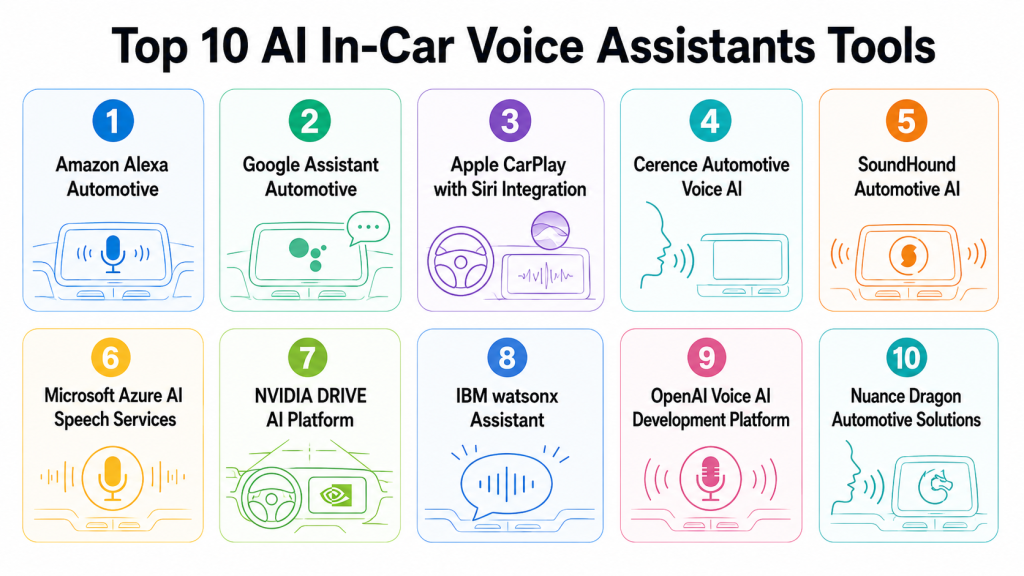
Top 10 AI In-Car Voice Assistants Tools
#1 — Amazon Alexa Automotive
One-line verdict: Best for automakers seeking a mature conversational AI ecosystem for connected vehicles.
Short description:
Amazon Alexa Automotive provides voice assistant capabilities designed for vehicle environments. It enables drivers to interact with entertainment, navigation-related services, smart devices, and connected features through natural voice commands.
Standout Capabilities
- Natural language voice interaction.
- Cloud-based conversational AI.
- Smart device connectivity.
- Entertainment control.
- Voice-based information access.
- Developer ecosystem support.
- Connected vehicle experiences.
AI-Specific Depth
- Model support: Uses proprietary conversational AI capabilities.
- RAG / knowledge integration: Varies depending on automotive implementation.
- Evaluation: Voice performance testing depends on deployment.
- Guardrails: Safety controls depend on vehicle integration and permissions.
- Observability: Monitoring capabilities vary by implementation.
Pros
- Strong consumer voice assistant ecosystem.
- Familiar user experience.
- Supports connected device integration.
Cons
- Automotive capabilities depend on manufacturer implementation.
- Requires internet connectivity for many features.
- Customization options vary.
Security & Compliance
Security features depend on vehicle integration and implementation. Specific automotive certifications are not publicly stated.
Deployment & Platforms
- Embedded automotive systems.
- Connected vehicle environments.
- Cloud-connected deployments.
Integrations & Ecosystem
Alexa Automotive can integrate with:
- Vehicle infotainment systems
- Smart home ecosystems
- Mobile applications
- Entertainment services
- Developer platforms
Pricing Model
Not publicly stated. Pricing depends on automotive partnerships and deployment models.
Best-Fit Scenarios
- Automotive manufacturers adding voice capabilities.
- Connected vehicle platforms.
- Drivers wanting smart assistant experiences.
#2 — Google Assistant Automotive
One-line verdict: Best for vehicles requiring strong conversational AI and ecosystem integration.
Short description:
Google Assistant Automotive provides voice interaction capabilities for connected vehicles, enabling users to access navigation, communication, entertainment, and digital services through voice commands.
Standout Capabilities
- Natural language understanding.
- Voice-controlled navigation.
- Connected service integration.
- Search capabilities.
- Personalized interactions.
- Smartphone ecosystem connectivity.
- Automotive infotainment support.
AI-Specific Depth
- Model support: Proprietary AI models and services.
- RAG / knowledge integration: Varies depending on implementation.
- Evaluation: Voice quality evaluation depends on deployment.
- Guardrails: Safety controls depend on automotive integration.
- Observability: Monitoring varies by implementation.
Pros
- Strong conversational AI capabilities.
- Familiar ecosystem for many users.
- Good integration with digital services.
Cons
- Automotive features depend on manufacturer support.
- Requires ecosystem compatibility.
- Availability varies across vehicles.
Security & Compliance
Security capabilities depend on implementation. Specific automotive certifications are not publicly stated.
Deployment & Platforms
- Automotive infotainment systems.
- Connected vehicle platforms.
Integrations & Ecosystem
Supports:
- Navigation services
- Mobile devices
- Digital applications
- Entertainment platforms
- Smart services
Pricing Model
Not publicly stated.
Best-Fit Scenarios
- Connected car manufacturers.
- Vehicles requiring integrated voice experiences.
- Users needing digital assistant functionality.
#3 — Apple CarPlay with Siri Integration
One-line verdict: Best for drivers and automakers seeking seamless smartphone-based voice interaction.
Short description:
Apple CarPlay with Siri integration provides voice-enabled access to navigation, communication, entertainment, and mobile applications inside vehicles. It extends smartphone AI capabilities into the automotive environment while maintaining a familiar user experience.
Standout Capabilities
- Voice-controlled communication.
- Navigation assistance.
- Message handling.
- Music and entertainment control.
- Smartphone integration.
- Personalized user experience.
- Hands-free vehicle interaction.
AI-Specific Depth
- Model support: Proprietary AI and speech technologies.
- RAG / knowledge integration: Varies depending on connected services.
- Evaluation: Voice performance testing depends on deployment.
- Guardrails: Permission-based controls and safety restrictions vary.
- Observability: Monitoring capabilities depend on implementation.
Pros
- Strong smartphone ecosystem integration.
- Familiar interface for many users.
- Simple voice interaction experience.
Cons
- Depends heavily on smartphone connectivity.
- Vehicle-specific capabilities vary.
- Less customizable for automotive manufacturers.
Security & Compliance
Security depends on device, vehicle, and software implementation. Specific automotive certifications are not publicly stated.
Deployment & Platforms
- Automotive infotainment systems.
- Smartphone-connected vehicles.
Integrations & Ecosystem
Supports:
- Mobile applications
- Navigation systems
- Entertainment services
- Communication tools
- Vehicle infotainment platforms
Pricing Model
Not publicly stated. Availability depends on vehicle and ecosystem partnerships.
Best-Fit Scenarios
- Consumer vehicles with smartphone integration.
- Drivers seeking familiar voice controls.
- Automakers supporting connected experiences.
#4 — Cerence Automotive Voice AI
One-line verdict: Best for automotive manufacturers building customized embedded voice assistant experiences.
Short description:
Cerence provides automotive-focused conversational AI technology designed specifically for vehicles. Its solutions support voice interaction, natural language understanding, and connected vehicle experiences across automotive platforms.
Standout Capabilities
- Automotive-specific voice AI.
- Natural language understanding.
- Multi-language support.
- Vehicle control integration.
- Embedded assistant experiences.
- Conversational interaction.
- Automotive software customization.
AI-Specific Depth
- Model support: Proprietary automotive AI models.
- RAG / knowledge integration: Varies depending on vehicle implementation.
- Evaluation: Automotive voice testing depends on deployment.
- Guardrails: Vehicle command safety controls depend on integration.
- Observability: Monitoring capabilities vary.
Pros
- Designed specifically for automotive environments.
- Supports customized vehicle experiences.
- Handles automotive-specific voice scenarios.
Cons
- Primarily focused on automotive partners.
- Deployment requires manufacturer integration.
- Pricing information is not publicly stated.
Security & Compliance
Security capabilities depend on automotive implementation. Specific certifications are not publicly stated.
Deployment & Platforms
- Embedded vehicle systems.
- Cloud-connected automotive platforms.
- Hybrid deployments.
Integrations & Ecosystem
Supports:
- Vehicle operating systems
- Infotainment platforms
- Navigation systems
- Automotive software stacks
- Connected vehicle services
Pricing Model
Not publicly stated.
Best-Fit Scenarios
- Automotive manufacturers.
- Connected vehicle platforms.
- Premium in-car assistant experiences.
#5 — SoundHound Automotive AI
One-line verdict: Best for automakers seeking advanced conversational voice experiences inside vehicles.
Short description:
SoundHound Automotive AI provides conversational voice technology designed for automotive environments. It focuses on natural interactions, voice understanding, and connected vehicle experiences.
Standout Capabilities
- Conversational voice interaction.
- Natural language processing.
- Multi-domain voice commands.
- Automotive assistant capabilities.
- Real-time voice responses.
- Connected service integration.
- Custom voice experiences.
AI-Specific Depth
- Model support: Proprietary conversational AI models.
- RAG / knowledge integration: Varies depending on implementation.
- Evaluation: Voice accuracy testing depends on deployment.
- Guardrails: Safety controls depend on vehicle integration.
- Observability: Monitoring capabilities vary.
Pros
- Strong conversational AI focus.
- Designed for automotive use cases.
- Supports natural user interactions.
Cons
- Automotive deployment requires partnerships.
- Features vary by vehicle implementation.
- Pricing details are not publicly stated.
Security & Compliance
Security depends on deployment architecture. Specific certifications are not publicly stated.
Deployment & Platforms
- Embedded automotive systems.
- Cloud-connected platforms.
Integrations & Ecosystem
Supports:
- Vehicle systems
- Digital services
- Navigation platforms
- Entertainment systems
- Mobile applications
Pricing Model
Not publicly stated.
Best-Fit Scenarios
- Automotive manufacturers.
- Connected car platforms.
- Voice-first vehicle experiences.
#6 — Microsoft Azure AI Speech Services
One-line verdict: Best for organizations building custom automotive voice AI solutions.
Short description:
Microsoft Azure AI Speech Services provides speech recognition, text-to-speech, and language capabilities that can support custom in-car voice assistant development. Automotive companies can use these services as building blocks for intelligent vehicle interfaces.
Standout Capabilities
- Speech recognition.
- Text-to-speech.
- Language processing.
- Custom voice applications.
- AI model integration.
- Cloud-based speech processing.
- Developer APIs.
AI-Specific Depth
- Model support: Supports speech AI models and custom integrations.
- RAG / knowledge integration: Varies depending on application architecture.
- Evaluation: Speech accuracy evaluation capabilities available.
- Guardrails: Requires application-level implementation.
- Observability: Cloud monitoring capabilities available.
Pros
- Flexible for custom development.
- Strong enterprise AI ecosystem.
- Supports multiple languages.
Cons
- Requires automotive customization.
- Not a complete vehicle assistant.
- Needs engineering expertise.
Security & Compliance
Security depends on Azure configuration and application design. Specific automotive certifications are not publicly stated.
Deployment & Platforms
- Cloud.
- Hybrid environments.
- Connected vehicle applications.
Integrations & Ecosystem
Supports:
- Automotive applications
- APIs
- AI platforms
- Cloud systems
- Developer tools
- Data services
Pricing Model
Usage-based pricing model.
Best-Fit Scenarios
- Automotive software developers.
- Custom voice assistant projects.
- Connected vehicle platforms.
#7 — NVIDIA DRIVE AI Platform
One-line verdict: Best for automotive companies developing advanced AI-powered vehicle experiences.
Short description:
NVIDIA DRIVE provides AI computing and software capabilities for automotive applications. It supports intelligent vehicle systems, including AI-based interaction experiences, perception, and connected vehicle technologies.
Standout Capabilities
- AI computing platform.
- Automotive AI development.
- Edge processing.
- Real-time inference.
- Vehicle software support.
- AI application development.
- Connected vehicle capabilities.
AI-Specific Depth
- Model support: Supports AI models through automotive AI frameworks.
- RAG / knowledge integration: Varies depending on implementation.
- Evaluation: Model testing depends on application.
- Guardrails: Automotive safety controls depend on system design.
- Observability: Infrastructure monitoring varies.
Pros
- High-performance automotive AI processing.
- Supports advanced vehicle applications.
- Enables edge AI capabilities.
Cons
- Requires specialized automotive expertise.
- Hardware dependencies may increase complexity.
- Not only focused on voice assistants.
Security & Compliance
Depends on automotive implementation. Specific certifications are not publicly stated.
Deployment & Platforms
- Edge computing.
- Vehicle hardware.
- Cloud-connected systems.
Integrations & Ecosystem
Supports:
- Automotive software platforms
- AI frameworks
- Vehicle computers
- Sensor systems
- Cloud environments
Pricing Model
Varies depending on hardware and software requirements.
Best-Fit Scenarios
- Autonomous vehicle programs.
- Advanced automotive AI development.
- Premium vehicle technology platforms.
#8 — IBM watsonx Assistant
One-line verdict: Best for organizations creating enterprise conversational assistants with automotive customization.
Short description:
IBM watsonx Assistant provides conversational AI capabilities that organizations can customize for different industries. Automotive companies can use it to build voice-enabled customer and vehicle interaction experiences.
Standout Capabilities
- Conversational AI.
- Natural language understanding.
- Knowledge-based responses.
- Workflow automation.
- Enterprise integration.
- AI assistant customization.
- Multi-channel support.
AI-Specific Depth
- Model support: Supports enterprise AI models depending on configuration.
- RAG / knowledge integration: Available depending on implementation.
- Evaluation: Supports AI performance evaluation workflows.
- Guardrails: Governance features depend on deployment.
- Observability: Monitoring capabilities available.
Pros
- Strong enterprise AI capabilities.
- Supports customization.
- Useful for knowledge-based assistants.
Cons
- Not automotive-specific by default.
- Requires integration work.
- Pricing details vary.
Security & Compliance
Security capabilities depend on deployment configuration. Specific automotive certifications are not publicly stated.
Deployment & Platforms
- Cloud.
- Hybrid.
- Enterprise environments.
Integrations & Ecosystem
Supports:
- Enterprise applications
- APIs
- Knowledge systems
- Data platforms
- Workflow tools
Pricing Model
Not publicly stated.
Best-Fit Scenarios
- Automotive customer assistants.
- Connected service platforms.
- Enterprise conversational AI projects.
#9 — OpenAI Voice AI Development Platform
One-line verdict: Best for developers building advanced conversational voice experiences for vehicles.
Short description:
OpenAI voice AI capabilities can support developers creating conversational interfaces with natural language understanding and interactive voice experiences. Automotive applications can combine these capabilities with vehicle systems through custom development.
Standout Capabilities
- Natural conversational interaction.
- Advanced language understanding.
- Voice-based experiences.
- AI application development.
- Custom assistant workflows.
- Context-aware responses.
- Developer flexibility.
AI-Specific Depth
- Model support: Proprietary AI models.
- RAG / knowledge integration: Available through application architecture.
- Evaluation: Requires implementation-specific testing.
- Guardrails: Requires application-level safety controls.
- Observability: Depends on integration.
Pros
- Strong conversational capabilities.
- Flexible developer ecosystem.
- Supports advanced AI experiences.
Cons
- Requires automotive integration work.
- Vehicle safety controls need additional design.
- Deployment requirements vary.
Security & Compliance
Depends on implementation and deployment model. Specific automotive certifications are not publicly stated.
Deployment & Platforms
- Cloud-based AI applications.
- Custom automotive integrations.
Integrations & Ecosystem
Supports:
- APIs
- Applications
- Data systems
- Custom software platforms
- Developer workflows
Pricing Model
Varies based on usage and deployment requirements.
Best-Fit Scenarios
- Automotive software developers.
- Experimental AI vehicle interfaces.
- Connected mobility applications.
#10 — Nuance Dragon Automotive Solutions
One-line verdict: Best for organizations requiring established speech recognition technology in vehicles.
Short description:
Nuance Dragon Automotive solutions provide speech recognition and conversational technologies designed for automotive environments. They support voice-driven interactions between drivers and connected vehicle systems.
Standout Capabilities
- Speech recognition.
- Voice command processing.
- Automotive language understanding.
- Multi-language support.
- Connected vehicle interaction.
- Voice application development.
- Driver assistance experiences.
AI-Specific Depth
- Model support: Proprietary speech AI models.
- RAG / knowledge integration: Varies by implementation.
- Evaluation: Speech performance testing depends on deployment.
- Guardrails: Vehicle command safety depends on integration.
- Observability: Monitoring varies.
Pros
- Long experience in speech technology.
- Automotive-focused solutions.
- Supports complex voice interactions.
Cons
- Features depend on manufacturer deployment.
- Customization may require integration effort.
- Pricing is not publicly stated.
Security & Compliance
Security depends on implementation. Specific certifications are not publicly stated.
Deployment & Platforms
- Embedded automotive systems.
- Cloud-connected deployments.
Integrations & Ecosystem
Supports:
- Vehicle infotainment systems
- Automotive software
- Navigation platforms
- Connected services
- Voice applications
Pricing Model
Not publicly stated.
Best-Fit Scenarios
- Automotive manufacturers.
- Connected vehicle programs.
- Voice-enabled vehicle systems.
Comparison Table (Top 10 AI In-Car Voice Assistants Tools)
| Tool Name | Best For | Deployment | Model Flexibility | Strength | Watch-Out | Public Rating |
|---|---|---|---|---|---|---|
| Amazon Alexa Automotive | Connected vehicles | Cloud/Embedded | Hosted AI | Voice ecosystem | Depends on integration | N/A |
| Google Assistant Automotive | Digital vehicle assistant | Cloud/Embedded | Hosted AI | Conversational experience | Availability varies | N/A |
| Apple CarPlay with Siri | Smartphone integration | Embedded | Hosted AI | User familiarity | Limited customization | N/A |
| Cerence Automotive AI | Automotive voice systems | Embedded/Hybrid | Automotive AI | Vehicle specialization | Partner dependency | N/A |
| SoundHound Automotive AI | Voice-first vehicles | Cloud/Embedded | Proprietary AI | Natural conversation | Deployment variation | N/A |
| Azure AI Speech | Custom solutions | Cloud/Hybrid | Custom AI | Developer flexibility | Requires building | N/A |
| NVIDIA DRIVE | Automotive AI computing | Edge/Hybrid | Multi-model | AI performance | Complexity | N/A |
| IBM watsonx Assistant | Enterprise assistants | Cloud/Hybrid | Multi-model | Governance | Customization effort | N/A |
| OpenAI Voice AI | Advanced conversational AI | Cloud | Proprietary AI | Natural interaction | Automotive integration needed | N/A |
| Nuance Dragon Automotive | Speech recognition | Embedded | Proprietary AI | Automotive experience | Customization needs | N/A |
Scoring & Evaluation (Transparent Rubric)
The following scoring framework compares AI In-Car Voice Assistants based on practical automotive requirements. The evaluation considers conversational intelligence, speech accuracy, vehicle integration, AI reliability, privacy controls, deployment flexibility, ecosystem strength, and operational scalability. Scores are comparative indicators and should be validated based on vehicle architecture, user requirements, and manufacturer goals.
| Tool | Core | Reliability/Eval | Guardrails | Integrations | Ease | Perf/Cost | Security/Admin | Support | Weighted Total |
|---|---|---|---|---|---|---|---|---|---|
| Amazon Alexa Automotive | 9 | 8 | 8 | 9 | 9 | 8 | 8 | 9 | 8.55 |
| Google Assistant Automotive | 9 | 9 | 8 | 10 | 9 | 8 | 8 | 9 | 8.80 |
| Apple CarPlay with Siri | 8 | 8 | 8 | 10 | 10 | 8 | 9 | 9 | 8.80 |
| Cerence Automotive AI | 9 | 9 | 9 | 9 | 8 | 8 | 9 | 9 | 8.90 |
| SoundHound Automotive AI | 8 | 8 | 8 | 8 | 8 | 8 | 8 | 8 | 8.00 |
| Microsoft Azure AI Speech | 8 | 9 | 8 | 9 | 7 | 8 | 9 | 9 | 8.35 |
| NVIDIA DRIVE AI Platform | 9 | 9 | 8 | 9 | 7 | 9 | 8 | 9 | 8.55 |
| IBM watsonx Assistant | 8 | 8 | 9 | 8 | 7 | 8 | 9 | 9 | 8.25 |
| OpenAI Voice AI Platform | 9 | 8 | 8 | 9 | 8 | 8 | 8 | 9 | 8.40 |
| Nuance Dragon Automotive | 8 | 9 | 8 | 8 | 8 | 8 | 8 | 9 | 8.20 |
Top 3 for Enterprise
1. Cerence Automotive AI
Best suited for automotive manufacturers requiring vehicle-focused conversational AI, embedded voice experiences, and deep automotive integration.
2. Google Assistant Automotive
Strong option for connected vehicles requiring advanced conversational interaction and digital ecosystem integration.
3. NVIDIA DRIVE AI Platform
Suitable for organizations developing advanced AI-powered vehicle experiences with edge processing capabilities.
Top 3 for SMB
1. Apple CarPlay with Siri Integration
Useful for smaller automotive solutions needing a familiar smartphone-connected voice experience.
2. Amazon Alexa Automotive
Suitable for businesses looking for established voice assistant capabilities.
3. Microsoft Azure AI Speech
Good option for teams building customized voice-enabled applications.
Top 3 for Developers
1. OpenAI Voice AI Platform
Best for developers creating advanced conversational vehicle experiences.
2. Microsoft Azure AI Speech
Provides flexible speech AI building blocks.
3. Tensor-style custom AI development approaches using cloud AI platforms
Useful for teams creating specialized automotive voice workflows.
Which AI In-Car Voice Assistant Tool Is Right for You?
Choosing the right AI In-Car Voice Assistant depends on vehicle type, software architecture, user experience goals, connectivity requirements, and customization needs.
Automotive manufacturers may require deeply integrated embedded assistants, while developers may prefer flexible AI platforms for building custom experiences.
Solo / Freelancer
Individual developers and researchers usually need flexible AI tools rather than complete automotive voice systems.
Recommended Options:
- OpenAI Voice AI Platform for conversational prototypes.
- Microsoft Azure AI Speech for speech recognition experiments.
- Cloud-based AI services for testing voice workflows.
Best Approach:
- Build prototypes using simulated vehicle environments.
- Test voice accuracy.
- Evaluate conversational quality.
- Validate user interaction patterns.
SMB
Small automotive technology companies and mobility startups usually need practical voice capabilities without building everything internally.
Recommended Options:
- Apple CarPlay with Siri integration.
- Amazon Alexa Automotive.
- Microsoft Azure AI Speech.
Important Priorities:
- Easy integration.
- Low development complexity.
- Reliable voice interaction.
- Mobile ecosystem compatibility.
Mid-Market
Growing automotive software companies need scalable voice solutions that can support more vehicle features.
Recommended Options:
- SoundHound Automotive AI.
- Cerence Automotive AI.
- IBM watsonx Assistant.
Important Evaluation Areas:
- Vehicle system integration.
- Voice accuracy.
- Data privacy.
- Multi-language support.
- Software update capabilities.
Enterprise
Large automotive manufacturers require deeply integrated AI systems with security, reliability, and long-term support.
Recommended Options:
- Cerence Automotive AI.
- Google Assistant Automotive.
- NVIDIA DRIVE AI Platform.
Enterprise Priorities:
- Embedded AI processing.
- Vehicle command safety.
- Privacy controls.
- Real-time response.
- Over-the-air improvement capabilities.
- Large-scale deployment support.
Regulated Industries (Finance, Healthcare, Public Sector)
Connected vehicles increasingly interact with sensitive information such as user identity, location, and personal preferences.
Important considerations:
- Voice data protection.
- Secure authentication.
- Permission-based vehicle controls.
- Data retention management.
- Audit capabilities.
- Responsible AI practices.
Organizations should evaluate security capabilities based on their specific operational requirements.
Budget vs Premium
Budget-Focused Approach
Suitable for startups and smaller automotive technology teams.
Consider:
- Smartphone-connected assistants.
- Cloud speech AI services.
- Developer-focused voice platforms.
Advantages:
- Lower initial investment.
- Faster testing.
- Easier deployment.
Premium Enterprise Approach
Suitable for vehicle manufacturers and advanced mobility platforms.
Consider:
- Embedded automotive AI assistants.
- Custom conversational systems.
- Edge AI processing.
- Deep vehicle integration.
Advantages:
- Better user experience.
- Faster response times.
- More customization.
- Stronger control over vehicle interactions.
Build vs Buy (When to DIY)
Build Custom AI Voice Assistants When:
- The company wants unique vehicle experiences.
- Voice interaction is a competitive advantage.
- Custom vehicle commands are required.
- Internal AI engineering resources are available.
Buy Existing Solutions When:
- Faster automotive deployment is required.
- Proven speech technology is preferred.
- Maintenance resources are limited.
- Standard voice capabilities are sufficient.
A hybrid approach is often effective by combining automotive voice platforms with custom AI models for specialized vehicle experiences.
Implementation Playbook (30 / 60 / 90 Days)
First 30 Days: Pilot and Define Success Metrics
The first phase focuses on understanding user needs and testing voice capabilities.
Key Activities:
- Identify vehicle voice use cases.
- Select pilot vehicle systems.
- Collect user interaction requirements.
- Define performance goals.
Success Metrics:
- Speech recognition accuracy.
- Response time.
- User satisfaction.
- Task completion rate.
- Voice command success rate.
AI-Specific Tasks:
- Prepare voice datasets.
- Define evaluation benchmarks.
- Test different conversation scenarios.
- Establish privacy requirements.
First 60 Days: Security, Evaluation, and Controlled Rollout
The second phase focuses on reliability and production readiness.
Key Activities:
- Test voice assistant performance.
- Validate vehicle commands.
- Review user feedback.
- Improve conversational workflows.
AI-Specific Tasks:
- Evaluate speech accuracy.
- Test difficult accents and environments.
- Review AI response quality.
- Implement safety controls.
- Monitor system behavior.
First 90 Days: Optimization and Scale
The final phase focuses on improving performance and expanding deployment.
Key Activities:
- Expand supported features.
- Improve personalization.
- Optimize AI infrastructure.
- Deploy across additional vehicle models.
AI-Specific Tasks:
- Monitor model performance.
- Improve conversation flows.
- Update AI models.
- Optimize latency.
- Establish continuous governance.
Common Mistakes & How to Avoid Them
- ❌ Choosing a voice assistant without considering vehicle integration.
✅ Evaluate compatibility with existing automotive systems. - ❌ Ignoring background noise challenges.
✅ Test voice systems in real driving conditions. - ❌ Deploying without privacy controls.
✅ Protect voice data and user information. - ❌ Treating voice AI as only a command system.
✅ Focus on natural conversations. - ❌ Ignoring multilingual requirements.
✅ Test different languages and accents. - ❌ Automating vehicle controls without safety checks.
✅ Use permission-based actions. - ❌ Not evaluating response latency.
✅ Optimize for fast interactions. - ❌ Ignoring user trust.
✅ Provide transparency about AI behavior. - ❌ Not testing edge cases.
✅ Evaluate unusual requests and failures. - ❌ Creating dependency on one platform.
✅ Maintain flexible architecture. - ❌ Ignoring continuous improvement.
✅ Update AI models regularly. - ❌ Forgetting human-centered design.
✅ Prioritize driver convenience and safety.
FAQs
1. What are AI In-Car Voice Assistants?
AI In-Car Voice Assistants are intelligent systems that allow drivers to interact with vehicle features using natural voice commands.
2. How do AI voice assistants work in vehicles?
They combine speech recognition, natural language processing, AI models, and vehicle integrations to understand and respond to driver requests.
3. Can AI voice assistants control vehicle functions?
Yes, depending on vehicle integration, they may support functions such as navigation, entertainment, climate controls, and connected services.
4. Are AI voice assistants safe while driving?
Voice assistants can improve safety by reducing manual interactions, but vehicle control features require careful design and safeguards.
5. Do AI voice assistants require internet connectivity?
Many advanced features use cloud processing, while some systems support limited offline or edge processing.
6. Can automotive companies build custom voice assistants?
Yes. Companies can build custom assistants using AI speech platforms and automotive software frameworks.
7. How accurate are AI car voice assistants?
Accuracy depends on AI models, microphones, environmental conditions, language support, and system design.
8. Are voice recordings stored?
Data handling depends on the platform and privacy settings. Users and organizations should review retention policies.
9. Can AI assistants understand multiple languages?
Many modern systems support multiple languages, but availability depends on the platform and implementation.
10. Are AI voice assistants expensive?
Costs vary based on hardware requirements, AI services, software development, and deployment scale.
11. Can AI voice assistants work without a smartphone?
Some automotive systems are built directly into vehicles, while others rely on smartphone connectivity.
12. How do companies evaluate AI voice assistants?
Organizations evaluate speech accuracy, response speed, user satisfaction, safety, privacy, and integration quality.
13. How can companies prevent unauthorized vehicle commands?
They can use authentication, permissions, confirmation steps, and secure system design.
Conclusion
AI In-Car Voice Assistants are becoming a major component of connected vehicle experiences. By combining conversational AI, speech recognition, vehicle integration, and intelligent automation, these systems help drivers interact with vehicles more naturally and safely.The best solution depends on automotive goals, integration requirements, technical resources, and user expectations. Vehicle manufacturers may need embedded automotive AI platforms, while developers may benefit from flexible AI development tools.Successful implementation requires careful evaluation, strong privacy practices, continuous testing, and responsible AI design. Organizations that combine advanced AI capabilities with driver-focused experiences can create more intelligent and accessible vehicles.

Find Trusted Cardiac Hospitals
Compare heart hospitals by city and services — all in one place.
Explore Hospitals