
Introduction
AI Cabin UX Personalization tools use artificial intelligence, machine learning, sensor data, and connected vehicle technologies to create personalized experiences inside vehicles. These systems analyze driver preferences, passenger behavior, environmental conditions, usage patterns, and vehicle data to customize the in-cabin experience.
Modern vehicles are becoming software-defined environments where the cabin experience extends beyond traditional controls. AI personalization can adjust infotainment preferences, climate settings, seat configurations, lighting, entertainment recommendations, navigation preferences, and digital interactions based on individual users.
As automotive companies focus on connected vehicles and premium user experiences, AI-powered cabin personalization has become an important capability. These systems help create more comfortable, adaptive, and intelligent vehicle environments while supporting accessibility, convenience, and customer satisfaction.
Real-world use cases:
- 🚗 Automatically adjusting seat, mirror, and cabin preferences for different drivers.
- 🎵 Recommending personalized music, entertainment, and content choices.
- 🌡️ Adapting climate and comfort settings based on user preferences.
- 💡 Customizing ambient lighting and cabin environments.
- 🧭 Providing personalized navigation and travel recommendations.
- 🧑🤝🧑 Supporting multiple driver profiles with intelligent recognition.
Evaluation Criteria for Buyers:
- AI personalization accuracy and recommendation quality.
- Ability to recognize different users and preferences.
- Integration with vehicle hardware and software systems.
- Support for multimodal inputs such as voice, sensors, and cameras.
- Privacy controls for personal and behavioral data.
- Real-time response speed and processing capabilities.
- AI model flexibility and update capabilities.
- Security controls for user profiles and vehicle access.
- Explainability of personalization decisions.
- Support for edge AI and offline processing.
- Integration with entertainment, navigation, and smart services.
- Scalability across different vehicle models.
Best for: Automotive manufacturers, connected vehicle platforms, premium vehicle brands, fleet operators, and mobility companies building intelligent and personalized driving experiences.
Not ideal for: Older vehicles without connected systems, organizations without digital cabin infrastructure, or users who prefer fixed vehicle settings without AI-driven customization.
What’s Changed in AI Cabin UX Personalization in 2026+
AI Cabin UX Personalization is moving from basic user profiles toward intelligent, adaptive vehicle environments. Modern systems combine AI models, sensors, voice interfaces, and contextual data to create more responsive cabin experiences.
Key changes include:
- 🤖 AI-powered cabin assistants: Vehicles are increasingly using AI agents that understand user preferences and provide personalized recommendations.
- 🧠 Context-aware personalization: AI systems consider factors such as time, location, driving patterns, weather, and passenger behavior.
- 📷 Multimodal cabin intelligence: Modern vehicles combine voice, cameras, sensors, and touch interactions to understand user needs.
- ⚡ Edge AI processing: More personalization decisions are processed inside vehicles to reduce latency and improve privacy.
- 🎵 Adaptive entertainment experiences: AI systems recommend content based on user preferences and previous interactions.
- 🌡️ Smart comfort optimization: Cabin systems can personalize climate, seating, and environmental settings.
- 🔐 Privacy-focused personalization: Automotive companies are improving control over personal profiles and behavioral data.
- 🧪 AI evaluation and testing: Manufacturers are measuring personalization accuracy, reliability, and user satisfaction.
- 🛡️ Responsible AI adoption: Companies are focusing on transparent personalization and avoiding unwanted assumptions about users.
- 🔄 Continuous learning systems: AI models are improving through software updates and new interaction data.
- 💰 Cost and hardware optimization: Automotive AI teams are balancing advanced personalization features with vehicle computing requirements.
- 🔗 Connected ecosystem integration: Cabin personalization is expanding into mobile devices, smart homes, and digital services.
Quick Buyer Checklist (Scan-Friendly)
Use this checklist before selecting an AI Cabin UX Personalization platform:
✅ Personalization capabilities
- Can the system learn user preferences?
- Does it support multiple drivers and passengers?
✅ AI intelligence
- Does it understand context?
- Can it adapt based on changing user behavior?
✅ Data privacy
- How are user profiles stored?
- Are retention and consent controls available?
✅ Vehicle integration
- Can it connect with:
- Infotainment systems?
- Climate controls?
- Seat systems?
- Lighting systems?
✅ Multimodal support
- Voice interaction.
- Camera-based recognition.
- Sensor data.
- Touch interfaces.
✅ Performance
- Does it provide fast responses?
- Can it work with edge computing?
✅ AI evaluation
- Are personalization outcomes measurable?
- Can teams test recommendations?
✅ Security and governance
- User authentication.
- Profile protection.
- Access management.
- Audit capabilities.
✅ Customization
- Can manufacturers customize experiences?
- Does it support different vehicle models?
✅ Integration ecosystem
- Mobile applications.
- Smart devices.
- Cloud platforms.
- Automotive software systems.
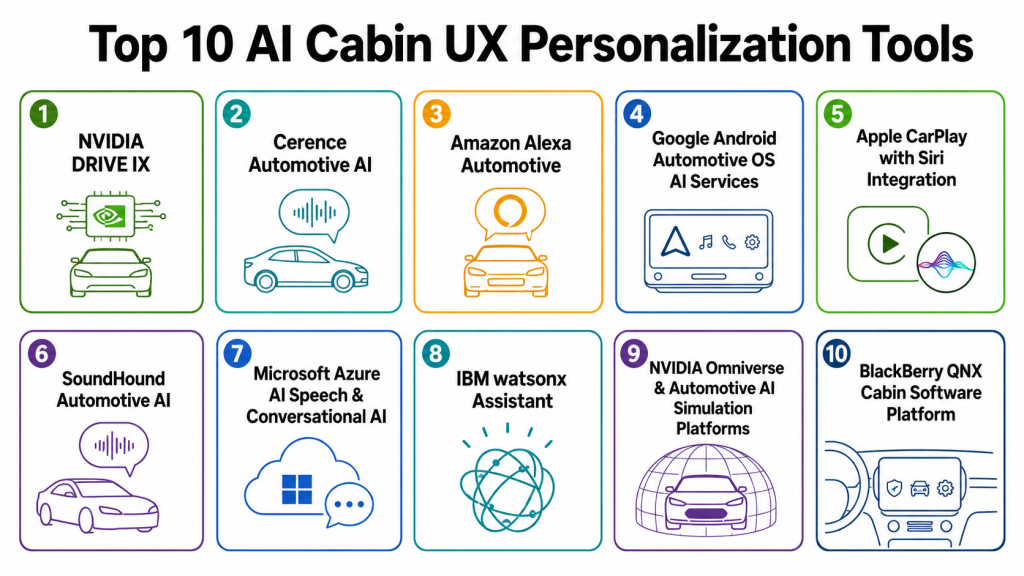
Top 10 AI Cabin UX Personalization Tools
#1 — NVIDIA DRIVE IX
One-line verdict: Best for automotive companies building advanced AI-powered cabin experiences.
Short description:
NVIDIA DRIVE IX provides AI software capabilities designed for intelligent vehicle experiences. It supports automotive applications involving driver monitoring, interaction systems, and personalized in-cabin experiences.
Standout Capabilities
- AI-powered cabin interaction.
- Driver monitoring support.
- Intelligent vehicle experiences.
- Real-time AI processing.
- Sensor-based personalization.
- Automotive AI development.
- Edge computing capabilities.
AI-Specific Depth
- Model support: Supports AI models through automotive AI frameworks.
- RAG / knowledge integration: Varies depending on implementation.
- Evaluation: Model testing depends on application design.
- Guardrails: Automotive safety controls depend on system integration.
- Observability: Monitoring capabilities vary.
Pros
- Designed specifically for automotive AI environments.
- Supports advanced in-cabin experiences.
- Enables edge AI processing.
Cons
- Requires automotive engineering expertise.
- Hardware integration can increase complexity.
- Not only focused on cabin personalization.
Security & Compliance
Security depends on vehicle architecture and implementation. Specific certifications are not publicly stated.
Deployment & Platforms
- Edge vehicle systems.
- Automotive computing platforms.
- Hybrid connected environments.
Integrations & Ecosystem
Supports:
- Vehicle sensors
- Automotive software platforms
- AI frameworks
- Infotainment systems
- Cloud services
Pricing Model
Varies depending on hardware, software, and deployment requirements.
Best-Fit Scenarios
- Premium vehicle manufacturers.
- Intelligent cockpit development.
- Connected vehicle platforms.
#2 — Cerence Automotive AI
One-line verdict: Best for automakers creating personalized conversational cabin experiences.
Short description:
Cerence Automotive AI provides conversational and interaction technologies designed for vehicle environments. It supports personalized voice experiences, digital assistants, and intelligent cabin interactions.
Standout Capabilities
- Automotive conversational AI.
- Voice-based personalization.
- Natural language understanding.
- Vehicle interaction support.
- Multi-language capabilities.
- Digital assistant experiences.
- Connected cabin workflows.
AI-Specific Depth
- Model support: Proprietary automotive AI models.
- RAG / knowledge integration: Varies depending on implementation.
- Evaluation: Voice and interaction testing depends on deployment.
- Guardrails: Vehicle interaction safety depends on integration.
- Observability: Monitoring varies.
Pros
- Automotive-focused AI technology.
- Supports personalized interactions.
- Designed for connected vehicle experiences.
Cons
- Requires manufacturer integration.
- Enterprise-focused deployment.
- Pricing details are not publicly stated.
Security & Compliance
Security capabilities depend on deployment architecture. Specific automotive certifications are not publicly stated.
Deployment & Platforms
- Embedded vehicle systems.
- Cloud-connected automotive platforms.
- Hybrid deployments.
Integrations & Ecosystem
Supports:
- Vehicle operating systems
- Infotainment platforms
- Voice systems
- Navigation services
- Connected vehicle applications
Pricing Model
Not publicly stated.
Best-Fit Scenarios
- Automotive manufacturers.
- Smart cockpit platforms.
- Connected vehicle experiences.
#3 — Amazon Alexa Automotive
One-line verdict: Best for automakers integrating conversational AI and connected services into vehicle cabins.
Short description:
Amazon Alexa Automotive provides voice-based AI capabilities for connected vehicles. It enables personalized in-cabin interactions by allowing drivers and passengers to access entertainment, information, smart devices, and digital services through natural voice commands.
Standout Capabilities
- Conversational voice interaction.
- Personalized user experiences.
- Smart device connectivity.
- Entertainment recommendations.
- Voice-controlled services.
- Connected vehicle workflows.
- Developer ecosystem support.
AI-Specific Depth
- Model support: Proprietary conversational AI models.
- RAG / knowledge integration: Varies depending on automotive implementation.
- Evaluation: Voice quality and personalization testing depend on deployment.
- Guardrails: Safety controls depend on vehicle integration.
- Observability: Monitoring capabilities vary.
Pros
- Mature voice assistant ecosystem.
- Strong consumer familiarity.
- Supports connected services.
Cons
- Vehicle features depend on manufacturer implementation.
- Requires connectivity for many advanced features.
- Custom automotive experiences require integration effort.
Security & Compliance
Security capabilities depend on deployment architecture. Specific automotive certifications are not publicly stated.
Deployment & Platforms
- Embedded automotive systems.
- Cloud-connected vehicles.
- Hybrid deployments.
Integrations & Ecosystem
Supports:
- Vehicle infotainment systems
- Smart home devices
- Mobile applications
- Entertainment platforms
- Digital services
Pricing Model
Not publicly stated. Deployment costs vary based on automotive partnerships and implementation scope.
Best-Fit Scenarios
- Connected vehicle manufacturers.
- Smart cockpit solutions.
- Consumer-focused automotive experiences.
#4 — Google Android Automotive OS AI Services
One-line verdict: Best for manufacturers building software-defined vehicles with integrated AI experiences.
Short description:
Android Automotive OS provides an automotive operating environment that enables vehicle manufacturers to integrate digital services, applications, and AI-powered experiences into the cabin. It supports personalized infotainment and connected vehicle workflows.
Standout Capabilities
- Automotive operating system foundation.
- App ecosystem support.
- Voice assistant integration.
- Personalized user profiles.
- Infotainment customization.
- Connected service support.
- Digital cockpit capabilities.
AI-Specific Depth
- Model support: Depends on integrated AI services.
- RAG / knowledge integration: Varies depending on application design.
- Evaluation: Depends on implemented AI features.
- Guardrails: Vehicle-level controls depend on manufacturer integration.
- Observability: Monitoring varies by implementation.
Pros
- Strong automotive software ecosystem.
- Supports customized cabin experiences.
- Flexible application environment.
Cons
- Requires manufacturer software integration.
- AI personalization depends on additional services.
- Implementation complexity can be high.
Security & Compliance
Security depends on manufacturer implementation and vehicle architecture. Specific certifications are not publicly stated.
Deployment & Platforms
- Embedded automotive systems.
- Vehicle infotainment platforms.
Integrations & Ecosystem
Supports:
- Automotive applications
- Navigation systems
- Entertainment platforms
- Mobile services
- Vehicle software systems
Pricing Model
Not publicly stated.
Best-Fit Scenarios
- Software-defined vehicles.
- Automotive manufacturers building digital cockpits.
- Connected vehicle platforms.
#5 — Apple CarPlay with Siri Integration
One-line verdict: Best for smartphone-connected vehicles requiring familiar personalized digital experiences.
Short description:
Apple CarPlay with Siri integration extends smartphone-based AI interaction into vehicles. It enables personalized access to navigation, communication, entertainment, and mobile services through voice and interface integration.
Standout Capabilities
- Voice-based interaction.
- Personalized mobile experience.
- Navigation support.
- Entertainment control.
- Communication management.
- Smartphone integration.
- User familiarity.
AI-Specific Depth
- Model support: Proprietary AI technologies.
- RAG / knowledge integration: Varies depending on connected services.
- Evaluation: User experience testing depends on deployment.
- Guardrails: Permission controls depend on implementation.
- Observability: Monitoring varies.
Pros
- Simple user experience.
- Strong ecosystem adoption.
- Familiar interaction model.
Cons
- Limited vehicle-specific customization.
- Depends on smartphone connectivity.
- Less control for automotive manufacturers.
Security & Compliance
Security depends on device and vehicle integration. Specific automotive certifications are not publicly stated.
Deployment & Platforms
- Automotive infotainment systems.
- Smartphone-connected vehicles.
Integrations & Ecosystem
Supports:
- Mobile applications
- Navigation services
- Entertainment platforms
- Communication tools
- Vehicle displays
Pricing Model
Not publicly stated.
Best-Fit Scenarios
- Consumer vehicles.
- Smartphone-integrated cabins.
- Entry-level personalization experiences.
#6 — SoundHound Automotive AI
One-line verdict: Best for automakers seeking natural conversational cabin interaction.
Short description:
SoundHound Automotive AI provides conversational voice technology designed for vehicles. It helps create more natural interactions between drivers, passengers, and connected vehicle services.
Standout Capabilities
- Conversational voice AI.
- Natural language understanding.
- Multi-domain interaction.
- Real-time responses.
- Personalized digital assistant experiences.
- Vehicle service integration.
- Voice-first cabin workflows.
AI-Specific Depth
- Model support: Proprietary conversational AI models.
- RAG / knowledge integration: Varies depending on implementation.
- Evaluation: Voice interaction testing depends on deployment.
- Guardrails: Safety controls depend on vehicle integration.
- Observability: Monitoring capabilities vary.
Pros
- Strong conversational experience.
- Automotive-focused solutions.
- Supports natural interactions.
Cons
- Requires automotive integration.
- Features vary by implementation.
- Pricing information is not publicly stated.
Security & Compliance
Security depends on implementation. Specific certifications are not publicly stated.
Deployment & Platforms
- Embedded automotive systems.
- Cloud-connected platforms.
Integrations & Ecosystem
Supports:
- Vehicle systems
- Voice applications
- Entertainment platforms
- Connected services
- Digital assistants
Pricing Model
Not publicly stated.
Best-Fit Scenarios
- Premium vehicles.
- Intelligent cockpit experiences.
- Voice-first automotive platforms.
#7 — Microsoft Azure AI Speech & Conversational AI
One-line verdict: Best for organizations developing custom AI-powered cabin personalization solutions.
Short description:
Microsoft Azure AI Speech and conversational AI services provide building blocks for creating personalized in-car experiences. Automotive companies can use speech recognition, language understanding, and AI services to develop custom cabin applications.
Standout Capabilities
- Speech recognition.
- Text-to-speech.
- Conversational AI.
- Custom assistant development.
- Language processing.
- Cloud AI integration.
- Developer APIs.
AI-Specific Depth
- Model support: Supports AI speech models and custom integrations.
- RAG / knowledge integration: Varies by application architecture.
- Evaluation: Speech accuracy evaluation capabilities available.
- Guardrails: Requires application-level safety controls.
- Observability: Cloud monitoring capabilities available.
Pros
- Flexible development platform.
- Strong enterprise ecosystem.
- Supports customization.
Cons
- Requires development expertise.
- Not a complete automotive cabin platform.
- Vehicle integration requires additional work.
Security & Compliance
Security depends on Azure configuration and implementation. Specific automotive certifications are not publicly stated.
Deployment & Platforms
- Cloud.
- Hybrid environments.
- Connected vehicle applications.
Integrations & Ecosystem
Supports:
- Automotive applications
- APIs
- AI services
- Data platforms
- Developer tools
Pricing Model
Usage-based pricing model.
Best-Fit Scenarios
- Automotive software developers.
- Custom AI cabin projects.
- Connected mobility platforms.
#8 — IBM watsonx Assistant
One-line verdict: Best for enterprises creating intelligent conversational cabin assistants.
Short description:
IBM watsonx Assistant provides conversational AI capabilities that can support personalized vehicle interactions. It helps organizations build assistants that connect users with information, services, and workflows.
Standout Capabilities
- Conversational AI.
- Knowledge-based responses.
- Workflow automation.
- AI assistant development.
- Enterprise integration.
- Personalization workflows.
- Multi-channel support.
AI-Specific Depth
- Model support: Supports enterprise AI models depending on configuration.
- RAG / knowledge integration: Available depending on implementation.
- Evaluation: Supports AI performance evaluation.
- Guardrails: Governance features depend on deployment.
- Observability: Monitoring capabilities available.
Pros
- Strong enterprise AI capabilities.
- Supports customization.
- Good governance focus.
Cons
- Requires integration effort.
- Not automotive-specific by default.
- Deployment complexity varies.
Security & Compliance
Security depends on deployment configuration. Specific automotive certifications are not publicly stated.
Deployment & Platforms
- Cloud.
- Hybrid.
- Enterprise environments.
Integrations & Ecosystem
Supports:
- Enterprise applications
- APIs
- Knowledge systems
- Data platforms
- Workflow tools
Pricing Model
Not publicly stated.
Best-Fit Scenarios
- Automotive customer assistants.
- Enterprise mobility services.
- Digital cockpit applications.
#9 — NVIDIA Omniverse & Automotive AI Simulation Platforms
One-line verdict: Best for automotive companies testing personalized cabin experiences through simulation.
Short description:
NVIDIA automotive simulation and AI platforms help manufacturers design, test, and optimize intelligent vehicle experiences. They support AI development workflows involving digital environments and connected vehicle systems.
Standout Capabilities
- AI simulation environments.
- Digital vehicle development.
- Sensor data simulation.
- AI model testing.
- Automotive workflow support.
- Virtual validation.
- Advanced computing.
AI-Specific Depth
- Model support: Supports AI model development workflows.
- RAG / knowledge integration: Varies depending on application.
- Evaluation: Supports simulation-based testing.
- Guardrails: Depends on system design.
- Observability: Monitoring depends on deployment.
Pros
- Useful for AI testing and validation.
- Supports advanced automotive development.
- Enables virtual experimentation.
Cons
- Requires specialized expertise.
- Not a direct cabin personalization product.
- Infrastructure requirements may be high.
Security & Compliance
Depends on implementation.
Deployment & Platforms
- Cloud.
- Enterprise infrastructure.
- Simulation environments.
Integrations & Ecosystem
Supports:
- Automotive simulation tools
- AI platforms
- Digital twins
- Vehicle development workflows
- Computing systems
Pricing Model
Varies depending on software and infrastructure requirements.
Best-Fit Scenarios
- Automotive R&D teams.
- Intelligent vehicle development.
- AI testing environments.
#10 — BlackBerry QNX Cabin Software Platform
One-line verdict: Best for automakers needing secure automotive software foundations.
Short description:
BlackBerry QNX provides automotive software platforms that support digital cockpits, infotainment systems, and vehicle software environments. It can serve as a foundation for AI-powered personalization features.
Standout Capabilities
- Automotive software platform.
- Digital cockpit support.
- Embedded systems.
- Vehicle software integration.
- Infotainment support.
- Secure architecture.
- Real-time operating environment.
AI-Specific Depth
- Model support: Depends on integrated AI solutions.
- RAG / knowledge integration: Varies.
- Evaluation: Depends on connected AI applications.
- Guardrails: Security controls depend on implementation.
- Observability: Monitoring depends on deployment.
Pros
- Automotive-focused software foundation.
- Strong embedded systems capabilities.
- Supports vehicle-grade environments.
Cons
- Not primarily an AI personalization engine.
- Requires additional AI components.
- Automotive integration expertise required.
Security & Compliance
Security capabilities depend on implementation. Specific certifications are not publicly stated.
Deployment & Platforms
- Embedded automotive systems.
- Vehicle software platforms.
Integrations & Ecosystem
Supports:
- Automotive applications
- Infotainment systems
- Embedded software
- Vehicle hardware platforms
- Connected services
Pricing Model
Not publicly stated.
Best-Fit Scenarios
- Automotive manufacturers.
- Digital cockpit platforms.
- Secure vehicle software environments.
Comparison Table (Top 10 AI Cabin UX Personalization Tools)
| Tool Name | Best For | Deployment | Model Flexibility | Strength | Watch-Out | Public Rating |
|---|---|---|---|---|---|---|
| NVIDIA DRIVE IX | AI cockpit experiences | Edge/Hybrid | Multi-model | Automotive AI | Complexity | N/A |
| Cerence Automotive AI | Vehicle personalization | Embedded/Hybrid | Proprietary AI | Automotive specialization | Integration effort | N/A |
| Amazon Alexa Automotive | Voice personalization | Cloud/Embedded | Hosted AI | Voice ecosystem | Connectivity dependency | N/A |
| Android Automotive OS | Digital cockpit platforms | Embedded | Flexible | Software ecosystem | Manufacturer effort | N/A |
| Apple CarPlay with Siri | Smartphone UX | Embedded | Hosted AI | User familiarity | Limited customization | N/A |
| SoundHound Automotive AI | Voice cabin UX | Cloud/Embedded | Proprietary AI | Conversation quality | Deployment variation | N/A |
| Azure AI Speech | Custom AI cabins | Cloud/Hybrid | Custom AI | Developer flexibility | Requires development | N/A |
| IBM watsonx Assistant | Enterprise assistants | Cloud/Hybrid | Multi-model | Governance | Complexity | N/A |
| NVIDIA Simulation Platforms | AI testing | Cloud/Enterprise | Multi-model | Simulation | High requirements | N/A |
| BlackBerry QNX | Vehicle software foundation | Embedded | Flexible | Automotive security | Needs AI layer | N/A |
Scoring & Evaluation (Transparent Rubric)
The following scoring framework compares AI Cabin UX Personalization tools based on practical automotive requirements. The evaluation considers AI personalization capabilities, conversational intelligence, vehicle integration, privacy, security, deployment flexibility, ecosystem strength, and scalability. Scores are comparative indicators and should be validated according to vehicle architecture, customer expectations, and manufacturer goals.
| Tool | Core | Reliability/Eval | Guardrails | Integrations | Ease | Perf/Cost | Security/Admin | Support | Weighted Total |
|---|---|---|---|---|---|---|---|---|---|
| NVIDIA DRIVE IX | 9 | 9 | 8 | 9 | 7 | 9 | 8 | 9 | 8.55 |
| Cerence Automotive AI | 9 | 9 | 9 | 9 | 8 | 8 | 9 | 9 | 8.90 |
| Amazon Alexa Automotive | 9 | 8 | 8 | 9 | 9 | 8 | 8 | 9 | 8.55 |
| Android Automotive OS | 9 | 8 | 8 | 10 | 8 | 8 | 9 | 9 | 8.70 |
| Apple CarPlay with Siri | 8 | 8 | 8 | 10 | 10 | 8 | 9 | 9 | 8.80 |
| SoundHound Automotive AI | 8 | 8 | 8 | 8 | 8 | 8 | 8 | 8 | 8.00 |
| Microsoft Azure AI Speech | 8 | 9 | 8 | 9 | 7 | 8 | 9 | 9 | 8.35 |
| IBM watsonx Assistant | 8 | 8 | 9 | 8 | 7 | 8 | 9 | 9 | 8.25 |
| NVIDIA Simulation Platforms | 8 | 9 | 8 | 8 | 7 | 9 | 8 | 9 | 8.20 |
| BlackBerry QNX Platform | 8 | 9 | 8 | 9 | 7 | 8 | 9 | 9 | 8.30 |
Top 3 for Enterprise
1. Cerence Automotive AI
Best suited for automotive manufacturers requiring specialized vehicle interaction systems and personalized cabin experiences.
2. Android Automotive OS
Strong choice for manufacturers developing software-defined vehicles with flexible digital cockpit capabilities.
3. NVIDIA DRIVE IX
Suitable for companies building advanced AI-powered vehicle environments with edge processing and intelligent cabin features.
Top 3 for SMB
1. Apple CarPlay with Siri Integration
Useful for smaller automotive solutions needing a familiar and easy-to-adopt personalized experience.
2. Amazon Alexa Automotive
Suitable for businesses looking for established voice-driven cabin interactions.
3. Microsoft Azure AI Speech
Good option for teams building customized AI cabin applications.
Top 3 for Developers
1. Microsoft Azure AI Speech
Provides flexible AI building blocks for custom cabin experiences.
2. NVIDIA DRIVE IX
Useful for developers creating advanced automotive AI applications.
3. IBM watsonx Assistant
Suitable for building conversational and knowledge-based automotive assistants.
Which AI Cabin UX Personalization Tool Is Right for You?
Selecting the right AI Cabin UX Personalization platform depends on vehicle type, software architecture, personalization goals, privacy requirements, and available development resources.
Automotive manufacturers may require deeply integrated cabin intelligence, while software developers may prefer flexible AI platforms for creating custom experiences.
Solo / Freelancer
Individual developers, researchers, and automotive innovators usually need flexible AI tools for prototypes and experiments.
Recommended Options:
- Microsoft Azure AI Speech for voice and conversational experiments.
- IBM watsonx Assistant for AI interaction prototypes.
- NVIDIA development platforms for automotive AI research.
Best Approach:
- Create simulated cabin environments.
- Test personalization workflows.
- Evaluate voice and interaction quality.
- Measure user experience improvements.
SMB
Small automotive technology companies and mobility startups usually need practical solutions with manageable development requirements.
Recommended Options:
- Apple CarPlay with Siri Integration.
- Amazon Alexa Automotive.
- Microsoft Azure AI Speech.
Important Priorities:
- Easy integration.
- Lower development complexity.
- Reliable user interaction.
- Flexible customization.
Mid-Market
Growing automotive software companies need scalable platforms that can support more advanced cabin experiences.
Recommended Options:
- SoundHound Automotive AI.
- Cerence Automotive AI.
- Android Automotive OS.
Important Evaluation Areas:
- User personalization.
- Vehicle compatibility.
- Data privacy.
- Multi-user support.
- Software update capabilities.
Enterprise
Large automotive manufacturers require secure, scalable, and deeply integrated AI cabin platforms.
Recommended Options:
- Cerence Automotive AI.
- NVIDIA DRIVE IX.
- Android Automotive OS.
Enterprise Priorities:
- Embedded AI processing.
- Secure user profiles.
- Real-time personalization.
- Vehicle software integration.
- Long-term platform support.
Regulated Industries (Finance, Healthcare, Public Sector)
Connected vehicle systems increasingly handle sensitive information such as identity, location, preferences, and usage behavior.
Important considerations:
- User consent management.
- Data privacy controls.
- Secure profile storage.
- Access permissions.
- Audit capabilities.
- Responsible AI practices.
Organizations should evaluate privacy and security capabilities according to their specific operational requirements.
Budget vs Premium
Budget-Focused Approach
Suitable for startups and companies testing personalization concepts.
Consider:
- Smartphone-connected experiences.
- Cloud AI services.
- Basic user preference systems.
Advantages:
- Lower investment.
- Faster experimentation.
- Easier deployment.
Premium Enterprise Approach
Suitable for automotive manufacturers creating advanced digital cockpit experiences.
Consider:
- Embedded AI assistants.
- Edge processing.
- Sensor-based personalization.
- Custom vehicle intelligence.
Advantages:
- Better performance.
- Higher customization.
- Improved user experience.
- Greater control.
Build vs Buy (When to DIY)
Build Custom AI Cabin UX Systems When:
- Personalization is a competitive advantage.
- The company needs unique vehicle experiences.
- Internal AI engineering resources are available.
- Custom sensor integration is required.
Buy Existing Platforms When:
- Faster deployment is needed.
- Automotive reliability is important.
- Standard personalization features are enough.
- Development resources are limited.
A hybrid approach is often effective by combining automotive platforms with custom AI models for specialized cabin experiences.
Implementation Playbook (30 / 60 / 90 Days)
First 30 Days: Pilot and Define Success Metrics
The first phase focuses on identifying personalization opportunities and testing AI capabilities.
Key Activities:
- Identify cabin personalization goals.
- Define user profiles and experiences.
- Select pilot vehicle environments.
- Collect interaction requirements.
Success Metrics:
- Personalization accuracy.
- User satisfaction.
- Response speed.
- Feature usage.
- Interaction completion rate.
AI-Specific Tasks:
- Prepare user preference datasets.
- Define evaluation benchmarks.
- Test personalization scenarios.
- Establish privacy requirements.
First 60 Days: Security, Evaluation, and Controlled Rollout
The second phase focuses on improving reliability and preparing for broader deployment.
Key Activities:
- Test AI personalization features.
- Review user feedback.
- Improve recommendations.
- Validate vehicle interactions.
AI-Specific Tasks:
- Evaluate model performance.
- Test different user scenarios.
- Monitor AI recommendations.
- Review privacy controls.
- Implement safety restrictions.
First 90 Days: Optimization and Scale
The final phase focuses on improving performance and expanding deployment.
Key Activities:
- Deploy across additional vehicle models.
- Improve personalization quality.
- Optimize AI processing.
- Connect additional digital services.
AI-Specific Tasks:
- Monitor model behavior.
- Improve personalization algorithms.
- Update AI models.
- Optimize latency.
- Establish continuous governance.
Common Mistakes & How to Avoid Them
- ❌ Personalizing without user consent.
✅ Provide clear controls and privacy options. - ❌ Collecting unnecessary personal data.
✅ Follow data minimization practices. - ❌ Ignoring different passenger preferences.
✅ Support multiple user profiles. - ❌ Testing only in ideal environments.
✅ Validate in real driving conditions. - ❌ Building AI without security planning.
✅ Protect user profiles and vehicle systems. - ❌ Making personalization too aggressive.
✅ Allow users to adjust recommendations. - ❌ Ignoring latency requirements.
✅ Optimize for fast in-cabin responses. - ❌ Not evaluating AI recommendations.
✅ Measure personalization quality. - ❌ Overlooking software updates.
✅ Plan continuous improvement. - ❌ Creating vendor dependency.
✅ Maintain flexible architecture. - ❌ Ignoring accessibility needs.
✅ Design inclusive experiences. - ❌ Focusing only on technology.
✅ Prioritize driver and passenger experience.
FAQs
1. What is AI Cabin UX Personalization?
AI Cabin UX Personalization uses artificial intelligence to customize vehicle experiences based on driver preferences, passenger behavior, and contextual information.
2. How does AI personalize vehicle cabins?
AI analyzes user preferences, sensor information, interactions, and vehicle data to adjust settings and provide personalized experiences.
3. What features can AI personalize inside a vehicle?
Common examples include infotainment, climate settings, seating preferences, lighting, navigation, and digital assistant interactions.
4. Does AI cabin personalization require internet connectivity?
Some features use cloud AI services, while others can operate through onboard vehicle computing systems.
5. Is cabin personalization available in all vehicles?
No. Availability depends on vehicle software architecture, hardware capabilities, and manufacturer implementation.
6. Can multiple drivers have separate AI profiles?
Yes. Many personalized systems support different user profiles with separate preferences.
7. How is user privacy protected?
Protection depends on system design, including data controls, consent management, and secure storage practices.
8. Can manufacturers create custom AI cabin experiences?
Yes. Automotive companies can combine AI platforms with custom software to build unique experiences.
9. Are AI cabin systems expensive?
Costs vary depending on hardware, AI services, software development, and vehicle integration requirements.
10. Can AI personalization work without cameras?
Yes. Personalization can use voice, preferences, sensors, mobile profiles, and other data sources.
11. How do companies evaluate personalization quality?
They measure user satisfaction, accuracy, response speed, feature usage, and interaction success rates.
12. Can AI cabin systems improve accessibility?
Yes. AI assistants can support easier vehicle interaction for users with different accessibility needs.
13. How can companies avoid privacy risks?
Organizations should use transparent data policies, strong security controls, and user-managed personalization settings.
Conclusion
AI Cabin UX Personalization is becoming an important part of the next generation of connected vehicles. By combining artificial intelligence, sensors, conversational systems, and vehicle software, these solutions create more comfortable, adaptive, and personalized experiences for drivers and passengers.The right platform depends on automotive goals, software architecture, customization needs, and privacy requirements. Manufacturers building premium intelligent vehicles may require advanced embedded AI systems, while smaller teams may benefit from flexible cloud-based AI services.Successful implementation requires responsible data usage, continuous evaluation, secure design, and a strong focus on user experience. Organizations that combine AI innovation with driver-centered design can create smarter and more engaging vehicle cabins.

Find Trusted Cardiac Hospitals
Compare heart hospitals by city and services — all in one place.
Explore Hospitals