
Introduction
AI Robot Fleet Management tools are intelligent software platforms that help organizations monitor, coordinate, optimize, and manage multiple robots operating together. These platforms use artificial intelligence, machine learning, automation, analytics, and real-time data processing to improve robot performance, task allocation, maintenance planning, and operational efficiency.
Traditional robot management systems often relied on manual monitoring and fixed workflows. As companies deploy larger fleets of autonomous mobile robots, warehouse robots, delivery robots, and industrial robots, AI-powered fleet management has become essential for coordinating complex robotic operations.
Modern AI robot fleet management platforms analyze robot status, location data, workload patterns, battery levels, maintenance requirements, and operational conditions. They help organizations improve productivity, reduce downtime, optimize robot utilization, and make better decisions across large-scale robotic environments.
AI-powered fleet management is becoming important in warehouses, manufacturing facilities, logistics operations, healthcare environments, agriculture, and autonomous service industries. These systems allow organizations to manage multiple robots efficiently while improving safety, reliability, and scalability.
Real-world use cases:
- 🤖 Coordinating hundreds of autonomous robots in warehouses and factories.
- 📦 Optimizing robot task assignment for logistics operations.
- 🔋 Predicting battery usage and scheduling charging automatically.
- 🛠️ Monitoring robot health and identifying maintenance requirements.
- 🗺️ Optimizing robot routes and reducing operational conflicts.
- 📊 Analyzing fleet performance for continuous improvement.
Evaluation Criteria for Buyers:
- Fleet monitoring capabilities.
- AI-based task allocation.
- Multi-robot coordination.
- Real-time operational visibility.
- Predictive maintenance support.
- Robot hardware compatibility.
- Integration with warehouse and enterprise systems.
- AI evaluation and performance monitoring.
- Security and access controls.
- Scalability for large robot fleets.
- Deployment flexibility.
- Cost optimization capabilities.
Best for: Warehouses, manufacturing companies, logistics providers, robotics companies, autonomous vehicle operators, and enterprises managing multiple robots.
Not ideal for: Small organizations operating only one or two simple robots, environments without automation needs, or businesses where manual robot management is sufficient.
What’s Changed in AI Robot Fleet Management in 2026+
AI Robot Fleet Management is evolving from basic monitoring dashboards into intelligent robotic operations platforms. Modern solutions combine AI planning, predictive analytics, automation, and real-time decision-making.
Key changes include:
- 🤖 AI-powered fleet orchestration: Robots are increasingly managed through intelligent systems that optimize workloads and operational priorities.
- 🧠 Autonomous task allocation: AI helps assign tasks to robots based on location, availability, battery status, and workload.
- 📊 Predictive fleet analytics: Machine learning helps identify performance issues before they affect operations.
- 🔋 Smart energy management: AI optimizes charging schedules and battery usage across robot fleets.
- 🛠️ Predictive maintenance: Fleet systems analyze robot behavior to identify potential maintenance needs.
- 🌐 Multi-robot coordination: AI improves collaboration between different robot types working in shared environments.
- 🧪 AI evaluation and monitoring: Organizations are measuring robot performance, efficiency, and reliability.
- 🛡️ Safety-focused automation: Modern platforms include operational controls to reduce robot conflicts and unsafe behaviors.
- 🔐 Robotics cybersecurity improvements: Companies are protecting robot communication, data, and control systems.
- ⚡ Edge AI optimization: More intelligence is moving closer to robots for faster decisions.
- ☁️ Cloud-edge fleet management: Organizations are combining centralized intelligence with local robot control.
- 🔗 Open robotics ecosystem integration: Fleet platforms increasingly connect with different robot manufacturers and software systems.
Quick Buyer Checklist (Scan-Friendly)
Use this checklist before selecting an AI Robot Fleet Management platform:
✅ Fleet visibility
- Does the platform provide real-time robot status?
- Can teams monitor location, activity, and performance?
✅ Robot coordination
- Can it manage multiple robots?
- Does it optimize task distribution?
✅ AI capabilities
- Predictive analytics.
- Intelligent scheduling.
- Performance optimization.
✅ Robot compatibility
- Supports different robot types.
- Works with existing hardware platforms.
✅ Operational intelligence
- Performance dashboards.
- Usage analytics.
- Failure monitoring.
✅ Maintenance management
- Battery monitoring.
- Predictive maintenance.
- Downtime reduction.
✅ Security and governance
- User access controls.
- Secure communication.
- Operational monitoring.
✅ Scalability
- Supports growing robot fleets.
- Handles complex environments.
✅ Integration capabilities
- Warehouse systems.
- Enterprise software.
- Robotics platforms.
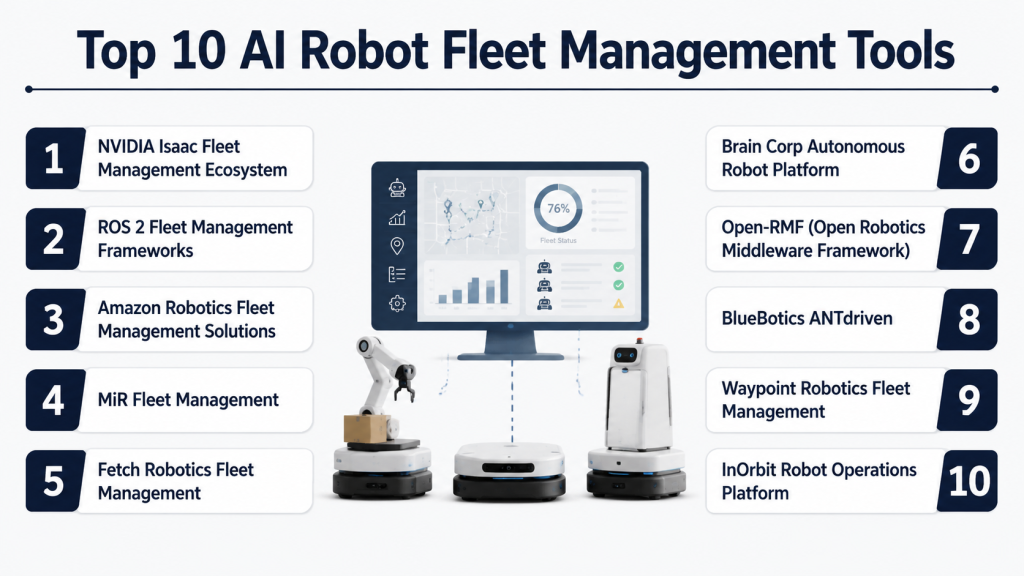
Top 10 AI Robot Fleet Management Tools
#1 — NVIDIA Isaac Fleet Management Ecosystem
One-line verdict: Best for enterprises building advanced AI-powered robot fleets with intelligent coordination.
Short description:
NVIDIA Isaac robotics technologies provide AI development capabilities for autonomous robots, including perception, simulation, and fleet-related workflows. Organizations use these technologies to develop intelligent robotic systems with advanced automation capabilities.
Standout Capabilities
- AI robotics development.
- Robot coordination workflows.
- Simulation support.
- Autonomous system development.
- AI perception integration.
- Robotics optimization.
- Hardware acceleration.
AI-Specific Depth
- Model support: Supports AI robotics models and machine learning workflows.
- RAG / knowledge integration: N/A.
- Evaluation: Supports robotics testing and performance evaluation.
- Guardrails: Safety controls depend on implementation.
- Observability: Monitoring depends on integrated robotics tools.
Pros
- Strong AI robotics ecosystem.
- Supports advanced autonomous systems.
- Useful for large-scale robotics development.
Cons
- Requires robotics expertise.
- Hardware requirements may vary.
- Enterprise implementation can be complex.
Security & Compliance
Security depends on deployment configuration. Specific certifications are not publicly stated.
Deployment & Platforms
- Edge robotics systems.
- GPU-enabled environments.
- Cloud-connected deployments.
Integrations & Ecosystem
Supports:
- Robotics frameworks
- AI models
- Simulation systems
- Robot hardware
- Enterprise applications
Pricing Model
Not publicly stated.
Best-Fit Scenarios
- Industrial robot fleets.
- Autonomous robotics platforms.
- Large-scale AI robotics projects.
#2 — ROS 2 Fleet Management Frameworks
One-line verdict: Best for developers building customizable robot fleet management systems.
Short description:
ROS 2 provides an open robotics middleware foundation that enables communication between robots, sensors, and software components. Developers use it to build custom fleet coordination and management solutions.
Standout Capabilities
- Robot communication.
- Multi-robot coordination.
- Hardware abstraction.
- Distributed robotics systems.
- Sensor integration.
- Custom fleet workflows.
- Robotics application development.
AI-Specific Depth
- Model support: Supports integration with AI and machine learning systems.
- RAG / knowledge integration: N/A.
- Evaluation: Requires custom fleet evaluation workflows.
- Guardrails: Requires application-specific safety controls.
- Observability: Supports robotics debugging and monitoring tools.
Pros
- Flexible open ecosystem.
- Supports many robot platforms.
- Strong developer community.
Cons
- Requires technical expertise.
- Fleet features require customization.
- Implementation complexity varies.
Security & Compliance
Security depends on implementation. Specific certifications are not publicly stated.
Deployment & Platforms
- Linux.
- Edge robotics systems.
- Cloud-connected environments.
Integrations & Ecosystem
Supports:
- Robot hardware
- Sensors
- AI frameworks
- Simulation tools
- Robotics applications
Pricing Model
Open-source framework.
Best-Fit Scenarios
- Robotics research.
- Custom fleet platforms.
- Autonomous robot development.
#3 — Amazon Robotics Fleet Management Solutions
One-line verdict: Best for large-scale warehouse operations requiring automated robot coordination and logistics optimization.
Short description:
Amazon Robotics technologies support warehouse automation through autonomous robots, intelligent workflows, and operational coordination systems. These solutions help manage robotic activities in large fulfillment environments.
Standout Capabilities
- Autonomous warehouse robot coordination.
- Inventory movement optimization.
- Robot workflow management.
- Logistics automation support.
- Operational analytics.
- Warehouse efficiency improvement.
- Large-scale automation support.
AI-Specific Depth
- Model support: AI capabilities vary by implementation.
- RAG / knowledge integration: N/A.
- Evaluation: Operational metrics and workflow evaluation depend on deployment.
- Guardrails: Safety controls depend on warehouse implementation.
- Observability: Operational monitoring capabilities vary.
Pros
- Designed for large automation environments.
- Strong logistics application focus.
- Supports high-volume operations.
Cons
- Primarily focused on warehouse environments.
- Customization options may vary.
- Specific AI capabilities are not publicly stated.
Security & Compliance
Security depends on implementation. Specific certifications are not publicly stated.
Deployment & Platforms
- Enterprise warehouse environments.
- Automated logistics systems.
Integrations & Ecosystem
Supports:
- Warehouse management systems
- Robotics platforms
- Logistics workflows
- Inventory systems
- Operational analytics
Pricing Model
Not publicly stated.
Best-Fit Scenarios
- Large fulfillment centers.
- Warehouse robotics.
- Logistics automation.
#4 — MiR Fleet Management
One-line verdict: Best for organizations managing autonomous mobile robot fleets in industrial environments.
Short description:
MiR Fleet Management supports coordination and monitoring of autonomous mobile robots used in manufacturing, logistics, and internal transportation operations. It helps organizations manage robot tasks and workflows.
Standout Capabilities
- Multi-robot coordination.
- Task scheduling.
- Robot monitoring.
- Traffic management.
- Workflow optimization.
- Fleet visibility.
- Industrial automation support.
AI-Specific Depth
- Model support: AI capabilities vary by robot deployment.
- RAG / knowledge integration: N/A.
- Evaluation: Operational performance metrics depend on implementation.
- Guardrails: Robot safety features depend on configuration.
- Observability: Fleet monitoring capabilities available.
Pros
- Designed specifically for mobile robot fleets.
- Supports industrial automation.
- Improves robot coordination.
Cons
- Focused mainly on mobile robots.
- Requires compatible robot systems.
- Advanced AI features vary.
Security & Compliance
Security depends on deployment. Specific certifications are not publicly stated.
Deployment & Platforms
- Industrial environments.
- Enterprise robot fleets.
Integrations & Ecosystem
Supports:
- Autonomous mobile robots
- Manufacturing systems
- Logistics workflows
- Enterprise applications
- Robot controllers
Pricing Model
Not publicly stated.
Best-Fit Scenarios
- Manufacturing facilities.
- Internal logistics.
- Industrial automation.
#5 — Fetch Robotics Fleet Management
One-line verdict: Best for warehouse and logistics teams deploying collaborative mobile robot fleets.
Short description:
Fetch Robotics provides autonomous mobile robot solutions designed for logistics and warehouse environments. Fleet management capabilities help coordinate robot operations and optimize material movement.
Standout Capabilities
- Autonomous mobile robots.
- Fleet coordination.
- Warehouse automation.
- Task scheduling.
- Robot monitoring.
- Material transport workflows.
- Operational analytics.
AI-Specific Depth
- Model support: AI capabilities vary by solution.
- RAG / knowledge integration: N/A.
- Evaluation: Depends on operational metrics.
- Guardrails: Safety depends on robot configuration.
- Observability: Fleet monitoring capabilities vary.
Pros
- Strong warehouse automation focus.
- Supports collaborative robot workflows.
- Helps optimize material movement.
Cons
- Primarily logistics-focused.
- Platform capabilities depend on deployment.
- Product availability and capabilities may vary.
Security & Compliance
Security depends on implementation. Specific certifications are not publicly stated.
Deployment & Platforms
- Warehouse environments.
- Cloud-connected robot systems.
Integrations & Ecosystem
Supports:
- Warehouse systems
- Mobile robots
- Logistics applications
- Enterprise software
- Operational dashboards
Pricing Model
Not publicly stated.
Best-Fit Scenarios
- Warehouses.
- Distribution centers.
- Material handling operations.
#6 — Brain Corp Autonomous Robot Platform
One-line verdict: Best for organizations managing autonomous service robot operations at scale.
Short description:
Brain Corp develops AI-powered autonomous robot technologies used in commercial environments. Its platform supports autonomous operation, fleet monitoring, and robot management workflows.
Standout Capabilities
- Autonomous robot intelligence.
- Fleet monitoring.
- Robot performance analytics.
- Navigation support.
- Operational automation.
- Service robot management.
- Data-driven improvements.
AI-Specific Depth
- Model support: AI models support autonomous robot workflows.
- RAG / knowledge integration: N/A.
- Evaluation: Performance evaluation depends on operational data.
- Guardrails: Safety mechanisms depend on deployment.
- Observability: Robot monitoring capabilities available.
Pros
- Strong autonomous robotics focus.
- Supports commercial robot deployments.
- Provides operational intelligence.
Cons
- Focused on specific robot categories.
- Customization varies.
- Exact AI details are not publicly stated.
Security & Compliance
Security depends on implementation. Specific certifications are not publicly stated.
Deployment & Platforms
- Commercial robot environments.
- Cloud-connected systems.
Integrations & Ecosystem
Supports:
- Autonomous robots
- Service workflows
- Operational platforms
- Data systems
- Fleet monitoring tools
Pricing Model
Not publicly stated.
Best-Fit Scenarios
- Commercial facilities.
- Cleaning robots.
- Service robotics operations.
#7 — Open-RMF (Open Robotics Middleware Framework)
One-line verdict: Best for developers building interoperable multi-robot coordination systems.
Short description:
Open-RMF is an open-source framework designed to coordinate multiple robots and integrate robotic systems within shared environments. It helps organizations manage interactions between different robot platforms.
Standout Capabilities
- Multi-robot coordination.
- Interoperability.
- Traffic management.
- Shared environment management.
- Robot communication.
- Scheduling workflows.
- Open robotics integration.
AI-Specific Depth
- Model support: Supports integration with AI-based robotics systems.
- RAG / knowledge integration: N/A.
- Evaluation: Requires custom operational evaluation.
- Guardrails: Supports coordination constraints.
- Observability: Requires additional monitoring tools.
Pros
- Open-source flexibility.
- Supports multiple robot systems.
- Useful for complex environments.
Cons
- Requires engineering expertise.
- Needs customization.
- Not a complete commercial fleet platform.
Security & Compliance
Security depends on implementation. Specific certifications are not publicly stated.
Deployment & Platforms
- Linux environments.
- Robotics facilities.
- Multi-robot systems.
Integrations & Ecosystem
Supports:
- Robotics platforms
- Autonomous systems
- Building management systems
- Robot APIs
- Scheduling systems
Pricing Model
Open-source framework.
Best-Fit Scenarios
- Research institutions.
- Smart buildings.
- Multi-robot environments.
#8 — BlueBotics ANTdriven
One-line verdict: Best for industrial fleets requiring autonomous navigation and robot coordination.
Short description:
BlueBotics provides autonomous navigation technologies for industrial mobile robots. Its solutions support robot localization, navigation, and fleet-related automation workflows.
Standout Capabilities
- Autonomous navigation.
- Industrial robot coordination.
- Localization support.
- Mobile robot workflows.
- Navigation optimization.
- Industrial automation.
- Robot integration.
AI-Specific Depth
- Model support: AI capabilities vary by implementation.
- RAG / knowledge integration: N/A.
- Evaluation: Requires operational testing.
- Guardrails: Navigation safety controls depend on configuration.
- Observability: Monitoring depends on deployment.
Pros
- Strong industrial navigation expertise.
- Supports autonomous mobile robots.
- Useful for factory automation.
Cons
- Focused on industrial applications.
- Fleet capabilities vary.
- Requires compatible systems.
Security & Compliance
Security depends on deployment. Specific certifications are not publicly stated.
Deployment & Platforms
- Industrial environments.
- Mobile robot systems.
Integrations & Ecosystem
Supports:
- Autonomous mobile robots
- Industrial systems
- Navigation hardware
- Automation workflows
- Enterprise applications
Pricing Model
Not publicly stated.
Best-Fit Scenarios
- Manufacturing automation.
- Industrial logistics.
- Mobile robot fleets.
#9 — Waypoint Robotics Fleet Management
One-line verdict: Best for organizations managing autonomous mobile robots in flexible industrial environments.
Short description:
Waypoint Robotics provides autonomous mobile robot technologies designed for industrial movement and logistics tasks. Fleet management capabilities support robot coordination and operational efficiency.
Standout Capabilities
- Autonomous mobile robots.
- Robot coordination.
- Material transport.
- Navigation support.
- Operational monitoring.
- Workflow automation.
- Industrial mobility.
AI-Specific Depth
- Model support: AI capabilities vary by deployment.
- RAG / knowledge integration: N/A.
- Evaluation: Depends on operational testing.
- Guardrails: Safety depends on implementation.
- Observability: Monitoring capabilities vary.
Pros
- Supports flexible robot operations.
- Useful for industrial mobility.
- Simplifies material movement.
Cons
- Focused on mobile robotics.
- Advanced AI details vary.
- Deployment requirements differ.
Security & Compliance
Security depends on implementation. Specific certifications are not publicly stated.
Deployment & Platforms
- Industrial facilities.
- Warehouse environments.
Integrations & Ecosystem
Supports:
- Mobile robots
- Industrial workflows
- Automation systems
- Logistics applications
- Control platforms
Pricing Model
Not publicly stated.
Best-Fit Scenarios
- Industrial transportation.
- Factory automation.
- Warehouse robotics.
#10 — InOrbit Robot Operations Platform
One-line verdict: Best for organizations needing centralized robot fleet monitoring and operational management.
Short description:
InOrbit provides robot operations management capabilities for monitoring, analyzing, and improving autonomous robot deployments. It helps teams manage robot performance and operational workflows.
Standout Capabilities
- Robot monitoring.
- Fleet analytics.
- Operational dashboards.
- Robot data management.
- Performance tracking.
- Deployment management.
- Remote operations support.
AI-Specific Depth
- Model support: Supports integration with robotic AI systems.
- RAG / knowledge integration: N/A.
- Evaluation: Provides operational analytics capabilities.
- Guardrails: Depends on robot implementation.
- Observability: Strong focus on robot operations visibility.
Pros
- Centralized robot monitoring.
- Supports multiple robot deployments.
- Useful for robot operations teams.
Cons
- Requires integration with robot systems.
- AI capabilities depend on connected robots.
- Enterprise deployment may require customization.
Security & Compliance
Security depends on deployment. Specific certifications are not publicly stated.
Deployment & Platforms
- Cloud-based robot operations platform.
- Enterprise environments.
Integrations & Ecosystem
Supports:
- Robot platforms
- APIs
- Operational systems
- Data platforms
- Robotics applications
Pricing Model
Not publicly stated.
Best-Fit Scenarios
- Robot fleet operations.
- Autonomous robot monitoring.
- Multi-robot deployments.
Comparison Table (Top 10 AI Robot Fleet Management Tools)
| Tool Name | Best For | Deployment | Model Flexibility | Strength | Watch-Out | Public Rating |
|---|---|---|---|---|---|---|
| NVIDIA Isaac Ecosystem | AI robotics fleets | Edge/Cloud | AI models | Advanced robotics | Complexity | N/A |
| ROS 2 Fleet Frameworks | Custom fleets | Local/Edge | Multi-model | Flexibility | Requires development | N/A |
| Amazon Robotics | Warehouse fleets | Enterprise | AI workflows | Logistics automation | Warehouse focus | N/A |
| MiR Fleet Management | Industrial robots | Enterprise | Robotics models | Mobile robot control | Robot compatibility | N/A |
| Fetch Robotics | Warehouse automation | Cloud | AI robotics | Material movement | Scope limitations | N/A |
| Brain Corp | Service robots | Cloud | AI models | Autonomous operations | Category focus | N/A |
| Open-RMF | Multi-robot systems | Local | Open-source | Interoperability | Engineering effort | N/A |
| BlueBotics | Industrial navigation | Enterprise | Robotics models | Navigation | Industrial focus | N/A |
| Waypoint Robotics | Mobile robots | Enterprise | Robotics models | Flexibility | Limited scope | N/A |
| InOrbit | Robot operations | Cloud | API-based | Monitoring | Integration needs | N/A |
Scoring & Evaluation (Transparent Rubric)
The following scoring framework compares AI Robot Fleet Management tools based on practical enterprise and robotics requirements. The evaluation considers fleet coordination capabilities, AI intelligence, operational visibility, integrations, scalability, security, deployment flexibility, and overall usability. Scores are comparative indicators and should be validated according to robot types, fleet size, operational environment, and business objectives.
| Tool | Core | Reliability/Eval | Guardrails | Integrations | Ease | Perf/Cost | Security/Admin | Support | Weighted Total |
|---|---|---|---|---|---|---|---|---|---|
| NVIDIA Isaac Ecosystem | 9 | 9 | 8 | 10 | 8 | 9 | 9 | 9 | 8.95 |
| ROS 2 Fleet Frameworks | 9 | 8 | 8 | 10 | 8 | 8 | 8 | 10 | 8.75 |
| Amazon Robotics Solutions | 9 | 9 | 9 | 9 | 8 | 9 | 9 | 9 | 8.95 |
| MiR Fleet Management | 8 | 8 | 8 | 9 | 9 | 8 | 8 | 9 | 8.35 |
| Fetch Robotics Platform | 8 | 8 | 8 | 8 | 9 | 8 | 8 | 9 | 8.20 |
| Brain Corp Platform | 8 | 8 | 8 | 8 | 9 | 8 | 8 | 9 | 8.20 |
| Open-RMF | 8 | 8 | 8 | 9 | 7 | 8 | 8 | 9 | 8.05 |
| BlueBotics ANTdriven | 8 | 8 | 8 | 8 | 9 | 8 | 8 | 8 | 8.10 |
| Waypoint Robotics | 8 | 8 | 8 | 8 | 8 | 8 | 8 | 8 | 8.00 |
| InOrbit | 8 | 8 | 8 | 9 | 9 | 8 | 8 | 9 | 8.35 |
Top 3 for Enterprise
1. NVIDIA Isaac Ecosystem
Best suited for enterprises developing advanced autonomous robot fleets requiring AI acceleration, simulation, and robotics intelligence.
2. Amazon Robotics Solutions
Suitable for large-scale logistics organizations managing high-volume warehouse robot operations.
3. ROS 2 Fleet Frameworks
A strong option for organizations requiring flexible and customizable fleet architectures.
Top 3 for SMB
1. MiR Fleet Management
A practical choice for small and medium industrial organizations deploying autonomous mobile robots.
2. InOrbit Robot Operations Platform
Useful for teams requiring centralized robot monitoring and operational visibility.
3. Open-RMF
Suitable for organizations experimenting with multi-robot coordination.
Top 3 for Developers
1. ROS 2 Fleet Frameworks
Best for developers building customized robot fleet management solutions.
2. Open-RMF
Ideal for developers working on interoperable multi-robot environments.
3. NVIDIA Isaac Ecosystem
Useful for developers building AI-powered autonomous robotics applications.
Which AI Robot Fleet Management Tool Is Right for You?
Selecting the right AI Robot Fleet Management platform depends on fleet size, robot types, operational complexity, integration requirements, and AI maturity.
A warehouse with hundreds of robots requires different capabilities compared with a small company managing a few autonomous mobile robots. Organizations should evaluate current needs while considering future fleet expansion.
Solo / Freelancer
Individual developers and robotics researchers usually need flexible frameworks for experimentation and learning.
Recommended Options:
- ROS 2 Fleet Frameworks.
- Open-RMF.
- Robotics simulation platforms.
Best Approach:
- Start with a small robot fleet.
- Test communication workflows.
- Build monitoring dashboards.
- Experiment with task allocation.
Important Priorities:
- Open ecosystem.
- Documentation.
- Community support.
- Development flexibility.
SMB
Small and medium businesses typically need practical fleet management without heavy infrastructure complexity.
Recommended Options:
- MiR Fleet Management.
- InOrbit.
- Open-RMF.
Important Priorities:
- Easy deployment.
- Robot compatibility.
- Operational monitoring.
- Lower maintenance effort.
SMBs should prioritize solutions that improve efficiency without requiring large robotics engineering teams.
Mid-Market
Growing organizations need scalable fleet platforms that can support increasing automation.
Recommended Options:
- NVIDIA Isaac Ecosystem.
- MiR Fleet Management.
- ROS 2-based solutions.
Important Evaluation Areas:
- Fleet scalability.
- Robot coordination.
- Data analytics.
- Integration capabilities.
- Performance monitoring.
Mid-market companies should select platforms that support both current operations and future expansion.
Enterprise
Large organizations require robust fleet orchestration, security controls, analytics, and integration capabilities.
Recommended Options:
- NVIDIA Isaac Ecosystem.
- Amazon Robotics Solutions.
- ROS 2 Fleet Frameworks.
Enterprise Priorities:
- Large-scale robot coordination.
- High availability.
- Security governance.
- Operational analytics.
- Integration with enterprise systems.
- Long-term scalability.
Regulated Industries (Finance, Healthcare, Public Sector)
Organizations using robots in sensitive environments need strong operational controls and data protection practices.
Important considerations:
- Secure robot communication.
- Access management.
- Operational audit capabilities.
- Data protection.
- Human safety controls.
- AI governance processes.
Before deployment, organizations should review how robot data is collected, stored, accessed, and managed.
Budget vs Premium
Budget-Focused Approach
Suitable for startups, research teams, and organizations testing robotic automation.
Consider:
- Open-source robotics frameworks.
- Custom fleet management solutions.
- Community-supported tools.
Advantages:
- Lower initial investment.
- More customization.
- Flexible experimentation.
Premium Enterprise Approach
Suitable for companies operating large robot fleets.
Consider:
- Enterprise fleet platforms.
- AI-powered orchestration systems.
- Integrated robotics ecosystems.
Advantages:
- Better scalability.
- Advanced analytics.
- Improved operational efficiency.
- Professional support options.
Build vs Buy (When to DIY)
Build Custom Fleet Management Systems When:
- The organization has unique robot workflows.
- Multiple robot types need custom coordination.
- Internal engineering teams are available.
- Existing platforms cannot meet requirements.
Buy Existing Fleet Platforms When:
- Faster deployment is required.
- Standard fleet management capabilities are sufficient.
- Maintenance resources are limited.
- Proven solutions are preferred.
Many organizations use a hybrid approach by combining existing fleet platforms with custom AI workflows and analytics.
Implementation Playbook (30 / 60 / 90 Days)
First 30 Days: Pilot and Define Success Metrics
The first phase focuses on understanding operational requirements and testing fleet workflows.
Key Activities:
- Identify robot fleet goals.
- Select pilot robots.
- Define operational metrics.
- Connect monitoring systems.
Success Metrics:
- Robot utilization rate.
- Task completion efficiency.
- Downtime reduction.
- Battery optimization.
- Navigation performance.
AI-Specific Tasks:
- Collect robot operational data.
- Define evaluation benchmarks.
- Test AI-based scheduling.
- Establish data management practices.
First 60 Days: Security, Evaluation, and Controlled Rollout
The second phase focuses on reliability, security, and operational improvement.
Key Activities:
- Expand fleet testing.
- Review robot performance.
- Improve task allocation.
- Train operational teams.
AI-Specific Tasks:
- Evaluate AI recommendations.
- Monitor model performance.
- Test unusual scenarios.
- Track operational failures.
- Establish incident handling processes.
First 90 Days: Optimization and Scale
The final phase focuses on expanding automation and improving efficiency.
Key Activities:
- Deploy across larger fleets.
- Improve workflows.
- Optimize resource usage.
- Integrate additional systems.
AI-Specific Tasks:
- Monitor AI performance.
- Improve task prediction.
- Optimize robot scheduling.
- Track fleet analytics.
- Establish governance processes.
Common Mistakes & How to Avoid Them
- ❌ Managing robots without centralized visibility.
✅ Use fleet monitoring systems. - ❌ Ignoring robot interoperability.
✅ Select flexible platforms. - ❌ Deploying AI without quality data.
✅ Improve data collection first. - ❌ Focusing only on robot count.
✅ Measure operational efficiency. - ❌ Ignoring cybersecurity risks.
✅ Protect robot networks and systems. - ❌ Skipping testing before scaling.
✅ Start with controlled pilots. - ❌ Not monitoring robot failures.
✅ Track operational issues continuously. - ❌ Choosing tools without integration planning.
✅ Evaluate enterprise compatibility. - ❌ Over-automating without human oversight.
✅ Maintain operational controls. - ❌ Ignoring maintenance planning.
✅ Use predictive monitoring. - ❌ Not evaluating AI decisions.
✅ Create performance benchmarks. - ❌ Building without future scalability.
✅ Plan for fleet growth.
FAQs
1. What is AI Robot Fleet Management?
AI Robot Fleet Management uses artificial intelligence and automation to monitor, coordinate, and optimize multiple robots operating together.
2. Why do companies need robot fleet management?
Fleet management helps organizations improve robot utilization, reduce downtime, and coordinate complex robotic operations.
3. Can AI manage multiple robot types?
Yes. Many fleet platforms support coordination between different robotic systems depending on integration capabilities.
4. How does AI improve robot scheduling?
AI analyzes workloads, locations, availability, and operational conditions to improve task assignment.
5. Can fleet management reduce robot downtime?
Yes. Monitoring and predictive analytics can help identify maintenance needs earlier.
6. Are robot fleet platforms suitable for warehouses?
Yes. Warehouses commonly use fleet management systems for autonomous mobile robot coordination.
7. Can small businesses use AI fleet management?
Yes. Smaller organizations can use scalable solutions depending on robot requirements.
8. What data does fleet management collect?
Common data includes robot location, battery status, task history, performance metrics, and operational information.
9. Are AI robot fleet systems secure?
Security depends on implementation, access controls, network protection, and operational practices.
10. Can organizations integrate fleet platforms with enterprise systems?
Many platforms support integrations with business systems, APIs, and robotics software.
11. Does AI replace human robot operators?
No. AI assists operators by improving monitoring, planning, and decision-making.
12. What is the future of AI Robot Fleet Management?
Future systems are expected to provide more autonomous coordination, predictive intelligence, and adaptive robot operations.
Conclusion
AI Robot Fleet Management is becoming essential as organizations deploy larger and more complex robotic operations. These platforms help businesses coordinate robots, optimize workflows, reduce downtime, and improve operational visibility.The best solution depends on robot types, fleet size, industry requirements, and technology goals. Small teams may benefit from flexible open-source frameworks, while enterprises may require advanced AI-powered fleet orchestration platforms.Successful adoption requires reliable data, strong security practices, continuous evaluation, and careful scaling. Organizations that implement AI fleet management effectively can build more efficient, intelligent, and scalable robotic operations.

Find Trusted Cardiac Hospitals
Compare heart hospitals by city and services — all in one place.
Explore Hospitals