
Introduction
AI Scientific Data Cleaning Tools use artificial intelligence, machine learning, and automated data processing techniques to help researchers improve the quality, consistency, and reliability of scientific datasets. These tools assist in identifying errors, removing duplicates, detecting anomalies, correcting inconsistencies, and preparing complex research data for analysis.
Scientific research generates large volumes of data from laboratories, experiments, sensors, medical systems, simulations, and computational workflows. Managing this information manually can be time-consuming and increases the risk of inaccurate analysis. AI-powered data cleaning tools help researchers automate repetitive quality checks while improving data preparation processes.
As scientific organizations increasingly depend on data-driven research, high-quality datasets have become essential for reliable discoveries. AI data cleaning solutions support researchers in fields such as healthcare, biotechnology, environmental science, engineering, and manufacturing by improving data accuracy and usability.
Common use cases include:
- Laboratory data quality improvement
- Biomedical dataset preparation
- Research database cleaning
- Sensor data processing
- Scientific experiment data validation
- Machine learning dataset preparation
When evaluating AI Scientific Data Cleaning Tools, organizations should consider anomaly detection capabilities, data validation accuracy, metadata management, automation features, integration with scientific platforms, privacy controls, scalability, explainability, workflow automation, and support for different scientific data formats.
Best for: Research institutions, universities, biotechnology companies, healthcare organizations, laboratories, engineering teams, data scientists, and R&D departments handling large scientific datasets.
Not ideal for: Small projects with limited datasets, teams requiring only basic spreadsheet cleaning, or organizations expecting AI to automatically fix scientific data without human validation.
What’s Changed in AI Scientific Data Cleaning Tools in 2026+
AI-powered scientific data cleaning is evolving as researchers handle increasingly complex datasets from experiments, simulations, sensors, and AI-driven research systems.
Key trends include:
- AI-powered data quality agents: AI systems are increasingly helping identify data issues, suggest corrections, and automate quality improvement workflows.
- Automated anomaly detection: Modern tools are improving their ability to detect unusual values, inconsistencies, missing information, and unexpected patterns in scientific datasets.
- Multimodal scientific data cleaning: AI tools are expanding beyond structured data to support documents, images, sensor outputs, experimental records, and other scientific formats.
- Research data governance: Organizations are focusing more on data lineage, traceability, validation history, and responsible data management.
- AI-assisted metadata correction: Scientific datasets require accurate descriptions, labels, and context. AI is helping improve metadata quality.
- Integration with laboratory systems: Data cleaning tools are becoming more connected with laboratory information systems, research platforms, and scientific databases.
- Improved data validation workflows: Researchers are adopting automated checks to improve confidence before analysis or model training.
- Privacy-focused data processing: Healthcare and scientific organizations require stronger controls for sensitive research information.
- AI-ready dataset preparation: Organizations are preparing cleaner datasets for machine learning, simulations, and advanced analytics.
- Explainable data corrections: Researchers increasingly need transparency into why AI suggested a specific correction or modification.
Quick Buyer Checklist (Scan-Friendly)
Before selecting an AI Scientific Data Cleaning Tool, evaluate:
- Scientific data format support
- Structured and unstructured data handling
- Automated anomaly detection
- Duplicate detection
- Missing data handling
- Data validation rules
- Metadata management
- Data lineage tracking
- AI correction explainability
- Human review workflows
- Research database integration
- Laboratory system compatibility
- Machine learning dataset preparation
- Data privacy controls
- Access management
- API availability
- Cloud or self-hosted deployment
- Collaboration features
- Automation capabilities
- Scalability
- Cost management options
- Vendor ecosystem maturity
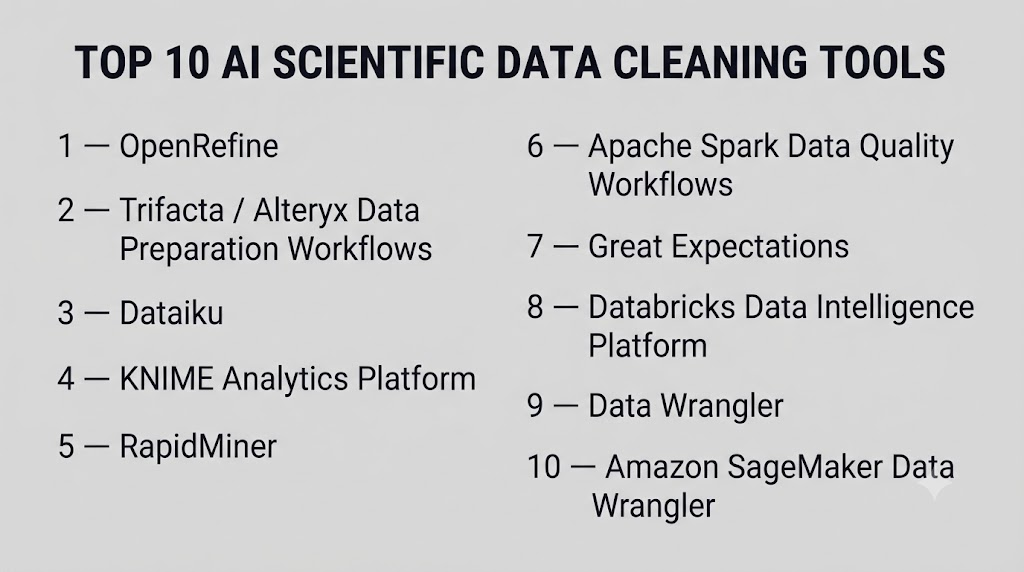
Top 10 AI Scientific Data Cleaning Tools
#1 — OpenRefine
One-line verdict: Best for researchers cleaning messy datasets and improving scientific data quality.
Short description (2–3 lines):
OpenRefine is an open-source data cleaning and transformation tool used to explore, standardize, and improve datasets.
It helps researchers identify inconsistencies, clean structured data, and prepare information for analysis.
Standout Capabilities
- Data cleaning workflows
- Duplicate detection
- Data transformation
- Dataset exploration
- Pattern identification
- Metadata improvement
- Data normalization
AI-Specific Depth (Must Include)
- Model support: AI capabilities depend on connected extensions and workflows.
- RAG / knowledge integration: Requires external integration for retrieval-based workflows.
- Evaluation: Data corrections require user validation.
- Guardrails: Depends on configured cleaning rules and workflows.
- Observability: Depends on workflow tracking and external monitoring.
Pros
- Powerful data cleaning capabilities.
- Flexible open-source ecosystem.
- Useful for research data preparation.
Cons
- Requires user expertise.
- Not a complete AI data management platform.
- Advanced automation needs customization.
Security & Compliance
Not publicly stated.
Deployment & Platforms
- Platforms: Desktop environments.
- Deployment: Self-managed.
Integrations & Ecosystem
Supports:
- Research datasets
- Data transformation workflows
- External data sources
- Metadata workflows
- Analytical pipelines
Pricing Model
Open-source.
Best-Fit Scenarios
- Scientific dataset cleaning
- Research data preparation
- Data quality improvement
#2 — Trifacta / Alteryx Data Preparation Workflows
One-line verdict: Best for organizations automating large-scale scientific data preparation workflows.
Short description (2–3 lines):
Data preparation platforms such as Trifacta and Alteryx workflows help organizations clean, transform, and organize complex datasets before analysis.
They support teams working with large amounts of structured research and operational data.
Standout Capabilities
- Data profiling
- Data transformation
- Quality improvement workflows
- Automated preparation
- Data pipeline support
- Pattern detection
- Dataset standardization
AI-Specific Depth (Must Include)
- Model support: AI capabilities depend on platform features and integrations.
- RAG / knowledge integration: Depends on connected data systems.
- Evaluation: Data quality checks require validation rules.
- Guardrails: Depends on organizational policies.
- Observability: Data workflow monitoring depends on configuration.
Pros
- Suitable for enterprise data preparation.
- Supports automation.
- Handles complex datasets.
Cons
- May require technical expertise.
- Not specifically designed only for scientific data.
- Advanced features depend on configuration.
Security & Compliance
Security capabilities depend on deployment configuration. Specific certifications vary.
Deployment & Platforms
- Platforms: Cloud and enterprise environments.
- Deployment: Cloud, hybrid, and enterprise options vary.
Integrations & Ecosystem
Supports:
- Data warehouses
- Analytics platforms
- Research databases
- Enterprise applications
- Data pipelines
Pricing Model
Varies depending on deployment and usage.
Best-Fit Scenarios
- Large research organizations
- Enterprise data cleaning
- Scientific analytics preparation
#3 — Dataiku
One-line verdict: Best for teams combining AI workflows with scientific data preparation and analytics.
Short description (2–3 lines):
Dataiku is a collaborative data science platform that supports data preparation, machine learning workflows, and analytics processes.
It helps organizations manage data quality tasks alongside AI development workflows.
Standout Capabilities
- Data preparation
- Machine learning workflows
- Data quality checks
- Collaborative analytics
- Visual data workflows
- Automation capabilities
- Model development support
AI-Specific Depth (Must Include)
- Model support: Supports machine learning workflows and integrations with different AI technologies.
- RAG / knowledge integration: Depends on connected data and AI architecture.
- Evaluation: Supports data and model evaluation workflows.
- Guardrails: Depends on governance configuration.
- Observability: Monitoring depends on deployment setup.
Pros
- Combines data cleaning and AI workflows.
- Supports collaboration between technical and non-technical teams.
- Useful for enterprise analytics.
Cons
- Requires learning for advanced workflows.
- Not specialized only for scientific datasets.
- Enterprise features may require planning.
Security & Compliance
Security capabilities depend on deployment configuration. Specific certifications are not publicly stated.
Deployment & Platforms
- Platforms: Web-based enterprise environments.
- Deployment: Cloud, hybrid, and self-managed options vary.
Integrations & Ecosystem
Supports:
- Data platforms
- Machine learning workflows
- Analytics systems
- Research datasets
- AI applications
Pricing Model
Not publicly stated.
Best-Fit Scenarios
- Research analytics teams
- AI data preparation
- Enterprise scientific workflows
#4 — KNIME Analytics Platform
One-line verdict: Best for researchers needing visual data cleaning and analytics workflows without heavy coding.
Short description (2–3 lines):
KNIME Analytics Platform is a workflow-based analytics tool that helps researchers process, clean, transform, and analyze scientific datasets.
It provides visual workflows for combining data preparation, machine learning, and analytical processes.
Standout Capabilities
- Visual data workflows
- Data cleaning automation
- Data transformation
- Machine learning integration
- Workflow reuse
- Data quality processing
- Analytics automation
AI-Specific Depth (Must Include)
- Model support: Supports machine learning workflows and integration with different AI technologies.
- RAG / knowledge integration: Depends on connected systems and extensions.
- Evaluation: Supports workflow-based validation and analytical evaluation.
- Guardrails: Depends on implemented data rules and governance processes.
- Observability: Workflow monitoring depends on configuration.
Pros
- User-friendly visual workflow approach.
- Supports complex data preparation tasks.
- Useful for research and analytics teams.
Cons
- Advanced workflows require technical knowledge.
- AI capabilities depend on extensions.
- Large-scale deployments may require planning.
Security & Compliance
Not publicly stated.
Deployment & Platforms
- Platforms: Desktop and enterprise environments.
- Deployment: Self-managed and enterprise options vary.
Integrations & Ecosystem
Supports:
- Scientific datasets
- Machine learning tools
- Data sources
- Analytics platforms
- Research workflows
Pricing Model
Open-source and enterprise options vary.
Best-Fit Scenarios
- Scientific data preparation
- Research analytics
- Workflow-based cleaning
#5 — RapidMiner
One-line verdict: Best for organizations combining AI analytics with automated data preparation workflows.
Short description (2–3 lines):
RapidMiner is a data science platform that supports data preparation, machine learning, and analytics workflows.
It helps teams clean datasets, build models, and improve data-driven decision processes.
Standout Capabilities
- Data preprocessing
- Machine learning workflows
- Data quality improvement
- Visual analytics
- Automated modeling
- Workflow automation
- Data transformation
AI-Specific Depth (Must Include)
- Model support: Supports machine learning workflows and AI integrations.
- RAG / knowledge integration: Depends on connected systems.
- Evaluation: Supports model and data evaluation workflows.
- Guardrails: Depends on organizational governance configuration.
- Observability: Depends on workflow monitoring setup.
Pros
- Combines data cleaning with AI analytics.
- Supports visual workflows.
- Useful for data science teams.
Cons
- Not designed specifically for scientific research.
- Advanced features require expertise.
- Enterprise capabilities vary.
Security & Compliance
Not publicly stated.
Deployment & Platforms
- Platforms: Desktop and enterprise environments.
- Deployment: Cloud and self-managed options vary.
Integrations & Ecosystem
Supports:
- Data platforms
- Machine learning environments
- Analytics workflows
- Research datasets
- Business applications
Pricing Model
Not publicly stated.
Best-Fit Scenarios
- Research analytics
- Data science teams
- AI dataset preparation
#6 — Apache Spark Data Quality Workflows
One-line verdict: Best for large-scale scientific data cleaning and distributed processing environments.
Short description (2–3 lines):
Apache Spark provides distributed data processing capabilities that organizations use for large-scale data transformation, cleaning, and analytics workflows.
It is commonly used when scientific datasets are too large for traditional processing approaches.
Standout Capabilities
- Distributed data processing
- Large dataset handling
- Data transformation
- Batch processing
- Data pipeline automation
- Analytics workflows
- Scalable processing
AI-Specific Depth (Must Include)
- Model support: Supports machine learning workflows through connected libraries.
- RAG / knowledge integration: Requires external architecture.
- Evaluation: Data validation depends on implemented rules.
- Guardrails: Depends on pipeline design.
- Observability: Requires monitoring tools and configurations.
Pros
- Handles massive datasets.
- Flexible open-source ecosystem.
- Suitable for enterprise-scale processing.
Cons
- Requires technical expertise.
- Not a ready-to-use AI cleaning assistant.
- Infrastructure management may be required.
Security & Compliance
Depends on deployment environment.
Deployment & Platforms
- Platforms: Distributed computing environments.
- Deployment: Cloud, hybrid, and self-managed options.
Integrations & Ecosystem
Supports:
- Data lakes
- Cloud storage
- Machine learning pipelines
- Research databases
- Analytics systems
Pricing Model
Open-source.
Best-Fit Scenarios
- Large scientific datasets
- Research data pipelines
- Enterprise-scale cleaning
#7 — Great Expectations
One-line verdict: Best for researchers building automated data validation and quality monitoring workflows.
Short description (2–3 lines):
Great Expectations is an open-source data quality framework that helps teams define, test, and monitor data quality expectations.
It supports reliable data pipelines by validating datasets before analysis.
Standout Capabilities
- Data quality testing
- Validation rules
- Automated checks
- Data documentation
- Pipeline monitoring
- Data profiling
- Quality reporting
AI-Specific Depth (Must Include)
- Model support: AI capabilities depend on connected data workflows.
- RAG / knowledge integration: Requires external integration.
- Evaluation: Strong focus on data validation and testing.
- Guardrails: Provides data quality controls through validation rules.
- Observability: Supports data quality monitoring workflows.
Pros
- Strong data validation capabilities.
- Improves dataset reliability.
- Useful for research reproducibility.
Cons
- Requires technical setup.
- Not a complete AI cleaning platform.
- Requires users to define validation rules.
Security & Compliance
Not publicly stated.
Deployment & Platforms
- Platforms: Development environments.
- Deployment: Self-managed and cloud workflows.
Integrations & Ecosystem
Supports:
- Data pipelines
- Databases
- Analytics platforms
- Machine learning workflows
- Data engineering systems
Pricing Model
Open-source.
Best-Fit Scenarios
- Research data validation
- AI dataset preparation
- Quality-controlled pipelines
#8 — Databricks Data Intelligence Platform
One-line verdict: Best for organizations managing scientific data engineering, analytics, and AI workflows at scale.
Short description (2–3 lines):
Databricks provides a unified platform for data engineering, analytics, machine learning, and AI workflows.
It supports organizations preparing, cleaning, and analyzing large scientific datasets.
Standout Capabilities
- Data engineering
- Data transformation
- Machine learning workflows
- Data governance
- Large-scale analytics
- Data pipeline automation
- AI development support
AI-Specific Depth (Must Include)
- Model support: Supports multiple AI and machine learning workflows depending on configuration.
- RAG / knowledge integration: Supports retrieval-based AI architectures through connected data systems.
- Evaluation: Supports analytics and model evaluation workflows.
- Guardrails: Governance capabilities depend on implementation.
- Observability: Monitoring depends on configured tools.
Pros
- Strong enterprise data platform.
- Supports large-scale scientific workflows.
- Combines data and AI capabilities.
Cons
- Requires technical expertise.
- Can be complex for smaller teams.
- Cost management requires planning.
Security & Compliance
Security capabilities depend on deployment configuration. Specific certifications vary.
Deployment & Platforms
- Platforms: Cloud-based environments.
- Deployment: Cloud and hybrid options vary.
Integrations & Ecosystem
Supports:
- Data lakes
- Machine learning platforms
- Research datasets
- Analytics systems
- AI applications
Pricing Model
Usage-based and varies.
Best-Fit Scenarios
- Enterprise scientific data platforms
- Large research organizations
- AI data pipelines
#9 — Data Wrangler
One-line verdict: Best for interactive scientific data preparation and exploration workflows.
Short description (2–3 lines):
Data Wrangler tools help researchers explore datasets, identify quality issues, transform information, and prepare data for analysis.
They are useful during early-stage data preparation activities.
Standout Capabilities
- Interactive data cleaning
- Data transformation
- Dataset exploration
- Quality issue identification
- Data preparation workflows
- Visualization support
- Research data organization
AI-Specific Depth (Must Include)
- Model support: Depends on connected AI and analytics tools.
- RAG / knowledge integration: Depends on external systems.
- Evaluation: Requires user validation.
- Guardrails: Depends on cleaning rules.
- Observability: Depends on workflow implementation.
Pros
- Useful for exploring datasets.
- Helps identify data issues quickly.
- Supports preparation before analysis.
Cons
- Limited enterprise automation.
- Requires manual interaction.
- AI capabilities vary.
Security & Compliance
Not publicly stated.
Deployment & Platforms
- Platforms: Development environments.
- Deployment: Depends on implementation.
Integrations & Ecosystem
Supports:
- Data science workflows
- Analytics tools
- Research datasets
- Machine learning preparation
Pricing Model
Varies.
Best-Fit Scenarios
- Data exploration
- Research preparation
- Dataset cleaning
#10 — Amazon SageMaker Data Wrangler
One-line verdict: Best for machine learning teams preparing scientific datasets for AI workflows.
Short description (2–3 lines):
Amazon SageMaker Data Wrangler provides data preparation capabilities that help teams clean, transform, and analyze datasets before machine learning development.
It supports organizations preparing data for AI and analytics workflows.
Standout Capabilities
- Data preparation
- Feature engineering
- Dataset analysis
- Transformation workflows
- Machine learning integration
- Data exploration
- AI pipeline support
AI-Specific Depth (Must Include)
- Model support: Supports machine learning workflows within connected environments.
- RAG / knowledge integration: Depends on connected AI architecture.
- Evaluation: Supports data analysis and preparation validation.
- Guardrails: Depends on implementation and governance.
- Observability: Depends on monitoring configuration.
Pros
- Designed for AI data preparation.
- Integrates with cloud ML workflows.
- Supports scalable data processing.
Cons
- Requires cloud expertise.
- Best suited for ML workflows rather than all scientific use cases.
- Usage costs vary.
Security & Compliance
Security capabilities depend on cloud configuration. Specific certifications vary.
Deployment & Platforms
- Platforms: Cloud-based environments.
- Deployment: Cloud.
Integrations & Ecosystem
Supports:
- Machine learning workflows
- Cloud storage
- AI platforms
- Data pipelines
- Analytics environments
Pricing Model
Usage-based and varies.
Best-Fit Scenarios
- AI dataset preparation
- Machine learning experiments
- Cloud research workflows
Comparison Table
| Tool Name | Best For | Deployment (Cloud/Self-hosted/Hybrid) | Model Flexibility (Hosted / BYO / Multi-model / Open-source) | Strength | Watch-Out | Public Rating |
|---|---|---|---|---|---|---|
| OpenRefine | Research dataset cleaning | Self-hosted/Desktop | Open-source | Flexible data transformation | Requires manual workflows | N/A |
| Trifacta / Alteryx Workflows | Enterprise data preparation | Cloud/Hybrid | Hosted workflows | Automated data preparation | Not scientific-specific | N/A |
| Dataiku | AI data preparation workflows | Cloud/Hybrid/Self-managed | Multi-model integrations | Data + AI collaboration | Requires learning | N/A |
| KNIME Analytics Platform | Visual scientific data workflows | Desktop/Self-managed | Open-source + integrations | Workflow-based analytics | Advanced tasks need expertise | N/A |
| RapidMiner | Data science preparation | Cloud/Enterprise | AI workflow integrations | Automated analytics | Enterprise features vary | N/A |
| Apache Spark Data Quality Workflows | Large-scale data processing | Cloud/Self-managed | Open-source | Distributed processing | Requires engineering skills | N/A |
| Great Expectations | Data validation and quality checks | Self-managed/Cloud workflows | Open-source | Data quality testing | Requires configuration | N/A |
| Databricks Data Intelligence Platform | Enterprise scientific data platforms | Cloud/Hybrid | Multi-model/BYO options vary | Unified data and AI workflows | Higher complexity | N/A |
| Data Wrangler | Interactive data preparation | Cloud/Development environments | Integration-based | Dataset exploration | Limited automation | N/A |
| Amazon SageMaker Data Wrangler | ML dataset preparation | Cloud | AI/ML workflow integration | AI-ready data preparation | Cloud dependency | N/A |
Scoring & Evaluation (Transparent Rubric)
The following scoring compares AI Scientific Data Cleaning Tools based on data preparation capabilities, AI reliability, validation support, integrations, usability, performance, security, and ecosystem maturity.
The evaluation is comparative rather than absolute. Different organizations may prioritize different capabilities depending on research domain, dataset size, compliance requirements, and technical resources.
| Tool | Core | Reliability/Eval | Guardrails | Integrations | Ease | Perf/Cost | Security/Admin | Support | Weighted Total |
|---|---|---|---|---|---|---|---|---|---|
| OpenRefine | 8 | 8 | 7 | 8 | 8 | 9 | 7 | 8 | 7.9 |
| Trifacta / Alteryx Workflows | 9 | 8 | 8 | 9 | 8 | 8 | 8 | 8 | 8.3 |
| Dataiku | 9 | 8 | 8 | 9 | 8 | 8 | 8 | 9 | 8.4 |
| KNIME Analytics Platform | 8 | 8 | 8 | 8 | 8 | 8 | 7 | 8 | 7.9 |
| RapidMiner | 8 | 8 | 8 | 8 | 8 | 8 | 8 | 8 | 8.0 |
| Apache Spark Workflows | 9 | 9 | 8 | 10 | 6 | 10 | 8 | 9 | 8.7 |
| Great Expectations | 8 | 9 | 9 | 9 | 7 | 9 | 8 | 8 | 8.4 |
| Databricks Data Intelligence Platform | 10 | 9 | 9 | 10 | 7 | 9 | 9 | 9 | 9.1 |
| Data Wrangler | 8 | 8 | 7 | 8 | 9 | 8 | 8 | 8 | 8.0 |
| Amazon SageMaker Data Wrangler | 9 | 9 | 8 | 9 | 8 | 8 | 9 | 9 | 8.8 |
Top 3 for Enterprise
1. Databricks Data Intelligence Platform
Best suited for organizations managing large-scale scientific data engineering, AI workflows, and research analytics.
2. Amazon SageMaker Data Wrangler
A strong choice for organizations preparing datasets for machine learning and AI research workflows.
3. Apache Spark Data Quality Workflows
Useful for enterprises processing extremely large scientific datasets through distributed computing.
Top 3 for SMB
1. Dataiku
A practical option for teams combining data cleaning, analytics, and AI workflows.
2. OpenRefine
Best for smaller research teams needing flexible and cost-effective data cleaning.
3. KNIME Analytics Platform
Suitable for teams wanting visual workflows without building everything from code.
Top 3 for Developers
1. Apache Spark Data Quality Workflows
Best for developers building scalable scientific data pipelines.
2. Great Expectations
Useful for developers implementing automated data validation systems.
3. Amazon SageMaker Data Wrangler
Suitable for developers preparing datasets for AI and machine learning workflows.
Which AI Scientific Data Cleaning Tool Is Right for You?
Solo / Freelancer
Independent researchers, students, and technical professionals should focus on:
- Simple dataset cleaning
- Easy setup
- Low operational cost
- Flexible workflows
Recommended options:
- OpenRefine
- KNIME Analytics Platform
- Data Wrangler
Solo users generally benefit from tools that allow quick data exploration and correction without complex infrastructure.
Important considerations:
- Data format support
- Learning curve
- Export capabilities
- Research workflow compatibility
SMB
Small research teams should prioritize:
- Collaboration
- Automation
- Affordable scaling
- Data quality improvement
Recommended options:
- Dataiku
- OpenRefine
- KNIME Analytics Platform
SMBs should evaluate:
- Dataset volume
- Integration requirements
- Team skills
- Future growth needs
The best solution should improve data quality without requiring a large engineering team.
Mid-Market
Growing organizations require stronger automation and governance.
Recommended options:
- Dataiku
- Great Expectations
- Databricks Data Intelligence Platform
Important requirements:
- Automated validation
- Data lineage
- Research workflow integration
- Quality monitoring
- Team collaboration
Mid-market teams should create standardized data cleaning processes before expanding AI adoption.
Enterprise
Large organizations managing scientific data at scale need secure and highly integrated platforms.
Recommended options:
- Databricks Data Intelligence Platform
- Amazon SageMaker Data Wrangler
- Apache Spark Data Quality Workflows
Enterprise buyers should prioritize:
- Large dataset processing
- Governance controls
- Security management
- Data pipeline integration
- AI readiness
For enterprise research environments, data cleaning should become part of a complete data governance strategy.
Regulated Industries (Finance / Healthcare / Public Sector)
Organizations handling sensitive research data should focus on:
- Data privacy
- Auditability
- Access controls
- Validation workflows
- Data lineage
Recommended approach:
- Maintain original datasets.
- Track all AI-assisted corrections.
- Require human approval for important changes.
- Document transformation processes.
AI data cleaning should improve quality while maintaining transparency and accountability.
Budget vs Premium
Budget Approach
Suitable for:
- Students
- Individual researchers
- Small teams
Consider:
- Open-source tools
- Desktop solutions
- Lightweight validation frameworks
Advantages:
- Lower cost
- Flexible customization
- Fast adoption
Challenges:
- More manual work
- Limited enterprise controls
- Requires user expertise
Premium Enterprise Approach
Suitable for:
- Research institutions
- Pharmaceutical companies
- Large R&D organizations
Advantages:
- Better scalability
- Advanced governance
- Enterprise integrations
- Automation capabilities
Challenges:
- Higher investment
- Implementation complexity
Build vs Buy (When to DIY)
Build a custom AI scientific data cleaning system when:
- You process unique scientific datasets.
- Specialized cleaning rules are required.
- Internal AI and data engineering resources exist.
- Integration with proprietary systems is necessary.
Choose existing platforms when:
- Standard data quality workflows are enough.
- Faster deployment is important.
- Maintenance resources are limited.
A hybrid approach is often effective by combining existing data cleaning platforms with custom AI validation workflows.
Implementation Playbook (30 / 60 / 90 Days)
First 30 Days: Pilot + Success Metrics
The first phase should focus on understanding data quality challenges and testing AI-assisted cleaning workflows.
Key activities:
- Identify important datasets.
- Select pilot projects.
- Analyze current data issues.
- Test cleaning workflows.
- Define quality metrics.
AI-specific tasks:
- Evaluate anomaly detection.
- Test automated corrections.
- Compare AI suggestions with expert decisions.
- Measure improvement.
Success metrics:
- Data quality improvement
- Error reduction
- Cleaning time reduction
- Research productivity
- Validation accuracy
First 60 Days: Security + Evaluation
The second phase focuses on reliability and responsible data processing.
Key activities:
- Establish data quality rules.
- Configure access controls.
- Improve validation workflows.
- Train research teams.
AI-specific tasks:
- Create evaluation processes.
- Review AI corrections.
- Track incorrect modifications.
- Improve cleaning workflows.
Security improvements:
- Data access management
- Privacy controls
- Dataset protection
- Audit tracking
First 90 Days: Optimization + Governance
The final phase focuses on scaling reliable scientific data workflows.
Key activities:
- Automate repetitive cleaning tasks.
- Integrate data systems.
- Improve governance.
- Standardize quality processes.
AI-specific improvements:
- Continuous data monitoring
- Automated validation
- Dataset quality scoring
- AI workflow optimization
- Research data governance
Organizations should build a structured data quality framework where AI improves efficiency while researchers maintain control over important scientific information.
Common Mistakes & How to Avoid Them
AI Scientific Data Cleaning Tools can significantly improve research data quality, but incorrect implementation can introduce hidden errors, reduce trust, and create challenges during analysis.
Below are common mistakes organizations should avoid:
- Assuming AI corrections are always accurate AI-generated data corrections should be reviewed before becoming part of important scientific datasets. Researchers must verify changes against original information.
- Cleaning data without understanding scientific context A value that appears unusual to an AI system may represent a meaningful scientific observation. Domain expertise is required before removing or modifying data.
- Ignoring data lineage Organizations should track where data originated, what changes were applied, and why modifications were made.
- Overwriting original datasets Researchers should preserve original data and create controlled versions of cleaned datasets for analysis.
- Skipping validation rules AI cleaning should work together with predefined quality checks, scientific standards, and validation workflows.
- Using AI without measuring data quality improvements Organizations should evaluate whether cleaning workflows actually improve accuracy, consistency, and research outcomes.
- Ignoring missing data problems Missing values can affect scientific conclusions. Teams should carefully determine whether data should be removed, corrected, or statistically handled.
- Failing to consider data bias Cleaning processes can unintentionally remove important variations or introduce bias into research datasets.
- Using generic tools for specialized scientific data Scientific datasets often require domain-specific understanding, such as biological measurements, laboratory results, or sensor data.
- Ignoring privacy requirements Research datasets may include sensitive information. Organizations should establish proper access controls and data handling practices.
- Not integrating cleaning workflows with research systems Data cleaning becomes more effective when connected with laboratory platforms, analytics systems, and research pipelines.
- Lack of human review AI should support researchers, not replace expert decisions regarding important data modifications.
- Building complex custom systems unnecessarily Custom solutions may increase maintenance requirements when existing tools can handle standard cleaning needs.
- Ignoring scalability requirements Tools suitable for small datasets may not work effectively for large scientific data environments.
FAQs
What are AI Scientific Data Cleaning Tools?
AI Scientific Data Cleaning Tools are software solutions that use artificial intelligence and automation to improve the quality of scientific datasets.
They help detect errors, identify inconsistencies, remove duplicates, and prepare data for research analysis.
Why is scientific data cleaning important?
Scientific research depends on accurate and reliable data.
Poor-quality datasets can affect analysis results, machine learning models, and research conclusions.
How does AI improve scientific data cleaning?
AI can help identify patterns, detect anomalies, suggest corrections, and automate repetitive quality checks.
Researchers can use these capabilities to reduce manual data preparation effort.
Can AI automatically clean scientific datasets?
AI can automate many cleaning tasks, but human validation remains important.
Scientific data often requires expert interpretation before changes are accepted.
Which industries use AI scientific data cleaning tools?
Common users include:
- Healthcare research
- Biotechnology
- Pharmaceutical development
- Environmental science
- Engineering
- Manufacturing
- Academic research
Can AI cleaning tools handle laboratory data?
Many tools can support laboratory data workflows through integrations, data processing pipelines, or research platforms.
Capabilities depend on the specific system.
Are AI data cleaning tools suitable for healthcare research?
Yes, they can support healthcare research data preparation.
However, organizations must carefully manage privacy, validation, and responsible data handling requirements.
Can AI tools detect incorrect scientific measurements?
AI can identify unusual patterns, missing values, and potential inconsistencies.
However, determining whether a measurement is scientifically incorrect requires expert review.
What is data lineage in scientific data cleaning?
Data lineage tracks where data comes from, what transformations occurred, and how datasets changed over time.
It helps researchers maintain transparency and reproducibility.
Do AI scientific data cleaning tools support machine learning workflows?
Yes. Many tools help prepare datasets used for machine learning, analytics, and AI model development.
Can organizations use open-source AI data cleaning tools?
Yes. Open-source tools can provide flexibility and customization options.
However, organizations may need technical expertise for implementation and maintenance.
How secure are AI Scientific Data Cleaning Tools?
Security depends on the platform, deployment model, and organization’s configuration.
Teams should evaluate access controls, privacy features, and data protection practices.
What is the difference between data cleaning and data validation?
Data cleaning focuses on correcting, transforming, and improving datasets.
Data validation focuses on checking whether data meets predefined quality requirements.
Can AI data cleaning tools work with unstructured scientific data?
Some platforms support documents, images, text, and other complex formats.
Capabilities vary depending on the tool and implementation.
How much do AI Scientific Data Cleaning Tools cost?
Pricing varies based on platform features, usage, deployment model, and organization requirements.
Exact pricing details are not publicly stated for many tools.
Should organizations build custom AI data cleaning systems?
Custom systems may be useful when organizations have unique scientific datasets, specialized workflows, or strict integration requirements.
For standard needs, existing solutions may provide faster adoption.
Conclusion
AI Scientific Data Cleaning Tools are becoming essential for organizations that depend on accurate, reliable, and analysis-ready research data. As scientific datasets continue to grow in size and complexity, manual cleaning approaches are becoming difficult to maintain.These AI-powered solutions help researchers identify data quality issues, automate repetitive preparation tasks, and improve confidence in datasets used for analysis, simulations, and machine learning workflows.The right tool depends on the organization’s research environment, data complexity, technical capabilities, and governance requirements. Small research teams may benefit from flexible open-source solutions, while large organizations may require enterprise platforms with stronger automation and data management capabilities.AI should be used as a support system for scientific data quality rather than a replacement for researcher judgment. The most reliable workflows combine AI automation with expert validation, transparent data lineage, and strong governance practices.Organizations planning adoption should focus on selecting tools that balance automation, accuracy, security, scalability, and usability.

Find Trusted Cardiac Hospitals
Compare heart hospitals by city and services — all in one place.
Explore Hospitals