
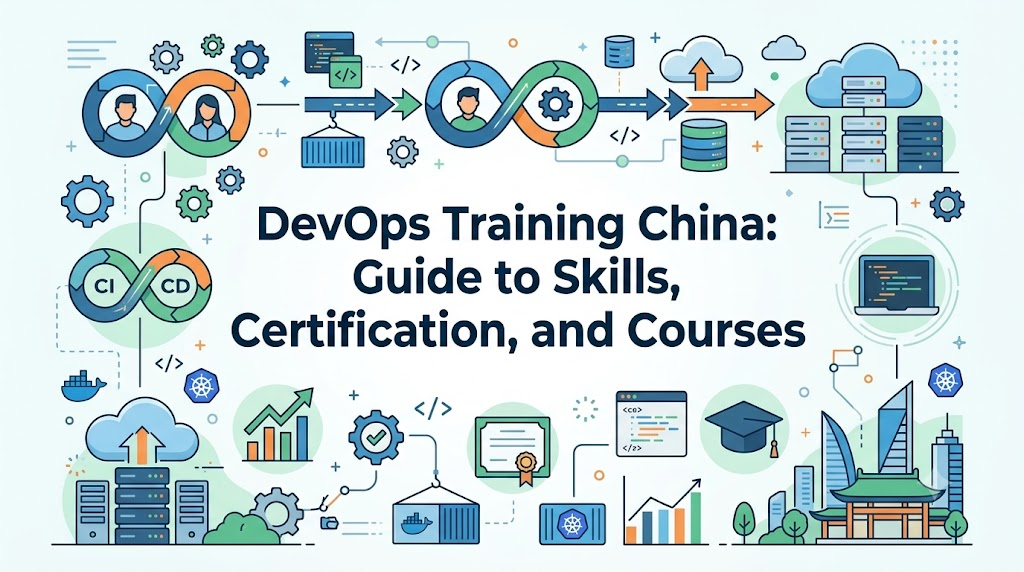
Software engineering teams face continuous pressure to ship features quickly without sacrificing system stability. Traditional silos between development, quality assurance, and operations teams often create bottlenecks, leading to delayed deployments, manual errors, and prolonged recovery times during outages. To address these challenges, organizations rely on automation, continuous integration and delivery (CI/CD), containers, cloud infrastructure, and observability.
As these engineering practices mature, demand for structured upskilling has grown. DevOps Training China provides engineers, IT managers, and enterprise teams with a practical roadmap to adopt modern delivery practices, master foundational tools, and improve software delivery performance.
What Is DevOps?
DevOps is an engineering culture and operational approach designed to shorten the systems development life cycle while delivering features, fixes, and updates frequently and reliably.
Rather than treating software creation and infrastructure maintenance as isolated functions, DevOps brings development and operations workflows together. Key components include:
- Continuous Integration and Continuous Delivery (CI/CD): Automating code validation, testing, and deployment to reduce release friction.
- Infrastructure as Code (IaC): Managing infrastructure setups through version-controlled configuration files instead of manual provisioning.
- Containerization: Packaging software with its dependencies to ensure consistency across development, staging, and production environments.
- Monitoring and Observability: Using metrics, logs, and distributed tracing to detect regressions and diagnose failures.
- Integrated Security: Embedding security reviews, code scanning, and policy checks early in the delivery pipeline.
- Continuous Improvement: Reviewing system metrics and team workflows regularly to eliminate delivery blockers.
DevOps is not simply a collection of tools like Git, Docker, or Jenkins. While mastering automation platforms is necessary, DevOps fundamentally relies on shared team responsibility, measurable workflows, and automated feedback loops.
Why Is DevOps Training Important in China?
Enterprise technology environments are increasingly distributed, utilizing microservices architectures, cloud platforms, and large-scale data systems. For technical professionals, keeping pace with these shifts requires hands-on familiarity with automation frameworks, container clusters, and distributed systems design.
Structured training helps teams build predictable deployment pipelines and operate reliable services. The practical benefits span multiple engineering roles:
- Software Developers: Learn how code runs in production environments, debug containerized services, and build automated test suites for delivery pipelines.
- IT Operations and System Administrators: Transition from manual server configuration and ad-hoc scripting to version-controlled infrastructure automation.
- Cloud and SRE Teams: Establish scalable runtime platforms, configure auto-scaling mechanisms, and implement standardized telemetry.
- Engineering Managers: Gain insight into deployment frequency, change failure rates, and lead times to improve cross-functional collaboration.
Instead of relying on fragmented tutorials, structured training provides cohesive, end-to-end architectures, demonstrating how individual components integrate into a production system.
What Do You Learn in DevOps Training?
Comprehensive training programs focus on building resilient software delivery systems. While specific toolsets vary across providers and tech stacks, core curricula typically cover the following modules:
- Version Control (Git): Branching strategies (Gitflow, trunk-based), merge conflicts, semantic versioning, and collaborative repository management.
- CI/CD Automation: Pipeline construction, automated unit and integration testing, build artifact management, and automated release triggering using platforms such as Jenkins, GitHub Actions, or GitLab CI/CD.
- Containerization: Writing optimized Dockerfiles, managing multi-stage builds, handling container networking, and securing container images.
- Container Orchestration: Cluster components, workload scheduling, high availability, storage volumes, and service discovery.
- Infrastructure as Code (IaC): Writing declarative configurations, managing environment states, and automating resource provisioning with Terraform.
- Configuration Management: Automating software installation, user management, and system policies across fleets using tools like Ansible.
- Cloud Fundamentals: Managing object storage, virtual private clouds (VPCs), serverless components, identity and access management (IAM), and security groups.
- Monitoring and Observability: Collecting metrics, configuring dashboards, setting up alert policies, and tracing requests using tools like Prometheus and Grafana.
- DevSecOps Practices: Performing static and dynamic application security testing (SAST/DAST), scanning image registries for vulnerabilities, and handling secrets securely.
- Automation Scripting: Automating operational tasks and workflow orchestration using Bash or Python.
DevOps Training Roadmap for Beginners
For professionals transitioning into DevOps, approaching the entire ecosystem at once can be overwhelming. A step-by-step progression helps build a durable skill base:
Linux & Networking Basics ➔ Git & Scripting ➔ CI/CD Pipelines ➔ Containers (Docker)
                                                                        │
Certifications & Advanced Ops 🡰 Cloud & DevSecOps 🡰 IaC 🡰 Orchestration (Kubernetes)
- System Fundamentals: Learn Linux command-line utilities, process states, file systems, permissions, and basic networking (TCP/IP, DNS, HTTP/S, SSH).
- Version Control and Scripting: Master core Git workflows. Write clean Bash or Python scripts to automate repetitive system tasks.
- Continuous Integration: Set up automated pipelines that pull source code, run tests, and report build health.
- Container Fundamentals: Learn to package applications with Docker, configure persistent volumes, and map container ports.
- Cluster Management: Learn container orchestration patterns, service routing, and deployment updates.
- Infrastructure Automation: Provision and update virtualized infrastructure declaratively using Terraform or OpenTofu.
- Cloud Architecture: Learn core cloud infrastructure paradigms, networking boundaries, and permission models.
- Telemetry and Monitoring: Configure metric scrapers, aggregate application logs, and build service health dashboards.
- Security Integration: Add automated secret scanners and vulnerability checks into existing pipelines.
- Practical Integration: Build a complete, end-to-end pipeline hosting a functional microservices application.
DevOps Certification China
Professionals researching DevOps Certification China will find vendor-neutral credentials (such as those from the Linux Foundation, DevOps Institute, or DevOpsSchool) alongside platform-specific certifications (from major cloud providers).
When evaluating certifications, consider:
- Hands-On Validation: Practical, performance-based exams (where you configure live environments) reflect real-world capability better than multiple-choice tests.
- Curriculum Coverage: Ensure the syllabus covers open engineering patterns rather than locking your skills into a single vendor’s ecosystem.
- Career Relevance: Match the certification to your current or target job function, such as pipeline engineering, infrastructure operations, or cloud architecture.
Certifications demonstrate baseline knowledge and personal dedication. However, they are most effective when supported by real-world projects and direct experience managing systems.
Kubernetes Training China
Kubernetes has become the standard platform for running containerized workloads at scale. Consequently, Kubernetes Training China is one of the most requested specializations within the broader DevOps space.
A practical Kubernetes curriculum covers:
- Control Plane Architecture: API Server, etcd, scheduler, and controller manager interactions.
- Workload Resources: Managing Pods, Deployments, ReplicaSets, StatefulSets, DaemonSets, and CronJobs.
- Networking and Routing: ClusterIP, NodePort, Ingress controllers, CoreDNS, and service meshes.
- Configuration and Secrets: Decoupling environment configs using ConfigMaps and Secrets.
- Storage Management: Managing stateful data with StorageClasses, PersistentVolumes, and PersistentVolumeClaims.
- Operations and Troubleshooting: Diagnosing crash loops, managing node drain procedures, configuring rolling updates, and handling horizontal pod autoscaling (HPA).
This training is ideal for software engineers deploying microservices, system administrators managing modern compute clusters, and cloud architects standardizing enterprise infrastructure.
SRE Training China
Site Reliability Engineering (SRE), pioneered by Google, applies software engineering techniques to solve infrastructure and operations problems. While DevOps focuses on delivery speed and collaboration across the development lifecycle, SRE provides the operational framework to keep those systems running reliably.
SRE Training China focuses on core operational disciplines:
- Service Level Metrics: Defining Service Level Indicators (SLIs) and setting realistic Service Level Objectives (SLOs).
- Error Budgets: Using acceptable failure limits to balance the release velocity of new features with operational stability.
- Toil Reduction: Identifying and automating manual, repetitive administrative tasks through software.
- Incident Response: Setting up on-call rotations, running structured post-mortems, and conducting root-cause investigations.
- Disaster Recovery: Practicing chaos engineering, testing failover mechanisms, and establishing recovery targets (RTO/RPO).
SRE and DevOps work in tandem: DevOps helps teams ship changes continuously, while SRE ensures production systems maintain target availability.
DevSecOps Training China
Traditional security practices often relied on manual reviews at the end of the development cycle, delaying release timelines. DevSecOps shifts security responsibilities earlier into the build and deployment process (“shifting left”).
Key topics covered in DevSecOps Training China include:
- Source Code Scanning (SAST): Automated static analysis to detect insecure code patterns during pull requests.
- Dependency Checking (SCA): Identifying known Common Vulnerabilities and Exposures (CVEs) in third-party packages and open-source libraries.
- Container Security: Scanning base images for vulnerabilities and enforcing non-root runtime policies.
- Dynamic Analysis (DAST): Automated security testing against running staging environments.
- Secrets Management: Preventing credential leaks in source code using tools like HashiCorp Vault.
- Compliance as Code: Automating infrastructure audits and enforcing configuration compliance policies before resources are provisioned.
Automating these checks allows development teams to ship regular updates without bypassing core compliance and security policies.
Cloud Computing Training China
Modern DevOps architectures rely heavily on elastic cloud resources. Completing Cloud Computing Training China gives engineers the operational grounding needed to design and manage these cloud-native environments.
Core focus areas include:
- Compute and Networking: Configuring virtual machine instances, serverless runtimes, private subnets, NAT gateways, and load balancers.
- Identity and Security Policies: Writing granular IAM policies, managing access tokens, and enforcing the principle of least privilege.
- Cloud Storage Architecture: Choosing appropriate storage classes (block, file, object) for stateful applications and archival pipelines.
- Managed Container Services: Provisioning and maintaining managed container clusters (e.g., ACK, EKS, or GKE).
- Cloud Cost Optimization (FinOps): Monitoring resource consumption, configuring automatic scaling, and pruning unused development resources.
Understanding cloud infrastructure ensures that DevOps automation runs on efficient, secure, and cost-effective foundations.
Corporate DevOps Training China
For companies modernizing legacy applications or migrating to containerized platforms, upskilling entire teams simultaneously accelerates adoption. Corporate DevOps Training China helps organizations establish consistent delivery standards and bridge knowledge gaps across departments.
Organizations commonly pursue group training to:
- Standardize release management across multiple development teams.
- Migrate workloads from bare-metal or legacy virtual machines to container platforms.
- Replace manual deployment procedures with auditable CI/CD pipelines.
- Improve cross-functional collaboration between development and operations teams.
Corporate training programs can be delivered through online sessions, instructor-led workshops, or focused, hands-on labs built around the organization’s existing technology stack.
DevOps Consulting China
While training helps internal teams build skills, some organizational challenges require hands-on technical guidance. Organizations often choose DevOps Consulting China when addressing specific architectural, scaling, or operational hurdles.
| Engagement Factor | DevOps Training | DevOps Consulting |
| Primary Goal | Skill development and personal upskilling | Problem resolution, architecture, and system design |
| Target Audience | Individual engineers, managers, and cross-functional teams | Enterprise departments and engineering leadership |
| Typical Deliverable | Coursework, hands-on labs, and certification preparation | Architecture blueprints, pipeline setups, and audit reports |
| When to Choose | When teams need to learn how to operate modern tools | When systems need auditing, migration planning, or pipeline rebuilds |
Consulting is particularly useful during platform migrations, compliance audits, large-scale CI/CD redesigns, or when establishing an initial platform engineering team.
Platform Engineering Training China
Platform engineering has emerged as an operational evolution of DevOps, focused on designing Internal Developer Platforms (IDPs) that reduce cognitive load for software developers.
Platform Engineering Training China covers:
- Internal Developer Platforms (IDP): Building self-service portals that let developers provision environments and deploy services independently.
- Golden Paths: Creating standardized, secure, and pre-configured deployment templates for engineering teams.
- Infrastructure Abstraction: Decoupling low-level cloud and container configurations from application code.
- Developer Experience (DevEx): Measuring developer friction, reducing deployment lead times, and improving local testing environments.
Rather than replacing DevOps, platform engineering provides the internal infrastructure products that enable DevOps patterns to scale across large engineering organizations.
MLOps Training China
Deploying and maintaining machine learning applications introduces unique operational challenges, including model drift, data pipeline failures, and heavy hardware demands. MLOps applies DevOps automation principles to machine learning lifecycles.
Key areas covered in MLOps Training China include:
- Continuous Training (CT): Automating model retraining pipelines as new production data arrives.
- Data and Pipeline Versioning: Tracking datasets, model parameters, and dependencies systematically.
- Model Serving: Deploying models via RESTful APIs, gRPC endpoints, or streaming architectures on containerized infrastructure.
- Telemetry and Drift Detection: Monitoring production inference models for data drift, concept drift, and performance drops.
- Experiment Tracking: Recording training metrics, hyperparameter runs, and model artifacts.
This path is designed for data scientists, machine learning engineers, and platform teams operating machine learning systems in production.
Who Should Take DevOps Training?
DevOps principles apply across a wide variety of technical roles:
- Software Developers: Looking to master containerization, local testing, and automated release workflows.
- System Administrators & Support Engineers: Transitioning to modern infrastructure automation and cloud platforms.
- Cloud & Infrastructure Engineers: Specializing in declarative provisioning, state management, and network automation.
- Quality Assurance Engineers: Automating end-to-end testing within CI/CD pipelines.
- Engineering Managers: Seeking practical understanding of modern delivery pipelines to evaluate tooling and team capacity.
- Computer Science Students: Building production-focused engineering skills to prepare for modern IT roles.
How to Choose the Right DevOps Training in China
Selecting an effective training program requires evaluating practical coursework over marketing materials:
- Curriculum Depth: Ensure the course covers real-world production challenges (such as rolling updates, network policies, and state management) rather than only surface-level commands.
- Lab Environments: Practical lab exercises are essential. Look for programs that provide hands-on terminal access to real cloud and container environments.
- Instructor Experience: Prioritize courses taught by instructors who have managed production deployments and real-world incidents.
- Project Work: Look for courses requiring you to build a complete, multi-tier deployment pipeline from scratch.
- Format Flexibility: Choose a delivery format (live interactive sessions, self-paced modules, or corporate workshops) that fits your current work schedule.
DevOps Career Paths
DevOps skills open up a variety of technical career opportunities across software development and infrastructure management:
- DevOps Engineer: Designs, maintains, and optimizes continuous integration, deployment pipelines, and operational automation.
- Cloud Infrastructure Engineer: Builds, scales, and secures public and hybrid cloud infrastructure.
- Site Reliability Engineer (SRE): Focuses on system uptime, incident response, capacity planning, and automation to maintain service health.
- Platform Engineer: Develops internal developer tools, platforms, and self-service deployment pipelines for product teams.
- DevSecOps Engineer: Integrates automated vulnerability scanning, policy compliance, and access management across delivery pipelines.
- MLOps Engineer: Manages the operational pipelines, hardware scaling, and monitoring frameworks for production machine learning models.
Practical DevOps Projects to Build
Building end-to-end projects is one of the most effective ways to solidify concepts learned during training:
- Multi-Stage Dockerized Web Application: Containerize a multi-tier application (such as Node.js or Go with PostgreSQL), minimizing image size using multi-stage builds and non-root users.
- Automated CI/CD Pipeline: Configure a pipeline that pulls code from Git, runs linters and unit tests, builds container images, scans for vulnerabilities, and pushes to a container registry.
- Declarative Infrastructure Deployment: Write reusable Terraform modules to provision a virtual network, managed container cluster, and firewall rules on a cloud provider.
- Zero-Downtime Deployment on Kubernetes: Create Kubernetes manifests featuring Deployments, ClusterIP Services, Ingress rules, and Horizontal Pod Autoscalers, testing zero-downtime rolling updates.
- Full Observability Stack: Set up Prometheus metrics scraping for an application, configure custom Grafana performance dashboards, and set up alert notifications.
DevOps Training vs. Self-Learning
Both structured courses and self-directed learning are viable ways to develop DevOps skills. The right choice depends on your experience, schedule, and learning style:
| Factor | Structured DevOps Training | Self-Directed Learning |
| Learning Path | Curated, step-by-step curriculum | Self-assembled via documentation and tutorials |
| Mentorship | Access to experienced trainers and technical support | Dependent on community forums and discussion boards |
| Hands-On Labs | Pre-configured, dedicated practice environments | Manually configured on local machines or personal cloud accounts |
| Time Investment | Scheduled, milestone-driven progression | Variable pacing; requires high self-discipline |
| Cost | Upfront course tuition fees | Low financial cost; requires more time to curate resources |
| Project Feedback | Direct reviews of code and pipeline design | Self-evaluated against documentation |
Structured training helps learners avoid common configuration pitfalls and fast-tracks the transition to production-grade workflows.
Why Choose DevOpsSchool.cn?
For technical professionals and organizations in China looking for focused engineering education, DevOpsSchool.cn provides comprehensive training programs across modern infrastructure disciplines.
Courses are structured to provide practical, hands-on experience with production-grade tooling, covering:
- DevOps Training China: Foundational through advanced training in CI/CD, automation, and delivery practices.
- DevOps Certification China: Structured preparation for performance-based industry certifications.
- Kubernetes Training China: Deep dives into container orchestration, cluster networking, and production administration.
- SRE Training China: Practical systems reliability, SLI/SLO implementation, and automated operational practices.
- DevSecOps Training China: Integrating security analysis, container scanning, and compliance into pipelines.
- Cloud Computing Training China: Real-world cloud administration, networking, and infrastructure design.
- Corporate DevOps Training China: Customized training programs for enterprise development and operations teams.
- Platform Engineering Training China: Guidance on building internal developer platforms and standardized deployment paths.
- MLOps Training China: Deployment automation and monitoring frameworks for machine learning systems.
Through instructor-led sessions, practical lab exercises, and modern curriculum design, DevOpsSchool.cn helps engineers develop the practical skills needed to support modern software delivery.
Frequently Asked Questions
What is DevOps training in China?
DevOps training in China includes specialized technical courses and workshops designed to teach developers, operations engineers, and IT teams how to automate deployments, manage cloud infrastructure, build CI/CD pipelines, and collaborate effectively.
Who should take DevOps training?
Software developers, system administrators, cloud engineers, operations personnel, QA automation engineers, and engineering managers looking to modernize their deployment and infrastructure practices will benefit from training.
What core skills are required to become a DevOps engineer?
Essential skills include proficiency with Linux system administration, version control using Git, scripting (Bash or Python), containerization (Docker), orchestration (Kubernetes), Infrastructure as Code (Terraform), CI/CD platforms, and observability tools.
Is a DevOps certification useful for IT professionals?
Yes. A certification validates your baseline technical knowledge to prospective employers and clients. It is most valuable when backed by demonstrable, hands-on project experience.
What is typically covered in Kubernetes training?
Kubernetes courses cover cluster components, workload deployments, pod networking, service discovery, configuration management, storage provisioning, rolling updates, auto-scaling, and cluster troubleshooting.
What is the primary difference between DevOps and SRE?
DevOps focuses broadly on delivery velocity, team collaboration, and automated pipelines across the development lifecycle. Site Reliability Engineering (SRE) applies software engineering practices specifically to maintain service reliability, manage incidents, and reduce operational toil.
Why is DevSecOps important?
DevSecOps embeds security checks and compliance testing directly into automated build pipelines. This allows teams to identify code vulnerabilities, configuration errors, and dependency flaws early without slowing down release cycles.
Should I learn cloud computing before DevOps?
Understanding basic cloud concepts (such as networking, virtual compute, and IAM) is helpful, as modern CI/CD pipelines and container platforms run predominantly on cloud infrastructure. However, you can also learn cloud concepts concurrently with DevOps tools.
What is platform engineering?
Platform engineering focuses on designing and operating self-service internal developer platforms (IDPs). These platforms provide standardized tools and infrastructure workflows, reducing cognitive load for software development teams.
How can I start a career in DevOps?
Begin by building a solid foundation in Linux and networking, learn a scripting language, and master Git. From there, progress through containerization, CI/CD automation, cloud infrastructure, and configuration management while assembling a portfolio of complete deployment projects.
Conclusion
DevOps is not a one-time project or a single software package—it is an evolving discipline that brings together culture, automated processes, and modern engineering practices. Modern delivery pipelines require a working knowledge of version control, CI/CD systems, container orchestration, infrastructure automation, observability, and proactive security.
Whether you are an individual engineer looking to expand your technical capabilities or an engineering leader standardizing operational workflows across your team, structured learning helps you build production-ready systems efficiently. Explore the comprehensive technical courses and certification programs at DevOpsSchool.cn to begin your journey with DevOps Training China.

Find Trusted Cardiac Hospitals
Compare heart hospitals by city and services — all in one place.
Explore Hospitals