
Introduction
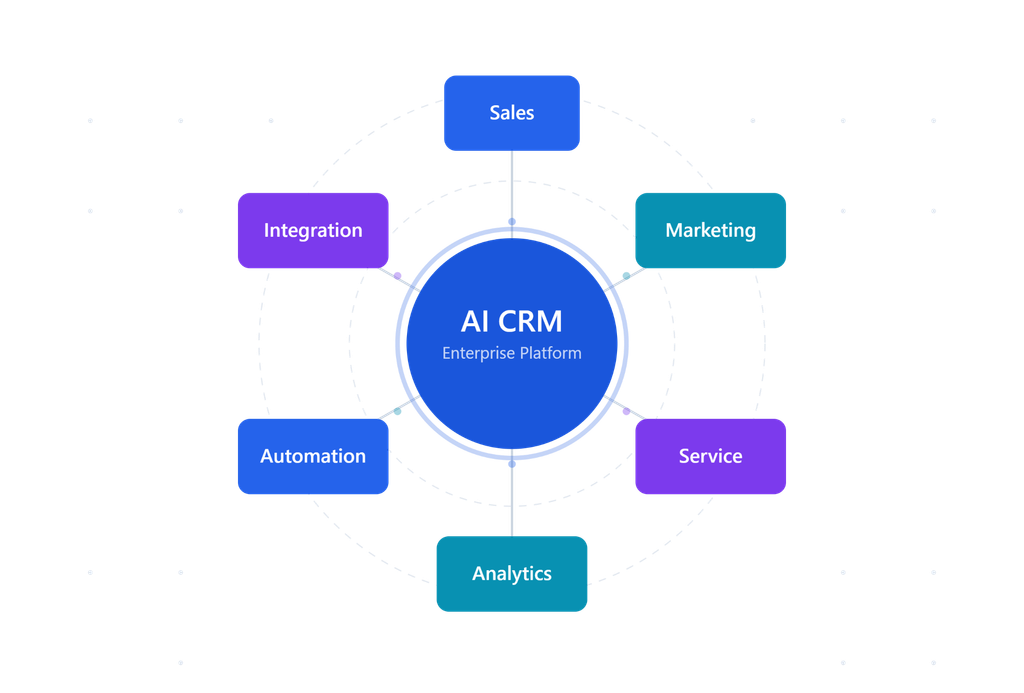
An AI CRM is a customer relationship management platform that embeds artificial intelligence directly into sales, marketing, and service workflows, automating decisions, predicting outcomes, and executing tasks that previously required manual effort. Unlike conventional CRMs that treat AI as a bolt-on feature, modern AI CRM platforms are built with intelligence at the core, enabling enterprise teams to act faster, personalize at scale, and operate with fewer repetitive tasks.
For enterprise organizations, the stakes are high. Poor CRM selection leads to fragmented data, slow adoption, and ballooning customization costs. The right AI CRM unifies sales, marketing, and service on a single platform, automates complex cross-functional workflows, and gives leadership the visibility to make data-backed decisions across large teams and multiple business units.
Real-world enterprise use cases include automating lead qualification and scoring, triggering AI-generated outreach based on customer behavior, routing service cases with intelligent assignment, generating forecasts from pipeline data, and running agentic workflows that span multiple departments simultaneously. When evaluating AI CRMs for enterprise, buyers should assess depth of AI capability, customization flexibility, governance and compliance controls, integration ecosystem, total cost of ownership, and vendor stability.
Best for: Mid-market and large organizations across financial services, manufacturing, healthcare, insurance, public sector, retail, and technology — serving sales operations, revenue teams, customer success, marketing, and service departments that require automation at scale, complex workflow management, and enterprise-grade security.
Not ideal for: Small teams, startups, or businesses with simple sales pipelines that do not require AI-driven automation, complex workflow orchestration, or multi-department coordination. Lightweight or free-tier CRMs may be a better fit in those cases.
10 Best AI CRMs for Enterprise Companies
The top AI CRMs for enterprise companies in 2027 are Creatio, Salesforce (Agentforce), Microsoft Dynamics 365 Sales, Oracle CX Cloud, SAP Sales Cloud, Pegasystems, HubSpot Enterprise, Zoho CRM, Freshsales, and ServiceNow CRM.
To build this list, we looked at the AI CRM platforms that large organizations most often shortlist for sales, marketing, and service. Each one made the cut because it offers native AI capabilities (predictive, generative, or agentic) and meets core enterprise requirements for scale, security, and integration.
We then evaluated every platform against seven weighted criteria: AI capability depth, no-code flexibility, enterprise scalability, integration ecosystem, security and compliance, total cost of ownership, and support. Our sources were vendor documentation, analyst research, and public user reviews. The full methodology is in the Evaluation & Scoring section below.
1. Creatio
Short description: Creatio is an enterprise AI CRM that unifies sales, marketing, and service on one AI-native platform and data model, with AI agents built into every product. Every data object, relationship, and process is natively accessible to these agents from day one, so they act on real business context without workarounds or integration overhead.
Recognized by Gartner as a Visionary in Sales Force Automation and a Leader in B2B Marketing Automation, and by Forrester as a Strong Performer in Customer Service Solutions.
Key features:
- Creatio AI Studio — a governed workspace to build, test, deploy, and optimize AI agents across the full agent lifecycle, with two development paths: a Prompt Agent Designer for natural-language agent creation and coding agents and SDKs for complex enterprise deployments, model-agnostic across OpenAI, Anthropic Claude, Google Gemini, and any LLM
- Creatio AI Twin — lets business users build personal AI agents without technical skills: they describe what they need in natural language, refine the requirements, test the agent conversationally, and move it from sandbox to production through the built-in governance framework. Each agent inherits the role-based access of the employee it acts for and keeps a full audit trail
- AI-native architecture where every data object, relationship, and business process is natively accessible to AI agents, enabling context-aware automation without integration workarounds
- No-code Business Studio with drag-and-drop visual designers for workflows, applications, and AI scenarios, allowing business users to build and modify without IT dependency
- Creatio AI Trust Framework covering data privacy, model governance, human oversight, role-based access controls, audit logs, and retrieval grounded in an approved knowledge base
- Unlimited plan model removing per-seat limits on users, agents, applications, workflows, and API calls — consolidating fragmented point-license spend on a single predictable model
Pros:
- AI-native by design rather than retrofitted — agents have native access to every record, relationship, and process without custom integration work
- AI Studio provides full agent lifecycle management with dual development paths suited to both business users and professional solution designers
- Unlimited plan eliminates per-seat pricing penalties and scales execution across users, agents, and workflows on a single predictable model
Cons:
- Initial learning curve due to the breadth of customization and configuration options across the platform
- No free trial available; access requires a live demo request
Security & compliance: Enterprise-grade security with multi-factor authentication, end-to-end encryption, role-based access control, and full audit logs. The Creatio AI Trust Framework provides model governance, transparency, human oversight, and compliance across GDPR, HIPAA, and SOC 2 certification.
Support & community: Support plan included with every subscription across three response tiers. Global partner ecosystem, marketplace applications, and dedicated customer success resources. Tens of millions of workflows run daily by thousands of clients in over 100 countries.
2. Salesforce (Agentforce)
Short description: Salesforce is the largest enterprise CRM platform globally, now augmented with Agentforce, its agentic AI layer that deploys autonomous agents across sales, service, and marketing workflows.
Key features:
- Agentforce autonomous AI agents for sales, service, and marketing
- Einstein AI for predictive scoring, forecasting, and recommendations
- Highly customizable workflows and automation via Flow
- Multi-cloud architecture covering Sales, Service, Marketing, and Commerce
- Extensive third-party AppExchange ecosystem
- Advanced analytics and reporting with Tableau integration
Pros:
- Market-leading ecosystem and integration breadth
- Strong AI investment and roadmap visibility
- Extremely scalable for global enterprise deployments
Cons:
- High total cost of ownership including licensing, implementation, and administration
- AI features and advanced capabilities often require higher-tier plans or add-on purchases
- Complex implementation typically requires certified partners and dedicated admins
Security & compliance: Enterprise-grade security, SSO, role-based access, encryption, audit logs, GDPR, SOC 2, ISO certifications.
Support & community: Large global partner network, extensive documentation, Trailhead training platform, tiered enterprise support plans.
3. Microsoft Dynamics 365 Sales
Short description: Microsoft Dynamics 365 Sales is an enterprise CRM tightly integrated with the Microsoft 365 ecosystem, featuring Copilot AI capabilities for sales automation, pipeline management, and productivity.
Key features:
- Microsoft Copilot embedded across sales workflows for AI-generated summaries, emails, and insights
- Deep integration with Microsoft 365, Teams, and Azure
- Advanced pipeline management and forecasting
- AI-powered lead and opportunity scoring
- Custom workflows via Power Automate
- Flexible cloud and hybrid deployment options
Pros:
- Seamless integration for organizations already operating in the Microsoft ecosystem
- Strong compliance and regulatory coverage for regulated industries
- Flexible deployment models for enterprises with data residency requirements
Cons:
- Complexity increases significantly for organizations outside the Microsoft stack
- Requires technical expertise for configuration and ongoing administration
- Licensing model can become costly as features and user counts scale
Security & compliance: Enterprise security, SSO, encryption, GDPR, SOC 2, ISO 27001, and broad regulatory compliance for financial services, government, and healthcare.
Support & community: Extensive Microsoft documentation, global certified partner network, Microsoft FastTrack support, and dedicated enterprise support tiers.
4. Oracle CX Cloud
Short description: Oracle CX Cloud is an enterprise customer experience suite combining CRM, marketing automation, and service management with embedded AI across the full customer lifecycle.
Key features:
- AI-powered sales forecasting and pipeline intelligence
- Integrated marketing automation and customer data platform
- Service automation with intelligent case routing
- Native integration with Oracle ERP and HCM
- Adaptive intelligence for next-best-action recommendations
- Unified customer data across sales, marketing, and service
Pros:
- Deep integration with Oracle ERP for end-to-end enterprise visibility
- Strong capabilities for large, complex B2B sales environments
- Robust data management and customer intelligence features
Cons:
- Primarily suited for organizations already invested in the Oracle ecosystem
- High implementation complexity and total cost of ownership
- User interface can feel dated compared to newer CRM platforms
Security & compliance: Enterprise-grade security, encryption, GDPR, SOC 2, ISO 27001, FedRAMP, and broad industry compliance certifications.
Support & community: Oracle Support portal, certified implementation partners, Oracle University training, and enterprise SLA-based support plans.
5. SAP Sales Cloud
Short description: SAP Sales Cloud is an enterprise CRM designed for organizations running SAP ERP, offering AI-assisted selling, intelligent forecasting, and native integration across the SAP ecosystem.
Key features:
- AI-powered opportunity and lead scoring
- Guided selling with next-best-action recommendations
- Native ERP integration for real-time pricing, inventory, and order data
- Intelligent sales forecasting and pipeline analytics
- Configure, price, quote (CPQ) capabilities
- Mobile-first interface for field sales teams
Pros:
- Best-in-class ERP-to-CRM integration for SAP customers
- Strong CPQ and complex pricing management for manufacturing and distribution
- Reliable roadmap from a major enterprise software vendor
Cons:
- Limited value for organizations not running SAP ERP
- Implementation is complex and typically requires SAP-certified partners
- Interface and user experience lag behind cloud-native competitors
Security & compliance: SAP Trust Center standards, encryption, GDPR, ISO 27001, SOC 2, and industry-specific compliance for financial services and manufacturing.
Support & community: SAP Enterprise Support plans, SAP Partner ecosystem, SAP Learning Hub, and dedicated customer success resources.
6. Pegasystems (Pega CRM)
Short description: Pega CRM is an enterprise platform combining AI-powered decisioning, customer engagement, and process automation, particularly strong in financial services, insurance, and telecommunications.
Key features:
- AI-driven next-best-action decisioning engine
- Real-time customer engagement across digital and assisted channels
- Case management and service automation
- Low-code application development for workflow customization
- Predictive analytics and customer lifetime value modeling
- Omnichannel orchestration across web, mobile, and contact center
Pros:
- Industry-leading AI decisioning for highly regulated, high-volume customer interactions
- Strong case management and service workflow capabilities
- Deep industry solutions for financial services, insurance, and telecom
Cons:
- High implementation cost and complexity
- Requires specialized technical resources for full platform configuration
- Less intuitive for sales-led organizations focused on pipeline management
Security & compliance: Enterprise-grade security, encryption, GDPR, SOC 2, ISO 27001, FedRAMP authorization, and financial services regulatory compliance.
Support & community: Pega Support portal, global partner network, Pega Academy training, and SLA-based enterprise support tiers.
7. HubSpot (Enterprise)
Short description: HubSpot Enterprise is a unified CRM platform with Breeze AI agents embedded across its Sales, Marketing, Service, and Content Hubs, targeting mid-market organizations scaling toward enterprise complexity.
Key features:
- Breeze AI agents for prospecting, content creation, and customer service
- Unified CRM database across sales, marketing, service, and operations
- Advanced sales forecasting and pipeline management
- AI-powered email and content recommendations
- Custom objects and advanced workflow automation
- Robust reporting and multi-touch attribution
Pros:
- Unified platform across marketing, sales, and service on a single data model
- Strong ease of use and fast adoption across non-technical teams
- Growing AI capabilities embedded across all hubs at no additional cost
Cons:
- Advanced features and AI capabilities locked behind higher Enterprise tiers
- Costs escalate quickly as contact lists and feature requirements grow
- Less flexible for complex enterprise workflows compared to composable platforms
Security & compliance: SSO, encryption, GDPR compliance, SOC 2, role-based access controls, and standard enterprise security features.
Support & community: HubSpot Academy training, extensive documentation, active user community, and dedicated enterprise support plans.
8. Zoho CRM
Short description: Zoho CRM is a customizable cloud CRM with Zia AI capabilities for sales intelligence, anomaly detection, and workflow automation, targeting growing mid-market and enterprise teams.
Key features:
- Zia AI for lead and deal scoring, churn prediction, and sales forecasting
- Custom modules, layouts, and fields for complex sales processes
- Multichannel communication tracking across email, phone, social, and chat
- Workflow automation and macro-based process execution
- Deep integration with the broader Zoho One ecosystem
- Territory management and quota tracking for large sales organizations
Pros:
- Cost-effective pricing relative to enterprise CRM competitors
- High degree of customization without requiring extensive developer support
- Strong integration ecosystem within the Zoho product suite
Cons:
- Zia AI features gated to higher-tier plans
- Interface can feel cluttered in complex enterprise configurations
- Performance can degrade with very large datasets or heavy custom reporting loads
Security & compliance: Encryption, role-based access, GDPR compliance, ISO 27001, and SOC 2 certification.
Support & community: Zoho documentation portal, community forums, email and phone support, and premium enterprise support options.
9. Freshsales
Short description: Freshsales is a sales CRM with Freddy AI embedded for lead scoring, deal insights, and automated workflows, designed for growing enterprise sales teams seeking simplicity alongside intelligence.
Key features:
- Freddy AI for contact and deal scoring, next-best-action suggestions, and deal insights
- Built-in phone, email, and chat for unified communication tracking
- AI-powered workflow automation and smart notifications
- Visual pipeline management with drag-and-drop interface
- Custom modules and field-level customization
- Integration with Freshdesk for unified sales and service
Pros:
- Clean, intuitive interface that reduces onboarding time
- Freddy AI included without additional licensing cost on Enterprise tier
- Strong built-in communication tools reduce reliance on third-party integrations
Cons:
- AI capabilities less mature compared to market leaders
- Customization depth insufficient for very complex enterprise workflows
- Integration ecosystem smaller than Salesforce or Microsoft Dynamics
Security & compliance: Encryption, SSO, GDPR compliance, role-based access controls, and SOC 2 certification.
Support & community: Freshworks Academy training, documentation portal, 24/7 enterprise support, and growing partner ecosystem.
10. ServiceNow CRM
Short description: ServiceNow CRM (Autonomous CRM) unifies sales, customer service, and field service on the ServiceNow AI Platform, using Now Assist and AI agents to orchestrate work across front, middle, and back offices for large enterprises.
Key features:
- Now Assist generative AI for case summarization, response drafting, and agent assistance
- AI agents that autonomously resolve requests and execute cross-department workflows
- Unified platform connecting sales, order management, customer service, and field service
- Configure, price, quote (CPQ) and order management built into the same data model
- Low-code App Engine and workflow designer for custom processes
- Native integration with ServiceNow IT service management and HR workflows
Pros:
- Strong end-to-end workflow orchestration beyond the front office
- Single platform and data model for enterprises already using ServiceNow ITSM
- Mature governance, auditability, and controls for AI agents
Cons:
- Sales capabilities less established than service and field service modules
- Premium pricing and complex licensing for AI features
- Implementation typically requires certified partners and platform expertise
Security & compliance: Encryption at rest and in transit, SSO, role-based access controls, SOC 1/SOC 2, ISO 27001, FedRAMP, HIPAA support, and GDPR compliance.
Support & community: ServiceNow Community, Now Learning training and certifications, extensive documentation, and a large global partner ecosystem.
Comparison Table
| Tool Name | Best For | Platforms | Standout Feature | Rating |
| Creatio | Enterprise AI CRM across sales, marketing, and service | Web, Mobile | Agentic AI with human-in-the-loop controls | 4.6/5 |
| Salesforce (Agentforce) | Large enterprise, multi-cloud deployments | Web, Mobile | Agentforce autonomous AI agents | 4.4/5 |
| Microsoft Dynamics 365 | Microsoft-ecosystem enterprises | Web, Mobile | Copilot AI across Microsoft 365 | 4.6/5 |
| Oracle CX Cloud | Oracle ERP enterprises | Web, Mobile | ERP-native AI decisioning | 3.9/5 |
| SAP Sales Cloud | SAP ERP enterprises | Web, Mobile | Native ERP-to-CRM integration | 4.2/5 |
| Pegasystems | Financial services, insurance, telecom | Web, Mobile | AI next-best-action decisioning | 4.2/5 |
| HubSpot Enterprise | Growing mid-market organizations | Web, Mobile | Unified platform across all hubs | 4.4/5 |
| Zoho CRM | Cost-conscious mid-market teams | Web, Mobile | Customization at competitive price | 4.1/5 |
| Freshsales | Sales-focused enterprise teams | Web, Mobile | Built-in communication tools | 4.4/5 |
| ServiceNow CRM | Enterprises unifying sales and service workflows | Web, Mobile | AI agents across front, middle, and back office | 4.4/5 |
Evaluation & Scoring
| Criteria | Weight | Description |
| AI capability depth | 25% | Maturity and scope of AI agents, predictive, and generative AI features |
| Customization and no-code flexibility | 20% | Ability to configure workflows without developer involvement |
| Enterprise scalability | 15% | Performance and governance at large user and data volumes |
| Integration ecosystem | 15% | Native and third-party connectivity across enterprise tools |
| Security and compliance | 10% | Data protection, certifications, and regulatory coverage |
| Total cost of ownership | 10% | Licensing, implementation, and ongoing administration costs |
| Support and community | 5% | Documentation, partner network, and customer success resources |
Which AI CRM Is Right for Your Enterprise?
Choosing the right AI CRM for an enterprise organization depends on the depth of AI capability required, the complexity of existing workflows, and the technology ecosystem already in place.
- Organizations seeking AI-native automation without heavy IT dependency: Creatio’s composable no-code architecture with built-in AI agents provides enterprise-grade automation that business teams can configure and extend independently.
- Large enterprises fully committed to Salesforce or Microsoft: Agentforce and Dynamics 365 Copilot extend existing investments with AI capabilities, though at higher total cost.
- Regulated industries with strict data residency requirements: Creatio, SAP Sales Cloud, Oracle CX Cloud, and ServiceNow CRM offer deployment flexibility and compliance coverage for heavily regulated environments.
- Mid-market organizations scaling toward enterprise complexity: HubSpot or Freshsales offer faster adoption and lower initial cost, with AI features sufficient for many growing teams.
- Financial services, insurance, and telecom enterprises: Creatio and Pegasystems offer purpose-built AI decisioning and case management suited to high-volume, regulated customer interactions.
Budget considerations should include not just licensing cost but implementation time, customization overhead, and long-term administration requirements. Organizations that prioritize fast time-to-value and predictable total cost of ownership consistently benefit from platforms where business users can own configuration without developer dependency.
Frequently Asked Questions
1. What is an AI CRM for enterprise companies?
An AI CRM for enterprises is a CRM platform that embeds artificial intelligence across sales, marketing, and service workflows, enabling automation, prediction, and agentic task execution at scale.
2. How is an AI CRM different from a traditional CRM?
Traditional CRMs store and organize customer data. AI CRMs actively analyze that data, predict outcomes, generate content, and execute actions autonomously through AI agents without requiring manual input at every step.
3. Which AI CRM is best for large enterprise organizations?
The best choice depends on existing technology investments. Creatio is well-suited for enterprises seeking AI-native automation and no-code flexibility, while Salesforce and Microsoft Dynamics 365 are strong for organizations already using those ecosystems.
4. Do enterprise AI CRMs require coding to customize?
Not always. Platforms like Creatio are built on no-code architecture that allows business users to configure workflows, agents, and applications without developer involvement. Others, like Salesforce and Oracle, require technical expertise for deep customization.
5. How much do enterprise AI CRMs typically cost?
Pricing varies significantly. Entry-level enterprise plans typically start between $40 and $75 per user per month, while platforms like Salesforce and Oracle can reach several hundred dollars per user depending on modules and AI features selected.
6. Can AI CRMs integrate with ERP systems?
Yes. SAP Sales Cloud and Oracle CX Cloud offer native ERP integration. Creatio, Salesforce, and Microsoft Dynamics 365 support ERP connectivity through APIs and pre-built connectors.
7. What AI capabilities should enterprise buyers prioritize?
Enterprise buyers should evaluate generative AI for content creation, predictive AI for scoring and forecasting, and agentic AI for autonomous workflow execution. Governance controls over agent autonomy are particularly important for regulated industries.
8. Is AI functionality included in standard CRM plans or sold separately?
This varies by vendor. Some platforms include AI across all plans at no extra cost. Others require add-on purchases or higher-tier plans to access core AI features.
9. How long does enterprise AI CRM implementation take?
Implementation timelines range from a few weeks for platforms with no-code configuration to six or more months for complex enterprise deployments requiring heavy customization and integration.
10. How do I evaluate AI CRM vendors for enterprise procurement?
Request a live demo using real enterprise use cases from your industry. Evaluate AI depth, customization flexibility, integration coverage, compliance certifications, implementation timeline, and total cost of ownership across a three-to-five year horizon.
Conclusion
AI CRM platforms are reshaping how enterprise organizations manage customer relationships, run revenue workflows, and deploy intelligent automation at scale. The gap between AI-native platforms and those bolting AI onto legacy architecture is widening, and enterprise buyers are increasingly aware of the difference.
No single AI CRM is the right choice for every organization. The best platform aligns with the enterprise’s existing technology investments, AI maturity, regulatory environment, and operational complexity. By evaluating AI depth, customization flexibility, total cost of ownership, and vendor stability, enterprise teams can select a platform that delivers measurable value across sales, marketing, and service functions over the long term.

Find Trusted Cardiac Hospitals
Compare heart hospitals by city and services — all in one place.
Explore Hospitals