
A practical guide to custom permalinks, date-free pages, redirects, reverse proxies and SEO-safe migration. Updated November 2026.
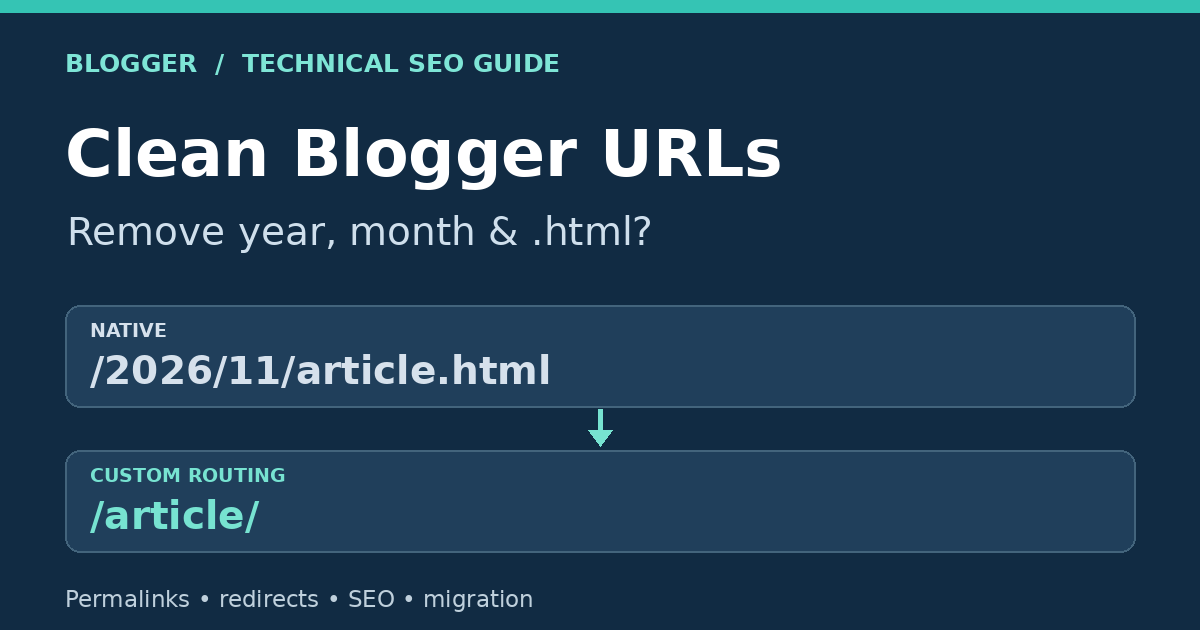
Featured image (1200 × 630 px). Original illustration.
Blogger makes publishing easy, but the platform controls how post URLs are generated. If you want a clean, evergreen address without a year or month, the distinction between changing a slug, creating an alias and actually serving content at a new route is crucial.
The short answer
No native Blogger setting removes the year and month from regular post URLs. Custom permalinks change the slug only. Pages omit dates but retain /p/ and .html. A redirect can provide a memorable entry address, but only a separately controlled frontend, proxy or migration provides genuine date-free post routes.
1. Understand Blogger URL anatomy
https://example.blogspot.com/2026/11/article.htmlCode language: JavaScript (javascript)Component | Meaning | Control |
|---|---|---|
example.blogspot.com | Hostname | Custom domain supported |
2026 / 11 | Publication year / month | Derived from publication date |
article | Post slug | Custom permalink |
.html | Platform suffix | Not configurable |
Do not change publication dates solely to manipulate URLs: dates represent publication history, and changing an existing URL can break links.
2. Compare all available methods
Method | Date-free? | What it really does |
|---|---|---|
Custom permalink | No | Shortens the slug |
Blogger Pages | Yes | Static content at /p/slug.html |
Custom redirects | Alias only | Sends visitors to dated URL |
JavaScript History API | Visual only | Changes address bar, not routing |
Theme XML / API | No | Presentation or content operations |
Custom domain alone | No | Changes hostname only |
Cloudflare Worker / NGINX | Yes | Own public routing; engineering required |
Headless frontend | Yes | Own rendering and routing |
WordPress migration | Yes | Native permalink flexibility |
Choose by your actual objective
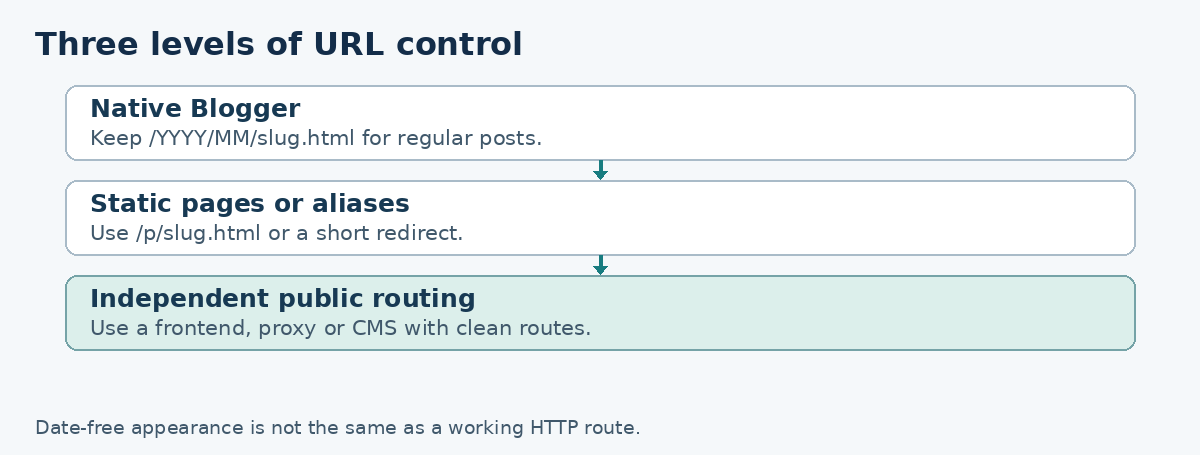
Figure 1. URL control options and their boundaries.
For a free Blogspot blog, use descriptive slugs and static Pages. For an established site, do not undertake a migration purely for cosmetic SEO improvements.
3. Method 1: Optimize the native permalink
Documented workflow; not performed against your Blogger account. Start with a disposable draft or a test blog.
Sign in at blogger.com and select the blog.
Open Posts and create a new post.
In the post settings, expand Permalink and select Custom Permalink.
Enter a short slug, for example ai-aviation-academy, and publish.
Open the published URL in a private browser window.
Example: AI Aviation Academy
Original example supplied by the reader:
https://aiaviationacademyofficial.blogspot.com/2026/11/
ai-aviation-academy-where-aviation.htmlCode language: JavaScript (javascript)
Illustrative shorter path:
/2026/11/ai-aviation-academy.htmlCode language: JavaScript (javascript)The first example is split across lines for readability; the actual URL is continuous. The second is a proposed URL, not a claim that the blog has been changed.
Changing an existing post
Record the old URL and back up the article.
Open the published article and use Revert to draft if available.
Check whether the editor exposes Custom Permalink. If it does, set the new slug and republish.
If the path changed, create a permanent redirect from the old relative path to the new relative path.
Verify the status, destination, canonical URL and internal links.
The published-post edit behavior can depend on the editor state. If the permalink is locked, avoid deleting a ranked post simply to shorten its URL. A new post may lose comments and historical signals. The native documentation confirms custom permalinks and redirects, not every possible edit-state behavior.
4. Method 2: Use Blogger Pages
For date-free static content such as an About page, contact information, service descriptions or an academy overview, Blogger Pages are a native alternative.
Open Blogger Dashboard → Pages → New Page.
Enter a meaningful title and the content; publish.
Open the generated page and record the URL.
Add it to the Pages gadget or other navigation, if needed.
/p/about-us.html
/p/ai-aviation-academy.html
These paths are illustrative; confirm the generated slug. Pages are not regular posts: they do not participate in the usual chronological post feeds, labels and archives. Recreating a post as a Page does not automatically migrate its comments or post identity.
5. Method 3: Create short redirect aliases
A custom redirect is useful for a memorable campaign URL. It does not change Blogger’s underlying canonical post route.
Go to Settings → Errors and redirects → Custom redirects.
Add a redirect using the relative source and destination paths shown below.
Select Permanent and save.
Open the source URL directly and confirm that it reaches the intended article.
From: /aviation-academy
To:   /2026/11/ai-aviation-academy.html
Permanent: enabledCode language: HTTP (http)
Use an unused source path and a real published destination. The destination above is illustrative. A working redirect should ultimately reach the dated URL; do not advertise this as a new canonical URL.
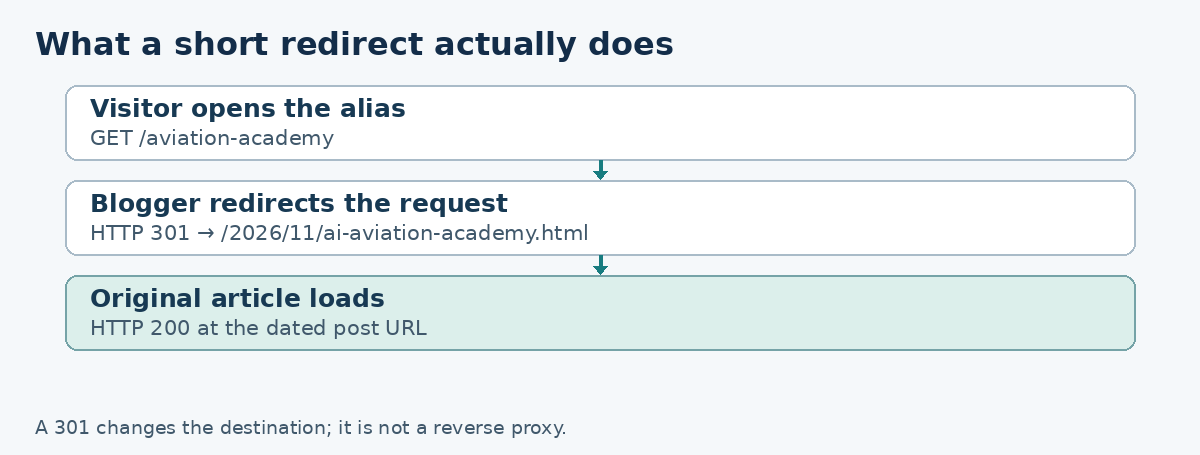
Figure 2. Native redirect request flow.
Hands-on exercise: verify the alias
curl -I https://example.blogspot.com/aviation-academy
curl -IL https://example.blogspot.com/aviation-academyCode language: JavaScript (javascript)
Documented command examples; replace the hostname. Expect a permanent redirect followed by a successful response. If HEAD is handled differently, repeat with a GET using curl -sS -D – -o /dev/null URL. The sample URLs are not deployed test endpoints.
6. Methods that do not create real clean routes
JavaScript and the browser History API
A script may remove dates and the suffix in the address bar without requesting a new document. The next refresh, shared link or direct request can fail because Blogger has no route for the clean path. The script below is an educational demonstration only; do not deploy it in a production theme.
const oldPath = window.location.pathname;
const cleanPath = oldPath.replace(
  /^\/\d{4}\/\d{2}\/(.+)\.html$/, "/$1"
);
if (cleanPath !== oldPath) {
  history.replaceState(null, "",
    cleanPath + location.search + location.hash);
}Code language: JavaScript (javascript)
The History API changes browser state, not the HTTP router. Canonical tags, sitemap entries and direct requests remain independent of this visual change.
Theme XML and REST API
Theme → Edit HTML changes the rendered markup, not Blogger’s server routing. Editing canonical links alone cannot make nonexistent URLs valid. Likewise, the documented Blogger API supports content operations and exposes post URLs, but no global permalink template setting.
Retrieve original URLs for an inventory
curl -G "https://www.googleapis.com/blogger/v3/blogs/${BLOG_ID}/posts" \
  --data-urlencode "key=${GOOGLE_API_KEY}" \
  --data-urlencode "fields=items(id,title,url),nextPageToken"Code language: JavaScript (javascript)
Documented API example, not executed with credentials. Use a restricted API key for public content; private content requires authorized access. Follow nextPageToken until all posts are retrieved, and keep secrets out of source control. The resulting inventory is useful for redirect mapping.
7. Method 4: Attach a custom domain
Settings → Publishing → Custom domain lets you attach a hostname you own. Use the CNAME records Blogger provides, including the verification record when required, and enable HTTPS and HTTPS redirection. A custom domain changes the hostname, not the dated path. Blogger’s Blogspot-to-custom-domain redirect behavior must be checked before a migration. Never point the same public hostname to both a Worker custom domain and Blogger simultaneously.
8. Method 5: Cloudflare Workers reverse proxy
An independent public hostname can serve content retrieved from a separate Blogger origin. This is not an officially supported Blogger permalink setting. A proof of concept is useful to demonstrate HTTP routing, but complete SEO compatibility requires additional work.
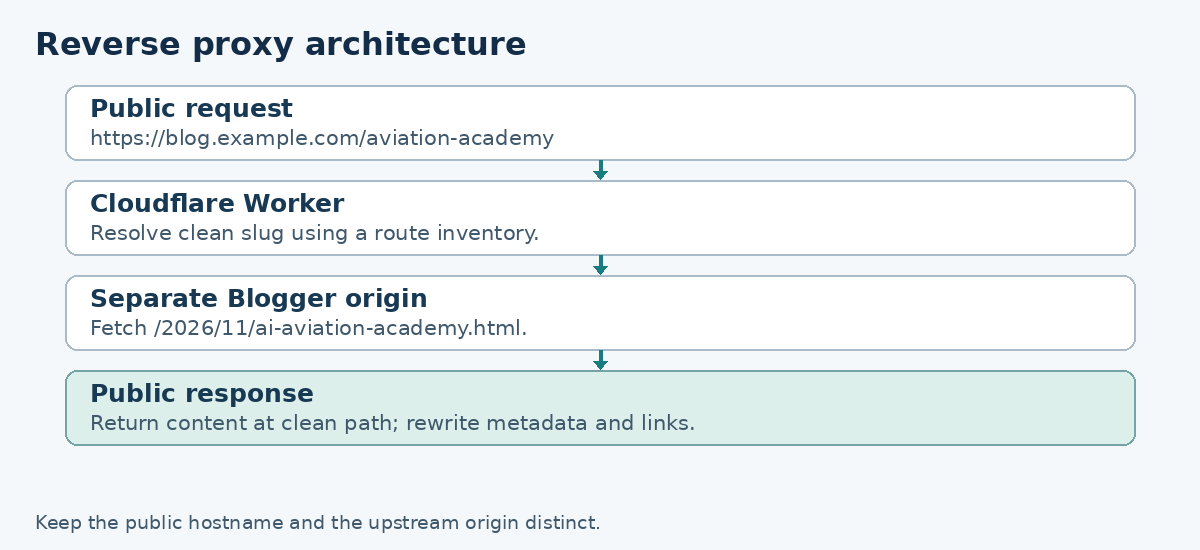
Figure 3. Reverse proxy architecture (conceptual).
Prerequisites and route design
A Cloudflare zone and public hostname you control.
A separate, reachable Blogger origin that does not redirect back to the public hostname.
An inventory of old paths with unique clean slugs. Use post IDs or explicit collision handling.
A staging environment excluded from search indexing until ready.
{
  "/aviation-academy": "/2026/11/ai-aviation-academy.html",
  "/pilot-training": "/2026/10/pilot-training.html"
}Code language: JSON / JSON with Comments (json)
A slug alone cannot reveal its original publication month. Maintain both forward and reverse mappings. For larger inventories, automate updates from the Blogger API and store mappings in a database or KV, accounting for eventual consistency.
Cloudflare Worker: minimal mapped-post lab
Illustrative JavaScript; syntax checked with Node.js, not live-deployed. Attach the Worker to a staging custom domain using Workers & Pages and replace both example hostnames. The lab intentionally serves only one mapped post; it is not a full website.
const PUBLIC = "https://blog.example.com";
const ORIGIN = "https://origin.example.com";
const CLEAN = "/aviation-academy";
const OLD = "/2026/11/ai-aviation-academy.html";
export default {
  async fetch(request) {
    const u = new URL(request.url);
    if (!["GET", "HEAD"].includes(request.method)) {
      return new Response("Method Not Allowed", {
        status: 405, headers: { Allow: "GET, HEAD" }
      });
    }
    if (u.pathname === OLD) {
      return Response.redirect(PUBLIC + CLEAN + u.search, 301);
    }
    if (u.pathname !== CLEAN) {
      return new Response("Not Found", { status: 404 });
    }
    const r = await fetch(ORIGIN + OLD + u.search, {
      method: request.method, redirect: "manual"
    });
    if (r.status >= 300 && r.status < 400) {
      return new Response("Unexpected upstream redirect", {
        status: 502
      });
    }
    if (r.status !== 200 || request.method === "HEAD" ||
        !(r.headers.get("content-type") || "").includes("text/html")) {
      return r;
    }
    return new HTMLRewriter()
      .on('link[rel="canonical"]', {
        element(el) {
          el.setAttribute("href", PUBLIC + CLEAN);
        }
      }).transform(r);
  }
};Code language: JavaScript (javascript)
The demo updates an existing canonical element only. It does not insert one if missing, rewrite all links, provide a sitemap, preserve comments, or prevent origin indexing. Inspect upstream headers and avoid forwarding private cookies or credentials. Do not route production traffic until the complete checklist below passes.
Production engineering checklist
Concern | Required behavior |
|---|---|
Routing | Homepage, pages, labels, archives, feeds, pagination and assets |
Redirects | Old public paths reach equivalent clean routes; no loops |
Canonical / metadata | Self-referencing clean canonical; update Open Graph and JSON-LD |
Internal links | Rewrite origin and relative links; preserve relevant query/hash |
Discovery | Generate clean sitemap and correct robots.txt |
Duplicate origin | Consolidate via redirects where possible or consistent canonical signals |
HTTP semantics | Real 404 / 5xx; no soft 404; correct HEAD and GET |
Security / caching | Restrict methods, avoid credential leakage; define cache policy |
Compatibility | Mobile ?m=1, comments, images, CSS, forms, feeds |
Operations | Logs, mapping updates, monitoring, rollback |
Do not block the original URLs in robots.txt as a substitute for canonicalization; search engines need to crawl redirects or canonical signals. If you cannot control the upstream duplicate and its canonical signals, prefer a proper migration or a standalone frontend with an explicit indexing strategy.
9. Method 6: NGINX reverse proxy
A Linux-hosted reverse proxy can serve the same role. The following single-article configuration is a documented-pattern example, not a tested deployment. Use valid certificates, an independent upstream hostname and a suitable CA bundle for your distribution.
server {
    listen 443 ssl;
    server_name blog.example.com;
    ssl_certificate /path/to/fullchain.pem;
    ssl_certificate_key /path/to/privkey.pem;
    location = /aviation-academy {
        proxy_pass https://origin.example.com/2026/11/ai-aviation-academy.html;
        proxy_ssl_server_name on;
        proxy_ssl_verify on;
        proxy_ssl_trusted_certificate /etc/ssl/certs/ca-certificates.crt;
        proxy_set_header Host origin.example.com;
    }
    location = /2026/11/ai-aviation-academy.html {
        return 301 /aviation-academy;
    }
    location / { return 404; }
}Code language: PHP (php)
sudo nginx -t
sudo systemctl reload nginxThe config does not rewrite upstream HTML or headers. Implement and test those separately. Reload only after a successful syntax check and with a rollback copy available.
10. Method 7: Headless Blogger
Use Blogger as an editorial backend while an independent frontend retrieves public content via the API. Next.js, Astro or another static generator can render the articles with arbitrary public slugs. A static deployment avoids the need to rewrite Blogger-generated themes, though it introduces synchronization and publishing responsibilities.
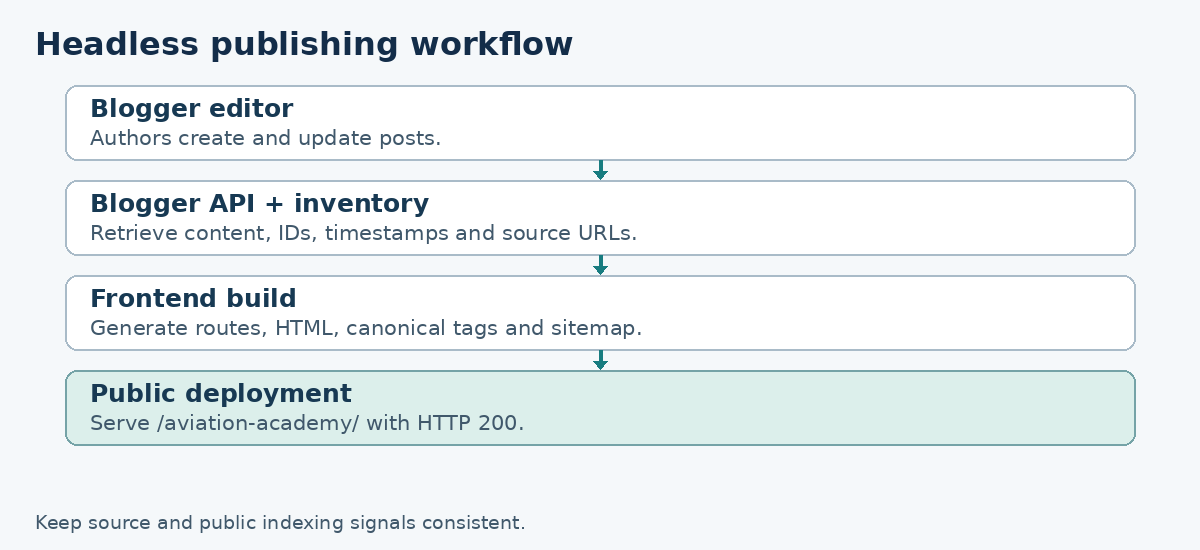
Figure 4. Independent frontend publishing architecture.
Store a stable mapping from Blogger post ID to public slug.
Fetch all pages of API results and handle updates and deletions.
Sanitize retrieved HTML as appropriate for your rendering context.
Build consistent metadata, RSS, sitemap and genuine 404 responses.
Decide how the original public Blogger content will be consolidated before launch.
11. Method 8: Migrate to WordPress
If full permalink control is a long-term requirement, self-hosted WordPress may be simpler than maintaining a proxy. In Settings → Permalinks select Post name and save.
/%postname%/
/%category%/%postname%/
Export Blogger content, import it into WordPress using an appropriate importer, verify images and comments, then configure one-to-one redirects. For a free Blogspot hostname, control of external redirects is limited; test your approach before changing the old site. For a custom hostname you own, configure redirects at the new hosting layer.
12. SEO: dates are not a ranking penalty
Google Search Central recommends URLs that are readable and logically organized. Its guidance does not require removing dates or file extensions. A dated URL can rank well if it is crawlable and the article satisfies the search intent. No standalone ranking improvement is established for removing /YYYY/MM/ or .html.
URL | SEO interpretation |
|---|---|
/2026/11/learn-kubernetes.html | Valid descriptive URL |
/p/about-us.html | Valid static page URL |
/learn-kubernetes/ | Valid when the server actually serves it |
/learn-kubernetes (JS-only) | May be broken on direct request |
Best practices for native Blogger URLs
Choose concise, descriptive, lowercase slugs with hyphens.
Do not stuff keywords or repeatedly change existing URLs.
Maintain truthful published and updated dates on the article.
Use helpful original content, logical internal links and relevant references.
Keep canonical, sitemap and internal link signals aligned.
SEO-safe migration workflow
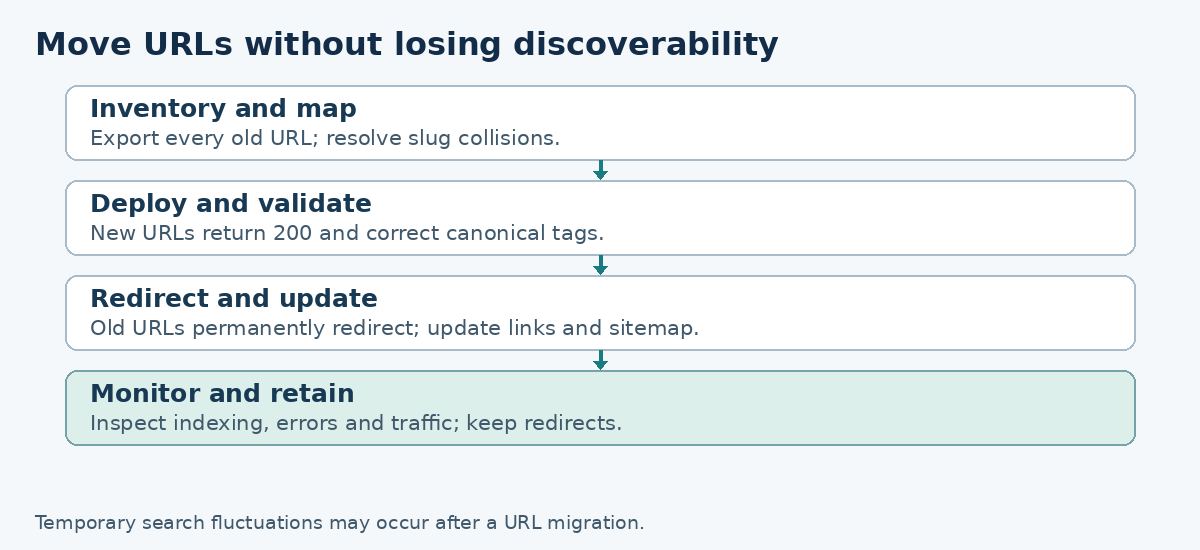
Figure 5. SEO-safe URL migration sequence.
Keep permanent redirects for at least a year when feasible, as Google’s migration guidance recommends; longer is preferable for users and existing backlinks. Avoid redirecting unrelated articles to the homepage.
13. Hands-on validation and troubleshooting
Run these commands only after replacing the example host with your own staging or production hostname. Expected responses are acceptance criteria, not evidence of a live test.
HTTP status and redirect chain
BASE=https://blog.example.com
curl -I "$BASE/aviation-academy"
curl -IL "$BASE/2026/11/ai-aviation-academy.html"
curl -I "$BASE/nonexistent-article"Code language: JavaScript (javascript)
Expected results
Request | Expected |
|---|---|
Clean article | 200 OK |
Old article | 301 to equivalent clean URL, then 200 |
Unknown article | 404 Not Found |
Metadata and discovery
curl -fsSL "$BASE/aviation-academy" | grep -i canonical
curl -fsSL "$BASE/robots.txt"
curl -fsSL "$BASE/sitemap.xml"Code language: JavaScript (javascript)
Inspect the full HTML if the canonical element spans multiple lines. Use Search Console URL Inspection to check the live response and selected canonical after indexing. Confirm the sitemap lists clean URLs and intended pages are crawlable.
Troubleshooting matrix
Symptom | Likely cause / corrective action |
|---|---|
Clean path gives 404 | No server route. Add explicit mapping or use native URL. |
Refresh fails after JS | Only browser history changed. Remove hack. |
301 loop / 502 | Origin redirects to public host. Separate hostnames and inspect Location. |
Wrong article | Slug collision. Use unique mapping keyed by post ID. |
Google selects old canonical | Conflicting metadata, links, sitemap or origin signals. Align them. |
Missing images or comments | Relative paths or origin scripts fail. Test and rewrite where necessary. |
Soft 404 | Generic 200 for missing routes. Return real 404. |
Rollback: restore the last known-good routing configuration, retain original URLs, and check that indexing directives and internal links match the restored state. Never delete original content while validating migration.
14. Frequently asked questions
Can I remove dates on a free blogspot.com post?
Not with native routing. Pages omit dates, and redirects provide aliases; neither changes the regular post route.
Can I remove .html only?
Not natively from regular posts or Pages. A separate frontend or proxy can choose another suffix.
Does a custom domain solve the problem?
No. It changes the hostname, not Blogger’s path pattern.
Can I change a published permalink?
Try reverting to draft and checking the editor. If it permits a change, redirect the old path and verify it. Do not assume all editor states expose this option.
Can I use DNS or a CNAME to rewrite URLs?
No. DNS resolves hostnames; application-level routing handles paths.
Will a JavaScript hack improve SEO?
No reliable benefit. It can create broken URLs and conflicting indexing signals.
Do Blogger Pages replace posts?
No. Pages suit static content and lack the regular post publishing workflow.
Should I migrate a ranked site just to remove dates?
Usually not. Balance migration risk against business requirements and long-term control.
Can I automate URL mapping?
Yes. Retrieve post IDs and URLs from the Blogger API, handle pagination and collisions, and generate explicit mappings.
Does a redirect alias become canonical?
A permanent redirect signals the destination as the preferred URL. The alias is not an independently served article.
15. Final recommendation
Use native custom permalinks for normal Blogger posts and date-free Pages for static business content. Use a redirect alias for sharing. If you truly require clean, date-independent post URLs, select a controlled frontend or migrate to WordPress; consider a reverse proxy only if you can support routing and SEO engineering over time.
16. Official documentation and further reading
- Blogger Help — SEO settings and custom permalinks
- Blogger Help — manage settings and redirects
- Blogger Help — create Pages
- Blogger Help — custom domain setup
- Google Developers — Blogger API reference
- Google Developers — list posts
- Google Search Central — URL structure
- Google Search Central — redirects
- Google Search Central — site moves
- Google Search Central — canonicalization
- MDN — History.replaceState
- Cloudflare — Worker custom domains
- Cloudflare — HTMLRewriter
- NGINX — HTTP proxy module
- WordPress — customize permalinks
- WordPress — Mammoth DOCX Converter
Publishing metadata (editorial, not article body)
Field | Suggested value |
|---|---|
SEO title | How to Remove Year, Month and .html from Blogger URLs |
Meta description | Learn what Blogger permits, how to create date-free Pages and short redirects, and how to implement clean URLs safely with a proxy or migration. |
Focus keyword | remove year and month from Blogger URL |
Secondary keywords | Blogger permalink, Blogspot URL structure, remove .html, Blogger SEO, clean URLs |
Categories | Blogging; SEO; Web Development |
Tags | Blogger, Blogspot, permalinks, redirects, Cloudflare Workers, WordPress, SEO |
URL slug | remove-year-month-html-blogger-url |
WordPress import note: move the Heading 1 text into the post title if needed; select the embedded featured image from the media library as the post’s featured image. Copy the SEO fields into your SEO plugin and remove this editorial section from the public article. Mammoth imports content, not WordPress post metadata automatically.
Verification scope: official references were retrieved; examples are documented or illustrative and were not executed against a live Blogger, Cloudflare, NGINX or WordPress installation.

I’m Rajesh Kumar, a DevOps, SRE, DevSecOps, Cloud, and Platform Engineering expert passionate about sharing practical knowledge, real-world experiences, and industry best practices. I have worked at Cotocus and regularly write about technology, travel, investing, health, product reviews, and digital marketing through my various platforms.
I publish technical articles at DevOps School, travel stories at Holiday Landmark, stock market insights at Stocks Mantra, health and fitness guidance at My Medic Plus, product reviews at TrueReviewNow, and SEO and digital marketing strategies at Wizbrand.
Find Trusted Cardiac Hospitals
Compare heart hospitals by city and services — all in one place.
Explore Hospitals