

DevOps teams built ChatOps to keep engineers out of ticket queues. Slack bots triage alerts, Teams integrations page the on-call engineer, and chat becomes the control plane for everything from deployments to incident response. That part of the story is familiar to anyone who has spent time in this field.
What’s less familiar is where that automation logic is headed next. The same teams that built internal chatbots for incident response are now being pulled into a very different conversation: customer-facing support. As ticket volume grows and AI-agent adoption accelerates, the line between “internal ops automation” and “customer-facing automation” is starting to blur, and DevOps and platform engineers are often the ones asked to build, deploy, and govern both.
Where Ops Automation and Customer Support Automation Converge

AI-agent adoption inside service organizations jumped from 39% in 2025 to 66% in 2026, according to Salesforce data reported by ChatMaxima, a 1.7x year-over-year increase that ranks among the fastest enterprise-software adoption curves on record. That kind of growth doesn’t stay contained to a single department. When customer support volume spikes and leadership wants an AI-driven answer fast, the request usually lands on whichever team already understands automation, monitoring, and deployment pipelines, and that’s frequently DevOps or platform engineering.
This is the convergence worth paying attention to. Building a customer-facing chatbot isn’t really a separate discipline from the ChatOps work most DevOps teams already do. It’s an extension of the same automation stack: webhooks, API integrations, escalation logic, and uptime monitoring, just pointed outward instead of inward.
A platform like Infobip’s chatbot building platform embodies this convergence well. It’s built for no-code conversation design and omnichannel deployment across WhatsApp, SMS, RCS, and web chat, with escalation routing that hands conversations off to a human agent when the bot hits its limits. For a team that already treats chat as infrastructure, that kind of platform fits naturally into the existing toolchain rather than sitting off to the side as a marketing tool.
The practical upshot is fewer tickets reaching engineering in the first place. A well-governed customer chatbot resolves routine questions before they escalate, which means the support queue that used to spill into engineering during high-traffic periods stays smaller. That’s a direct, measurable benefit for any team that owns on-call rotations.
The Cost and Efficiency Case for Automated Customer Chatbots
The financial argument is hard to ignore. Gartner projects that conversational AI will reduce contact center agent labor costs by $80 billion in 2026, with 80% of customer service organizations expected to use some form of conversational AI. That’s not a distant projection anymore; it’s the current planning year.
The per-interaction math backs this up. According to ChatMaxima’s 2026 customer support data, chatbot interactions typically cost between $0.50 and $0.70 each, compared to $6 to $15 for a human agent interaction, a 90-95% cost reduction per conversation. Multiply that across thousands of monthly interactions and the budget case writes itself. But the operational case matters just as much as the financial one. Every routine question a chatbot resolves is one less ticket that needs a human, and by extension, one less potential escalation that eventually lands on an engineer’s desk during an incident review.
Pressure from leadership is rising too. 91% of customer service leaders feel pressured into implementing AI in 2026, up from 77% in 2025, per Gartner research cited by CX Today. Technical teams are getting pulled into these deployment decisions whether they asked for the responsibility or not, which is exactly why understanding the platform options matters now rather than later.
What to Look for in a Chatbot Building Platform (from a DevOps Lens)
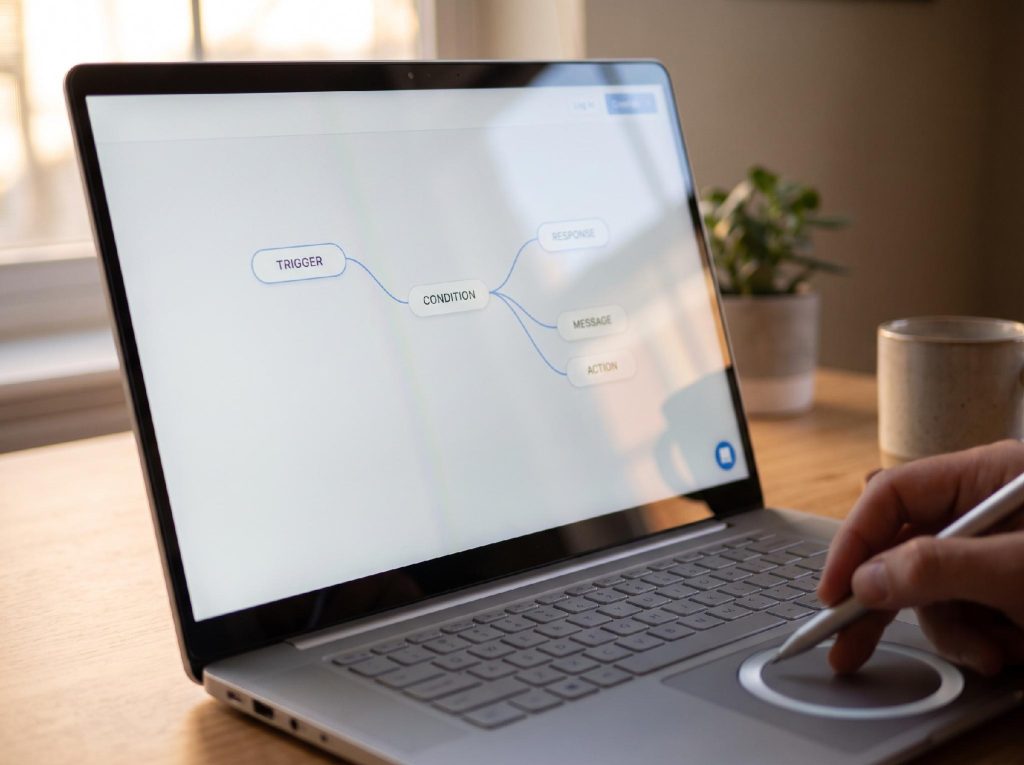
Not every chatbot platform is built with engineering teams in mind. A few criteria separate the ones worth adopting from the ones that create more work down the line:
- No-code or low-code flow builder, so both technical and non-technical staff can design and iterate on conversation flows without a full development cycle
- Omnichannel deployment across WhatsApp, SMS, RCS, and web chat from a single backend, rather than maintaining separate integrations per channel
- API access and webhook support, so engineering teams can hook the bot into existing monitoring, CRM, or ticketing systems
- Escalation routing that hands off from bot to AI agent to human cleanly, without losing conversation context
- Multi-language support for organizations operating across regions
These are the same qualities DevOps teams already look for in any piece of infrastructure: composability, observability, and the ability to integrate rather than operate as a silo. Our AIOps use cases guide covers similar principles around anomaly detection and automated root cause analysis, and the overlap with chatbot platform evaluation isn’t a coincidence. IBM’s overview of ChatOps benefits makes a similar point about chat becoming a genuine control plane rather than a convenience layer.
Governance, Monitoring, and the Agentic AI Frontier
ChatMaxima’s 2026 research found that 62% of organizations are experimenting with agentic AI capable of multi-step autonomous workflows, with customer support as the most common entry point. Only 10% report mature deployment. That gap between experimentation and maturity is where governance problems tend to show up, and it’s exactly the kind of gap DevOps teams are trained to close.
Treating a customer chatbot like any other production system means applying the same rigor: uptime monitoring, escalation-accuracy tracking, and conversation-log auditing as observability signals, not afterthoughts. Our guide on how AI supports DevOps workflows touches on this same discipline applied to internal automation, and it transfers directly.
AWS has published a useful technical walkthrough of building an AIOps chatbot with custom plugins, a good reference point for teams weighing internal versus customer-facing implementations side by side. The underlying technology itself is well documented in vendor-neutral terms too, which is useful context regardless of which platform a team eventually picks. The common thread across all of this: chatbot infrastructure, whether internal or customer-facing, needs the same monitoring discipline that keeps any production system reliable.
Bringing It Together
The distinction between “our internal ChatOps bot” and “the customer support chatbot” is fading fast, and pretending otherwise just means engineering teams get looped in later than they should be, usually during an incident rather than during planning. Teams that treat chatbot building platforms as core infrastructure, not a marketing add-on, end up with better escalation paths and fewer surprises when traffic spikes.
That means applying the same standards already in place for CI/CD and incident response: version-controlled conversation flows, monitored uptime, and clear escalation criteria. Teams looking to formalize this skill set might also consider our AIOps certification training, which covers the monitoring and automation principles that carry directly into chatbot governance. The tools are converging. The question now is which teams get ahead of that shift instead of reacting to it after the fact.

Find Trusted Cardiac Hospitals
Compare heart hospitals by city and services — all in one place.
Explore Hospitals
Customer-facing chatbot automation introduces a new operational responsibility that goes beyond deployment and integration. Teams need to treat these systems like production services by defining reliability metrics such as response accuracy, escalation success rate, user satisfaction, and failure recovery behavior. In real environments, chatbot quality can degrade as business processes change, knowledge sources become outdated, or user expectations evolve. A mature approach should include continuous testing of conversation flows, feedback-driven improvements, access control for knowledge updates, and clear ownership between support, engineering, and product teams. The future of chatbot automation will depend on building systems that are not only available 24/7 but also trustworthy, measurable, and continuously improved through operational feedback.