
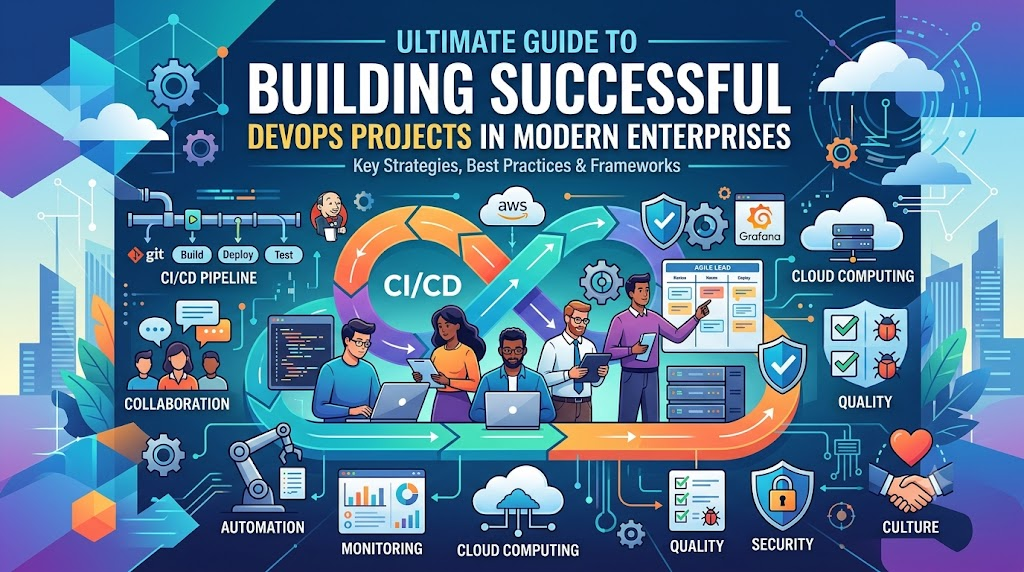
In traditional IT environments, deployments mean tense late-night conference calls, manual configuration fixes, and high risk of severe downtime, whereas modern organizations running Successful DevOps Projects roll out updates automatically on a Tuesday afternoon without a single customer noticing—a stark contrast that highlights how true project success relies not merely on adopting complex cloud tools, but on establishing a seamless synergy between human culture, organizational alignment, intelligent automation, and continuous feedback, which you can master by exploring structured learning resources at DevOpsSchool.
What Is a Successful DevOps Project?
A successful DevOps project is not defined by the sheer number of open-source tools installed in your cloud account or the complexity of your deployment pipelines. True success is defined by the measurable business and operational value delivered to end users safely, reliably, and continuously.
At its core, success means bridging the historical gap between software development (Dev) and IT operations (Ops) to establish a unified, continuous feedback loop. It transforms software delivery from a high-risk, sporadic event into a predictable, daily operational utility.
+-------------------+      +--------------------+      +--------------------+
|  Software Dev     | ---> |  Automated CI/CD   | ---> |  IT Operations     |
|  (Rapid Changes)  |      |  Pipeline & Tests  |      |  (Stability/Scale) |
+-------------------+      +--------------------+      +--------------------+
          ^                                                      |
          |-------------- Continuous Feedback & Metrics ---------|
Business and Technical Success Metrics
When evaluating project success, engineering leaders must balance business outcomes with underlying technical capability.
- Business Success Metrics: Reduced time-to-market for critical business features, lowered operational expenditure through efficient resource utilization, higher application availability, and improved customer satisfaction scores.
- Technical Success Metrics: Increased deployment frequency, shortened lead time for code changes, decreased change failure rates, and rapid Mean Time to Recovery (MTTR) when incidents occur.
The Continuous Improvement Mindset
A successful project is never truly “finished.” DevOps is an ongoing methodology of iterative refinement. Teams analyze deployment data, review incident post-mortems without pointing blame, optimize pipeline execution times, and constantly refine application resilience. The objective is to establish an ecosystem where shipping high-quality software is safe, repeatable, and routine.
Why Some DevOps Projects Fail
Despite heavy investments in modern tooling, many organizational transformations stumble or fail entirely. Understanding these common failure points helps teams bypass costly mistakes during execution.
       +-------------------------------------------------------+
       |           Common Causes of DevOps Failure             |
       +-------------------------------------------------------+
                                   |
         +-------------------------+-------------------------+
         |                                                   |
  [ People & Process ]                                 [ Technology ]
  * Cultural Resistance                                * Tool-First Approach
  * Siloed Teams                                       * Unmanaged Complexity
  * Lack of Executive Support                          * Neglecting Security
  * Absence of Clear KPIs                              * Manual Bottlenecks
Tool-First Approach Without Cultural Alignment
Installing software such as Kubernetes, Terraform, or Jenkins does not magically create a DevOps organization. When companies adopt advanced technology without changing team behavior, they simply automate bad habits. Tooling must serve a well-defined process, not replace it.
Lack of Executive Support and Clear Strategy
DevOps transformations alter how teams collaborate, spend budget, and manage operational risk. Without executive sponsorship, initiatives get bogged down in inter-departmental politics. Leaders must clearly connect engineering objectives with core business outcomes.
Cultural Resistance and Siloed Teams
If developers continue writing code without considering production maintenance, and operations staff continue acting as strict gatekeepers, true integration remains out of reach. Throwing code over virtual walls creates bottlenecks, inflates release risk, and demoralizes engineering staff.
Absence of Measurable KPIs and Feedback Loops
Organizations often attempt to transform everything simultaneously without tracking baseline performance. Without tracking concrete metrics like deployment speed or error budgets, leadership cannot measure project value, identify system bottlenecks, or justify long-term investment.
Characteristics of Successful DevOps Projects
High-performing DevOps initiatives share core operational characteristics that balance delivery velocity with system reliability.
| Success Factor | Why It Matters | Business Impact |
| Strong Executive Leadership | Secures resources, aligns goals, and breaks down organizational barriers. | Faster organizational transformation and higher ROI. |
| Collaborative Culture | Eliminates team silos and encourages shared accountability for code quality. | Reduced delivery friction and improved morale. |
| End-to-End Automation | Removes human manual errors from testing, provisioning, and releases. | Accelerated release cycles and consistent environments. |
| Robust CI/CD Pipelines | Validates every code check-in via automated builds and testing. | Higher software quality and rapid feature delivery. |
| Infrastructure as Code (IaC) | Enables predictable, repeatable environment deployment across cloud regions. | Eliminated environment drift and lower hosting costs. |
| Continuous Monitoring | Provides deep visibility into application performance and service health. | Lower MTTR and improved user uptime. |
| Shift-Left Security | Integrates security analysis directly into early pipeline phases. | Lower compliance risk and reduced remediation costs. |
Building the Right DevOps Culture
Culture is the foundation of any sustainable software delivery model. Without a collaborative mindset, technical automation quickly degrades into fragmented scripts managed by isolated engineers.
Shared Ownership and Cross-Functional Collaboration
In a mature culture, developers share responsibility for production performance, while operations engineers participate in initial application design reviews. Team members collaborate across every stage of the lifecycle:
[ Plan ] ---> [ Code ] ---> [ Build ] ---> [ Test ] ---> [ Release ] ---> [ Deploy ] ---> [ Operate ] ---> [ Monitor ]
   ^                                                                                                         |
   +------------------------------------ Shared Team Accountability -----------------------------------------+
This cross-functional structure aligns engineers around a single goal: shipping value safely to the customer.
Psychological Safety and Learning From Failures
High-performing engineering cultures foster psychological safety. When an outage occurs, the focus remains on systemic improvement rather than assigning personal blame.
- Blameless Post-Mortems: Analyze incident root causes candidly, focusing on missing safeguards, flawed automated tests, or unclear operational procedures.
- Failure as a Learning Opportunity: Treat system faults as insights into operational weaknesses, using them to design more resilient architectures.
Leadership Support and Business Alignment
Successful engineering efforts rely heavily on strong executive support and clear business alignment. Leadership creates the operational space needed for long-term platform evolution.
Securing Executive Sponsorship
DevOps initiatives require dedicated resources, continuous training, tool investments, and temporary productivity trade-offs during initial migration phases. Executive sponsors protect engineering teams from short-term feature delivery pressure while core infrastructure is modernized.
Aligning Engineering Objectives with Business Value
Technical metrics must align directly with organizational goals:
- Goal: Increase Market Share $\rightarrow$ Engineering Strategy: Increase deployment frequency to ship market features faster.
- Goal: Improve Customer Retention $\rightarrow$ Engineering Strategy: Reduce change failure rates and improve overall platform availability.
- Goal: Optimize Operational Spend $\rightarrow$ Engineering Strategy: Implement auto-scaling cloud infrastructure driven by Infrastructure as Code.
Importance of Clear Goals and KPIs
To judge the health of software delivery pipelines, organizations track concrete indicators. The DORA (DevOps Research and Assessment) metrics serve as the primary industry benchmark for measuring performance.
Essential Software Delivery Metrics
- Deployment Frequency (DF): How often code is successfully pushed to production (e.g., multiple times per day versus once per quarter).
- Lead Time for Changes (LTC): The total time required for a committed line of code to run through CI/CD pipelines and reach production.
- Change Failure Rate (CFR): The percentage of production deployments that result in degraded service or require immediate hotfixes/rollbacks.
- Mean Time to Recovery (MTTR): The average time needed to restore service when a production outage or degradation occurs.
KPI Target Outcome Comparison
| Delivery Metric | Traditional Software Teams | High-Performing DevOps Teams | Target Performance Outcome |
| Deployment Frequency | Monthly to Quarterly | Multiple times per day | On-demand releases |
| Lead Time for Changes | 1 to 6 Months | Less than 1 hour | Rapid iteration cycles |
| Change Failure Rate | 30% – 45% | 0% – 15% | High release stability |
| Mean Time to Recovery | Hours to Days | Less than 15 Minutes | Automated restoration |
Automation: The Backbone of Successful DevOps
Automation eliminates tedious manual tasks, reduces human error, and gives engineers time to focus on business features.
Source Code Commit
        |
        v
[ Automated Build Process ]
        |
        v
[ Automated Unit & Security Tests ]
        |
        v
[ Automated Environment Provisioning ]
        |
        v
[ Automated Deployment to Staging/Prod ]
Key Areas for Automation
- Build Automation: Compiling code assets, managing dependencies, and packaging binaries automatically upon code check-in.
- Test Automation: Running unit tests, integration suites, security checks, and end-to-end regression scripts inside build pipelines.
- Deployment Automation: Moving built artifacts through testing, staging, and production environments using progressive deployment models.
- Infrastructure Provisioning: Generating cloud resources automatically using declarative code templates.
Core Automation Orchestration Tools
- Jenkins: Highly flexible, open-source automation server backed by a vast plugin ecosystem.
- GitHub Actions: Native CI/CD orchestration built directly into GitHub repositories for seamless workflow execution.
- GitLab CI/CD: Integrated solution managing software lifecycles from issue planning to production deployment.
CI/CD Implementation Best Practices
Continuous Integration (CI) and Continuous Delivery/Deployment (CD) form the mechanical heart of modern software release pipelines.
+-----------------------------------------------------------------------------------+
|                            Continuous Integration (CI)                            |
|  [ Code Commit ] ---> [ Automated Build ] ---> [ Unit & Integration Testing ]      |
+-----------------------------------------------------------------------------------+
                                          |
                                          v
+-----------------------------------------------------------------------------------+
|                           Continuous Delivery (CD)                                |
|  [ Staging Deployment ] ---> [ Automated Acceptance Testing ] ---> [ Production ]  |
+-----------------------------------------------------------------------------------+
Continuous Integration (CI) Practices
Continuous Integration requires developers to merge code changes into a main repository branch frequently, ideally multiple times per day. Each check-in triggers an automated build and test sequence to catch integration bugs early.
- Maintain a single source code repository.
- Keep main build branches stable and deployment-ready at all times.
- Ensure automated test suites complete execution quickly to keep feedback loops short.
Continuous Delivery vs. Continuous Deployment
- Continuous Delivery: Code changes are automatically built, tested, and pushed to a staging environment, requiring a single manual approval click to deploy to production.
- Continuous Deployment: Every change that passes automated tests flows directly into production without manual intervention.
Pipeline Optimization and Safety Nets
- Blue-Green Deployments: Maintain two identical production environments. Direct live traffic to Blue while deploying updates to Green, switching router paths once green health checks pass.
- Canary Releases: Roll out new software updates to a tiny subset of users first (e.g., 5%). Monitor metrics for errors before expanding the release to the full user base.
- Automated Rollbacks: Configure pipelines to instantly revert to the last stable state if production error rates spike after a release.
Infrastructure as Code (IaC)
Infrastructure as Code treats servers, networks, load balancers, and cloud resources with the same discipline as application software. Instead of manually clicking cloud console buttons, engineers define infrastructure in declarative code files.
+--------------------------+
|  Declarative IaC Code    | (e.g., Terraform / Ansible)
+--------------------------+
             |
             v
+--------------------------+
|  Execution Engine        | (Version Control & State Management)
+--------------------------+
             |
             v
+--------------------------+
| Cloud Infrastructure     | (AWS / Azure / GCP Instances, VPCs, DBs)
+--------------------------+
Strategic Benefits of IaC
- Consistency and Standardization: Eliminates environment drift across development, testing, and production stages.
- Disaster Recovery: Enables complete production environments to be re-created in alternate cloud regions in minutes during severe outages.
- Version Control: Allows infrastructure modifications to be peer-reviewed, audited, and rolled back via Git pull requests.
Industry-Standard IaC Frameworks
- HashiCorp Terraform: Cloud-agnostic declarative tool used to provision multi-cloud infrastructure assets.
- Ansible: Agentless configuration management engine ideal for system configuration, software installation, and task automation.
- AWS CloudFormation / Azure ARM: Native, vendor-specific templates designed for single-cloud deployments.
Monitoring and Observability
Modern distributed systems require more than basic uptime checks. Observability gives engineering teams complete, deep visibility into internal application states based on system outputs.
                    +------------------------------+
                    |    Observability Ecosystem   |
                    +------------------------------+
                                   |
         +-------------------------+-------------------------+
         |                         |                         |
    [ Metrics ]                [ Logs ]                  [ Traces ]
(Numeric Aggregates)     (Structured Events)      (End-to-End Latency)
         |                         |                         |
         +-------------------------+-------------------------+
                                   |
                                   v
                    +------------------------------+
                    | Alerting & Incident Response |
                    +------------------------------+
The Three Pillars of Observability
- Metrics: Numeric aggregated data points measuring resource usage, queue lengths, error counts, and request rates over time (e.g., CPU utilization at 85%).
- Logs: Immutable, time-stamped records of application events that provide precise detail on system exceptions and transaction histories.
- Distributed Tracing: Tracks the path of a single client request as it travels across multiple microservices, pin-pointing performance bottlenecks.
Essential Observability Tools
- Prometheus & Grafana: Open-source platform for scraping time-series metrics and building real-time operational dashboards.
- ELK Stack (Elasticsearch, Logstash, Kibana): Powerful suite for centralizing, searching, and visualizing structured application log data.
- Datadog & Dynatrace: Enterprise-grade observability platforms combining metrics, traces, and AI-driven anomaly detection.
DevSecOps and Security Integration
Security must never be an afterthought applied right before software launches. DevSecOps embeds security practices into every phase of the development lifecycle, a concept known as “shifting left.”
Traditional Security:
[ Plan ] -> [ Code ] -> [ Build ] -> [ Test ] -> [ Deploy ] -> [ SECURITY AUDIT ] (Gatekeeper Bottleneck)

DevSecOps (Shift-Left Security):
[ Plan ] ---> [ Code ] ---> [ Build ] ---> [ Test ] ---> [ Deploy ]
   |             |             |             |             |
   v             v             v             v             v
[ threat ]    [ SAST ]      [ SAST/ ]     [ DAST ]     [ Runtime ]
[ modeling]  [ linting ]   [ SCA   ]    [ testing]    [ protection]
Key DevSecOps Execution Principles
- Static Application Security Testing (SAST): Scans raw source code for security vulnerabilities during the build process.
- Software Composition Analysis (SCA): Inspects third-party open-source libraries and dependencies for known security flaws (CVEs).
- Dynamic Application Security Testing (DAST): Tests running applications in staging environments for vulnerabilities like SQL injection and cross-site scripting (XSS).
- Secrets Management: Secures API keys, database credentials, and certificates using dedicated stores like HashiCorp Vault instead of hardcoding them in source files.
Cloud-Native Architecture and Scalability
Modern DevOps practices achieve peak efficiency when paired with cloud-native architectures built around microservices and containers.
+-----------------------------------------------------------------+
|                     Kubernetes Cluster                          |
|                                                                 |
|  +---------------------+             +---------------------+    |
|  | Microservice A Pods |             | Microservice B Pods |    |
|  |  (App Interface)    |             |  (Payment Engine)   |    |
|  +---------------------+             +---------------------+    |
|             ^                                   ^               |
|             |--- Auto-Scaling (HPA) Policy -----|               |
+-----------------------------------------------------------------+
Core Components of Cloud-Native Platforms
- Containerization (Docker): Packages applications and their exact runtime dependencies into lightweight, portable, and isolated containers.
- Container Orchestration (Kubernetes): Automates deployment, scaling, health monitoring, and networking for containerized workloads across server clusters.
- Microservices Architecture: Decomposes monolithic applications into independent, loosely coupled services that teams can build, test, and deploy individually.
- Platform Engineering: Internal developer platforms (IDPs) that give engineering teams self-service capabilities, lowering cognitive load and speeding up delivery.
Team Collaboration and Communication
Tools facilitate workflows, but people drive outcomes. Seamless collaboration across functional disciplines prevents bottlenecks and keeps delivery smooth.
Cross-Functional Workflow Alignment
+------------------+      +-------------------+      +-------------------+
| Software Devs    | <--> | Operations Engine | <--> | Security Teams    |
| (Feature Code)   |      | (Platform Scale)  |      | (Risk & Compliance|
+------------------+      +-------------------+      +-------------------+
         ^                          ^                          ^
         |                          |                          |
         +--------------------------+--------------------------+
                                    |
                         +--------------------+
                         | QA & Product Owners|
                         | (Value Validation) |
                         +--------------------+
Code language: HTML, XML (xml)- Developers & QA Engineers: Work together to build automated unit and acceptance tests alongside application code.
- Operations & Developers: Pair up to define Infrastructure as Code modules, resource limits, and alerting levels.
- Security & Operations: Automate compliance checks and access policies without delaying deployment pipelines.
Skills Needed for Successful DevOps Projects
Building and supporting modern deployment pipelines requires a balance of core technical competencies and essential interpersonal skills.
                       +-----------------------------------+
                       |    Core DevOps Skill Spectrum     |
                       +-----------------------------------+
                                         |
         +-------------------------------+-------------------------------+
         |                                                               |
  [ Technical Capabilities ]                                    [ Professional Soft Skills ]
  * Linux Administration & Shell Scripting                      * Cross-Team Communication
  * Distributed Version Control (Git)                           * Systems Thinking & Analysis
  * Cloud Architectures (AWS/Azure/GCP)                         * Blameless Problem-Solving
  * Container Orchestration (Kubernetes)                        * Technical Mentorship
  * Pipeline Orchestration & CI/CD                              * Continuous Adaptability
Essential Skills Checklist
- Systems Administration: Mastery of Linux operating systems, process management, networking protocols, and security configurations.
- Version Control Expertise: Deep experience managing Git workflows, branching strategies, and repository structures.
- Infrastructure Provisioning: Hands-on experience with declarative tools like Terraform and configuration frameworks like Ansible.
- Cloud Architecture: Proficiency in designing secure, scalable infrastructure across cloud platforms such as AWS, Microsoft Azure, or GCP.
- Continuous Learning: The technology space moves fast; staying adaptable and up to date on cloud-native practices is critical.
Real-World DevOps Project Workflow
Here is how a code change travels through an automated enterprise delivery workflow:
[1. User Story] -> [2. Local Dev & Git Commit] -> [3. Trigger CI Pipeline] -> [4. Automated Tests & Security Scans]
                                                                                        |
[8. Continuous Monitoring] <- [7. Progressive Canary Release] <- [6. Provision IaC] <- [5. Store Container Artifact]
- Planning: Product owners and engineers define user stories and acceptance criteria in tracking systems like Jira.
- Local Development: Developers write code locally and run quick unit tests before pushing changes to a Git feature branch.
- Continuous Integration Trigger: Pushing code triggers a CI server (e.g., GitHub Actions or Jenkins) to create an isolated build runner.
- Automated Testing & Security: The pipeline compiles the code, executes unit tests, runs SAST scanners, and builds a container image.
- Artifact Storage: The verified container image is tagged and pushed to an enterprise container registry (e.g., Harbor or Amazon ECR).
- Infrastructure Provisioning: Infrastructure as Code templates verify that target cloud staging environments match expected configurations.
- Progressive Deployment: Canary or Blue-Green deployment scripts push the container to Kubernetes, routing live traffic progressively while running health checks.
- Observability & Feedback: Monitoring tools collect metric, log, and trace data. Live performance data flows back to the development team to inform the next sprint.
Common Challenges During DevOps Implementation
Transitioning to modern delivery models comes with hurdles. Here is how organizations overcome common failure points:
+---------------------------+-----------------------------------+---------------------------------------+
| Implementation Challenge  | Root Cause                        | Recommended Solution                  |
+---------------------------+-----------------------------------+---------------------------------------+
| Legacy System Monoliths   | Tightly coupled codebase          | Apply Strangler Fig pattern gradually |
| Technical Skill Gaps      | Fast-changing tool landscape      | Invest in training & platform tools   |
| Cultural Resistance       | Fear of changing roles            | Build trust through small quick wins  |
| Toolchain Complexity      | Uncoordinated open-source tools   | Standardize on centralized IDPs       |
+---------------------------+-----------------------------------+---------------------------------------+
Taming Legacy Architectures
Monolithic systems do not need to be refactored all at once. Apply the Strangler Fig Pattern: gradually extract small, self-contained microservices from the legacy codebase over time, routing traffic to the new services until the old system can be retired safely.
Bridging Team Skill Gaps
Avoid expecting developers to master complex cloud infrastructure configurations overnight. Form dedicated platform engineering teams to build internal developer platforms (IDPs). These platforms offer simple, self-service portals that hide lower-level infrastructure complexity.
Best Practices for Successful DevOps Projects
Following established industry patterns helps teams lower risk and achieve steady success:
+-----------------------------------------------------------------------------------+
|                        Actionable Implementation Roadmap                          |
+-----------------------------------------------------------------------------------+
  [Step 1] Start Small: Target a low-risk service for initial pipeline automation.
     |
  [Step 2] Measure Baselines: Track initial deployment lead time and failure rates.
     |
  [Step 3] Automate Pipelines: Implement basic CI/CD, unit testing, and SAST steps.
     |
  [Step 4] Adopt IaC: Convert manual environment steps into code scripts.
     |
  [Step 5] Add Observability: Set up central metrics, logging, and tracing tools.
     |
  [Step 6] Iterate & Expand: Apply learnings to core, business-critical applications.
Code language: JavaScript (javascript)- Start Small and Scale Incrementally: Pilot new automation processes on a small, non-critical application first. Refine the pipeline design before expanding to complex enterprise architectures.
- Treat Infrastructure Like Code: Keep all configuration files, infrastructure templates, and pipeline definitions under strict version control.
- Enforce Quality Gates Early: Halt builds immediately if automated unit tests, security scans, or linting checks fail.
- Maintain Comprehensive Documentation: Document setup steps, architectural decisions, and runbooks cleanly to make onboarding simple.
DevOps Success Metrics
To measure project performance accurately, track operational progress across distinct delivery phases:
| Metric Name | Operational Significance | Target Baseline Outcome |
| Deployment Frequency | Measures pipeline agility and release capability. | Multiple stable releases per day. |
| Lead Time for Changes | Measures efficiency from initial commit to live production. | Under 60 minutes. |
| Mean Time to Recovery | Measures operational resilience and incident handling. | Under 15 minutes. |
| Change Failure Rate | Measures code stability and test coverage quality. | Below 10%. |
| System Availability | Measures overall platform uptime for end users. | 99.99% availability (“four nines”). |
| Automated Test Coverage | Measures the percentage of code checked by automated tests. | 80%+ coverage across core logic. |
Popular Tools Used in Successful DevOps Projects
Choosing the right toolchain components helps build reliable, scalable delivery pipelines.
+-----------------------------------------------------------------------------------+
|                        Modern DevOps Toolchain Overview                           |
+-----------------------------------------------------------------------------------+
  [ Code & Version Control ] ---> Git, GitHub, GitLab
  [ CI/CD Orchestration    ] ---> Jenkins, GitHub Actions, GitLab CI, ArgoCD
  [ Infrastructure as Code ] ---> Terraform, Ansible, CloudFormation
  [ Container & Orchestration] ---> Docker, Kubernetes, Helm
  [ Observability & Logs   ] ---> Prometheus, Grafana, ELK Stack, Datadog
  [ DevSecOps & Secrets    ] ---> SonarQube, Vault, Trivy
Code language: JavaScript (javascript)| Tool Name | Core Purpose | Learning Curve | Industry Usage |
| Git | Distributed Version Control | Low | Universal |
| Jenkins | CI/CD Build Automation | Moderate | Enterprise Standard |
| Docker | Application Containerization | Low to Moderate | Universal |
| Kubernetes | Container Orchestration | High | Enterprise Standard |
| Terraform | Declarative Infrastructure as Code | Moderate | High Adoption |
| Ansible | System Configuration Management | Low to Moderate | High Adoption |
| Prometheus | Time-Series Metrics Monitoring | Moderate | Cloud-Native Standard |
| SonarQube | Code Quality and Security Analysis | Low | Wide Adoption |
Industries Where DevOps Projects Thrive
Fast, safe software delivery drives competitive advantages across many commercial sectors:
+-----------------------------------------------------------------------------------+
|                        Industry Use Cases & Transformation                         |
+-----------------------------------------------------------------------------------+
  [ Banking & Finance ] ---> High-frequency updates, zero-downtime, strict compliance.
  [ Healthcare       ] ---> Secure patient data pipelines, HIPAA auditability.
  [ E-Commerce       ] ---> Peak traffic auto-scaling during high-demand sales events.
  [ SaaS & Cloud     ] ---> Rapid feature delivery and continuously available APIs.
Code language: PHP (php)
Banking, Financial Services, and Insurance (BFSI)
Financial platforms rely on DevSecOps to maintain strict regulatory compliance, execute instant transactions, and eliminate maintenance downtime. Automated compliance checks ensure every release satisfies security standards without delaying deployments.
Retail and E-Commerce
E-commerce networks handle unpredictable spikes in traffic during holiday sales. Auto-scaling container clusters managed by Infrastructure as Code allow systems to scale seamlessly under sudden heavy load and scale back down when traffic normalates.
Certifications and Learning Paths
Structured learning accelerates career growth and equips engineering teams with practical hands-on skills. Organizations like DevOpsSchool offer tailored programs that bridge theoretical concepts with real-world implementation techniques.
+-----------------------------------------------------------------------------------+
|                           Recommended Certification Path                          |
+-----------------------------------------------------------------------------------+
  [ Foundation ] ---> Linux & Git Essentials
        |
        v
  [ Associate   ] ---> AWS Certified Solutions Architect / Docker Certified
        |
        v
  [ Specialist ] ---> Certified Kubernetes Administrator (CKA) / Terraform Associate
        |
        v
  [ Expert      ] ---> Certified DevOps Engineer / Enterprise Architect
| Certification | Recommended Audience | Skill Level | Core Technical Focus |
| Certified Kubernetes Administrator (CKA) | Systems Engineers / Cloud Architects | Advanced | Container Orchestration |
| AWS Certified DevOps Engineer – Professional | Cloud Engineers / DevOps Practitioners | Advanced | Cloud Architecture & Automation |
| HashiCorp Certified: Terraform Associate | Infrastructure Engineers | Intermediate | Declarative IaC Provisioning |
| Docker Certified Associate (DCA) | Software Developers / Operations | Intermediate | Containerization Fundamentals |
Beginner Mistakes That Hurt DevOps Projects
Avoiding common beginner errors keeps implementation efforts on track.
  [X] Installing complex tools before fixing manual processes.
  [X] Skipping automated unit and security tests to chase speed.
  [X] Hardcoding configuration keys and passwords into source repositories.
  [X] Building pipelines without setting up centralized log collections.
  [X] Running manual configuration steps on production servers ("snowflake servers").
Code language: CSS (css)
The Pitfall of “Snowflake Servers”
Configuring servers manually turns them into non-reproducible “snowflakes.” When a server fails, rebuilding it from scratch becomes a manual nightmare. Enforce a strict rule: all server modifications must be applied exclusively via Infrastructure as Code scripts.
Treating Security as a Final Approval Gate
Delaying security checks until right before launch leads to last-minute release rejections and friction between security and engineering teams. Embed security checks directly into daily pipeline builds instead.
Future of Successful DevOps Projects
Software delivery models continue to adapt alongside emerging technology trends:
+-----------------------------------------------------------------------------------+
|                             Future Horizon Trends                                 |
+-----------------------------------------------------------------------------------+
  [ Platform Engineering ] ---> Self-service internal developer platforms (IDPs).
  [ GitOps Automation    ] ---> Git as the single source of truth (ArgoCD / Flux).
  [ AI-Driven AIOps      ] ---> Machine learning for proactive incident resolution.
  [ Serverless & Edge    ] ---> No-infrastructure operations models for rapid scaling.
Code language: PHP (php)- Platform Engineering: Internal Developer Platforms (IDPs) reduce cognitive overload on developers by providing standardized, self-service infrastructure blueprints.
- GitOps: Using Git repositories as the absolute source of truth for application code and infrastructure configurations, with tools like ArgoCD automatically syncing changes to Kubernetes clusters.
- AIOps: Leveraging machine learning algorithms to analyze massive volumes of telemetry data, identify performance anomalies, and execute self-healing steps automatically.
FAQs (15 Questions)
What makes a DevOps project successful?
A DevOps project succeeds when it aligns team culture, automated tools, and continuous feedback to ship reliable software to production frequently while maintaining platform stability.
Why do many DevOps implementations fail?
Failure usually stems from treating DevOps purely as a tool installation exercise while ignoring team collaboration, executive sponsorship, clear KPIs, and cultural change.
Is full automation necessary for DevOps success?
Automation is critical because it eliminates manual human errors, speeds up test feedback loops, and makes infrastructure provisioning predictable and repeatable.
How critical is CI/CD to modern engineering success?
CI/CD is foundational. It automates software compilation, test validation, and deployment steps, transforming risky manual releases into routine automated events.
What role does Kubernetes play in DevOps?
Kubernetes orchestrates containerized applications, handling automatic scaling, self-healing container restarts, load balancing, and rollout management across server clusters.
Why is culture considered more important than tools?
Without a collaborative, blameless culture, teams continue working in isolated silos. Tools simply speed up workflows; culture dictates how teams use them.
Which key metrics should engineering teams track?
Track the four core DORA metrics: Deployment Frequency, Lead Time for Changes, Change Failure Rate, and Mean Time to Recovery (MTTR).
Can small companies and startups adopt DevOps effectively?
Yes. Startups often adopt these practices faster than large enterprises because they carry less legacy technical debt and organizational overhead.
How does DevSecOps enhance project success?
DevSecOps embeds security checks early into the development pipeline. This catches vulnerabilities early when they are easier and cheaper to fix.
Is cloud infrastructure required to run DevOps?
No. While cloud platforms make on-demand scaling easier, the core principles of continuous integration, deployment automation, and testing apply equally to on-premises servers.
What fundamental skills must a DevOps engineer master?
Key skills include Linux administration, Git version control, continuous integration pipelines, container orchestration, Infrastructure as Code, and strong communication abilities.
How long does a typical enterprise DevOps migration take?
Cultural and operational transformations take time. Initial pilot wins can happen in 3 to 6 months, while full enterprise adoption usually takes 12 to 24 months.
Which industries benefit most from DevOps workflows?
Industries requiring fast feature delivery and high availability benefit heavily, including BFSI, e-commerce, healthcare, SaaS platforms, and telecommunications.
How do certifications support career growth?
Certifications validate practical knowledge of industry tools like Kubernetes, Terraform, and AWS, helping engineers gain structured expertise and clear career pathways.
Is DevOps still a promising career path?
Yes. As systems adopt cloud-native architectures, platform engineering, and automated security, skilled practitioners remain in high demand globally.
Final Thoughts
Achieving long-term success in DevOps is an ongoing journey of continuous learning and operational refinement, rather than a fixed destination. Technology choices will evolve, open-source projects will change, and platform frameworks will advance over time. However, the core engineering principles remain unchanged: breaking down team silos, automating repetitive manual tasks, measuring performance objectively, and maintaining absolute focus on delivering customer value safely.
Successful organizations understand that tools exist to empower human potential. By establishing a collaborative environment, giving engineers modern automation tools, and building an adaptive learning culture, your team can transform software delivery into a smooth, high-speed, and reliable engine for modern innovation.

Find Trusted Cardiac Hospitals
Compare heart hospitals by city and services — all in one place.
Explore Hospitals
A successful DevOps project shouldn’t be measured only by whether CI/CD pipelines are implemented or deployments become faster. The real indicator of success is how well the platform evolves over time while maintaining reliability, security, and developer productivity. Engineering teams should regularly review DORA metrics, technical debt, platform adoption, and operational feedback to identify bottlenecks before they impact delivery. Investing in reusable platform capabilities, self-service infrastructure, and continuous improvement processes ensures that DevOps remains a long-term business capability rather than a one-time transformation initiative.